Agile Software DevelopmentPrimer
What is Agile Development?
"The ability to move faster than those things that can harm your project…"
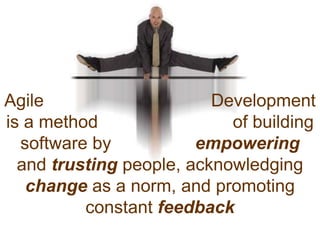
Agile					   Development    is a method 			       of building software by 			   empowering and trusting people, acknowledgingchange as a norm, and promoting constant feedback
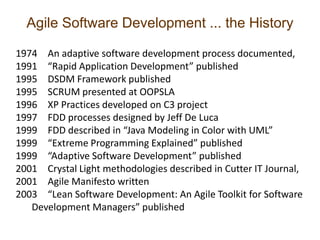
Agile Software Development ... the History1974	An adaptive software development process documented, 1991	“Rapid Application Development” published1995	DSDM Framework published1995	SCRUM presented at OOPSLA1996	XP Practices developed on C3 project1997	FDD processes designed by Jeff De Luca1999	FDD described in “Java Modeling in Color with UML”1999	“Extreme Programming Explained” published1999	“Adaptive Software Development” published2001	Crystal Light methodologies described in Cutter IT Journal, 2001	Agile Manifesto written2003	“Lean Software Development: An Agile Toolkit for Software Development Managers” published
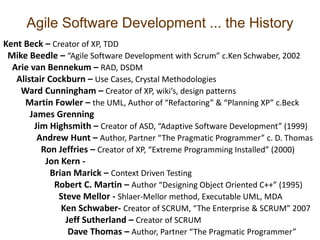
Agile Software Development ... the HistoryKent Beck – Creator of XP, TDD  Mike Beedle – “Agile Software Development with Scrum” c.KenSchwaber, 2002Arie van Bennekum – RAD, DSDM      Alistair Cockburn – Use Cases, Crystal Methodologies         Ward Cunningham – Creator of XP, wiki’s, design patterns          Martin Fowler – the UML, Author of “Refactoring” & “Planning XP” c.Beck            James Grenning              Jim Highsmith – Creator of ASD, “Adaptive Software Development” (1999)               Andrew Hunt – Author, Partner “The Pragmatic Programmer” c. D. Thomas                 Ron Jeffries – Creator of XP, “Extreme Programming Installed” (2000)                   Jon Kern -                      Brian Marick – Context Driven Testing                       Robert C. Martin – Author “Designing Object Oriented C++” (1995)                         Steve Mellor - Shlaer-Mellor method, Executable UML, MDA                          Ken Schwaber- Creator of SCRUM, “The Enterprise & SCRUM” 2007                            Jeff Sutherland – Creator of SCRUM                             Dave Thomas – Author, Partner “The Pragmatic Programmer”
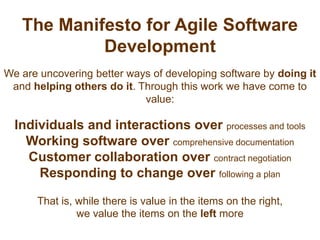
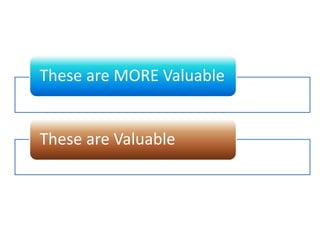
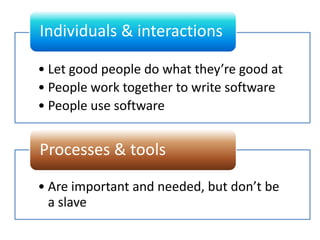
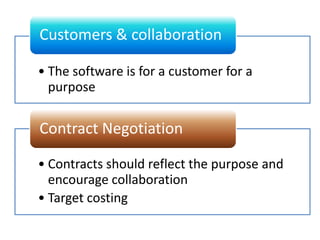
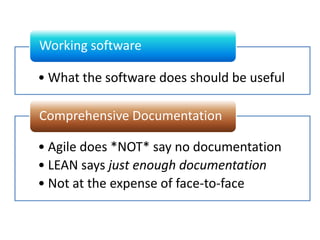
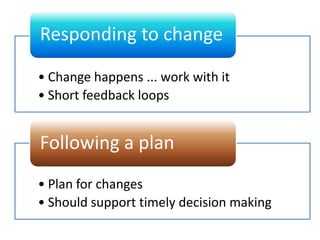
The Manifesto for Agile Software DevelopmentWe are uncovering better ways of developing software by doingit and helping others do it. Through this work we have come to value:Individuals and interactions over processes and toolsWorking software over comprehensive documentationCustomer collaboration over contract negotiationResponding to change over following a planThat is, while there is value in the items on the right, we value the items on the left more
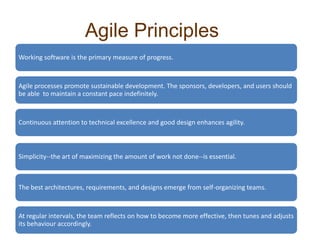
Agile PrinciplesOur highest priority is to satisfy the customer through early and continuous delivery of valuable software. Welcome changing requirements, even late in development. Agile processes harness change for the customer's competitive advantage. Deliver working software frequently, from a couple of weeks to a couple of months, with a preference to the shorter timescale. Business people and developers must work together daily throughout the project. Build projects around motivated individuals. Give them the environment and support they need, and trust them to get the job done. The most efficient and effective method of conveying information to and within a development team is face-to-face conversation.
Agile Principles1. Satisfy the Customer2. Welcome Change3. Deliver Frequently4. Work as a Team5. Motivate People6. Communicate Face to Face
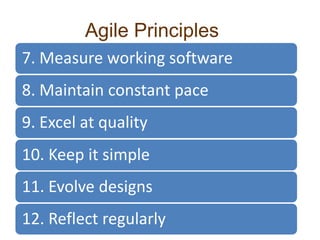
Agile Principles
Agile Principles
Agile Practices
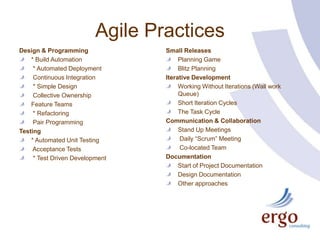
Agile PracticesDesign & Programming* Build Automation * Automated Deployment Continuous Integration * Simple Design Collective OwnershipFeature Teams * Refactoring Pair ProgrammingTesting* Automated Unit Testing Acceptance Tests * Test Driven DevelopmentSmall ReleasesPlanning GameBlitz PlanningIterative DevelopmentWorking Without Iterations (Wall work Queue)Short Iteration Cycles The Task CycleCommunication & CollaborationStand Up Meetings Daily “Scrum” Meeting Co-located TeamDocumentationStart of Project DocumentationDesign DocumentationOther approaches
Design & Programming *Build Automation *Automated Deployment Continuous Integration *Simple Design Collective Ownership*Refactoring Pair Programming
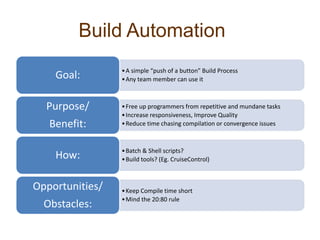
Build Automation
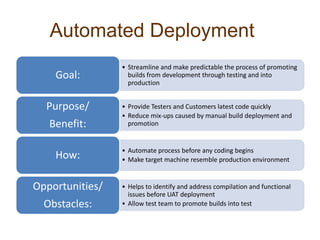
Automated Deployment
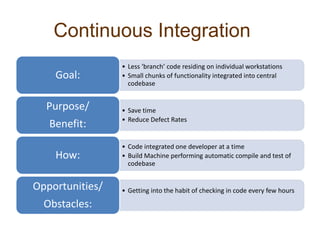
Continuous Integration
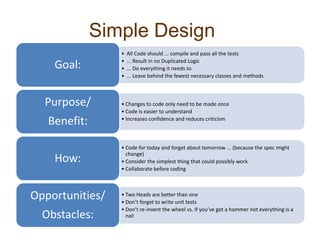
Simple Design
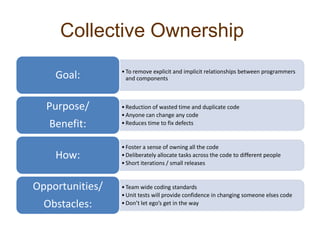
Collective Ownership
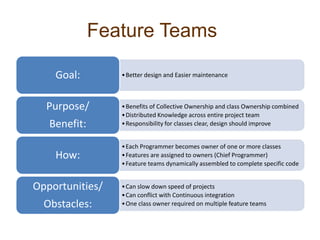
Feature Teams
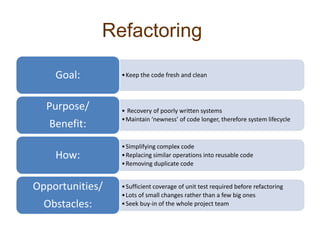
Refactoring
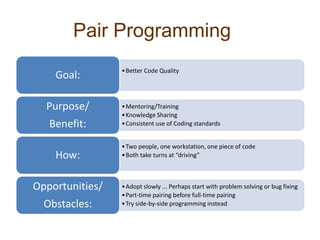
Pair Programming
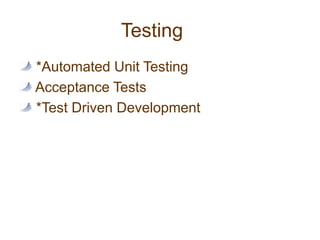
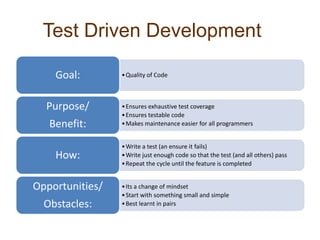
Testing *Automated Unit Testing Acceptance Tests *Test Driven Development
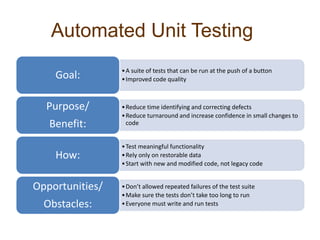
Automated Unit Testing
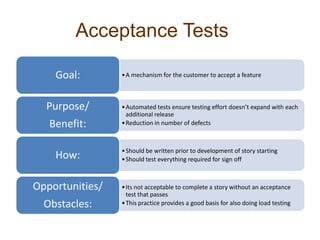
Acceptance Tests
Test Driven Development
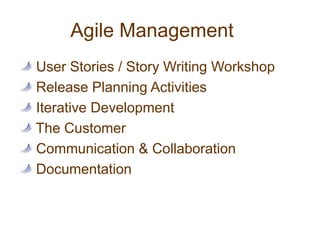
Agile Management User Stories / Story Writing Workshop Release Planning Activities Iterative Development The Customer Communication & Collaboration Documentation
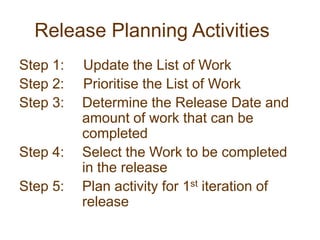
Release Planning ActivitiesStep 1:	Update the List of WorkStep 2:	Prioritise the List of WorkStep 3:	Determine the Release Date and amount of work that can be completedStep 4:	Select the Work to be completed in the releaseStep 5:	Plan activity for 1st iteration of release
Release Planning Specifics
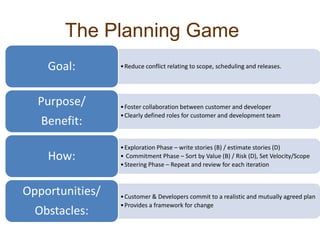
The Planning Game
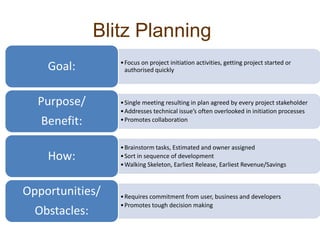
Blitz Planning
What are the benefits and pitfalls of Iterative Development?
What is the role of the Customer in an Agile Project?
What to look for in a good Customer
Communication & Collaboration Stand Up Meetings Daily “Scrum” Meeting Co-located Team
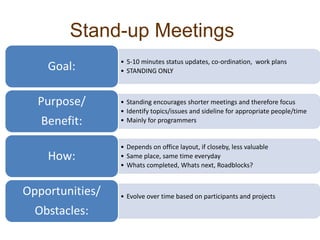
Stand-up Meetings
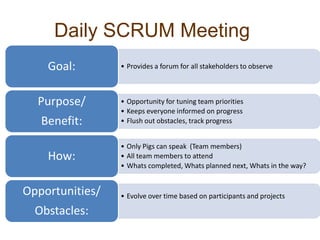
Daily SCRUM Meeting
We value working software over comprehensive documentation
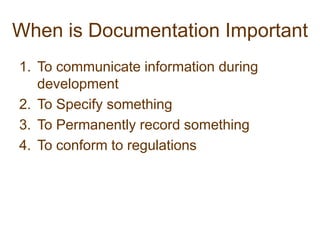
When is Documentation ImportantTo communicate information during developmentTo Specify somethingTo Permanently record somethingTo conform to regulations
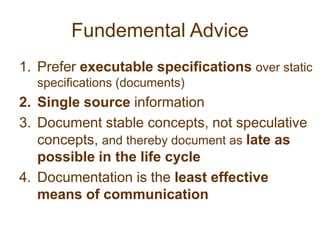
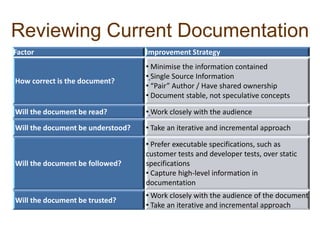
Fundemental AdvicePrefer executable specifications over static specifications (documents)Single source informationDocument stable concepts, not speculative concepts, and thereby document as late as possible in the life cycleDocumentation is the least effective means of communication
Reviewing Current Documentation
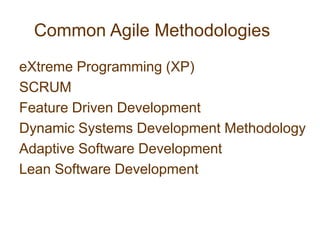
Common Agile MethodologieseXtreme Programming (XP)SCRUMFeature Driven DevelopmentDynamic Systems Development MethodologyAdaptive Software DevelopmentLean Software Development
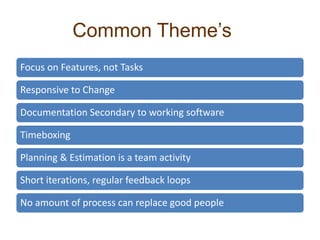
Common Theme’s
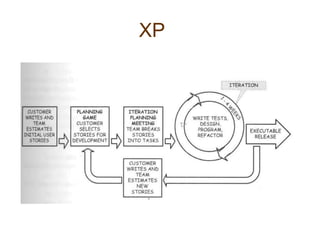
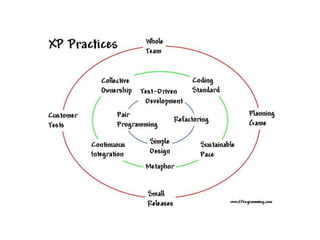
XP
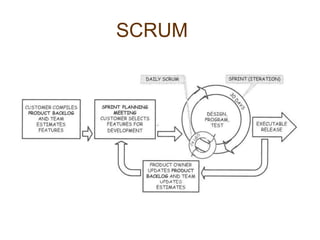
SCRUM
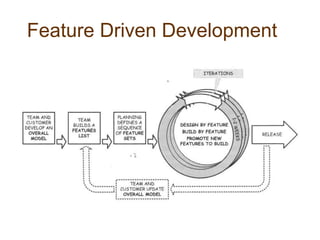
Feature Driven Development
Crystal Clear
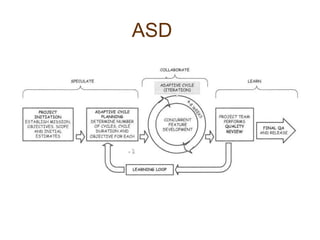
ASD
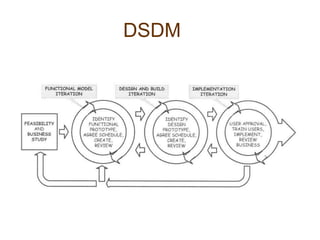
DSDM
LEANNot a specific set of practices or processesProcess, Documentation, Best practices take a back seat to goal of operational excellence.Defined by how quickly and reliably an organisation can serve its customers.
Seven LEAN PrinicplesEliminate WasteAmplify LearningDecide as Late as PossibleDeliver as fast as PossibleEmpower the TeamBuild in IntegritySee the Whole
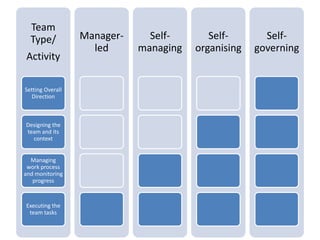
Teams
Self-Organising TeamsCommunication & CollaborationAccountability & ResponsibilityLearning Teams
Why are Self-Organising Teams Better?
Engendering a Communicative and Collaborative culture
working in an AROculture
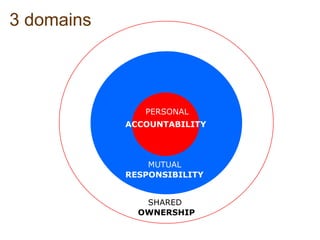
3 domainsPERSONALACCOUNTABILITYMUTUALRESPONSIBILITYSHAREDOWNERSHIP
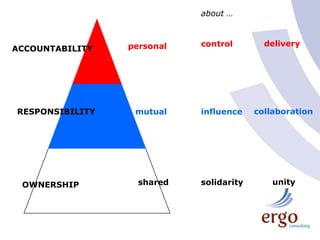
about …deliverycontrolpersonalACCOUNTABILITYcollaborationRESPONSIBILITYmutualinfluenceunitysharedsolidarityOWNERSHIP
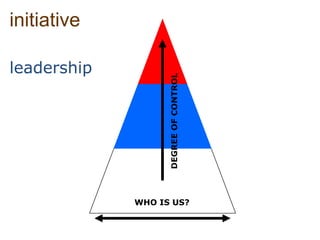
initiativeleadershipDEGREE OF CONTROLWHO IS US?
personal accountabilityI have the control leversDefines the decisions that are ultimately mineIs the set of things my boss will hold me to and for which I am employed.‘I assure you’ rather than ‘trust me’Included in my performance agreementThis defines what is important or central in my work. I do not have to be asked to go here … it is my job to be here.Expect others to come here when your behaviour has an impact on an arena for which they are accountable, or when there is overlap with an arena for which they have shared responsibility.
mutual responsibilityI have the responsibility to influenceAnything that is impacted by my behaviour or my decisions is within my influenceWill include cultural and environmental dimensions, and will therefore be a significant component of my performance review conversationSomeone must be accountable, but I have the responsibility to give input, state my case, and ensure alignment with my arena of accountabilityGo here when invited or when it impacts an arena for which I am accountable.Remember that this patch may be an arena that someone else is ultimately accountable
shared ownershipSolidarity, who is ‘we’?The domain that falls outside the sphere of my influence, but that remains part of the whole of which I am a partAs broad as possibleAll that sits under the strategic plan, that wears our brandGo here when the brand or the ‘whole’ is threatenedBe careful because others will know more than you
Behaviour in an ARO culture is …Focused and targeted, not scatteredProject rather then role or position orientedDisciplinedHigh performanceCommunication isEntrepreneurial rather than beaurocraticTransparent: knowledge and power is necessarily sharedRobust and often difficult because there is lots of grey in the shared responsibility domain
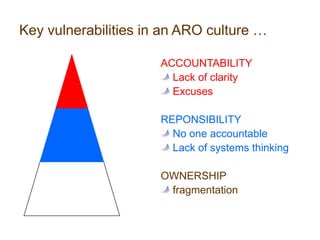
Key vulnerabilities in an ARO culture …ACCOUNTABILITYLack of clarityExcusesREPONSIBILITYNo one accountableLack of systems thinkingOWNERSHIPfragmentation
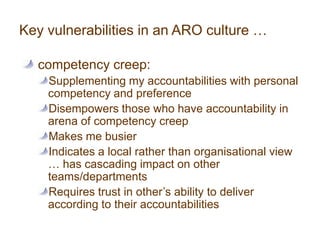
Key vulnerabilities in an ARO culture … competency creep:Supplementing my accountabilities with personal competency and preferenceDisempowers those who have accountability in arena of competency creepMakes me busierIndicates a local rather than organisational view … has cascading impact on other teams/departmentsRequires trust in other’s ability to deliver according to their accountabilities

An Agile Development Primer

  • 1.
  • 3.
    What is AgileDevelopment?
  • 4.
    "The ability tomove faster than those things that can harm your project…"
  • 5.
    Agile Development is a method of building software by empowering and trusting people, acknowledgingchange as a norm, and promoting constant feedback
  • 6.
    Agile Software Development... the History1974 An adaptive software development process documented, 1991 “Rapid Application Development” published1995 DSDM Framework published1995 SCRUM presented at OOPSLA1996 XP Practices developed on C3 project1997 FDD processes designed by Jeff De Luca1999 FDD described in “Java Modeling in Color with UML”1999 “Extreme Programming Explained” published1999 “Adaptive Software Development” published2001 Crystal Light methodologies described in Cutter IT Journal, 2001 Agile Manifesto written2003 “Lean Software Development: An Agile Toolkit for Software Development Managers” published
  • 7.
    Agile Software Development... the HistoryKent Beck – Creator of XP, TDD Mike Beedle – “Agile Software Development with Scrum” c.KenSchwaber, 2002Arie van Bennekum – RAD, DSDM Alistair Cockburn – Use Cases, Crystal Methodologies Ward Cunningham – Creator of XP, wiki’s, design patterns Martin Fowler – the UML, Author of “Refactoring” & “Planning XP” c.Beck James Grenning Jim Highsmith – Creator of ASD, “Adaptive Software Development” (1999) Andrew Hunt – Author, Partner “The Pragmatic Programmer” c. D. Thomas Ron Jeffries – Creator of XP, “Extreme Programming Installed” (2000) Jon Kern - Brian Marick – Context Driven Testing Robert C. Martin – Author “Designing Object Oriented C++” (1995) Steve Mellor - Shlaer-Mellor method, Executable UML, MDA Ken Schwaber- Creator of SCRUM, “The Enterprise & SCRUM” 2007 Jeff Sutherland – Creator of SCRUM Dave Thomas – Author, Partner “The Pragmatic Programmer”
  • 8.
    The Manifesto forAgile Software DevelopmentWe are uncovering better ways of developing software by doingit and helping others do it. Through this work we have come to value:Individuals and interactions over processes and toolsWorking software over comprehensive documentationCustomer collaboration over contract negotiationResponding to change over following a planThat is, while there is value in the items on the right, we value the items on the left more
  • 15.
    Agile PrinciplesOur highestpriority is to satisfy the customer through early and continuous delivery of valuable software. Welcome changing requirements, even late in development. Agile processes harness change for the customer's competitive advantage. Deliver working software frequently, from a couple of weeks to a couple of months, with a preference to the shorter timescale. Business people and developers must work together daily throughout the project. Build projects around motivated individuals. Give them the environment and support they need, and trust them to get the job done. The most efficient and effective method of conveying information to and within a development team is face-to-face conversation.
  • 16.
    Agile Principles1. Satisfythe Customer2. Welcome Change3. Deliver Frequently4. Work as a Team5. Motivate People6. Communicate Face to Face
  • 17.
  • 18.
  • 19.
  • 20.
    Agile PracticesDesign &Programming* Build Automation * Automated Deployment Continuous Integration * Simple Design Collective OwnershipFeature Teams * Refactoring Pair ProgrammingTesting* Automated Unit Testing Acceptance Tests * Test Driven DevelopmentSmall ReleasesPlanning GameBlitz PlanningIterative DevelopmentWorking Without Iterations (Wall work Queue)Short Iteration Cycles The Task CycleCommunication & CollaborationStand Up Meetings Daily “Scrum” Meeting Co-located TeamDocumentationStart of Project DocumentationDesign DocumentationOther approaches
  • 21.
    Design & Programming*Build Automation *Automated Deployment Continuous Integration *Simple Design Collective Ownership*Refactoring Pair Programming
  • 22.
  • 23.
  • 24.
  • 25.
  • 26.
  • 27.
  • 28.
  • 29.
  • 30.
    Testing *Automated UnitTesting Acceptance Tests *Test Driven Development
  • 31.
  • 32.
  • 33.
  • 34.
    Agile Management UserStories / Story Writing Workshop Release Planning Activities Iterative Development The Customer Communication & Collaboration Documentation
  • 35.
    Release Planning ActivitiesStep1: Update the List of WorkStep 2: Prioritise the List of WorkStep 3: Determine the Release Date and amount of work that can be completedStep 4: Select the Work to be completed in the releaseStep 5: Plan activity for 1st iteration of release
  • 36.
  • 37.
  • 38.
  • 39.
    What are thebenefits and pitfalls of Iterative Development?
  • 40.
    What is therole of the Customer in an Agile Project?
  • 41.
    What to lookfor in a good Customer
  • 42.
    Communication & CollaborationStand Up Meetings Daily “Scrum” Meeting Co-located Team
  • 43.
  • 44.
  • 45.
    We value workingsoftware over comprehensive documentation
  • 46.
    When is DocumentationImportantTo communicate information during developmentTo Specify somethingTo Permanently record somethingTo conform to regulations
  • 47.
    Fundemental AdvicePrefer executablespecifications over static specifications (documents)Single source informationDocument stable concepts, not speculative concepts, and thereby document as late as possible in the life cycleDocumentation is the least effective means of communication
  • 48.
  • 49.
    Common Agile MethodologieseXtremeProgramming (XP)SCRUMFeature Driven DevelopmentDynamic Systems Development MethodologyAdaptive Software DevelopmentLean Software Development
  • 50.
  • 51.
  • 53.
  • 54.
  • 55.
  • 56.
  • 57.
  • 58.
    LEANNot a specificset of practices or processesProcess, Documentation, Best practices take a back seat to goal of operational excellence.Defined by how quickly and reliably an organisation can serve its customers.
  • 59.
    Seven LEAN PrinicplesEliminateWasteAmplify LearningDecide as Late as PossibleDeliver as fast as PossibleEmpower the TeamBuild in IntegritySee the Whole
  • 60.
  • 62.
    Self-Organising TeamsCommunication &CollaborationAccountability & ResponsibilityLearning Teams
  • 63.
  • 64.
    Engendering a Communicativeand Collaborative culture
  • 65.
    working in anAROculture
  • 66.
  • 67.
  • 68.
  • 69.
    personal accountabilityI havethe control leversDefines the decisions that are ultimately mineIs the set of things my boss will hold me to and for which I am employed.‘I assure you’ rather than ‘trust me’Included in my performance agreementThis defines what is important or central in my work. I do not have to be asked to go here … it is my job to be here.Expect others to come here when your behaviour has an impact on an arena for which they are accountable, or when there is overlap with an arena for which they have shared responsibility.
  • 70.
    mutual responsibilityI havethe responsibility to influenceAnything that is impacted by my behaviour or my decisions is within my influenceWill include cultural and environmental dimensions, and will therefore be a significant component of my performance review conversationSomeone must be accountable, but I have the responsibility to give input, state my case, and ensure alignment with my arena of accountabilityGo here when invited or when it impacts an arena for which I am accountable.Remember that this patch may be an arena that someone else is ultimately accountable
  • 71.
    shared ownershipSolidarity, whois ‘we’?The domain that falls outside the sphere of my influence, but that remains part of the whole of which I am a partAs broad as possibleAll that sits under the strategic plan, that wears our brandGo here when the brand or the ‘whole’ is threatenedBe careful because others will know more than you
  • 72.
    Behaviour in anARO culture is …Focused and targeted, not scatteredProject rather then role or position orientedDisciplinedHigh performanceCommunication isEntrepreneurial rather than beaurocraticTransparent: knowledge and power is necessarily sharedRobust and often difficult because there is lots of grey in the shared responsibility domain
  • 73.
    Key vulnerabilities inan ARO culture …ACCOUNTABILITYLack of clarityExcusesREPONSIBILITYNo one accountableLack of systems thinkingOWNERSHIPfragmentation
  • 74.
    Key vulnerabilities inan ARO culture … competency creep:Supplementing my accountabilities with personal competency and preferenceDisempowers those who have accountability in arena of competency creepMakes me busierIndicates a local rather than organisational view … has cascading impact on other teams/departmentsRequires trust in other’s ability to deliver according to their accountabilities

Editor's Notes

  • #4 Workshop Question. 15 minutes discussion around small tables then group feedback
  • #7 Agile is not a new concept. 1974 Edwards discussed the flaws in the waterfall methodology.Evolution through the 90’s (following RAD in the 80’s) of various approaches to structure a software development project to deliver results.