Chap. 6 – Antigen-Antibody interactions
Characterized as:
• Non-covalent interaction (similar to “lock and key” fit of
enzyme-substrate)
• Does not lead to irreversible alteration of Ag or Ab
• This exact and specific interaction has led to many
immunological assays used to:
» detect Ag or Ab
» diagnose disease
» measure magnitude of humoral IR
» identify molecules of bio and med interest
Ag-Ab interactions
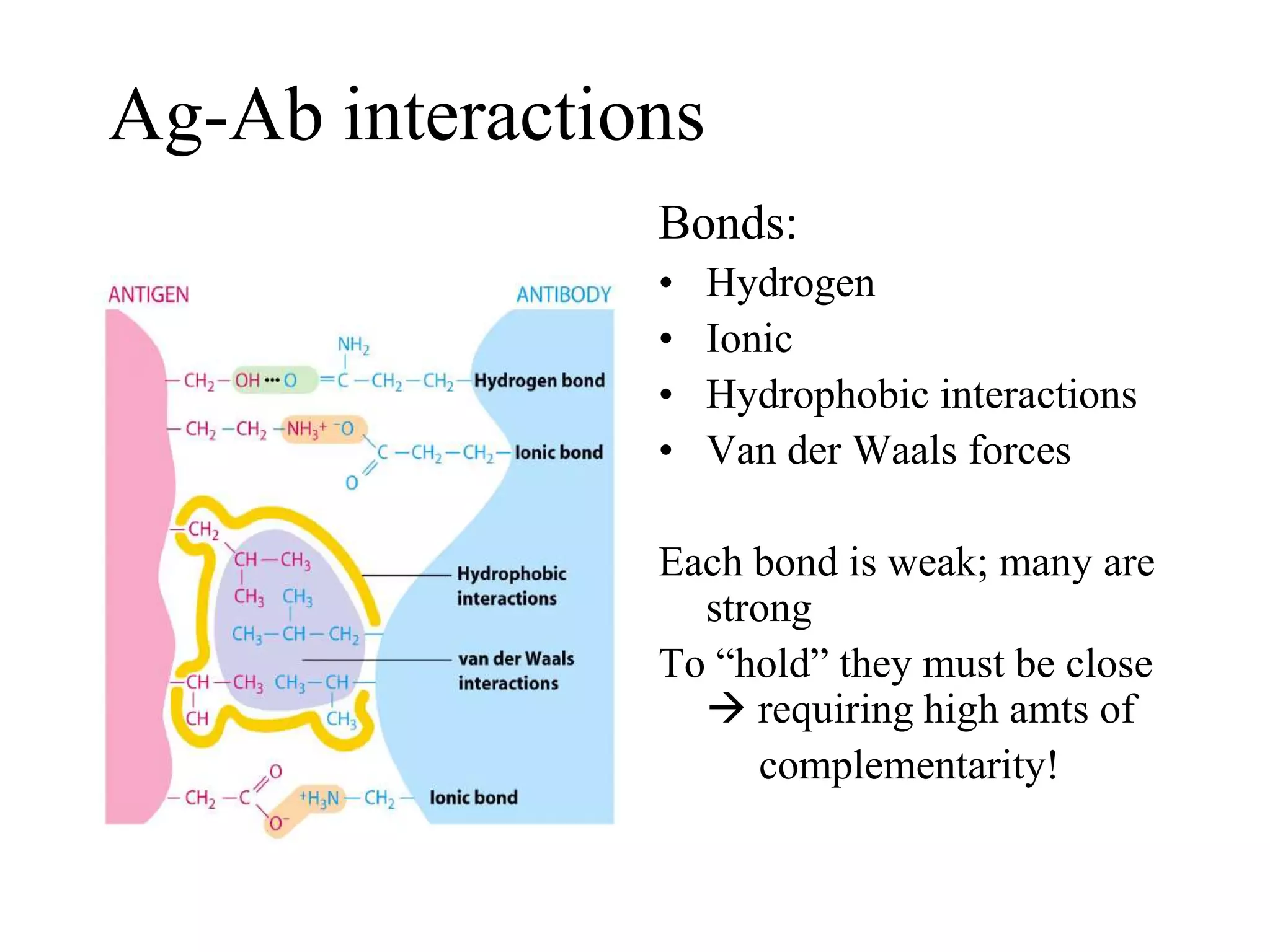
Bonds:
• Hydrogen
• Ionic
• Hydrophobic interactions
• Van der Waals forces
Each bond is weak; many are
strong
To “hold” they must be close
 requiring high amts of
complementarity!
Measuring affinity of Ab to Ag
Assoc between CDR and monovalent Ag can be expressed
as:
Ag + Ab ⇆ Ag-Ab;
k1 = forward (assoc) rate constant whereby k1/k-1 = Ka
k-1 = reverse (dissoc) rate constant the assoc/equilibrium
constant
Ka = [Ag-Ab] value of Ka depends on k1;
[Ag] [Ab] for small haptens, k1 is high
for large protein Ag’s, k1 is lower
Ka determined by
equilibrium dialysis
Cross-reactivity
Sometimes, Ab can “cross-react” with unrelated Ag….
(can occur if Ag’s share an identical/similar epitope)
Often seen with polysaccharide Ag’s
e.g. ABO Blood groups – glycoproteins
-persons lacking one or both of the blood (AB) Ag’s will
have serum Ab’s vs.the missing Ag’s
-these Ab’s produced from cross-reactive MO Ag’s!!
-provides basis for blood typing tests
-necessitates compatible blood types during transfusions, etc.
Other MO cross-reactions: 1) Streptococcus pyogenes
2) Vaccinia virus
Immunologic tests:
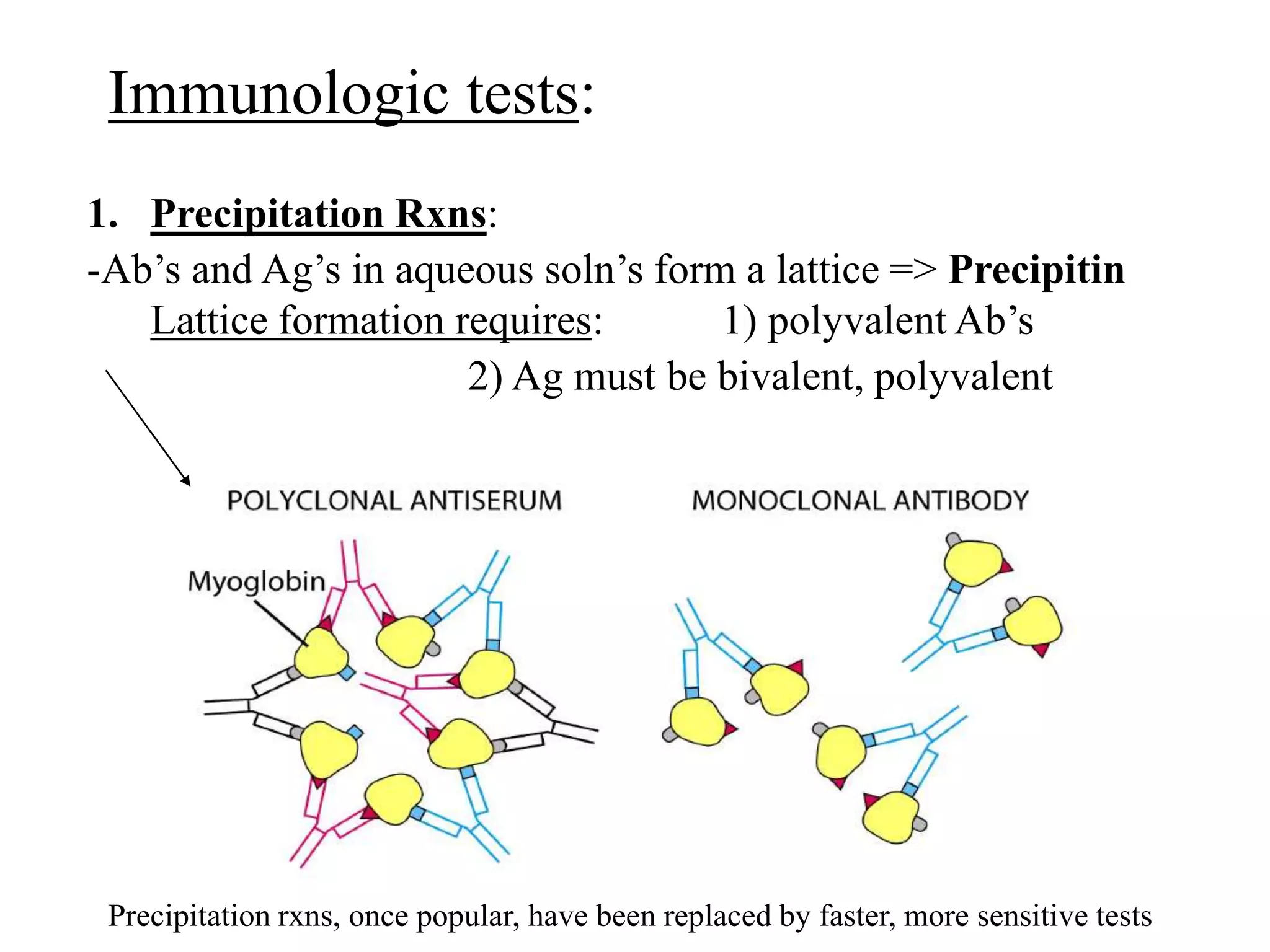
1. Precipitation Rxns:
-Ab’s and Ag’s in aqueous soln’s form a lattice => Precipitin
Lattice formation requires: 1) polyvalent Ab’s
2) Ag must be bivalent, polyvalent
Precipitation rxns, once popular, have been replaced by faster, more sensitive tests
Immunologic tests:
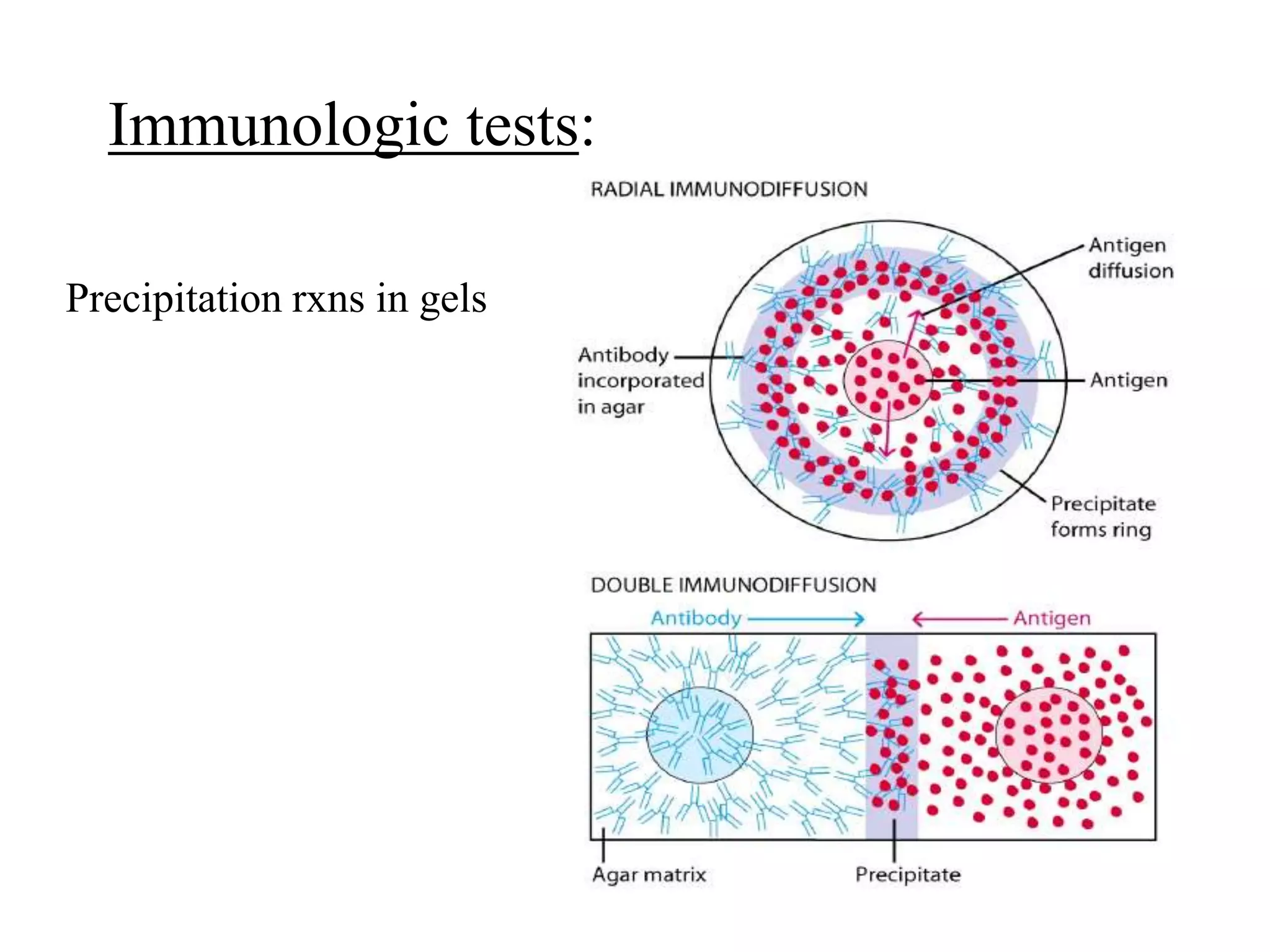
Precipitation rxns in gels
Immunologic tests:
2. Immunoelectrophoresis: Incorp electrophoresis
w/ double diffusion
• An Ag mixture is 1st separated by charge
• Then, “troughs” are cut ∥to direction of elec field
and antisera is added to trough
• Ag’s and Ab’s diffuse towards each other to
produce precipitin bands
• Used to detect: a)presence/absence of specific
proteins or Ig classes
b) immunodeficiency or immunoproliferative disorder
Immunologic tests:
Immunoelectrophoresis:
Immunologic tests:
3) Agglutination reactions – simple,
inexpensive, but sensitive!
Several types exist:
a) Hemagglutination of RBC’s
b) Bacterial Agglutination
c) Passive Agglutination
d) Agglutination Inhibition
Immunologic tests:
4) Radioimmunoassay (RIA)– very sensitive test; used
for measuring hormones, serum proteins, drugs, etc.
at low [C]’s (≤ 0.001ug/ml)
measures “competitive binding” of radiolabelled Ag +
unlabelled (test) Ag to high affinity Ab
Immunologic tests:
5. ELISA tests: dep on enzyme conugated to 2 Ab
reacting with a specific substrate to produce a color
rxn. Most sensitive of tests for Ag/Ab!!
Variations of ELISA’s:
Allows for qualitative or quantitative testing.
Each one can be used for qualitative detection of Ag or Ab
Also, a std curve based on known [C]’s of Ag/Ab can be
prepped and an unknown [C} can be ascertained
a. Indirect ELISA
b. Sandwich ELISA
c. Competitive ELISA
Immunologic tests: Types of ELISA’s…
Immunologic tests:
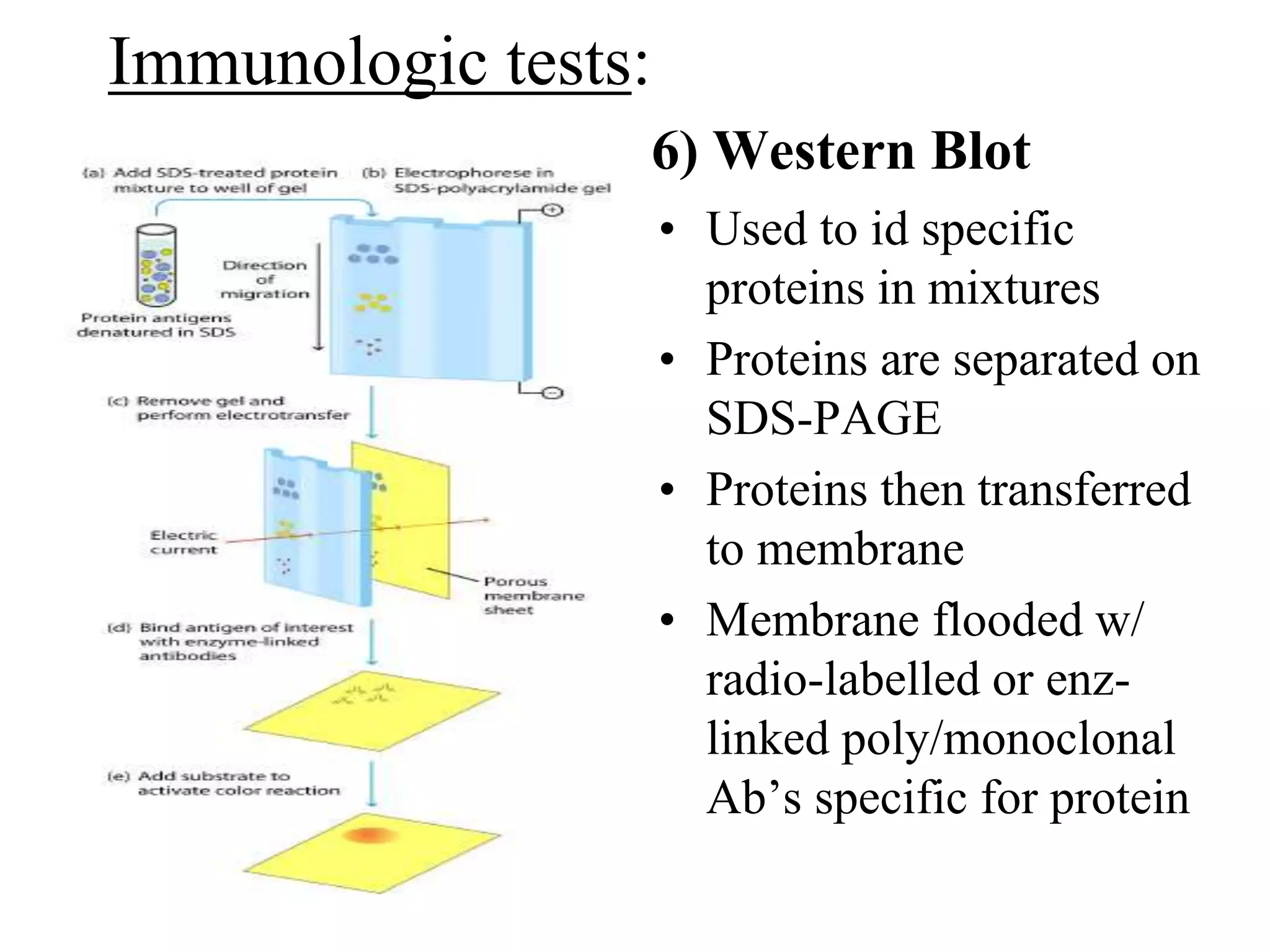
6) Western Blot
• Used to id specific
proteins in mixtures
• Proteins are separated on
SDS-PAGE
• Proteins then transferred
to membrane
• Membrane flooded w/
radio-labelled or enz-
linked poly/monoclonal
Ab’s specific for protein
Immunologic tests: 7) Immunoprecipitation
• Provides a quick and
sensitive test for finding
proteins/Ag’s
– Especially in low [C]’s
• Binds Ab to synthetic
bead support 
centrifuged
• Or 2° Ab w/ bead or
magnetic bead -> collect
by magnetism
Immunologic tests: 8) Immunofluorescence
• Provides a quick method for the id of
pathogens and lymphocytes
– Ab’s are conjugated with a fluorescent dye
(fluorescein, rhodamine, phycoerythrin)
– If Ab’s bind to specific Ag’s, they can be illum
w/ UV light and emit bright colors
– There are currently 2 methods employed:
• Direct staining
• Indirect staining
Direct and indirect
Immunofluorescence

Antigen antibody interaction

  • 1.
    Chap. 6 –Antigen-Antibody interactions Characterized as: • Non-covalent interaction (similar to “lock and key” fit of enzyme-substrate) • Does not lead to irreversible alteration of Ag or Ab • This exact and specific interaction has led to many immunological assays used to: » detect Ag or Ab » diagnose disease » measure magnitude of humoral IR » identify molecules of bio and med interest
  • 2.
    Ag-Ab interactions Bonds: • Hydrogen •Ionic • Hydrophobic interactions • Van der Waals forces Each bond is weak; many are strong To “hold” they must be close  requiring high amts of complementarity!
  • 3.
    Measuring affinity ofAb to Ag Assoc between CDR and monovalent Ag can be expressed as: Ag + Ab ⇆ Ag-Ab; k1 = forward (assoc) rate constant whereby k1/k-1 = Ka k-1 = reverse (dissoc) rate constant the assoc/equilibrium constant Ka = [Ag-Ab] value of Ka depends on k1; [Ag] [Ab] for small haptens, k1 is high for large protein Ag’s, k1 is lower
  • 4.
  • 5.
    Cross-reactivity Sometimes, Ab can“cross-react” with unrelated Ag…. (can occur if Ag’s share an identical/similar epitope) Often seen with polysaccharide Ag’s e.g. ABO Blood groups – glycoproteins -persons lacking one or both of the blood (AB) Ag’s will have serum Ab’s vs.the missing Ag’s -these Ab’s produced from cross-reactive MO Ag’s!! -provides basis for blood typing tests -necessitates compatible blood types during transfusions, etc. Other MO cross-reactions: 1) Streptococcus pyogenes 2) Vaccinia virus
  • 6.
    Immunologic tests: 1. PrecipitationRxns: -Ab’s and Ag’s in aqueous soln’s form a lattice => Precipitin Lattice formation requires: 1) polyvalent Ab’s 2) Ag must be bivalent, polyvalent Precipitation rxns, once popular, have been replaced by faster, more sensitive tests
  • 7.
  • 8.
    Immunologic tests: 2. Immunoelectrophoresis:Incorp electrophoresis w/ double diffusion • An Ag mixture is 1st separated by charge • Then, “troughs” are cut ∥to direction of elec field and antisera is added to trough • Ag’s and Ab’s diffuse towards each other to produce precipitin bands • Used to detect: a)presence/absence of specific proteins or Ig classes b) immunodeficiency or immunoproliferative disorder
  • 9.
  • 10.
    Immunologic tests: 3) Agglutinationreactions – simple, inexpensive, but sensitive! Several types exist: a) Hemagglutination of RBC’s b) Bacterial Agglutination c) Passive Agglutination d) Agglutination Inhibition
  • 11.
    Immunologic tests: 4) Radioimmunoassay(RIA)– very sensitive test; used for measuring hormones, serum proteins, drugs, etc. at low [C]’s (≤ 0.001ug/ml) measures “competitive binding” of radiolabelled Ag + unlabelled (test) Ag to high affinity Ab
  • 12.
    Immunologic tests: 5. ELISAtests: dep on enzyme conugated to 2 Ab reacting with a specific substrate to produce a color rxn. Most sensitive of tests for Ag/Ab!! Variations of ELISA’s: Allows for qualitative or quantitative testing. Each one can be used for qualitative detection of Ag or Ab Also, a std curve based on known [C]’s of Ag/Ab can be prepped and an unknown [C} can be ascertained a. Indirect ELISA b. Sandwich ELISA c. Competitive ELISA
  • 13.
    Immunologic tests: Typesof ELISA’s…
  • 14.
    Immunologic tests: 6) WesternBlot • Used to id specific proteins in mixtures • Proteins are separated on SDS-PAGE • Proteins then transferred to membrane • Membrane flooded w/ radio-labelled or enz- linked poly/monoclonal Ab’s specific for protein
  • 15.
    Immunologic tests: 7)Immunoprecipitation • Provides a quick and sensitive test for finding proteins/Ag’s – Especially in low [C]’s • Binds Ab to synthetic bead support  centrifuged • Or 2° Ab w/ bead or magnetic bead -> collect by magnetism
  • 16.
    Immunologic tests: 8)Immunofluorescence • Provides a quick method for the id of pathogens and lymphocytes – Ab’s are conjugated with a fluorescent dye (fluorescein, rhodamine, phycoerythrin) – If Ab’s bind to specific Ag’s, they can be illum w/ UV light and emit bright colors – There are currently 2 methods employed: • Direct staining • Indirect staining
  • 17.