Leukocyte Activation
►Activation
 the increase in leukocyte biochemical activity as
it prepares for battle
Leukocyte Activation
► Increased movement
 Function of cellular skeleton
► Increase in Adhesion molecules
 Expression
 Increased avidity
► Degranulation, secretion of lysosomal enzymes, and
oxidative burst
► Production of inflammatory mediators
 Arachadonic acid metabolites
 Secretion of cytokines
Activation, Receptors
►Surface receptors in activation
 Toll-like receptors activate leukocytes
►Respond to bacterial products (LPS, proteoglycans,
unmethylated nucleotides) (PAMPs)
►Viral products: double stranded RNA
 7-transmembrane G-coupled receptors
►Recognize N-fM residues (bacterial peptides)
►Also chemokines, C5a, eicosanoids, PAF
►Induce migration, cytoskeletal changes, oxidative burst
 Cytokine receptors (eg. gIFN on mF)
 Opsonin receptors
►CR1, C1q, Fc, integrins
►Stimulate phagocytosis and oxidative burst
Leukocyte Killing Mechanisms
► Killing (bactericidal) mechanisms, granule contents
► 1) Neutral proteases
 a) elastase: effective against gram-positive bacteria
 b) cathepsin G: in presence of elatase effective against both gram-
positive and gram-negative bacteria and fungi
 c) lysozyme: attacks bacterial cell walls, most effective against gram-
positive bacteria (FYI attacks muramic acid-N-acetylglucosamine)
 d) Bactericidal/permeability increasing protein (BPI): also has
lipopolysaccharide (LPS) binding and neutralizing properties
► 2) Defensins: small antimicrobial peptides with broad
spectrum activity against bacteria, fungi, and some
enveloped viruses
► 3) Lactoferrin: glycoprotein that binds iron making it
unavailable to the bacteria
► 4) Nramp1 (natural resistance-associated macrophage
protein 1): transporter protein which acts as an iron pump.
Associated with the membrane of the phagolysosome and
depletes the interior of iron. It also affects pH of the
phagolysosome.
Leukocyte Killing Mechanisms
►1) Respiratory burst of phagocytosis
 Rapid 2- to 4-fold increase in oxygen consumption in
PMN and increase in glucose metabolism
 Formation of superoxide (O2
-) on membrane of
phagolysosome through action of membrane bound
NADPH oxidase and cytochrome b from specific and
tertiary granules
 Superoxide charge partially neutralized by large K+
influx resulting in alkalinization (pH 7.8-8.0) and
hypertonicity
 Liberates cationic proteases from the negatively charged
matrix of the granules
Leukocyte Killing
►Oxygen dependent ?killing?
 Probably not important in PMN phagosome, may
be important extracellularly and in mF
 Generation of superoxide anion by NADPH
oxidase
►O2 + e-  O2
-
 NO + superoxide peroxynitrite
►Is essential for mF killing of intracellular organisms
Leukocyte killing
► O2 dependent ?killing?
 Superoxide converts to other reactive species
►O2
- + e- + 2H+  H2O2 (SO dismutase/spontaneous)
 Myeloperoxidase-halide system (PMN)
►Important to scavenge H2O2 to prevent protease inactivation,
not for direct intracellular killing
►H2O2 + Cl-  HOCl + H2O
 Kill via membrane, DNA, protein peroxidation (limited by
free-radical scavengers)
► Digestive enzymes:
 acid hydrolases, etc. come in later to finish degrading
dead bacteria and debris
Leukocyte Killing Mechanisms
Collateral Damage
► Loss of leukocyte products into the extracellular
matrix
► Cytotoxic release (lysosomal suicide)
 cell ruptures and releases contents to environment
 neutrophils, eosinophils
 major cause of tissue damage in purulent exudates
 does not occur with apoptosis
► Granule release
 release of granules into environment
 neutrophils, eosinophils
 important with eosinophilic inflammation collagen
necrosis
Leukocyte Killing Mechanisms
► Frustrated phagocytosis
 seen with large objects (ag-ab complexes in basement
membranes, nematodes)
 Neutrophils, eosinophils
 probably major cause of chronic damage with
autoimmune diseases
► Regurgitation
 leakage during phagocytosis as channel to surface
remains partly open
 probably common but minor leakage source
 macrophages, neutrophils
Inhibition of tissue damage
► 1) Antiproteinases
 a) a2-macroglobulin: produced in liver and circulates in
plasma. Inhibits all classes of leukocyte proteinases
 b) serine proteinase inhibitors: also from plasma
 c) tissue inhibitors of MMPs: synthesized by leukocytes
and connective tissue cells
 d) a1-antitrypsin: major inhibitor of neutrophil elastase
► 2) antioxidants
 Vitamin E, glutathione/glutathione peroxidase (Se),
superoxide dismutase, catalase, ascorbate, and
ceruloplasmin
Mechanisms of bacterial escape
►Protective coating (capsules)
 Inhibit opsonization and phagocytosis
 Protect against phagolysosomal killing
►Escape from phagosome into cytoplasm
►Prevention of phagosome/lysosome fusion
►Kill/lyse the leukocyte (leukotoxins and
cytotoxins)
Chemical Mediators of
Inflammation
Leukocyte defects
►Leukocyte adhesion deficiency-Cattle and
Dogs
 Lack functional integrins on leukocytes
 Predisposed to serious bacterial infections
►Chediak-Higashi syndrome- Cats, mink,
mice, whales, cattle
 Abnormal giant lysosomal granules
 Neutropenia and recurrent pyogenic infections
Vasoactive Amines
►Source - Mast cells, platelets
 release with antigen stimulation, endothelial damage,
mast cell activation
 Preformed and stored in granules
►Function
 vasodilation and leakage (endothelial retraction)
 bronchoconstriction
►Clinically
 acute allergic responses
 heat, cold, other physical reactions
Vasoactive Amines
►Histamine
 Primary source is mast cells
 Numerous stimuli
►Endogenous: cross-linked IgE/Ag, complement
fragments, cytokines
►Exogenous: thermal or physical injury
 Histaminase is specific inactivator
►Serotonin
 Primarily from platelets
 Most commonly released when platelets
aggregate
 Monoamine oxidase inactivation
Kinin System
Kinin System
► Bradykinin (short lived)
 bronchoconstriction
 blood vessel dilation or constriction
 Increased permeability
 pain
► Activation of other systems
 complement
 fibrinolysis
 eicosanoids
► Inactivation by kininases
Arachidonic Acid Metabolites
► Created de novo: not preformed
 from phospholipids of cell membrane
► Lipoxygenase products: leukotrienes
 primarily from leukocytes
 LTB4: neutrophil chemotaxin
 LTC4, LTD4, LTE4 - (sustained) vasoconstriction,
bronchoconstriction, increase vasopermeability
► Cyclooxygenase products: prostaglandins
 from most cells
 PGE2, PGF2a, PGD2, PGI2:prolonged vasodilation, leakage,
pain, fever (PGE2)
► Locally active:
 Rapid spontaneous decay & enzymatic destruction
Arachidonic Acid Metabolites
Leukotrienes and Prostaglandins
Plasma proteases
► Hageman factor (factor XII)
 Activated by negatively charged surfaces
 Initiates blood clotting intrinsic pathway
 Stimulates activation of the fibrinolytic system
 Generates kinins (bradykinin)
 Activates the complement cascade
► Blood clotting system:
 Thrombin (factor IIa) causes increased leukocytes adhesion
and fibroblast proliferation
►Its action on fibrinogen produces fibrinopeptides, which increase
vascular permeability and are chemotactic
 Factor Xa causes increased vascular permeability and
leukocyte exudation
Coagulation System
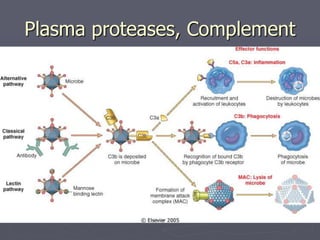
Complement cascade
► About 20 circulating proteins, many of which are proteases
when activated
► *Key step: activation of C3 (cleavage into C3b and C3a) →
the point where the intrinsic and extrinsic systems converge
► Complement system is closely regulated by specific protein
inhibitors
► Classical pathway involves recognition of IgG or IgM bound
to a cell membrane by C1
► Alternate pathway (properdin system) is activated by
bacterial cell wall components (LPS), immunoglobulin
aggregates, complex polysaccharides, etc.
Complement cascade
► C3a and C5a (anaphylatoxins) cause increased vascular
permeability and vasodilation by causing histamine release
from mast cells
► C5a is also potent chemotaxin for PMNs, monocytes,
eosinophils, and basophils
► C3b is an important opsonin
 Fixes to bacterial cell walls and interacts with specific
receptors on PMNs and m
► Control
 plasma proteases
 innate instabilities
 inhibitors (for C1 C3 C5)
 inactivators (C3b)
Plasma proteases, Complement
Platelet Activating Factor (PAF)
►Source - numerous cells types (PLA2)
►Functions
 prolong and sustain inflammatory reaction
 affects multiple systems
►endothelial cells
►neutrophils
►smooth muscle
►Platelets
►Stimulates eicosanoid production
Platelet Activating Factor (PAF)
 Prolong and sustain
inflammatory reaction
 Stimulates platelet
aggregation
 Vasoconstriction
 Bronchoconstriction
 Vasodilation and
increased permeability
at low concentrations
 Enhance leukocyte
adhesion by
upregulating integrins
 Stimulates WBC
degranulation
 Oxidative burst
 Chemotaxis
 Also boosts eicosanoid
production by WBC
• Source - numerous cells types (platelets, mast cells, m,
EC…)
• Formed by initial phospholipid cleavage by
phospholipase A2 (PLA2) with subsequent
acetylation
Functions
Cytokines
► Small polypeptides with autocrine, paracrine and endocrine
like activity
► Protein mediators produced mainly by m, Ly, MC, EC, etc.
► Produced during immune and inflammatory reactions
► Types
 Interleukins (IL)
 Interferons (IFN)
 Chemokines
 Growth factors (GF)
 Colony stimulating factors (CSF)
Cytokines
►5 classes:
 Cytokines that regulate lymphocyte function:
►IL-2, IL-4, IL-5, IL-10, TGF-
 Cytokines involved with innate immunity:
►TNF-a, IL-1, IFN- a & , IL-6
 Cytokines that activate inflammatory cells (m)
►IFN-g, TNF, IL-5, IL-10, IL-12
 Chemokines:
►IL-8, MIP-1, eotaxin, (others)
 Cytokines that stimulate hematopoiesis:
►IL-13, IL-7, GM-CSF, M-CSF, G-CSF, stem cell factor
Interleukin I & TNF
► Master Inflammatory
Cytokines
► Source:
 primarily mF (IL-1, TNF-a),
T-lymphocytes (TNF-), &
early mast cell (TNF-a)
 also many other cells
► Secretion stimuli:
 LPS
 immune complexes
 toxins
 physical injury
 other inflammatory stimuli
Interleukin 1 & TNF
Systemic vs Localized Effects
► Inflammatory effects
 Activation and priming of PMNs (TNF) and macrophages
 Increased release of proteolytic enzymes
 Neutrophilia via increased release
► Endothelial Effects
 Increased adhesion molecule synthesis and expression
 Vasodilation (via NO/PGI2 release)
 Endothelial retraction
 Procoagulation
►PAF, tissue factor, t-PA inhibitor
 Synthesis of cytokines, chemokines, eicosinoids, NO,
increased surface thrombogenicity
Interleukin I & TNF
Interleukin 1 & TNF
►With IL-6, IL-1 and TNF induce acute phase
response:
 Fever
 Anorexia
 Increased slow-wave sleep
 Release of PMNs into circulation
 Release of glucocorticoids
 Hemodynamic effects  shock
►Prolonged over-release of TNFa leads to
cachexia (neoplasia or chronic infections)
Other Interleukins
► IL-6
 from macrophages, EC
 Induced by IL-1/TNF
 important in acute phase response
► IL-4, IL-10, IL-13
 from T cells
 macrophage inhibitors
 drives immune response to humoral branch (Th2)
Other Interleukins
► IL-12 and IFNg
 from T cells
 drive cell mediated (Th1) immunity
 macrophage activation
► IL-8
 from macrophages, EC
 part of chemokine group (neutrophil)
 neutrophil activation
Chemokines
► All bind to cell G protein-linked cell surface
receptors and cause cytoskeletal alterations
► C-X-C (alpha) class: IL-8 is typical
 secreted by m, EC in response to IL-1 and TNF, bacterial
products
 most active on PMN
► C-C (beta) class: MCP-1, MIP-1a, RANTES, eotaxin
 attract monocytes, eosinophils, lymphocytes, basophils,
but not PMN.
 Exception: eotaxin is specific for eosinophils
Chemokines
► C (gamma) class: lymphotactin
 Specific for lymphocytes
► C-X3-C class: fractalkine
 Exists as membrane form  monocyte and T
lymphocyte strong adhesion
 Soluble form  chemotactic for same
Cytokine Cascade
Interferons
►IFNa, IFN
 primarily antiviral effects
 inhibits cell replication
►IFNg
 from T cells (Th1)
 potent macrophage activator
 also antiviral
Nitric Oxide (NO)
► Sources and functions
 endothelium - vasodilation, platelet inhibition
 macrophages - cytotoxic free radicals, vasodilation
 neurons – not important in inflammation
Nitric oxide
►Major actions:
 Vasodilation – short acting gas first recognized
as the endothelium-derived relaxing factor;
causes vasodilation by relaxation of arteriolar
smooth muscle
 An effector of the host defense against certain
pathogens
 A signaling molecule, particularly in the CNS
Nitric oxide
► Constitutively expressed in EC (eNOS) and
neurons (nNOS) and can be rapidly upregulated by
increased cytoplasmic calcium
► Induced in m (iNOS) by TNFa and IFNg in the
inflammatory response
► Inflammation is important for :
 Vasodilation
 Reduces platelet aggregation, inhibits mast cells
 At higher levels (such as occurs when iNOS is activated)
reduces WBC recruitment
Nitric oxide
► In the host’s response to infection:
 Over-secretion due to iNOS activation leads to the
peripheral vasodilation of septic shock
►iNOS can produce more NO than eNOS or nNOS
 Reactive species generated from NO are bactericidal
►e.g. peroxynitrite, ONOO., generated by NO reacting with
superoxide
► NO and reactive intermediates rapidly,
spontaneously decay, and are inactivated by heme
groups
Neuropeptides
►Substance P and others (neurokinin)
►Early release
►Stimulate histamine release from MC
 Vasodilation and increased permeability
Growth factors
►Common theme: GFs bind to cell-surface
receptors, initiate signal transduction, DNA
synthesis, and subsequent mitosis
►In healing, most are produced and act
locally
 m, platelets, fibroblasts, and EC
 GFs can act in autocrine, paracrine, or
endocrine fashion
►Some are are also chemotactic for EC and
fibroblasts
Growth Factors
►TGF (some effects concentration
dependent)
 from macrophages, EC
 switches cells from pro- to anti-inflammatory
 increases collagen production at repair sites
 turns on production of other growth factors
Growth Factors:
Inhibitors, Reducers, and Suppressors
of the Inflammatory Process
Nonspecific Methods
► Dilution - mediator concentration is all important
► Natural Instability - spontaneous degeneration
► Inactivators - both specific and nonspecific
 Proteases - continue to chew on peptides
 kininases - breakdown bradykinin
► Antiproteases - prevent formation of more active
compounds and deactivate existing compounds
Specific Inhibitors
► Inhibitors of cell response - corticosteroids,
epinephrine
► Antagonistic cytokines - switch inflammatory cells off
 TGF, IL 4, IL10, IL13
► Anti-inflammatory eicosanoids
 Lipoxins and resolvins
 Inhibit leukocyte recruitment and activation
 Resolution of inflammation
► Competitive antagonist
 compete for receptor - IL1ra
 compete for cytokine - soluble receptors
Outcomes of Inflammation and
Necrosis

Immune Mediators

  • 1.
    Leukocyte Activation ►Activation  theincrease in leukocyte biochemical activity as it prepares for battle
  • 2.
    Leukocyte Activation ► Increasedmovement  Function of cellular skeleton ► Increase in Adhesion molecules  Expression  Increased avidity ► Degranulation, secretion of lysosomal enzymes, and oxidative burst ► Production of inflammatory mediators  Arachadonic acid metabolites  Secretion of cytokines
  • 3.
    Activation, Receptors ►Surface receptorsin activation  Toll-like receptors activate leukocytes ►Respond to bacterial products (LPS, proteoglycans, unmethylated nucleotides) (PAMPs) ►Viral products: double stranded RNA  7-transmembrane G-coupled receptors ►Recognize N-fM residues (bacterial peptides) ►Also chemokines, C5a, eicosanoids, PAF ►Induce migration, cytoskeletal changes, oxidative burst  Cytokine receptors (eg. gIFN on mF)  Opsonin receptors ►CR1, C1q, Fc, integrins ►Stimulate phagocytosis and oxidative burst
  • 4.
    Leukocyte Killing Mechanisms ►Killing (bactericidal) mechanisms, granule contents ► 1) Neutral proteases  a) elastase: effective against gram-positive bacteria  b) cathepsin G: in presence of elatase effective against both gram- positive and gram-negative bacteria and fungi  c) lysozyme: attacks bacterial cell walls, most effective against gram- positive bacteria (FYI attacks muramic acid-N-acetylglucosamine)  d) Bactericidal/permeability increasing protein (BPI): also has lipopolysaccharide (LPS) binding and neutralizing properties ► 2) Defensins: small antimicrobial peptides with broad spectrum activity against bacteria, fungi, and some enveloped viruses ► 3) Lactoferrin: glycoprotein that binds iron making it unavailable to the bacteria ► 4) Nramp1 (natural resistance-associated macrophage protein 1): transporter protein which acts as an iron pump. Associated with the membrane of the phagolysosome and depletes the interior of iron. It also affects pH of the phagolysosome.
  • 5.
    Leukocyte Killing Mechanisms ►1)Respiratory burst of phagocytosis  Rapid 2- to 4-fold increase in oxygen consumption in PMN and increase in glucose metabolism  Formation of superoxide (O2 -) on membrane of phagolysosome through action of membrane bound NADPH oxidase and cytochrome b from specific and tertiary granules  Superoxide charge partially neutralized by large K+ influx resulting in alkalinization (pH 7.8-8.0) and hypertonicity  Liberates cationic proteases from the negatively charged matrix of the granules
  • 6.
    Leukocyte Killing ►Oxygen dependent?killing?  Probably not important in PMN phagosome, may be important extracellularly and in mF  Generation of superoxide anion by NADPH oxidase ►O2 + e-  O2 -  NO + superoxide peroxynitrite ►Is essential for mF killing of intracellular organisms
  • 7.
    Leukocyte killing ► O2dependent ?killing?  Superoxide converts to other reactive species ►O2 - + e- + 2H+  H2O2 (SO dismutase/spontaneous)  Myeloperoxidase-halide system (PMN) ►Important to scavenge H2O2 to prevent protease inactivation, not for direct intracellular killing ►H2O2 + Cl-  HOCl + H2O  Kill via membrane, DNA, protein peroxidation (limited by free-radical scavengers) ► Digestive enzymes:  acid hydrolases, etc. come in later to finish degrading dead bacteria and debris
  • 8.
    Leukocyte Killing Mechanisms CollateralDamage ► Loss of leukocyte products into the extracellular matrix ► Cytotoxic release (lysosomal suicide)  cell ruptures and releases contents to environment  neutrophils, eosinophils  major cause of tissue damage in purulent exudates  does not occur with apoptosis ► Granule release  release of granules into environment  neutrophils, eosinophils  important with eosinophilic inflammation collagen necrosis
  • 9.
    Leukocyte Killing Mechanisms ►Frustrated phagocytosis  seen with large objects (ag-ab complexes in basement membranes, nematodes)  Neutrophils, eosinophils  probably major cause of chronic damage with autoimmune diseases ► Regurgitation  leakage during phagocytosis as channel to surface remains partly open  probably common but minor leakage source  macrophages, neutrophils
  • 10.
    Inhibition of tissuedamage ► 1) Antiproteinases  a) a2-macroglobulin: produced in liver and circulates in plasma. Inhibits all classes of leukocyte proteinases  b) serine proteinase inhibitors: also from plasma  c) tissue inhibitors of MMPs: synthesized by leukocytes and connective tissue cells  d) a1-antitrypsin: major inhibitor of neutrophil elastase ► 2) antioxidants  Vitamin E, glutathione/glutathione peroxidase (Se), superoxide dismutase, catalase, ascorbate, and ceruloplasmin
  • 11.
    Mechanisms of bacterialescape ►Protective coating (capsules)  Inhibit opsonization and phagocytosis  Protect against phagolysosomal killing ►Escape from phagosome into cytoplasm ►Prevention of phagosome/lysosome fusion ►Kill/lyse the leukocyte (leukotoxins and cytotoxins)
  • 12.
  • 13.
    Leukocyte defects ►Leukocyte adhesiondeficiency-Cattle and Dogs  Lack functional integrins on leukocytes  Predisposed to serious bacterial infections ►Chediak-Higashi syndrome- Cats, mink, mice, whales, cattle  Abnormal giant lysosomal granules  Neutropenia and recurrent pyogenic infections
  • 14.
    Vasoactive Amines ►Source -Mast cells, platelets  release with antigen stimulation, endothelial damage, mast cell activation  Preformed and stored in granules ►Function  vasodilation and leakage (endothelial retraction)  bronchoconstriction ►Clinically  acute allergic responses  heat, cold, other physical reactions
  • 15.
    Vasoactive Amines ►Histamine  Primarysource is mast cells  Numerous stimuli ►Endogenous: cross-linked IgE/Ag, complement fragments, cytokines ►Exogenous: thermal or physical injury  Histaminase is specific inactivator ►Serotonin  Primarily from platelets  Most commonly released when platelets aggregate  Monoamine oxidase inactivation
  • 16.
  • 17.
    Kinin System ► Bradykinin(short lived)  bronchoconstriction  blood vessel dilation or constriction  Increased permeability  pain ► Activation of other systems  complement  fibrinolysis  eicosanoids ► Inactivation by kininases
  • 18.
    Arachidonic Acid Metabolites ►Created de novo: not preformed  from phospholipids of cell membrane ► Lipoxygenase products: leukotrienes  primarily from leukocytes  LTB4: neutrophil chemotaxin  LTC4, LTD4, LTE4 - (sustained) vasoconstriction, bronchoconstriction, increase vasopermeability ► Cyclooxygenase products: prostaglandins  from most cells  PGE2, PGF2a, PGD2, PGI2:prolonged vasodilation, leakage, pain, fever (PGE2) ► Locally active:  Rapid spontaneous decay & enzymatic destruction
  • 19.
  • 20.
    Plasma proteases ► Hagemanfactor (factor XII)  Activated by negatively charged surfaces  Initiates blood clotting intrinsic pathway  Stimulates activation of the fibrinolytic system  Generates kinins (bradykinin)  Activates the complement cascade ► Blood clotting system:  Thrombin (factor IIa) causes increased leukocytes adhesion and fibroblast proliferation ►Its action on fibrinogen produces fibrinopeptides, which increase vascular permeability and are chemotactic  Factor Xa causes increased vascular permeability and leukocyte exudation
  • 21.
  • 22.
    Complement cascade ► About20 circulating proteins, many of which are proteases when activated ► *Key step: activation of C3 (cleavage into C3b and C3a) → the point where the intrinsic and extrinsic systems converge ► Complement system is closely regulated by specific protein inhibitors ► Classical pathway involves recognition of IgG or IgM bound to a cell membrane by C1 ► Alternate pathway (properdin system) is activated by bacterial cell wall components (LPS), immunoglobulin aggregates, complex polysaccharides, etc.
  • 23.
    Complement cascade ► C3aand C5a (anaphylatoxins) cause increased vascular permeability and vasodilation by causing histamine release from mast cells ► C5a is also potent chemotaxin for PMNs, monocytes, eosinophils, and basophils ► C3b is an important opsonin  Fixes to bacterial cell walls and interacts with specific receptors on PMNs and m ► Control  plasma proteases  innate instabilities  inhibitors (for C1 C3 C5)  inactivators (C3b)
  • 24.
  • 25.
    Platelet Activating Factor(PAF) ►Source - numerous cells types (PLA2) ►Functions  prolong and sustain inflammatory reaction  affects multiple systems ►endothelial cells ►neutrophils ►smooth muscle ►Platelets ►Stimulates eicosanoid production
  • 26.
    Platelet Activating Factor(PAF)  Prolong and sustain inflammatory reaction  Stimulates platelet aggregation  Vasoconstriction  Bronchoconstriction  Vasodilation and increased permeability at low concentrations  Enhance leukocyte adhesion by upregulating integrins  Stimulates WBC degranulation  Oxidative burst  Chemotaxis  Also boosts eicosanoid production by WBC • Source - numerous cells types (platelets, mast cells, m, EC…) • Formed by initial phospholipid cleavage by phospholipase A2 (PLA2) with subsequent acetylation Functions
  • 27.
    Cytokines ► Small polypeptideswith autocrine, paracrine and endocrine like activity ► Protein mediators produced mainly by m, Ly, MC, EC, etc. ► Produced during immune and inflammatory reactions ► Types  Interleukins (IL)  Interferons (IFN)  Chemokines  Growth factors (GF)  Colony stimulating factors (CSF)
  • 28.
    Cytokines ►5 classes:  Cytokinesthat regulate lymphocyte function: ►IL-2, IL-4, IL-5, IL-10, TGF-  Cytokines involved with innate immunity: ►TNF-a, IL-1, IFN- a & , IL-6  Cytokines that activate inflammatory cells (m) ►IFN-g, TNF, IL-5, IL-10, IL-12  Chemokines: ►IL-8, MIP-1, eotaxin, (others)  Cytokines that stimulate hematopoiesis: ►IL-13, IL-7, GM-CSF, M-CSF, G-CSF, stem cell factor
  • 29.
    Interleukin I &TNF ► Master Inflammatory Cytokines ► Source:  primarily mF (IL-1, TNF-a), T-lymphocytes (TNF-), & early mast cell (TNF-a)  also many other cells ► Secretion stimuli:  LPS  immune complexes  toxins  physical injury  other inflammatory stimuli
  • 30.
    Interleukin 1 &TNF Systemic vs Localized Effects
  • 31.
    ► Inflammatory effects Activation and priming of PMNs (TNF) and macrophages  Increased release of proteolytic enzymes  Neutrophilia via increased release ► Endothelial Effects  Increased adhesion molecule synthesis and expression  Vasodilation (via NO/PGI2 release)  Endothelial retraction  Procoagulation ►PAF, tissue factor, t-PA inhibitor  Synthesis of cytokines, chemokines, eicosinoids, NO, increased surface thrombogenicity Interleukin I & TNF
  • 32.
    Interleukin 1 &TNF ►With IL-6, IL-1 and TNF induce acute phase response:  Fever  Anorexia  Increased slow-wave sleep  Release of PMNs into circulation  Release of glucocorticoids  Hemodynamic effects  shock ►Prolonged over-release of TNFa leads to cachexia (neoplasia or chronic infections)
  • 33.
    Other Interleukins ► IL-6 from macrophages, EC  Induced by IL-1/TNF  important in acute phase response ► IL-4, IL-10, IL-13  from T cells  macrophage inhibitors  drives immune response to humoral branch (Th2)
  • 34.
    Other Interleukins ► IL-12and IFNg  from T cells  drive cell mediated (Th1) immunity  macrophage activation ► IL-8  from macrophages, EC  part of chemokine group (neutrophil)  neutrophil activation
  • 35.
    Chemokines ► All bindto cell G protein-linked cell surface receptors and cause cytoskeletal alterations ► C-X-C (alpha) class: IL-8 is typical  secreted by m, EC in response to IL-1 and TNF, bacterial products  most active on PMN ► C-C (beta) class: MCP-1, MIP-1a, RANTES, eotaxin  attract monocytes, eosinophils, lymphocytes, basophils, but not PMN.  Exception: eotaxin is specific for eosinophils
  • 36.
    Chemokines ► C (gamma)class: lymphotactin  Specific for lymphocytes ► C-X3-C class: fractalkine  Exists as membrane form  monocyte and T lymphocyte strong adhesion  Soluble form  chemotactic for same
  • 37.
  • 38.
    Interferons ►IFNa, IFN  primarilyantiviral effects  inhibits cell replication ►IFNg  from T cells (Th1)  potent macrophage activator  also antiviral
  • 39.
    Nitric Oxide (NO) ►Sources and functions  endothelium - vasodilation, platelet inhibition  macrophages - cytotoxic free radicals, vasodilation  neurons – not important in inflammation
  • 40.
    Nitric oxide ►Major actions: Vasodilation – short acting gas first recognized as the endothelium-derived relaxing factor; causes vasodilation by relaxation of arteriolar smooth muscle  An effector of the host defense against certain pathogens  A signaling molecule, particularly in the CNS
  • 41.
    Nitric oxide ► Constitutivelyexpressed in EC (eNOS) and neurons (nNOS) and can be rapidly upregulated by increased cytoplasmic calcium ► Induced in m (iNOS) by TNFa and IFNg in the inflammatory response ► Inflammation is important for :  Vasodilation  Reduces platelet aggregation, inhibits mast cells  At higher levels (such as occurs when iNOS is activated) reduces WBC recruitment
  • 42.
    Nitric oxide ► Inthe host’s response to infection:  Over-secretion due to iNOS activation leads to the peripheral vasodilation of septic shock ►iNOS can produce more NO than eNOS or nNOS  Reactive species generated from NO are bactericidal ►e.g. peroxynitrite, ONOO., generated by NO reacting with superoxide ► NO and reactive intermediates rapidly, spontaneously decay, and are inactivated by heme groups
  • 43.
    Neuropeptides ►Substance P andothers (neurokinin) ►Early release ►Stimulate histamine release from MC  Vasodilation and increased permeability
  • 44.
    Growth factors ►Common theme:GFs bind to cell-surface receptors, initiate signal transduction, DNA synthesis, and subsequent mitosis ►In healing, most are produced and act locally  m, platelets, fibroblasts, and EC  GFs can act in autocrine, paracrine, or endocrine fashion ►Some are are also chemotactic for EC and fibroblasts
  • 45.
    Growth Factors ►TGF (someeffects concentration dependent)  from macrophages, EC  switches cells from pro- to anti-inflammatory  increases collagen production at repair sites  turns on production of other growth factors
  • 46.
  • 47.
    Inhibitors, Reducers, andSuppressors of the Inflammatory Process Nonspecific Methods ► Dilution - mediator concentration is all important ► Natural Instability - spontaneous degeneration ► Inactivators - both specific and nonspecific  Proteases - continue to chew on peptides  kininases - breakdown bradykinin ► Antiproteases - prevent formation of more active compounds and deactivate existing compounds
  • 48.
    Specific Inhibitors ► Inhibitorsof cell response - corticosteroids, epinephrine ► Antagonistic cytokines - switch inflammatory cells off  TGF, IL 4, IL10, IL13 ► Anti-inflammatory eicosanoids  Lipoxins and resolvins  Inhibit leukocyte recruitment and activation  Resolution of inflammation ► Competitive antagonist  compete for receptor - IL1ra  compete for cytokine - soluble receptors
  • 49.