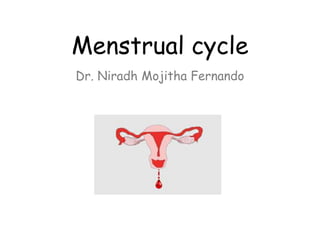
Menstrual cycle
Dr. Niradh Mojitha Fernando
ANYONE?
Overview
• Rhythmic series of physiological changes that
occur in fertile women
• This happens under the control of endocrine
system
• Necessary for reproduction
• Average length is 28 days but it can be
different with short and long cycles
Overview cont…
• Menarche
Women’s 1st menstruation
- Typically occurs around age 12
- Occurrence depends on overall health and diet
• Menopause
End of women’s reproductive phase, commonly
occurs between age 45-55
- Age of menopause is largely the result of genetics
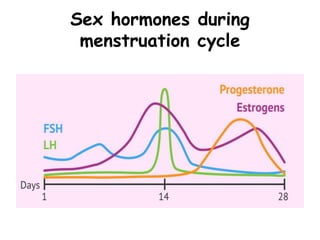
Female sex hormones
A woman's sex hormones are produced in pituitary gland (FSH and LH) and in
ovaries (estrogen and progesterone)
• FSH (follicle stimulating hormone)
It begins to secrete at the beginning of the sexual cycle and its function is
to stimulate the ovary to primordial follicles develop. Follicles are fluid-
filled structures that contain eggs at different stages of maturation.
• LH (luteinizing hormone)
It is responsible for triggering ovulation once the follicle containing the
egg has fully matured.
• Estrogenare
secreted by the ovary as follicles develop. They have a regulating function
of the entire menstrual cycle and sexual development of women.
• Progesterone
secreted by the ovary after ovulation. Its main function is to increase the
endometrial thickness so that the embryo can implant and pregnancy
takes place.
Sex hormones during
menstruation cycle
Phases of the menstrual cycle
• There are few stages of menstrual cycle,
1. Menstruation
2. Follicular phase
3. Ovulation phase
4. Luteal phase
Menstruation
• Menstrual bleeding
• Discharge of bloody fluid containing endometrial cells,
glandular secretions and blood cells, this will lasts for 3-5
days
• The endometrium is the innermost layer of the uterus,
which is renewed in each menstrual cycle in order to
accommodate the embryo during pregnancy.
• Due to strong vasoconstriction and proteolytic activity,
functional stratum of endometrial tissues and is discharged
during menstrual bleeding
• Endometrium becomes very thin, but due to low estrogen
levels, hypophysis secretes more FSH
• FSH stimulates secretion of estrogen and estrogen seves as
proliferation signal to endometrial basal layer
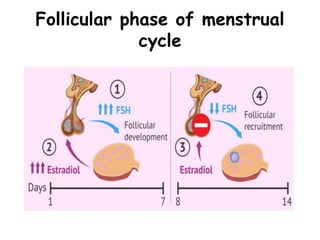
Follicular phase
• The follicular phase, also known as the proliferative or
preovulatory phase
• Happens due to rise of FSH during the first days of the
cycle
• Follicles compete with each other for dominance
• Follicle that reaches maturity is called graafian follicle
• Mature follicles secrete high amount of estrogen,
which thickens the new functional layer of
endometrium in the uterus
• Estrogen also stimulates crypts in the cervix to produce
fertile cervical mucus
• At the end of this phase ovulation occurs
Follicular phase of menstrual
cycle
Ovulation phase
• During the follicular phase estrogen suppresses
production of LH from the pituitary gland
• When the ovum has nearly matured, levels of
estrogen reach a threshold above which they
stimulate production of LH
• The release of LH matures the ovum and weakens
the wall of the follicle in the ovary, causing the
fully developed follicle to release its secondary
oocyte
• After being released from the ovary, the ovum is
swept into the fallopian tube
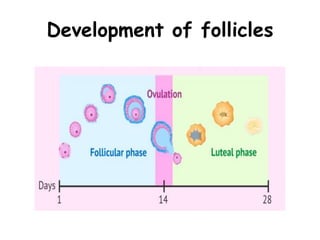
Development of follicles
Luteal phase
• Corpus luteum – solid body formed in an ovary
after the ovum has been released into the
fallopian tube
• Produced significant amounts of progesterone,
which making endometrium receptive to
implantation of the blastocyst
• High levels of estragon and progesterone
suppress the production of FSH and LH that the
corpus luteum needs to maintain itself
• Falling levels of progesterone trigger
menstruation and the beginning of the next cycle
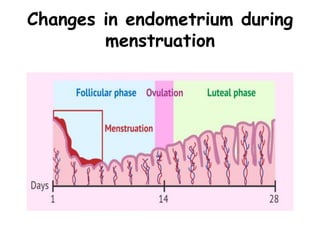
Changes in endometrium during
menstruation
Menstrual cycle.pptx

Menstrual cycle.pptx

  • 1.
  • 2.
  • 3.
    Overview • Rhythmic seriesof physiological changes that occur in fertile women • This happens under the control of endocrine system • Necessary for reproduction • Average length is 28 days but it can be different with short and long cycles
  • 4.
    Overview cont… • Menarche Women’s1st menstruation - Typically occurs around age 12 - Occurrence depends on overall health and diet • Menopause End of women’s reproductive phase, commonly occurs between age 45-55 - Age of menopause is largely the result of genetics
  • 5.
    Female sex hormones Awoman's sex hormones are produced in pituitary gland (FSH and LH) and in ovaries (estrogen and progesterone) • FSH (follicle stimulating hormone) It begins to secrete at the beginning of the sexual cycle and its function is to stimulate the ovary to primordial follicles develop. Follicles are fluid- filled structures that contain eggs at different stages of maturation. • LH (luteinizing hormone) It is responsible for triggering ovulation once the follicle containing the egg has fully matured. • Estrogenare secreted by the ovary as follicles develop. They have a regulating function of the entire menstrual cycle and sexual development of women. • Progesterone secreted by the ovary after ovulation. Its main function is to increase the endometrial thickness so that the embryo can implant and pregnancy takes place.
  • 6.
  • 7.
    Phases of themenstrual cycle • There are few stages of menstrual cycle, 1. Menstruation 2. Follicular phase 3. Ovulation phase 4. Luteal phase
  • 8.
    Menstruation • Menstrual bleeding •Discharge of bloody fluid containing endometrial cells, glandular secretions and blood cells, this will lasts for 3-5 days • The endometrium is the innermost layer of the uterus, which is renewed in each menstrual cycle in order to accommodate the embryo during pregnancy. • Due to strong vasoconstriction and proteolytic activity, functional stratum of endometrial tissues and is discharged during menstrual bleeding • Endometrium becomes very thin, but due to low estrogen levels, hypophysis secretes more FSH • FSH stimulates secretion of estrogen and estrogen seves as proliferation signal to endometrial basal layer
  • 9.
    Follicular phase • Thefollicular phase, also known as the proliferative or preovulatory phase • Happens due to rise of FSH during the first days of the cycle • Follicles compete with each other for dominance • Follicle that reaches maturity is called graafian follicle • Mature follicles secrete high amount of estrogen, which thickens the new functional layer of endometrium in the uterus • Estrogen also stimulates crypts in the cervix to produce fertile cervical mucus • At the end of this phase ovulation occurs
  • 10.
    Follicular phase ofmenstrual cycle
  • 11.
    Ovulation phase • Duringthe follicular phase estrogen suppresses production of LH from the pituitary gland • When the ovum has nearly matured, levels of estrogen reach a threshold above which they stimulate production of LH • The release of LH matures the ovum and weakens the wall of the follicle in the ovary, causing the fully developed follicle to release its secondary oocyte • After being released from the ovary, the ovum is swept into the fallopian tube
  • 12.
  • 13.
    Luteal phase • Corpusluteum – solid body formed in an ovary after the ovum has been released into the fallopian tube • Produced significant amounts of progesterone, which making endometrium receptive to implantation of the blastocyst • High levels of estragon and progesterone suppress the production of FSH and LH that the corpus luteum needs to maintain itself • Falling levels of progesterone trigger menstruation and the beginning of the next cycle
  • 14.
    Changes in endometriumduring menstruation