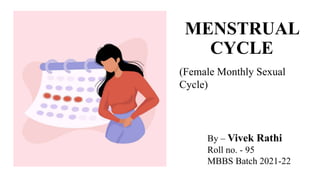
MENSTRUAL
CYCLE
By – Vivek Rathi
Roll no. - 95
MBBS Batch 2021-22
(Female Monthly Sexual
Cycle)
Contents :
• Introduction
• Duration
• Gonadotropic hormones and their effects
• Different phases of ovarian cycle
• Different phases of uterine cycle
• Regulation of female monthly rhythm
• Applied Aspects/ Abnormalities
• Summary
INTRODUCTION –
• The reproductive system of women, during her normal
reproductive years, shows regular cyclic changes that
purposely may be regarded as periodic preparations for
fertilization and pregnancy. This cycle is known as the
menstrual cycle.
• Also, monthly rhythmic changes happen in the rates of
secretion of female hormones corresponding to which
physical changes happen in ovaries and other sexual organs.
• It’s most prominent feature is the periodic vaginal bleeding
that occurs with the shedding of the uterine mucosa
(menstruation).
DURATION -
• The cycle is described by number of days, the first day being
the day of beginning of menstrual bleeding.
• The length of menstrual cycle usually averages at about 28
days. Normally, it may range from 20 to 45 days.
• Abnormal cycle length is frequently associated with
decreased fertility.
GONADOTROPIC HORMONES AND THEIR EFFECTS -
• Gonadotropic hormones – FSH and LH – secreted by the
anterior pituitary gland
• Ovarian changes that occur during the female sexual cycle
depend completely on FSH and LH.
• In the absence of these hormones, ovaries remain inactive,
which is the case throughout the childhood, i.e., before
puberty.
• Between 11-15 years of age, pituitary gland begins to secrete
progressively more FSH and LH which leads to the onset of
normal monthly sexual cycle in female – first menstrual cycle
– menarche.
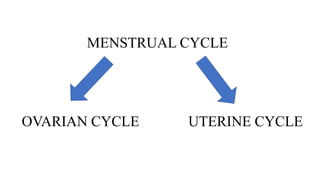
MENSTRUAL CYCLE
OVARIAN CYCLE UTERINE CYCLE
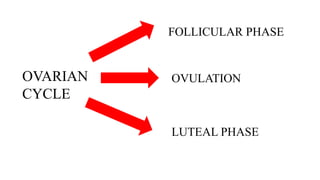
OVARIAN
CYCLE
FOLLICULAR PHASE
OVULATION
LUTEAL PHASE
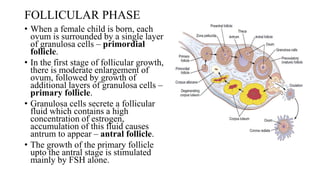
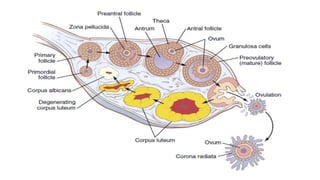
FOLLICULAR PHASE
• When a female child is born, each
ovum is surrounded by a single layer
of granulosa cells – primordial
follicle.
• In the first stage of follicular growth,
there is moderate enlargement of
ovum, followed by growth of
additional layers of granulosa cells –
primary follicle.
• Granulosa cells secrete a follicular
fluid which contains a high
concentration of estrogen,
accumulation of this fluid causes
antrum to appear – antral follicle.
• The growth of the primary follicle
upto the antral stage is stimulated
mainly by FSH alone.
• Then, greatly accelerated growth occurs, leading to the
formation of larger follicle – vesicular follicle. This
accelerated growth is caused by 3 mechanisms.
• FSH causes accelerated growth of 6-12 primary follicles each
month but only one follicle fully matures each month and the
remaining undergo atresia.
• Cause of atresia – secretion of large amounts of estrogen
from the most rapidly growing follicle
• The single follicle which reaches a diameter of 1-1.5 cm at
the time of ovulation is called the mature follicle.
OVULATION -
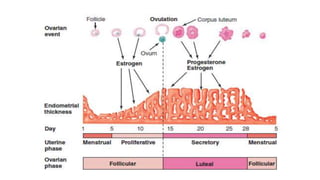
• If a women has a normal 28 day female sexual cycle, then
ovulation will occur 14 days after the onset of menstruation.
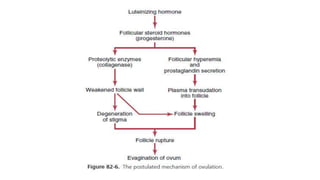
• A surge of luteinizing hormone is necessary for final
follicular growth and ovulation. Without LH, the follicle,
even in the presence of large quantities of FSH will not
progress to the stage of ovulation.
• So, how does initiation of ovulation occurs ? – let’s
understand it with the help of a flowchart.
LUTEAL PHASE -
• Remaining granulosa and theca interna cells change into
lutein cells, get filled with lipid inclusions – a process called
as luteinization.
• Formation of corpus luteum
• Granulosa cells – development of SER – progesterone and
estrogen
• Theca cells – androgens – androstenedione and testosterone ,
role of enzyme aromatase
• Luteinizing function of LH
• Involution of corpus luteum – by inhibin hormone
• Then, onset of next ovarian cycle
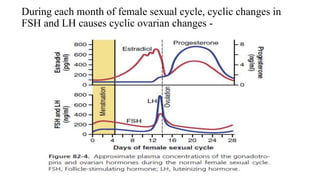
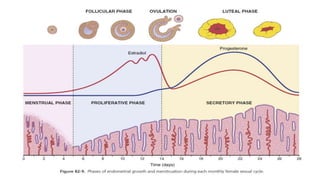
During each month of female sexual cycle, cyclic changes in
FSH and LH causes cyclic ovarian changes -
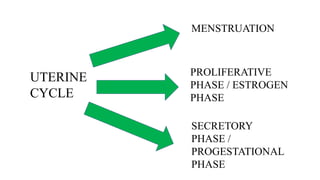
UTERINE
CYCLE
MENSTRUATION
PROLIFERATIVE
PHASE / ESTROGEN
PHASE
SECRETORY
PHASE /
PROGESTATIONAL
PHASE
MENSTRUATION -
• If ovum is not fertilized, corpus luteum involutes and
menstruation occurs.
• Firstly, decreased stimulation of endometrial cells by
reduction in estrogen and progesterone hormones.
• Then, rapid involution of endometrium to 65% of its previous
thickness.
• Blood vessels to mucosa of endometrium become vasospastic
leading to decrease in nutrients to endometrium
• Initiation of necrosis
• Growth of haemorrhagic areas
• All the superficial layers of endometrium become
desquamated.
• Initiation of uterine contractions
• In normal menstruation, approximately 40 ml of blood and 35
ml of serous fluid is lost.
• Menstrual fluid is non-clotting because of fibrinolysin.
• Leukorrhea during menstruation – so, uterus is highly
resistant to infection during menstruation.
• Within 4-7 days, loss of blood decreases because
endometrium becomes re-epithelialized.
PROLIFERATIVE PHASE -
• Estrogen phase, occurring before ovulation
• In menstrual phase, most of the endometrium becomes
desquamated. So now, under the influence of estrogen,
stromal cells and epithelial cells of uterus proliferate rapidly.
• So, endometrium increases greatly in thickness. (at time of
ovulation, 3-5mm in thickness)
• Growth of endometrial glands and new blood vessels occurs
• Cervical endometrial glands secrete thin, stringy mucus
forming channels that guide sperms.
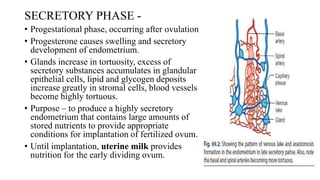
SECRETORY PHASE -
• Progestational phase, occurring after ovulation
• Progesterone causes swelling and secretory
development of endometrium.
• Glands increase in tortuosity, excess of
secretory substances accumulates in glandular
epithelial cells, lipid and glycogen deposits
increase greatly in stromal cells, blood vessels
become highly tortuous.
• Purpose – to produce a highly secretory
endometrium that contains large amounts of
stored nutrients to provide appropriate
conditions for implantation of fertilized ovum.
• Until implantation, uterine milk provides
nutrition for the early dividing ovum.
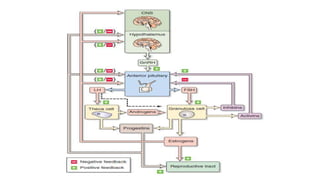
REGULATION OF FEMALE MONTHLY RHYTHM -
• By interplay between ovarian and hypothalamic pituitary
hormones
• Hypothalamus secretes GnRH, which causes the anterior
pituitary gland to secrete LH and FSH – pulsatile release
• Negative feedback effects of estrogen and progesterone to
decrease LH and FSH secretion
• Positive feedback effect of estrogen before ovulation – the
preovulatory LH surge
• Feedback oscillation of hypothalamic-pituitary-ovarian
system
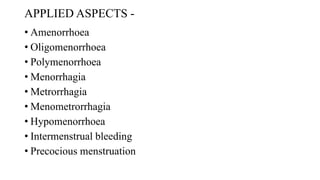
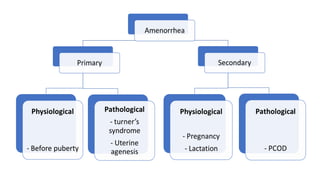
APPLIED ASPECTS -
• Amenorrhoea
• Oligomenorrhoea
• Polymenorrhoea
• Menorrhagia
• Metrorrhagia
• Menometrorrhagia
• Hypomenorrhoea
• Intermenstrual bleeding
• Precocious menstruation
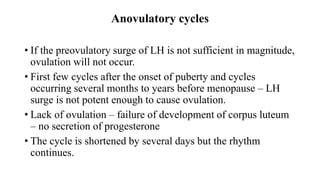
Anovulatory cycles
• If the preovulatory surge of LH is not sufficient in magnitude,
ovulation will not occur.
• First few cycles after the onset of puberty and cycles
occurring several months to years before menopause – LH
surge is not potent enough to cause ovulation.
• Lack of ovulation – failure of development of corpus luteum
– no secretion of progesterone
• The cycle is shortened by several days but the rhythm
continues.
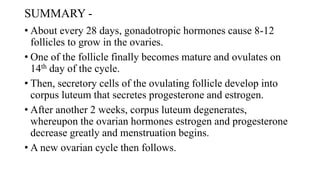
SUMMARY -
• About every 28 days, gonadotropic hormones cause 8-12
follicles to grow in the ovaries.
• One of the follicle finally becomes mature and ovulates on
14th day of the cycle.
• Then, secretory cells of the ovulating follicle develop into
corpus luteum that secretes progesterone and estrogen.
• After another 2 weeks, corpus luteum degenerates,
whereupon the ovarian hormones estrogen and progesterone
decrease greatly and menstruation begins.
• A new ovarian cycle then follows.
References :
• Ganong’s Review of Medical Physiology, 26th Edition
• Guyton and Hall, Textbook of Medical Physiology, 3rd South
Asian Edition
• Shaw’s Textbook of Gynaecology, 16th edition
A special thanks to my moderator – Dr. Sonia ma’am

menstrual cycle.pptx

  • 1.
    MENSTRUAL CYCLE By – VivekRathi Roll no. - 95 MBBS Batch 2021-22 (Female Monthly Sexual Cycle)
  • 2.
    Contents : • Introduction •Duration • Gonadotropic hormones and their effects • Different phases of ovarian cycle • Different phases of uterine cycle • Regulation of female monthly rhythm • Applied Aspects/ Abnormalities • Summary
  • 3.
    INTRODUCTION – • Thereproductive system of women, during her normal reproductive years, shows regular cyclic changes that purposely may be regarded as periodic preparations for fertilization and pregnancy. This cycle is known as the menstrual cycle. • Also, monthly rhythmic changes happen in the rates of secretion of female hormones corresponding to which physical changes happen in ovaries and other sexual organs. • It’s most prominent feature is the periodic vaginal bleeding that occurs with the shedding of the uterine mucosa (menstruation).
  • 4.
    DURATION - • Thecycle is described by number of days, the first day being the day of beginning of menstrual bleeding. • The length of menstrual cycle usually averages at about 28 days. Normally, it may range from 20 to 45 days. • Abnormal cycle length is frequently associated with decreased fertility.
  • 5.
    GONADOTROPIC HORMONES ANDTHEIR EFFECTS - • Gonadotropic hormones – FSH and LH – secreted by the anterior pituitary gland • Ovarian changes that occur during the female sexual cycle depend completely on FSH and LH. • In the absence of these hormones, ovaries remain inactive, which is the case throughout the childhood, i.e., before puberty. • Between 11-15 years of age, pituitary gland begins to secrete progressively more FSH and LH which leads to the onset of normal monthly sexual cycle in female – first menstrual cycle – menarche.
  • 6.
  • 7.
  • 8.
    FOLLICULAR PHASE • Whena female child is born, each ovum is surrounded by a single layer of granulosa cells – primordial follicle. • In the first stage of follicular growth, there is moderate enlargement of ovum, followed by growth of additional layers of granulosa cells – primary follicle. • Granulosa cells secrete a follicular fluid which contains a high concentration of estrogen, accumulation of this fluid causes antrum to appear – antral follicle. • The growth of the primary follicle upto the antral stage is stimulated mainly by FSH alone.
  • 9.
    • Then, greatlyaccelerated growth occurs, leading to the formation of larger follicle – vesicular follicle. This accelerated growth is caused by 3 mechanisms. • FSH causes accelerated growth of 6-12 primary follicles each month but only one follicle fully matures each month and the remaining undergo atresia. • Cause of atresia – secretion of large amounts of estrogen from the most rapidly growing follicle • The single follicle which reaches a diameter of 1-1.5 cm at the time of ovulation is called the mature follicle.
  • 10.
    OVULATION - • Ifa women has a normal 28 day female sexual cycle, then ovulation will occur 14 days after the onset of menstruation. • A surge of luteinizing hormone is necessary for final follicular growth and ovulation. Without LH, the follicle, even in the presence of large quantities of FSH will not progress to the stage of ovulation. • So, how does initiation of ovulation occurs ? – let’s understand it with the help of a flowchart.
  • 12.
    LUTEAL PHASE - •Remaining granulosa and theca interna cells change into lutein cells, get filled with lipid inclusions – a process called as luteinization. • Formation of corpus luteum • Granulosa cells – development of SER – progesterone and estrogen • Theca cells – androgens – androstenedione and testosterone , role of enzyme aromatase • Luteinizing function of LH • Involution of corpus luteum – by inhibin hormone • Then, onset of next ovarian cycle
  • 13.
    During each monthof female sexual cycle, cyclic changes in FSH and LH causes cyclic ovarian changes -
  • 15.
  • 16.
    MENSTRUATION - • Ifovum is not fertilized, corpus luteum involutes and menstruation occurs. • Firstly, decreased stimulation of endometrial cells by reduction in estrogen and progesterone hormones. • Then, rapid involution of endometrium to 65% of its previous thickness. • Blood vessels to mucosa of endometrium become vasospastic leading to decrease in nutrients to endometrium • Initiation of necrosis • Growth of haemorrhagic areas
  • 17.
    • All thesuperficial layers of endometrium become desquamated. • Initiation of uterine contractions • In normal menstruation, approximately 40 ml of blood and 35 ml of serous fluid is lost. • Menstrual fluid is non-clotting because of fibrinolysin. • Leukorrhea during menstruation – so, uterus is highly resistant to infection during menstruation. • Within 4-7 days, loss of blood decreases because endometrium becomes re-epithelialized.
  • 18.
    PROLIFERATIVE PHASE - •Estrogen phase, occurring before ovulation • In menstrual phase, most of the endometrium becomes desquamated. So now, under the influence of estrogen, stromal cells and epithelial cells of uterus proliferate rapidly. • So, endometrium increases greatly in thickness. (at time of ovulation, 3-5mm in thickness) • Growth of endometrial glands and new blood vessels occurs • Cervical endometrial glands secrete thin, stringy mucus forming channels that guide sperms.
  • 19.
    SECRETORY PHASE - •Progestational phase, occurring after ovulation • Progesterone causes swelling and secretory development of endometrium. • Glands increase in tortuosity, excess of secretory substances accumulates in glandular epithelial cells, lipid and glycogen deposits increase greatly in stromal cells, blood vessels become highly tortuous. • Purpose – to produce a highly secretory endometrium that contains large amounts of stored nutrients to provide appropriate conditions for implantation of fertilized ovum. • Until implantation, uterine milk provides nutrition for the early dividing ovum.
  • 21.
    REGULATION OF FEMALEMONTHLY RHYTHM - • By interplay between ovarian and hypothalamic pituitary hormones • Hypothalamus secretes GnRH, which causes the anterior pituitary gland to secrete LH and FSH – pulsatile release • Negative feedback effects of estrogen and progesterone to decrease LH and FSH secretion • Positive feedback effect of estrogen before ovulation – the preovulatory LH surge • Feedback oscillation of hypothalamic-pituitary-ovarian system
  • 23.
    APPLIED ASPECTS - •Amenorrhoea • Oligomenorrhoea • Polymenorrhoea • Menorrhagia • Metrorrhagia • Menometrorrhagia • Hypomenorrhoea • Intermenstrual bleeding • Precocious menstruation
  • 25.
    Anovulatory cycles • Ifthe preovulatory surge of LH is not sufficient in magnitude, ovulation will not occur. • First few cycles after the onset of puberty and cycles occurring several months to years before menopause – LH surge is not potent enough to cause ovulation. • Lack of ovulation – failure of development of corpus luteum – no secretion of progesterone • The cycle is shortened by several days but the rhythm continues.
  • 26.
    SUMMARY - • Aboutevery 28 days, gonadotropic hormones cause 8-12 follicles to grow in the ovaries. • One of the follicle finally becomes mature and ovulates on 14th day of the cycle. • Then, secretory cells of the ovulating follicle develop into corpus luteum that secretes progesterone and estrogen. • After another 2 weeks, corpus luteum degenerates, whereupon the ovarian hormones estrogen and progesterone decrease greatly and menstruation begins. • A new ovarian cycle then follows.
  • 28.
    References : • Ganong’sReview of Medical Physiology, 26th Edition • Guyton and Hall, Textbook of Medical Physiology, 3rd South Asian Edition • Shaw’s Textbook of Gynaecology, 16th edition
  • 29.
    A special thanksto my moderator – Dr. Sonia ma’am