Meningococcal Disease
By- Sumbul Parveen
Group- GM20-115
It commences suddenly with prostration of strength,
often extreme: the face is distorted, the pulse feeble.
There appears a violent pain in the head, especially
over the forehead; then there comes pain of the heart or
vomiting of greenish material, stiffness of the spine,
and in infants, convulsions. In cases which were fatal,
loss of consciousness occurred. The course of the
disease is very rapid, termination by death or by cure.
In most of the patients who died in 24 hours or a little
after, the body is covered with purple spots at the
moment of death or very little time afterward.
The Disease Which Raged During the Spring of 1805
Gaspard Vieusseux
Epidemiology
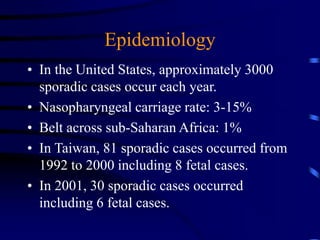
• In the United States, approximately 3000
sporadic cases occur each year.
• Nasopharyngeal carriage rate: 3-15%
• Belt across sub-Saharan Africa: 1%
• In Taiwan, 81 sporadic cases occurred from
1992 to 2000 including 8 fetal cases.
• In 2001, 30 sporadic cases occurred
including 6 fetal cases.
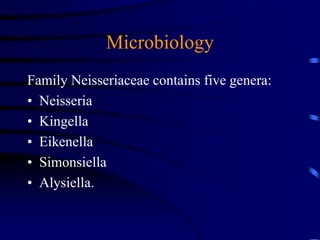
Microbiology
Family Neisseriaceae contains five genera:
• Neisseria
• Kingella
• Eikenella
• Simonsiella
• Alysiella.
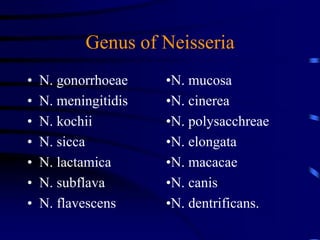
Genus of Neisseria
• N. gonorrhoeae
• N. meningitidis
• N. kochii
• N. sicca
• N. lactamica
• N. subflava
• N. flavescens
•N. mucosa
•N. cinerea
•N. polysacchreae
•N. elongata
•N. macacae
•N. canis
•N. dentrificans.
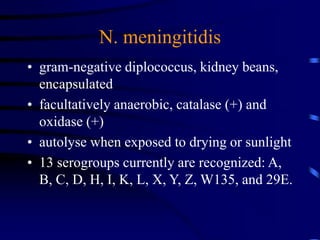
N. meningitidis
• gram-negative diplococcus, kidney beans,
encapsulated
• facultatively anaerobic, catalase (+) and
oxidase (+)
• autolyse when exposed to drying or sunlight
• 13 serogroups currently are recognized: A,
B, C, D, H, I, K, L, X, Y, Z, W135, and 29E.
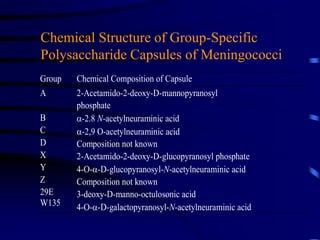
Group Chemical Composition of Capsule
A
B
C
D
X
Y
Z
29E
W135
2-Acetamido-2-deoxy-D-mannopyranosyl
phosphate
-2.8 N-acetylneuraminic acid
-2,9 O-acetylneuraminic acid
Composition not known
2-Acetamido-2-deoxy-D-glucopyranosyl phosphate
4-O--D-glucopyranosyl-N-acetylneuraminic acid
Composition not known
3-deoxy-D-manno-octulosonic acid
4-O--D-galactopyranosyl-N-acetylneuraminic acid
Chemical Structure of Group-Specific
Polysaccharide Capsules of Meningococci
• Serogroups A, B, and C account for more than 90
% of meningococcal disease worldwide.
• Serogroup A: periodic epidemics in developing
countries, is responsible for only 3 % of in the
United States.
• Serogroup B: sporadic disease but occasionally is
associated with outbreaks.
• Serogroup C: associated with numerous outbreaks
in the United States, Canada, and Europe.
• Serotype Y: has been associated with
meningococcal pneumonia in military recruits.
• The germ is spread by direct contact with
secretions from the nose and throat, such as
by kissing, coughing, sneezing, and sharing
of cigarettes, drinks, and food.
• Prevalence : winter and spring
• Incubation period: 1-10 days, most < 4
days
Risk factors
• inversely to age
• upper respiratory pathogens
• smoke and passive smoke
• family members
• late complement component deficiencies
• alternate pathway (properdin) deficiency
Clinical manifestations
• Serious/Invasive Disease
• Conjunctivitis
• Pharyngitis
• Meningococcal Pneumonia
• Meningococcal Pericarditis
• Mesenteric Adenitis and Peritonitis
• Infections of the Genitourinary Tract
• Chronic Meningococcemia
• Symptoms are usually sudden and initially
are like the flu: fever, feeling generally
unwell, headache, vomiting, and in some
cases a stiff neck.
• People with this disease are visibly sick and
may be confused, excited, or drowsy.
• Sometimes a reddish-purple rash that may
look like bruises appears.
Symptoms and Signs
• The rash is flat and smooth, does not itch,
and may spread quickly once it starts.
• In rare cases, the symptoms are followed by
lowered blood pressure, shock, delirium,
sudden extreme weakness, coma, and death.
• Because the disease spreads quickly in the
body, it is important to see a physician
immediately if symptoms suggesting
meningococcal disease develop.
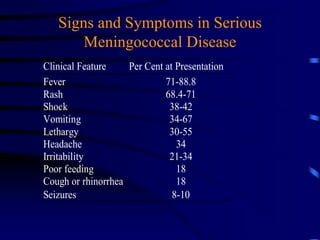
Clinical Feature Per Cent at Presentation
Fever 71-88.8
Rash 68.4-71
Shock 38-42
Vomiting 34-67
Lethargy 30-55
Headache 34
Irritability 21-34
Poor feeding 18
Cough or rhinorrhea 18
Seizures 8-10
Signs and Symptoms in Serious
Meningococcal Disease
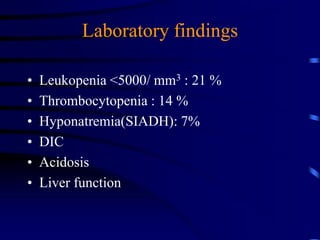
Laboratory findings
• Leukopenia <5000/ mm3 : 21 %
• Thrombocytopenia : 14 %
• Hyponatremia(SIADH): 7%
• DIC
• Acidosis
• Liver function
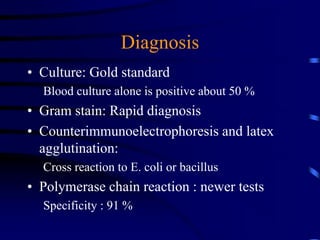
Diagnosis
• Culture: Gold standard
Blood culture alone is positive about 50 %
• Gram stain: Rapid diagnosis
• Counterimmunoelectrophoresis and latex
agglutination:
Cross reaction to E. coli or bacillus
• Polymerase chain reaction : newer tests
Specificity : 91 %
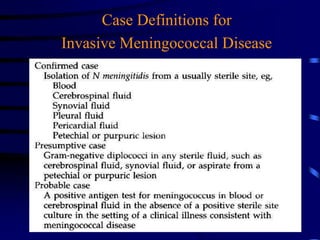
Case Definitions for
Invasive Meningococcal Disease
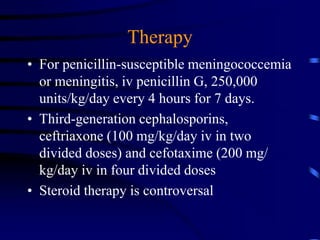
Therapy
• For penicillin-susceptible meningococcemia
or meningitis, iv penicillin G, 250,000
units/kg/day every 4 hours for 7 days.
• Third-generation cephalosporins,
ceftriaxone (100 mg/kg/day iv in two
divided doses) and cefotaxime (200 mg/
kg/day iv in four divided doses
• Steroid therapy is controversal
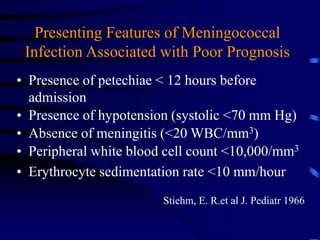
Presenting Features of Meningococcal
Infection Associated with Poor Prognosis
• Presence of petechiae < 12 hours before
admission
• Presence of hypotension (systolic <70 mm Hg)
• Absence of meningitis (<20 WBC/mm3)
• Peripheral white blood cell count <10,000/mm3
• Erythrocyte sedimentation rate <10 mm/hour
Stiehm, E. R.et al J. Pediatr 1966
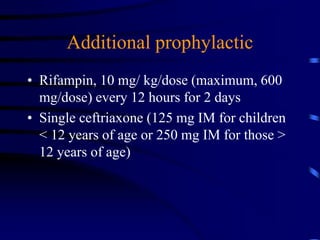
Additional prophylactic
• Rifampin, 10 mg/ kg/dose (maximum, 600
mg/dose) every 12 hours for 2 days
• Single ceftriaxone (125 mg IM for children
< 12 years of age or 250 mg IM for those >
12 years of age)
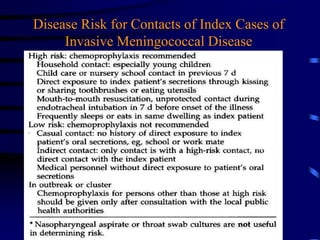
Disease Risk for Contacts of Index Cases of
Invasive Meningococcal Disease
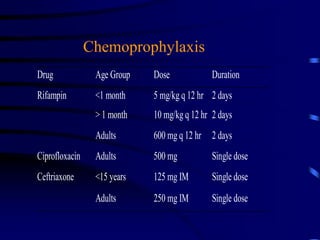
Drug Age Group Dose Duration
Rifampin <1 month 5 mg/kg q 12 hr 2 days
> 1 month 10 mg/kg q 12 hr 2 days
Adults 600 mg q 12 hr 2 days
Ciprofloxacin Adults 500 mg Single dose
Ceftriaxone <15 years 125 mg IM Single dose
Adults 250 mg IM Single dose
Chemoprophylaxis
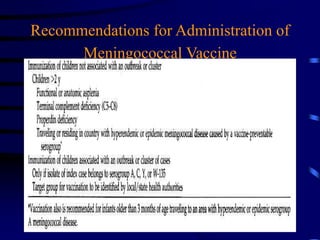
Recommendations for Administration of
Meningococcal Vaccine

Meningococcal infection

  • 1.
    Meningococcal Disease By- SumbulParveen Group- GM20-115
  • 2.
    It commences suddenlywith prostration of strength, often extreme: the face is distorted, the pulse feeble. There appears a violent pain in the head, especially over the forehead; then there comes pain of the heart or vomiting of greenish material, stiffness of the spine, and in infants, convulsions. In cases which were fatal, loss of consciousness occurred. The course of the disease is very rapid, termination by death or by cure. In most of the patients who died in 24 hours or a little after, the body is covered with purple spots at the moment of death or very little time afterward. The Disease Which Raged During the Spring of 1805 Gaspard Vieusseux
  • 3.
    Epidemiology • In theUnited States, approximately 3000 sporadic cases occur each year. • Nasopharyngeal carriage rate: 3-15% • Belt across sub-Saharan Africa: 1% • In Taiwan, 81 sporadic cases occurred from 1992 to 2000 including 8 fetal cases. • In 2001, 30 sporadic cases occurred including 6 fetal cases.
  • 4.
    Microbiology Family Neisseriaceae containsfive genera: • Neisseria • Kingella • Eikenella • Simonsiella • Alysiella.
  • 5.
    Genus of Neisseria •N. gonorrhoeae • N. meningitidis • N. kochii • N. sicca • N. lactamica • N. subflava • N. flavescens •N. mucosa •N. cinerea •N. polysacchreae •N. elongata •N. macacae •N. canis •N. dentrificans.
  • 6.
    N. meningitidis • gram-negativediplococcus, kidney beans, encapsulated • facultatively anaerobic, catalase (+) and oxidase (+) • autolyse when exposed to drying or sunlight • 13 serogroups currently are recognized: A, B, C, D, H, I, K, L, X, Y, Z, W135, and 29E.
  • 7.
    Group Chemical Compositionof Capsule A B C D X Y Z 29E W135 2-Acetamido-2-deoxy-D-mannopyranosyl phosphate -2.8 N-acetylneuraminic acid -2,9 O-acetylneuraminic acid Composition not known 2-Acetamido-2-deoxy-D-glucopyranosyl phosphate 4-O--D-glucopyranosyl-N-acetylneuraminic acid Composition not known 3-deoxy-D-manno-octulosonic acid 4-O--D-galactopyranosyl-N-acetylneuraminic acid Chemical Structure of Group-Specific Polysaccharide Capsules of Meningococci
  • 8.
    • Serogroups A,B, and C account for more than 90 % of meningococcal disease worldwide. • Serogroup A: periodic epidemics in developing countries, is responsible for only 3 % of in the United States. • Serogroup B: sporadic disease but occasionally is associated with outbreaks. • Serogroup C: associated with numerous outbreaks in the United States, Canada, and Europe. • Serotype Y: has been associated with meningococcal pneumonia in military recruits.
  • 9.
    • The germis spread by direct contact with secretions from the nose and throat, such as by kissing, coughing, sneezing, and sharing of cigarettes, drinks, and food. • Prevalence : winter and spring • Incubation period: 1-10 days, most < 4 days
  • 10.
    Risk factors • inverselyto age • upper respiratory pathogens • smoke and passive smoke • family members • late complement component deficiencies • alternate pathway (properdin) deficiency
  • 11.
    Clinical manifestations • Serious/InvasiveDisease • Conjunctivitis • Pharyngitis • Meningococcal Pneumonia • Meningococcal Pericarditis • Mesenteric Adenitis and Peritonitis • Infections of the Genitourinary Tract • Chronic Meningococcemia
  • 12.
    • Symptoms areusually sudden and initially are like the flu: fever, feeling generally unwell, headache, vomiting, and in some cases a stiff neck. • People with this disease are visibly sick and may be confused, excited, or drowsy. • Sometimes a reddish-purple rash that may look like bruises appears. Symptoms and Signs
  • 13.
    • The rashis flat and smooth, does not itch, and may spread quickly once it starts. • In rare cases, the symptoms are followed by lowered blood pressure, shock, delirium, sudden extreme weakness, coma, and death. • Because the disease spreads quickly in the body, it is important to see a physician immediately if symptoms suggesting meningococcal disease develop.
  • 14.
    Clinical Feature PerCent at Presentation Fever 71-88.8 Rash 68.4-71 Shock 38-42 Vomiting 34-67 Lethargy 30-55 Headache 34 Irritability 21-34 Poor feeding 18 Cough or rhinorrhea 18 Seizures 8-10 Signs and Symptoms in Serious Meningococcal Disease
  • 15.
    Laboratory findings • Leukopenia<5000/ mm3 : 21 % • Thrombocytopenia : 14 % • Hyponatremia(SIADH): 7% • DIC • Acidosis • Liver function
  • 16.
    Diagnosis • Culture: Goldstandard Blood culture alone is positive about 50 % • Gram stain: Rapid diagnosis • Counterimmunoelectrophoresis and latex agglutination: Cross reaction to E. coli or bacillus • Polymerase chain reaction : newer tests Specificity : 91 %
  • 17.
    Case Definitions for InvasiveMeningococcal Disease
  • 18.
    Therapy • For penicillin-susceptiblemeningococcemia or meningitis, iv penicillin G, 250,000 units/kg/day every 4 hours for 7 days. • Third-generation cephalosporins, ceftriaxone (100 mg/kg/day iv in two divided doses) and cefotaxime (200 mg/ kg/day iv in four divided doses • Steroid therapy is controversal
  • 19.
    Presenting Features ofMeningococcal Infection Associated with Poor Prognosis • Presence of petechiae < 12 hours before admission • Presence of hypotension (systolic <70 mm Hg) • Absence of meningitis (<20 WBC/mm3) • Peripheral white blood cell count <10,000/mm3 • Erythrocyte sedimentation rate <10 mm/hour Stiehm, E. R.et al J. Pediatr 1966
  • 20.
    Additional prophylactic • Rifampin,10 mg/ kg/dose (maximum, 600 mg/dose) every 12 hours for 2 days • Single ceftriaxone (125 mg IM for children < 12 years of age or 250 mg IM for those > 12 years of age)
  • 21.
    Disease Risk forContacts of Index Cases of Invasive Meningococcal Disease
  • 22.
    Drug Age GroupDose Duration Rifampin <1 month 5 mg/kg q 12 hr 2 days > 1 month 10 mg/kg q 12 hr 2 days Adults 600 mg q 12 hr 2 days Ciprofloxacin Adults 500 mg Single dose Ceftriaxone <15 years 125 mg IM Single dose Adults 250 mg IM Single dose Chemoprophylaxis
  • 23.
    Recommendations for Administrationof Meningococcal Vaccine