MENINGITIS
PRESENTED BY
SUCHISMITA GIRI
MSC TUTOR
SUM NURSING COLLEGE
The meninges is the system of
membranes which envelops the
central nervous syThe meninges
is the system of membranes which
envelops the
central nervous system.
It has 3 layers:
1. Dura mater
2. Arachnoid mater
3. Pia mater
Subarachnoid space -
is the space which
exists between the
arachnoid and the pia
mater, which is filled
with cerebrospinal
fluid.stem.
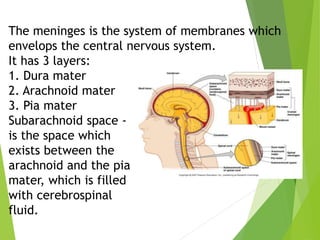
The meninges is the system of membranes which
envelops the central nervous system.
It has 3 layers:
1. Dura mater
2. Arachnoid mater
3. Pia mater
Subarachnoid space -
is the space which
exists between the
arachnoid and the pia
mater, which is filled
with cerebrospinal
fluid.
DEFINITION
Meningitis is an inflammation of the
meninges, the protective membranes
that surround the brain and spinal
cord.
INCIDENCE
 Meningitis can occur at all ages but it is
commonest in infancy. While 95% of the
cases take place between 1 month- 5 years
of age.
 It is more common in males than females
TYPES
 Bacterial meningitis/ pyogenic
meningitis
 Viral (aseptic) meningitis
 Tuberculous meningitis
Pyogenic Meningitis
 It is caused by a wide variety of pyogenic
bacteria like hemophilius influenza,
meningococcus, pneumococcus and
streptococcus.
Viral meningitis
 The viral agents for aseptic meningitis include the
following:
 Enterovirus (polio virus, Echovirus,
 Coxsackievirus )
 Herpesvirus (Hsv-1,2, Varicella.Z,EBV )
 Paramyxovirus (Mumps, Measles)
 Togavirus (Rubella)
 Rhabdovirus (Rabies)
 Retrovirus (HIV)
Tuberculous meningitis
 It is caused by mycobacterium
tuberculosis.
ETIOLOGY
 Common causes of meningitis may include: Bacteria,
Virus, Fungi and Parasites
 Varies with age:
1. Newborn to 3 months of age:
 E. coli and other coliforms, group B Streptococci,
 Listeria monocytogenes, Strep pneumoniae,
 H. influenza type b, Neisseria meningitidis
2. Age 3 months to adolescence:
 N. meningitidis, S pneumoniae, H influenza type b
(in young children)
 Mycobacterium tuberculosis is most common in young
children, but can affect children of any age.
Viral Causes (aseptic meningitis) include:-
 Mumps
 Enterovirus (coxackie, polio)
 Adenovirus and
 Herpes simplex
PATHOPHYSIOLOGY
 INFECTION FROM ANY PART OF THE BODY LIKE
NASOPHARYNX.
 ORGANISM INVADE SURROUNDING BLOOD VESSELS.
 THROUGH BLOOD, ORGANISM ENTER CEREBROSPINAL
FLUID.
 INFECTION SPREADS THROUGH SUBARACHNOID SPACE
 INFLAMMATORY PROCESS BEGINS.
 INCREASE IN CSF EXUDATION IN VENTRICLES
 INTERFERENCE IN CSF FLOW THROUGH VENTRICULAR
AQUEDUCT.
 THROMBOPHLEBITIS OF CEREBRAL VESSELS
 INFECTION OF CEREBRAL CORTEX, CEREBRAL DAMAGE
AND CRANIAL NERVES MAY BE AFFECTED.
CLINICAL FEATURES
 Young infants < 3 months: The signs and symptoms are
non specific and may include:
 Fever or hypothermia
 Bulging fontanelle or acute increase in head
circumference
 Convulsions / seizures
 High-pitched cry, irritability
 Lethargy, altered mental state
 Apnoea
 Poor feeding, vomiting
 Children > 3 months to adolescents:
 Fever is present in about ~ 50% of patients.
 Headache, photophobia, stiff neck, irritability or
lethargy, vomiting and altered level of
consciousness.
Convulsions in 20 – 30% of cases.
Focal neurologyical deficits due to vasculitis or
thrombosis of blood vessels.
Papilledema (Swelling of the optic disc)
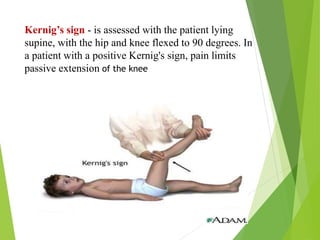
Kernig’s sign - is assessed with the patient lying
supine, with the hip and knee flexed to 90 degrees. In
a patient with a positive Kernig's sign, pain limits
passive extension of the knee
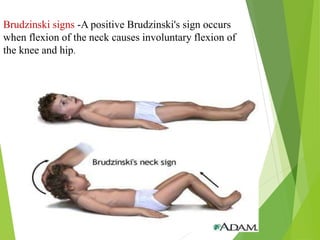
Brudzinski signs -A positive Brudzinski's sign occurs
when flexion of the neck causes involuntary flexion of
the knee and hip.
Laboratory Investigations
 CSF- Lumbar puncture or a shunt tap is
performed As soon as the diagnosis of
meningitis is suspected.
CSF should be examined for:
 Microbiology and
 Biochemistry
 Polymerase chain reaction
 C-Reactive protein (CRP).
 Blood culture and other cultures (urine, abscess,
and middle ear).
 Full Blood Picture (CBC) and ESR.
 Serum electrolytes, BUN, Creatinine
Other examinations
Electro encephalogram (EEG) if seizures are
prominent.
 Head imaging (CT).
MANAGEMENT
 Give antibiotic treatment as soon as possible:
Infants < 3 month old:
 Ampicillin 200 mg/kg/day IV div q6hr,
 Cefotaxime 200 mg/kg/day IV div q6hr for
10 to 14 days
 Age 3 months to < 18 years; choose on of the
following regimens:
 Chloramphenicol 25 mg/kg IV (or IM) 6
hourly, plus Ampicillin 50 mg/kg IV (or IM) 6
hourly
Chloramphenicol 25 mg/kg IV (or IM) 6
hourly, plus Benzyl penicillin 6o mg/kg (100,000
IU /kg) IV or IM 6 hourly
Supportive treatment
 Give paracetamol 15 mg/kg 6 – 8 hrly for
fever (>38.50 C)
IV fluids: isotonic fluids at maintenance rate
(250 ml/24hrs).
Feeding according to age requirement (75– 100
kcal/kg/day).
 Give anticonvulsant if convulsing
 Correct hypoglycemia if present
 NGT for feeding
 Physiotherapy
Nursing management
 Monitor vital signs 2-4 hrly (Temperature Pulse rate,
Oxygen saturation, BP, and Respiratory Rate)
 Monitor Input/output
 Give treatment as prescribed.
 Maintain a clear airway
 Turn the patient every 2 hours.
 Do not allow the child to lie in a wet bed.
 Monitor IV fluids very carefully and examine frequently
for signs of fluid overload.
ISOLATE THE CHILD
 When the child is admitted with suspected meningitis
the nurse should isolate the child in order to protect
others from infection.
 Proper isolation technique and strict hand washing
technique need to be followed.
 Nobody with upper respiratory tract infection should
attend the child .
ADMINISTRATION OF DRUGS
 Antibiotics and anticonvulsants should be administered
as prescribed by the physician.
 Intravenous antibiotics should be given for 7-10 days.
CONTROL OF SEIZURE AND
PROTECT THE CHILD FROM
INJURY
 Monitor the child's level of consciousness.
 Side rails of bed should be up and padded to prevent
falls.
 Never leave the child alone.
MAINTAIN FLUID INTAKE AND
NUTRITION
 If the child is unconscious intravenous fluids are given
to meet the nutritional requirements of the body.
 If the child's condition permits then nasogastric feeding
can be given.
 Maintain intake and output record to asses for any fluid
retention, impending shock .
 When oral feed are started the diet should be rich in
protein , calories and vitamins.
PROVIDE COMFORT AND REST
 The child may have photophobia so avoid bright light in
patients room.
 The environment of the child should be calm and quite
to ensure adequate rest and sleep.
 Avoid use of pillow as the child may have nuchal rigidity.
 Position the child on side so as to prevent any
aspiration.
 Care should be taken while moving and lifting the child
as this may leads to pain and discomfort.
 Provide passive exercise to the child.
MONITOR THE CHILDS
CONDITION
 Vital sign should be monitored frequently.
 Asses the neurological status and level of consciousness
frequently.
 Asses the frontanell and measure head circumference
daily.
PARENTAL GUIDANCE AND
SUPPORT
 Inform the parents about child's disease and condition.
 If the child develops deficits, teach them about care of
child at home.
 Referrals are made as necessary to provide support to
child and family.
COMPLICATION
 SUBDURAL EFFUSION
 CEREBRAL INFARCTION
 ENCEPHALITIS
 BRAIN ABSCESS
 HYDROCEPHALUS
PREVENTION
 The vaccines against Hib, measles, mumps, polio,
 meningococcus, and pneumococcus can protect against
 meningitis
 Hib vaccine: all infants should receive at 2,4,6
months of
 age & booster 1 year later.
 After 1 year 1 dose is given till the age of 5 years.
 Pneumococcal vaccine: 0.5 ml is given IM (<2 yrs
Thank you

Meningitis

  • 1.
  • 2.
    The meninges isthe system of membranes which envelops the central nervous syThe meninges is the system of membranes which envelops the central nervous system. It has 3 layers: 1. Dura mater 2. Arachnoid mater 3. Pia mater Subarachnoid space - is the space which exists between the arachnoid and the pia mater, which is filled with cerebrospinal fluid.stem. The meninges is the system of membranes which envelops the central nervous system. It has 3 layers: 1. Dura mater 2. Arachnoid mater 3. Pia mater Subarachnoid space - is the space which exists between the arachnoid and the pia mater, which is filled with cerebrospinal fluid.
  • 4.
    DEFINITION Meningitis is aninflammation of the meninges, the protective membranes that surround the brain and spinal cord.
  • 5.
    INCIDENCE  Meningitis canoccur at all ages but it is commonest in infancy. While 95% of the cases take place between 1 month- 5 years of age.  It is more common in males than females
  • 6.
    TYPES  Bacterial meningitis/pyogenic meningitis  Viral (aseptic) meningitis  Tuberculous meningitis
  • 7.
    Pyogenic Meningitis  Itis caused by a wide variety of pyogenic bacteria like hemophilius influenza, meningococcus, pneumococcus and streptococcus.
  • 8.
    Viral meningitis  Theviral agents for aseptic meningitis include the following:  Enterovirus (polio virus, Echovirus,  Coxsackievirus )  Herpesvirus (Hsv-1,2, Varicella.Z,EBV )  Paramyxovirus (Mumps, Measles)  Togavirus (Rubella)  Rhabdovirus (Rabies)  Retrovirus (HIV)
  • 9.
    Tuberculous meningitis  Itis caused by mycobacterium tuberculosis.
  • 10.
    ETIOLOGY  Common causesof meningitis may include: Bacteria, Virus, Fungi and Parasites  Varies with age: 1. Newborn to 3 months of age:  E. coli and other coliforms, group B Streptococci,  Listeria monocytogenes, Strep pneumoniae,  H. influenza type b, Neisseria meningitidis 2. Age 3 months to adolescence:  N. meningitidis, S pneumoniae, H influenza type b (in young children)  Mycobacterium tuberculosis is most common in young children, but can affect children of any age.
  • 11.
    Viral Causes (asepticmeningitis) include:-  Mumps  Enterovirus (coxackie, polio)  Adenovirus and  Herpes simplex
  • 12.
    PATHOPHYSIOLOGY  INFECTION FROMANY PART OF THE BODY LIKE NASOPHARYNX.  ORGANISM INVADE SURROUNDING BLOOD VESSELS.  THROUGH BLOOD, ORGANISM ENTER CEREBROSPINAL FLUID.  INFECTION SPREADS THROUGH SUBARACHNOID SPACE  INFLAMMATORY PROCESS BEGINS.  INCREASE IN CSF EXUDATION IN VENTRICLES  INTERFERENCE IN CSF FLOW THROUGH VENTRICULAR AQUEDUCT.  THROMBOPHLEBITIS OF CEREBRAL VESSELS  INFECTION OF CEREBRAL CORTEX, CEREBRAL DAMAGE AND CRANIAL NERVES MAY BE AFFECTED.
  • 13.
    CLINICAL FEATURES  Younginfants < 3 months: The signs and symptoms are non specific and may include:  Fever or hypothermia  Bulging fontanelle or acute increase in head circumference  Convulsions / seizures  High-pitched cry, irritability  Lethargy, altered mental state  Apnoea  Poor feeding, vomiting
  • 14.
     Children >3 months to adolescents:  Fever is present in about ~ 50% of patients.  Headache, photophobia, stiff neck, irritability or lethargy, vomiting and altered level of consciousness. Convulsions in 20 – 30% of cases. Focal neurologyical deficits due to vasculitis or thrombosis of blood vessels. Papilledema (Swelling of the optic disc)
  • 15.
    Kernig’s sign -is assessed with the patient lying supine, with the hip and knee flexed to 90 degrees. In a patient with a positive Kernig's sign, pain limits passive extension of the knee
  • 16.
    Brudzinski signs -Apositive Brudzinski's sign occurs when flexion of the neck causes involuntary flexion of the knee and hip.
  • 17.
    Laboratory Investigations  CSF-Lumbar puncture or a shunt tap is performed As soon as the diagnosis of meningitis is suspected. CSF should be examined for:  Microbiology and  Biochemistry  Polymerase chain reaction
  • 18.
     C-Reactive protein(CRP).  Blood culture and other cultures (urine, abscess, and middle ear).  Full Blood Picture (CBC) and ESR.  Serum electrolytes, BUN, Creatinine Other examinations Electro encephalogram (EEG) if seizures are prominent.  Head imaging (CT).
  • 19.
    MANAGEMENT  Give antibiotictreatment as soon as possible: Infants < 3 month old:  Ampicillin 200 mg/kg/day IV div q6hr,  Cefotaxime 200 mg/kg/day IV div q6hr for 10 to 14 days
  • 20.
     Age 3months to < 18 years; choose on of the following regimens:  Chloramphenicol 25 mg/kg IV (or IM) 6 hourly, plus Ampicillin 50 mg/kg IV (or IM) 6 hourly Chloramphenicol 25 mg/kg IV (or IM) 6 hourly, plus Benzyl penicillin 6o mg/kg (100,000 IU /kg) IV or IM 6 hourly
  • 21.
    Supportive treatment  Giveparacetamol 15 mg/kg 6 – 8 hrly for fever (>38.50 C) IV fluids: isotonic fluids at maintenance rate (250 ml/24hrs). Feeding according to age requirement (75– 100 kcal/kg/day).  Give anticonvulsant if convulsing  Correct hypoglycemia if present  NGT for feeding  Physiotherapy
  • 22.
    Nursing management  Monitorvital signs 2-4 hrly (Temperature Pulse rate, Oxygen saturation, BP, and Respiratory Rate)  Monitor Input/output  Give treatment as prescribed.  Maintain a clear airway  Turn the patient every 2 hours.  Do not allow the child to lie in a wet bed.  Monitor IV fluids very carefully and examine frequently for signs of fluid overload.
  • 23.
    ISOLATE THE CHILD When the child is admitted with suspected meningitis the nurse should isolate the child in order to protect others from infection.  Proper isolation technique and strict hand washing technique need to be followed.  Nobody with upper respiratory tract infection should attend the child .
  • 24.
    ADMINISTRATION OF DRUGS Antibiotics and anticonvulsants should be administered as prescribed by the physician.  Intravenous antibiotics should be given for 7-10 days.
  • 25.
    CONTROL OF SEIZUREAND PROTECT THE CHILD FROM INJURY  Monitor the child's level of consciousness.  Side rails of bed should be up and padded to prevent falls.  Never leave the child alone.
  • 26.
    MAINTAIN FLUID INTAKEAND NUTRITION  If the child is unconscious intravenous fluids are given to meet the nutritional requirements of the body.  If the child's condition permits then nasogastric feeding can be given.  Maintain intake and output record to asses for any fluid retention, impending shock .  When oral feed are started the diet should be rich in protein , calories and vitamins.
  • 27.
    PROVIDE COMFORT ANDREST  The child may have photophobia so avoid bright light in patients room.  The environment of the child should be calm and quite to ensure adequate rest and sleep.  Avoid use of pillow as the child may have nuchal rigidity.  Position the child on side so as to prevent any aspiration.  Care should be taken while moving and lifting the child as this may leads to pain and discomfort.  Provide passive exercise to the child.
  • 28.
    MONITOR THE CHILDS CONDITION Vital sign should be monitored frequently.  Asses the neurological status and level of consciousness frequently.  Asses the frontanell and measure head circumference daily.
  • 29.
    PARENTAL GUIDANCE AND SUPPORT Inform the parents about child's disease and condition.  If the child develops deficits, teach them about care of child at home.  Referrals are made as necessary to provide support to child and family.
  • 30.
    COMPLICATION  SUBDURAL EFFUSION CEREBRAL INFARCTION  ENCEPHALITIS  BRAIN ABSCESS  HYDROCEPHALUS
  • 31.
    PREVENTION  The vaccinesagainst Hib, measles, mumps, polio,  meningococcus, and pneumococcus can protect against  meningitis  Hib vaccine: all infants should receive at 2,4,6 months of  age & booster 1 year later.  After 1 year 1 dose is given till the age of 5 years.  Pneumococcal vaccine: 0.5 ml is given IM (<2 yrs
  • 32.