GENETICS
Dr. Gurminder Rawal
• Introduction to Genetics and heredity
• Gregor Mendel – a brief sketch
• Genetic terminology
• Monohybrid crosses
• Patterns of inheritance
• Dihybrid crosses
• Test cross
Introduction to Genetics
• GENETICS – A branch of biology concerned
with the study of genes, genetic variation, and
heredity in organisms
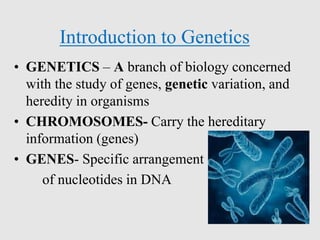
• CHROMOSOMES- Carry the hereditary
information (genes)
• GENES- Specific arrangement
of nucleotides in DNA
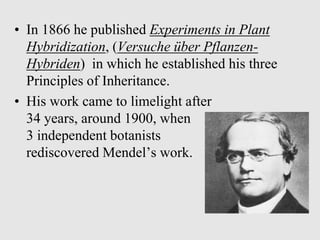
Gregor Johann Mendel
• Austrian Monk, born in 1822
• Son of peasant farmer, was
ordained
priest Order St. Augustine.
• Went to the university of Vienna,
where he
studied botany and learned the
Scientific Method
• Worked with pure lines of peas for
eight years
• In 1866 he published Experiments in Plant
Hybridization, (Versuche über Pflanzen-
Hybriden) in which he established his three
Principles of Inheritance.
• His work came to limelight after
34 years, around 1900, when
3 independent botanists
rediscovered Mendel’s work.
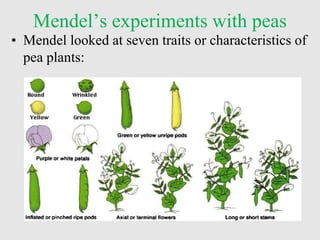
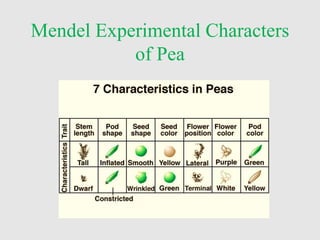
Mendel’s experiments with peas
• Mendel looked at seven traits or characteristics of
pea plants:
GENETICS TERMS
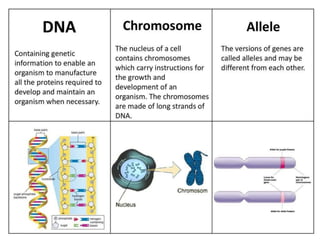
• Gene – Unit of heredity; a section of DNA,
specific nucleotide sequence, encoding a single
protein
• Genome –The entire set of genes in an
organism
• Alleles –Alternative forms of a gene/ two genes
that occupy the same position on homologous
chromosomes and that cover the same trait (like
T and t for height).
• Locus – A fixed location on a strand of DNA
where a gene or one of its alleles is located.
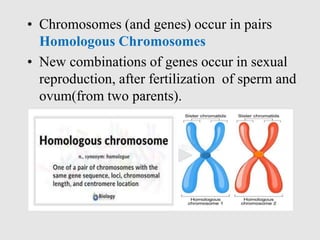
• Chromosomes (and genes) occur in pairs
Homologous Chromosomes
• New combinations of genes occur in sexual
reproduction, after fertilization of sperm and
ovum(from two parents).
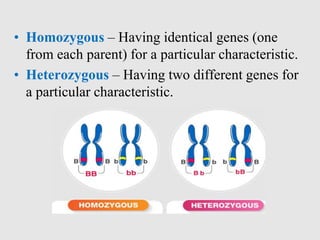
• Homozygous – Having identical genes (one
from each parent) for a particular characteristic.
• Heterozygous – Having two different genes for
a particular characteristic.
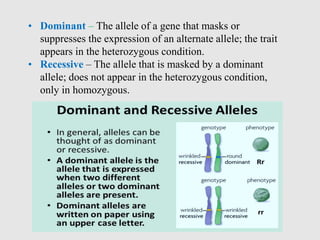
• Dominant – The allele of a gene that masks or
suppresses the expression of an alternate allele; the trait
appears in the heterozygous condition.
• Recessive – The allele that is masked by a dominant
allele; does not appear in the heterozygous condition,
only in homozygous.
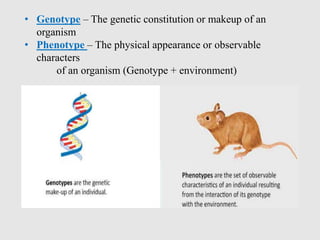
• Genotype – The genetic constitution or makeup of an
organism
• Phenotype – The physical appearance or observable
characters
of an organism (Genotype + environment)
• Monohybrid cross: A genetic cross involving
a single pair of genes (one trait); parents differ
by a single trait.
• P = Parental generation
• F1 = First filial generation; offspring from a
genetic cross.
• F2 = Second filial generation of a genetic cross
Mendel Experimental Characters
of Pea
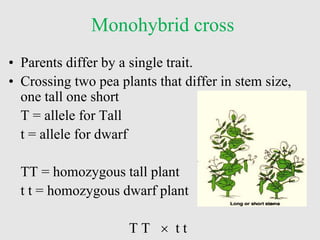
Monohybrid cross
• Parents differ by a single trait.
• Crossing two pea plants that differ in stem size,
one tall one short
T = allele for Tall
t = allele for dwarf
TT = homozygous tall plant
t t = homozygous dwarf plant
T T  t t
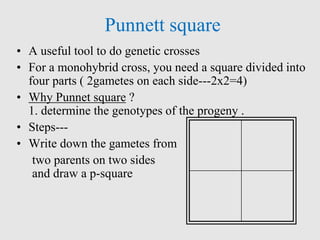
Punnett square
• A useful tool to do genetic crosses
• For a monohybrid cross, you need a square divided into
four parts ( 2gametes on each side---2x2=4)
• Why Punnet square ?
1. determine the genotypes of the progeny .
• Steps---
• Write down the gametes from
two parents on two sides
and draw a p-square
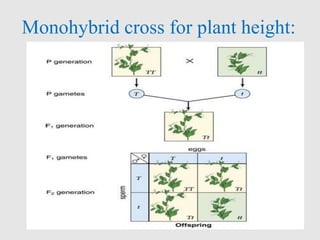
Monohybrid cross for plant height:
T t
(all tall plants)
Punnett square
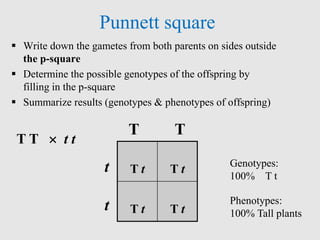
 Write down the gametes from both parents on sides outside
the p-square
 Determine the possible genotypes of the offspring by
filling in the p-square
 Summarize results (genotypes & phenotypes of offspring)
T t T t
T t T t
T T
t
t
Genotypes:
100% T t
Phenotypes:
100% Tall plants
T T  t t
Monohybrid cross: F2 generation
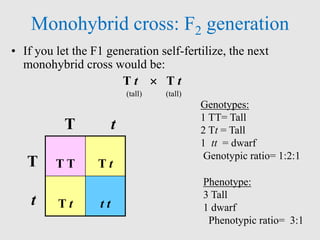
• If you let the F1 generation self-fertilize, the next
monohybrid cross would be:
T t  T t
(tall) (tall)
T T T t
T t t t
T t
T
t
Genotypes:
1 TT= Tall
2 Tt = Tall
1 tt = dwarf
Genotypic ratio= 1:2:1
Phenotype:
3 Tall
1 dwarf
Phenotypic ratio= 3:1
Secret of the Punnett Square
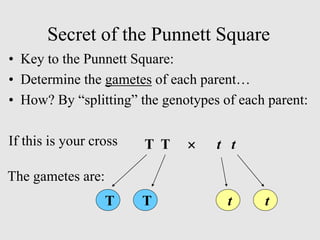
• Key to the Punnett Square:
• Determine the gametes of each parent…
• How? By “splitting” the genotypes of each parent:
If this is your cross T T  t t
T T t t
The gametes are:
If you have another cross…
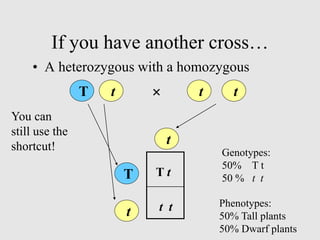
• A heterozygous with a homozygous
T t t t

T
t
t
T t
t t
Genotypes:
50% T t
50 % t t
Phenotypes:
50% Tall plants
50% Dwarf plants
You can
still use the
shortcut!
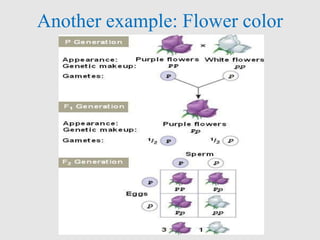
Another example: Flower color
Mendel’s Laws
• 1. Law of Dominance:
One allele masked another, one allele was
dominant over the other in the F1 generation.
• 2. Law of Segregation:
When gametes are formed, the pairs of
hereditary factors (genes) become separated,
so that each sex cell (egg/sperm) receives
only one kind of gene.
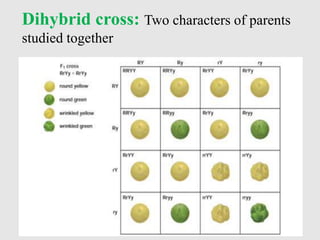
Dihybrid cross: Two characters of parents
studied together
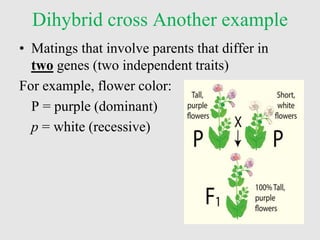
Dihybrid cross Another example
• Matings that involve parents that differ in
two genes (two independent traits)
For example, flower color:
P = purple (dominant)
p = white (recessive)
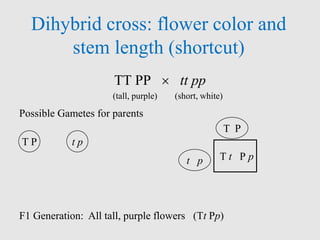
Dihybrid cross: flower color and
stem length (shortcut)
TT PP  tt pp
(tall, purple) (short, white)
Possible Gametes for parents
F1 Generation: All tall, purple flowers (Tt Pp)
T t P p
T P t p
T P
t p
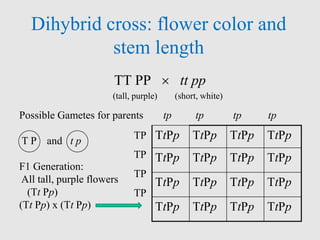
Dihybrid cross: flower color and
stem length
TT PP  tt pp
(tall, purple) (short, white)
Possible Gametes for parents
T P and t p
F1 Generation:
All tall, purple flowers
(Tt Pp)
(Tt Pp) x (Tt Pp)
TtPp TtPp TtPp TtPp
TtPp TtPp TtPp TtPp
TtPp TtPp TtPp TtPp
TtPp TtPp TtPp TtPp
tp tp tp tp
TP
TP
TP
TP
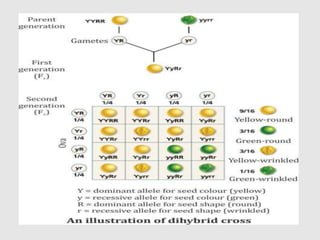
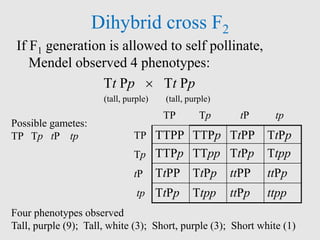
Dihybrid cross F2
If F1 generation is allowed to self pollinate,
Mendel observed 4 phenotypes:
Tt Pp  Tt Pp
(tall, purple) (tall, purple)
Possible gametes:
TP Tp tP tp
Four phenotypes observed
Tall, purple (9); Tall, white (3); Short, purple (3); Short white (1)
TTPP TTPp TtPP TtPp
TTPp TTpp TtPp Ttpp
TtPP TtPp ttPP ttPp
TtPp Ttpp ttPp ttpp
TP Tp tP tp
TP
Tp
tP
tp
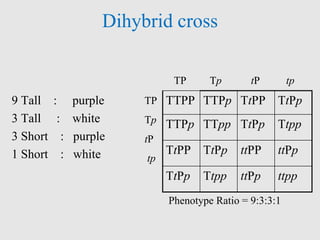
Dihybrid cross
9 Tall : purple
3 Tall : white
3 Short : purple
1 Short : white
TTPP TTPp TtPP TtPp
TTPp TTpp TtPp Ttpp
TtPP TtPp ttPP ttPp
TtPp Ttpp ttPp ttpp
TP Tp tP tp
TP
Tp
tP
tp
Phenotype Ratio = 9:3:3:1
Law of Independent Assortment
• 3. Law of Independent Assortment:
“Members of one gene pair segregate
independently from other gene pairs during
gamete formation”
Mutation
 Sudden change in genetic makeup or DNA
sequence.
 Mutations can result from DNA copying
mistakes made during cell division, exposure to
ionizing radiation, exposure to chemicals called
mutagens, or infection by viruses.
 Cystic fibrosis, Sickle cell anemia
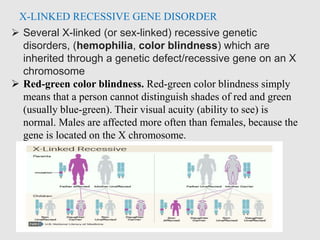
 Several X-linked (or sex-linked) recessive genetic
disorders, (hemophilia, color blindness) which are
inherited through a genetic defect/recessive gene on an X
chromosome
 Red-green color blindness. Red-green color blindness simply
means that a person cannot distinguish shades of red and green
(usually blue-green). Their visual acuity (ability to see) is
normal. Males are affected more often than females, because the
gene is located on the X chromosome.
X-LINKED RECESSIVE GENE DISORDER
Summary of Genetics
• Chromosomes carry hereditary info (genes)
• Chromosomes (and genes) occur in pairs
• New combinations of genes occur in sexual
reproduction
• Monohybrid vs. Dihybrid crosses
• Mendel’s Principles:
– Dominance: one allele masks another
– Segregation: genes become separated in gamete formation
– Independent Assortment: Members of one gene pair
segregate independently from other gene pairs during gamete
formation
Thanks!

Mendelian genetics

  • 1.
  • 2.
    • Introduction toGenetics and heredity • Gregor Mendel – a brief sketch • Genetic terminology • Monohybrid crosses • Patterns of inheritance • Dihybrid crosses • Test cross
  • 3.
    Introduction to Genetics •GENETICS – A branch of biology concerned with the study of genes, genetic variation, and heredity in organisms • CHROMOSOMES- Carry the hereditary information (genes) • GENES- Specific arrangement of nucleotides in DNA
  • 4.
    Gregor Johann Mendel •Austrian Monk, born in 1822 • Son of peasant farmer, was ordained priest Order St. Augustine. • Went to the university of Vienna, where he studied botany and learned the Scientific Method • Worked with pure lines of peas for eight years
  • 5.
    • In 1866he published Experiments in Plant Hybridization, (Versuche über Pflanzen- Hybriden) in which he established his three Principles of Inheritance. • His work came to limelight after 34 years, around 1900, when 3 independent botanists rediscovered Mendel’s work.
  • 6.
    Mendel’s experiments withpeas • Mendel looked at seven traits or characteristics of pea plants:
  • 7.
    GENETICS TERMS • Gene– Unit of heredity; a section of DNA, specific nucleotide sequence, encoding a single protein • Genome –The entire set of genes in an organism • Alleles –Alternative forms of a gene/ two genes that occupy the same position on homologous chromosomes and that cover the same trait (like T and t for height). • Locus – A fixed location on a strand of DNA where a gene or one of its alleles is located.
  • 9.
    • Chromosomes (andgenes) occur in pairs Homologous Chromosomes • New combinations of genes occur in sexual reproduction, after fertilization of sperm and ovum(from two parents).
  • 10.
    • Homozygous –Having identical genes (one from each parent) for a particular characteristic. • Heterozygous – Having two different genes for a particular characteristic.
  • 11.
    • Dominant –The allele of a gene that masks or suppresses the expression of an alternate allele; the trait appears in the heterozygous condition. • Recessive – The allele that is masked by a dominant allele; does not appear in the heterozygous condition, only in homozygous.
  • 12.
    • Genotype –The genetic constitution or makeup of an organism • Phenotype – The physical appearance or observable characters of an organism (Genotype + environment)
  • 13.
    • Monohybrid cross:A genetic cross involving a single pair of genes (one trait); parents differ by a single trait. • P = Parental generation • F1 = First filial generation; offspring from a genetic cross. • F2 = Second filial generation of a genetic cross
  • 14.
  • 15.
    Monohybrid cross • Parentsdiffer by a single trait. • Crossing two pea plants that differ in stem size, one tall one short T = allele for Tall t = allele for dwarf TT = homozygous tall plant t t = homozygous dwarf plant T T  t t
  • 16.
    Punnett square • Auseful tool to do genetic crosses • For a monohybrid cross, you need a square divided into four parts ( 2gametes on each side---2x2=4) • Why Punnet square ? 1. determine the genotypes of the progeny . • Steps--- • Write down the gametes from two parents on two sides and draw a p-square
  • 17.
    Monohybrid cross forplant height: T t (all tall plants)
  • 18.
    Punnett square  Writedown the gametes from both parents on sides outside the p-square  Determine the possible genotypes of the offspring by filling in the p-square  Summarize results (genotypes & phenotypes of offspring) T t T t T t T t T T t t Genotypes: 100% T t Phenotypes: 100% Tall plants T T  t t
  • 19.
    Monohybrid cross: F2generation • If you let the F1 generation self-fertilize, the next monohybrid cross would be: T t  T t (tall) (tall) T T T t T t t t T t T t Genotypes: 1 TT= Tall 2 Tt = Tall 1 tt = dwarf Genotypic ratio= 1:2:1 Phenotype: 3 Tall 1 dwarf Phenotypic ratio= 3:1
  • 20.
    Secret of thePunnett Square • Key to the Punnett Square: • Determine the gametes of each parent… • How? By “splitting” the genotypes of each parent: If this is your cross T T  t t T T t t The gametes are:
  • 21.
    If you haveanother cross… • A heterozygous with a homozygous T t t t  T t t T t t t Genotypes: 50% T t 50 % t t Phenotypes: 50% Tall plants 50% Dwarf plants You can still use the shortcut!
  • 22.
  • 23.
    Mendel’s Laws • 1.Law of Dominance: One allele masked another, one allele was dominant over the other in the F1 generation. • 2. Law of Segregation: When gametes are formed, the pairs of hereditary factors (genes) become separated, so that each sex cell (egg/sperm) receives only one kind of gene.
  • 24.
    Dihybrid cross: Twocharacters of parents studied together
  • 26.
    Dihybrid cross Anotherexample • Matings that involve parents that differ in two genes (two independent traits) For example, flower color: P = purple (dominant) p = white (recessive)
  • 27.
    Dihybrid cross: flowercolor and stem length (shortcut) TT PP  tt pp (tall, purple) (short, white) Possible Gametes for parents F1 Generation: All tall, purple flowers (Tt Pp) T t P p T P t p T P t p
  • 28.
    Dihybrid cross: flowercolor and stem length TT PP  tt pp (tall, purple) (short, white) Possible Gametes for parents T P and t p F1 Generation: All tall, purple flowers (Tt Pp) (Tt Pp) x (Tt Pp) TtPp TtPp TtPp TtPp TtPp TtPp TtPp TtPp TtPp TtPp TtPp TtPp TtPp TtPp TtPp TtPp tp tp tp tp TP TP TP TP
  • 29.
    Dihybrid cross F2 IfF1 generation is allowed to self pollinate, Mendel observed 4 phenotypes: Tt Pp  Tt Pp (tall, purple) (tall, purple) Possible gametes: TP Tp tP tp Four phenotypes observed Tall, purple (9); Tall, white (3); Short, purple (3); Short white (1) TTPP TTPp TtPP TtPp TTPp TTpp TtPp Ttpp TtPP TtPp ttPP ttPp TtPp Ttpp ttPp ttpp TP Tp tP tp TP Tp tP tp
  • 30.
    Dihybrid cross 9 Tall: purple 3 Tall : white 3 Short : purple 1 Short : white TTPP TTPp TtPP TtPp TTPp TTpp TtPp Ttpp TtPP TtPp ttPP ttPp TtPp Ttpp ttPp ttpp TP Tp tP tp TP Tp tP tp Phenotype Ratio = 9:3:3:1
  • 31.
    Law of IndependentAssortment • 3. Law of Independent Assortment: “Members of one gene pair segregate independently from other gene pairs during gamete formation”
  • 32.
    Mutation  Sudden changein genetic makeup or DNA sequence.  Mutations can result from DNA copying mistakes made during cell division, exposure to ionizing radiation, exposure to chemicals called mutagens, or infection by viruses.  Cystic fibrosis, Sickle cell anemia
  • 33.
     Several X-linked(or sex-linked) recessive genetic disorders, (hemophilia, color blindness) which are inherited through a genetic defect/recessive gene on an X chromosome  Red-green color blindness. Red-green color blindness simply means that a person cannot distinguish shades of red and green (usually blue-green). Their visual acuity (ability to see) is normal. Males are affected more often than females, because the gene is located on the X chromosome. X-LINKED RECESSIVE GENE DISORDER
  • 34.
    Summary of Genetics •Chromosomes carry hereditary info (genes) • Chromosomes (and genes) occur in pairs • New combinations of genes occur in sexual reproduction • Monohybrid vs. Dihybrid crosses • Mendel’s Principles: – Dominance: one allele masks another – Segregation: genes become separated in gamete formation – Independent Assortment: Members of one gene pair segregate independently from other gene pairs during gamete formation
  • 35.