NORDITE Conference 2011

                                                                        Quality Hotel 33, Oslo
                                                                              June 14th, 2011


        MEMS Based Reconfigurable RF Systems for Software
            Radio, Wireless Sensors, and MMID Technology
                                              (MOSART)
                                                                                 Jussi Varis

                                                  VTT Technical Research Centre of Finland

                                                 Sweden, FOI: R. Malmqvist, C. Samuelsson
                                              Sweden, Uppsala University: A. Rydberg, X. Hu
Finland, VTT: J. Varis, P. Rantakari, J. Säily, M. Lahti, M. Kaunisto, J. Saijets, and T. Vähä-
                                                                                        Heikkilä
Outline

1. Project overview
2. Motivation and applications
3. Produced devices and modules
    •   RF MEMS Devices
    •   Antennas on LTCC
    •   LTCC packaged RF MEMS devices
    •   Sub-system modules
4. Related on-going efforts
5. Benefits from MOSART
6. Summary


        NORDITE Conference 2011, June 14th, 2011             2
Project overview


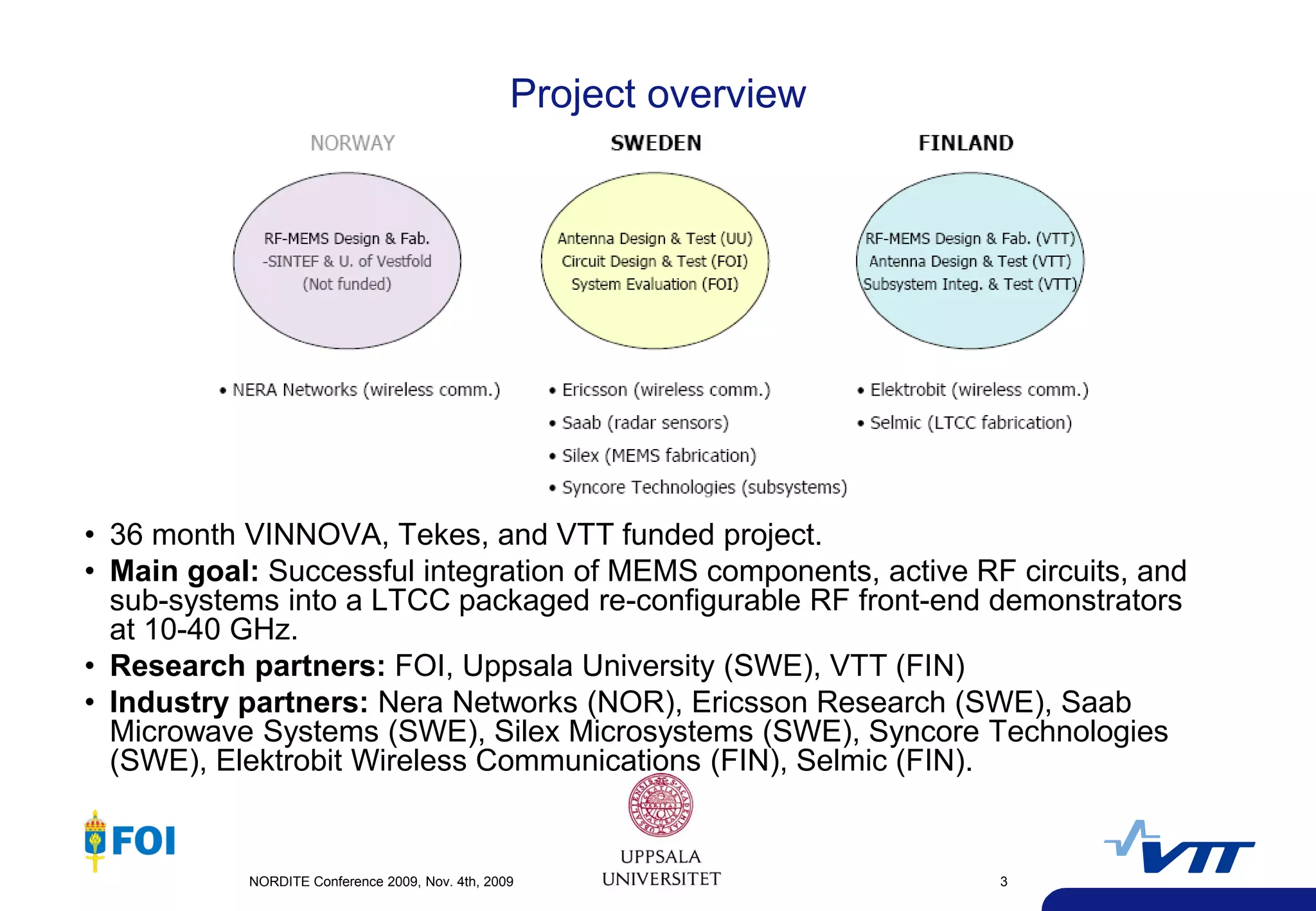
• 36 month VINNOVA, Tekes, and VTT funded project.
• Main goal: Successful integration of MEMS components, active RF circuits, and
  sub-systems into a LTCC packaged re-configurable RF front-end demonstrators
  at 10-40 GHz.
• Research partners: FOI, Uppsala University (SWE), VTT (FIN)
• Industry partners: Nera Networks (NOR), Ericsson Research (SWE), Saab
  Microwave Systems (SWE), Silex Microsystems (SWE), Syncore Technologies
  (SWE), Elektrobit Wireless Communications (FIN), Selmic (FIN).


           NORDITE Conference 2009, Nov. 4th, 2009                  3
Motivation


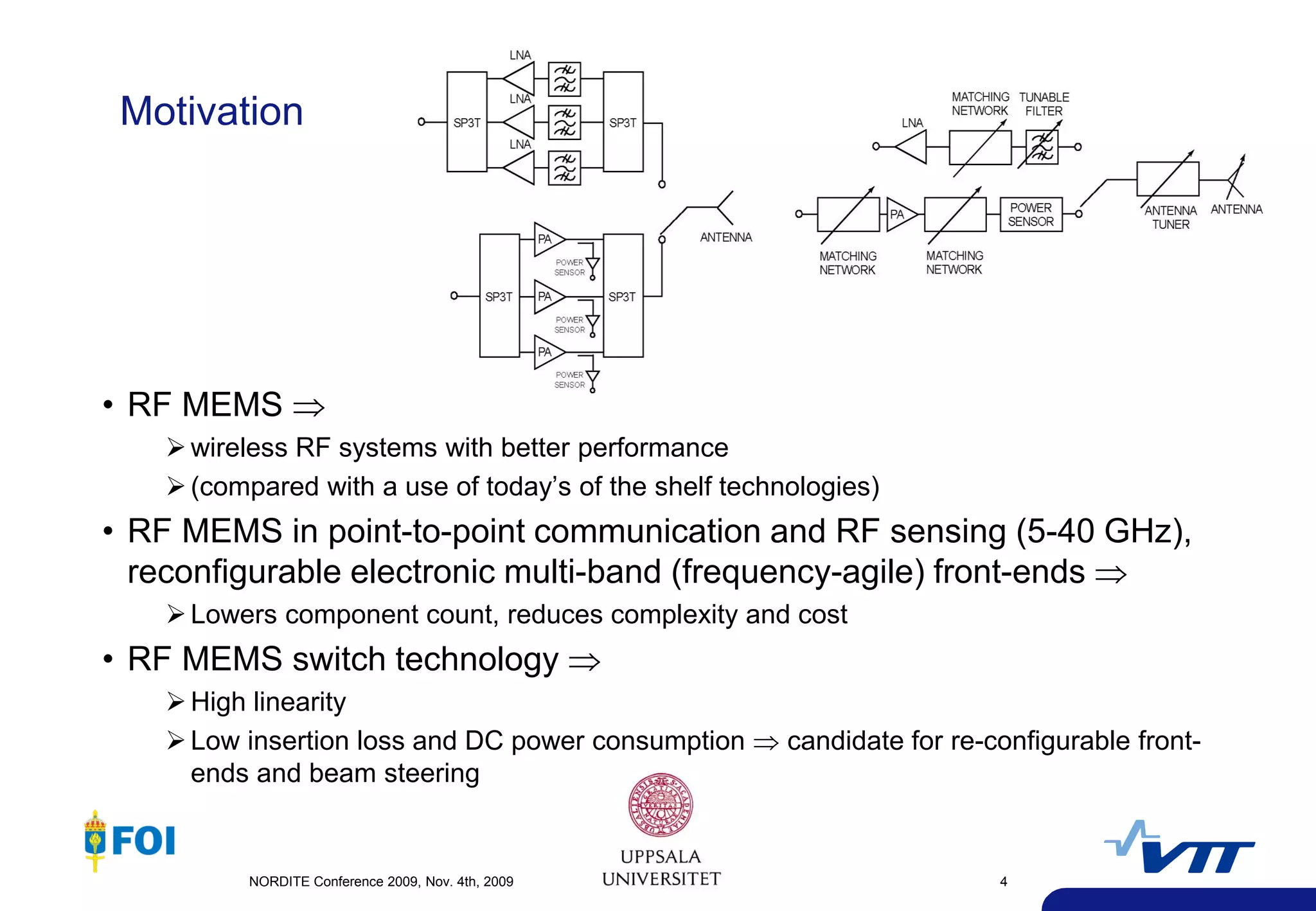
• RF MEMS 
     wireless RF systems with better performance
     (compared with a use of today’s of the shelf technologies)
• RF MEMS in point-to-point communication and RF sensing (5-40 GHz),
  reconfigurable electronic multi-band (frequency-agile) front-ends 
     Lowers component count, reduces complexity and cost
• RF MEMS switch technology 
     High linearity
     Low insertion loss and DC power consumption  candidate for re-configurable front-
      ends and beam steering


           NORDITE Conference 2009, Nov. 4th, 2009                     4
Applications
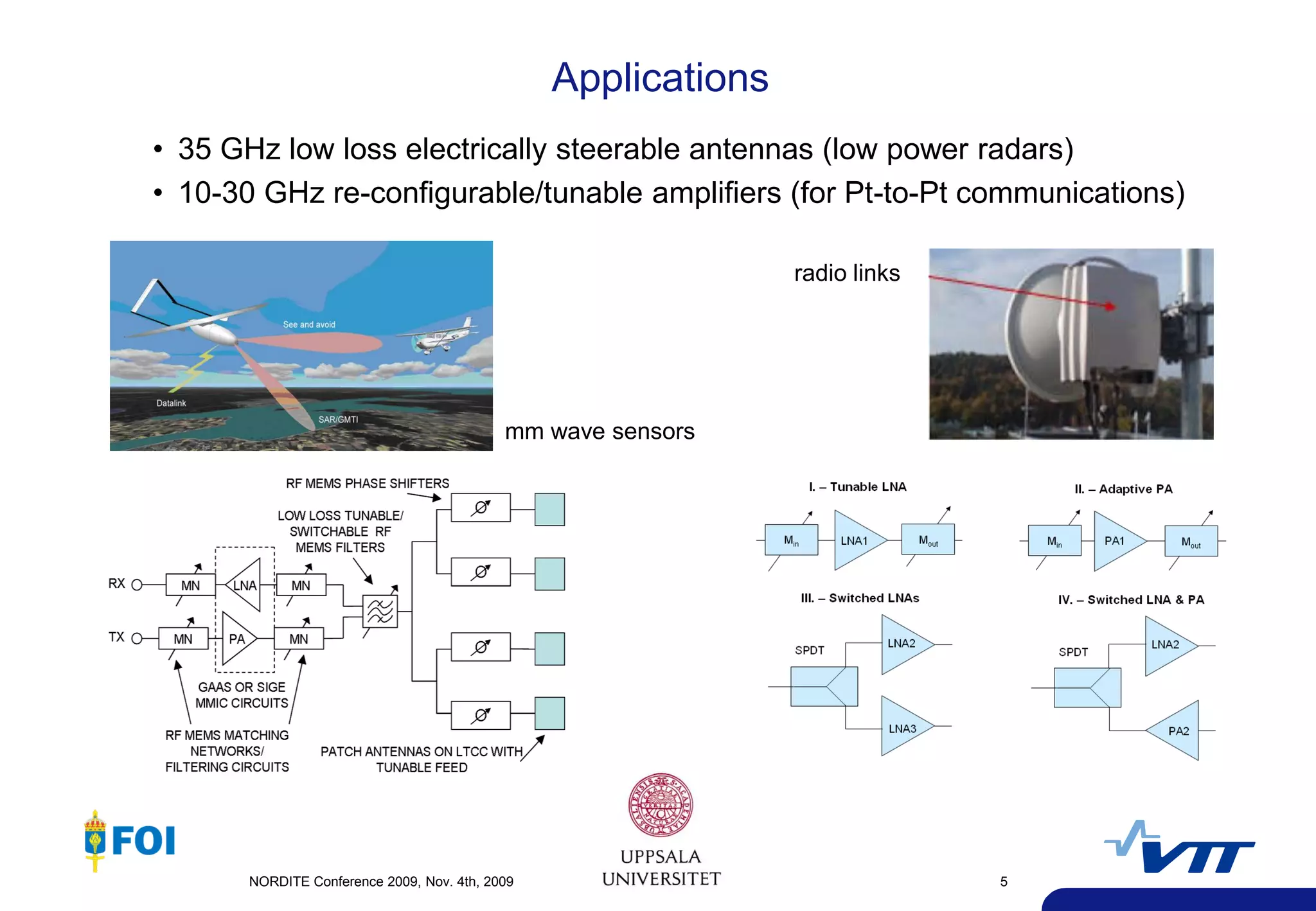
• 35 GHz low loss electrically steerable antennas (low power radars)
• 10-30 GHz re-configurable/tunable amplifiers (for Pt-to-Pt communications)

                                                                radio links


                                            mm wave sensors


       NORDITE Conference 2009, Nov. 4th, 2009                                5
MOSART RF MEMS devices


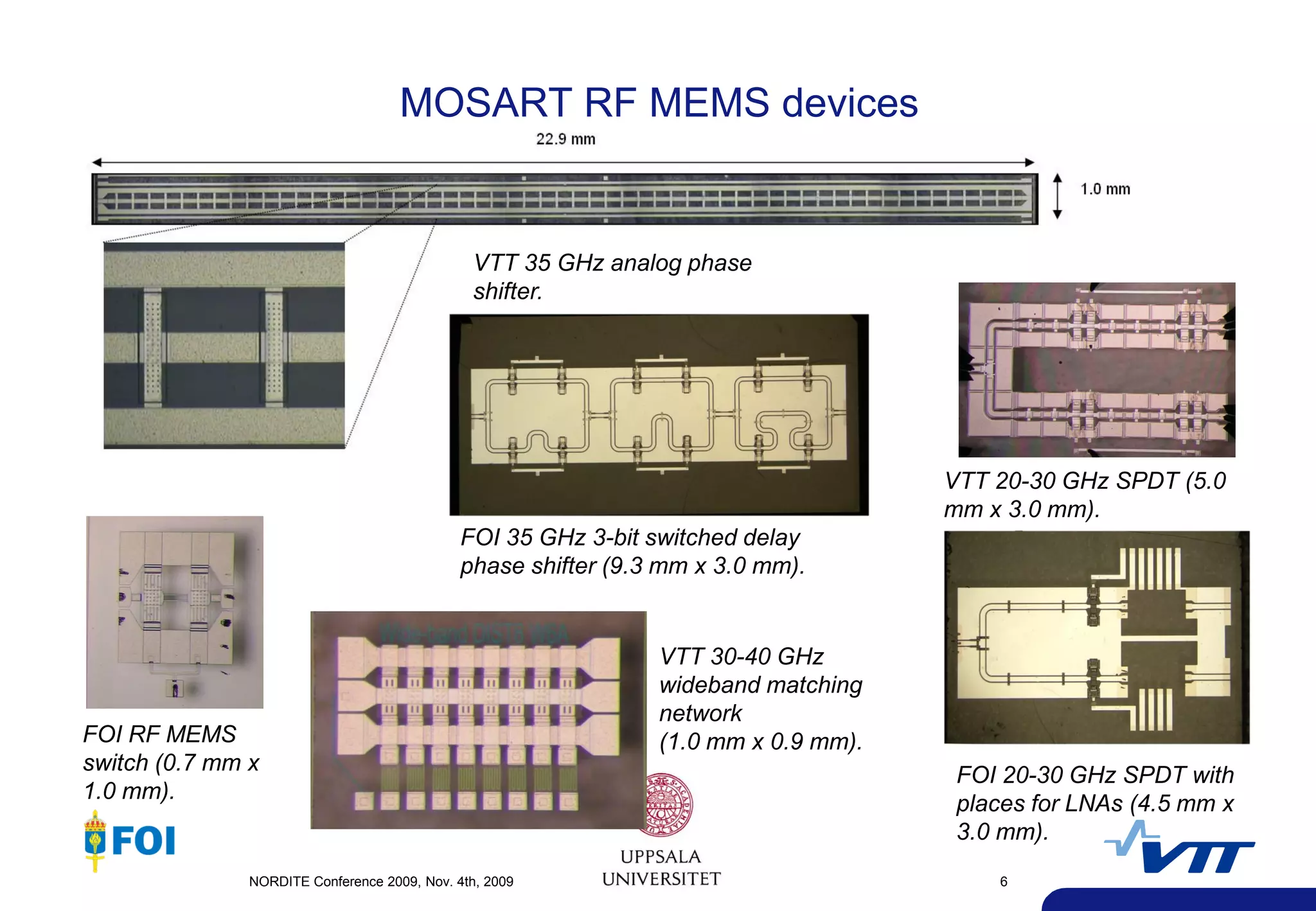
                                               VTT 35 GHz analog phase
                                               shifter.


                                                                                     VTT 20-30 GHz SPDT (5.0
                                                                                     mm x 3.0 mm).
                                              FOI 35 GHz 3-bit switched delay
                                              phase shifter (9.3 mm x 3.0 mm).


                                                                VTT 30-40 GHz
                                                                wideband matching
                                                                network
FOI RF MEMS                                                     (1.0 mm x 0.9 mm).
switch (0.7 mm x
                                                                                      FOI 20-30 GHz SPDT with
1.0 mm).
                                                                                      places for LNAs (4.5 mm x
                                                                                      3.0 mm).
               NORDITE Conference 2009, Nov. 4th, 2009                                   6
MOSART antennas on LTCC


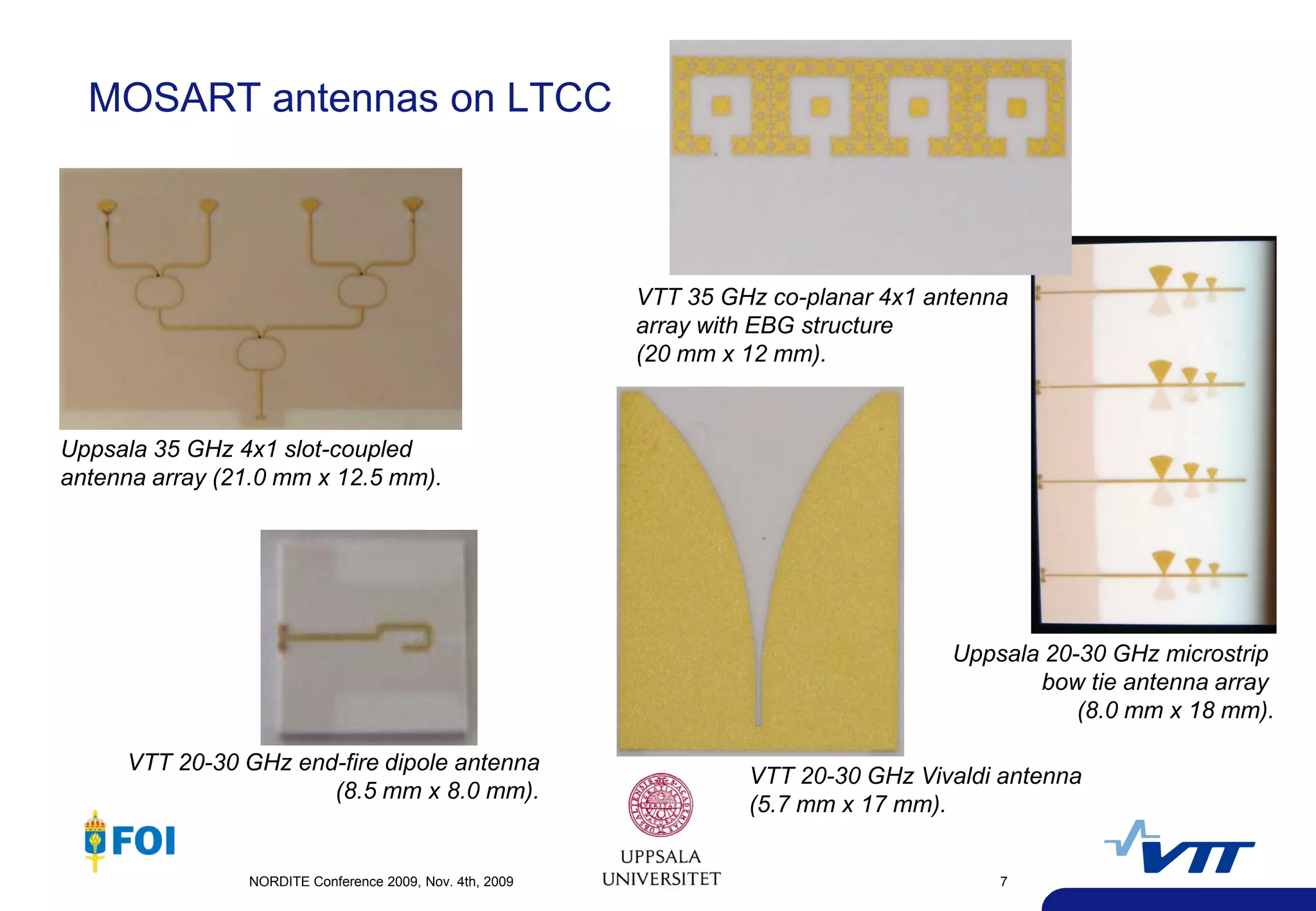
                                                          VTT 35 GHz co-planar 4x1 antenna
                                                          array with EBG structure
                                                          (20 mm x 12 mm).


Uppsala 35 GHz 4x1 slot-coupled
antenna array (21.0 mm x 12.5 mm).


                                                                                     Uppsala 20-30 GHz microstrip
                                                                                            bow tie antenna array
                                                                                                (8.0 mm x 18 mm).

     VTT 20-30 GHz end-fire dipole antenna
                                                                   VTT 20-30 GHz Vivaldi antenna
                      (8.5 mm x 8.0 mm).
                                                                   (5.7 mm x 17 mm).


                NORDITE Conference 2009, Nov. 4th, 2009                                  7
MOSART LTCC packaged RF MEMS devices


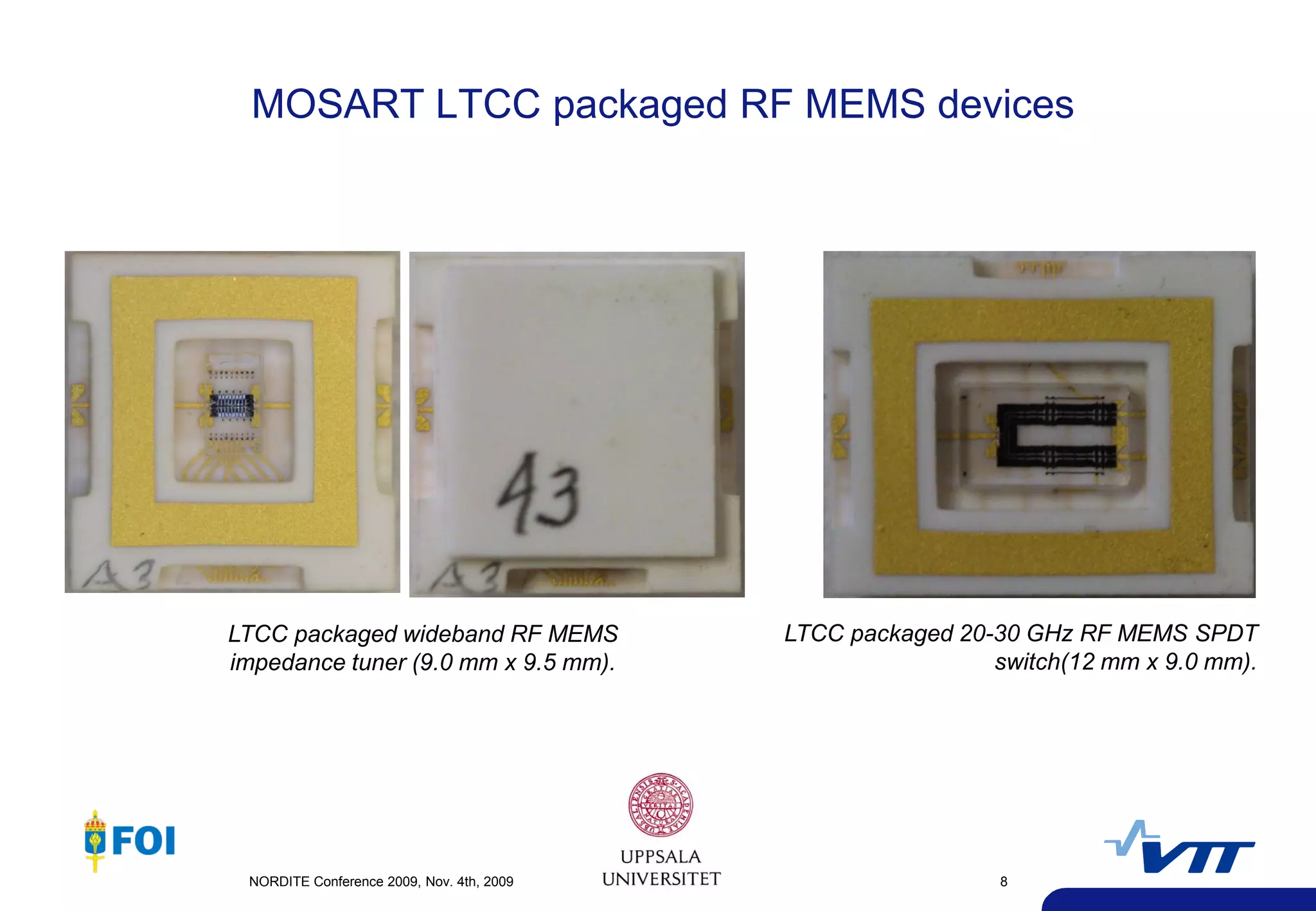
LTCC packaged wideband RF MEMS             LTCC packaged 20-30 GHz RF MEMS SPDT
impedance tuner (9.0 mm x 9.5 mm).                          switch(12 mm x 9.0 mm).


 NORDITE Conference 2009, Nov. 4th, 2009                     8
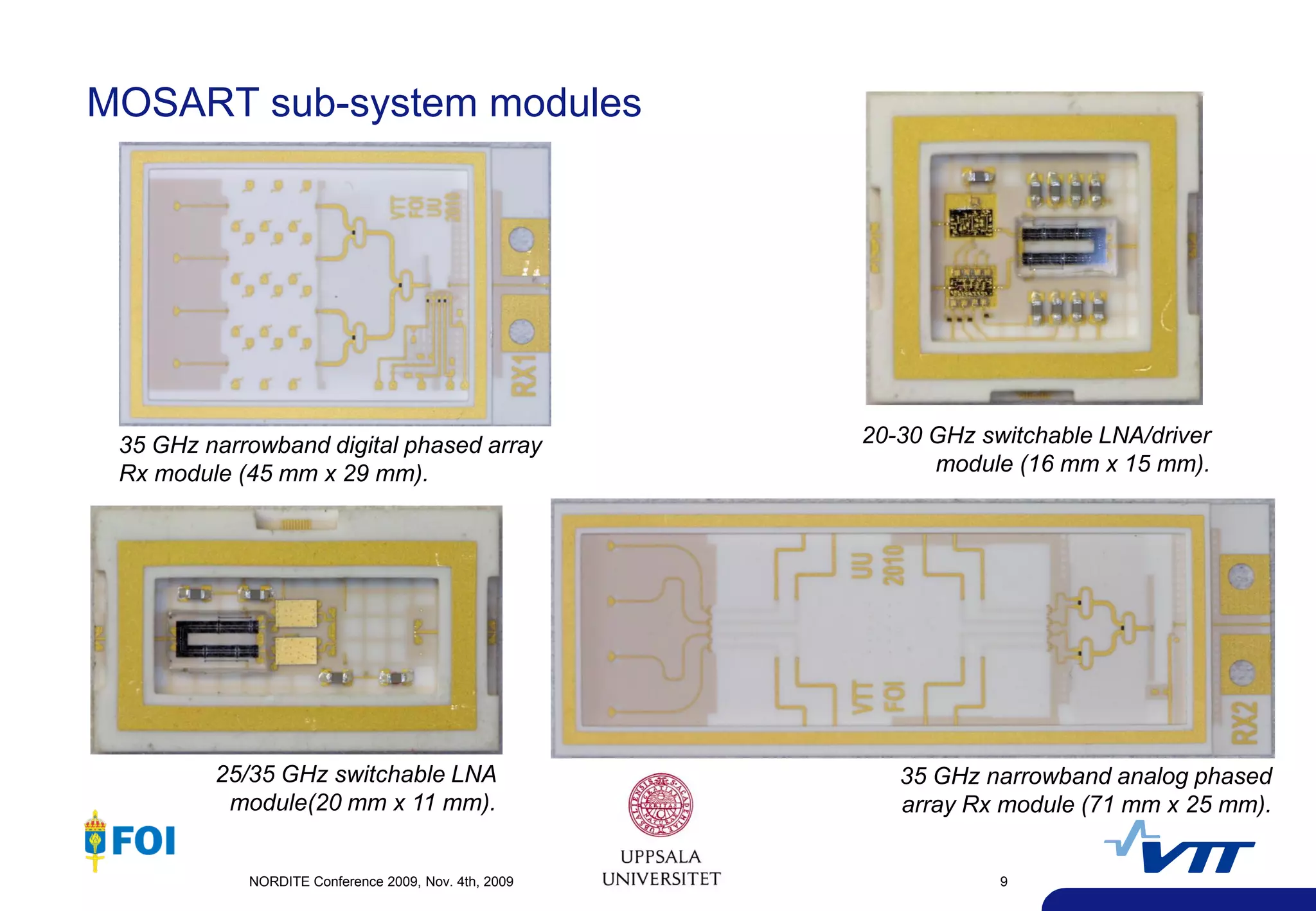
MOSART sub-system modules


 35 GHz narrowband digital phased array               20-30 GHz switchable LNA/driver
 Rx module (45 mm x 29 mm).                                 module (16 mm x 15 mm).


         25/35 GHz switchable LNA                        35 GHz narrowband analog phased
          module(20 mm x 11 mm).                         array Rx module (71 mm x 25 mm).


            NORDITE Conference 2009, Nov. 4th, 2009               9
Main remaining challenges


• RF MEMS reliability
     Process quality (residuals, layer thicknesses).
     Design parameter stability (MEMS switch gap height, capacitance ratio, pull-in
      voltage)
     Environmental susceptibility (temperature, mechanical, charging, etc.)

• Integration
     Flip-chip bonding vs. ribbon bonding
     Alignment accuracy on LTCC
     MEMS temperature tolerance in various integration and post integration
      phases.


     NORDITE Conference 2009, Nov. 4th, 2009                      10
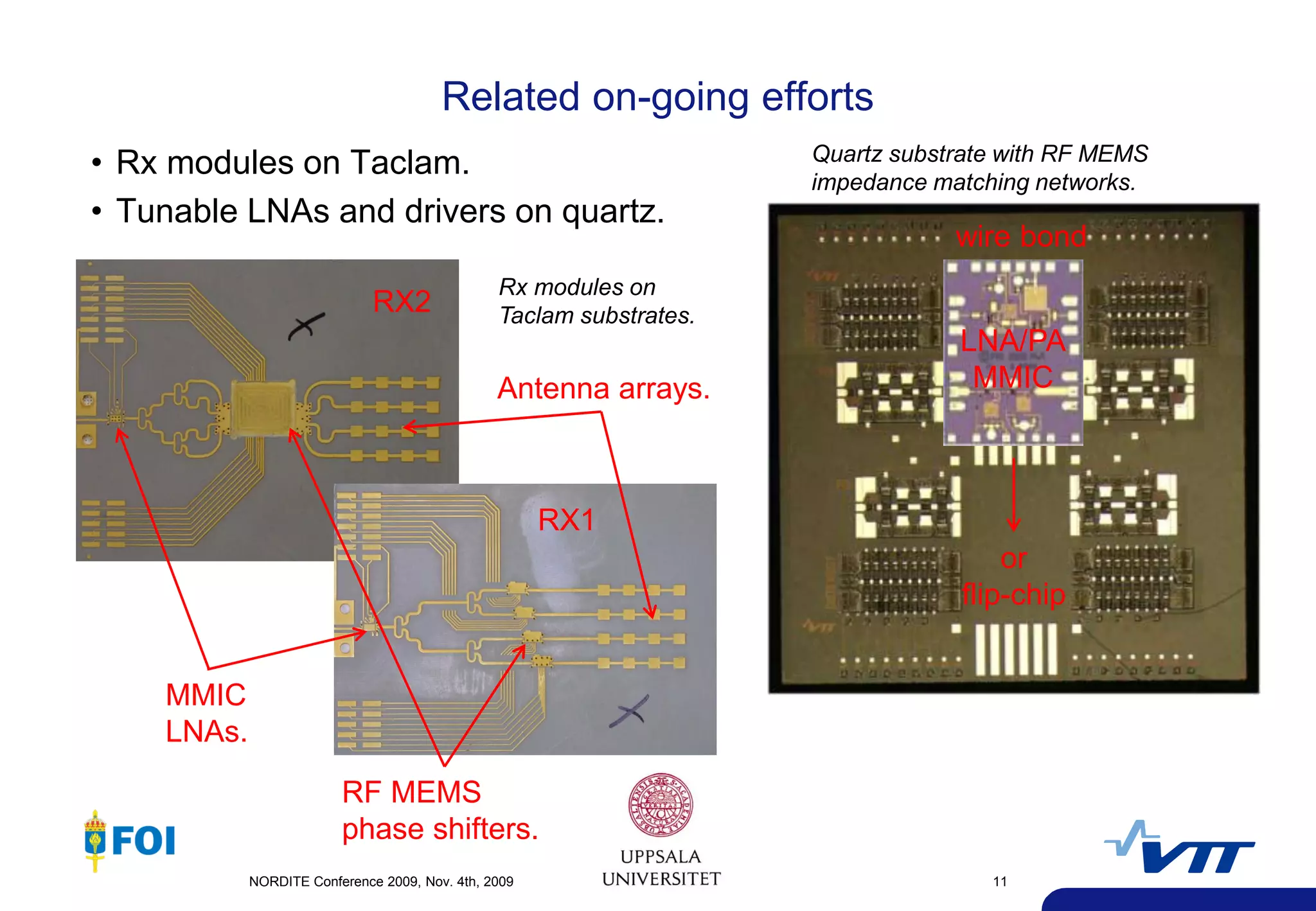
Related on-going efforts
• Rx modules on Taclam.                                              Quartz substrate with RF MEMS
                                                                     impedance matching networks.
• Tunable LNAs and drivers on quartz.
                                                                                 wire bond
                                                Rx modules on
                              RX2               Taclam substrates.
                                                                                 LNA/PA
                                                Antenna arrays.                   MMIC


                                                      RX1
                                                                                     or
                                                                                 flip-chip


    MMIC
    LNAs.

                         RF MEMS
                         phase shifters.
            NORDITE Conference 2009, Nov. 4th, 2009                                 11
Benefits from MOSART

• Nordic countries and Europe have in place technologies to produce
  packaged re-configurable radio modules.
     RF MEMS
     LTCC
     MMICs


• Benefits to industry partners in MOSART
     Saab: electrically steerable phased array front-ends for sensor applications
     Nera, Ericsson, Elektrobit: re-configurable/tunable radio sub-systems for Pt-to-Pt
      applications
     Syncore: novel integated sub-systems
     Selmic: micro and mm wave frequency LTCC module processing
     Silex: micro and mm wave RF MEMS processing


       NORDITE Conference 2009, Nov. 4th, 2009                        12
Benefits from MOSART

• Expanding European frontiers in RF MEMS and LTCC related
  development
    MEMS-4-MMIC (EU FP7, 2008-2011, on-chip integration of MMIC and RF
     MEMS): OMMIC and CNRS-IEMN (FRA), FOI and Saab (SWE), IMST (GER),
     IMT (ROM), VTT (FIN)
    SATURNE (EU FP7, 2010-2013, GaN and RF MEMS for space applications):
     UU (SWE), Thales and CNRS-IEMN (FRA), EADS (GER), Thales Alenia
     Space (ITA), TopGAN (POL)
    MiniMEMS (EU FP7, 2010-2013, miniaturised RF MEMS for airport and
     weather radar systems): ÅAC Microtec and UU (SWE), Thales and CNRS-
     IEMN (FRA), Vaisala (FIN)
    MEMSMOD (ESA and participants, 2010-2012, LTCC packaged RF MEMS
     switch reliability and environmental testing and assessment): EADS (GER),
     Selmic and VTT (FIN)


      NORDITE Conference 2009, Nov. 4th, 2009                   13
Towards commercial systems
                                          • RF MEMS switches and sub-systems
                                            (circuits & antennas) have been
                                            demonstrated with state-of-the-art
                                            performance from DC-100 GHz and beyond
                                          • Enabling technology for miniaturized, low-
                                            power high performance re-configurable RF
                                            systems (e.g. for wireless comm., space,
                                            security & defense)
                                          • High reliability (switch cycles) and
                                            fabrication yields needed for a higher market
                                            penetration
                                          • Today, just a few commercial vendors
                                            offering RF MEMS as packaged (discrete)
                                            components: RadantMEMS (US), OMRON
                                            (JPN), DELFMEMS (FR)
                                          • A few MMIC foundries developing RF-
                                            MEMS: OMMIC (FR) – GaAs, IHP (GE) –
                                            SiGe, Selex (IT) – GaN
                                          • RF-MEMS technology in the US (e.g.
                                            Radant) has demonstrated a much higher
                                            TRL than what is currently available in
                                            Europe.


NORDITE Conference 2009, Nov. 4th, 2009                           14
Summary

• MOSART has demonstrated
    RF MEMS matching networks, phase shifters and SPDT switches
    Antenna arrays and wideband antennas on LTCC
    Module concepts for electronically steerable or re-configurable radio systems
    Processing technologies for manufacturing RF MEMS devices and LTCC modules.


• MOSART has
    Brought together a large number of Nordic companies and research institutes.
    Utilised synergy (for example MMIC design and manufacturing) from other related on-
     going projects and networks.
    Expanded RF MEMS and LTCC related development to include more Nordic and
     European companies and institutes in Nordic, EU, and ESA related projects.


• Challenges remain
    RF MEMS reliability and stability
    Integration related issues.


          NORDITE Conference 2009, Nov. 4th, 2009                     15
Contact information

• Project manager and national contact in Finland:
    Dr. Jussi Varis, VTT, jussi.varis@vtt.fi, tel: +358-40-569 4089,
     fax: +358-20-722 7013

• National contact in Sweden:
    Prof. Anders Rydberg, Uppsala University,
     anders.rydberg@angstrom.uu.se, tel: +46-18-471 3228, fax:
     +46-18-555096

• Chairman of the Steering Group:
     Dr. Robert Malmqvist, FOI Swedish Defense Research
     Agency, robert.malmqvist@foi.se, tel: +46-13-378 353, fax:
     +46-13-378 519


       NORDITE Conference 2009, Nov. 4th, 2009                 16

MEMS Based Reconfigurable RF Systems for SoftwareRadio, Wireless Sensors, and MMID Technology, Jussi Varis, VTT

  • 1.
    NORDITE Conference 2011 Quality Hotel 33, Oslo June 14th, 2011 MEMS Based Reconfigurable RF Systems for Software Radio, Wireless Sensors, and MMID Technology (MOSART) Jussi Varis VTT Technical Research Centre of Finland Sweden, FOI: R. Malmqvist, C. Samuelsson Sweden, Uppsala University: A. Rydberg, X. Hu Finland, VTT: J. Varis, P. Rantakari, J. Säily, M. Lahti, M. Kaunisto, J. Saijets, and T. Vähä- Heikkilä
  • 2.
    Outline 1. Project overview 2.Motivation and applications 3. Produced devices and modules • RF MEMS Devices • Antennas on LTCC • LTCC packaged RF MEMS devices • Sub-system modules 4. Related on-going efforts 5. Benefits from MOSART 6. Summary NORDITE Conference 2011, June 14th, 2011 2
  • 3.
    Project overview • 36month VINNOVA, Tekes, and VTT funded project. • Main goal: Successful integration of MEMS components, active RF circuits, and sub-systems into a LTCC packaged re-configurable RF front-end demonstrators at 10-40 GHz. • Research partners: FOI, Uppsala University (SWE), VTT (FIN) • Industry partners: Nera Networks (NOR), Ericsson Research (SWE), Saab Microwave Systems (SWE), Silex Microsystems (SWE), Syncore Technologies (SWE), Elektrobit Wireless Communications (FIN), Selmic (FIN). NORDITE Conference 2009, Nov. 4th, 2009 3
  • 4.
    Motivation • RF MEMS  wireless RF systems with better performance  (compared with a use of today’s of the shelf technologies) • RF MEMS in point-to-point communication and RF sensing (5-40 GHz), reconfigurable electronic multi-band (frequency-agile) front-ends   Lowers component count, reduces complexity and cost • RF MEMS switch technology   High linearity  Low insertion loss and DC power consumption  candidate for re-configurable front- ends and beam steering NORDITE Conference 2009, Nov. 4th, 2009 4
  • 5.
    Applications • 35 GHzlow loss electrically steerable antennas (low power radars) • 10-30 GHz re-configurable/tunable amplifiers (for Pt-to-Pt communications) radio links mm wave sensors NORDITE Conference 2009, Nov. 4th, 2009 5
  • 6.
    MOSART RF MEMSdevices VTT 35 GHz analog phase shifter. VTT 20-30 GHz SPDT (5.0 mm x 3.0 mm). FOI 35 GHz 3-bit switched delay phase shifter (9.3 mm x 3.0 mm). VTT 30-40 GHz wideband matching network FOI RF MEMS (1.0 mm x 0.9 mm). switch (0.7 mm x FOI 20-30 GHz SPDT with 1.0 mm). places for LNAs (4.5 mm x 3.0 mm). NORDITE Conference 2009, Nov. 4th, 2009 6
  • 7.
    MOSART antennas onLTCC VTT 35 GHz co-planar 4x1 antenna array with EBG structure (20 mm x 12 mm). Uppsala 35 GHz 4x1 slot-coupled antenna array (21.0 mm x 12.5 mm). Uppsala 20-30 GHz microstrip bow tie antenna array (8.0 mm x 18 mm). VTT 20-30 GHz end-fire dipole antenna VTT 20-30 GHz Vivaldi antenna (8.5 mm x 8.0 mm). (5.7 mm x 17 mm). NORDITE Conference 2009, Nov. 4th, 2009 7
  • 8.
    MOSART LTCC packagedRF MEMS devices LTCC packaged wideband RF MEMS LTCC packaged 20-30 GHz RF MEMS SPDT impedance tuner (9.0 mm x 9.5 mm). switch(12 mm x 9.0 mm). NORDITE Conference 2009, Nov. 4th, 2009 8
  • 9.
    MOSART sub-system modules 35 GHz narrowband digital phased array 20-30 GHz switchable LNA/driver Rx module (45 mm x 29 mm). module (16 mm x 15 mm). 25/35 GHz switchable LNA 35 GHz narrowband analog phased module(20 mm x 11 mm). array Rx module (71 mm x 25 mm). NORDITE Conference 2009, Nov. 4th, 2009 9
  • 10.
    Main remaining challenges •RF MEMS reliability  Process quality (residuals, layer thicknesses).  Design parameter stability (MEMS switch gap height, capacitance ratio, pull-in voltage)  Environmental susceptibility (temperature, mechanical, charging, etc.) • Integration  Flip-chip bonding vs. ribbon bonding  Alignment accuracy on LTCC  MEMS temperature tolerance in various integration and post integration phases. NORDITE Conference 2009, Nov. 4th, 2009 10
  • 11.
    Related on-going efforts •Rx modules on Taclam. Quartz substrate with RF MEMS impedance matching networks. • Tunable LNAs and drivers on quartz. wire bond Rx modules on RX2 Taclam substrates. LNA/PA Antenna arrays. MMIC RX1 or flip-chip MMIC LNAs. RF MEMS phase shifters. NORDITE Conference 2009, Nov. 4th, 2009 11
  • 12.
    Benefits from MOSART •Nordic countries and Europe have in place technologies to produce packaged re-configurable radio modules.  RF MEMS  LTCC  MMICs • Benefits to industry partners in MOSART  Saab: electrically steerable phased array front-ends for sensor applications  Nera, Ericsson, Elektrobit: re-configurable/tunable radio sub-systems for Pt-to-Pt applications  Syncore: novel integated sub-systems  Selmic: micro and mm wave frequency LTCC module processing  Silex: micro and mm wave RF MEMS processing NORDITE Conference 2009, Nov. 4th, 2009 12
  • 13.
    Benefits from MOSART •Expanding European frontiers in RF MEMS and LTCC related development  MEMS-4-MMIC (EU FP7, 2008-2011, on-chip integration of MMIC and RF MEMS): OMMIC and CNRS-IEMN (FRA), FOI and Saab (SWE), IMST (GER), IMT (ROM), VTT (FIN)  SATURNE (EU FP7, 2010-2013, GaN and RF MEMS for space applications): UU (SWE), Thales and CNRS-IEMN (FRA), EADS (GER), Thales Alenia Space (ITA), TopGAN (POL)  MiniMEMS (EU FP7, 2010-2013, miniaturised RF MEMS for airport and weather radar systems): ÅAC Microtec and UU (SWE), Thales and CNRS- IEMN (FRA), Vaisala (FIN)  MEMSMOD (ESA and participants, 2010-2012, LTCC packaged RF MEMS switch reliability and environmental testing and assessment): EADS (GER), Selmic and VTT (FIN) NORDITE Conference 2009, Nov. 4th, 2009 13
  • 14.
    Towards commercial systems • RF MEMS switches and sub-systems (circuits & antennas) have been demonstrated with state-of-the-art performance from DC-100 GHz and beyond • Enabling technology for miniaturized, low- power high performance re-configurable RF systems (e.g. for wireless comm., space, security & defense) • High reliability (switch cycles) and fabrication yields needed for a higher market penetration • Today, just a few commercial vendors offering RF MEMS as packaged (discrete) components: RadantMEMS (US), OMRON (JPN), DELFMEMS (FR) • A few MMIC foundries developing RF- MEMS: OMMIC (FR) – GaAs, IHP (GE) – SiGe, Selex (IT) – GaN • RF-MEMS technology in the US (e.g. Radant) has demonstrated a much higher TRL than what is currently available in Europe. NORDITE Conference 2009, Nov. 4th, 2009 14
  • 15.
    Summary • MOSART hasdemonstrated  RF MEMS matching networks, phase shifters and SPDT switches  Antenna arrays and wideband antennas on LTCC  Module concepts for electronically steerable or re-configurable radio systems  Processing technologies for manufacturing RF MEMS devices and LTCC modules. • MOSART has  Brought together a large number of Nordic companies and research institutes.  Utilised synergy (for example MMIC design and manufacturing) from other related on- going projects and networks.  Expanded RF MEMS and LTCC related development to include more Nordic and European companies and institutes in Nordic, EU, and ESA related projects. • Challenges remain  RF MEMS reliability and stability  Integration related issues. NORDITE Conference 2009, Nov. 4th, 2009 15
  • 16.
    Contact information • Projectmanager and national contact in Finland: Dr. Jussi Varis, VTT, jussi.varis@vtt.fi, tel: +358-40-569 4089, fax: +358-20-722 7013 • National contact in Sweden: Prof. Anders Rydberg, Uppsala University, anders.rydberg@angstrom.uu.se, tel: +46-18-471 3228, fax: +46-18-555096 • Chairman of the Steering Group:  Dr. Robert Malmqvist, FOI Swedish Defense Research Agency, robert.malmqvist@foi.se, tel: +46-13-378 353, fax: +46-13-378 519 NORDITE Conference 2009, Nov. 4th, 2009 16