Harbinder Singh et al Int. Journal of Engineering Research and Applications www.ijera.com
ISSN : 2248-9622, Vol. 4, Issue 5( Version 1), May 2014, pp.138-142
www.ijera.com 138 | P a g e
Steering Wheel Shaped Frequency Reconfigurable Antenna for
Cognitive Radio
Harbinder Singh1
, Ranju Kanwar2
, Malika Singh3
1
(M. Tech Student, Department of ECE, PCET, Punjab, India)
2, 3
(Assistant Professor, Department of ECE, PCET, Punjab, India)
ABSTRACT
This paper depicts an outline to design a novel compact and low profile frequency reconfigurable microstrip
patch antenna for possible applications in cognitive radio systems to act as a fast switching antenna capable of
operating in seven different frequencies in the range of 6.25 to 8.25 GHz. The antenna structure comprises a
center rectangular encircled patch, in which rectangular patch is driven patch and the encirclement is for
frequency reconfigure ability. The reconfiguration ability of the antenna is obtained by placing four radio
frequency micro-electromechanical system (RF-MEMS) switches in between encircled patch and driven patch.
Different switch configurations were investigated and the same was evaluated for diverse frequency ranges.
Keywords - Cognitive radio, CST, MEMS, Microstrip antennas, Software Define Radio.
I. INTRODUCTION
The electromagnetic spectrum is a shared
resource, limited and regulated, that is more and
more congested with the increasing number of users
of wireless devices. The further exploitation of the
available frequencies by other services possesses
practical and regulatory difficulties. According to
recent literature, a significant amount of the licensed
spectrum remains unused or underutilized for more
than 90% of the time [1], [2]. This fact has triggered
the wireless communication community to find new
and more efficient ways of utilizing the frequency
spectrum. The concept of Cognitive Radio (CR) [3]
has emerged as a possible solution.
In general, CR refers to full communication
system architectures that are able to sense the
environment for primary (licensed) users and utilize
available spectrum not currently being used. The
basic architecture of a cognitive radio system
generally includes two antennas. One is wideband
antenna that continuously senses the wireless
medium and simultaneously searches for unused
frequency bands. The other is a reconfigurable
narrowband antenna that dynamically modifies its
resonance frequency to perform the required
communication within the unused frequency bands.
Also, wide-narrowband reconfigurable antennas can
be used for both sensing and communication
purposes. But due to the difficulty in providing
sufficient isolation between sensing and
communication antennas, it is suggested to use two
different antennas for quick sensing and filtering
operation in limited space. These required features of
cognitive radio systems provide many unique
challenges to antenna designers. Some of these
challenges and requirements are detailed in [4].
Frequency reconfigurable antennas have received
increasing attention for such type of software defined
radio (SDR) applications, where it is required to have
a single common aperture antenna that can be
dynamically reconfigured to transmit or receive on
multiple frequency bands. Such common-aperture
antennas lead to considerable savings in size, weight
and cost.
In the recent years various frequency
reconfigurable patch antennas for cognitive radio has
been reported [5]-[17]. In general the reconfiguration
is obtained by adjusting the path of currents on the
antenna or by altering the geometry of the radiating
device. This can be done either mechanically or
electrically. Mechanically reconfigurable antennas
consist of mechanically movable parts in which
frequency reconfiguration is obtained by adjusting
the movable parts [6], [11]. The shortcoming of such
design was that the overall antenna size required was
distinct with respect to the tuned frequency.
Moreover, the actuator used to produce the
mechanical movements was very problematical and
engaged much space, which led to a bulky and
expensive structure. Electrically reconfigurable
antennas are found more popular. The switching
mechanisms used in electrically reconfigurable
antenna are solid state switches such as PIN diodes
[5], [10], [17], varactors [13] and radio frequency
micro-electromechanical system (RF-MEMS)
switches [9], [14], [16]. RF-MEMS switches are
chosen as the switching elements for antenna
reconfiguration due to their satisfactory RF properties
including low insertion loss (0.1-0.2 dB) in the on
state and high isolation (25-35 dB) in the off state
RESEARCH ARTICLE OPEN ACCESS
Harbinder Singh et al Int. Journal of Engineering Research and Applications www.ijera.com
ISSN : 2248-9622, Vol. 4, Issue 5( Version 1), May 2014, pp.138-142
www.ijera.com 139 | P a g e
over an extremely wide band (DC to 40GHz) that
makes them a perfect contender among all[18], [19].
In this paper, a novel steering wheel shaped
frequency reconfigurable antenna design is presented
as a new band switching patch antenna. The antenna
structure comprises a rectangular encircled patch
with four RF-MEMS switches capable of operating in
seven different operating frequencies in 6.25 to 8.25
GHz. In this present simulation study, shorting pins
are used as switching element for verification, but
scaling in frequency allows the use of MEMS
switches for future study. The proposed antenna
design is studied and simulated using CST
Microwave Studio.
The paper is organized as follows. Section II
discusses the frequency reconfigurable concept and
introduces our newly proposed design, Section III
discusses the results.
II. ANTENNA DESIGN
The proposed frequency reconfigurable
patch antenna consists of rectangular encircled patch
with four MEMS switches D1, D2, D3 and D4, as
shown in Fig. 1. A 50Ω coaxial feed is located at the
center of patch with external and internal diameter of
5.7 mm and 1 mm respectively. The antenna is
designed on a low cost FR4 (lossy) substrate which is
1.574 mm thick and having dielectric constant ∈ 𝑟 =
4.3. The dimensions of the optimized antenna are
given in Table 1.
(a)
(b)
Figure1 (a), 1(b): Front and bottom view of antenna
design
Table 1: Parameter description of antenna design
Parameter Description Dimensions(mm)
Lg length of ground
and substrate
37.8
Wg width of ground
and substrate
45.8
Lp length of
rectangular patch
16
Wp width of
rectangular patch
22
Wd width of diode
connecting strips
1
Ro outer radius of
circular patch
17
Ri inner radius of
circular patch
15
III. RESULT AND DISCUSSIONS
By the implementation of RF-MEMS
switches, one can vary the dimension of radiating
patch and hence the resonating frequencies. The
frequency reconfiguration concept is introduced by
changing the dimensions of the radiating patch,
which further culminates in variation of current and
the resonating frequency. Thus alteration in patch
dimensions strongly controls the resonant modes of
the patch antenna, and this altered patch dimensions
results in a desired operating frequency bands.
In the given antenna design we proposed
four RF-MEMS switches amid rectangular patch and
circular patch. The switches will offer 24
i.e. 16
different configurations as given in Table 2. For
simulation of antenna ideal switching mode of RF-
MEMS switches is considered i.e. in ON state the
switch is replaced by short circuiting a conducting
pin and in OFF state the switch is considered as open
circuit.
Table 2: Different switching configuration of RF-
MEMS switches
Case D1 D2 D3 D4
C-1 OFF OFF OFF OFF
C-2 OFF OFF OFF ON
C-3 OFF OFF ON OFF
C-4 OFF OFF ON ON
C-5 OFF ON OFF OFF
C-6 OFF ON OFF ON
C-7 OFF ON ON OFF
C-8 OFF ON ON ON
C-9 ON OFF OFF OFF
C-10 ON OFF OFF ON
C-11 ON OFF ON OFF
C-12 ON OFF ON ON
C-13 ON ON OFF OFF
Harbinder Singh et al Int. Journal of Engineering Research and Applications www.ijera.com
ISSN : 2248-9622, Vol. 4, Issue 5( Version 1), May 2014, pp.138-142
www.ijera.com 140 | P a g e
C-14 ON ON OFF ON
C-15 ON ON ON OFF
C-16 ON ON ON ON
For all the sixteen cases mentioned above,
the proposed antenna design is simulated for return
loss, resonance frequency, band-width, surface
current, directivity and radiation pattern.
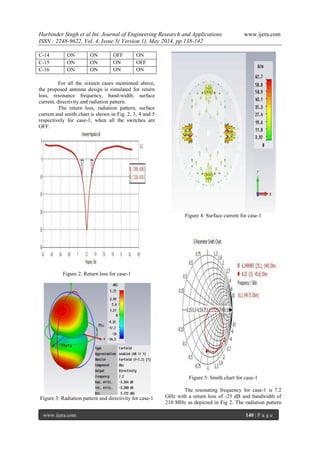
The return loss, radiation pattern, surface
current and smith chart is shown in Fig. 2, 3, 4 and 5
respectively for case-1, when all the switches are
OFF.
Figure 2: Return loss for case-1
Figure 3: Radiation pattern and directivity for case-1
Figure 4: Surface current for case-1
Figure 5: Smith chart for case-1
The resonating frequency for case-1 is 7.2
GHz with a return loss of -25 dB and bandwidth of
210 MHz as depicted in Fig 2. The radiation pattern
Harbinder Singh et al Int. Journal of Engineering Research and Applications www.ijera.com
ISSN : 2248-9622, Vol. 4, Issue 5( Version 1), May 2014, pp.138-142
www.ijera.com 141 | P a g e
at resonant frequency of 7.2 GHz with a directivity of
5.722 dBi is shown in Fig 3. Surface current and
smith chart in Fig 4, 5 imparts the information
regarding the current flowing through patch and input
impedance respectively.
The remaining cases are simulated similarly
and are summarized in Table 3.
Table 3: Summarized result for all the sixteen cases
Case Resonance
frequency
fr (GHz)
Return
loss
(dB)
Band-
width
(MHz)
Directivity
(dBi)
C-1 7.2 -25 210 5.722
C-2 6.82 -17.5 120 5.361
C-3 7.37 -19 210 5.871
C-4 6.94 -15.5 160 6.010
C-5 6.82 -17.5 120 5.361
C-6 6.64 -11 50 5.355
C-7 6.94 -15.5 120 6.010
C-8 6.69 -15 110 5.217
C-9 7.37 -19 200 5.871
C-10 6.94 -15.5 120 6.010
C-11 7.85 -45.5 250 4.731
C-12 7.2 -25 210 5.722
C-13 6.94 -15.5 120 6.010
C-14 6.69 -15 110 5.217
C-15 7.2 -25 210 5.722
C-16 6.94 -15.5 120 6.010
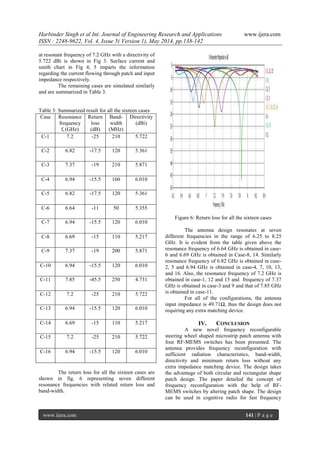
The return loss for all the sixteen cases are
shown in fig. 6 representing seven different
resonance frequencies with related return loss and
band-width.
Figure 6: Return loss for all the sixteen cases
The antenna design resonates at seven
different frequencies in the range of 6.25 to 8.25
GHz. It is evident from the table given above the
resonance frequency of 6.64 GHz is obtained in case-
6 and 6.69 GHz is obtained in Case-8, 14. Similarly
resonance frequency of 6.82 GHz is obtained in case-
2, 5 and 6.94 GHz is obtained in case-4, 7, 10, 13,
and 16. Also, the resonance frequency of 7.2 GHz is
obtained in case-1, 12 and 15 and frequency of 7.37
GHz is obtained in case-3 and 9 and that of 7.85 GHz
is obtained in case-11.
For all of the configurations, the antenna
input impedance is 49.71Ω, thus the design does not
requiring any extra matching device.
IV. CONCLUSION
A new novel frequency reconfigurable
steering wheel shaped microstrip patch antenna with
four RF-MEMS switches has been presented. The
antenna provides frequency reconfiguration with
sufficient radiation characteristics, band-width,
directivity and minimum return loss without any
extra impedance matching device. The design takes
the advantage of both circular and rectangular shape
patch design. The paper detailed the concept of
frequency reconfiguration with the help of RF-
MEMS switches by altering patch shape. The design
can be used in cognitive radio for fast frequency
Harbinder Singh et al Int. Journal of Engineering Research and Applications www.ijera.com
ISSN : 2248-9622, Vol. 4, Issue 5( Version 1), May 2014, pp.138-142
www.ijera.com 142 | P a g e
switching in the range of 6.25 to 8.25 GHz, capable
of operating in seven different frequencies.
Future work includes comparison of measured and
simulated result by implementation of RF-MEMS
switches
REFERENCES
[1] B. Wang and K. J. R. Liu, “Advances in
cognitive radio networks: A survey”, IEEE
J. Sel. Topics Signal Process., vol. 5, no. 1,
Feb. 2011, pp. 5–23.
[2] K.-L. Yau, P. Komisarczuk, and P. Teal, “A
context-aware and intelligent dynamic
channel selection scheme for cognitive radio
networks”, 4th International Conference on
Cognitive Radio Oriented Wireless
Networks and Communications, Hannover,
Germany, June 2009, pp. 1 –6.
[3] J.Mitola and G. Q.Maguire, “Cognitive
radio:Making software radios more
personal” ,IEEE Pers. Commun., vol. 6, no.
4, Aug. 1999, pp. 13–18.
[4] P. S. Hall, P. Gardner, and A. Faraone,
“Antenna requirements for software defined
and cognitive radios”, Proc. IEEE, vol. 100,
no. 7, 2012, pp. 2262–2270
[5] Ghanshyam Singh, Mithilesh Kumar,
“Design of Frequency Reconfigurable
Microstrip Patch Antenna”, IEEE 6th
International Conference on Industrial and
Information Systems, Sri Lanka, Aug. 16-19,
2011
[6] Y. Tawk, J. Costantine, C. G.
Christodoulou, “A Rotatable Reconfigurable
Antenna for Cognitive Radio Applications”,
IEEE Transactions on Antennas and
Propagation, 2011
[7] Rahul Agrawal, Girish Awadhwal, M.K.
Meshram, S.P. Singh, “A Novel
Reconfigurable Multiband Patch Antenna”,
IEEE Students Conference on Electrical,
Electronics and Computer Science,2012
[8] N. Ramli, M. T. Ali, A. L. Yusof, S.
Muhamud, “A Frequency Reconfigurable
Stacked Patch Microstrip Antenna
(FRSPMA) using C-Foam in Stacked
Substrate”, IEEE Asia-Pacific Conference
on Applied Electromagnetics (APACE
2012), Melaka, Malaysia, December 11 - 13,
2012.
[9] Hesamedin Joodaki, Hossein Vailee,
Mohammad Bayat, “Reconfigurable Dual
Frequency Microstrip MIMO Patch Antenna
Using RF MEMS Switches for WLAN
Application”, IEEE 25th
Chinese Control
and Decision Conference, 2013
[10] Lei Ge, Kwai-Man Luk, “A Band-
Reconfigurable Antenna Based On Directed
Dipole”, IEEE Transactions on Antennas
and Propagation, Vol. 62, No. 1, January
2014
[11] H. L. Zhu, X. H. Liu, S. W. Cheung, T. I.
Yuk, “Frequency-Reconfigurable Antenna
Using Metasurface”, IEEE Transactions on
Antennas and Propagation, Vol. 62, No. 1,
January 2014
[12] Adam Narbudowicz, Xiulong Bao, Max
Ammann, Hammam Shakhtour, Dirk
Heberling, “Circularly Polarized Antenna
With Steerable Dipole-Like Radiation
Pattern”, IEEE Transactions on Antennas
and Propagation, Vol. 62, No. 2, February
2014
[13] Thomas Apperley, Michal Okoniewski, “An
Air Gap Based Frequency Switching
Method for the Dielectric Resonator
Antenna”, IEEE Antennas and Wireless
Propagation Letters, 2014
[14] Harish Rajagopalan, Joshua M. Kovitz,
Yahya Rahmat-Samii, “MEMS
Reconfigurable Optimized E-Shaped Patch
Antenna Design”, IEEE Transactions on
Antennas and Propagation, Vol. 62, No. 3,
March 2014
[15] Deepali K. Borakhade, S.B.Pokle, “Design
Approach for Frequency Reconfigurable
Vivaldi Antenna with Pentagoan Slot
Resonator”,IEEE International Conference
on Electronic Systems, Signal Processing
and Computing Technologies, 2014
[16] Simone Genovesi, Alessio Di Candia,
Agostino Monorchio, “Compact and Low
Profile Frequency Agile Antenna for Multi
standard Wireless Communication
Systems”, IEEE Transactions on Antennas
and Propagation, Vol. 62, No. 3, March
2014
[17] Lev Pazin, Yehuda Leviatan,
“Reconfigurable Rotated-T Slot Antenna for
Cognitive Radio Systems”, IEEE
Transactions on Antennas and Propagation,
2014
[18] G. M. Rebeiz, RF MEMS: Theory, Design
and Technology. New York, NY, USA:
Wiley, 2003.
[19] I. Kim and Y. Rahmat-Samii, “RF MEMS
Switchable slot patch antenna integrated
with bias network”, IEEE Trans. Antennas
Propag., vol. 59, no. 12, Dec. 2011, pp.
4811–4815.

X4501138142

  • 1.
    Harbinder Singh etal Int. Journal of Engineering Research and Applications www.ijera.com ISSN : 2248-9622, Vol. 4, Issue 5( Version 1), May 2014, pp.138-142 www.ijera.com 138 | P a g e Steering Wheel Shaped Frequency Reconfigurable Antenna for Cognitive Radio Harbinder Singh1 , Ranju Kanwar2 , Malika Singh3 1 (M. Tech Student, Department of ECE, PCET, Punjab, India) 2, 3 (Assistant Professor, Department of ECE, PCET, Punjab, India) ABSTRACT This paper depicts an outline to design a novel compact and low profile frequency reconfigurable microstrip patch antenna for possible applications in cognitive radio systems to act as a fast switching antenna capable of operating in seven different frequencies in the range of 6.25 to 8.25 GHz. The antenna structure comprises a center rectangular encircled patch, in which rectangular patch is driven patch and the encirclement is for frequency reconfigure ability. The reconfiguration ability of the antenna is obtained by placing four radio frequency micro-electromechanical system (RF-MEMS) switches in between encircled patch and driven patch. Different switch configurations were investigated and the same was evaluated for diverse frequency ranges. Keywords - Cognitive radio, CST, MEMS, Microstrip antennas, Software Define Radio. I. INTRODUCTION The electromagnetic spectrum is a shared resource, limited and regulated, that is more and more congested with the increasing number of users of wireless devices. The further exploitation of the available frequencies by other services possesses practical and regulatory difficulties. According to recent literature, a significant amount of the licensed spectrum remains unused or underutilized for more than 90% of the time [1], [2]. This fact has triggered the wireless communication community to find new and more efficient ways of utilizing the frequency spectrum. The concept of Cognitive Radio (CR) [3] has emerged as a possible solution. In general, CR refers to full communication system architectures that are able to sense the environment for primary (licensed) users and utilize available spectrum not currently being used. The basic architecture of a cognitive radio system generally includes two antennas. One is wideband antenna that continuously senses the wireless medium and simultaneously searches for unused frequency bands. The other is a reconfigurable narrowband antenna that dynamically modifies its resonance frequency to perform the required communication within the unused frequency bands. Also, wide-narrowband reconfigurable antennas can be used for both sensing and communication purposes. But due to the difficulty in providing sufficient isolation between sensing and communication antennas, it is suggested to use two different antennas for quick sensing and filtering operation in limited space. These required features of cognitive radio systems provide many unique challenges to antenna designers. Some of these challenges and requirements are detailed in [4]. Frequency reconfigurable antennas have received increasing attention for such type of software defined radio (SDR) applications, where it is required to have a single common aperture antenna that can be dynamically reconfigured to transmit or receive on multiple frequency bands. Such common-aperture antennas lead to considerable savings in size, weight and cost. In the recent years various frequency reconfigurable patch antennas for cognitive radio has been reported [5]-[17]. In general the reconfiguration is obtained by adjusting the path of currents on the antenna or by altering the geometry of the radiating device. This can be done either mechanically or electrically. Mechanically reconfigurable antennas consist of mechanically movable parts in which frequency reconfiguration is obtained by adjusting the movable parts [6], [11]. The shortcoming of such design was that the overall antenna size required was distinct with respect to the tuned frequency. Moreover, the actuator used to produce the mechanical movements was very problematical and engaged much space, which led to a bulky and expensive structure. Electrically reconfigurable antennas are found more popular. The switching mechanisms used in electrically reconfigurable antenna are solid state switches such as PIN diodes [5], [10], [17], varactors [13] and radio frequency micro-electromechanical system (RF-MEMS) switches [9], [14], [16]. RF-MEMS switches are chosen as the switching elements for antenna reconfiguration due to their satisfactory RF properties including low insertion loss (0.1-0.2 dB) in the on state and high isolation (25-35 dB) in the off state RESEARCH ARTICLE OPEN ACCESS
  • 2.
    Harbinder Singh etal Int. Journal of Engineering Research and Applications www.ijera.com ISSN : 2248-9622, Vol. 4, Issue 5( Version 1), May 2014, pp.138-142 www.ijera.com 139 | P a g e over an extremely wide band (DC to 40GHz) that makes them a perfect contender among all[18], [19]. In this paper, a novel steering wheel shaped frequency reconfigurable antenna design is presented as a new band switching patch antenna. The antenna structure comprises a rectangular encircled patch with four RF-MEMS switches capable of operating in seven different operating frequencies in 6.25 to 8.25 GHz. In this present simulation study, shorting pins are used as switching element for verification, but scaling in frequency allows the use of MEMS switches for future study. The proposed antenna design is studied and simulated using CST Microwave Studio. The paper is organized as follows. Section II discusses the frequency reconfigurable concept and introduces our newly proposed design, Section III discusses the results. II. ANTENNA DESIGN The proposed frequency reconfigurable patch antenna consists of rectangular encircled patch with four MEMS switches D1, D2, D3 and D4, as shown in Fig. 1. A 50Ω coaxial feed is located at the center of patch with external and internal diameter of 5.7 mm and 1 mm respectively. The antenna is designed on a low cost FR4 (lossy) substrate which is 1.574 mm thick and having dielectric constant ∈ 𝑟 = 4.3. The dimensions of the optimized antenna are given in Table 1. (a) (b) Figure1 (a), 1(b): Front and bottom view of antenna design Table 1: Parameter description of antenna design Parameter Description Dimensions(mm) Lg length of ground and substrate 37.8 Wg width of ground and substrate 45.8 Lp length of rectangular patch 16 Wp width of rectangular patch 22 Wd width of diode connecting strips 1 Ro outer radius of circular patch 17 Ri inner radius of circular patch 15 III. RESULT AND DISCUSSIONS By the implementation of RF-MEMS switches, one can vary the dimension of radiating patch and hence the resonating frequencies. The frequency reconfiguration concept is introduced by changing the dimensions of the radiating patch, which further culminates in variation of current and the resonating frequency. Thus alteration in patch dimensions strongly controls the resonant modes of the patch antenna, and this altered patch dimensions results in a desired operating frequency bands. In the given antenna design we proposed four RF-MEMS switches amid rectangular patch and circular patch. The switches will offer 24 i.e. 16 different configurations as given in Table 2. For simulation of antenna ideal switching mode of RF- MEMS switches is considered i.e. in ON state the switch is replaced by short circuiting a conducting pin and in OFF state the switch is considered as open circuit. Table 2: Different switching configuration of RF- MEMS switches Case D1 D2 D3 D4 C-1 OFF OFF OFF OFF C-2 OFF OFF OFF ON C-3 OFF OFF ON OFF C-4 OFF OFF ON ON C-5 OFF ON OFF OFF C-6 OFF ON OFF ON C-7 OFF ON ON OFF C-8 OFF ON ON ON C-9 ON OFF OFF OFF C-10 ON OFF OFF ON C-11 ON OFF ON OFF C-12 ON OFF ON ON C-13 ON ON OFF OFF
  • 3.
    Harbinder Singh etal Int. Journal of Engineering Research and Applications www.ijera.com ISSN : 2248-9622, Vol. 4, Issue 5( Version 1), May 2014, pp.138-142 www.ijera.com 140 | P a g e C-14 ON ON OFF ON C-15 ON ON ON OFF C-16 ON ON ON ON For all the sixteen cases mentioned above, the proposed antenna design is simulated for return loss, resonance frequency, band-width, surface current, directivity and radiation pattern. The return loss, radiation pattern, surface current and smith chart is shown in Fig. 2, 3, 4 and 5 respectively for case-1, when all the switches are OFF. Figure 2: Return loss for case-1 Figure 3: Radiation pattern and directivity for case-1 Figure 4: Surface current for case-1 Figure 5: Smith chart for case-1 The resonating frequency for case-1 is 7.2 GHz with a return loss of -25 dB and bandwidth of 210 MHz as depicted in Fig 2. The radiation pattern
  • 4.
    Harbinder Singh etal Int. Journal of Engineering Research and Applications www.ijera.com ISSN : 2248-9622, Vol. 4, Issue 5( Version 1), May 2014, pp.138-142 www.ijera.com 141 | P a g e at resonant frequency of 7.2 GHz with a directivity of 5.722 dBi is shown in Fig 3. Surface current and smith chart in Fig 4, 5 imparts the information regarding the current flowing through patch and input impedance respectively. The remaining cases are simulated similarly and are summarized in Table 3. Table 3: Summarized result for all the sixteen cases Case Resonance frequency fr (GHz) Return loss (dB) Band- width (MHz) Directivity (dBi) C-1 7.2 -25 210 5.722 C-2 6.82 -17.5 120 5.361 C-3 7.37 -19 210 5.871 C-4 6.94 -15.5 160 6.010 C-5 6.82 -17.5 120 5.361 C-6 6.64 -11 50 5.355 C-7 6.94 -15.5 120 6.010 C-8 6.69 -15 110 5.217 C-9 7.37 -19 200 5.871 C-10 6.94 -15.5 120 6.010 C-11 7.85 -45.5 250 4.731 C-12 7.2 -25 210 5.722 C-13 6.94 -15.5 120 6.010 C-14 6.69 -15 110 5.217 C-15 7.2 -25 210 5.722 C-16 6.94 -15.5 120 6.010 The return loss for all the sixteen cases are shown in fig. 6 representing seven different resonance frequencies with related return loss and band-width. Figure 6: Return loss for all the sixteen cases The antenna design resonates at seven different frequencies in the range of 6.25 to 8.25 GHz. It is evident from the table given above the resonance frequency of 6.64 GHz is obtained in case- 6 and 6.69 GHz is obtained in Case-8, 14. Similarly resonance frequency of 6.82 GHz is obtained in case- 2, 5 and 6.94 GHz is obtained in case-4, 7, 10, 13, and 16. Also, the resonance frequency of 7.2 GHz is obtained in case-1, 12 and 15 and frequency of 7.37 GHz is obtained in case-3 and 9 and that of 7.85 GHz is obtained in case-11. For all of the configurations, the antenna input impedance is 49.71Ω, thus the design does not requiring any extra matching device. IV. CONCLUSION A new novel frequency reconfigurable steering wheel shaped microstrip patch antenna with four RF-MEMS switches has been presented. The antenna provides frequency reconfiguration with sufficient radiation characteristics, band-width, directivity and minimum return loss without any extra impedance matching device. The design takes the advantage of both circular and rectangular shape patch design. The paper detailed the concept of frequency reconfiguration with the help of RF- MEMS switches by altering patch shape. The design can be used in cognitive radio for fast frequency
  • 5.
    Harbinder Singh etal Int. Journal of Engineering Research and Applications www.ijera.com ISSN : 2248-9622, Vol. 4, Issue 5( Version 1), May 2014, pp.138-142 www.ijera.com 142 | P a g e switching in the range of 6.25 to 8.25 GHz, capable of operating in seven different frequencies. Future work includes comparison of measured and simulated result by implementation of RF-MEMS switches REFERENCES [1] B. Wang and K. J. R. Liu, “Advances in cognitive radio networks: A survey”, IEEE J. Sel. Topics Signal Process., vol. 5, no. 1, Feb. 2011, pp. 5–23. [2] K.-L. Yau, P. Komisarczuk, and P. Teal, “A context-aware and intelligent dynamic channel selection scheme for cognitive radio networks”, 4th International Conference on Cognitive Radio Oriented Wireless Networks and Communications, Hannover, Germany, June 2009, pp. 1 –6. [3] J.Mitola and G. Q.Maguire, “Cognitive radio:Making software radios more personal” ,IEEE Pers. Commun., vol. 6, no. 4, Aug. 1999, pp. 13–18. [4] P. S. Hall, P. Gardner, and A. Faraone, “Antenna requirements for software defined and cognitive radios”, Proc. IEEE, vol. 100, no. 7, 2012, pp. 2262–2270 [5] Ghanshyam Singh, Mithilesh Kumar, “Design of Frequency Reconfigurable Microstrip Patch Antenna”, IEEE 6th International Conference on Industrial and Information Systems, Sri Lanka, Aug. 16-19, 2011 [6] Y. Tawk, J. Costantine, C. G. Christodoulou, “A Rotatable Reconfigurable Antenna for Cognitive Radio Applications”, IEEE Transactions on Antennas and Propagation, 2011 [7] Rahul Agrawal, Girish Awadhwal, M.K. Meshram, S.P. Singh, “A Novel Reconfigurable Multiband Patch Antenna”, IEEE Students Conference on Electrical, Electronics and Computer Science,2012 [8] N. Ramli, M. T. Ali, A. L. Yusof, S. Muhamud, “A Frequency Reconfigurable Stacked Patch Microstrip Antenna (FRSPMA) using C-Foam in Stacked Substrate”, IEEE Asia-Pacific Conference on Applied Electromagnetics (APACE 2012), Melaka, Malaysia, December 11 - 13, 2012. [9] Hesamedin Joodaki, Hossein Vailee, Mohammad Bayat, “Reconfigurable Dual Frequency Microstrip MIMO Patch Antenna Using RF MEMS Switches for WLAN Application”, IEEE 25th Chinese Control and Decision Conference, 2013 [10] Lei Ge, Kwai-Man Luk, “A Band- Reconfigurable Antenna Based On Directed Dipole”, IEEE Transactions on Antennas and Propagation, Vol. 62, No. 1, January 2014 [11] H. L. Zhu, X. H. Liu, S. W. Cheung, T. I. Yuk, “Frequency-Reconfigurable Antenna Using Metasurface”, IEEE Transactions on Antennas and Propagation, Vol. 62, No. 1, January 2014 [12] Adam Narbudowicz, Xiulong Bao, Max Ammann, Hammam Shakhtour, Dirk Heberling, “Circularly Polarized Antenna With Steerable Dipole-Like Radiation Pattern”, IEEE Transactions on Antennas and Propagation, Vol. 62, No. 2, February 2014 [13] Thomas Apperley, Michal Okoniewski, “An Air Gap Based Frequency Switching Method for the Dielectric Resonator Antenna”, IEEE Antennas and Wireless Propagation Letters, 2014 [14] Harish Rajagopalan, Joshua M. Kovitz, Yahya Rahmat-Samii, “MEMS Reconfigurable Optimized E-Shaped Patch Antenna Design”, IEEE Transactions on Antennas and Propagation, Vol. 62, No. 3, March 2014 [15] Deepali K. Borakhade, S.B.Pokle, “Design Approach for Frequency Reconfigurable Vivaldi Antenna with Pentagoan Slot Resonator”,IEEE International Conference on Electronic Systems, Signal Processing and Computing Technologies, 2014 [16] Simone Genovesi, Alessio Di Candia, Agostino Monorchio, “Compact and Low Profile Frequency Agile Antenna for Multi standard Wireless Communication Systems”, IEEE Transactions on Antennas and Propagation, Vol. 62, No. 3, March 2014 [17] Lev Pazin, Yehuda Leviatan, “Reconfigurable Rotated-T Slot Antenna for Cognitive Radio Systems”, IEEE Transactions on Antennas and Propagation, 2014 [18] G. M. Rebeiz, RF MEMS: Theory, Design and Technology. New York, NY, USA: Wiley, 2003. [19] I. Kim and Y. Rahmat-Samii, “RF MEMS Switchable slot patch antenna integrated with bias network”, IEEE Trans. Antennas Propag., vol. 59, no. 12, Dec. 2011, pp. 4811–4815.