MEMRISTORS
Presented by,
Sagar Shashank
Roll No.- Gau-C-15/027
Table of Contents:
• Introduction
• What is Memristor?
• Analogy of Memristor
• Companies researching
• Why use?
• Future Scope & Research
• Conclusion
• Bibliography
Introduction:
• Every person with a basic knowledge of electronics would be familiar with the three
fundamental circuit element ---
Resistor (R)
Capacitor (C)
Inductor (L)
• These three elements are defined by the relation between two of the four fundamental
circuit variables ---- Current, Voltage, Charge and Flux.
• But, In 1971, Professor Leon Chua predicted that there should be a fourth fundamental element ----
Memristor (M)
Mathematics behind:
What is a Memristor ?
• Memristor is really a MEMory + ResISTOR
• Memristor can be defined as two terminal device which shows the relation between
Magnetic Flux and Charge.
• A Memristor is a semiconductor whose resistance varies as a function of Flux and Charge.
This allows it to remember what has passed to the circuit.
• Characterized by Memristance.
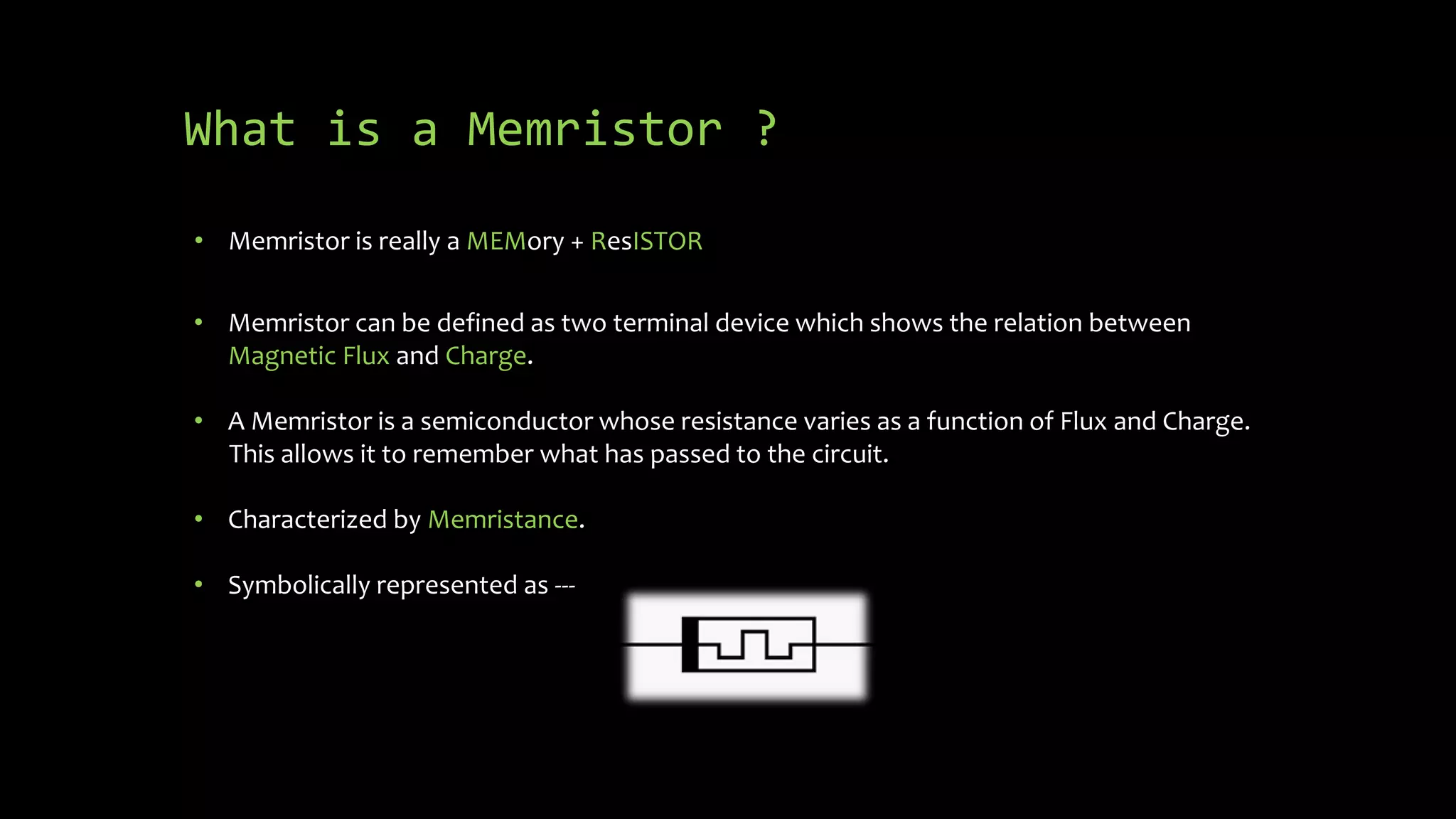
• Symbolically represented as ---
Analogy of Memristor:
An analogy for a Memristor is an interesting kind of pipe that expands or shrinks
when water flows through it.
• If water flows through the pipe in
one direction, the diameter of the
pipe increases, thus enabling the
water to flow faster.
• If water flows through the pipe in
the opposite direction, the diameter
of the pipe decreases, thus slowing
down the flow of water.
• If water pressure is turned off, the
pipe will retain its most recent
diameter until the water is turned
back on.
Companies researching:
• Unity Semiconductor
• AMD
• Micron Technology
• Samsung
• HP
Why use ?
• Would allow for a quicker boot up since information is not lost when the device is
turned off.
• Non-volatile memories
• Use less energy and produce less heat
• Logic/Computing
• Faster to store a bit of data i.e., in less than 100 picoseconds
• Artificial Brain
• Artificial Intelligence etc.
Future Scope & Research:
• Recently, researchers have defined two new memdevices namely
memcapacitor and meminductor, thus generalizing the concept
of memory devices to capacitors and inductors.
• The memcapacitor and meminductor are the memdevices in which the
capacitance and inductance respectively depends on the state and history
of the system.
Conclusion:
Nanotechnology is fast emerging, and nanoscale devices automatically bring in
memristive functions. Thus, memristors might revolutionize the 21st century as
radically as the transistor in the 20th century. Memristor memories have already
been developed and the researchers at HP believe that they can offer a product
with a storage density of about 20 gigabytes per square centimetre by 2013.
As Prof. Leon Chua rightly said – “ Its time to rewrite all the Electrical & Electronics
books”.
Bibliography:
• http://www.memristor.org
• http://www.hpl.hp.com/news/2011/apr-jun/memristors.html
• http://en.wikipedia.org/wiki/Memristor
THANK YOU

Memristors

  • 1.
  • 2.
    Table of Contents: •Introduction • What is Memristor? • Analogy of Memristor • Companies researching • Why use? • Future Scope & Research • Conclusion • Bibliography
  • 3.
    Introduction: • Every personwith a basic knowledge of electronics would be familiar with the three fundamental circuit element --- Resistor (R) Capacitor (C) Inductor (L) • These three elements are defined by the relation between two of the four fundamental circuit variables ---- Current, Voltage, Charge and Flux. • But, In 1971, Professor Leon Chua predicted that there should be a fourth fundamental element ---- Memristor (M)
  • 5.
  • 6.
    What is aMemristor ? • Memristor is really a MEMory + ResISTOR • Memristor can be defined as two terminal device which shows the relation between Magnetic Flux and Charge. • A Memristor is a semiconductor whose resistance varies as a function of Flux and Charge. This allows it to remember what has passed to the circuit. • Characterized by Memristance. • Symbolically represented as ---
  • 7.
    Analogy of Memristor: Ananalogy for a Memristor is an interesting kind of pipe that expands or shrinks when water flows through it. • If water flows through the pipe in one direction, the diameter of the pipe increases, thus enabling the water to flow faster. • If water flows through the pipe in the opposite direction, the diameter of the pipe decreases, thus slowing down the flow of water. • If water pressure is turned off, the pipe will retain its most recent diameter until the water is turned back on.
  • 8.
    Companies researching: • UnitySemiconductor • AMD • Micron Technology • Samsung • HP
  • 9.
    Why use ? •Would allow for a quicker boot up since information is not lost when the device is turned off. • Non-volatile memories • Use less energy and produce less heat • Logic/Computing • Faster to store a bit of data i.e., in less than 100 picoseconds • Artificial Brain • Artificial Intelligence etc.
  • 10.
    Future Scope &Research: • Recently, researchers have defined two new memdevices namely memcapacitor and meminductor, thus generalizing the concept of memory devices to capacitors and inductors. • The memcapacitor and meminductor are the memdevices in which the capacitance and inductance respectively depends on the state and history of the system.
  • 11.
    Conclusion: Nanotechnology is fastemerging, and nanoscale devices automatically bring in memristive functions. Thus, memristors might revolutionize the 21st century as radically as the transistor in the 20th century. Memristor memories have already been developed and the researchers at HP believe that they can offer a product with a storage density of about 20 gigabytes per square centimetre by 2013. As Prof. Leon Chua rightly said – “ Its time to rewrite all the Electrical & Electronics books”.
  • 12.
  • 13.