Low Down and Dirty:  Anti-forensic Rootkits Presented by Darren Bilby Ruxcon 2006
Anti-forensics Overview Digital Forensics Acquisition  The Live Imaging Process How Live Forensics Tools Work DDefy Introduction NTFS Basics DDefy Disk Forensics Demonstration DDefy Challenges DDefy Memory Forensics Demonstration Better Methods for Live Imaging Agenda
This is Not… A demonstration of 0day rootkit techniques This is … Showing flaws in current and proposed forensic techniques Showing how evidence could be manipulated and people wrongly convicted through bad forensic methodologies
Digital Anti-forensics
Anti-Forensics Methods Data Contraception Prevent evidence data from existing somewhere that can be analyzed E.g. Memory only malware, memory only exploitation Data Hiding Put the data on disk but put it somewhere the forensic analyst is unlikely to look  E.g. Defilers toolkit, runefs,
Anti-Forensics Overview Data Destruction Destroy any evidence before someone gets a chance to find it E.g. Disk wiping, wipe, srm, evidence eliminator, necrofile Data Misdirection Provide the forensic analyst false data that is indistinguishable from the real thing No public examples… until now.
Digital Forensics Acquisition Need to gather an evidential copy of a system The Aim Gather the “best” evidence available Gather volatile information  memory, process list, network connections, open files… Power off machine and image disk
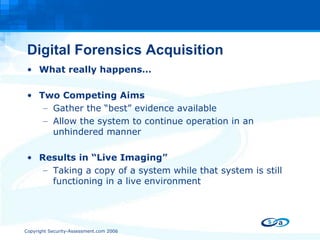
Digital Forensics Acquisition What really happens… Two Competing Aims Gather the “best” evidence available Allow the system to continue operation in an unhindered manner Results in “Live Imaging” Taking a copy of a system while that system is still functioning in a live environment
Reasons for “Live Imaging” Business critical systems that cannot be shut down Shutting down systems may create legal liability for examiners through: damaging equipment unintentional data loss  hampering operations Judge instructs that evidence gathering must be conducted using the least intrusive methods available Encrypted volumes
Digital Forensics Acquisition Live imaging is now common practice Tools Helix (dd/netcat) Prodiscover IR Encase EEE/FIM FTK Smart  …
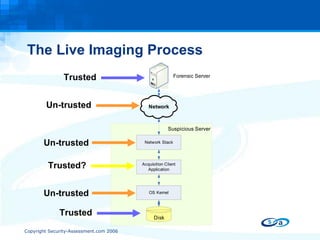
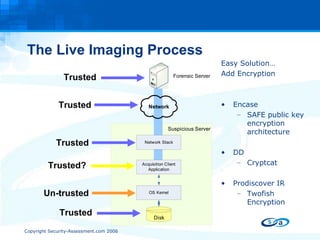
The Live Imaging Process Trusted Un-trusted Un-trusted Trusted Un-trusted Trusted?
The Live Imaging Process Trusted Trusted Trusted Trusted Un-trusted Trusted? Easy Solution…  Add Encryption Encase  SAFE public key encryption architecture DD Cryptcat  Prodiscover IR Twofish Encryption
So this is common practice, accepted as legitimate by most courts of law, supported by many big name forensic vendors, it must be foolproof right?  uhhh… ok
Live imaging… …  is like turning up to a homicide at the docks and asking the mafia to collect your evidence and take it back to the police station for you.
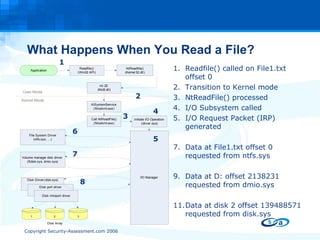
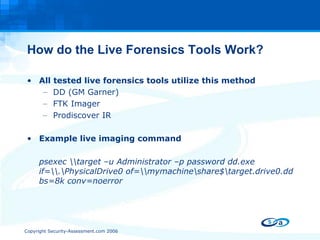
What Happens When You Read a File? Readfile() called on File1.txt offset 0 Transition to Kernel mode NtReadFile() processed I/O Subsystem called I/O Request Packet (IRP) generated Data at File1.txt offset 0 requested from ntfs.sys Data at D: offset 2138231 requested from dmio.sys Data at disk 2 offset 139488571 requested from disk.sys 1 2 3 5 6 7 8 4
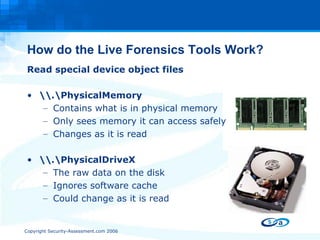
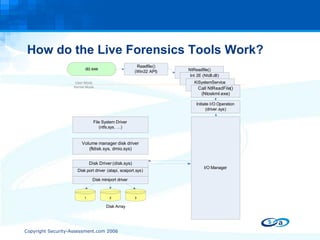
How do the Live Forensics Tools Work? Read special device object files \\.\PhysicalMemory Contains what is in physical memory Only sees memory it can access safely Changes as it is read \\.\PhysicalDriveX The raw data on the disk Ignores software cache Could change as it is read
How do the Live Forensics Tools Work?
How do the Live Forensics Tools Work? All tested live forensics tools utilize this method DD (GM Garner) FTK Imager Prodiscover IR Example live imaging command psexec \\target –u Administrator –p password dd.exe if=\\.\PhysicalDrive0 of=\\mymachine\share$\target.drive0.dd bs=8k conv=noerror
How do the Live Forensics Tools Work? Aim: Get an accurate low level copy of disk and memory. Good Things about Live Forensics Tools: Bypass standard rootkit techniques so a hacker can’t hide their files Bypass major parts of the Windows driver stack including the File System Driver and Volume Manager Driver
DDefy Anti-forensic Rootkit
DDefy: The Idea Live forensics tools trust a bad kernel to give them clean data Lets create a rootkit that hooks below the forensic tools Provide the forensic tool a valid but “cleansed” version of the system Implement as low as we can get while still being practical Implement instead of claiming theory
DDefy: The Challenge From Live forensics tool documentation: Q. Can't a rootkit be written to avoid detection? A.   While it is  theoretically possible  to create a rootkit to alter the lower level disk sector read command,   it would be extremely difficult and would require significant information about the specific machine being rooted .  Any attempt to determine which sectors contain the data the rootkit is trying to hide would need to keep track of virtually the complete disk data structure on the system to keep the normal operation of the system from overwriting the files. If the cracker tried to mark a section of disk "bad" to prevent the system from altering the hidden files, it would no longer be available to read using the rooted disk sector commands.   We believe it is impractical to create this low level rootkit.
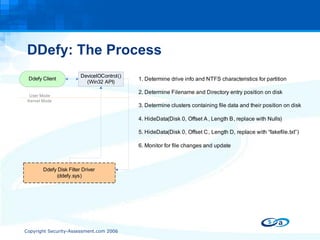
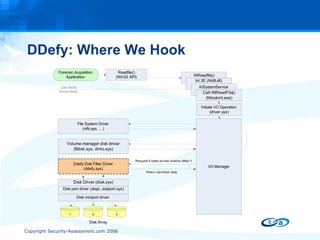
DDefy: Implementation The Aim: When someone does live forensics on my system they should get a valid image, but not my sensitive data.  Written on the power of short blacks and jack daniels Proof of concept for 2K/XP/2k3 Kernel mode Rootkit Upper Disk Filter Driver  Intercepts IRP_MJ_READ I/O Request Packets sent to the disk and modifies the return data
DDefy Disk Forensics Demo
DDefy: Results Any data that is stored on the physical disk can be hidden from a live forensics or detection tool There is no way to completely prevent this Live forensic imaging is still a useful tool but it needs to be used with full knowledge of the limitations Image the disk offline whenever possible
DDefy: Challenges Where do we intercept? (hook) How do we understand the file system without a file system? How do we ensure we give our investigator a valid image? How do we avoid detection?
Where do we Intercept?
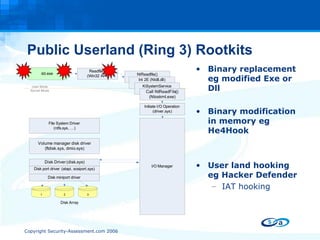
Public Userland (Ring 3) Rootkits Binary replacement eg modified Exe or Dll Binary modification in memory eg He4Hook User land hooking eg Hacker Defender IAT hooking
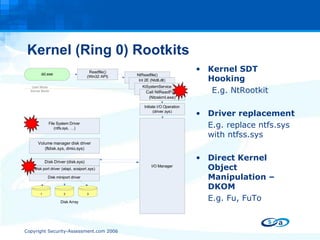
Kernel (Ring 0) Rootkits Kernel SDT Hooking  E.g. NtRootkit Driver replacement  E.g. replace ntfs.sys with ntfss.sys Direct Kernel Object Manipulation – DKOM  E.g. Fu, FuTo
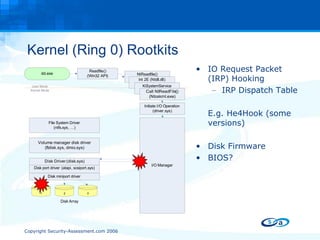
Kernel (Ring 0) Rootkits IO Request Packet (IRP) Hooking  IRP Dispatch Table E.g. He4Hook (some versions) Disk Firmware BIOS?
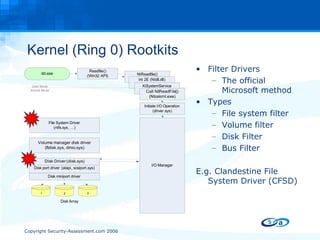
Kernel (Ring 0) Rootkits Filter Drivers The official Microsoft method Types File system filter Volume filter Disk Filter Bus Filter E.g. Clandestine File System Driver (CFSD)
Wherever we want The Windows driver model leaves us a lot of scope Personally I like disk filter drivers or IRP hooks because a) They are simple to implement b) They’re not detected by most rootkit detectors DDefy: Where Do We Intercept?
DDefy: Where We Hook
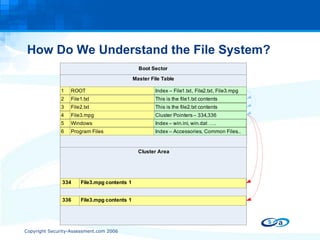
How Do We Understand the File System? NTFS is my target Easy thanks to recent publications (File System Forensics – B. Carrier)  Ask the operating system to give us most of the information anyway We could do this ourselves, but I assume ntfs.sys is a better NTFS interpreter than I am
How Do We Understand the File System?
How Do We Understand the File System? To completely hide a file from \\.\PhysicalDrive0 with DDefy we have to fake: Directory Entry (Index) Master File Table (MFT) Entry MFT Data (for small files) Data in Clusters (for larger files)
DDefy: The Process
Avoiding Detection This is all irrelevant if the forensic analyst finds “hacker.exe” running in memory So how does the forensics guy get his process listing? Network connections etc? \\.\PhysicalMemory Can we clean this up with some kernel modifications?
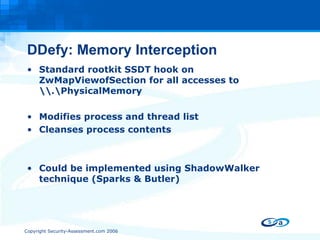
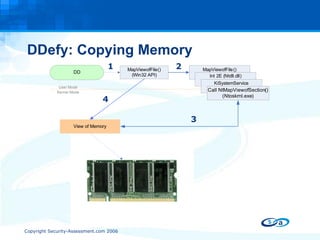
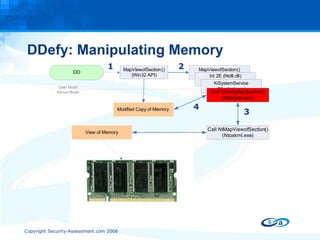
DDefy: Memory Interception Standard rootkit SSDT hook on ZwMapViewofSection for all accesses to \\.\PhysicalMemory Modifies process and thread list Cleanses process contents Could be implemented using ShadowWalker technique (Sparks & Butler)
DDefy: Copying Memory 1 2 3 4
DDefy: Manipulating Memory 1 2 3 4
DDefy Memory Forensics Demo
DDefy Memory Interception Detectable Ongoing rootkit detection arms race Avoidable Zw Interception easily bypassed by multiple unpublished forensic memory techniques Firewire works too   Doesn’t hide Memory mapped files Memory paged to disk
Some solutions…
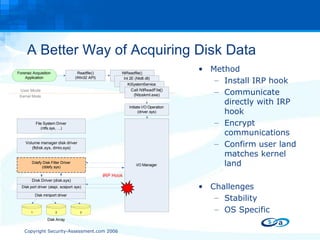
A Better Way of Acquiring Disk Data Method Install IRP hook Communicate directly with IRP hook Encrypt communications  Confirm user land matches kernel land Challenges Stability OS Specific
What it Means Live forensic imaging is a broken concept Data gathered via live imaging cannot be trusted Manipulation of evidence is both possible and probable However, live imaging is still useful if combined with the right knowledge
Future Work Defeating cross view rootkit detection tools in a generic way Implementation of an open source imaging tool to defeat these anti-forensic techniques
Questions ? http://www.security-assessment.com [email_address]
Resources Windows System Internals 4 th  Edition–  D. Solomon, M. Russinovich Rootkits –  G. Hoglund, J. Butler Primary Windows Rootkit Resource  http://www.rootkit.com Joanna Rutkowska – Stealth Malware Detection  http://www.invisiblethings.org Windows Driver Development Resource  http://www.osronline.com

Anti-Forensic Rootkits

  • 1.
    Low Down andDirty: Anti-forensic Rootkits Presented by Darren Bilby Ruxcon 2006
  • 2.
    Anti-forensics Overview DigitalForensics Acquisition The Live Imaging Process How Live Forensics Tools Work DDefy Introduction NTFS Basics DDefy Disk Forensics Demonstration DDefy Challenges DDefy Memory Forensics Demonstration Better Methods for Live Imaging Agenda
  • 3.
    This is Not…A demonstration of 0day rootkit techniques This is … Showing flaws in current and proposed forensic techniques Showing how evidence could be manipulated and people wrongly convicted through bad forensic methodologies
  • 4.
  • 5.
    Anti-Forensics Methods DataContraception Prevent evidence data from existing somewhere that can be analyzed E.g. Memory only malware, memory only exploitation Data Hiding Put the data on disk but put it somewhere the forensic analyst is unlikely to look E.g. Defilers toolkit, runefs,
  • 6.
    Anti-Forensics Overview DataDestruction Destroy any evidence before someone gets a chance to find it E.g. Disk wiping, wipe, srm, evidence eliminator, necrofile Data Misdirection Provide the forensic analyst false data that is indistinguishable from the real thing No public examples… until now.
  • 7.
    Digital Forensics AcquisitionNeed to gather an evidential copy of a system The Aim Gather the “best” evidence available Gather volatile information memory, process list, network connections, open files… Power off machine and image disk
  • 8.
    Digital Forensics AcquisitionWhat really happens… Two Competing Aims Gather the “best” evidence available Allow the system to continue operation in an unhindered manner Results in “Live Imaging” Taking a copy of a system while that system is still functioning in a live environment
  • 9.
    Reasons for “LiveImaging” Business critical systems that cannot be shut down Shutting down systems may create legal liability for examiners through: damaging equipment unintentional data loss hampering operations Judge instructs that evidence gathering must be conducted using the least intrusive methods available Encrypted volumes
  • 10.
    Digital Forensics AcquisitionLive imaging is now common practice Tools Helix (dd/netcat) Prodiscover IR Encase EEE/FIM FTK Smart …
  • 11.
    The Live ImagingProcess Trusted Un-trusted Un-trusted Trusted Un-trusted Trusted?
  • 12.
    The Live ImagingProcess Trusted Trusted Trusted Trusted Un-trusted Trusted? Easy Solution… Add Encryption Encase SAFE public key encryption architecture DD Cryptcat Prodiscover IR Twofish Encryption
  • 13.
    So this iscommon practice, accepted as legitimate by most courts of law, supported by many big name forensic vendors, it must be foolproof right? uhhh… ok
  • 14.
    Live imaging… … is like turning up to a homicide at the docks and asking the mafia to collect your evidence and take it back to the police station for you.
  • 15.
    What Happens WhenYou Read a File? Readfile() called on File1.txt offset 0 Transition to Kernel mode NtReadFile() processed I/O Subsystem called I/O Request Packet (IRP) generated Data at File1.txt offset 0 requested from ntfs.sys Data at D: offset 2138231 requested from dmio.sys Data at disk 2 offset 139488571 requested from disk.sys 1 2 3 5 6 7 8 4
  • 16.
    How do theLive Forensics Tools Work? Read special device object files \\.\PhysicalMemory Contains what is in physical memory Only sees memory it can access safely Changes as it is read \\.\PhysicalDriveX The raw data on the disk Ignores software cache Could change as it is read
  • 17.
    How do theLive Forensics Tools Work?
  • 18.
    How do theLive Forensics Tools Work? All tested live forensics tools utilize this method DD (GM Garner) FTK Imager Prodiscover IR Example live imaging command psexec \\target –u Administrator –p password dd.exe if=\\.\PhysicalDrive0 of=\\mymachine\share$\target.drive0.dd bs=8k conv=noerror
  • 19.
    How do theLive Forensics Tools Work? Aim: Get an accurate low level copy of disk and memory. Good Things about Live Forensics Tools: Bypass standard rootkit techniques so a hacker can’t hide their files Bypass major parts of the Windows driver stack including the File System Driver and Volume Manager Driver
  • 20.
  • 21.
    DDefy: The IdeaLive forensics tools trust a bad kernel to give them clean data Lets create a rootkit that hooks below the forensic tools Provide the forensic tool a valid but “cleansed” version of the system Implement as low as we can get while still being practical Implement instead of claiming theory
  • 22.
    DDefy: The ChallengeFrom Live forensics tool documentation: Q. Can't a rootkit be written to avoid detection? A. While it is theoretically possible to create a rootkit to alter the lower level disk sector read command, it would be extremely difficult and would require significant information about the specific machine being rooted . Any attempt to determine which sectors contain the data the rootkit is trying to hide would need to keep track of virtually the complete disk data structure on the system to keep the normal operation of the system from overwriting the files. If the cracker tried to mark a section of disk "bad" to prevent the system from altering the hidden files, it would no longer be available to read using the rooted disk sector commands. We believe it is impractical to create this low level rootkit.
  • 23.
    DDefy: Implementation TheAim: When someone does live forensics on my system they should get a valid image, but not my sensitive data. Written on the power of short blacks and jack daniels Proof of concept for 2K/XP/2k3 Kernel mode Rootkit Upper Disk Filter Driver Intercepts IRP_MJ_READ I/O Request Packets sent to the disk and modifies the return data
  • 24.
  • 25.
    DDefy: Results Anydata that is stored on the physical disk can be hidden from a live forensics or detection tool There is no way to completely prevent this Live forensic imaging is still a useful tool but it needs to be used with full knowledge of the limitations Image the disk offline whenever possible
  • 26.
    DDefy: Challenges Wheredo we intercept? (hook) How do we understand the file system without a file system? How do we ensure we give our investigator a valid image? How do we avoid detection?
  • 27.
    Where do weIntercept?
  • 28.
    Public Userland (Ring3) Rootkits Binary replacement eg modified Exe or Dll Binary modification in memory eg He4Hook User land hooking eg Hacker Defender IAT hooking
  • 29.
    Kernel (Ring 0)Rootkits Kernel SDT Hooking E.g. NtRootkit Driver replacement E.g. replace ntfs.sys with ntfss.sys Direct Kernel Object Manipulation – DKOM E.g. Fu, FuTo
  • 30.
    Kernel (Ring 0)Rootkits IO Request Packet (IRP) Hooking IRP Dispatch Table E.g. He4Hook (some versions) Disk Firmware BIOS?
  • 31.
    Kernel (Ring 0)Rootkits Filter Drivers The official Microsoft method Types File system filter Volume filter Disk Filter Bus Filter E.g. Clandestine File System Driver (CFSD)
  • 32.
    Wherever we wantThe Windows driver model leaves us a lot of scope Personally I like disk filter drivers or IRP hooks because a) They are simple to implement b) They’re not detected by most rootkit detectors DDefy: Where Do We Intercept?
  • 33.
  • 34.
    How Do WeUnderstand the File System? NTFS is my target Easy thanks to recent publications (File System Forensics – B. Carrier) Ask the operating system to give us most of the information anyway We could do this ourselves, but I assume ntfs.sys is a better NTFS interpreter than I am
  • 35.
    How Do WeUnderstand the File System?
  • 36.
    How Do WeUnderstand the File System? To completely hide a file from \\.\PhysicalDrive0 with DDefy we have to fake: Directory Entry (Index) Master File Table (MFT) Entry MFT Data (for small files) Data in Clusters (for larger files)
  • 37.
  • 38.
    Avoiding Detection Thisis all irrelevant if the forensic analyst finds “hacker.exe” running in memory So how does the forensics guy get his process listing? Network connections etc? \\.\PhysicalMemory Can we clean this up with some kernel modifications?
  • 39.
    DDefy: Memory InterceptionStandard rootkit SSDT hook on ZwMapViewofSection for all accesses to \\.\PhysicalMemory Modifies process and thread list Cleanses process contents Could be implemented using ShadowWalker technique (Sparks & Butler)
  • 40.
  • 41.
  • 42.
  • 43.
    DDefy Memory InterceptionDetectable Ongoing rootkit detection arms race Avoidable Zw Interception easily bypassed by multiple unpublished forensic memory techniques Firewire works too  Doesn’t hide Memory mapped files Memory paged to disk
  • 44.
  • 45.
    A Better Wayof Acquiring Disk Data Method Install IRP hook Communicate directly with IRP hook Encrypt communications Confirm user land matches kernel land Challenges Stability OS Specific
  • 46.
    What it MeansLive forensic imaging is a broken concept Data gathered via live imaging cannot be trusted Manipulation of evidence is both possible and probable However, live imaging is still useful if combined with the right knowledge
  • 47.
    Future Work Defeatingcross view rootkit detection tools in a generic way Implementation of an open source imaging tool to defeat these anti-forensic techniques
  • 48.
  • 49.
    Resources Windows SystemInternals 4 th Edition– D. Solomon, M. Russinovich Rootkits – G. Hoglund, J. Butler Primary Windows Rootkit Resource http://www.rootkit.com Joanna Rutkowska – Stealth Malware Detection http://www.invisiblethings.org Windows Driver Development Resource http://www.osronline.com