
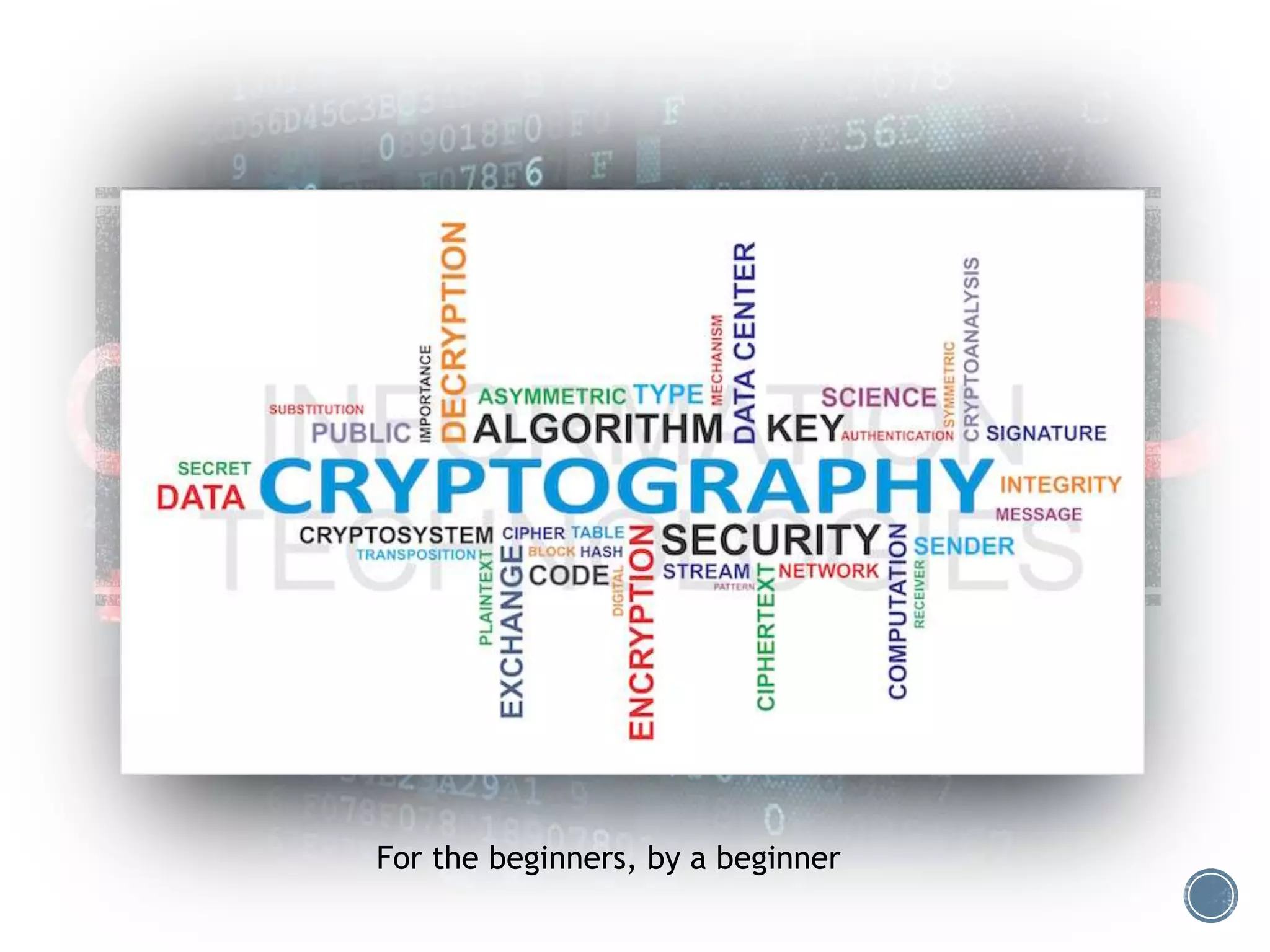
For the beginners, by a beginner
 Security Enthusiast
 Broke lock of my own bag.
 Start many things, finish nothing (mostly)
 Threat Researcher @ Symantec
 B&B
 Talking at badboy16a@gmail.com
 Broadcasting @_badbot
Functionality
Systems
 Encoding
 Encryption
 Obfuscation
 Cryptography
 Cryptanalysis
 Steganography
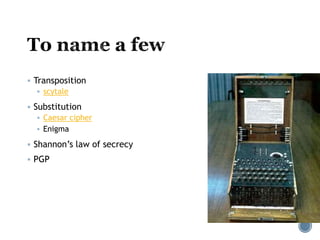
 Transposition
 scytale
 Substitution
 Caesar cipher
 Enigma
 Shannon’s law of secrecy
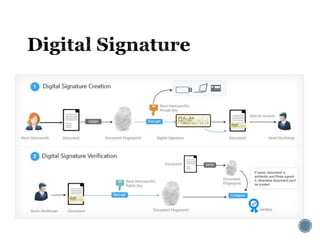
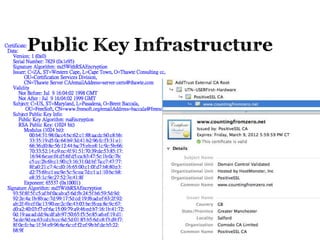
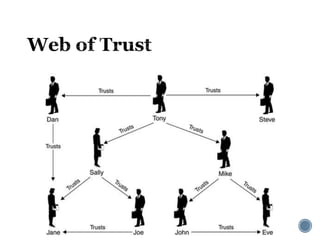
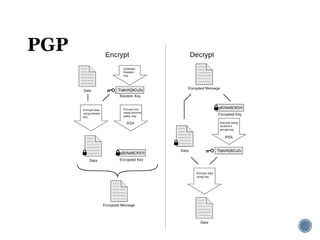
 PGP
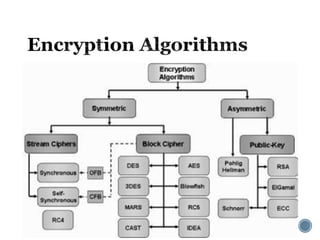
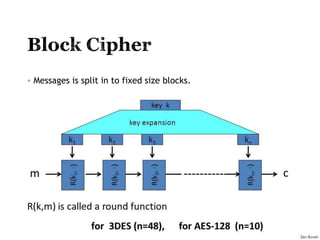
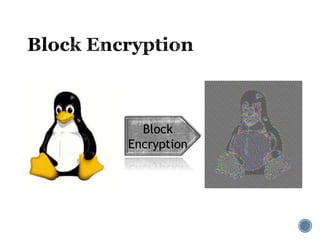
 Messages is split in to fixed size blocks.
Block
Encryption
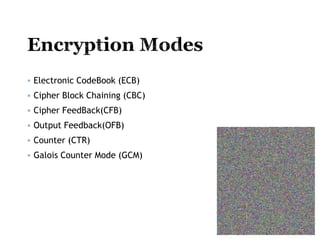
 Electronic CodeBook (ECB)
 Cipher Block Chaining (CBC)
 Cipher FeedBack(CFB)
 Output Feedback(OFB)
 Counter (CTR)
 Galois Counter Mode (GCM)
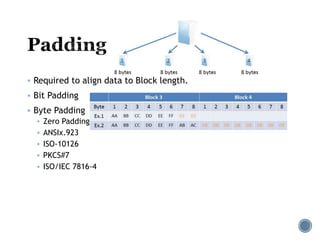
 Required to align data to Block length.
 Bit Padding
 Byte Padding
 Zero Padding
 ANSIx.923
 ISO-10126
 PKCS#7
 ISO/IEC 7816-4
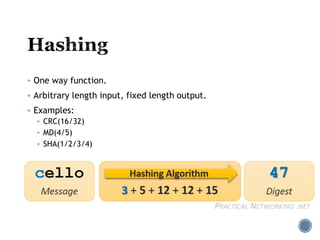
 One way function.
 Arbitrary length input, fixed length output.
 Examples:
 CRC(16/32)
 MD(4/5)
 SHA(1/2/3/4)
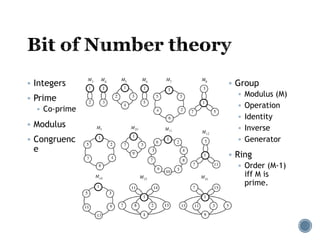
 Integers
 Prime
 Co-prime
 Modulus
 Congruenc
e
 Group
 Modulus (M)
 Operation
 Identity
 Inverse
 Generator
 Ring
 Order (M-1)
iff M is
prime.
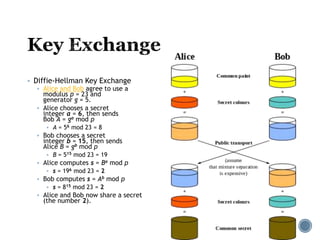
 Diffie-Hellman Key Exchange
 Alice and Bob agree to use a
modulus p = 23 and
generator g = 5.
 Alice chooses a secret
integer a = 6, then sends
Bob A = ga mod p
 A = 56 mod 23 = 8
 Bob chooses a secret
integer b = 15, then sends
Alice B = gb mod p
 B = 515 mod 23 = 19
 Alice computes s = Ba mod p
 s = 196 mod 23 = 2
 Bob computes s = Ab mod p
 s = 815 mod 23 = 2
 Alice and Bob now share a secret
(the number 2).
 Based on intractability principle
 Multiplying two large integers is easy
 Finding prime factors of large integers is an intractable problem.
 Computations are performed in “Group” modulo M.
 M being a very large prime.
 2 keys are generated simultaneously.
 Inverse of each other (modulo M).
 One encrypts (Public Key)
 Other decrypts (Private Key)
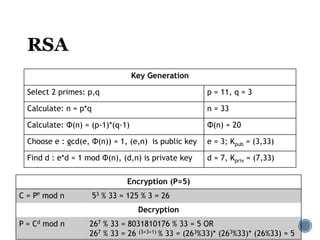
Encryption (P=5)
C = Pe
mod n 53 % 33 = 125 % 3 = 26
Decryption
P = Cd mod n 267 % 33 = 8031810176 % 33 = 5 OR
267 % 33 = 26 (3+3+1) % 33 = (263%33)* (263%33)* (26%33) = 5
Key Generation
Select 2 primes: p,q p = 11, q = 3
Calculate: n = p*q n = 33
Calculate: Φ(n) = (p-1)*(q-1) Φ(n) = 20
Choose e : gcd(e, Φ(n)) = 1, (e,n) is public key e = 3; Kpub = (3,33)
Find d : e*d = 1 mod Φ(n), (d,n) is private key d = 7, Kpriv = (7,33)
Basics of Cryptography

Basics of Cryptography

  • 1.
    For the beginners,by a beginner
  • 2.
     Security Enthusiast Broke lock of my own bag.  Start many things, finish nothing (mostly)  Threat Researcher @ Symantec  B&B  Talking at badboy16a@gmail.com  Broadcasting @_badbot
  • 3.
  • 4.
     Encoding  Encryption Obfuscation  Cryptography  Cryptanalysis  Steganography
  • 5.
     Transposition  scytale Substitution  Caesar cipher  Enigma  Shannon’s law of secrecy  PGP
  • 12.
     Messages issplit in to fixed size blocks.
  • 13.
  • 14.
     Electronic CodeBook(ECB)  Cipher Block Chaining (CBC)  Cipher FeedBack(CFB)  Output Feedback(OFB)  Counter (CTR)  Galois Counter Mode (GCM)
  • 15.
     Required toalign data to Block length.  Bit Padding  Byte Padding  Zero Padding  ANSIx.923  ISO-10126  PKCS#7  ISO/IEC 7816-4
  • 16.
     One wayfunction.  Arbitrary length input, fixed length output.  Examples:  CRC(16/32)  MD(4/5)  SHA(1/2/3/4)
  • 17.
     Integers  Prime Co-prime  Modulus  Congruenc e  Group  Modulus (M)  Operation  Identity  Inverse  Generator  Ring  Order (M-1) iff M is prime.
  • 18.
     Diffie-Hellman KeyExchange  Alice and Bob agree to use a modulus p = 23 and generator g = 5.  Alice chooses a secret integer a = 6, then sends Bob A = ga mod p  A = 56 mod 23 = 8  Bob chooses a secret integer b = 15, then sends Alice B = gb mod p  B = 515 mod 23 = 19  Alice computes s = Ba mod p  s = 196 mod 23 = 2  Bob computes s = Ab mod p  s = 815 mod 23 = 2  Alice and Bob now share a secret (the number 2).
  • 19.
     Based onintractability principle  Multiplying two large integers is easy  Finding prime factors of large integers is an intractable problem.  Computations are performed in “Group” modulo M.  M being a very large prime.  2 keys are generated simultaneously.  Inverse of each other (modulo M).  One encrypts (Public Key)  Other decrypts (Private Key)
  • 20.
    Encryption (P=5) C =Pe mod n 53 % 33 = 125 % 3 = 26 Decryption P = Cd mod n 267 % 33 = 8031810176 % 33 = 5 OR 267 % 33 = 26 (3+3+1) % 33 = (263%33)* (263%33)* (26%33) = 5 Key Generation Select 2 primes: p,q p = 11, q = 3 Calculate: n = p*q n = 33 Calculate: Φ(n) = (p-1)*(q-1) Φ(n) = 20 Choose e : gcd(e, Φ(n)) = 1, (e,n) is public key e = 3; Kpub = (3,33) Find d : e*d = 1 mod Φ(n), (d,n) is private key d = 7, Kpriv = (7,33)

Editor's Notes

  • #6 PGP Later
  • #7 https://www.digicert.com/images/iot/IoTSecuritySolutionGraphic_400x400.png
  • #9 DES: by IBM, Lucifer, NSA? Why not 2DES? Meet-in-the-middle
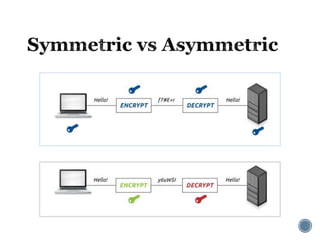
  • #10 Symmetric key must be shared before use.
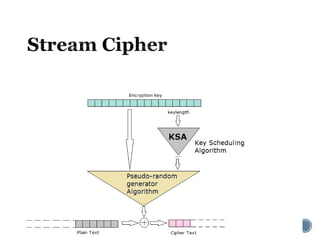
  • #11 Encrypts one bit/byte. Perfect: One Time Pad
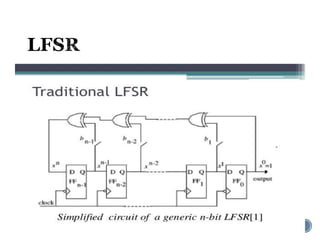
  • #12 Linear Feedback Shift Register Designed to be implemented in H/W (A5/1), CSS Initial State, Key, Tap Points
  • #13 DES Block size: 64 bits, Keysize: 56b (+8b parity) AES Block Size: 64 bits, Key size: 64, 128, 256
  • #15 GCM provides authentication also.
  • #16 Must be identifiable after decryption Ciphertext Stealing
  • #17 SHAttered Fuzzy hashing.
  • #18 Primality Test Multiplicative Group
  • #20 Multiplicative group
  • #21 RSA?? Extended Euclid,s Algorithm e is small, usually 65537.
  • #24 Trust = Sign their public key.
  • #26 The Irony