
LURIA - NEBRASKA BATTERY
By – Ankita manwani
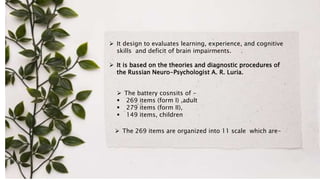
 It design to evaluates learning, experience, and cognitive
skills and deficit of brain impairments.
 It is based on the theories and diagnostic procedures of
the Russian Neuro-Psychologist A. R. Luria.
 The 269 items are organized into 11 scale which are-
 The battery cosnsits of -
 269 items (form I) ,adult
 279 items (form II),
 149 items, children
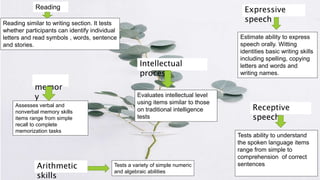
Receptive
speech
Expressive
speech
Reading
Arithmetic
skills
memor
y
Intellectual
process
Tests ability to understand
the spoken language items
range from simple to
comprehension of correct
sentences
Estimate ability to express
speech orally. Witting
identities basic writing skills
including spelling, copying
letters and words and
writing names.
Reading similar to writing section. It tests
whether participants can identify individual
letters and read symbols , words, sentence
and stories.
Tests a variety of simple numeric
and algebraic abilities
Assesses verbal and
nonverbal memory skills
items range from simple
recall to complete
memorization tasks
Evaluates intellectual level
using items similar to those
on traditional intelligence
tests
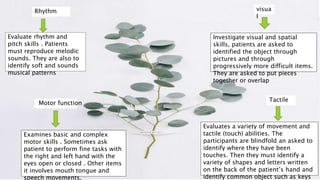
Motor function
RhythmRhythm visua
l
Tactile
Evaluates a variety of movement and
tactile (touch) abilities. The
participants are blindfold an asked to
identify where they have been
touches. Then they must identify a
variety of shapes and letters written
on the back of the patient’s hand and
identify common object such as keys
Investigate visual and spatial
skills, patients are asked to
identified the object through
pictures and through
progressively more difficult items.
They are asked to put pieces
together or overlap
Evaluate rhythm and
pitch skills . Patients
must reproduce melodic
sounds. They are also to
identify soft and sounds
musical patterns
Examines basic and complex
motor skills . Sometimes ask
patient to perform fine tasks with
the right and left hand with the
eyes open or closed . Other items
it involves mouth tongue and
speech movements.
Scoring
269 items, which is scored on 2 or 3 point scale
0 = normal performance
1 = borderlines performance
2 = abnormal performance
Higher the score worse the performance
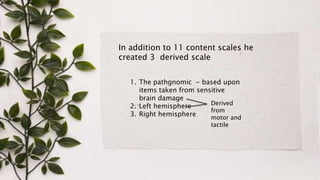
In addition to 11 content scales he
created 3 derived scale
1. The pathgnomic - based upon
items taken from sensitive
brain damage
2. Left hemisphere
3. Right hemisphere
Derived
from
motor and
tactile
The probability of brain damage is assessed
by comparing an individual's score on each
of the battery's 11 clinical scales to a
critical level appropriate for that person's
age and education level.
For example, if a person has five to seven
scores above the critical level, they most
likely have some sign of neurological
impairment. Eight or more scores above the
critical level indicate a clear history of
neurological disorder.
Thankyou

Luria Nebraska battery brain damage

  • 1.
    LURIA - NEBRASKABATTERY By – Ankita manwani
  • 2.
     It designto evaluates learning, experience, and cognitive skills and deficit of brain impairments.  It is based on the theories and diagnostic procedures of the Russian Neuro-Psychologist A. R. Luria.  The 269 items are organized into 11 scale which are-  The battery cosnsits of -  269 items (form I) ,adult  279 items (form II),  149 items, children
  • 3.
    Receptive speech Expressive speech Reading Arithmetic skills memor y Intellectual process Tests ability tounderstand the spoken language items range from simple to comprehension of correct sentences Estimate ability to express speech orally. Witting identities basic writing skills including spelling, copying letters and words and writing names. Reading similar to writing section. It tests whether participants can identify individual letters and read symbols , words, sentence and stories. Tests a variety of simple numeric and algebraic abilities Assesses verbal and nonverbal memory skills items range from simple recall to complete memorization tasks Evaluates intellectual level using items similar to those on traditional intelligence tests
  • 4.
    Motor function RhythmRhythm visua l Tactile Evaluatesa variety of movement and tactile (touch) abilities. The participants are blindfold an asked to identify where they have been touches. Then they must identify a variety of shapes and letters written on the back of the patient’s hand and identify common object such as keys Investigate visual and spatial skills, patients are asked to identified the object through pictures and through progressively more difficult items. They are asked to put pieces together or overlap Evaluate rhythm and pitch skills . Patients must reproduce melodic sounds. They are also to identify soft and sounds musical patterns Examines basic and complex motor skills . Sometimes ask patient to perform fine tasks with the right and left hand with the eyes open or closed . Other items it involves mouth tongue and speech movements.
  • 5.
    Scoring 269 items, whichis scored on 2 or 3 point scale 0 = normal performance 1 = borderlines performance 2 = abnormal performance Higher the score worse the performance
  • 6.
    In addition to11 content scales he created 3 derived scale 1. The pathgnomic - based upon items taken from sensitive brain damage 2. Left hemisphere 3. Right hemisphere Derived from motor and tactile
  • 7.
    The probability ofbrain damage is assessed by comparing an individual's score on each of the battery's 11 clinical scales to a critical level appropriate for that person's age and education level. For example, if a person has five to seven scores above the critical level, they most likely have some sign of neurological impairment. Eight or more scores above the critical level indicate a clear history of neurological disorder.
  • 8.