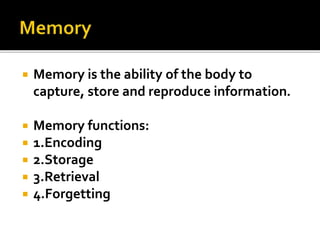
 Memory is the ability of the body to
capture, store and reproduce information.
 Memory functions:
 1.Encoding
 2.Storage
 3.Retrieval
 4.Forgetting
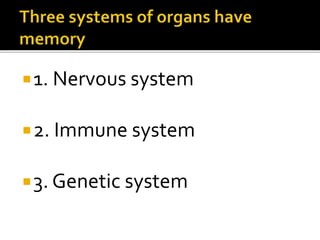
1. Nervous system
2. Immune system
3. Genetic system
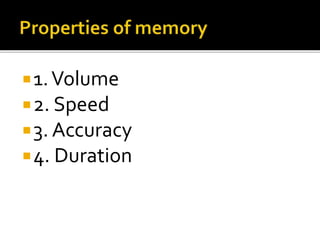
1.Volume
2. Speed
3. Accuracy
4. Duration
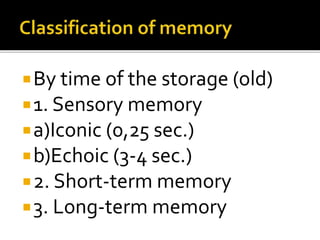
By time of the storage (old)
1. Sensory memory
a)Iconic (0,25 sec.)
b)Echoic (3-4 sec.)
2. Short-term memory
3. Long-term memory
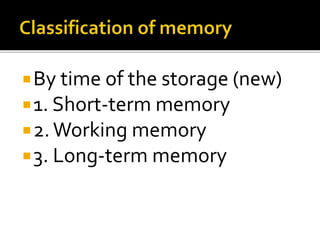
By time of the storage (new)
1. Short-term memory
2.Working memory
3. Long-term memory
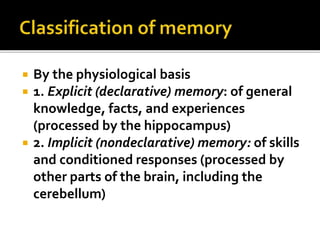
 By the physiological basis
 1. Explicit (declarative) memory: of general
knowledge, facts, and experiences
(processed by the hippocampus)
 2. Implicit (nondeclarative) memory: of skills
and conditioned responses (processed by
other parts of the brain, including the
cerebellum)
 The ability of a person to concentrate
his "cognitive processes" on a single
object in order to study it.
 concentration,
 distribution,
 volume,
 switchability,
 stability.
1) - voluntary attention
- involuntary attention
2) - Sustained attention - the ability to maintain a consistent
behavioral response during continuous and repetitive activity.
- Selective attention - the ability to maintain a behavioral or
cognitive set in the face of distracting or competing stimuli.
- Alternating attention - the ability of mental flexibility that
allows individuals to shift their focus of attention and move
between tasks having different cognitive requirements.
- Divided attention - refers to the ability to respond
simultaneously to multiple tasks or multiple task demands

2. Memory and attention.pptx

  • 2.
     Memory isthe ability of the body to capture, store and reproduce information.  Memory functions:  1.Encoding  2.Storage  3.Retrieval  4.Forgetting
  • 3.
    1. Nervous system 2.Immune system 3. Genetic system
  • 4.
  • 5.
    By time ofthe storage (old) 1. Sensory memory a)Iconic (0,25 sec.) b)Echoic (3-4 sec.) 2. Short-term memory 3. Long-term memory
  • 6.
    By time ofthe storage (new) 1. Short-term memory 2.Working memory 3. Long-term memory
  • 7.
     By thephysiological basis  1. Explicit (declarative) memory: of general knowledge, facts, and experiences (processed by the hippocampus)  2. Implicit (nondeclarative) memory: of skills and conditioned responses (processed by other parts of the brain, including the cerebellum)
  • 8.
     The abilityof a person to concentrate his "cognitive processes" on a single object in order to study it.
  • 9.
     concentration,  distribution, volume,  switchability,  stability.
  • 10.
    1) - voluntaryattention - involuntary attention 2) - Sustained attention - the ability to maintain a consistent behavioral response during continuous and repetitive activity. - Selective attention - the ability to maintain a behavioral or cognitive set in the face of distracting or competing stimuli. - Alternating attention - the ability of mental flexibility that allows individuals to shift their focus of attention and move between tasks having different cognitive requirements. - Divided attention - refers to the ability to respond simultaneously to multiple tasks or multiple task demands