STATISTICS FOR
PSYCHOLOGY I
UNIT 1
MEANING
● Numerical Facts
● Method/Methods
● Summarized Figures of Numerical Facts
NEED AND IMPORTANCE OF STATISTICS IN
EDUCATION AND PSYCHOLOGY
● Collection of evidences or facts
● Classification, organization and summarization of
numerical facts
● Drawing general conclusions and inferences [or] Making
predictions
BRANCHES OF STATISTICAL METHODS
Descriptive Statistics
Used to summarize, organize and simplify data to “Describe” a group of numbers.
Inferential Statistics
Draw conclusions and make inferences that are based on the numbers.
Make generalizations about the population from which they were selected.
BASIC CONCEPTS
Variable- Condition or characteristic that can have different values.
● It can “vary”
● Changes from one person to another
Value - Just a number / category
Score - His or her value on a variable
“On an average, a person may have an IQ between 90-110. After an intelligence test I found that
my IQ is 102”
SCALES OF MEASUREMENT
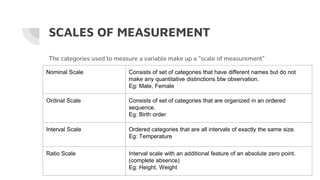
The categories used to measure a variable make up a “scale of measurement”
Nominal Scale Consists of set of categories that have different names but do not
make any quantitative distinctions btw observation.
Eg: Male, Female
Ordinal Scale Consists of set of categories that are organized in an ordered
sequence.
Eg: Birth order
Interval Scale Ordered categories that are all intervals of exactly the same size.
Eg: Temperature
Ratio Scale Interval scale with an additional feature of an absolute zero point.
(complete absence)
Eg: Height, Weight
SCALES OF MEASUREMENT
(Video Reference)
https://www.youtube.com/watch?v=eq3GNEXAXBY
https://www.youtube.com/watch?v=KhaaoPM6fmg
https://www.youtube.com/watch?v=KMFcBoSg6Ak
ORGANIZATION OF DATA
● Statistical Tables
● Rank Order
● Frequency Distribution
STATISTICAL TABLES
General Rules in Constructing Statistical table
● Title - Simple, concise and unambiguous [Appear on top of the table]
● Rows and columns - arranged in logical order
● Heading of each column should be brief. Similar headings grouped under common
topic / sub-headings.
● Subtotals for each classification and general total for all combined classes
● Units - mentioned, preferably in headings of rows/columns
● Footnotes - essential explanation - bottom of table
● Source/sources [primary/secondary] - end of the table
● Long columns - space after every five or ten rows
● Numbers - more than three significant figures - space btw every 3 numbers.
● Simple
RANK ORDER
Ascending / Descending Order
22, 4, 17, 18, 55, 9, 14, 6, 44 54, 37, 82, 77, 39, 66, 1, 63, 29, 93, 48, 39, 60, 55, 20, 71, 10,
63, 77, 40, 27, 12, 19, 5, 84, 69, 72, 81, 35, 92, 100, 52, 14, 33, 11, 99, 62, 50, 73, 19, 41
FREQUENCY DISTRIBUTION
How to Construct a Frequency Distribution Table
Step 1 - Finding the range
Range = Highest score - Lowest score
Step 2 - Determining class interval
Rule 1 → Class interval (i)
i = Range / No.of classes desired
Tate (1955)
< 50 items 10 classes
50-100 items 10-15 classes
> 100 items >15 classes *10-20 classes desirable.
Rule 2 → Class interval decided → No.of classes
Step 3 - Writing contents of the frequency distribution
*class intervals of 2, 3, 5 or 10 units
Form Frequency Distribution for:
22, 4, 17, 18, 55, 9, 14, 6, 44 54, 37, 82, 77, 39, 66, 1, 63, 29, 93, 48, 39, 60, 55, 20, 71,
10, 63, 77, 40, 27, 12, 19, 5, 84, 69, 72, 81, 35, 92, 100, 52, 14, 33, 11, 99, 62, 50, 73, 19,
41
Form Frequency Distribution for:
Marks obtained by 20 students in the test are as follows.
10, 20, 15, 5, 20, 20, 15, 15, 15, 10, 10, 10, 20, 15, 5, 18, 18, 18, 18
Form Frequency Distribution for:
100 schools decided to plant 100 tree saplings in their gardens on world environment day.
Represent the given data in the form of frequency distribution along with cumulative
frequency distribution and cumulative percentage frequency distribution. Create a statistical
table using these information.
95, 67, 28, 32, 65, 65, 69, 33, 98, 96, 76, 42, 32, 38, 42, 40, 40, 69, 95, 92, 75, 83, 76, 83, 85, 62, 37,
65, 63, 42, 89, 65, 73, 81, 49, 52, 64, 76, 83, 92, 93, 68, 52, 79, 81, 83, 59, 82, 75, 82, 86, 90, 44, 62,
31, 36, 38, 42, 39, 83, 87, 56, 58, 23, 35, 76, 83, 85, 30, 68, 69, 83, 86, 43, 45, 39, 83, 75, 66, 83, 92,
75, 89, 66, 91, 27, 88, 89, 93, 42, 53, 69, 90, 55, 66, 49, 52, 83, 34, 36

Introduction to Statistics.pptx

  • 1.
  • 2.
    MEANING ● Numerical Facts ●Method/Methods ● Summarized Figures of Numerical Facts
  • 3.
    NEED AND IMPORTANCEOF STATISTICS IN EDUCATION AND PSYCHOLOGY ● Collection of evidences or facts ● Classification, organization and summarization of numerical facts ● Drawing general conclusions and inferences [or] Making predictions
  • 4.
    BRANCHES OF STATISTICALMETHODS Descriptive Statistics Used to summarize, organize and simplify data to “Describe” a group of numbers. Inferential Statistics Draw conclusions and make inferences that are based on the numbers. Make generalizations about the population from which they were selected.
  • 5.
    BASIC CONCEPTS Variable- Conditionor characteristic that can have different values. ● It can “vary” ● Changes from one person to another Value - Just a number / category Score - His or her value on a variable “On an average, a person may have an IQ between 90-110. After an intelligence test I found that my IQ is 102”
  • 6.
    SCALES OF MEASUREMENT Thecategories used to measure a variable make up a “scale of measurement” Nominal Scale Consists of set of categories that have different names but do not make any quantitative distinctions btw observation. Eg: Male, Female Ordinal Scale Consists of set of categories that are organized in an ordered sequence. Eg: Birth order Interval Scale Ordered categories that are all intervals of exactly the same size. Eg: Temperature Ratio Scale Interval scale with an additional feature of an absolute zero point. (complete absence) Eg: Height, Weight
  • 7.
  • 8.
    SCALES OF MEASUREMENT (VideoReference) https://www.youtube.com/watch?v=eq3GNEXAXBY https://www.youtube.com/watch?v=KhaaoPM6fmg https://www.youtube.com/watch?v=KMFcBoSg6Ak
  • 9.
    ORGANIZATION OF DATA ●Statistical Tables ● Rank Order ● Frequency Distribution
  • 10.
  • 11.
    General Rules inConstructing Statistical table ● Title - Simple, concise and unambiguous [Appear on top of the table] ● Rows and columns - arranged in logical order ● Heading of each column should be brief. Similar headings grouped under common topic / sub-headings. ● Subtotals for each classification and general total for all combined classes ● Units - mentioned, preferably in headings of rows/columns ● Footnotes - essential explanation - bottom of table ● Source/sources [primary/secondary] - end of the table ● Long columns - space after every five or ten rows ● Numbers - more than three significant figures - space btw every 3 numbers. ● Simple
  • 13.
    RANK ORDER Ascending /Descending Order 22, 4, 17, 18, 55, 9, 14, 6, 44 54, 37, 82, 77, 39, 66, 1, 63, 29, 93, 48, 39, 60, 55, 20, 71, 10, 63, 77, 40, 27, 12, 19, 5, 84, 69, 72, 81, 35, 92, 100, 52, 14, 33, 11, 99, 62, 50, 73, 19, 41
  • 14.
  • 15.
    How to Constructa Frequency Distribution Table Step 1 - Finding the range Range = Highest score - Lowest score Step 2 - Determining class interval Rule 1 → Class interval (i) i = Range / No.of classes desired Tate (1955) < 50 items 10 classes 50-100 items 10-15 classes > 100 items >15 classes *10-20 classes desirable.
  • 16.
    Rule 2 →Class interval decided → No.of classes Step 3 - Writing contents of the frequency distribution *class intervals of 2, 3, 5 or 10 units
  • 17.
    Form Frequency Distributionfor: 22, 4, 17, 18, 55, 9, 14, 6, 44 54, 37, 82, 77, 39, 66, 1, 63, 29, 93, 48, 39, 60, 55, 20, 71, 10, 63, 77, 40, 27, 12, 19, 5, 84, 69, 72, 81, 35, 92, 100, 52, 14, 33, 11, 99, 62, 50, 73, 19, 41
  • 18.
    Form Frequency Distributionfor: Marks obtained by 20 students in the test are as follows. 10, 20, 15, 5, 20, 20, 15, 15, 15, 10, 10, 10, 20, 15, 5, 18, 18, 18, 18
  • 19.
    Form Frequency Distributionfor: 100 schools decided to plant 100 tree saplings in their gardens on world environment day. Represent the given data in the form of frequency distribution along with cumulative frequency distribution and cumulative percentage frequency distribution. Create a statistical table using these information. 95, 67, 28, 32, 65, 65, 69, 33, 98, 96, 76, 42, 32, 38, 42, 40, 40, 69, 95, 92, 75, 83, 76, 83, 85, 62, 37, 65, 63, 42, 89, 65, 73, 81, 49, 52, 64, 76, 83, 92, 93, 68, 52, 79, 81, 83, 59, 82, 75, 82, 86, 90, 44, 62, 31, 36, 38, 42, 39, 83, 87, 56, 58, 23, 35, 76, 83, 85, 30, 68, 69, 83, 86, 43, 45, 39, 83, 75, 66, 83, 92, 75, 89, 66, 91, 27, 88, 89, 93, 42, 53, 69, 90, 55, 66, 49, 52, 83, 34, 36