MANAGING Tough Times
Business Plan VS Feasibility
Study
MANAGING Tough Times
Business Plan
• It`s a management tool used to simplify
and explain objectives and work plans,
it`s used to convince others in a simple,
clear, short, organized, comprehensive
and inspiring way
• it`s a document that determines the
objectives and the methodology to
manage activities to achieve those
objectives
MANAGING Tough Times
Main Uses
• Planning tool
• Promotion and communication
• Implementation guidance
• Financing purposes
• Monitoring and control
• Developmental stages
• Official use
MANAGING Tough Times
Business Plan - TOC
1. Cover page and title
2. Executive summary
3. Project overview
4. Product / service provided
5. Market analysis
6. Marketing plan
7. Operational and administrative plan
8. Developmental plan
9. Investment and financial plan
10.Legislative identity
11.Action plan
12.Appendices
MANAGING Tough Times
What is a Feasibility Study
Is this a good business idea?
Helps answer the question of
whether to go forward with the
business idea.
MANAGING Tough Times
What is a Feasibility Study
A feasibility study is valuable for:
• Starting a new business
• Expansion of an existing business
• Adding an enterprise to an existing
business
• Purchasing an existing business
MANAGING Tough Times
What is a Feasibility Study
A feasible business will:
• Generate adequate cash flow and profits,
• Withstand risks,
• Remain viable in the long-term
• Meet the goals of the founders
MANAGING Tough Times
What is a Feasibility Study
Evaluate Alternatives
The feasibility study helps to “frame” and
“flesh-out” specific business scenarios
so they can be studied in-depth.
MANAGING Tough Times
What is a Feasibility Study
Pre-Feasibility Study
May help sort our alternatives and
determine if a full-blown feasibility study
is warranted.
MANAGING Tough Times
What is a Feasibility Study
Market Assessment
A market assessment may be conducted
first to identify market opportunities. If
no opportunities exist, there may be no
reason to proceed further.
MANAGING Tough Times
What is a Feasibility Study
Study Results
Outline in depth the various business
scenarios examined and the
implications, strengths and weaknesses
of each.
MANAGING Tough Times
What is a Feasibility Study
Go/No Go Decision
The feasibility study will be a major
information source in making this critical
decision.
MANAGING Tough Times
Reasons Not to do a Study
• We already know it is feasible.
• We did a study a couple of years ago.
• Just a way for consultants to make money.
• The company selling us the equipment says it
is feasible.
• Lets hire a general manager and have him do
the study.
• Waste of time – we need to buy the site and
begin construction.
MANAGING Tough Times
Reasons to Do a Study
• Gives focus to the project.
• Narrows the business alternatives.
• Identifies new opportunities.
• Identifies reasons not to proceed.
• Provides valuable information for “go/no go”
decision.
• Increases probability of business success by
identifying weaknesses early.
MANAGING Tough Times
Reasons to Do a Study
• Provides documentation that the idea was
thoroughly investigated.
• Helps attract funding from lenders, grant
providers, etc.
• Helps attract equity investment
MANAGING Tough Times
Pre-Feasibility Study
• Examines overall potential of project
• Should maintain same quality of information across
all variables
• Wherever possible should use secondary
information
Key questions:
a. Is this project financially and economically feasible
throughout the project’s life?
b. What are the key variables?
c. What are the sources of risk?
d. How can the risk be reduced?
MANAGING Tough Times
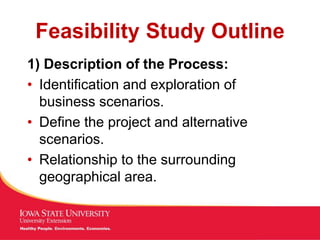
Feasibility Study Outline
1) Description of the Process:
• Identification and exploration of
business scenarios.
• Define the project and alternative
scenarios.
• Relationship to the surrounding
geographical area.
MANAGING Tough Times
Feasibility Study Outline
2) Market Feasibility
• Industry description.
• Industry competitiveness.
• Market potential
• Access to market outlets.
• Sales projection
MANAGING Tough Times
Feasibility Study Outline
3) Technical Feasibility
• Determine facility needs.
• Suitability of production technology.
• Availability and suitable of site.
• Raw materials.
• Other inputs.
MANAGING Tough Times
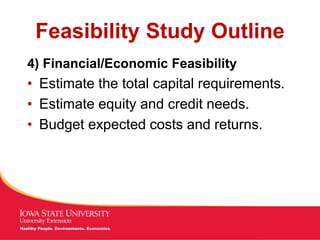
Feasibility Study Outline
4) Financial/Economic Feasibility
• Estimate the total capital requirements.
• Estimate equity and credit needs.
• Budget expected costs and returns.
MANAGING Tough Times
Feasibility Study Outline
5) Organizational/Managerial
Feasibility
• Business Structure
• Business Founders
MANAGING Tough Times
To complement the feasibility
study:
• What about the environmental study?
• What about the social study?
• What about the sensitivity analysis?
• Cost benefit analysis!
MANAGING Tough Times
Social and Stakeholder Analysis
• Local Government
• Consumers
• Operator/Utility
• Vulnerable groups
• Wider community
• Financier
 Ultimately all ventures
are about people!
 It’s more important to
understand the people
than the technology:
Who gains? Who loses?
 Social and distribution
analysis of project effects
(different beneficiaries)
 Poverty Impact Analysis
MANAGING Tough Times
Environmental Impact Analysis
 Assessment of project impacts to physical and
also non-physical environmental aspects:
Physical (water, air, land)
Biodiversity
Nuances (noise, odors)
Safety
Aesthetics, cultural and historical heritage
 Two possible levels of assessment:
Preliminary (Initial) Environmental Review
Full Environmental Impact Assessment
MANAGING Tough Times
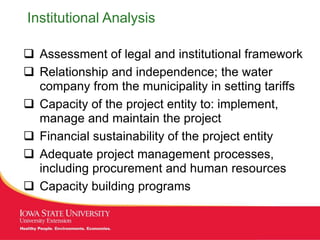
Institutional Analysis
 Assessment of legal and institutional framework
 Relationship and independence; the water
company from the municipality in setting tariffs
 Capacity of the project entity to: implement,
manage and maintain the project
 Financial sustainability of the project entity
 Adequate project management processes,
including procurement and human resources
 Capacity building programs
MANAGING Tough Times
Sensitivity and Risk Analysis
 A technique for investigating the impact of
changes in project variables
 Identify key variables which influence project
costs and benefits
 Investigate the consequences of likely adverse
changes
 Identify mitigation actions
 Qualitative Risk Analysis at the: project level,
sector level and national level
MANAGING Tough Times
Economic Cost-Benefit Analysis of a Project
 Purpose: To assess the project economic
worth to the country
 Evaluates and calculates the project’s
economic benefits and costs to the whole
economy in constant economy prices
(adjusted financial prices) including external
benefits:
Environmental benefits
Health effects
Non-technical losses
MANAGING Tough Times
Feasibility Study Outline
Study Results
• Identify and describe various business
scenarios.
• Compare and contrast scenarios.
• Outline criteria for decision making.
MANAGING Tough Times
When to Do & How to Use
• When to do a Study?
• Who will do the Analysis?
• How will you Monitor the Study Progress?
• How to Accept or Reject the Study?
• How to Use the Results?
MANAGING Tough Times
Summary
• The feasibility analysis is an internationally
accepted process used to evaluate various
project dimensions important for achieving
the desired project benefits.
• An effective tool for appraising the project
from standpoints of all project stakeholders
• It is not a waste of time. It significantly
reduces the risks in project implementation
MANAGING Tough Times
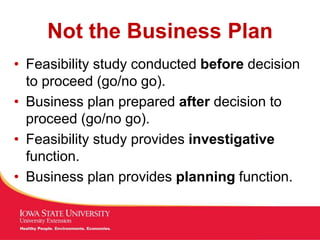
Not the Business Plan
• Feasibility study conducted before decision
to proceed (go/no go).
• Business plan prepared after decision to
proceed (go/no go).
• Feasibility study provides investigative
function.
• Business plan provides planning function.
MANAGING Tough Times
Not the Business Plan
• The business plan provides a planning
function and outlines the actions needed to
take the proposal from “idea” to “reality”
• The feasibility study outlines and analyzes
several alternatives and identifies the best
business scenario(s).
• The business plan deals with only one
alternative or scenario.
MANAGING Tough Times
Not the Business Plan
• The feasibility study is conducted before the
business plan. A business plan is prepared
only after the business venture has been
deemed to be feasible
• It provides a “roadmap” of how the business
will be created and developed.
• The business plan provides the “blueprint” for
project implementation.

Business Plan VS Feasibility study

  • 1.
    MANAGING Tough Times BusinessPlan VS Feasibility Study
  • 2.
  • 3.
    MANAGING Tough Times BusinessPlan • It`s a management tool used to simplify and explain objectives and work plans, it`s used to convince others in a simple, clear, short, organized, comprehensive and inspiring way • it`s a document that determines the objectives and the methodology to manage activities to achieve those objectives
  • 4.
    MANAGING Tough Times MainUses • Planning tool • Promotion and communication • Implementation guidance • Financing purposes • Monitoring and control • Developmental stages • Official use
  • 5.
    MANAGING Tough Times BusinessPlan - TOC 1. Cover page and title 2. Executive summary 3. Project overview 4. Product / service provided 5. Market analysis 6. Marketing plan 7. Operational and administrative plan 8. Developmental plan 9. Investment and financial plan 10.Legislative identity 11.Action plan 12.Appendices
  • 6.
    MANAGING Tough Times Whatis a Feasibility Study Is this a good business idea? Helps answer the question of whether to go forward with the business idea.
  • 7.
    MANAGING Tough Times Whatis a Feasibility Study A feasibility study is valuable for: • Starting a new business • Expansion of an existing business • Adding an enterprise to an existing business • Purchasing an existing business
  • 8.
    MANAGING Tough Times Whatis a Feasibility Study A feasible business will: • Generate adequate cash flow and profits, • Withstand risks, • Remain viable in the long-term • Meet the goals of the founders
  • 9.
    MANAGING Tough Times Whatis a Feasibility Study Evaluate Alternatives The feasibility study helps to “frame” and “flesh-out” specific business scenarios so they can be studied in-depth.
  • 10.
    MANAGING Tough Times Whatis a Feasibility Study Pre-Feasibility Study May help sort our alternatives and determine if a full-blown feasibility study is warranted.
  • 11.
    MANAGING Tough Times Whatis a Feasibility Study Market Assessment A market assessment may be conducted first to identify market opportunities. If no opportunities exist, there may be no reason to proceed further.
  • 12.
    MANAGING Tough Times Whatis a Feasibility Study Study Results Outline in depth the various business scenarios examined and the implications, strengths and weaknesses of each.
  • 13.
    MANAGING Tough Times Whatis a Feasibility Study Go/No Go Decision The feasibility study will be a major information source in making this critical decision.
  • 14.
    MANAGING Tough Times ReasonsNot to do a Study • We already know it is feasible. • We did a study a couple of years ago. • Just a way for consultants to make money. • The company selling us the equipment says it is feasible. • Lets hire a general manager and have him do the study. • Waste of time – we need to buy the site and begin construction.
  • 15.
    MANAGING Tough Times Reasonsto Do a Study • Gives focus to the project. • Narrows the business alternatives. • Identifies new opportunities. • Identifies reasons not to proceed. • Provides valuable information for “go/no go” decision. • Increases probability of business success by identifying weaknesses early.
  • 16.
    MANAGING Tough Times Reasonsto Do a Study • Provides documentation that the idea was thoroughly investigated. • Helps attract funding from lenders, grant providers, etc. • Helps attract equity investment
  • 17.
    MANAGING Tough Times Pre-FeasibilityStudy • Examines overall potential of project • Should maintain same quality of information across all variables • Wherever possible should use secondary information Key questions: a. Is this project financially and economically feasible throughout the project’s life? b. What are the key variables? c. What are the sources of risk? d. How can the risk be reduced?
  • 18.
    MANAGING Tough Times FeasibilityStudy Outline 1) Description of the Process: • Identification and exploration of business scenarios. • Define the project and alternative scenarios. • Relationship to the surrounding geographical area.
  • 19.
    MANAGING Tough Times FeasibilityStudy Outline 2) Market Feasibility • Industry description. • Industry competitiveness. • Market potential • Access to market outlets. • Sales projection
  • 20.
    MANAGING Tough Times FeasibilityStudy Outline 3) Technical Feasibility • Determine facility needs. • Suitability of production technology. • Availability and suitable of site. • Raw materials. • Other inputs.
  • 21.
    MANAGING Tough Times FeasibilityStudy Outline 4) Financial/Economic Feasibility • Estimate the total capital requirements. • Estimate equity and credit needs. • Budget expected costs and returns.
  • 22.
    MANAGING Tough Times FeasibilityStudy Outline 5) Organizational/Managerial Feasibility • Business Structure • Business Founders
  • 23.
    MANAGING Tough Times Tocomplement the feasibility study: • What about the environmental study? • What about the social study? • What about the sensitivity analysis? • Cost benefit analysis!
  • 24.
    MANAGING Tough Times Socialand Stakeholder Analysis • Local Government • Consumers • Operator/Utility • Vulnerable groups • Wider community • Financier  Ultimately all ventures are about people!  It’s more important to understand the people than the technology: Who gains? Who loses?  Social and distribution analysis of project effects (different beneficiaries)  Poverty Impact Analysis
  • 25.
    MANAGING Tough Times EnvironmentalImpact Analysis  Assessment of project impacts to physical and also non-physical environmental aspects: Physical (water, air, land) Biodiversity Nuances (noise, odors) Safety Aesthetics, cultural and historical heritage  Two possible levels of assessment: Preliminary (Initial) Environmental Review Full Environmental Impact Assessment
  • 26.
    MANAGING Tough Times InstitutionalAnalysis  Assessment of legal and institutional framework  Relationship and independence; the water company from the municipality in setting tariffs  Capacity of the project entity to: implement, manage and maintain the project  Financial sustainability of the project entity  Adequate project management processes, including procurement and human resources  Capacity building programs
  • 27.
    MANAGING Tough Times Sensitivityand Risk Analysis  A technique for investigating the impact of changes in project variables  Identify key variables which influence project costs and benefits  Investigate the consequences of likely adverse changes  Identify mitigation actions  Qualitative Risk Analysis at the: project level, sector level and national level
  • 28.
    MANAGING Tough Times EconomicCost-Benefit Analysis of a Project  Purpose: To assess the project economic worth to the country  Evaluates and calculates the project’s economic benefits and costs to the whole economy in constant economy prices (adjusted financial prices) including external benefits: Environmental benefits Health effects Non-technical losses
  • 29.
    MANAGING Tough Times FeasibilityStudy Outline Study Results • Identify and describe various business scenarios. • Compare and contrast scenarios. • Outline criteria for decision making.
  • 30.
    MANAGING Tough Times Whento Do & How to Use • When to do a Study? • Who will do the Analysis? • How will you Monitor the Study Progress? • How to Accept or Reject the Study? • How to Use the Results?
  • 31.
    MANAGING Tough Times Summary •The feasibility analysis is an internationally accepted process used to evaluate various project dimensions important for achieving the desired project benefits. • An effective tool for appraising the project from standpoints of all project stakeholders • It is not a waste of time. It significantly reduces the risks in project implementation
  • 32.
    MANAGING Tough Times Notthe Business Plan • Feasibility study conducted before decision to proceed (go/no go). • Business plan prepared after decision to proceed (go/no go). • Feasibility study provides investigative function. • Business plan provides planning function.
  • 33.
    MANAGING Tough Times Notthe Business Plan • The business plan provides a planning function and outlines the actions needed to take the proposal from “idea” to “reality” • The feasibility study outlines and analyzes several alternatives and identifies the best business scenario(s). • The business plan deals with only one alternative or scenario.
  • 34.
    MANAGING Tough Times Notthe Business Plan • The feasibility study is conducted before the business plan. A business plan is prepared only after the business venture has been deemed to be feasible • It provides a “roadmap” of how the business will be created and developed. • The business plan provides the “blueprint” for project implementation.