Human Resource Management
Fifteenth Edition
Chapter 6
Employee Testing
and Selection
Copyright © 2017, 2015, 2013 Pearson Education, Inc. All Rights Reserved
Learning Objectives (1 of 2)
6-1. Answer the question: Why is it important to
test and select employees?
6-2. Explain what is meant by reliability and
validity.
Copyright © 2017, 2015, 2013 Pearson Education, Inc. All Rights Reserved
6-3. List and briefly describe the basic categories of
selection tests, with examples.
6-4. Explain how to use two work simulations for
selection.
6-5. Describe four ways to improve an employer’s
background checking process.
Learning Objectives (2 of 2)
Copyright © 2017, 2015, 2013 Pearson Education, Inc. All Rights Reserved
I.
Answer the question: Why is it
important to test and select
employees?
Copyright © 2017, 2015, 2013 Pearson Education, Inc. All Rights Reserved
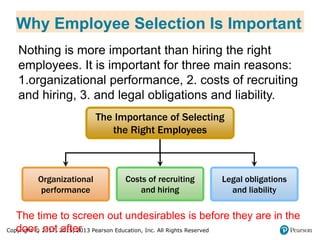
Why Employee Selection Is Important
Organizational
performance
Costs of recruiting
and hiring
The Importance of Selecting
the Right Employees
Legal obligations
and liability
Nothing is more important than hiring the right
employees. It is important for three main reasons:
1.organizational performance, 2. costs of recruiting
and hiring, 3. and legal obligations and liability.
The time to screen out undesirables is before they are in the
door, not after
Copyright © 2017, 2015, 2013 Pearson Education, Inc. All Rights Reserved
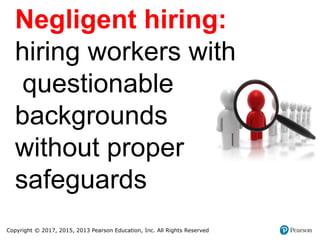
Negligent hiring:
hiring workers with
questionable
backgrounds
without proper
safeguards
Copyright © 2017, 2015, 2013 Pearson Education, Inc. All Rights Reserved
Person and job/organization fit
The main aim of employee
selection is to achieve person-job
fit.
person-job fit: refers to matching (1) the
knowledge, skills, abilities (KSAs), and
competencies that are central to
performing the job ( as determined by job
analysis) With (2) the prospective
employee’s knowledge, skills, abilities ,
and competencies
Copyright © 2017, 2015, 2013 Pearson Education, Inc. All Rights Reserved
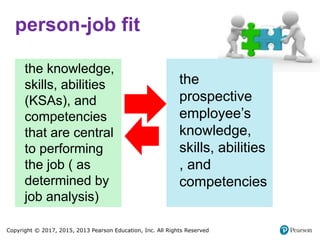
person-job fit
the knowledge,
skills, abilities
(KSAs), and
competencies
that are central
to performing
the job ( as
determined by
job analysis)
the
prospective
employee’s
knowledge,
skills, abilities
, and
competencies
Copyright © 2017, 2015, 2013 Pearson Education, Inc. All Rights Reserved
person- organization fit
A candidate might be “ right” for
a job, but wrong for the
organization. Employers should
care about person-organization
fit as well
Copyright © 2017, 2015, 2013 Pearson Education, Inc. All Rights Reserved
II.
Explain what is meant by
reliability and validity.
Copyright © 2017, 2015, 2013 Pearson Education, Inc. All Rights Reserved
Basic Testing Concepts
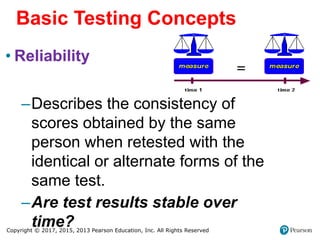
• Reliability
–Describes the consistency of
scores obtained by the same
person when retested with the
identical or alternate forms of the
same test.
–Are test results stable over
time?
Copyright © 2017, 2015, 2013 Pearson Education, Inc. All Rights Reserved
Test Validity
Indicates whether a test is measuring
what it is supposed to be measuring.
Does the test actually measure what
it’s supposed to measure?
Copyright © 2017, 2015, 2013 Pearson Education, Inc. All Rights Reserved
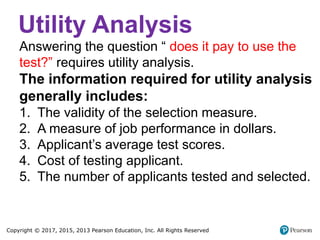
Utility Analysis
Answering the question “ does it pay to use the
test?” requires utility analysis.
The information required for utility analysis
generally includes:
1. The validity of the selection measure.
2. A measure of job performance in dollars.
3. Applicant’s average test scores.
4. Cost of testing applicant.
5. The number of applicants tested and selected.
Copyright © 2017, 2015, 2013 Pearson Education, Inc. All Rights Reserved
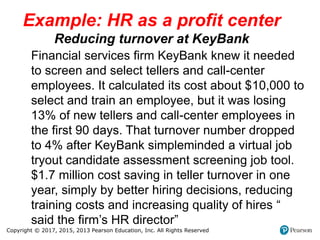
Example: HR as a profit center
Reducing turnover at KeyBank
Financial services firm KeyBank knew it needed
to screen and select tellers and call-center
employees. It calculated its cost about $10,000 to
select and train an employee, but it was losing
13% of new tellers and call-center employees in
the first 90 days. That turnover number dropped
to 4% after KeyBank simpleminded a virtual job
tryout candidate assessment screening job tool.
$1.7 million cost saving in teller turnover in one
year, simply by better hiring decisions, reducing
training costs and increasing quality of hires “
said the firm’s HR director”
Copyright © 2017, 2015, 2013 Pearson Education, Inc. All Rights Reserved
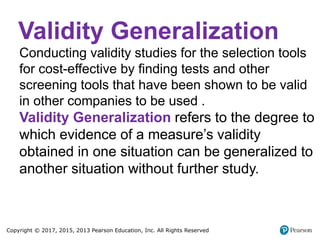
Validity Generalization
Conducting validity studies for the selection tools
for cost-effective by finding tests and other
screening tools that have been shown to be valid
in other companies to be used .
Validity Generalization refers to the degree to
which evidence of a measure’s validity
obtained in one situation can be generalized to
another situation without further study.
Copyright © 2017, 2015, 2013 Pearson Education, Inc. All Rights Reserved
III.
List and briefly describe the
basic categories of selection
tests, with examples.
Copyright © 2017, 2015, 2013 Pearson Education, Inc. All Rights Reserved
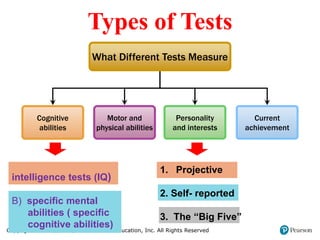
Types of Tests
We can classify tests according to whether they
measure:
1. Cognitive (mental) abilities.
2. Motor and physical abilities.
3. Personality and interests
4. Achievement.
Copyright © 2017, 2015, 2013 Pearson Education, Inc. All Rights Reserved
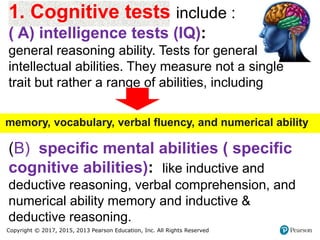
1. Cognitive tests include :
( A) intelligence tests (IQ):
general reasoning ability. Tests for general
intellectual abilities. They measure not a single
trait but rather a range of abilities, including
(B) specific mental abilities ( specific
cognitive abilities): like inductive and
deductive reasoning, verbal comprehension, and
numerical ability memory and inductive &
deductive reasoning.
memory, vocabulary, verbal fluency, and numerical ability
Copyright © 2017, 2015, 2013 Pearson Education, Inc. All Rights Reserved
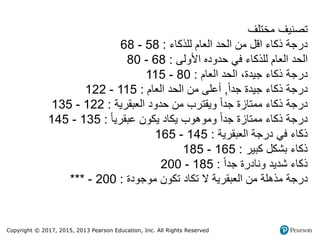
‫مختلف‬ ‫تصنيف‬
‫للذكاء‬ ‫العام‬ ‫الحد‬ ‫من‬ ‫اقل‬ ‫ذكاء‬ ‫درجة‬:58-68
‫األولى‬ ‫حدوده‬ ‫في‬ ‫للذكاء‬ ‫العام‬ ‫الحد‬:68-80
‫العام‬ ‫الحد‬ ،‫جيدة‬ ‫ذكاء‬ ‫درجة‬:80-115
‫جدا‬ ‫جيدة‬ ‫ذكاء‬ ‫درجة‬,‫العام‬ ‫الحد‬ ‫من‬ ‫أعلى‬:115-122
‫العبقرية‬ ‫حدود‬ ‫من‬ ‫ويقترب‬ ‫جدا‬ ‫ممتازة‬ ‫ذكاء‬ ‫درجة‬:122-135
‫عبقريا‬ ‫يكون‬ ‫يكاد‬ ‫وموهوب‬ ‫جدا‬ ‫ممتازة‬ ‫ذكاء‬ ‫درجة‬:135-145
‫العبقرية‬ ‫درجة‬ ‫في‬ ‫ذكاء‬:145-165
‫كبير‬ ‫بشكل‬ ‫ذكاء‬:165-185
‫جدا‬ ‫ونادرة‬ ‫شديد‬ ‫ذكاء‬:185-200
‫موجودة‬ ‫تكون‬ ‫تكاد‬ ‫ال‬ ‫العبقرية‬ ‫من‬ ‫مذهلة‬ ‫درجة‬:200-***
Copyright © 2017, 2015, 2013 Pearson Education, Inc. All Rights Reserved
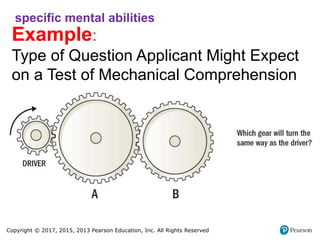
Example:
Type of Question Applicant Might Expect
on a Test of Mechanical Comprehension
specific mental abilities
Copyright © 2017, 2015, 2013 Pearson Education, Inc. All Rights Reserved
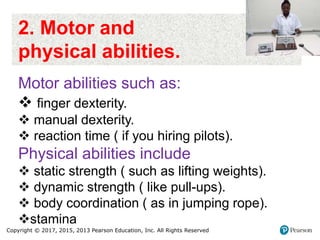
2. Motor and
physical abilities.
Motor abilities such as:
 finger dexterity.
 manual dexterity.
 reaction time ( if you hiring pilots).
Physical abilities include
 static strength ( such as lifting weights).
 dynamic strength ( like pull-ups).
 body coordination ( as in jumping rope).
stamina
Copyright © 2017, 2015, 2013 Pearson Education, Inc. All Rights Reserved
3. Measuring
personality and interests.
A person’s cognitive and
physical abilities alone seldom
explain his or her job performance. Other
factors, like motivation and interpersonal
skills, are very important.
“ most people are hired based on qualification, but
are fired for non performance” .
Nonperformance “ is usually the result of personal
characteristics, such as attitude, motivation, and
especially, temperament.
Copyright © 2017, 2015, 2013 Pearson Education, Inc. All Rights Reserved
What do Personality tests measure?
basic aspects of an applicant’s personality, such as
introversion, stability, and motivation.
Some of these tests are:
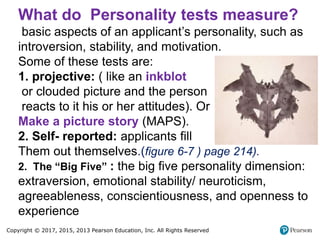
1. projective: ( like an inkblot
or clouded picture and the person
reacts to it his or her attitudes). Or
Make a picture story (MAPS).
2. Self- reported: applicants fill
Them out themselves.(figure 6-7 ) page 214).
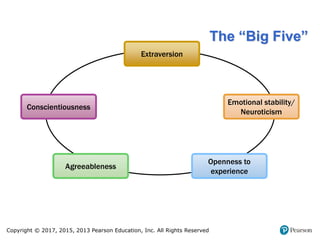
2. The “Big Five” : the big five personality dimension:
extraversion, emotional stability/ neuroticism,
agreeableness, conscientiousness, and openness to
experience
Copyright © 2017, 2015, 2013 Pearson Education, Inc. All Rights Reserved
The “Big Five”
Extraversion
Emotional stability/
Neuroticism
Agreeableness
Openness to
experience
Conscientiousness
Copyright © 2017, 2015, 2013 Pearson Education, Inc. All Rights Reserved
4. Achievement tests
measure what someone has learned.
Most of the tests you take in school
are achievement tests. They
measure your “job knowledge” in
areas like economics, marketing, or
human resources.
Copyright © 2017, 2015, 2013 Pearson Education, Inc. All Rights Reserved
Types of Tests
Cognitive
abilities
Motor and
physical abilities
Personality
and interests
What Different Tests Measure
Current
achievement
intelligence tests (IQ)
B) specific mental
abilities ( specific
cognitive abilities)
1. Projective
2. Self- reported
3. The “Big Five”
Copyright © 2017, 2015, 2013 Pearson Education, Inc. All Rights Reserved
Work Samples and Simulations
1. Work samples: actual job tasks used in
testing applicant’s performance
( measuring performance directly ).
•Work sampling: differ from most tests, because
they measure job performance directly ( for example for
a cashier may include operating a cash register and
counting money).
examinees are presented with situations
representative of the job for which they’re
applying, and are evaluated on their
responses.
Copyright © 2017, 2015, 2013 Pearson Education, Inc. All Rights Reserved
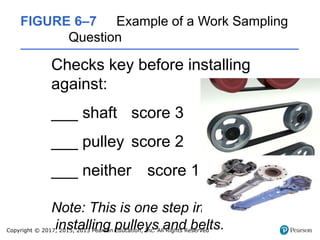
FIGURE 6–7 Example of a Work Sampling
Question
Checks key before installing
against:
___ shaft score 3
___ pulley score 2
___ neither score 1
Note: This is one step in
installing pulleys and belts.
Copyright © 2017, 2015, 2013 Pearson Education, Inc. All Rights Reserved
Situational judgment tests
Are personnel tests “ designed to
asses applicant’s judgment regarding
a situation encountered in the
workplace”.
They are effective and widely used.
Copyright © 2017, 2015, 2013 Pearson Education, Inc. All Rights Reserved
3. Management assessment centers: is two
to three days simulation in which 10 to 12
candidates perform realistic tasks( like
making presentations) in hypothetical
situation and are scored on their
performance. It involves testing and the
use of management games
Copyright © 2017, 2015, 2013 Pearson Education, Inc. All Rights Reserved
Situational testing and video-based
situational testing
1. Situational test: a test that requires
examinees to respond to situations
representative of the job
2. Video-based simulation: a situational
test in which examinees respond to
video simulation of realistic job
situations
Copyright © 2017, 2015, 2013 Pearson Education, Inc. All Rights Reserved
6. The miniature job training and
evaluation approach: training
candidates to perform several of the
job’s tasks, and then evaluating the
candidates’ performance prior to hire.
( example: HONDA company)
Copyright © 2017, 2015, 2013 Pearson Education, Inc. All Rights Reserved
Realistic job previews: applicants who
receive realistic job previews are more
likely to turn down job offers, but firms
are more likely to have lower turnover.
( example: Walmart found that many new
associates quit within the first 90 days)
Copyright © 2017, 2015, 2013 Pearson Education, Inc. All Rights Reserved
Background Investigations and
Other Selection Methods
• Testing is only part of an employer’s selection
process, other tools may include:
– Background investigation and reference
checks
– Preemployment information services
– Honesty testing
– graphology
– Substance abuse screening
Copyright © 2017, 2015, 2013 Pearson Education, Inc. All Rights Reserved
Why perform Background
investigation and reference
checks?
To verify factual information
provided by applicants
To uncover damaging
information such as criminal
records
To avoid hiring mistakes
Copyright © 2017, 2015, 2013 Pearson Education, Inc. All Rights Reserved
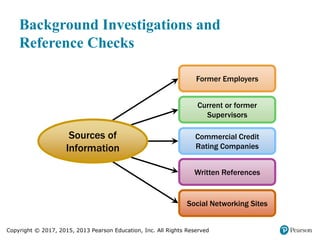
Background Investigations and
Reference Checks
Former Employers
Current or former
Supervisors
Written References
Social Networking Sites
Commercial Credit
Rating Companies
Sources of
Information
Copyright © 2017, 2015, 2013 Pearson Education, Inc. All Rights Reserved
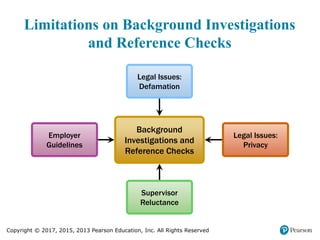
Limitations on Background Investigations
and Reference Checks
Background
Investigations and
Reference Checks
Supervisor
Reluctance
Employer
Guidelines
Legal Issues:
Privacy
Legal Issues:
Defamation
Copyright © 2017, 2015, 2013 Pearson Education, Inc. All Rights Reserved
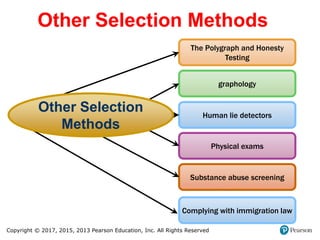
Other Selection Methods
The Polygraph and Honesty
Testing
graphology
Physical exams
Substance abuse screening
Human lie detectors
Complying with immigration law
Other Selection
Methods
Copyright © 2017, 2015, 2013 Pearson Education, Inc. All Rights Reserved
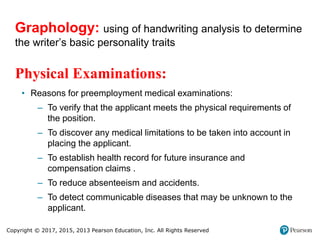
Physical Examinations:
• Reasons for preemployment medical examinations:
– To verify that the applicant meets the physical requirements of
the position.
– To discover any medical limitations to be taken into account in
placing the applicant.
– To establish health record for future insurance and
compensation claims .
– To reduce absenteeism and accidents.
– To detect communicable diseases that may be unknown to the
applicant.
Graphology: using of handwriting analysis to determine
the writer’s basic personality traits
Copyright © 2017, 2015, 2013 Pearson Education, Inc. All Rights Reserved
Copyright

Employee Testing and selection /Human Resource Management

  • 1.
    Human Resource Management FifteenthEdition Chapter 6 Employee Testing and Selection Copyright © 2017, 2015, 2013 Pearson Education, Inc. All Rights Reserved
  • 2.
    Copyright © 2017,2015, 2013 Pearson Education, Inc. All Rights Reserved Learning Objectives (1 of 2) 6-1. Answer the question: Why is it important to test and select employees? 6-2. Explain what is meant by reliability and validity.
  • 3.
    Copyright © 2017,2015, 2013 Pearson Education, Inc. All Rights Reserved 6-3. List and briefly describe the basic categories of selection tests, with examples. 6-4. Explain how to use two work simulations for selection. 6-5. Describe four ways to improve an employer’s background checking process. Learning Objectives (2 of 2)
  • 4.
    Copyright © 2017,2015, 2013 Pearson Education, Inc. All Rights Reserved I. Answer the question: Why is it important to test and select employees?
  • 5.
    Copyright © 2017,2015, 2013 Pearson Education, Inc. All Rights Reserved Why Employee Selection Is Important Organizational performance Costs of recruiting and hiring The Importance of Selecting the Right Employees Legal obligations and liability Nothing is more important than hiring the right employees. It is important for three main reasons: 1.organizational performance, 2. costs of recruiting and hiring, 3. and legal obligations and liability. The time to screen out undesirables is before they are in the door, not after
  • 6.
    Copyright © 2017,2015, 2013 Pearson Education, Inc. All Rights Reserved Negligent hiring: hiring workers with questionable backgrounds without proper safeguards
  • 7.
    Copyright © 2017,2015, 2013 Pearson Education, Inc. All Rights Reserved Person and job/organization fit The main aim of employee selection is to achieve person-job fit. person-job fit: refers to matching (1) the knowledge, skills, abilities (KSAs), and competencies that are central to performing the job ( as determined by job analysis) With (2) the prospective employee’s knowledge, skills, abilities , and competencies
  • 8.
    Copyright © 2017,2015, 2013 Pearson Education, Inc. All Rights Reserved person-job fit the knowledge, skills, abilities (KSAs), and competencies that are central to performing the job ( as determined by job analysis) the prospective employee’s knowledge, skills, abilities , and competencies
  • 9.
    Copyright © 2017,2015, 2013 Pearson Education, Inc. All Rights Reserved person- organization fit A candidate might be “ right” for a job, but wrong for the organization. Employers should care about person-organization fit as well
  • 10.
    Copyright © 2017,2015, 2013 Pearson Education, Inc. All Rights Reserved II. Explain what is meant by reliability and validity.
  • 11.
    Copyright © 2017,2015, 2013 Pearson Education, Inc. All Rights Reserved Basic Testing Concepts • Reliability –Describes the consistency of scores obtained by the same person when retested with the identical or alternate forms of the same test. –Are test results stable over time?
  • 12.
    Copyright © 2017,2015, 2013 Pearson Education, Inc. All Rights Reserved Test Validity Indicates whether a test is measuring what it is supposed to be measuring. Does the test actually measure what it’s supposed to measure?
  • 13.
    Copyright © 2017,2015, 2013 Pearson Education, Inc. All Rights Reserved Utility Analysis Answering the question “ does it pay to use the test?” requires utility analysis. The information required for utility analysis generally includes: 1. The validity of the selection measure. 2. A measure of job performance in dollars. 3. Applicant’s average test scores. 4. Cost of testing applicant. 5. The number of applicants tested and selected.
  • 14.
    Copyright © 2017,2015, 2013 Pearson Education, Inc. All Rights Reserved Example: HR as a profit center Reducing turnover at KeyBank Financial services firm KeyBank knew it needed to screen and select tellers and call-center employees. It calculated its cost about $10,000 to select and train an employee, but it was losing 13% of new tellers and call-center employees in the first 90 days. That turnover number dropped to 4% after KeyBank simpleminded a virtual job tryout candidate assessment screening job tool. $1.7 million cost saving in teller turnover in one year, simply by better hiring decisions, reducing training costs and increasing quality of hires “ said the firm’s HR director”
  • 15.
    Copyright © 2017,2015, 2013 Pearson Education, Inc. All Rights Reserved Validity Generalization Conducting validity studies for the selection tools for cost-effective by finding tests and other screening tools that have been shown to be valid in other companies to be used . Validity Generalization refers to the degree to which evidence of a measure’s validity obtained in one situation can be generalized to another situation without further study.
  • 16.
    Copyright © 2017,2015, 2013 Pearson Education, Inc. All Rights Reserved III. List and briefly describe the basic categories of selection tests, with examples.
  • 17.
    Copyright © 2017,2015, 2013 Pearson Education, Inc. All Rights Reserved Types of Tests We can classify tests according to whether they measure: 1. Cognitive (mental) abilities. 2. Motor and physical abilities. 3. Personality and interests 4. Achievement.
  • 18.
    Copyright © 2017,2015, 2013 Pearson Education, Inc. All Rights Reserved 1. Cognitive tests include : ( A) intelligence tests (IQ): general reasoning ability. Tests for general intellectual abilities. They measure not a single trait but rather a range of abilities, including (B) specific mental abilities ( specific cognitive abilities): like inductive and deductive reasoning, verbal comprehension, and numerical ability memory and inductive & deductive reasoning. memory, vocabulary, verbal fluency, and numerical ability
  • 19.
    Copyright © 2017,2015, 2013 Pearson Education, Inc. All Rights Reserved ‫مختلف‬ ‫تصنيف‬ ‫للذكاء‬ ‫العام‬ ‫الحد‬ ‫من‬ ‫اقل‬ ‫ذكاء‬ ‫درجة‬:58-68 ‫األولى‬ ‫حدوده‬ ‫في‬ ‫للذكاء‬ ‫العام‬ ‫الحد‬:68-80 ‫العام‬ ‫الحد‬ ،‫جيدة‬ ‫ذكاء‬ ‫درجة‬:80-115 ‫جدا‬ ‫جيدة‬ ‫ذكاء‬ ‫درجة‬,‫العام‬ ‫الحد‬ ‫من‬ ‫أعلى‬:115-122 ‫العبقرية‬ ‫حدود‬ ‫من‬ ‫ويقترب‬ ‫جدا‬ ‫ممتازة‬ ‫ذكاء‬ ‫درجة‬:122-135 ‫عبقريا‬ ‫يكون‬ ‫يكاد‬ ‫وموهوب‬ ‫جدا‬ ‫ممتازة‬ ‫ذكاء‬ ‫درجة‬:135-145 ‫العبقرية‬ ‫درجة‬ ‫في‬ ‫ذكاء‬:145-165 ‫كبير‬ ‫بشكل‬ ‫ذكاء‬:165-185 ‫جدا‬ ‫ونادرة‬ ‫شديد‬ ‫ذكاء‬:185-200 ‫موجودة‬ ‫تكون‬ ‫تكاد‬ ‫ال‬ ‫العبقرية‬ ‫من‬ ‫مذهلة‬ ‫درجة‬:200-***
  • 20.
    Copyright © 2017,2015, 2013 Pearson Education, Inc. All Rights Reserved Example: Type of Question Applicant Might Expect on a Test of Mechanical Comprehension specific mental abilities
  • 21.
    Copyright © 2017,2015, 2013 Pearson Education, Inc. All Rights Reserved 2. Motor and physical abilities. Motor abilities such as:  finger dexterity.  manual dexterity.  reaction time ( if you hiring pilots). Physical abilities include  static strength ( such as lifting weights).  dynamic strength ( like pull-ups).  body coordination ( as in jumping rope). stamina
  • 22.
    Copyright © 2017,2015, 2013 Pearson Education, Inc. All Rights Reserved 3. Measuring personality and interests. A person’s cognitive and physical abilities alone seldom explain his or her job performance. Other factors, like motivation and interpersonal skills, are very important. “ most people are hired based on qualification, but are fired for non performance” . Nonperformance “ is usually the result of personal characteristics, such as attitude, motivation, and especially, temperament.
  • 23.
    Copyright © 2017,2015, 2013 Pearson Education, Inc. All Rights Reserved What do Personality tests measure? basic aspects of an applicant’s personality, such as introversion, stability, and motivation. Some of these tests are: 1. projective: ( like an inkblot or clouded picture and the person reacts to it his or her attitudes). Or Make a picture story (MAPS). 2. Self- reported: applicants fill Them out themselves.(figure 6-7 ) page 214). 2. The “Big Five” : the big five personality dimension: extraversion, emotional stability/ neuroticism, agreeableness, conscientiousness, and openness to experience
  • 24.
    Copyright © 2017,2015, 2013 Pearson Education, Inc. All Rights Reserved
  • 25.
    Copyright © 2017,2015, 2013 Pearson Education, Inc. All Rights Reserved
  • 26.
    Copyright © 2017,2015, 2013 Pearson Education, Inc. All Rights Reserved The “Big Five” Extraversion Emotional stability/ Neuroticism Agreeableness Openness to experience Conscientiousness
  • 27.
    Copyright © 2017,2015, 2013 Pearson Education, Inc. All Rights Reserved 4. Achievement tests measure what someone has learned. Most of the tests you take in school are achievement tests. They measure your “job knowledge” in areas like economics, marketing, or human resources.
  • 28.
    Copyright © 2017,2015, 2013 Pearson Education, Inc. All Rights Reserved Types of Tests Cognitive abilities Motor and physical abilities Personality and interests What Different Tests Measure Current achievement intelligence tests (IQ) B) specific mental abilities ( specific cognitive abilities) 1. Projective 2. Self- reported 3. The “Big Five”
  • 29.
    Copyright © 2017,2015, 2013 Pearson Education, Inc. All Rights Reserved Work Samples and Simulations 1. Work samples: actual job tasks used in testing applicant’s performance ( measuring performance directly ). •Work sampling: differ from most tests, because they measure job performance directly ( for example for a cashier may include operating a cash register and counting money). examinees are presented with situations representative of the job for which they’re applying, and are evaluated on their responses.
  • 30.
    Copyright © 2017,2015, 2013 Pearson Education, Inc. All Rights Reserved FIGURE 6–7 Example of a Work Sampling Question Checks key before installing against: ___ shaft score 3 ___ pulley score 2 ___ neither score 1 Note: This is one step in installing pulleys and belts.
  • 31.
    Copyright © 2017,2015, 2013 Pearson Education, Inc. All Rights Reserved Situational judgment tests Are personnel tests “ designed to asses applicant’s judgment regarding a situation encountered in the workplace”. They are effective and widely used.
  • 32.
    Copyright © 2017,2015, 2013 Pearson Education, Inc. All Rights Reserved 3. Management assessment centers: is two to three days simulation in which 10 to 12 candidates perform realistic tasks( like making presentations) in hypothetical situation and are scored on their performance. It involves testing and the use of management games
  • 33.
    Copyright © 2017,2015, 2013 Pearson Education, Inc. All Rights Reserved Situational testing and video-based situational testing 1. Situational test: a test that requires examinees to respond to situations representative of the job 2. Video-based simulation: a situational test in which examinees respond to video simulation of realistic job situations
  • 34.
    Copyright © 2017,2015, 2013 Pearson Education, Inc. All Rights Reserved 6. The miniature job training and evaluation approach: training candidates to perform several of the job’s tasks, and then evaluating the candidates’ performance prior to hire. ( example: HONDA company)
  • 35.
    Copyright © 2017,2015, 2013 Pearson Education, Inc. All Rights Reserved Realistic job previews: applicants who receive realistic job previews are more likely to turn down job offers, but firms are more likely to have lower turnover. ( example: Walmart found that many new associates quit within the first 90 days)
  • 36.
    Copyright © 2017,2015, 2013 Pearson Education, Inc. All Rights Reserved Background Investigations and Other Selection Methods • Testing is only part of an employer’s selection process, other tools may include: – Background investigation and reference checks – Preemployment information services – Honesty testing – graphology – Substance abuse screening
  • 37.
    Copyright © 2017,2015, 2013 Pearson Education, Inc. All Rights Reserved Why perform Background investigation and reference checks? To verify factual information provided by applicants To uncover damaging information such as criminal records To avoid hiring mistakes
  • 38.
    Copyright © 2017,2015, 2013 Pearson Education, Inc. All Rights Reserved Background Investigations and Reference Checks Former Employers Current or former Supervisors Written References Social Networking Sites Commercial Credit Rating Companies Sources of Information
  • 39.
    Copyright © 2017,2015, 2013 Pearson Education, Inc. All Rights Reserved Limitations on Background Investigations and Reference Checks Background Investigations and Reference Checks Supervisor Reluctance Employer Guidelines Legal Issues: Privacy Legal Issues: Defamation
  • 40.
    Copyright © 2017,2015, 2013 Pearson Education, Inc. All Rights Reserved Other Selection Methods The Polygraph and Honesty Testing graphology Physical exams Substance abuse screening Human lie detectors Complying with immigration law Other Selection Methods
  • 41.
    Copyright © 2017,2015, 2013 Pearson Education, Inc. All Rights Reserved Physical Examinations: • Reasons for preemployment medical examinations: – To verify that the applicant meets the physical requirements of the position. – To discover any medical limitations to be taken into account in placing the applicant. – To establish health record for future insurance and compensation claims . – To reduce absenteeism and accidents. – To detect communicable diseases that may be unknown to the applicant. Graphology: using of handwriting analysis to determine the writer’s basic personality traits
  • 42.
    Copyright © 2017,2015, 2013 Pearson Education, Inc. All Rights Reserved Copyright

Editor's Notes

  • #2 Where Are We Now…. Chapter 6 The purpose of Chapter 6 is to explain how to use various tools to select the best candidate for the job. The main topics we’ll cover include the selection process, basic testing techniques, background and reference checks, ethical and legal questions in testing, types of tests, and work samples and simulations
  • #3 Learning Objectives: After studying this chapter, you will be able to: 6-1. Answer the question: Why is it important to test and select employees? 6-2. Explain what is meant by reliability and validity. 6-3. List and briefly describe the basic categories of selection tests, with examples.
  • #4 After studying this chapter, you will be able to: 6-4. Explain how to use two work simulations for selection. 6-5. Describe four ways to improve an employer’s background checking process.
  • #5 After reviewing the applicants’ résumés, the manager turns to selecting the best candidate for the job.
  • #6 Why Employee Selection is Important After reviewing the applicants’ résumés, the manager turns to selecting the best candidate for the job. This usually means reducing the applicant pool by using the screening tools we discuss in this and the following chapter: tests, assessment centers, interviews, and background and reference checks. The aim of employee selection is to achieve person-job fit. This means matching the knowledge, skills, abilities, and other competencies (KSACs) that are required for performing the job (based on job analysis) with the applicant’s KSACs. Of course, a candidate might be “right” for a job, but wrong for the organization. 3 For example, an experienced airline pilot might excel at American Airlines but perhaps not at Southwest, where the organizational values require that all employees help out, even with baggage handling. Therefore, while person-job fit is usually the main consideration, person-organization fit is important too First, employees with the right skills will perform better for you and the company. Second, it is important because it’s costly to recruit and hire employees. Third, it’s important because mismanaging hiring has legal consequences.
  • #11 Now, we will explain what is meant by reliability and validity .
  • #17 Lets now examine at what the tests are for the basic categories of employee selection.
  • #43 Copyright