It is the art of the Byzantine Empire, centered in Constantinople
(now Istanbul).
It was completely focused on the needs of the Orthodox church, in
the painting of icons and the decoration of churches with frescoes
and mosaics.
Basically ended with the fall of Constantinople to the Turks in
1453, during the European Renaissance. However, its influence
continued for a considerable time in Russia and elsewhere where the
Orthodox church held sway.
Byzantine Art
Byzantine Art has three periods namely:
Early Byzantine
Middle Byzantine
Late Byzantine
Early Byzantine (c. 330–750)
The Emperor Constantine adopted Christianity and in
330 moved his capital from Rome to Constantinople
(modern-day Istanbul), at the eastern frontier of the Roman
Empire. Christianity flourished and gradually supplanted
the Greco-Roman gods that had once defined Roman
religion and culture. This religious shift dramatically
affected the art that was created across the empire.
Decorations for the interior of churches, including icons
and mosaics, were also made during this period.
In this work, ethereal figures seem to float against a gold
background that is representative of no identifiable earthly
space. By placing these figures in a spiritual world, the
mosaics gave worshippers some access to that world as well.
At the same time, there are real-world political messages
affirming the power of the rulers in these mosaics. In this
sense, art of the Byzantine Empire continued some of the
traditions of Roman art.
Byzantine art differs from the art of the Romans in that it is
interested in depicting that which we cannot see—the
intangible world of Heaven and the spiritual. Thus, the Greco-
Roman interest in depth and naturalism is replaced by an
interest in flatness and mystery.
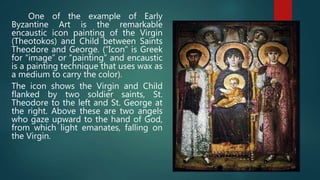
One of the example of Early
Byzantine Art is the remarkable
encaustic icon painting of the Virgin
(Theotokos) and Child between Saints
Theodore and George. (“Icon” is Greek
for “image” or “painting” and encaustic
is a painting technique that uses wax as
a medium to carry the color).
The icon shows the Virgin and Child
flanked by two soldier saints, St.
Theodore to the left and St. George at
the right. Above these are two angels
who gaze upward to the hand of God,
from which light emanates, falling on
the Virgin.
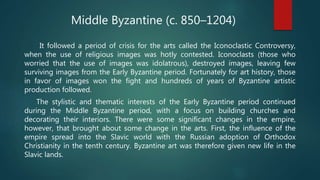
It followed a period of crisis for the arts called the Iconoclastic Controversy,
when the use of religious images was hotly contested. Iconoclasts (those who
worried that the use of images was idolatrous), destroyed images, leaving few
surviving images from the Early Byzantine period. Fortunately for art history, those
in favor of images won the fight and hundreds of years of Byzantine artistic
production followed.
The stylistic and thematic interests of the Early Byzantine period continued
during the Middle Byzantine period, with a focus on building churches and
decorating their interiors. There were some significant changes in the empire,
however, that brought about some change in the arts. First, the influence of the
empire spread into the Slavic world with the Russian adoption of Orthodox
Christianity in the tenth century. Byzantine art was therefore given new life in the
Slavic lands.
Middle Byzantine (c. 850–1204)
Architecture in the Middle Byzantine period
overwhelmingly moved toward the centralized
cross-in-square plan for which Byzantine
architecture is best known.
This was also a period of increased stability
and wealth. As such, wealthy patrons
commissioned private luxury items which was
used as a private devotional object.
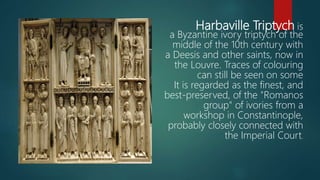
Harbaville Triptych is
a Byzantine ivory triptych of the
middle of the 10th century with
a Deesis and other saints, now in
the Louvre. Traces of colouring
can still be seen on some
It is regarded as the finest, and
best-preserved, of the "Romanos
group" of ivories from a
workshop in Constantinople,
probably closely connected with
the Imperial Court.
Between 1204 and 1261, the Byzantine Empire suffered another
crisis: the Latin Occupation. Crusaders from Western Europe invaded
and captured Constantinople in 1204, temporarily toppling the empire
in an attempt to bring the eastern empire back into the fold of
western Christendom
By 1261 the Byzantine Empire was free of its western occupiers
and stood as an independent empire once again, albeit markedly
weakened. The breadth of the empire had shrunk, and so had its
power. Nevertheless Byzantium survived until the Ottomans
took Constantinople in 1453. In spite of this period of diminished
wealth and stability, the arts continued to flourish in the Late
Byzantine period, much as it had before.
Late Byzantine (c. 1261–1453)
Although Constantinople fell to the Turks in
1453—bringing about the end of the Byzantine
Empire—Byzantine art and culture continued to live on
in its far-reaching outposts, as well as in Greece, Italy,
and the Ottoman Empire, where it had flourished for so
long. The Russian Empire, which was first starting to
emerge around the time Constantinople fell, carried on
as the heir of Byzantium, with churches and icons
created in a distinct “Russo-Byzantine” style.
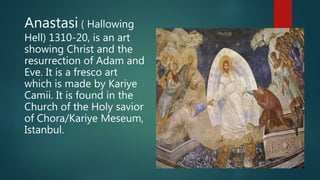
Anastasi ( Hallowing
Hell) 1310-20, is an art
showing Christ and the
resurrection of Adam and
Eve. It is a fresco art
which is made by Kariye
Camii. It is found in the
Church of the Holy savior
of Chora/Kariye Meseum,
Istanbul.
Gothic art
is a style of medieval art that developed in Northern France out
of Romanesque art in the 12th century AD, led by the concurrent
development of Gothic architecture. It spread to all of Western Europe, and
much of Southern and Central Europe, never quite effacing more classical
styles in Italy. In the late 14th century, the sophisticated court style
of International Gothic developed, which continued to evolve until the late
15th century. In many areas, especially Germany, Late Gothic art continued
well into the 16th century, before being subsumed into Renaissance period.
Primary media in the Gothic period included sculpture, panel
painting, stained glass, fresco and illuminated manuscript. The easily
recognizable shifts in architecture from Romanesque to Gothic, and Gothic
to Renaissance styles, are typically used to define the periods in art in all
media, although in many ways figurative art developed at a different pace.
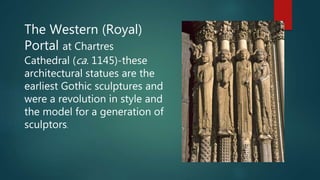
The Western (Royal)
Portal at Chartres
Cathedral (ca. 1145)-these
architectural statues are the
earliest Gothic sculptures and
were a revolution in style and
the model for a generation of
sculptors.
Early Renaissance
Renaissance art is the painting, sculpture and decorative arts of that period
of European history known as the Renaissance, emerging as a distinct style in
Italy in about 1400, in parallel with developments which occurred
in philosophy, literature, music and science. The Renaissance art, perceived as
the noblest of ancient traditions, took as its foundation the art of Classical
antiquity, but transformed that tradition by absorbing recent developments in
the art of Northern Europe and by applying contemporary scientific knowledge.
The Renaissance was a period of great creative and intellectual activity,
during which artists broke away from the restrictions of Byzantine Art.
Throughout the 15th century, artists studied the natural world in order to
perfect their understanding of such subjects as anatomy and perspective.
The Renaissance began in Italy, where there was always a residue
of Classical feeling in architecture. A Gothic building such as the Loggia
dei Lanzi in Florence was characterized by a large round arch instead of
the usual Gothic pointed arch and preserved the simplicity and
monumentality of Classical architecture. The Renaissance might have
been expected to appear first in Rome, where there was the greatest
quantity of ancient Roman ruins; however, during the 14th and early
15th centuries, when the Italians were impelled to renew classicism, the
political situation in Rome was very unfavorable for artistic endeavor.
Florence, however, under the leadership of the Medici family, was
economically prosperous and politically stable.
Among the many great artists of this period were Sandro
Botticelli, Domenico Ghirlandaio, Paolo Uccello and Piero della Francesca.
Lorenzo Ghiberti’s Gates of Paradise
are a set of bronze doors that were made for
the Florence Baptistery and took the
celebrated Italian artist 27 years to complete.
The doors that depict Old Testament scenes
on 10 panels were finally installed in 1452
and profoundly influenced his
contemporaries as well as the next
generation of Italian Renaissance artists. The
Gates of Paradise that are today admired in
the Baptistery, however, are a copy. The
original Ghiberti’s doors are held in the
Museo dell’Opera del Duomo that is located
just a few steps from the Baptistery.

Brocs kokey

  • 1.
    It is theart of the Byzantine Empire, centered in Constantinople (now Istanbul). It was completely focused on the needs of the Orthodox church, in the painting of icons and the decoration of churches with frescoes and mosaics. Basically ended with the fall of Constantinople to the Turks in 1453, during the European Renaissance. However, its influence continued for a considerable time in Russia and elsewhere where the Orthodox church held sway. Byzantine Art
  • 2.
    Byzantine Art hasthree periods namely: Early Byzantine Middle Byzantine Late Byzantine
  • 3.
    Early Byzantine (c.330–750) The Emperor Constantine adopted Christianity and in 330 moved his capital from Rome to Constantinople (modern-day Istanbul), at the eastern frontier of the Roman Empire. Christianity flourished and gradually supplanted the Greco-Roman gods that had once defined Roman religion and culture. This religious shift dramatically affected the art that was created across the empire. Decorations for the interior of churches, including icons and mosaics, were also made during this period.
  • 4.
    In this work,ethereal figures seem to float against a gold background that is representative of no identifiable earthly space. By placing these figures in a spiritual world, the mosaics gave worshippers some access to that world as well. At the same time, there are real-world political messages affirming the power of the rulers in these mosaics. In this sense, art of the Byzantine Empire continued some of the traditions of Roman art. Byzantine art differs from the art of the Romans in that it is interested in depicting that which we cannot see—the intangible world of Heaven and the spiritual. Thus, the Greco- Roman interest in depth and naturalism is replaced by an interest in flatness and mystery.
  • 5.
    One of theexample of Early Byzantine Art is the remarkable encaustic icon painting of the Virgin (Theotokos) and Child between Saints Theodore and George. (“Icon” is Greek for “image” or “painting” and encaustic is a painting technique that uses wax as a medium to carry the color). The icon shows the Virgin and Child flanked by two soldier saints, St. Theodore to the left and St. George at the right. Above these are two angels who gaze upward to the hand of God, from which light emanates, falling on the Virgin.
  • 6.
    It followed aperiod of crisis for the arts called the Iconoclastic Controversy, when the use of religious images was hotly contested. Iconoclasts (those who worried that the use of images was idolatrous), destroyed images, leaving few surviving images from the Early Byzantine period. Fortunately for art history, those in favor of images won the fight and hundreds of years of Byzantine artistic production followed. The stylistic and thematic interests of the Early Byzantine period continued during the Middle Byzantine period, with a focus on building churches and decorating their interiors. There were some significant changes in the empire, however, that brought about some change in the arts. First, the influence of the empire spread into the Slavic world with the Russian adoption of Orthodox Christianity in the tenth century. Byzantine art was therefore given new life in the Slavic lands. Middle Byzantine (c. 850–1204)
  • 7.
    Architecture in theMiddle Byzantine period overwhelmingly moved toward the centralized cross-in-square plan for which Byzantine architecture is best known. This was also a period of increased stability and wealth. As such, wealthy patrons commissioned private luxury items which was used as a private devotional object.
  • 8.
    Harbaville Triptych is aByzantine ivory triptych of the middle of the 10th century with a Deesis and other saints, now in the Louvre. Traces of colouring can still be seen on some It is regarded as the finest, and best-preserved, of the "Romanos group" of ivories from a workshop in Constantinople, probably closely connected with the Imperial Court.
  • 9.
    Between 1204 and1261, the Byzantine Empire suffered another crisis: the Latin Occupation. Crusaders from Western Europe invaded and captured Constantinople in 1204, temporarily toppling the empire in an attempt to bring the eastern empire back into the fold of western Christendom By 1261 the Byzantine Empire was free of its western occupiers and stood as an independent empire once again, albeit markedly weakened. The breadth of the empire had shrunk, and so had its power. Nevertheless Byzantium survived until the Ottomans took Constantinople in 1453. In spite of this period of diminished wealth and stability, the arts continued to flourish in the Late Byzantine period, much as it had before. Late Byzantine (c. 1261–1453)
  • 10.
    Although Constantinople fellto the Turks in 1453—bringing about the end of the Byzantine Empire—Byzantine art and culture continued to live on in its far-reaching outposts, as well as in Greece, Italy, and the Ottoman Empire, where it had flourished for so long. The Russian Empire, which was first starting to emerge around the time Constantinople fell, carried on as the heir of Byzantium, with churches and icons created in a distinct “Russo-Byzantine” style.
  • 11.
    Anastasi ( Hallowing Hell)1310-20, is an art showing Christ and the resurrection of Adam and Eve. It is a fresco art which is made by Kariye Camii. It is found in the Church of the Holy savior of Chora/Kariye Meseum, Istanbul.
  • 12.
    Gothic art is astyle of medieval art that developed in Northern France out of Romanesque art in the 12th century AD, led by the concurrent development of Gothic architecture. It spread to all of Western Europe, and much of Southern and Central Europe, never quite effacing more classical styles in Italy. In the late 14th century, the sophisticated court style of International Gothic developed, which continued to evolve until the late 15th century. In many areas, especially Germany, Late Gothic art continued well into the 16th century, before being subsumed into Renaissance period. Primary media in the Gothic period included sculpture, panel painting, stained glass, fresco and illuminated manuscript. The easily recognizable shifts in architecture from Romanesque to Gothic, and Gothic to Renaissance styles, are typically used to define the periods in art in all media, although in many ways figurative art developed at a different pace.
  • 13.
    The Western (Royal) Portalat Chartres Cathedral (ca. 1145)-these architectural statues are the earliest Gothic sculptures and were a revolution in style and the model for a generation of sculptors.
  • 14.
    Early Renaissance Renaissance artis the painting, sculpture and decorative arts of that period of European history known as the Renaissance, emerging as a distinct style in Italy in about 1400, in parallel with developments which occurred in philosophy, literature, music and science. The Renaissance art, perceived as the noblest of ancient traditions, took as its foundation the art of Classical antiquity, but transformed that tradition by absorbing recent developments in the art of Northern Europe and by applying contemporary scientific knowledge. The Renaissance was a period of great creative and intellectual activity, during which artists broke away from the restrictions of Byzantine Art. Throughout the 15th century, artists studied the natural world in order to perfect their understanding of such subjects as anatomy and perspective.
  • 15.
    The Renaissance beganin Italy, where there was always a residue of Classical feeling in architecture. A Gothic building such as the Loggia dei Lanzi in Florence was characterized by a large round arch instead of the usual Gothic pointed arch and preserved the simplicity and monumentality of Classical architecture. The Renaissance might have been expected to appear first in Rome, where there was the greatest quantity of ancient Roman ruins; however, during the 14th and early 15th centuries, when the Italians were impelled to renew classicism, the political situation in Rome was very unfavorable for artistic endeavor. Florence, however, under the leadership of the Medici family, was economically prosperous and politically stable. Among the many great artists of this period were Sandro Botticelli, Domenico Ghirlandaio, Paolo Uccello and Piero della Francesca.
  • 16.
    Lorenzo Ghiberti’s Gatesof Paradise are a set of bronze doors that were made for the Florence Baptistery and took the celebrated Italian artist 27 years to complete. The doors that depict Old Testament scenes on 10 panels were finally installed in 1452 and profoundly influenced his contemporaries as well as the next generation of Italian Renaissance artists. The Gates of Paradise that are today admired in the Baptistery, however, are a copy. The original Ghiberti’s doors are held in the Museo dell’Opera del Duomo that is located just a few steps from the Baptistery.