Prehistoric Sculpture

Presented by: Bruce Black Art.com
The Venus of Willendorf
After a wide variety of proposed dates, following
a revised analysis of the stratigraphy of its site in
1990, the figure has been estimated to have
been carved 24,000–22,000 BCE. Very little is
known about its origin, method of creation, or
cultural significance. The Venus of Willendorf was
recovered in a site that also contained a few
amulets of Moldavite.

Venus of Willendorf
The purpose of the carving is the subject of much
speculation. It never had feet and does not stand
on its own. The apparent large size of the breasts
and abdomen, have led scholars to interpret the
figure as a fertility symbol. The figure has no
visible face, her head being covered with circular
horizontal bands of what might be rows of
plaited hair, or a type of headdress. She was
thought to be very healthy given her weight and
size.
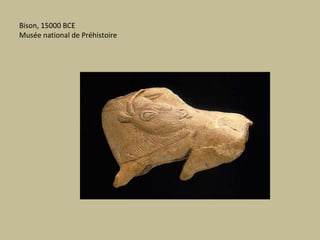
Bison, 15000 BCE
Musée national de Préhistoire
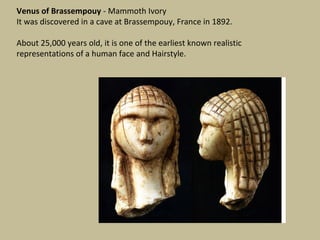
Venus of Brassempouy - Mammoth Ivory
It was discovered in a cave at Brassempouy, France in 1892.

About 25,000 years old, it is one of the earliest known realistic
representations of a human face and Hairstyle.
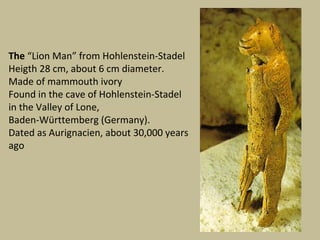
The “Lion Man” from Hohlenstein-Stadel
Heigth 28 cm, about 6 cm diameter.
Made of mammouth ivory
Found in the cave of Hohlenstein-Stadel
in the Valley of Lone,
Baden-Württemberg (Germany).
Dated as Aurignacien, about 30,000 years
ago
Madgdalenian horse head carved in bone - one of the most beautiful examples of
prehistoric carving. Found in a cave excavation, its date is fixed to about 12000 BC.
The structure of the bone did not allow for carving in the round, and the reverse side
is flat.
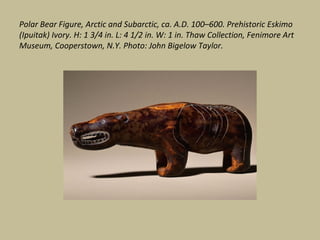
Polar Bear Figure, Arctic and Subarctic, ca. A.D. 100–600. Prehistoric Eskimo
(Ipuitak) Ivory. H: 1 3/4 in. L: 4 1/2 in. W: 1 in. Thaw Collection, Fenimore Art
Museum, Cooperstown, N.Y. Photo: John Bigelow Taylor.
ceramic figures known as dogu –
they are mysterious masterpieces
produced in great numbers in
prehistoric Japan. Dogu are from
the earliest-dated tradition of
pottery manufacture in the world,
dating to the prehistoric Jomon
period, which began 16,000 years
ago.
Dogū Pottery - small humanoid and animal figurines made during the late Jomon
Period (14,000 –400 BCE) of prehistoric Japan.
Olmec Art (1200 BCE through 400 BCE)
The first signs of complex society in Mesoamerica were the
Olmecs an ancient Pre-Columbian civilization living in the
tropical lowlands of south-central Mexico, in what are
roughly the modern-day states of Veracruz and Tabasco.

Olmec artforms emphasize both monumental statuary and
small jade carvings and jewelry. Much Olmec art is highly
stylized and uses an iconography reflective of the religious
meaning of the artworks. Some Olmec art, however, is
surprisingly naturalistic, displaying an accuracy of depiction
of human anatomy perhaps equaled in the Pre-Columbian
New World only by the best Maya Classic era art.
Olmec holds a half human-half jaguar baby.
Jade figure holding jaguar baby 1150-500 BC
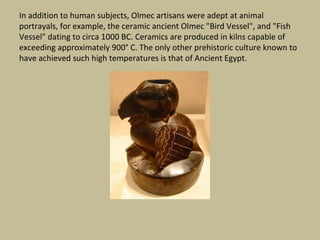
In addition to human subjects, Olmec artisans were adept at animal
portrayals, for example, the ceramic ancient Olmec "Bird Vessel", and "Fish
Vessel" dating to circa 1000 BC. Ceramics are produced in kilns capable of
exceeding approximately 900° C. The only other prehistoric culture known to
have achieved such high temperatures is that of Ancient Egypt.
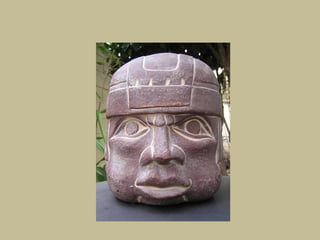
Colossal Heads While Olmec figurines are found abundantly in sites
throughout the Formative Period, it is the stone monuments such as the
colossal heads that are the most recognizable feature of Olmec culture.
These monuments can be divided into four classes:


                  This head dates from 1200 to 900 BCE
                  and is 2.9 meters high and 2.1 meters wide.
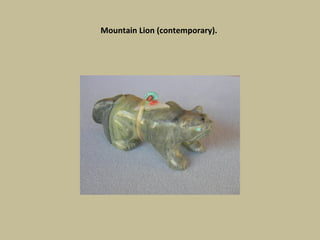
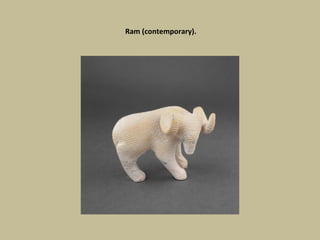
Zuni Fetish: American Indians have used fetishes throughout recorded
history, especially the Indians of the Southwest. A fetish is an object which is
believed to have magic power. Fetishes may be of any form or material, but
they all have one purpose - to assist man against any real or potential
problems. The problems can be those of the mind, body or universe.
Mountain Lion (contemporary).
Ram (contemporary).
End Slide Show
• Presented by: Bruce Black Art.com

Prehistoric sculpture

  • 1.
  • 2.
    The Venus ofWillendorf After a wide variety of proposed dates, following a revised analysis of the stratigraphy of its site in 1990, the figure has been estimated to have been carved 24,000–22,000 BCE. Very little is known about its origin, method of creation, or cultural significance. The Venus of Willendorf was recovered in a site that also contained a few amulets of Moldavite. Venus of Willendorf The purpose of the carving is the subject of much speculation. It never had feet and does not stand on its own. The apparent large size of the breasts and abdomen, have led scholars to interpret the figure as a fertility symbol. The figure has no visible face, her head being covered with circular horizontal bands of what might be rows of plaited hair, or a type of headdress. She was thought to be very healthy given her weight and size.
  • 3.
    Bison, 15000 BCE Muséenational de Préhistoire
  • 4.
    Venus of Brassempouy- Mammoth Ivory It was discovered in a cave at Brassempouy, France in 1892. About 25,000 years old, it is one of the earliest known realistic representations of a human face and Hairstyle.
  • 5.
    The “Lion Man”from Hohlenstein-Stadel Heigth 28 cm, about 6 cm diameter. Made of mammouth ivory Found in the cave of Hohlenstein-Stadel in the Valley of Lone, Baden-Württemberg (Germany). Dated as Aurignacien, about 30,000 years ago
  • 6.
    Madgdalenian horse headcarved in bone - one of the most beautiful examples of prehistoric carving. Found in a cave excavation, its date is fixed to about 12000 BC. The structure of the bone did not allow for carving in the round, and the reverse side is flat.
  • 7.
    Polar Bear Figure,Arctic and Subarctic, ca. A.D. 100–600. Prehistoric Eskimo (Ipuitak) Ivory. H: 1 3/4 in. L: 4 1/2 in. W: 1 in. Thaw Collection, Fenimore Art Museum, Cooperstown, N.Y. Photo: John Bigelow Taylor.
  • 8.
    ceramic figures knownas dogu – they are mysterious masterpieces produced in great numbers in prehistoric Japan. Dogu are from the earliest-dated tradition of pottery manufacture in the world, dating to the prehistoric Jomon period, which began 16,000 years ago.
  • 9.
    Dogū Pottery -small humanoid and animal figurines made during the late Jomon Period (14,000 –400 BCE) of prehistoric Japan.
  • 10.
    Olmec Art (1200BCE through 400 BCE) The first signs of complex society in Mesoamerica were the Olmecs an ancient Pre-Columbian civilization living in the tropical lowlands of south-central Mexico, in what are roughly the modern-day states of Veracruz and Tabasco. Olmec artforms emphasize both monumental statuary and small jade carvings and jewelry. Much Olmec art is highly stylized and uses an iconography reflective of the religious meaning of the artworks. Some Olmec art, however, is surprisingly naturalistic, displaying an accuracy of depiction of human anatomy perhaps equaled in the Pre-Columbian New World only by the best Maya Classic era art.
  • 11.
    Olmec holds ahalf human-half jaguar baby.
  • 12.
    Jade figure holdingjaguar baby 1150-500 BC
  • 13.
    In addition tohuman subjects, Olmec artisans were adept at animal portrayals, for example, the ceramic ancient Olmec "Bird Vessel", and "Fish Vessel" dating to circa 1000 BC. Ceramics are produced in kilns capable of exceeding approximately 900° C. The only other prehistoric culture known to have achieved such high temperatures is that of Ancient Egypt.
  • 14.
    Colossal Heads WhileOlmec figurines are found abundantly in sites throughout the Formative Period, it is the stone monuments such as the colossal heads that are the most recognizable feature of Olmec culture. These monuments can be divided into four classes: This head dates from 1200 to 900 BCE and is 2.9 meters high and 2.1 meters wide.
  • 16.
    Zuni Fetish: AmericanIndians have used fetishes throughout recorded history, especially the Indians of the Southwest. A fetish is an object which is believed to have magic power. Fetishes may be of any form or material, but they all have one purpose - to assist man against any real or potential problems. The problems can be those of the mind, body or universe.
  • 17.
  • 18.
  • 19.
    End Slide Show •Presented by: Bruce Black Art.com