• Definitions
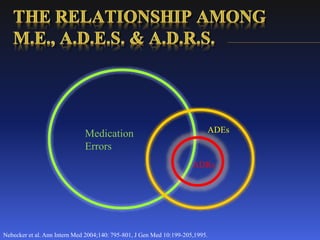
• The relationship between medication error, ADE & ADR
• Classifications, types & Reasons of medication error
• How to prevent medication error (Identifying, Focusing )
• How to approach error (Person Vs. System)
• Methods used to minimize or reduce medication errors
• Medication error reporting
• The goal of drug therapy is the achievement of defined
therapeutic outcomes that improve a patient’s quality of life
while minimizing patient risk
• With every therapy there must be a risk, it could be known or
unknown
• These risks are defined as drug misadventures, which includes
both adverse drug reactions (ADRs) & medication errors
• Medication error
Any preventable event that has the potential to lead to
inappropriate medication use or patient harm during
prescribing, transcribing, dispensing, administering,
adherence, or monitoring a drug
• Near Misses Or A Potential Adverse Drug Event :
Medication errors that are stopped before harm are sometimes called
• Adverse drug event (ADE)
Any injury caused by a medicine or lack of intended
medication ( e.g. Adverse drug reactions & overdoses, Dose
reductions & discontinuations of drug therapy)
• Adverse drug reaction (ADR)
Any unexpected, unintended, undesired, or excessive
response to a drug, with or without an “injury”
Medication
Errors
ADEs
ADRs
Nebecker et al. Ann Intern Med 2004;140: 795-801, J Gen Med 10:199-205,1995.
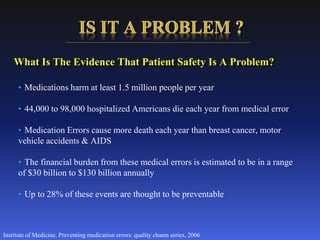
• Medications harm at least 1.5 million people per year
• 44,000 to 98,000 hospitalized Americans die each year from medical error
• Medication Errors cause more death each year than breast cancer, motor
vehicle accidents & AIDS
• The financial burden from these medical errors is estimated to be in a range
of $30 billion to $130 billion annually
• Up to 28% of these events are thought to be preventable
Institute of Medicine. Preventing medication errors: quality chasm series, 2006
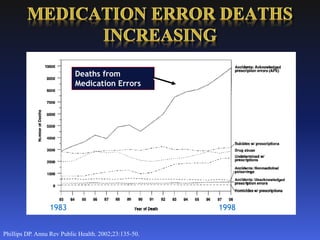
What Is The Evidence That Patient Safety Is A Problem?
Phillips DP. Annu Rev Public Health. 2002;23:135-50.
Deaths from
Medication Errors
1983 1998
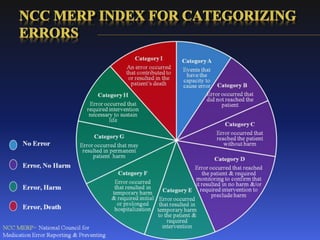
NCC MERP index ( National Coordinating
Council for Medication Error Reporting and
Prevention index) for categorizing medication
errors
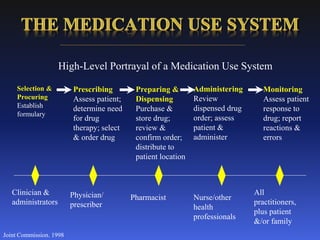
Medication Use System
Selection &
Procuring
Establish
formulary
Monitoring
Assess patient
response to
drug; report
reactions &
errors
Administering
Review
dispensed drug
order; assess
patient &
administer
Preparing &
Dispensing
Purchase &
store drug;
review &
confirm order;
distribute to
patient location
Prescribing
Assess patient;
determine need
for drug
therapy; select
& order drug
High-Level Portrayal of a Medication Use System
Clinician &
administrators
Physician/
prescriber
Pharmacist Nurse/other
health
professionals
All
practitioners,
plus patient
&/or family
Joint Commission. 1998
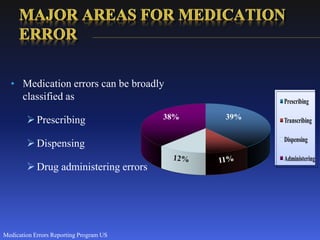
Prescribing
Transcribing
Dispensing
Administering
• Medication errors can be broadly
classified as
Prescribing
Dispensing
Drug administering errors
Medication Errors Reporting Program US
38% 39%
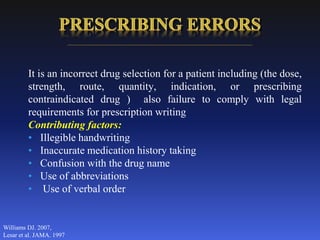
It is an incorrect drug selection for a patient including (the dose,
strength, route, quantity, indication, or prescribing
contraindicated drug ) also failure to comply with legal
requirements for prescription writing
Contributing factors:
• Illegible handwriting
• Inaccurate medication history taking
• Confusion with the drug name
• Use of abbreviations
• Use of verbal order
Williams DJ. 2007,
Lesar et al. JAMA. 1997
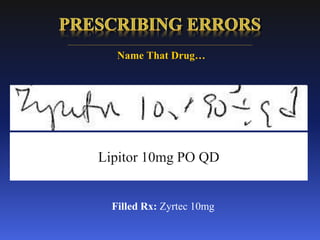
Name That Drug…
Lipitor 10mg PO QD
Filled Rx: Zyrtec 10mg
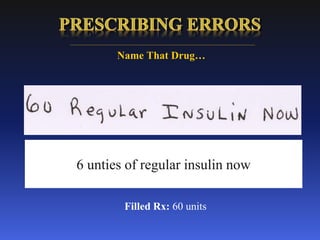
6 unties of regular insulin now
Name That Drug…
Filled Rx: 60 units
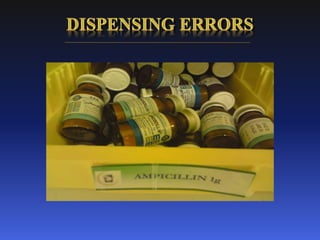
• It is an error that occurs at any stage during the dispensing
process from the receipt of a prescription in the pharmacy
through to the supply of a dispensed product to the patient
• Studies have estimated that dispensing errors occur at a rate of
1-24%
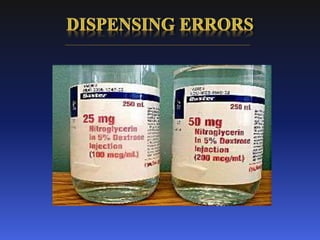
• These errors include the selection of the wrong
strength/product. This occurs primarily when 2 drugs have a
similar appearance or similar name (look-a-like/sound-a-like
errors)
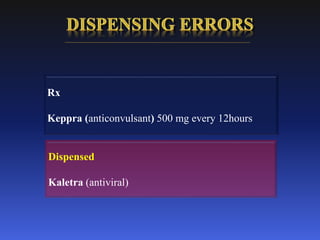
Rx
Keppra (anticonvulsant) 500 mg every 12hours
Dispensed
Kaletra (antiviral)
• Defined as a discrepancy between the drug therapy received by
the patient & the drug therapy intended by the prescriber
• HIGHEST RISK AREAS IN NURSING PRACTICE
• It involve errors of omission where administration is omitted
due to a variety of factors e.g. wrong patient, lack of stock
• Also wrong administration technique, administration of
expired drugs & wrong preparation administered
Contributing factors:
• Failure to check the patient’s identity prior to
administration
• Storage of similar preparations in similar areas
• Errors
Williams DJ. 2007
• More than one tablet for a single dose
• Calculation is required to determine the
correct dose
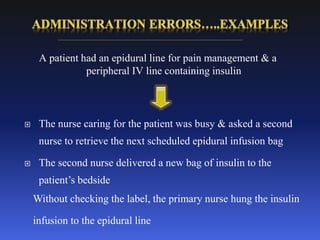
A patient had an epidural line for pain management & a
peripheral IV line containing insulin
 The nurse caring for the patient was busy & asked a second
nurse to retrieve the next scheduled epidural infusion bag
 The second nurse delivered a new bag of insulin to the
patient’s bedside
Without checking the label, the primary nurse hung the insulin
infusion to the epidural line
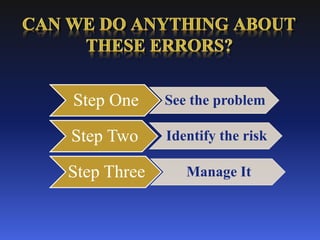
Step One See the problem
Step Two Identify the risk
Step Three Manage It
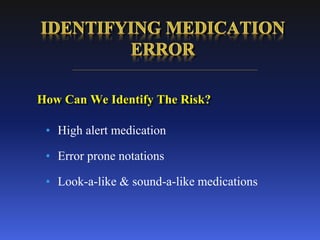
How Can We Identify The Risk?
• High alert medication
• Error prone notations
• Look-a-like & sound-a-like medications
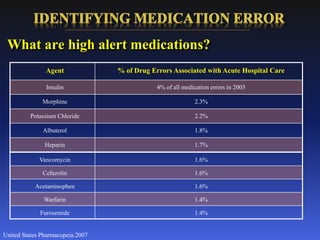
What are high alert medications?
United States Pharmacopeia.2007
Agent % of Drug Errors Associated with Acute Hospital Care
Insulin 4% of all medication errors in 2005
Morphine 2.3%
Potassium Chloride 2.2%
Albuterol 1.8%
Heparin 1.7%
Vancomycin 1.6%
Cefazolin 1.6%
Acetaminophen 1.6%
Warfarin 1.4%
Furosemide 1.4%
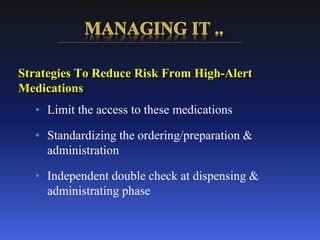
Strategies To Reduce Risk From High-Alert
Medications
• Limit the access to these medications
• Standardizing the ordering/preparation &
administration
• Independent double check at dispensing &
administrating phase
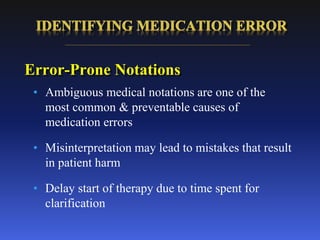
Error-Prone Notations
• Ambiguous medical notations are one of the
most common & preventable causes of
medication errors
• Misinterpretation may lead to mistakes that result
in patient harm
• Delay start of therapy due to time spent for
clarification
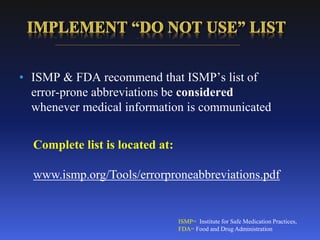
• ISMP & FDA recommend that ISMP’s list of
error-prone abbreviations be considered
whenever medical information is communicated
ISMP= Institute for Safe Medication Practices,
FDA= Food and Drug Administration
Complete list is located at:
www.ismp.org/Tools/errorproneabbreviations.pdf
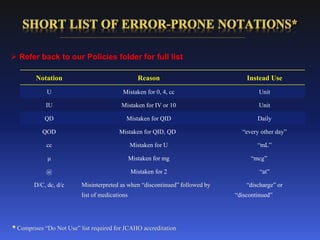
* Comprises “Do Not Use” list required for JCAHO accreditation
Notation Reason Instead Use
U Mistaken for 0, 4, cc Unit
IU Mistaken for IV or 10 Unit
QD Mistaken for QID Daily
QOD Mistaken for QID, QD “every other day”
cc Mistaken for U “mL”
μ Mistaken for mg “mcg”
@ Mistaken for 2 “at”
D/C, dc, d/c Misinterpreted as when “discontinued” followed by
list of medications
“discharge” or
“discontinued”
 Refer back to our Policies folder for full list
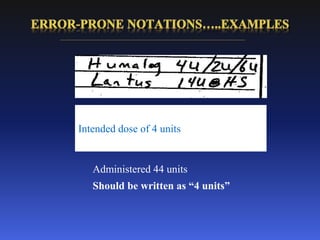
Intended dose of 4 units
Administered 44 units
Should be written as “4 units”
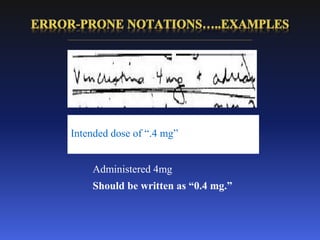
Administered 4mg
Should be written as “0.4 mg.”
Intended dose of “.4 mg”
Strategies To Reduce The Risk From
Error Prone Notations
 Person-centered approach
 System centered approach
 Person-Centered Approach
• It has been traditional used in analysis of medication
errors
• It looks at medication errors as occurring due to
human frailty, including
 Forgetfulness
 Poor motivation
 Carelessness, not paying
attention
 Negligence
 System-Centered Approach
– Errors expected to occur
– Errors are viewed as the end result & not the cause
– There is potential for error & recurring errors in
every system, & even the best systems fail
 System-Centered Approach
• Solutions are based on the belief that conditions can
be changed, rather than focusing on changing humans
• Barriers & safeguards should be implemented to help
prevent errors
• It is essential to focus on how & why the system
failed & not on which individual failed
 Steps to minimize medication error
 Prescriber actions
 Pharmacy (dispensing) actions
 Nurse (administrator) actions
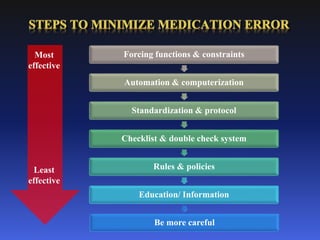
Forcing functions & constraints
Automation & computerization
Standardization & protocol
Checklist & double check system
Rules & policies
Education/ Information
Be more careful
Most
effective
Least
effective
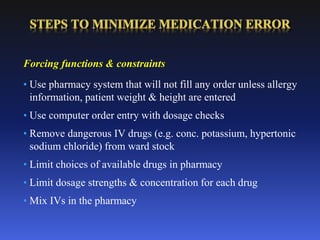
Forcing functions & constraints
• Use pharmacy system that will not fill any order unless allergy
information, patient weight & height are entered
• Use computer order entry with dosage checks
• Remove dangerous IV drugs (e.g. conc. potassium, hypertonic
sodium chloride) from ward stock
• Limit choices of available drugs in pharmacy
• Limit dosage strengths & concentration for each drug
• Mix IVs in the pharmacy
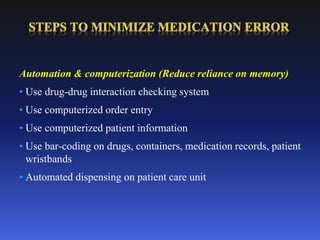
Automation & computerization (Reduce reliance on memory)
• Use drug-drug interaction checking system
• Use computerized order entry
• Use computerized patient information
• Use bar-coding on drugs, containers, medication records, patient
wristbands
• Automated dispensing on patient care unit
Standardization & protocol
• No error –prone abbreviations
• Use generic names rather then brand name
• Use standard equipment—one kind of pump or syringe
• Use protocol for complex medication administration e.g.
heparin, chemotherapy
• Stay current & knowledgeable concerning changes in
medication & treatment
• Utilize pharmacist consultation if available
• Ensure that drug orders are complete, clear, unambiguous &
legible
Including patient weight, dosage (mg/kg/dose or/day), frequency & route
of administration
Avoid use of terminal zero e.g. use 5 rather 5.0
Use a zero to the left of a zero ( use 0.2 rather .2 )
• Discuss medication changes with nursing & other staff &
families
• Independent double check orders both on calculation &
preparation
• Clarify confusing orders
• Checking for current patient drug allergy
• Dispense medication using unit-dose, ready to administration
form whenever possible
• Patient name, generic drug name, patient specific dose on all
labels
• Double check medication calculations
• Verify drug order & confirm patient identity &
weight before administration
• Have access to drug information on all medications
• Familiar with the operation of medication
administration device
Always remember
“to Err is Human!”

Medication safety 2011

  • 2.
    • Definitions • Therelationship between medication error, ADE & ADR • Classifications, types & Reasons of medication error • How to prevent medication error (Identifying, Focusing ) • How to approach error (Person Vs. System) • Methods used to minimize or reduce medication errors • Medication error reporting
  • 3.
    • The goalof drug therapy is the achievement of defined therapeutic outcomes that improve a patient’s quality of life while minimizing patient risk • With every therapy there must be a risk, it could be known or unknown • These risks are defined as drug misadventures, which includes both adverse drug reactions (ADRs) & medication errors
  • 4.
    • Medication error Anypreventable event that has the potential to lead to inappropriate medication use or patient harm during prescribing, transcribing, dispensing, administering, adherence, or monitoring a drug • Near Misses Or A Potential Adverse Drug Event : Medication errors that are stopped before harm are sometimes called
  • 5.
    • Adverse drugevent (ADE) Any injury caused by a medicine or lack of intended medication ( e.g. Adverse drug reactions & overdoses, Dose reductions & discontinuations of drug therapy) • Adverse drug reaction (ADR) Any unexpected, unintended, undesired, or excessive response to a drug, with or without an “injury”
  • 6.
    Medication Errors ADEs ADRs Nebecker et al.Ann Intern Med 2004;140: 795-801, J Gen Med 10:199-205,1995.
  • 7.
    • Medications harmat least 1.5 million people per year • 44,000 to 98,000 hospitalized Americans die each year from medical error • Medication Errors cause more death each year than breast cancer, motor vehicle accidents & AIDS • The financial burden from these medical errors is estimated to be in a range of $30 billion to $130 billion annually • Up to 28% of these events are thought to be preventable Institute of Medicine. Preventing medication errors: quality chasm series, 2006 What Is The Evidence That Patient Safety Is A Problem?
  • 8.
    Phillips DP. AnnuRev Public Health. 2002;23:135-50. Deaths from Medication Errors 1983 1998
  • 10.
    NCC MERP index( National Coordinating Council for Medication Error Reporting and Prevention index) for categorizing medication errors Medication Use System
  • 12.
    Selection & Procuring Establish formulary Monitoring Assess patient responseto drug; report reactions & errors Administering Review dispensed drug order; assess patient & administer Preparing & Dispensing Purchase & store drug; review & confirm order; distribute to patient location Prescribing Assess patient; determine need for drug therapy; select & order drug High-Level Portrayal of a Medication Use System Clinician & administrators Physician/ prescriber Pharmacist Nurse/other health professionals All practitioners, plus patient &/or family Joint Commission. 1998
  • 13.
    Prescribing Transcribing Dispensing Administering • Medication errorscan be broadly classified as Prescribing Dispensing Drug administering errors Medication Errors Reporting Program US 38% 39%
  • 14.
    It is anincorrect drug selection for a patient including (the dose, strength, route, quantity, indication, or prescribing contraindicated drug ) also failure to comply with legal requirements for prescription writing Contributing factors: • Illegible handwriting • Inaccurate medication history taking • Confusion with the drug name • Use of abbreviations • Use of verbal order Williams DJ. 2007, Lesar et al. JAMA. 1997
  • 15.
    Name That Drug… Lipitor10mg PO QD Filled Rx: Zyrtec 10mg
  • 16.
    6 unties ofregular insulin now Name That Drug… Filled Rx: 60 units
  • 17.
    • It isan error that occurs at any stage during the dispensing process from the receipt of a prescription in the pharmacy through to the supply of a dispensed product to the patient • Studies have estimated that dispensing errors occur at a rate of 1-24% • These errors include the selection of the wrong strength/product. This occurs primarily when 2 drugs have a similar appearance or similar name (look-a-like/sound-a-like errors)
  • 20.
    Rx Keppra (anticonvulsant) 500mg every 12hours Dispensed Kaletra (antiviral)
  • 21.
    • Defined asa discrepancy between the drug therapy received by the patient & the drug therapy intended by the prescriber • HIGHEST RISK AREAS IN NURSING PRACTICE • It involve errors of omission where administration is omitted due to a variety of factors e.g. wrong patient, lack of stock • Also wrong administration technique, administration of expired drugs & wrong preparation administered
  • 22.
    Contributing factors: • Failureto check the patient’s identity prior to administration • Storage of similar preparations in similar areas • Errors Williams DJ. 2007 • More than one tablet for a single dose • Calculation is required to determine the correct dose
  • 23.
    A patient hadan epidural line for pain management & a peripheral IV line containing insulin  The nurse caring for the patient was busy & asked a second nurse to retrieve the next scheduled epidural infusion bag  The second nurse delivered a new bag of insulin to the patient’s bedside Without checking the label, the primary nurse hung the insulin infusion to the epidural line
  • 25.
    Step One Seethe problem Step Two Identify the risk Step Three Manage It
  • 26.
    How Can WeIdentify The Risk? • High alert medication • Error prone notations • Look-a-like & sound-a-like medications
  • 27.
    What are highalert medications? United States Pharmacopeia.2007 Agent % of Drug Errors Associated with Acute Hospital Care Insulin 4% of all medication errors in 2005 Morphine 2.3% Potassium Chloride 2.2% Albuterol 1.8% Heparin 1.7% Vancomycin 1.6% Cefazolin 1.6% Acetaminophen 1.6% Warfarin 1.4% Furosemide 1.4%
  • 28.
    Strategies To ReduceRisk From High-Alert Medications • Limit the access to these medications • Standardizing the ordering/preparation & administration • Independent double check at dispensing & administrating phase
  • 29.
    Error-Prone Notations • Ambiguousmedical notations are one of the most common & preventable causes of medication errors • Misinterpretation may lead to mistakes that result in patient harm • Delay start of therapy due to time spent for clarification
  • 30.
    • ISMP &FDA recommend that ISMP’s list of error-prone abbreviations be considered whenever medical information is communicated ISMP= Institute for Safe Medication Practices, FDA= Food and Drug Administration Complete list is located at: www.ismp.org/Tools/errorproneabbreviations.pdf
  • 31.
    * Comprises “DoNot Use” list required for JCAHO accreditation Notation Reason Instead Use U Mistaken for 0, 4, cc Unit IU Mistaken for IV or 10 Unit QD Mistaken for QID Daily QOD Mistaken for QID, QD “every other day” cc Mistaken for U “mL” μ Mistaken for mg “mcg” @ Mistaken for 2 “at” D/C, dc, d/c Misinterpreted as when “discontinued” followed by list of medications “discharge” or “discontinued”  Refer back to our Policies folder for full list
  • 32.
    Intended dose of4 units Administered 44 units Should be written as “4 units”
  • 33.
    Administered 4mg Should bewritten as “0.4 mg.” Intended dose of “.4 mg”
  • 34.
    Strategies To ReduceThe Risk From Error Prone Notations
  • 35.
     Person-centered approach System centered approach
  • 36.
     Person-Centered Approach •It has been traditional used in analysis of medication errors • It looks at medication errors as occurring due to human frailty, including  Forgetfulness  Poor motivation  Carelessness, not paying attention  Negligence
  • 37.
     System-Centered Approach –Errors expected to occur – Errors are viewed as the end result & not the cause – There is potential for error & recurring errors in every system, & even the best systems fail
  • 38.
     System-Centered Approach •Solutions are based on the belief that conditions can be changed, rather than focusing on changing humans • Barriers & safeguards should be implemented to help prevent errors • It is essential to focus on how & why the system failed & not on which individual failed
  • 40.
     Steps tominimize medication error  Prescriber actions  Pharmacy (dispensing) actions  Nurse (administrator) actions
  • 41.
    Forcing functions &constraints Automation & computerization Standardization & protocol Checklist & double check system Rules & policies Education/ Information Be more careful Most effective Least effective
  • 42.
    Forcing functions &constraints • Use pharmacy system that will not fill any order unless allergy information, patient weight & height are entered • Use computer order entry with dosage checks • Remove dangerous IV drugs (e.g. conc. potassium, hypertonic sodium chloride) from ward stock • Limit choices of available drugs in pharmacy • Limit dosage strengths & concentration for each drug • Mix IVs in the pharmacy
  • 43.
    Automation & computerization(Reduce reliance on memory) • Use drug-drug interaction checking system • Use computerized order entry • Use computerized patient information • Use bar-coding on drugs, containers, medication records, patient wristbands • Automated dispensing on patient care unit
  • 44.
    Standardization & protocol •No error –prone abbreviations • Use generic names rather then brand name • Use standard equipment—one kind of pump or syringe • Use protocol for complex medication administration e.g. heparin, chemotherapy
  • 45.
    • Stay current& knowledgeable concerning changes in medication & treatment • Utilize pharmacist consultation if available • Ensure that drug orders are complete, clear, unambiguous & legible Including patient weight, dosage (mg/kg/dose or/day), frequency & route of administration Avoid use of terminal zero e.g. use 5 rather 5.0 Use a zero to the left of a zero ( use 0.2 rather .2 ) • Discuss medication changes with nursing & other staff & families
  • 46.
    • Independent doublecheck orders both on calculation & preparation • Clarify confusing orders • Checking for current patient drug allergy • Dispense medication using unit-dose, ready to administration form whenever possible • Patient name, generic drug name, patient specific dose on all labels
  • 47.
    • Double checkmedication calculations • Verify drug order & confirm patient identity & weight before administration • Have access to drug information on all medications • Familiar with the operation of medication administration device
  • 48.

Editor's Notes

  • #5 * Medication errors that are stopped before harm are sometimes called “near misses”, a potential adverse drug event
  • #16 Supposed to be: Lipitor 10mg PO 1 QD Read as: Zyrtec 10mg
  • #17 Supposed to be: 6 units of regular insulin now Read as: 60 units