MEDICATION ERROR
DEFINITION
The United States National Coordinating Council for Medication
Error Reporting and Prevention defines a medication error as:
“any preventable event that may cause or lead to inappropriate
medication use or patient harm while the medication is in the
control of the health care professional, patient, or consumer. Such
events may be related to professional practice, health care
products, procedures, and systems, including prescribing, order
communication, product labelling, packaging, and nomenclature,
compounding, dispensing, distribution, administration, education,
monitoring, and use”.
• May occur at any time, from the prescription to consumption of the
medicines by the patient
• Problems & sources of medication errors are multidisciplinary &
multifactorial
FACTORS THAT INFLUENCE MEDICATION
ERRORS
Factors associated with health care
professionals
• Lack of therapeutic training
• Inadequate drug knowledge and experience
• Inadequate knowledge of the patient
• Inadequate perception of risk
• Overworked or fatigued health care professionals
• Physical and emotional health issues
• Poor communication between health care
professional and with patients
FACTORS THAT INFLUENCE MEDICATION
ERRORS
Factors associated with patients
• Patient characteristics (e.g., personality, literacy and language
barriers)
• Complexity of clinical case, including multiple health
conditions, polypharmacy and high-risk medications causes of
medication errors
Factors associated with the work environment
• Workload and time pressures
• Distractions and interruptions (by both primary care staff and
patients)
• Lack of standardized protocols and procedures
• Insufficient resources
• Issues with the physical work environment (e.g., lighting,
temperature and ventilation)
FACTORS THAT INFLUENCE MEDICATION
ERRORS
Factors associated with medicines
• Naming of medicines
• Labelling and packaging
Factors associated with tasks
• Repetitive systems for ordering, processing and
authorization
• Patient monitoring (dependent on practice,
patient, other health care settings, prescriber)
FACTORS THAT INFLUENCE MEDICATION
ERRORS
Factors associated with computerized
information systems
• Difficult processes for generating first
prescriptions (e.g. drug pick lists, default dose
regimens and missed alerts)
• Difficult processes for generating correct repeat
prescriptions
• Lack of accuracy of patient records
• Inadequate design that allows for human error
EPIDEMIOLOGY
• Interesting but horrifying fact-
- More people in USA die in a given year as a
result of medical errors than from motor vehicle
accidents, breast cancers, or AIDS
- Majority are medication errors
• Indian study of paediatric intensive care unit
reported 68.5% of all errors were medication
errors
EPIDEMIOLOGY
• Numbers reported can be misleading due to
Small % of errors & adverse drug events
detected, even smaller number are reported
• Inconsistencies in way the errors reported &
counted
• Most studies have looked errors only in inpatient
settings
• Most studies focus on errors of commission(fails
to consider errors of omission)
CLASSIFICATION
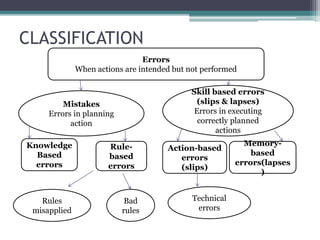
Errors
When actions are intended but not performed
Mistakes
Errors in planning
action
Skill based errors
(slips & lapses)
Errors in executing
correctly planned
actions
Knowledge
Based
errors
Rule-
based
errors
Action-based
errors
(slips)
Memory-
based
errors(lapses
)
Rules
misapplied
Bad
rules
Technical
errors
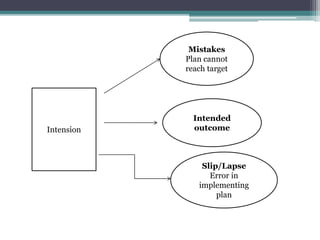
Intension
Mistakes
Plan cannot
reach target
Intended
outcome
Slip/Lapse
Error in
implementing
plan
SOURCES OF ERRORS
• Incorrect transcription
• Mix up of patients
• Mix up of drugs
• Mistakes in calculation of drugs concentration
• Incorrect or missing of labelling of solutions
• Wrong / omitted / passed expiry date
• Difficulties in handling certain IV preparation
techniques
• Use of inappropriate diluents
• Contamination of drugs
• Wrong storage
• Insufficient mixing of ingredients
• Incompatibilies
• Adsorption
• Incorrect infusion rate
• Incomplete delivery of the container contents
CAUSES OF ERRORS
Errors of Omission: errors related to prescription, drug
dispensing by pharmacist, drug administration by medical
personnel like nurses & patient themselves
• Errors of Commission: most common form of errors
encountered in clinical practice, this include –
1.) Wrong phenomenon
2.) Drug interaction related
3.) Communication failure
4.) Failure to follow appropriate policies related to drug
use
5.) Failure to follow drug-specific instructions
6.) Overuse of a drug(irrational drug use & polypharmacy)
CAUSES OF ERRORS
1. “Wrong” phenomenon –
- Wrong drug, wrong dose, wrong substitution for a
drug, wrong patient, wrong regimen, wrong route
2. Drug interaction related errors –
- Food-drug interaction, drug- drug interaction or
interactions with other alternative forms of medicine
- Responsible for medication errors, which may lead
to serious adverse events, sometimes hospitalization
or death of patient
CAUSES OF ERRORS
Communication failure –
- Failures during the process of patient
management
- Includes illegible handwriting, incomplete
prescribing order, vague instructions,
prescription not recognized & unknown
prescriber
- Common errors include: ‘g’ mistaken for ‘mg’, ‘4’
mistaken for ‘U’, decimal point(‘.1’ read as ‘1’)
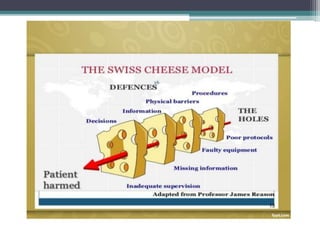
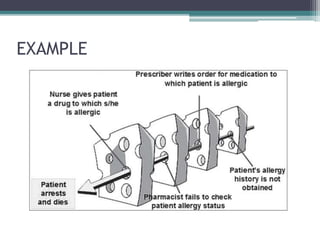
SWISS CHEESE MODEL
Pictorial model for medication errors
• Defences against error displayed as thin layers
with holes that describes latent errors in system
• Each layer successively represents the
prescriber, pharmacist, nurse & patient related
defences
• Missed error successively at various defence
levels, reaches the patient
EXAMPLE
Some other recognized types of medication errors-
Incomplete patient information
Drug information unavailable
Miscommunication of drug orders
Confusion in drug names
Misuse of zeros & decimal points
Confusion in dosing units
Inappropriate abbreviations
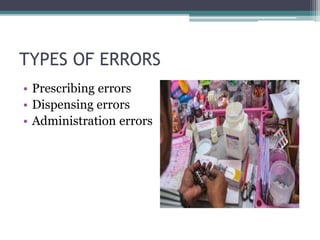
TYPES OF ERRORS
• Prescribing errors
• Dispensing errors
• Administration errors
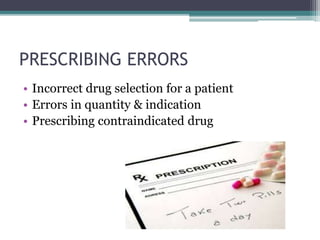
PRESCRIBING ERRORS
• Incorrect drug selection for a patient
• Errors in quantity & indication
• Prescribing contraindicated drug
FACTORS CONTRIBUTING
Lack of knowledge of the prescribed drug, dose,
patient details
Illegible handwriting
Inaccurate medication history taking
Confusion with the drug name
Inappropriate use of decimal points
Use of abbreviations (e.g. AZT)
Use of verbal orders
RISK FACTORS FOR PRESCRIBING
ERRORS
• Work environment & workload
• Miscommunication within team
• Physical & mental well being
• Lack of knowledge
• Inadequate training
• Low perceived importance of prescribing
• Absence of self awareness of errors
REDUCING PRESCRIBING ERRORS
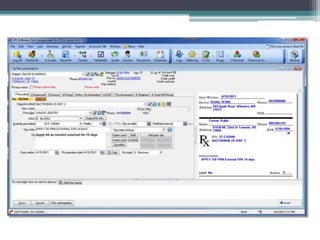
• Electronic prescribing reduces errors due to
illegible handwriting
• Computerized physician order entry system
eliminates need for transcription orders by
nursing staff
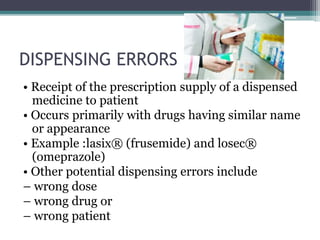
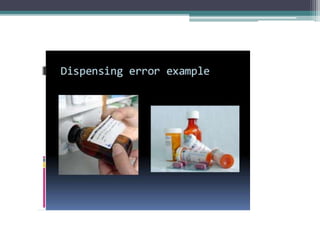
DISPENSING ERRORS
• Receipt of the prescription supply of a dispensed
medicine to patient
• Occurs primarily with drugs having similar name
or appearance
• Example :lasix® (frusemide) and losec®
(omeprazole)
• Other potential dispensing errors include
– wrong dose
– wrong drug or
– wrong patient
REDUCING DISPENSING ERRORS
• Ensuring a safe dispensing procedure
• Separating drugs with similar name or
appearance
• Unit dose medication dispensing
• Automated medication dispensing system
• Bar code medications for dispensing &
administration (patient given barcoded
wristband)
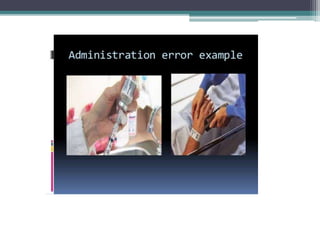
ADMINISTATION ERRORS
• Discrepancy between drug received by patient &
drug therapy intended by prescriber
• Errors of omission - the drug is not administered
• Incorrect administration technique &
administration of incorrect or expired
preparations
• Deliberate violation of guidelines
CONTRIBUTING FACTORS
• Failure to check patient’s identity prior to
administration
• Environmental factors such a noise,
interruptions, poor lighting
• Wrong calculation to determine the correct dose
REDUCING ADMINISTRATION ERRORS
• Checking patient’s identity.
• Ensuring dosage calculations are cross checked
independently by another health care
professional before drug is administered
• Ensuring medication given at correct time
• Minimizing interruptions during drug rounds
STEPS TO PREVENT MEDICATION
ERRORS
• Targeted physician education on optimal medication use
• Inclusion of clinical pharmacists in decision making
activities
• Computerized order entry by prescriber & medication
checking
• Standardize processes & equipment
• Avoid use of unknown abbreviations & symbols
• Double check patients having allergies before prescribing
• Check the expiry date of the drug before administration
• Medication Reconciliation
• Standardised ordering and administration
• Training, education, and organisational interventions
• Preparing medicine in well lighted room
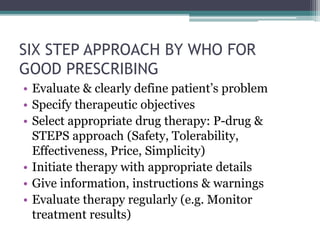
SIX STEP APPROACH BY WHO FOR
GOOD PRESCRIBING
• Evaluate & clearly define patient’s problem
• Specify therapeutic objectives
• Select appropriate drug therapy: P-drug &
STEPS approach (Safety, Tolerability,
Effectiveness, Price, Simplicity)
• Initiate therapy with appropriate details
• Give information, instructions & warnings
• Evaluate therapy regularly (e.g. Monitor
treatment results)
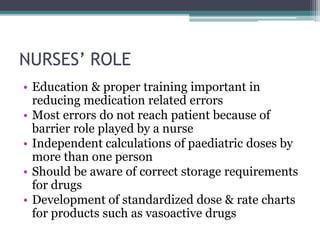
NURSES’ ROLE
• Education & proper training important in
reducing medication related errors
• Most errors do not reach patient because of
barrier role played by a nurse
• Independent calculations of paediatric doses by
more than one person
• Should be aware of correct storage requirements
for drugs
• Development of standardized dose & rate charts
for products such as vasoactive drugs
REFERENCES
• Medication Errors: Causes & its prevention,
Singh I, Shafiq N, Malhotra S;Drugs Bulletin
Vol.XXXVI No. 2, April 2011
• British journal of clinical pharmacology;67:6,
2009
• Look alike & Sound alike drug brand names;
Mukundraj S Keny, PV Rataboli; Indian journal
of clinical practice, Vol. 23, no.9, February 2013
REFERENCES

Medication errors.pptx

  • 1.
  • 2.
    DEFINITION The United StatesNational Coordinating Council for Medication Error Reporting and Prevention defines a medication error as: “any preventable event that may cause or lead to inappropriate medication use or patient harm while the medication is in the control of the health care professional, patient, or consumer. Such events may be related to professional practice, health care products, procedures, and systems, including prescribing, order communication, product labelling, packaging, and nomenclature, compounding, dispensing, distribution, administration, education, monitoring, and use”. • May occur at any time, from the prescription to consumption of the medicines by the patient • Problems & sources of medication errors are multidisciplinary & multifactorial
  • 3.
    FACTORS THAT INFLUENCEMEDICATION ERRORS Factors associated with health care professionals • Lack of therapeutic training • Inadequate drug knowledge and experience • Inadequate knowledge of the patient • Inadequate perception of risk • Overworked or fatigued health care professionals • Physical and emotional health issues • Poor communication between health care professional and with patients
  • 4.
    FACTORS THAT INFLUENCEMEDICATION ERRORS Factors associated with patients • Patient characteristics (e.g., personality, literacy and language barriers) • Complexity of clinical case, including multiple health conditions, polypharmacy and high-risk medications causes of medication errors Factors associated with the work environment • Workload and time pressures • Distractions and interruptions (by both primary care staff and patients) • Lack of standardized protocols and procedures • Insufficient resources • Issues with the physical work environment (e.g., lighting, temperature and ventilation)
  • 5.
    FACTORS THAT INFLUENCEMEDICATION ERRORS Factors associated with medicines • Naming of medicines • Labelling and packaging Factors associated with tasks • Repetitive systems for ordering, processing and authorization • Patient monitoring (dependent on practice, patient, other health care settings, prescriber)
  • 6.
    FACTORS THAT INFLUENCEMEDICATION ERRORS Factors associated with computerized information systems • Difficult processes for generating first prescriptions (e.g. drug pick lists, default dose regimens and missed alerts) • Difficult processes for generating correct repeat prescriptions • Lack of accuracy of patient records • Inadequate design that allows for human error
  • 7.
    EPIDEMIOLOGY • Interesting buthorrifying fact- - More people in USA die in a given year as a result of medical errors than from motor vehicle accidents, breast cancers, or AIDS - Majority are medication errors • Indian study of paediatric intensive care unit reported 68.5% of all errors were medication errors
  • 8.
    EPIDEMIOLOGY • Numbers reportedcan be misleading due to Small % of errors & adverse drug events detected, even smaller number are reported • Inconsistencies in way the errors reported & counted • Most studies have looked errors only in inpatient settings • Most studies focus on errors of commission(fails to consider errors of omission)
  • 9.
    CLASSIFICATION Errors When actions areintended but not performed Mistakes Errors in planning action Skill based errors (slips & lapses) Errors in executing correctly planned actions Knowledge Based errors Rule- based errors Action-based errors (slips) Memory- based errors(lapses ) Rules misapplied Bad rules Technical errors
  • 10.
  • 11.
    SOURCES OF ERRORS •Incorrect transcription • Mix up of patients • Mix up of drugs • Mistakes in calculation of drugs concentration • Incorrect or missing of labelling of solutions • Wrong / omitted / passed expiry date • Difficulties in handling certain IV preparation techniques • Use of inappropriate diluents • Contamination of drugs • Wrong storage • Insufficient mixing of ingredients • Incompatibilies • Adsorption • Incorrect infusion rate • Incomplete delivery of the container contents
  • 12.
    CAUSES OF ERRORS Errorsof Omission: errors related to prescription, drug dispensing by pharmacist, drug administration by medical personnel like nurses & patient themselves • Errors of Commission: most common form of errors encountered in clinical practice, this include – 1.) Wrong phenomenon 2.) Drug interaction related 3.) Communication failure 4.) Failure to follow appropriate policies related to drug use 5.) Failure to follow drug-specific instructions 6.) Overuse of a drug(irrational drug use & polypharmacy)
  • 13.
    CAUSES OF ERRORS 1.“Wrong” phenomenon – - Wrong drug, wrong dose, wrong substitution for a drug, wrong patient, wrong regimen, wrong route 2. Drug interaction related errors – - Food-drug interaction, drug- drug interaction or interactions with other alternative forms of medicine - Responsible for medication errors, which may lead to serious adverse events, sometimes hospitalization or death of patient
  • 14.
    CAUSES OF ERRORS Communicationfailure – - Failures during the process of patient management - Includes illegible handwriting, incomplete prescribing order, vague instructions, prescription not recognized & unknown prescriber - Common errors include: ‘g’ mistaken for ‘mg’, ‘4’ mistaken for ‘U’, decimal point(‘.1’ read as ‘1’)
  • 15.
    SWISS CHEESE MODEL Pictorialmodel for medication errors • Defences against error displayed as thin layers with holes that describes latent errors in system • Each layer successively represents the prescriber, pharmacist, nurse & patient related defences • Missed error successively at various defence levels, reaches the patient
  • 17.
  • 18.
    Some other recognizedtypes of medication errors- Incomplete patient information Drug information unavailable Miscommunication of drug orders Confusion in drug names Misuse of zeros & decimal points Confusion in dosing units Inappropriate abbreviations
  • 19.
    TYPES OF ERRORS •Prescribing errors • Dispensing errors • Administration errors
  • 20.
    PRESCRIBING ERRORS • Incorrectdrug selection for a patient • Errors in quantity & indication • Prescribing contraindicated drug
  • 21.
    FACTORS CONTRIBUTING Lack ofknowledge of the prescribed drug, dose, patient details Illegible handwriting Inaccurate medication history taking Confusion with the drug name Inappropriate use of decimal points Use of abbreviations (e.g. AZT) Use of verbal orders
  • 22.
    RISK FACTORS FORPRESCRIBING ERRORS • Work environment & workload • Miscommunication within team • Physical & mental well being • Lack of knowledge • Inadequate training • Low perceived importance of prescribing • Absence of self awareness of errors
  • 23.
    REDUCING PRESCRIBING ERRORS •Electronic prescribing reduces errors due to illegible handwriting • Computerized physician order entry system eliminates need for transcription orders by nursing staff
  • 25.
    DISPENSING ERRORS • Receiptof the prescription supply of a dispensed medicine to patient • Occurs primarily with drugs having similar name or appearance • Example :lasix® (frusemide) and losec® (omeprazole) • Other potential dispensing errors include – wrong dose – wrong drug or – wrong patient
  • 27.
    REDUCING DISPENSING ERRORS •Ensuring a safe dispensing procedure • Separating drugs with similar name or appearance • Unit dose medication dispensing • Automated medication dispensing system • Bar code medications for dispensing & administration (patient given barcoded wristband)
  • 28.
    ADMINISTATION ERRORS • Discrepancybetween drug received by patient & drug therapy intended by prescriber • Errors of omission - the drug is not administered • Incorrect administration technique & administration of incorrect or expired preparations • Deliberate violation of guidelines
  • 30.
    CONTRIBUTING FACTORS • Failureto check patient’s identity prior to administration • Environmental factors such a noise, interruptions, poor lighting • Wrong calculation to determine the correct dose
  • 31.
    REDUCING ADMINISTRATION ERRORS •Checking patient’s identity. • Ensuring dosage calculations are cross checked independently by another health care professional before drug is administered • Ensuring medication given at correct time • Minimizing interruptions during drug rounds
  • 32.
    STEPS TO PREVENTMEDICATION ERRORS • Targeted physician education on optimal medication use • Inclusion of clinical pharmacists in decision making activities • Computerized order entry by prescriber & medication checking • Standardize processes & equipment • Avoid use of unknown abbreviations & symbols • Double check patients having allergies before prescribing • Check the expiry date of the drug before administration • Medication Reconciliation • Standardised ordering and administration • Training, education, and organisational interventions • Preparing medicine in well lighted room
  • 33.
    SIX STEP APPROACHBY WHO FOR GOOD PRESCRIBING • Evaluate & clearly define patient’s problem • Specify therapeutic objectives • Select appropriate drug therapy: P-drug & STEPS approach (Safety, Tolerability, Effectiveness, Price, Simplicity) • Initiate therapy with appropriate details • Give information, instructions & warnings • Evaluate therapy regularly (e.g. Monitor treatment results)
  • 34.
    NURSES’ ROLE • Education& proper training important in reducing medication related errors • Most errors do not reach patient because of barrier role played by a nurse • Independent calculations of paediatric doses by more than one person • Should be aware of correct storage requirements for drugs • Development of standardized dose & rate charts for products such as vasoactive drugs
  • 35.
    REFERENCES • Medication Errors:Causes & its prevention, Singh I, Shafiq N, Malhotra S;Drugs Bulletin Vol.XXXVI No. 2, April 2011 • British journal of clinical pharmacology;67:6, 2009 • Look alike & Sound alike drug brand names; Mukundraj S Keny, PV Rataboli; Indian journal of clinical practice, Vol. 23, no.9, February 2013
  • 36.