DRUGS
DISPENSING AND ADMINISTRATION
ERRORS
LT COL SUBHA
S
PREPARING AND DISPENSING
CASE STUDY
 A 60yr old female patient was prescribed Syp. Eptoin-15ml, three times a
day after craniotomy. Since Syr Eptoin was not available in pharmacy, it
was substituted by another brand Dilantin. Eptoin contains (30mg/5ml of
phenytoin )while Syr Dilantin contains (125 mg/5ml of phenytoin). The
patient received 1025 mg of phenytoin instead of 270 mg for 5 days, this
resulted in abnormal CT changes and patient remained drowsy for 7 days.
 Dispensing refers to the process of preparing and giving out
medicines to a patient on the basis of prescription .
 Dispensing error is defined as the discrepancy between the
drugs prescribed, indented and dispensed.
 It involves the correct interpretation of the doctor’s prescription
and labelling of the medicine for the use by the patient as
advised.
Contd....
 From the receipt of the prescription in the pharmacy to the
supply of a dispensed medicine to the patient.
 This occurs primarily with drugs that have a similar name or
appearance (LASA Drugs).
Example: lasix® (frusemide) and losec® (omeprazole)
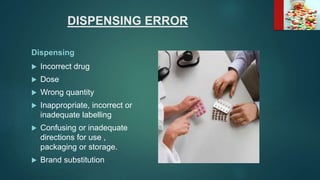
DISPENSING ERROR
Dispensing
 Incorrect drug
 Dose
 Wrong quantity
 Inappropriate, incorrect or
inadequate labelling
 Confusing or inadequate
directions for use ,
packaging or storage.
 Brand substitution
HOW TO REDUCE DISPENSING ERRORS
 LASA drugs should be identified and updated in IP & OP
frequently and information should be disseminated to all areas
where drugs are used.
 Dispensing of drugs requires qualified and trained pharmacist.
 Should have good calculations and arithmetic skills, skills in
assessing quality of preparations.
 Pharmacy should have sufficient storage and dispensing area.
 Compounding of drugs should be done at appropriate place.
 Keeping interruptions and maintaining the workload at safe and
manageable level.
 Introducing safe systematic procedures for dispensing
medicines in the pharmacy.
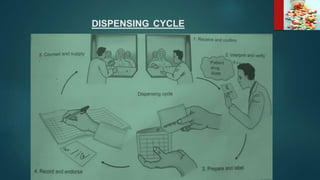
DISPENSING CYCLE
ADMINISTRATIVE ERRORS
CASE STUDY
 A patient was prescribed Inj. Tramadol 100 mg , intravenously.
The injection was to be diluted in 100ml of NS and to be
administered over a period of 30 min. But nurse gave it as a
slow intravenous injection without dilution resulting into local
reaction.
RESEARCH EVIDENCES
Phillips J , et al did a retrospective analysis of medication
errors found that the most common types of errors were from:-
 Improper dose - 40.9 %
 Over dose – 36.4 %
 Wrong route – 9.5 %
 Wrong drug – 19 %
 Knowledge deficit – 44 %
 Communication error – 15.8 %
ADMINISTRATION ERRORS
 Wrong drug
 Wrong patient
 Miss doses
 Extra doses
 Less doses
 Incorrect rate or frequency of
administration
 Incorrect dilution
 Incorrect route
CAUSES OF ADMINISTRATION ERRORS
 Lack of perceived risk
 Poor role models
 Lack of available technology
 Lack of knowledge of the
preparation or
administration procedures or
complex design of
equipment.
LEADING FACTORS
 􀂄 Personal neglect
 􀂄Heavy workload
 􀂄Unfamiliarity with medication
 􀂄New staff
 􀂄Complicated doctor-initiated order
 􀂄Unfamiliarity with patient’s condition
 􀂄Insufficient training
 􀂄 Physician prescribes the wrong dose
 􀂄 Misunderstood verbal order
 􀂄Procedure/policy not followed
CONTRIBUTING FACTORS
Failure to check the
patient’s identity prior
to administration
Environmental factors
such a noise,
interruptions ,poor
lighting
Wrong calculation to
determine the correct
dose
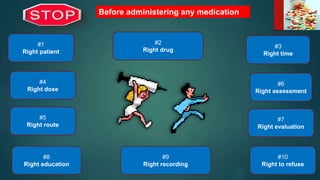
#1
Right patient
#2
Right drug
#3
Right time
#4
Right dose
#9
Right recording
#6
Right assessment
#8
Right education
#10
Right to refuse
#5
Right route
#7
Right evaluation
Before administering any medication
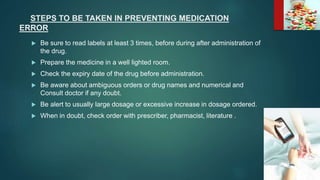
STEPS TO BE TAKEN IN PREVENTING MEDICATION
ERROR
 Be sure to read labels at least 3 times, before during after administration of
the drug.
 Prepare the medicine in a well lighted room.
 Check the expiry date of the drug before administration.
 Be aware about ambiguous orders or drug names and numerical and
Consult doctor if any doubt.
 Be alert to usually large dosage or excessive increase in dosage ordered.
 When in doubt, check order with prescriber, pharmacist, literature .
Contd....
 Double check all calculation, even simple
calculation
 Do not allow any other activity to interrupt your
administration of medication to a client.
 Routinely refer to drug interaction charts or drug
reference source and commit common
interactive drugs to memory.
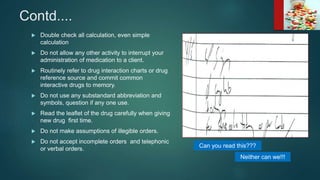
 Do not use any substandard abbreviation and
symbols, question if any one use.
 Read the leaflet of the drug carefully when giving
new drug first time.
 Do not make assumptions of illegible orders.
 Do not accept incomplete orders and telephonic
or verbal orders. Can you read this???
Neither can we!!!
Contd....
 Double check with a client who
has allergies about all new drugs
as they are added in treatment
plan.
 Question a drug form used in
unfamiliar way.
 Document all medication as soon
as they are given.
 When you have made an error
reflect on what went wrong and
ask how you could have
prevented the error.
Contd....
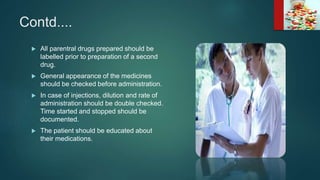
 All parentral drugs prepared should be
labelled prior to preparation of a second
drug.
 General appearance of the medicines
should be checked before administration.
 In case of injections, dilution and rate of
administration should be double checked.
Time started and stopped should be
documented.
 The patient should be educated about
their medications.
MONITORING ERROR
 Failure to review a
prescribed regime for
appropriateness and
detection of problems , or
failure to use appropriate
clinical or laboratory data for
adequate assessment of
patient response to
prescribed therapy is called
a monitoring error.
CASE STUDY
 A 55 yr old female patient was admitted with the
complaint of hypertension. She was prescribed Inj.
Frusemide. The nurse was unable to monitor the
patient carefully due to workload. The had a fall while
getting up from the bed, since she developed
postural hypotension.
REPORTING AND DETECTING ME
“ If errors go unreported, no one benefits. If we
learn about errors, we are a giant step closer
to preventing them”.
- (Michael R Cohen , 1999)
METHODS TO INDENTIFY ME
 Staff sensitization
 Reviewing patient’s file for medication charts , Doctor’s order
sheet, progress reports.
 Comparing medication administration record (MAR).
 Discharge summaries.
 Patient interview
 Direct observation
 Checking the intended and dispensed medication.
ADVERSE DRUG REACTIONS
 Definition
“It is a response to a drug that is noxious and unintended ,
and occurs at doses normally used in patients for
prophylaxis, diagnosis or therapy of a disease.
-World Health Organization
ADVERSE EVENT (AE):
Any untoward medical occurrence that may present
during treatment with a pharmaceutical product but
which does not necessarily have a causal relationship
with this treatment.
Therefore, an adverse drug reaction is an adverse event with a causal
link to a drug.
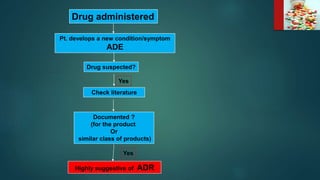
Drug administered
Pt. develops a new condition/symptom
ADE
Drug suspected?
Yes
Check literature
Documented ?
(for the product
Or
similar class of products)
Yes
Highly suggestive of ADR
Not documented in literature
Drug continued Drug discontinued
Worsening of symptoms Symptoms improve
(+ve dechallenge)
Drug restarted
Symptoms recur
(+ve rechallenge)
Any other possible causes?
• Concomitant therapy
• Underlying conditions
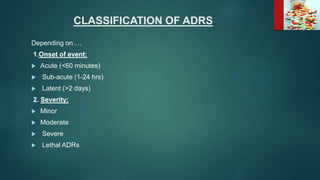
CLASSIFICATION OF ADRS
Depending on….
1.Onset of event:
 Acute (<60 minutes)
 Sub-acute (1-24 hrs)
 Latent (>2 days)
2. Severity:
 Minor
 Moderate
 Severe
 Lethal ADRs
Contd...
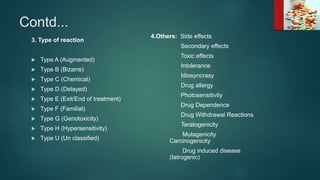
3. Type of reaction
 Type A (Augmented)
 Type B (Bizarre)
 Type C (Chemical)
 Type D (Delayed)
 Type E (Exit/End of treatment)
 Type F (Familial)
 Type G (Genotoxicity)
 Type H (Hypersensitivity)
 Type U (Un classified)
4.Others: Side effects
Secondary effects
Toxic effects
Intolerance
Idiosyncrasy
Drug allergy
Photosensitivity
Drug Dependence
Drug Withdrawal Reactions
Teratogenicity
Mutagenicity
Carcinogenicity
Drug induced disease
(Iatrogenic)
FACTORS CONTRIBUTING TO ADRS
 An error in diagnosing the disease.
 Prescription of the wrong drug for the right disease.
 Prescription of the wrong dose of right drug.
 The drug is right for the disease but wrong for the patient due to a genetic
or ethnic predisposition , age , some other illness ( like renal failure) or
medication , allergy or intolerance.
 Noncompliance on part of patient.
 Self medication by the patient.
 Taking of many drugs(poly-pharmacy) or receiving treatment from more
than one source(poly-therapy).
 Poor quality of pharmaceutical products.
HOW TO PREVENT ADRS
 Avoid inappropriate use of drugs.
 Use appropriate dose, route , frequency based on patient’s
need.
 Elicit history of allergy to drugs and allergic diseases.
 Adopt correct drug administration technique.
 Appropriate laboratory test monitoring.
HOW TO DEAL WITH ADRS
 Be alert to even minor changes in patient’s clinical status.
 Listen to minor complaints.
 May reduce the dose or withdraw the drug after consulting the
prescriber.
 Educate your patient.
 Encourage the patient to report immediately.
SUMMARY
Stay alert!
Question !
Learn!
Don’t let it happen to you
THANK YOU
Any Questions......

Presentation (1)

  • 1.
  • 2.
  • 3.
    CASE STUDY  A60yr old female patient was prescribed Syp. Eptoin-15ml, three times a day after craniotomy. Since Syr Eptoin was not available in pharmacy, it was substituted by another brand Dilantin. Eptoin contains (30mg/5ml of phenytoin )while Syr Dilantin contains (125 mg/5ml of phenytoin). The patient received 1025 mg of phenytoin instead of 270 mg for 5 days, this resulted in abnormal CT changes and patient remained drowsy for 7 days.
  • 4.
     Dispensing refersto the process of preparing and giving out medicines to a patient on the basis of prescription .  Dispensing error is defined as the discrepancy between the drugs prescribed, indented and dispensed.  It involves the correct interpretation of the doctor’s prescription and labelling of the medicine for the use by the patient as advised.
  • 5.
    Contd....  From thereceipt of the prescription in the pharmacy to the supply of a dispensed medicine to the patient.  This occurs primarily with drugs that have a similar name or appearance (LASA Drugs). Example: lasix® (frusemide) and losec® (omeprazole)
  • 6.
    DISPENSING ERROR Dispensing  Incorrectdrug  Dose  Wrong quantity  Inappropriate, incorrect or inadequate labelling  Confusing or inadequate directions for use , packaging or storage.  Brand substitution
  • 7.
    HOW TO REDUCEDISPENSING ERRORS  LASA drugs should be identified and updated in IP & OP frequently and information should be disseminated to all areas where drugs are used.  Dispensing of drugs requires qualified and trained pharmacist.  Should have good calculations and arithmetic skills, skills in assessing quality of preparations.  Pharmacy should have sufficient storage and dispensing area.  Compounding of drugs should be done at appropriate place.  Keeping interruptions and maintaining the workload at safe and manageable level.  Introducing safe systematic procedures for dispensing medicines in the pharmacy.
  • 8.
  • 9.
  • 10.
    CASE STUDY  Apatient was prescribed Inj. Tramadol 100 mg , intravenously. The injection was to be diluted in 100ml of NS and to be administered over a period of 30 min. But nurse gave it as a slow intravenous injection without dilution resulting into local reaction.
  • 11.
    RESEARCH EVIDENCES Phillips J, et al did a retrospective analysis of medication errors found that the most common types of errors were from:-  Improper dose - 40.9 %  Over dose – 36.4 %  Wrong route – 9.5 %  Wrong drug – 19 %  Knowledge deficit – 44 %  Communication error – 15.8 %
  • 12.
    ADMINISTRATION ERRORS  Wrongdrug  Wrong patient  Miss doses  Extra doses  Less doses  Incorrect rate or frequency of administration  Incorrect dilution  Incorrect route
  • 13.
    CAUSES OF ADMINISTRATIONERRORS  Lack of perceived risk  Poor role models  Lack of available technology  Lack of knowledge of the preparation or administration procedures or complex design of equipment.
  • 14.
    LEADING FACTORS  􀂄Personal neglect  􀂄Heavy workload  􀂄Unfamiliarity with medication  􀂄New staff  􀂄Complicated doctor-initiated order  􀂄Unfamiliarity with patient’s condition  􀂄Insufficient training  􀂄 Physician prescribes the wrong dose  􀂄 Misunderstood verbal order  􀂄Procedure/policy not followed
  • 15.
    CONTRIBUTING FACTORS Failure tocheck the patient’s identity prior to administration Environmental factors such a noise, interruptions ,poor lighting Wrong calculation to determine the correct dose
  • 16.
    #1 Right patient #2 Right drug #3 Righttime #4 Right dose #9 Right recording #6 Right assessment #8 Right education #10 Right to refuse #5 Right route #7 Right evaluation Before administering any medication
  • 17.
    STEPS TO BETAKEN IN PREVENTING MEDICATION ERROR  Be sure to read labels at least 3 times, before during after administration of the drug.  Prepare the medicine in a well lighted room.  Check the expiry date of the drug before administration.  Be aware about ambiguous orders or drug names and numerical and Consult doctor if any doubt.  Be alert to usually large dosage or excessive increase in dosage ordered.  When in doubt, check order with prescriber, pharmacist, literature .
  • 18.
    Contd....  Double checkall calculation, even simple calculation  Do not allow any other activity to interrupt your administration of medication to a client.  Routinely refer to drug interaction charts or drug reference source and commit common interactive drugs to memory.  Do not use any substandard abbreviation and symbols, question if any one use.  Read the leaflet of the drug carefully when giving new drug first time.  Do not make assumptions of illegible orders.  Do not accept incomplete orders and telephonic or verbal orders. Can you read this??? Neither can we!!!
  • 19.
    Contd....  Double checkwith a client who has allergies about all new drugs as they are added in treatment plan.  Question a drug form used in unfamiliar way.  Document all medication as soon as they are given.  When you have made an error reflect on what went wrong and ask how you could have prevented the error.
  • 20.
    Contd....  All parentraldrugs prepared should be labelled prior to preparation of a second drug.  General appearance of the medicines should be checked before administration.  In case of injections, dilution and rate of administration should be double checked. Time started and stopped should be documented.  The patient should be educated about their medications.
  • 21.
    MONITORING ERROR  Failureto review a prescribed regime for appropriateness and detection of problems , or failure to use appropriate clinical or laboratory data for adequate assessment of patient response to prescribed therapy is called a monitoring error.
  • 22.
    CASE STUDY  A55 yr old female patient was admitted with the complaint of hypertension. She was prescribed Inj. Frusemide. The nurse was unable to monitor the patient carefully due to workload. The had a fall while getting up from the bed, since she developed postural hypotension.
  • 23.
    REPORTING AND DETECTINGME “ If errors go unreported, no one benefits. If we learn about errors, we are a giant step closer to preventing them”. - (Michael R Cohen , 1999)
  • 24.
    METHODS TO INDENTIFYME  Staff sensitization  Reviewing patient’s file for medication charts , Doctor’s order sheet, progress reports.  Comparing medication administration record (MAR).  Discharge summaries.  Patient interview  Direct observation  Checking the intended and dispensed medication.
  • 25.
    ADVERSE DRUG REACTIONS Definition “It is a response to a drug that is noxious and unintended , and occurs at doses normally used in patients for prophylaxis, diagnosis or therapy of a disease. -World Health Organization
  • 26.
    ADVERSE EVENT (AE): Anyuntoward medical occurrence that may present during treatment with a pharmaceutical product but which does not necessarily have a causal relationship with this treatment. Therefore, an adverse drug reaction is an adverse event with a causal link to a drug.
  • 27.
    Drug administered Pt. developsa new condition/symptom ADE Drug suspected? Yes Check literature Documented ? (for the product Or similar class of products) Yes Highly suggestive of ADR
  • 28.
    Not documented inliterature Drug continued Drug discontinued Worsening of symptoms Symptoms improve (+ve dechallenge) Drug restarted Symptoms recur (+ve rechallenge) Any other possible causes? • Concomitant therapy • Underlying conditions
  • 29.
    CLASSIFICATION OF ADRS Dependingon…. 1.Onset of event:  Acute (<60 minutes)  Sub-acute (1-24 hrs)  Latent (>2 days) 2. Severity:  Minor  Moderate  Severe  Lethal ADRs
  • 30.
    Contd... 3. Type ofreaction  Type A (Augmented)  Type B (Bizarre)  Type C (Chemical)  Type D (Delayed)  Type E (Exit/End of treatment)  Type F (Familial)  Type G (Genotoxicity)  Type H (Hypersensitivity)  Type U (Un classified) 4.Others: Side effects Secondary effects Toxic effects Intolerance Idiosyncrasy Drug allergy Photosensitivity Drug Dependence Drug Withdrawal Reactions Teratogenicity Mutagenicity Carcinogenicity Drug induced disease (Iatrogenic)
  • 31.
    FACTORS CONTRIBUTING TOADRS  An error in diagnosing the disease.  Prescription of the wrong drug for the right disease.  Prescription of the wrong dose of right drug.  The drug is right for the disease but wrong for the patient due to a genetic or ethnic predisposition , age , some other illness ( like renal failure) or medication , allergy or intolerance.  Noncompliance on part of patient.  Self medication by the patient.  Taking of many drugs(poly-pharmacy) or receiving treatment from more than one source(poly-therapy).  Poor quality of pharmaceutical products.
  • 32.
    HOW TO PREVENTADRS  Avoid inappropriate use of drugs.  Use appropriate dose, route , frequency based on patient’s need.  Elicit history of allergy to drugs and allergic diseases.  Adopt correct drug administration technique.  Appropriate laboratory test monitoring.
  • 33.
    HOW TO DEALWITH ADRS  Be alert to even minor changes in patient’s clinical status.  Listen to minor complaints.  May reduce the dose or withdraw the drug after consulting the prescriber.  Educate your patient.  Encourage the patient to report immediately.
  • 34.
  • 35.
  • 36.