Medication
Errors
Presentation
Introduction
Medications treat infectious diseases, prevent problems from
chronic diseases, and ease pain, but medicines can also
cause harmful reactions if not used correctly.
Errors can happen in the hospital, at the health care
provider’s office, at the pharmacy, or at home; This is
particularly true of low- and middle income countries, so in
this presentation we will discuss the types of medication
errors and how to prevent them.
Definition of Medication Errors
Any preventable event that may cause or lead to
inappropriate medication use or patient harm.
A “preventable event” refers to events that are due to errors
that could be avoided. For example, a patient who receives
a wrong drug because of look-alike container labels is a
preventable event. A patient with no previous history of
allergies who experiences anaphylaxis after taking a certain
drug is not considered preventable.
Types of medication errors
Unauthorized
Drug
Error
Prescribing
Errors
Omission
Error
Wrong
Time
Error
Dose Error
Dosage
form
Error
There are many classifications for medication errors, so we will
provide a common classification scheme based on the nature of
the error.
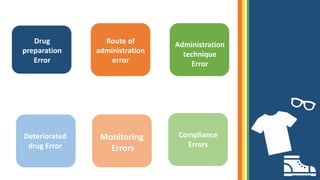
Drug
preparation
Error
Route of
administration
error
Administration
technique
Error
Deteriorated
drug Error
Monitoring
Errors
Compliance
Errors
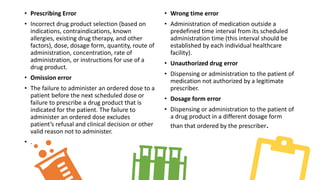
• Prescribing Error
• Incorrect drug product selection (based on
indications, contraindications, known
allergies, existing drug therapy, and other
factors), dose, dosage form, quantity, route of
administration, concentration, rate of
administration, or instructions for use of a
drug product.
• Omission error
• The failure to administer an ordered dose to a
patient before the next scheduled dose or
failure to prescribe a drug product that is
indicated for the patient. The failure to
administer an ordered dose excludes
patient’s refusal and clinical decision or other
valid reason not to administer.
• .
• Wrong time error
• Administration of medication outside a
predefined time interval from its scheduled
administration time (this interval should be
established by each individual healthcare
facility).
• Unauthorized drug error
• Dispensing or administration to the patient of
medication not authorized by a legitimate
prescriber.
• Dosage form error
• Dispensing or administration to the patient of
a drug product in a different dosage form
than that ordered by the prescriber.
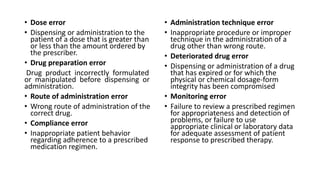
• Dose error
• Dispensing or administration to the
patient of a dose that is greater than
or less than the amount ordered by
the prescriber.
• Drug preparation error
Drug product incorrectly formulated
or manipulated before dispensing or
administration.
• Route of administration error
• Wrong route of administration of the
correct drug.
• Compliance error
• Inappropriate patient behavior
regarding adherence to a prescribed
medication regimen.
• Administration technique error
• Inappropriate procedure or improper
technique in the administration of a
drug other than wrong route.
• Deteriorated drug error
• Dispensing or administration of a drug
that has expired or for which the
physical or chemical dosage-form
integrity has been compromised
• Monitoring error
• Failure to review a prescribed regimen
for appropriateness and detection of
problems, or failure to use
appropriate clinical or laboratory data
for adequate assessment of patient
response to prescribed therapy.
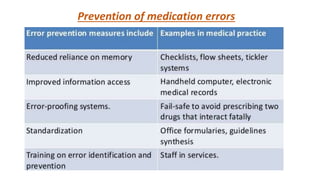
Prevention of medication errors
Thank you
References
1. https://www.fda.gov/Drugs/DrugSafety/MedicationErrors/default.htm
2. https://www.ncbi.nlm.nih.gov/pmc/articles/PMC2723204/
3. https://www.researchgate.net/post/What_are_the_types_of_medication_error
4. https://seniorjustice.com/florida-nursing-home-abuse-attorneys/medication-
errors/

Medication Errors Presentation

  • 1.
  • 2.
    Introduction Medications treat infectiousdiseases, prevent problems from chronic diseases, and ease pain, but medicines can also cause harmful reactions if not used correctly. Errors can happen in the hospital, at the health care provider’s office, at the pharmacy, or at home; This is particularly true of low- and middle income countries, so in this presentation we will discuss the types of medication errors and how to prevent them.
  • 3.
    Definition of MedicationErrors Any preventable event that may cause or lead to inappropriate medication use or patient harm. A “preventable event” refers to events that are due to errors that could be avoided. For example, a patient who receives a wrong drug because of look-alike container labels is a preventable event. A patient with no previous history of allergies who experiences anaphylaxis after taking a certain drug is not considered preventable.
  • 4.
    Types of medicationerrors Unauthorized Drug Error Prescribing Errors Omission Error Wrong Time Error Dose Error Dosage form Error There are many classifications for medication errors, so we will provide a common classification scheme based on the nature of the error.
  • 5.
  • 6.
    • Prescribing Error •Incorrect drug product selection (based on indications, contraindications, known allergies, existing drug therapy, and other factors), dose, dosage form, quantity, route of administration, concentration, rate of administration, or instructions for use of a drug product. • Omission error • The failure to administer an ordered dose to a patient before the next scheduled dose or failure to prescribe a drug product that is indicated for the patient. The failure to administer an ordered dose excludes patient’s refusal and clinical decision or other valid reason not to administer. • . • Wrong time error • Administration of medication outside a predefined time interval from its scheduled administration time (this interval should be established by each individual healthcare facility). • Unauthorized drug error • Dispensing or administration to the patient of medication not authorized by a legitimate prescriber. • Dosage form error • Dispensing or administration to the patient of a drug product in a different dosage form than that ordered by the prescriber.
  • 7.
    • Dose error •Dispensing or administration to the patient of a dose that is greater than or less than the amount ordered by the prescriber. • Drug preparation error Drug product incorrectly formulated or manipulated before dispensing or administration. • Route of administration error • Wrong route of administration of the correct drug. • Compliance error • Inappropriate patient behavior regarding adherence to a prescribed medication regimen. • Administration technique error • Inappropriate procedure or improper technique in the administration of a drug other than wrong route. • Deteriorated drug error • Dispensing or administration of a drug that has expired or for which the physical or chemical dosage-form integrity has been compromised • Monitoring error • Failure to review a prescribed regimen for appropriateness and detection of problems, or failure to use appropriate clinical or laboratory data for adequate assessment of patient response to prescribed therapy.
  • 13.
  • 14.
  • 15.
    References 1. https://www.fda.gov/Drugs/DrugSafety/MedicationErrors/default.htm 2. https://www.ncbi.nlm.nih.gov/pmc/articles/PMC2723204/ 3.https://www.researchgate.net/post/What_are_the_types_of_medication_error 4. https://seniorjustice.com/florida-nursing-home-abuse-attorneys/medication- errors/