MEDICATION
ERROR
DEFINIITON
• Medication errors, broadly defined as any error in
the prescribing, dispensing, or administration of a
drug, irrespective of whether such errors lead to
adverse consequences or not, are the single most
preventable cause of patient Harm.
• A medication error is any preventable event that may
cause or lead to inappropriate medication use or
client harm while the medication is in control of
health care professional client or consumers.
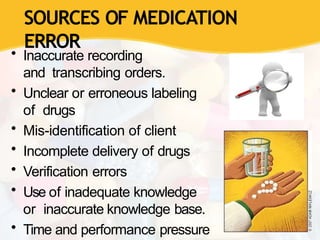
SOURCES OF MEDICATION
ERROR
• Inaccurate recording
and transcribing orders.
• Unclear or erroneous labeling
of drugs
• Mis-identification of client
• Incomplete delivery of drugs
• Verification errors
• Use of inadequate knowledge
or inaccurate knowledge base.
• Time and performance pressure
CLASSIFICATION OFMEDICATION
ERROR
The medication error may be classified in
to mistakes, slips, or lapses.
Medication errors may also be classified
according to where they occur in the
medication use cycle, i.e. at the stage of
prescribing, dispensing, or administration of a
drug.
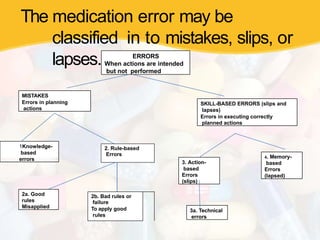
The medication error may be
classified in to mistakes, slips, or
lapses. ERRORS
When actions are intended
but not performed
MISTAKES
Errors in planning
actions
SKILL-BASED ERRORS (slips and
lapses)
Errors in executing correctly
planned actions
1Knowledge-
based
errors
2a. Good
rules
Misapplied
2. Rule-based
Errors
2b. Bad rules or
failure
To apply good
rules
3. Action-
based
Errors
(slips)
4. Memory-
based
Errors
(lapsed)
3a. Technical
errors
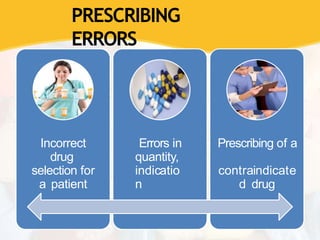
PRESCRIBING
ERRORS
Incorrect
drug
selection for
a patient
Errors in
quantity,
indicatio
n
Prescribing of a
contraindicate
d drug
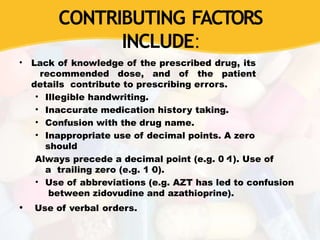
CONTRIBUTING FACTORS
INCLUDE:
• Lack of knowledge of the prescribed drug, its
recommended dose, and of the patient
details contribute to prescribing errors.
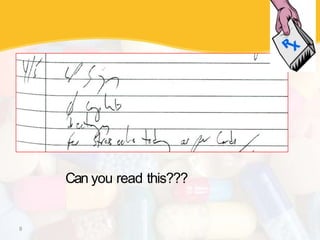
• Illegible handwriting.
• Inaccurate medication history taking.
• Confusion with the drug name.
• Inappropriate use of decimal points. A zero
should
Always precede a decimal point (e.g. 0Ā·1). Use of
a trailing zero (e.g. 1Ā·0).
• Use of abbreviations (e.g. AZT has led to confusion
between zidovudine and azathioprine).
• Use of verbal orders.
8
Can you read this???
9
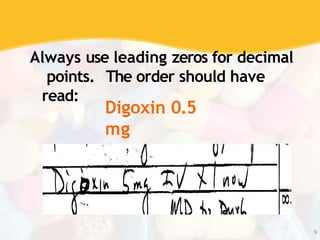
Always use leading zeros for decimal
points. The order should have
read:
Digoxin 0.5
mg
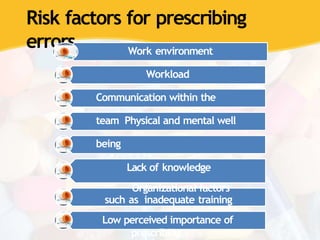
Risk factors for prescribing
errors Work environment
Workload
Communication within the
team Physical and mental well
being
Lack of knowledge
Organizational factors
such as inadequate training
Low perceived importance of
prescribing
Approaches for
reducing
prescribing errors
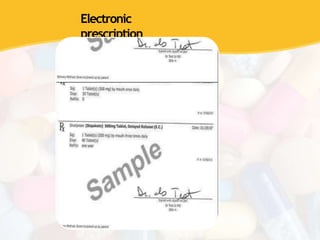
• Electronic prescribing may help to reduce
the risk of prescribing errors resulting from
illegible handwriting
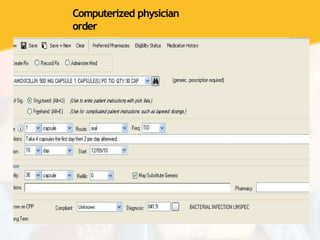
• Computerized physician order entry systems
eliminate the need for transcription of
orders by nursing staff
Electronic
prescription
Computerized physician
order
DISPENSING
ERROR
• From the receipt of the prescription in the
pharmacy to the supply of a dispensed
medicine to the patient.
• This occurs primarily with drugs that have
a similar name or appearance.
• Example :lasixĀ® (frusemide) and
losecĀ® (omeprazole)
• Other potential dispensing errors include
wrong dose, wrong drug, or wrong patient
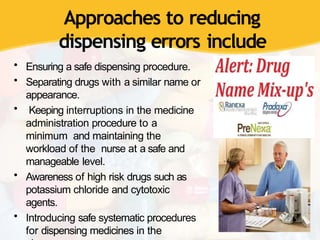
Approaches to reducing
dispensing errors include
• Ensuring a safe dispensing procedure.
• Separating drugs with a similar name or
appearance.
• Keeping interruptions in the medicine
administration procedure to a
minimum and maintaining the
workload of the nurse at a safe and
manageable level.
• Awareness of high risk drugs such as
potassium chloride and cytotoxic
agents.
• Introducing safe systematic procedures
for dispensing medicines in the
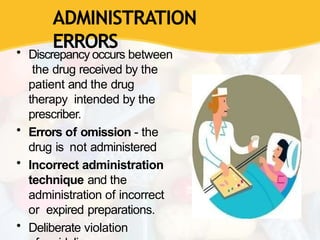
ADMINISTRATION
ERRORS
• Discrepancy occurs between
the drug received by the
patient and the drug
therapy intended by the
prescriber.
• Errors of omission - the
drug is not administered
• Incorrect administration
technique and the
administration of incorrect
or expired preparations.
• Deliberate violation
CAUSES OF ADMINISTRATION
ERRORS
• Lack of perceived risk
• Poor role models
• Lack of available technology
• Lack of knowledge of the preparation or
administration procedures Complex design
of equipment.
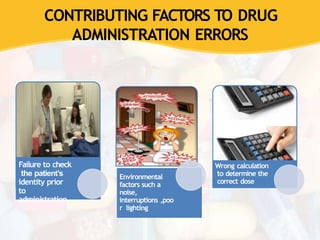
CONTRIBUTING FACTORS TO DRUG
ADMINISTRATION ERRORS
Failure to check
the patient’s
identity prior
to
administration
Environmental
factors such a
noise,
interruptions ,poo
r lighting
Wrong calculation
to determine the
correct dose
APPROACHES TO REDUCE DRUG
ADMINISTRATION ERRORS
INCLUDE:
• Checking the patient’s identity.
• Ensuring that dosage calculations are
checked independently by another health
care professional before the drug is
administered.
• Ensuring that the prescription, drug, and
patient are in the same place in order
that they may be checked against one
another.
• Ensuring the medication is given at the
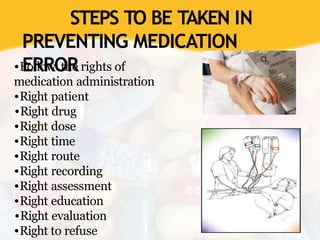
STEPS TO BE TAKEN IN
PREVENTING MEDICATION
ERROR
•Follow the rights of
medication administration
•Right patient
•Right drug
•Right dose
•Right time
•Right route
•Right recording
•Right assessment
•Right education
•Right evaluation
•Right to refuse
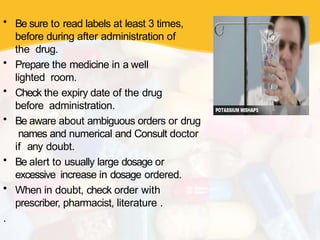
• Be sure to read labels at least 3 times,
before during after administration of
the drug.
• Prepare the medicine in a well
lighted room.
• Check the expiry date of the drug
before administration.
• Be aware about ambiguous orders or drug
names and numerical and Consult doctor
if any doubt.
• Be alert to usually large dosage or
excessive increase in dosage ordered.
• When in doubt, check order with
prescriber, pharmacist, literature .
.
• Double check all calculation, even simple
calculation
• Do not allow any other activity to interrupt
your administration of medication to a client.
• Routinely refer to drug interaction charts or drug
reference source and commit common
interactive drugs to memory.
• Do not use any unstandard abbreviation
and symbols, question if any one use
• Read the leaflet of the drug carefully when
giving new drug first time.
• Do not make assumptions of illegible orders.
• Do not accept incomplete orders and telephonic
or verbal orders.
• Double check with a client who has allergies about
all new drugs as they are added in treatment plan
• Question a drug form used in unfamiliar way.
• Document all medication as soon as they are given.
• When you have made an error reflect on what
went wrong ,ask how you could have prevented
the error
• Evaluate the context for any medication error to
determine if nurses have the necessary resources
for safe medication administration.
• When repeated medication error occurs within a
work area, identify and analyze the factors that may
have caused the errors and take corrective
action.
MEDICATION ERROR| PharmD Notes| B.pharm.pptx

  • 1.
  • 2.
    DEFINIITON • Medication errors,broadly defined as any error in the prescribing, dispensing, or administration of a drug, irrespective of whether such errors lead to adverse consequences or not, are the single most preventable cause of patient Harm. • A medication error is any preventable event that may cause or lead to inappropriate medication use or client harm while the medication is in control of health care professional client or consumers.
  • 3.
    SOURCES OF MEDICATION ERROR •Inaccurate recording and transcribing orders. • Unclear or erroneous labeling of drugs • Mis-identification of client • Incomplete delivery of drugs • Verification errors • Use of inadequate knowledge or inaccurate knowledge base. • Time and performance pressure
  • 4.
    CLASSIFICATION OFMEDICATION ERROR The medicationerror may be classified in to mistakes, slips, or lapses. Medication errors may also be classified according to where they occur in the medication use cycle, i.e. at the stage of prescribing, dispensing, or administration of a drug.
  • 5.
    The medication errormay be classified in to mistakes, slips, or lapses. ERRORS When actions are intended but not performed MISTAKES Errors in planning actions SKILL-BASED ERRORS (slips and lapses) Errors in executing correctly planned actions 1Knowledge- based errors 2a. Good rules Misapplied 2. Rule-based Errors 2b. Bad rules or failure To apply good rules 3. Action- based Errors (slips) 4. Memory- based Errors (lapsed) 3a. Technical errors
  • 6.
    PRESCRIBING ERRORS Incorrect drug selection for a patient Errorsin quantity, indicatio n Prescribing of a contraindicate d drug
  • 7.
    CONTRIBUTING FACTORS INCLUDE: • Lackof knowledge of the prescribed drug, its recommended dose, and of the patient details contribute to prescribing errors. • Illegible handwriting. • Inaccurate medication history taking. • Confusion with the drug name. • Inappropriate use of decimal points. A zero should Always precede a decimal point (e.g. 0Ā·1). Use of a trailing zero (e.g. 1Ā·0). • Use of abbreviations (e.g. AZT has led to confusion between zidovudine and azathioprine). • Use of verbal orders.
  • 8.
  • 9.
    9 Always use leadingzeros for decimal points. The order should have read: Digoxin 0.5 mg
  • 10.
    Risk factors forprescribing errors Work environment Workload Communication within the team Physical and mental well being Lack of knowledge Organizational factors such as inadequate training Low perceived importance of prescribing
  • 11.
    Approaches for reducing prescribing errors •Electronic prescribing may help to reduce the risk of prescribing errors resulting from illegible handwriting • Computerized physician order entry systems eliminate the need for transcription of orders by nursing staff
  • 12.
  • 13.
  • 14.
    DISPENSING ERROR • From thereceipt of the prescription in the pharmacy to the supply of a dispensed medicine to the patient. • This occurs primarily with drugs that have a similar name or appearance. • Example :lasixĀ® (frusemide) and losecĀ® (omeprazole) • Other potential dispensing errors include wrong dose, wrong drug, or wrong patient
  • 15.
    Approaches to reducing dispensingerrors include • Ensuring a safe dispensing procedure. • Separating drugs with a similar name or appearance. • Keeping interruptions in the medicine administration procedure to a minimum and maintaining the workload of the nurse at a safe and manageable level. • Awareness of high risk drugs such as potassium chloride and cytotoxic agents. • Introducing safe systematic procedures for dispensing medicines in the
  • 16.
    ADMINISTRATION ERRORS • Discrepancy occursbetween the drug received by the patient and the drug therapy intended by the prescriber. • Errors of omission - the drug is not administered • Incorrect administration technique and the administration of incorrect or expired preparations. • Deliberate violation
  • 17.
    CAUSES OF ADMINISTRATION ERRORS •Lack of perceived risk • Poor role models • Lack of available technology • Lack of knowledge of the preparation or administration procedures Complex design of equipment.
  • 18.
    CONTRIBUTING FACTORS TODRUG ADMINISTRATION ERRORS Failure to check the patient’s identity prior to administration Environmental factors such a noise, interruptions ,poo r lighting Wrong calculation to determine the correct dose
  • 19.
    APPROACHES TO REDUCEDRUG ADMINISTRATION ERRORS INCLUDE: • Checking the patient’s identity. • Ensuring that dosage calculations are checked independently by another health care professional before the drug is administered. • Ensuring that the prescription, drug, and patient are in the same place in order that they may be checked against one another. • Ensuring the medication is given at the
  • 20.
    STEPS TO BETAKEN IN PREVENTING MEDICATION ERROR •Follow the rights of medication administration •Right patient •Right drug •Right dose •Right time •Right route •Right recording •Right assessment •Right education •Right evaluation •Right to refuse
  • 21.
    • Be sureto read labels at least 3 times, before during after administration of the drug. • Prepare the medicine in a well lighted room. • Check the expiry date of the drug before administration. • Be aware about ambiguous orders or drug names and numerical and Consult doctor if any doubt. • Be alert to usually large dosage or excessive increase in dosage ordered. • When in doubt, check order with prescriber, pharmacist, literature . .
  • 22.
    • Double checkall calculation, even simple calculation • Do not allow any other activity to interrupt your administration of medication to a client. • Routinely refer to drug interaction charts or drug reference source and commit common interactive drugs to memory. • Do not use any unstandard abbreviation and symbols, question if any one use • Read the leaflet of the drug carefully when giving new drug first time. • Do not make assumptions of illegible orders. • Do not accept incomplete orders and telephonic or verbal orders.
  • 23.
    • Double checkwith a client who has allergies about all new drugs as they are added in treatment plan • Question a drug form used in unfamiliar way. • Document all medication as soon as they are given. • When you have made an error reflect on what went wrong ,ask how you could have prevented the error • Evaluate the context for any medication error to determine if nurses have the necessary resources for safe medication administration. • When repeated medication error occurs within a work area, identify and analyze the factors that may have caused the errors and take corrective action.