Bacillus
Prof. Dr. Tahir Yaqub
Director
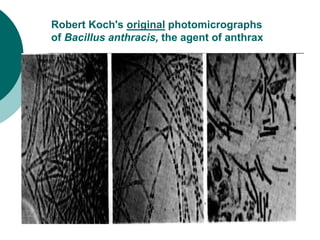
Robert Koch's original photomicrographs
of Bacillus anthracis, the agent of anthrax
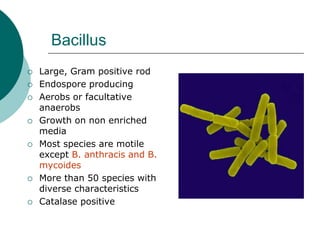
Bacillus
 Large, Gram positive rod
 Endospore producing
 Aerobs or facultative
anaerobs
 Growth on non enriched
media
 Most species are motile
except B. anthracis and B.
mycoides
 More than 50 species with
diverse characteristics
 Catalase positive
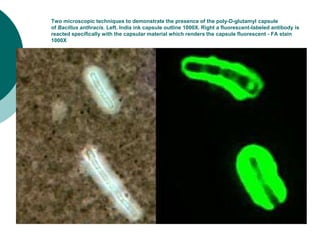
Two microscopic techniques to demonstrate the presence of the poly-D-glutamyl capsule
of Bacillus anthracis. Left. India ink capsule outline 1000X. Right a fluorescent-labeled antibody is
reacted specifically with the capsular material which renders the capsule fluorescent - FA stain
1000X
Introduction
 Oxidase negative
 Majority are non pathogenic
environmental organisms
 Many are saprophytic
 B. anthracis causes anthrax
 B. lechiniformis causes sporadic abortion
in cattle and sheep
 Bacillus cereus causes two types of
food-borne intoxications
Usual habitat
 Widely distributed in the
environment because they produce
highly resistant endospore
 In soil, can survive for more than
50 years
 Can tolerate extremely diverse
conditions such as desiccations and
high temperature
Differentation of Bacillus spp.
 Aerobic and catalase positive
(Distinguish from clostridia)
 Largely based on colonial
morphology and biochemical tests
 Many species do not produce
capsules when grown on laboratory
media
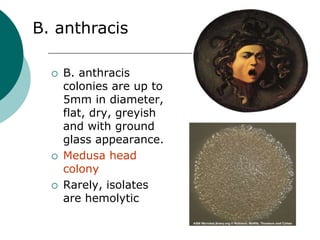
 B. anthracis
colonies are up to
5mm in diameter,
flat, dry, greyish
and with ground
glass appearance.
 Medusa head
colony
 Rarely, isolates
are hemolytic
B. anthracis
Characteristics of Bacillus species
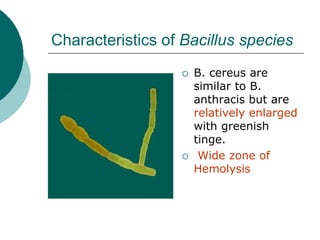
 B. cereus are
similar to B.
anthracis but are
relatively enlarged
with greenish
tinge.
 Wide zone of
Hemolysis
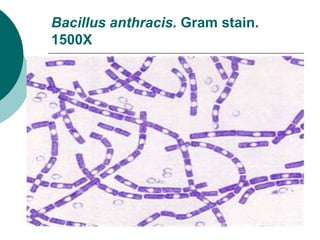
Bacillus anthracis. Gram stain.
1500X
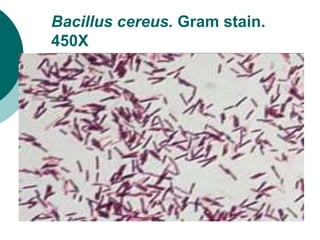
Bacillus cereus. Gram stain.
450X
Characteristics of Bacillus species
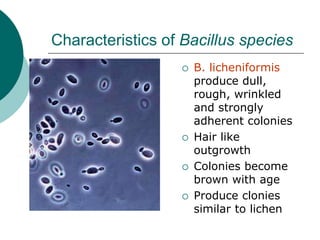
 B. licheniformis
produce dull,
rough, wrinkled
and strongly
adherent colonies
 Hair like
outgrowth
 Colonies become
brown with age
 Produce clonies
similar to lichen
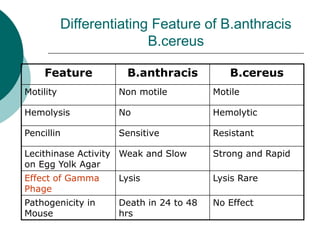
Differentiating Feature of B.anthracis
B.cereus
Feature B.anthracis B.cereus
Motility Non motile Motile
Hemolysis No Hemolytic
Pencillin Sensitive Resistant
Lecithinase Activity
on Egg Yolk Agar
Weak and Slow Strong and Rapid
Effect of Gamma
Phage
Lysis Lysis Rare
Pathogenicity in
Mouse
Death in 24 to 48
hrs
No Effect
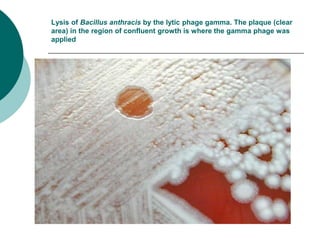
Lysis of Bacillus anthracis by the lytic phage gamma. The plaque (clear
area) in the region of confluent growth is where the gamma phage was
applied
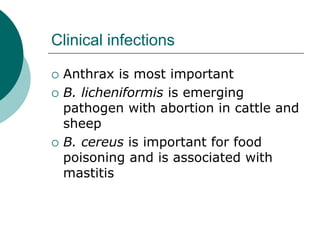
Clinical infections
 Anthrax is most important
 B. licheniformis is emerging
pathogen with abortion in cattle and
sheep
 B. cereus is important for food
poisoning and is associated with
mastitis
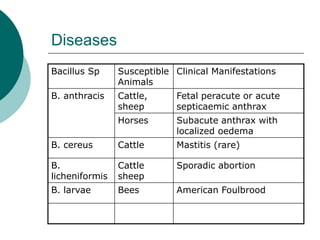
Diseases
Bacillus Sp Susceptible
Animals
Clinical Manifestations
B. anthracis Cattle,
sheep
Fetal peracute or acute
septicaemic anthrax
Horses Subacute anthrax with
localized oedema
B. cereus Cattle Mastitis (rare)
B.
licheniformis
Cattle
sheep
Sporadic abortion
B. larvae Bees American Foulbrood
Anthrax
 Severe disease which affects all
mammalian species including
humans
 Worldwide and endemic in some
countries
 Ruminants are highly susceptible
 Rapid fatal and septicemic form of
the disease
Anthrax
 Carnivores are resistant
 Birds are totally resistant due to
high body temperature
Pathogenesis and Pathogenicity
 Virulence derive from the presence
of capsule and ability to produce a
complex toxin
 Both factor are encoded by plasmid
 Expression is regulated by host
temperature and CO2 concentration
 Capsule, poly D glutamic acid,
inhibit phagocytosis
Pathogenesis and Pathogenicity
 Complex toxin consists of three
antigenic components
 Protective antigen, odema factor
and lethal factor
 Individually each factor lacks toxic
activity, although protective antigen
induces antibodies which confers
partial immunity
Pathogenesis and Pathogenicity
 Protective antigen acts as the binding
moiety for both lethal and odema factor
 Odema factor is calmodulin-dependant
adenylate cyclase that causes increased
levels of cyclic AMP.
 The resultant upset in water homeostasis
causes fluid accumulation seen in clinical
cases
 Neutrophils are principles target of odema
factor which inhibit their function
Pathogenesis and Pathogenicity
 Lethal toxin is zinc metallo protease
 Stimulate macrophages to release
cytokines.
 Complex toxin induce swelling and
darkening of tissues due to odema and
necrosis
 Septicemia increases vascular
permeability and extensive hemorrhages
lead to shock and death
Diagnosis
 Bloated and puterified carcsses
 No rigor mortis
 Dark unclotted blood may ooze
from natural openings
 Peripheral blood from tail vein-
stain with methylene blue-blue rods
with pink capsule
 Blood and McKonkey agar
Identification criteria
 Colonial morphology
 Microscopic appearance in Gram-
stained smear
 Absence of growth on McKonkey
agar
 Pathogenicity test in lab animal
 Biochemical test
Diagnosis
 Ascoli test (To perform the Ascoli test, put approximately 2 g of
sample in 5 ml of saline containing 1/100 final concentration of acetic
acid and boil for 5 minutes. The resultant solution is cooled and
filtered through filter paper. A few drops of rabbit antiserum (see
preparation below) are placed in a small test tube. The filtrate from
the previous step is gently layered over the top of the antiserum. A
positive test is the formation of a visible precipitin band in less than
15 minutes. Positive and negative control specimen suspensions
should be included).
 AGID
 CFT
 ELISA
 FAT
 PCR
Control
 Suspected cases must be reported
immediately to regulatory
authority
 In endemic region
1. Annual vaccination
2. Chemoprophylaxis
3. Killed vaccine for human
Control
 In non endemic region following a
disease outbreak
1. Restrict movement of animals
2. Personnel biosafety measures
3. Sealing and disinfecting the
contaminated building
4. Immediate disposal of carcasses
5. Scavenger should not be accessed
to suspected case
Anthrax in humans
 Three main form of the disease
 Cutaneous (Malignant pustules)
Result of endospore entering the abraded
skin
 Pulmonary anthrax
Follow inhalation of spores
 Intestinal anthrax
Follow ingestion of infective material
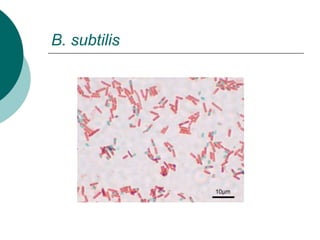
B. subtilis
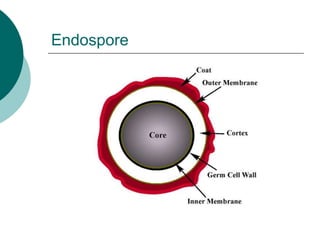
Endospore
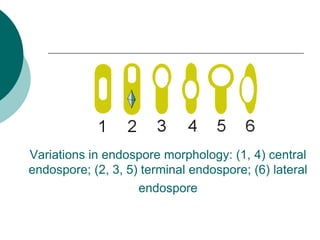
Variations in endospore morphology: (1, 4) central
endospore; (2, 3, 5) terminal endospore; (6) lateral
endospore
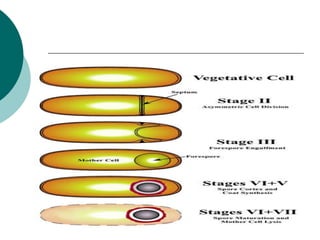
 Endospore Development: The process of forming an
endospore is complex. The model organism used to study
endospore formation is Bacillus subtilis. Endospore
development requires several hours to complete. Key
morphological changes in the process have been used as
markers to define stages of development. As a cell begins the
process of forming an endospore, it divides asymmetrically
(Stage II). This results in the creation of two compartments,
the larger mother cell and the smaller forespore. These two
cells have different developmental fates. Intercellular
communication systems coordinate cell-specific gene
expression through the sequential activation of specialized
sigma factors in each of the cells. Next (Stage III), the
peptidoglycan in the septum is degraded and the forespore is
engulfed by the mother cell, forming a cell within a cell. The
activities of the mother cell and forespore lead to the synthesis
of the endospore-specific compounds, formation of the cortex
and deposition of the coat (Stages VI+V). This is followed by
the final dehydration and maturation of the endospore (Stages
VI+VII). Finally, the mother cell is destroyed in a programmed
cell death, and the endospore is released into the
environment. The endospore will remain dormant until it senses
the return of more favorable conditions.
Sigma Factor · A small protein that directs RNA polymerase to
specific sites on the DNA to initiate gene expression
 Microorganisms sense and adapt to changes in their
environment. When favored nutrients are exhausted,
some bacteria may become motile to seek out nutrients,
or they may produce enzymes to exploit alternative
resources. One example of an extreme survival strategy
employed by certain low G+C Gram-positive bacteria is
the formation of endospores. This complex developmental
process is often initiated in response to nutrient
deprivation. It allows the bacterium to produce a dormant
and highly resistant cell to preserve the cell·s genetic
material in times of extreme stress.
 Endospores can survive environmental assaults that
would normally kill the bacterium. These stresses include
high temperature, high UV irradiation, desiccation,
chemical damage and enzymatic destruction. The
extraordinary resistance properties of endospores make
them of particular importance because they are not
readily killed by many antimicrobial treatments. A variety
of different microorganisms form ·spores· or ·cysts·, but
the endospores of low G+C Gram-positive bacteria are by
far the most resistant to harsh conditions.
Reactivation
 Reactivation of the endospore occurs when conditions
are more favourable and involves activation,
germination, and outgrowth. Even if an endospore is
located in plentiful nutrients, it may fail to germinate
unless activation has taken place. This may be
triggered by heating the endospore. Germination
involves the dormant endospore starting metabolic
activity and thus breaking hibernation. It is commonly
characterised by rupture or absorption of the spore
coat, swelling of the endospore, an increase in
metabolic activity, and loss of resistance to
environmental stress. Outgrowth follows germination
and involves the core of the endospore manufacturing
new chemical components and exiting the old spore
coat to develop into a fully functional vegetative
bacterial cell, which can divide to produce more cells.
 Up to 15% of the dry weight of the
endospore consists of calcium dipicolinate
within the core, which is thought to
stabilize the DNA. Dipicolinic acid could be
responsible for the heat resistance of the
spore, and calcium may aid in resistance
to heat and oxidizing agents. However,
mutants resistant to heat but lacking
dipicolinic acid have been isolated,
suggesting other mechanisms
contributing to heat resistance are at
work

Bacillus.ppt

  • 1.
  • 2.
    Robert Koch's originalphotomicrographs of Bacillus anthracis, the agent of anthrax
  • 3.
    Bacillus  Large, Grampositive rod  Endospore producing  Aerobs or facultative anaerobs  Growth on non enriched media  Most species are motile except B. anthracis and B. mycoides  More than 50 species with diverse characteristics  Catalase positive
  • 4.
    Two microscopic techniquesto demonstrate the presence of the poly-D-glutamyl capsule of Bacillus anthracis. Left. India ink capsule outline 1000X. Right a fluorescent-labeled antibody is reacted specifically with the capsular material which renders the capsule fluorescent - FA stain 1000X
  • 5.
    Introduction  Oxidase negative Majority are non pathogenic environmental organisms  Many are saprophytic  B. anthracis causes anthrax  B. lechiniformis causes sporadic abortion in cattle and sheep  Bacillus cereus causes two types of food-borne intoxications
  • 6.
    Usual habitat  Widelydistributed in the environment because they produce highly resistant endospore  In soil, can survive for more than 50 years  Can tolerate extremely diverse conditions such as desiccations and high temperature
  • 7.
    Differentation of Bacillusspp.  Aerobic and catalase positive (Distinguish from clostridia)  Largely based on colonial morphology and biochemical tests  Many species do not produce capsules when grown on laboratory media
  • 8.
     B. anthracis coloniesare up to 5mm in diameter, flat, dry, greyish and with ground glass appearance.  Medusa head colony  Rarely, isolates are hemolytic B. anthracis
  • 9.
    Characteristics of Bacillusspecies  B. cereus are similar to B. anthracis but are relatively enlarged with greenish tinge.  Wide zone of Hemolysis
  • 10.
  • 11.
  • 12.
    Characteristics of Bacillusspecies  B. licheniformis produce dull, rough, wrinkled and strongly adherent colonies  Hair like outgrowth  Colonies become brown with age  Produce clonies similar to lichen
  • 13.
    Differentiating Feature ofB.anthracis B.cereus Feature B.anthracis B.cereus Motility Non motile Motile Hemolysis No Hemolytic Pencillin Sensitive Resistant Lecithinase Activity on Egg Yolk Agar Weak and Slow Strong and Rapid Effect of Gamma Phage Lysis Lysis Rare Pathogenicity in Mouse Death in 24 to 48 hrs No Effect
  • 14.
    Lysis of Bacillusanthracis by the lytic phage gamma. The plaque (clear area) in the region of confluent growth is where the gamma phage was applied
  • 15.
    Clinical infections  Anthraxis most important  B. licheniformis is emerging pathogen with abortion in cattle and sheep  B. cereus is important for food poisoning and is associated with mastitis
  • 16.
    Diseases Bacillus Sp Susceptible Animals ClinicalManifestations B. anthracis Cattle, sheep Fetal peracute or acute septicaemic anthrax Horses Subacute anthrax with localized oedema B. cereus Cattle Mastitis (rare) B. licheniformis Cattle sheep Sporadic abortion B. larvae Bees American Foulbrood
  • 17.
    Anthrax  Severe diseasewhich affects all mammalian species including humans  Worldwide and endemic in some countries  Ruminants are highly susceptible  Rapid fatal and septicemic form of the disease
  • 18.
    Anthrax  Carnivores areresistant  Birds are totally resistant due to high body temperature
  • 19.
    Pathogenesis and Pathogenicity Virulence derive from the presence of capsule and ability to produce a complex toxin  Both factor are encoded by plasmid  Expression is regulated by host temperature and CO2 concentration  Capsule, poly D glutamic acid, inhibit phagocytosis
  • 20.
    Pathogenesis and Pathogenicity Complex toxin consists of three antigenic components  Protective antigen, odema factor and lethal factor  Individually each factor lacks toxic activity, although protective antigen induces antibodies which confers partial immunity
  • 21.
    Pathogenesis and Pathogenicity Protective antigen acts as the binding moiety for both lethal and odema factor  Odema factor is calmodulin-dependant adenylate cyclase that causes increased levels of cyclic AMP.  The resultant upset in water homeostasis causes fluid accumulation seen in clinical cases  Neutrophils are principles target of odema factor which inhibit their function
  • 22.
    Pathogenesis and Pathogenicity Lethal toxin is zinc metallo protease  Stimulate macrophages to release cytokines.  Complex toxin induce swelling and darkening of tissues due to odema and necrosis  Septicemia increases vascular permeability and extensive hemorrhages lead to shock and death
  • 23.
    Diagnosis  Bloated andputerified carcsses  No rigor mortis  Dark unclotted blood may ooze from natural openings  Peripheral blood from tail vein- stain with methylene blue-blue rods with pink capsule  Blood and McKonkey agar
  • 24.
    Identification criteria  Colonialmorphology  Microscopic appearance in Gram- stained smear  Absence of growth on McKonkey agar  Pathogenicity test in lab animal  Biochemical test
  • 25.
    Diagnosis  Ascoli test(To perform the Ascoli test, put approximately 2 g of sample in 5 ml of saline containing 1/100 final concentration of acetic acid and boil for 5 minutes. The resultant solution is cooled and filtered through filter paper. A few drops of rabbit antiserum (see preparation below) are placed in a small test tube. The filtrate from the previous step is gently layered over the top of the antiserum. A positive test is the formation of a visible precipitin band in less than 15 minutes. Positive and negative control specimen suspensions should be included).  AGID  CFT  ELISA  FAT  PCR
  • 26.
    Control  Suspected casesmust be reported immediately to regulatory authority  In endemic region 1. Annual vaccination 2. Chemoprophylaxis 3. Killed vaccine for human
  • 27.
    Control  In nonendemic region following a disease outbreak 1. Restrict movement of animals 2. Personnel biosafety measures 3. Sealing and disinfecting the contaminated building 4. Immediate disposal of carcasses 5. Scavenger should not be accessed to suspected case
  • 28.
    Anthrax in humans Three main form of the disease  Cutaneous (Malignant pustules) Result of endospore entering the abraded skin  Pulmonary anthrax Follow inhalation of spores  Intestinal anthrax Follow ingestion of infective material
  • 29.
  • 30.
  • 31.
    Variations in endosporemorphology: (1, 4) central endospore; (2, 3, 5) terminal endospore; (6) lateral endospore
  • 32.
     Endospore Development:The process of forming an endospore is complex. The model organism used to study endospore formation is Bacillus subtilis. Endospore development requires several hours to complete. Key morphological changes in the process have been used as markers to define stages of development. As a cell begins the process of forming an endospore, it divides asymmetrically (Stage II). This results in the creation of two compartments, the larger mother cell and the smaller forespore. These two cells have different developmental fates. Intercellular communication systems coordinate cell-specific gene expression through the sequential activation of specialized sigma factors in each of the cells. Next (Stage III), the peptidoglycan in the septum is degraded and the forespore is engulfed by the mother cell, forming a cell within a cell. The activities of the mother cell and forespore lead to the synthesis of the endospore-specific compounds, formation of the cortex and deposition of the coat (Stages VI+V). This is followed by the final dehydration and maturation of the endospore (Stages VI+VII). Finally, the mother cell is destroyed in a programmed cell death, and the endospore is released into the environment. The endospore will remain dormant until it senses the return of more favorable conditions. Sigma Factor · A small protein that directs RNA polymerase to specific sites on the DNA to initiate gene expression
  • 33.
     Microorganisms senseand adapt to changes in their environment. When favored nutrients are exhausted, some bacteria may become motile to seek out nutrients, or they may produce enzymes to exploit alternative resources. One example of an extreme survival strategy employed by certain low G+C Gram-positive bacteria is the formation of endospores. This complex developmental process is often initiated in response to nutrient deprivation. It allows the bacterium to produce a dormant and highly resistant cell to preserve the cell·s genetic material in times of extreme stress.  Endospores can survive environmental assaults that would normally kill the bacterium. These stresses include high temperature, high UV irradiation, desiccation, chemical damage and enzymatic destruction. The extraordinary resistance properties of endospores make them of particular importance because they are not readily killed by many antimicrobial treatments. A variety of different microorganisms form ·spores· or ·cysts·, but the endospores of low G+C Gram-positive bacteria are by far the most resistant to harsh conditions.
  • 35.
    Reactivation  Reactivation ofthe endospore occurs when conditions are more favourable and involves activation, germination, and outgrowth. Even if an endospore is located in plentiful nutrients, it may fail to germinate unless activation has taken place. This may be triggered by heating the endospore. Germination involves the dormant endospore starting metabolic activity and thus breaking hibernation. It is commonly characterised by rupture or absorption of the spore coat, swelling of the endospore, an increase in metabolic activity, and loss of resistance to environmental stress. Outgrowth follows germination and involves the core of the endospore manufacturing new chemical components and exiting the old spore coat to develop into a fully functional vegetative bacterial cell, which can divide to produce more cells.
  • 36.
     Up to15% of the dry weight of the endospore consists of calcium dipicolinate within the core, which is thought to stabilize the DNA. Dipicolinic acid could be responsible for the heat resistance of the spore, and calcium may aid in resistance to heat and oxidizing agents. However, mutants resistant to heat but lacking dipicolinic acid have been isolated, suggesting other mechanisms contributing to heat resistance are at work