Media Law: Understanding Freedom
of Expression
© 2008 The McGraw-Hill Companies, Inc. All rights reserved
Chapter Outline
History
Today’s Media Law
Controversies
 What are the 5 clauses of the first
amendment?
 Name the different types of mass media
that exist in our society
 The Development of the Philosophy of Free Speech
 Freedom to protest was important to the founders U.S. colonies
▪ After breaking away from the Roman Catholic Church
 Protestants made fun of under England’s licensing laws
▪ Not allowed to express religious views for more than a 100 years.
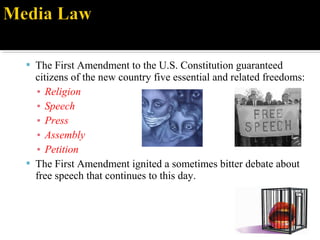
 The First Amendment to the U.S. Constitution guaranteed
citizens of the new country five essential and related freedoms:
▪ Religion
▪ Speech
▪ Press
▪ Assembly
▪ Petition
 The First Amendment ignited a sometimes bitter debate about
free speech that continues to this day.
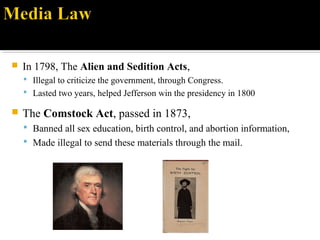
 In 1798, The Alien and Sedition Acts,
 Illegal to criticize the government, through Congress.
 Lasted two years, helped Jefferson win the presidency in 1800
 The Comstock Act, passed in 1873,
 Banned all sex education, birth control, and abortion information,
 Made illegal to send these materials through the mail.
 Muckrakers influenced passage of laws
▪ Sherman Antitrust Act of 1890
▪ Pure Food and Drug Act of 1906,
▪ Lead to restrictions in what and how the media could advertise.
▪ Espionage Act upheld the censorship of ideas considered injurious
to the war effort.
 Clear and Present Danger doctrine
 Justice Oliver Wendell Holmes wrote the in 1919
 “The question in every case is whether the words used are used in such
circumstances and are of such a nature as to create a clear and present
danger that they will bring about the substantive evils that the United States
Congress has a right to prevent.”
 Regulating Broadcasting
 FCC regulated more than radio stations on the frequency
spectrum.
▪ The Equal Time Rule
▪ Stations must give equal opportunity for other candidates of same office.
▪ The Fairness Doctrine (1949-1987)
▪ Required broadcasters to give time for discussion of big public issues.
 Telecommunications Act of
1996,
▪ Removed restrictions on a wide
range of communications
industries
▪ Allowing
 Cable TV,
 Long distance carriers,
 Local phone companies,
 Information services
 Internet service providers to
merge at will.
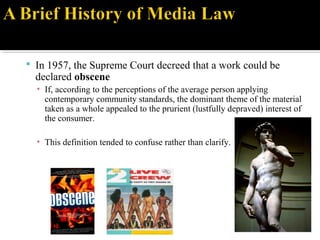
 In 1957, the Supreme Court decreed that a work could be
declared obscene
▪ If, according to the perceptions of the average person applying
contemporary community standards, the dominant theme of the material
taken as a whole appealed to the prurient (lustfully depraved) interest of
the consumer.
▪ This definition tended to confuse rather than clarify.
 In 1964 Justice Potter Stewart expressed frustration at the
difficulties of defining obscenity
▪ He famously said “I can’t define it, but I know it when I see it”.
 A new category, indecency, was created for broadcast controls.
▪ The FCC considers material indecent if it is “offensive to community
standards for broadcasting.”
 New Technology
 In 1996, Congress passed the Communications Decency Act,
 Which made it a crime to transmit indecent material over the
Internet if minors had access to it
▪ But the Supreme Court found it unconstitutional
▪ Why would this be unconstitutional
 New Technology
 Other laws had to be written for crimes that did not exist
before the Internet.
▪ A 1996 law made computer espionage illegal.
▪ In the 1990s, federal law made the development and
purposeful transmission of computer viruses illegal.
 The Legal System and Types of Law
▪ In criminal law
▪ Criminal acts.
▪ In civil law
▪ Disputes between private parties
▪ Constitutional law
▪ The U.S. Constitution prevails,
▪ Any state or local law that contradicts the First Amendment cannot be
legally implemented.
 Statutory law
 Collection of laws written by legislative bodies, such as the U.S. Congress,
 Administrative law
 Made up of the rules and regulations of governmental agencies
 Common law
 Made up of judges’ rulings which become precedents for future cases.
 Defamation
 False communication that and injures the
reputation
 Slander
 Defamation that appears in spoken form, such
as speech.
 Libel
 Published or broadcast defamation.
 In most cases, truth is the absolute defense
against a charge of libel.
 A public figure must prove actual malice
▪ Either knew it was false or had a reckless
disregard for the truth,.
 The copyright sign
▪ Does not have to appear in a work for it to be protected.
 Fair use
▪ Allows copying of a work for noncommercial use as long as it does
not exploit the copyright holder.
 Digital Millennium Copyright Act
▪ Made it a crime to break through any technology intended to secure
digital copies of software, literary works, videos, and music.
 Some forms of speech are more protected than others.
▪ Political speech
▪ Ideas and facts that backup the ideas about the meaning and correct
course of government is the most protected.
▪ Artistic speech
▪ Including creative work such as painting, dance and literature.
▪ Commercial speech
▪ includes advertising.
▪ Indecent speech
▪ Enjoys the least protection.

Media laws

  • 2.
    Media Law: UnderstandingFreedom of Expression © 2008 The McGraw-Hill Companies, Inc. All rights reserved Chapter Outline History Today’s Media Law Controversies
  • 3.
     What arethe 5 clauses of the first amendment?  Name the different types of mass media that exist in our society
  • 4.
     The Developmentof the Philosophy of Free Speech  Freedom to protest was important to the founders U.S. colonies ▪ After breaking away from the Roman Catholic Church  Protestants made fun of under England’s licensing laws ▪ Not allowed to express religious views for more than a 100 years.
  • 5.
     The FirstAmendment to the U.S. Constitution guaranteed citizens of the new country five essential and related freedoms: ▪ Religion ▪ Speech ▪ Press ▪ Assembly ▪ Petition  The First Amendment ignited a sometimes bitter debate about free speech that continues to this day.
  • 6.
     In 1798,The Alien and Sedition Acts,  Illegal to criticize the government, through Congress.  Lasted two years, helped Jefferson win the presidency in 1800  The Comstock Act, passed in 1873,  Banned all sex education, birth control, and abortion information,  Made illegal to send these materials through the mail.
  • 7.
     Muckrakers influencedpassage of laws ▪ Sherman Antitrust Act of 1890 ▪ Pure Food and Drug Act of 1906, ▪ Lead to restrictions in what and how the media could advertise. ▪ Espionage Act upheld the censorship of ideas considered injurious to the war effort.
  • 8.
     Clear andPresent Danger doctrine  Justice Oliver Wendell Holmes wrote the in 1919  “The question in every case is whether the words used are used in such circumstances and are of such a nature as to create a clear and present danger that they will bring about the substantive evils that the United States Congress has a right to prevent.”
  • 9.
     Regulating Broadcasting FCC regulated more than radio stations on the frequency spectrum. ▪ The Equal Time Rule ▪ Stations must give equal opportunity for other candidates of same office. ▪ The Fairness Doctrine (1949-1987) ▪ Required broadcasters to give time for discussion of big public issues.
  • 10.
     Telecommunications Actof 1996, ▪ Removed restrictions on a wide range of communications industries ▪ Allowing  Cable TV,  Long distance carriers,  Local phone companies,  Information services  Internet service providers to merge at will.
  • 11.
     In 1957,the Supreme Court decreed that a work could be declared obscene ▪ If, according to the perceptions of the average person applying contemporary community standards, the dominant theme of the material taken as a whole appealed to the prurient (lustfully depraved) interest of the consumer. ▪ This definition tended to confuse rather than clarify.
  • 12.
     In 1964Justice Potter Stewart expressed frustration at the difficulties of defining obscenity ▪ He famously said “I can’t define it, but I know it when I see it”.  A new category, indecency, was created for broadcast controls. ▪ The FCC considers material indecent if it is “offensive to community standards for broadcasting.”
  • 13.
     New Technology In 1996, Congress passed the Communications Decency Act,  Which made it a crime to transmit indecent material over the Internet if minors had access to it ▪ But the Supreme Court found it unconstitutional ▪ Why would this be unconstitutional
  • 14.
     New Technology Other laws had to be written for crimes that did not exist before the Internet. ▪ A 1996 law made computer espionage illegal. ▪ In the 1990s, federal law made the development and purposeful transmission of computer viruses illegal.
  • 15.
     The LegalSystem and Types of Law ▪ In criminal law ▪ Criminal acts. ▪ In civil law ▪ Disputes between private parties ▪ Constitutional law ▪ The U.S. Constitution prevails, ▪ Any state or local law that contradicts the First Amendment cannot be legally implemented.
  • 16.
     Statutory law Collection of laws written by legislative bodies, such as the U.S. Congress,  Administrative law  Made up of the rules and regulations of governmental agencies  Common law  Made up of judges’ rulings which become precedents for future cases.
  • 17.
     Defamation  Falsecommunication that and injures the reputation  Slander  Defamation that appears in spoken form, such as speech.  Libel  Published or broadcast defamation.  In most cases, truth is the absolute defense against a charge of libel.  A public figure must prove actual malice ▪ Either knew it was false or had a reckless disregard for the truth,.
  • 18.
     The copyrightsign ▪ Does not have to appear in a work for it to be protected.  Fair use ▪ Allows copying of a work for noncommercial use as long as it does not exploit the copyright holder.  Digital Millennium Copyright Act ▪ Made it a crime to break through any technology intended to secure digital copies of software, literary works, videos, and music.
  • 19.
     Some formsof speech are more protected than others. ▪ Political speech ▪ Ideas and facts that backup the ideas about the meaning and correct course of government is the most protected. ▪ Artistic speech ▪ Including creative work such as painting, dance and literature. ▪ Commercial speech ▪ includes advertising. ▪ Indecent speech ▪ Enjoys the least protection.