Law and Regulation J. Matthew Melton, Ph.D Lee University, Cleveland, TN
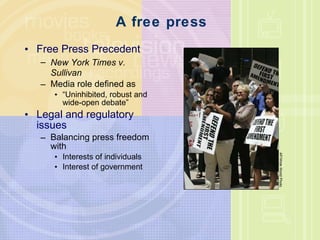
A free press Free Press Precedent New York Times v. Sullivan Media role defined as “ Uninhibited, robust and wide-open debate” Legal and regulatory issues Balancing press freedom with  Interests of individuals Interest of government AP/Wide World Photo
U.S. Constitution The First Amendment to the Constitution Congress shall make no law respecting an establishment of religion, or prohibiting the free exercise thereof; or abridging the freedom of speech, or of the press; or the right of the people peaceably to assemble, and to petition the Government for a redress of grievances. The “Fourth Estate” The press as “tribune of the people” An extra constitutional branch of government Exposes public mismanagement
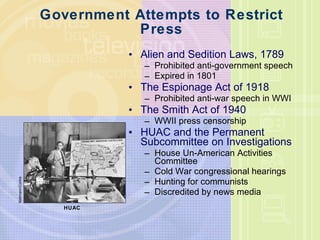
Government Attempts to Restrict Press Alien and Sedition Laws, 1789 Prohibited anti-government speech Expired in 1801 The Espionage Act of 1918 Prohibited anti-war speech in WWI The Smith Act of 1940 WWII press censorship HUAC and the Permanent Subcommittee on Investigations House Un-American Activities Committee Cold War congressional hearings Hunting for communists Discredited by news media Bettmann/Corbis HUAC
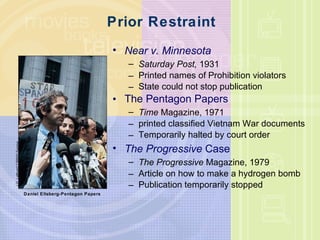
Prior Restraint Near v. Minnesota Saturday Post,  1931 Printed names of Prohibition violators State could not stop publication The Pentagon Papers Time  Magazine, 1971 printed classified Vietnam War documents Temporarily halted by court order The Progressive  Case The Progressive  Magazine, 1979 Article on how to make a hydrogen bomb Publication temporarily stopped J.P. Laffont/CORBIS Sygma Daniel Ellsberg-Pentagon Papers
Obscenity & Censorship Obscenity issues Boston and H.L. Mencken’s  The American Mercury,  1926 “ Salacious” content Magazine won the case Roth vs. United States , 1957 Obscenity not protected by the 1st Amendment Obscenity: “Material utterly without redeeming social importance” Obscenity appeals to “prurient interest” The “Roth Test” of contemporary community standards
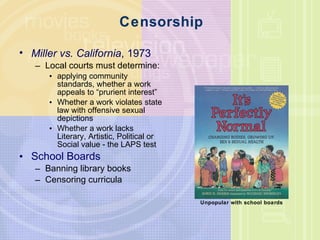
Censorship Miller vs. California , 1973 Local courts must determine: applying community standards, whether a work appeals to “prurient interest” Whether a work violates state law with offensive sexual depictions Whether a work lacks Literary, Artistic, Political or Social value - the LAPS test School Boards Banning library books Censoring curricula Unpopular with school boards
National Efforts to Control Free Speech The Meese Commission on Pornography, 1986 Argued that pornography is harmful No legislation resulted The Hazelwood Case 1988 Hazelwood High School, Missouri Articles in school paper censored by principal Upheld by U.S. Supreme Court Minors do not possess same extent of freedom as adults Student Press Law Center Southernfried/morgeufile.com
California’s “Free Choice” AB 47809 Students have the right to choose whatever topic they desire, within certain ethical boundaries, upon which to report. School administrators cannot legally stop the publication of any story by a school newspaper. What does this mean for us? Should we have a “no holds barred” approach to decide what stories/topics we should cover? What type of stories/topics should we avoid?
Libel Law The Sullivan Case, 1964 Public officials must prove malice Gertz v. Robert Welch , 1974 Editorial opinion is not libel Public figures Herbert v. Lando , 1979 Public figures may investigate reporters’ sources Masson v. The New Yorker , 1991 Grammatical changes not necessarily libelous Media Law Resource Center Libel FAQ Bigfoto.com
Libel Defense To prove libel, must show that: Statement communicated to third party Subject easily identifiable in the statement Statement injured the subject’s reputation Publisher of the statement is at fault Defenses for libel Truth If it’s true, it’s not libel Qualified privilege Information obtained in court or legislature Fair comment Opinion/Commentary/Editorials are not libel Ariadna/morguefile.com
Famous Libel Cases Carol Burnett v.  National Enquirer Sued for $10 million, 1983 Awarded $150,000 Gen. Westmoreland v. CBS Sued for $120 million, 1984 Settled out of court $18 million in legal fees Ariel Sharon v.  Time Sued for $50 million, 1988 Lost, paid $1 million in fees Wayne Newton v. NBC Sued for $6 million, 1990 Won, no damages awarded
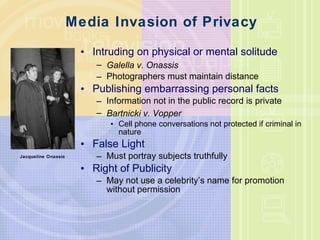
Media Invasion of Privacy Intruding on physical or mental solitude Galella v. Onassis Photographers must maintain distance Publishing embarrassing personal facts Information not in the public record is private Bartnicki v. Vopper Cell phone conversations not protected if criminal in nature False Light Must portray subjects truthfully Right of Publicity May not use a celebrity’s name for promotion without permission Jacqueline Onassis
Fair Trial, Access & Sources Fair Trial Sheppard v. Maxwell , 1954 Jury access to media later ruled as influence on a conviction (1966) Original verdict overturned Courtroom Access Gag orders Limited press access Closed proceedings No press access Both rarely applied Shield Laws Protect source confidentiality No federal protection
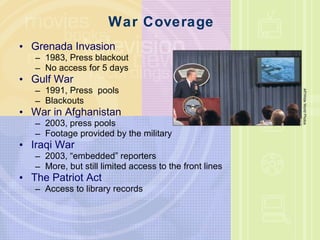
War Coverage Grenada Invasion 1983, Press blackout No access for 5 days Gulf War 1991, Press  pools Blackouts War in Afghanistan 2003, press pools Footage provided by the military Iraqi War 2003, “embedded” reporters More, but still limited access to the front lines The Patriot Act Access to library records AP/Wide World Photos
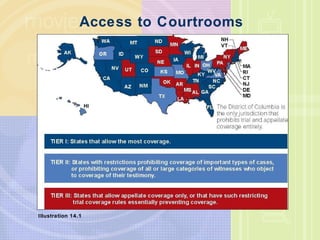
Access to Courtrooms Illustration 14.1
Regulating Broadcast and Cable Federal Communications Commission Regulates broadcasting 5 commissioners, 5-year terms Appointed by President, approved by Senate Licences all stations Federal Trade Commission Regulates advertising Airwaves are a “public trust” Broadcasters are “trustees operating in the public interest”
Telecommunications Act of 1996 Philosophy of Deregulation Competition improves choices Favors larger media companies Selling “The Bundle” Combination of services TV, telephone, cable, Internet Targeting “Power Users” People using a lot of media Spends three or more times what the average user spends
Effects of Deregulation Goal of Universal Service Access to all media for all people Deregulation of Free Media Radio & TV are “free media” Relaxed ownership/licensing rules Cross-ownership allowed TV and radio in the same market Local Phone Competition Phone companies allowed to offer video service Unregulated Cable Rates 1992 Cable Act removed Deregulated cable rates
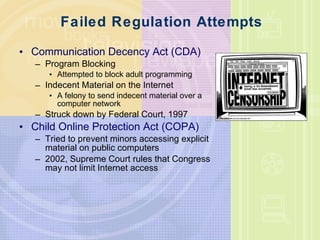
Failed Regulation Attempts Communication Decency Act (CDA) Program Blocking Attempted to block adult programming Indecent Material on the Internet A felony to send indecent material over a computer network Struck down by Federal Court, 1997 Child Online Protection Act (COPA) Tried to prevent minors accessing explicit material on public computers 2002, Supreme Court rules that Congress may not limit Internet access
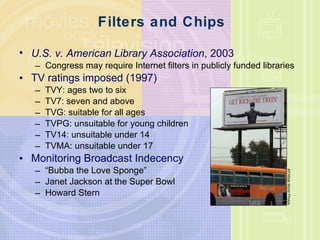
Filters and Chips U.S. v. American Library Association , 2003 Congress may require Internet filters in publicly funded libraries TV ratings imposed (1997) TVY: ages two to six TV7: seven and above TVG: suitable for all ages TVPG: unsuitable for young children TV14: unsuitable under 14 TVMA: unsuitable under 17 Monitoring Broadcast Indecency “ Bubba the Love Sponge” Janet Jackson at the Super Bowl Howard Stern AP/Wide World Photos
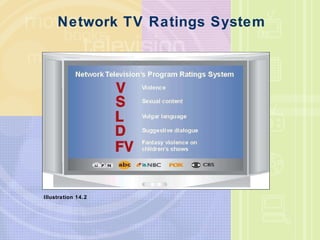
Network TV Ratings System Illustration 14.2
Intellectual Property Rights Ownership of creative ideas Digital Millennium Copyright Act  (DMCA) 1998, Ownership issues and the Internet World International  Property Organization treaties (WIPO) Aimed at preventing illegal copy of Internet published material Illegal to circumvent password protection technology New York Times v. Tasini Protects freelancer royalties, 2001 MGM v. Grokster , 2005 File-sharing software is liable
Advertising, Public Relations Law and Regulation Central Hudson v. Public Service Commission 1980 Supreme Court ruling Government may not regulate commercial speech so long as it is lawful and does not mislead The Texas Gulf Sulphur Case, 1960s U.S. Court of Appeals ruled that publicly owned companies may not conceal information that may impact investment options
Critical Discussion Banning books in grade school libraries continues to be a controversial issue. Should any books be forbidden to certain age groups? How should a community make this decision? Recent decisions of the FCC to enact fines on perceived indecency have had a major impact on decisions in radio and television. Should the FCC be monitoring broadcast content in this fashion?

Media law

  • 1.
    Law and RegulationJ. Matthew Melton, Ph.D Lee University, Cleveland, TN
  • 2.
    A free pressFree Press Precedent New York Times v. Sullivan Media role defined as “ Uninhibited, robust and wide-open debate” Legal and regulatory issues Balancing press freedom with Interests of individuals Interest of government AP/Wide World Photo
  • 3.
    U.S. Constitution TheFirst Amendment to the Constitution Congress shall make no law respecting an establishment of religion, or prohibiting the free exercise thereof; or abridging the freedom of speech, or of the press; or the right of the people peaceably to assemble, and to petition the Government for a redress of grievances. The “Fourth Estate” The press as “tribune of the people” An extra constitutional branch of government Exposes public mismanagement
  • 4.
    Government Attempts toRestrict Press Alien and Sedition Laws, 1789 Prohibited anti-government speech Expired in 1801 The Espionage Act of 1918 Prohibited anti-war speech in WWI The Smith Act of 1940 WWII press censorship HUAC and the Permanent Subcommittee on Investigations House Un-American Activities Committee Cold War congressional hearings Hunting for communists Discredited by news media Bettmann/Corbis HUAC
  • 5.
    Prior Restraint Nearv. Minnesota Saturday Post, 1931 Printed names of Prohibition violators State could not stop publication The Pentagon Papers Time Magazine, 1971 printed classified Vietnam War documents Temporarily halted by court order The Progressive Case The Progressive Magazine, 1979 Article on how to make a hydrogen bomb Publication temporarily stopped J.P. Laffont/CORBIS Sygma Daniel Ellsberg-Pentagon Papers
  • 6.
    Obscenity & CensorshipObscenity issues Boston and H.L. Mencken’s The American Mercury, 1926 “ Salacious” content Magazine won the case Roth vs. United States , 1957 Obscenity not protected by the 1st Amendment Obscenity: “Material utterly without redeeming social importance” Obscenity appeals to “prurient interest” The “Roth Test” of contemporary community standards
  • 7.
    Censorship Miller vs.California , 1973 Local courts must determine: applying community standards, whether a work appeals to “prurient interest” Whether a work violates state law with offensive sexual depictions Whether a work lacks Literary, Artistic, Political or Social value - the LAPS test School Boards Banning library books Censoring curricula Unpopular with school boards
  • 8.
    National Efforts toControl Free Speech The Meese Commission on Pornography, 1986 Argued that pornography is harmful No legislation resulted The Hazelwood Case 1988 Hazelwood High School, Missouri Articles in school paper censored by principal Upheld by U.S. Supreme Court Minors do not possess same extent of freedom as adults Student Press Law Center Southernfried/morgeufile.com
  • 9.
    California’s “Free Choice”AB 47809 Students have the right to choose whatever topic they desire, within certain ethical boundaries, upon which to report. School administrators cannot legally stop the publication of any story by a school newspaper. What does this mean for us? Should we have a “no holds barred” approach to decide what stories/topics we should cover? What type of stories/topics should we avoid?
  • 10.
    Libel Law TheSullivan Case, 1964 Public officials must prove malice Gertz v. Robert Welch , 1974 Editorial opinion is not libel Public figures Herbert v. Lando , 1979 Public figures may investigate reporters’ sources Masson v. The New Yorker , 1991 Grammatical changes not necessarily libelous Media Law Resource Center Libel FAQ Bigfoto.com
  • 11.
    Libel Defense Toprove libel, must show that: Statement communicated to third party Subject easily identifiable in the statement Statement injured the subject’s reputation Publisher of the statement is at fault Defenses for libel Truth If it’s true, it’s not libel Qualified privilege Information obtained in court or legislature Fair comment Opinion/Commentary/Editorials are not libel Ariadna/morguefile.com
  • 12.
    Famous Libel CasesCarol Burnett v. National Enquirer Sued for $10 million, 1983 Awarded $150,000 Gen. Westmoreland v. CBS Sued for $120 million, 1984 Settled out of court $18 million in legal fees Ariel Sharon v. Time Sued for $50 million, 1988 Lost, paid $1 million in fees Wayne Newton v. NBC Sued for $6 million, 1990 Won, no damages awarded
  • 13.
    Media Invasion ofPrivacy Intruding on physical or mental solitude Galella v. Onassis Photographers must maintain distance Publishing embarrassing personal facts Information not in the public record is private Bartnicki v. Vopper Cell phone conversations not protected if criminal in nature False Light Must portray subjects truthfully Right of Publicity May not use a celebrity’s name for promotion without permission Jacqueline Onassis
  • 14.
    Fair Trial, Access& Sources Fair Trial Sheppard v. Maxwell , 1954 Jury access to media later ruled as influence on a conviction (1966) Original verdict overturned Courtroom Access Gag orders Limited press access Closed proceedings No press access Both rarely applied Shield Laws Protect source confidentiality No federal protection
  • 15.
    War Coverage GrenadaInvasion 1983, Press blackout No access for 5 days Gulf War 1991, Press pools Blackouts War in Afghanistan 2003, press pools Footage provided by the military Iraqi War 2003, “embedded” reporters More, but still limited access to the front lines The Patriot Act Access to library records AP/Wide World Photos
  • 16.
    Access to CourtroomsIllustration 14.1
  • 17.
    Regulating Broadcast andCable Federal Communications Commission Regulates broadcasting 5 commissioners, 5-year terms Appointed by President, approved by Senate Licences all stations Federal Trade Commission Regulates advertising Airwaves are a “public trust” Broadcasters are “trustees operating in the public interest”
  • 18.
    Telecommunications Act of1996 Philosophy of Deregulation Competition improves choices Favors larger media companies Selling “The Bundle” Combination of services TV, telephone, cable, Internet Targeting “Power Users” People using a lot of media Spends three or more times what the average user spends
  • 19.
    Effects of DeregulationGoal of Universal Service Access to all media for all people Deregulation of Free Media Radio & TV are “free media” Relaxed ownership/licensing rules Cross-ownership allowed TV and radio in the same market Local Phone Competition Phone companies allowed to offer video service Unregulated Cable Rates 1992 Cable Act removed Deregulated cable rates
  • 20.
    Failed Regulation AttemptsCommunication Decency Act (CDA) Program Blocking Attempted to block adult programming Indecent Material on the Internet A felony to send indecent material over a computer network Struck down by Federal Court, 1997 Child Online Protection Act (COPA) Tried to prevent minors accessing explicit material on public computers 2002, Supreme Court rules that Congress may not limit Internet access
  • 21.
    Filters and ChipsU.S. v. American Library Association , 2003 Congress may require Internet filters in publicly funded libraries TV ratings imposed (1997) TVY: ages two to six TV7: seven and above TVG: suitable for all ages TVPG: unsuitable for young children TV14: unsuitable under 14 TVMA: unsuitable under 17 Monitoring Broadcast Indecency “ Bubba the Love Sponge” Janet Jackson at the Super Bowl Howard Stern AP/Wide World Photos
  • 22.
    Network TV RatingsSystem Illustration 14.2
  • 23.
    Intellectual Property RightsOwnership of creative ideas Digital Millennium Copyright Act (DMCA) 1998, Ownership issues and the Internet World International Property Organization treaties (WIPO) Aimed at preventing illegal copy of Internet published material Illegal to circumvent password protection technology New York Times v. Tasini Protects freelancer royalties, 2001 MGM v. Grokster , 2005 File-sharing software is liable
  • 24.
    Advertising, Public RelationsLaw and Regulation Central Hudson v. Public Service Commission 1980 Supreme Court ruling Government may not regulate commercial speech so long as it is lawful and does not mislead The Texas Gulf Sulphur Case, 1960s U.S. Court of Appeals ruled that publicly owned companies may not conceal information that may impact investment options
  • 25.
    Critical Discussion Banningbooks in grade school libraries continues to be a controversial issue. Should any books be forbidden to certain age groups? How should a community make this decision? Recent decisions of the FCC to enact fines on perceived indecency have had a major impact on decisions in radio and television. Should the FCC be monitoring broadcast content in this fashion?