Ethics in Media/keyprinciples
CF301 Communication Ethics and Rights.
Fall, 2012.
Instructor: Ayten Gorgun Smith Teaching assitant: Sabina Jafarova
Kadir Has University Grad. Stud. Kadir Has University
Faculty of Communications Faculty of Communications
Department of Public Department of New Media
Relations and Information
2.
Definition of Ethics.
•The way people behave based on how their
beliefs about what is right and wrong influence
behavior (www.ethics.org/resource/definitions-
values).
• ‘Ethics’ comes from the Greek ‘Ethos’, meaning
character, or what a good person is or does to
have a good character (Jay Black and Chris
Roberts Doing Ethics in Media, pp. 17).
3.
Doing ethics weconsider…
• Which values take precedence?
• What would my moral heroes and sheroes do?
• To whom do we owe something?
• Why ought we behave in particular way?
• What are the consequences of our behaviors?
Source: Jay Black and Chris Roberts Doing Ethics in Media, pp. 23
4.
Ethics in Journalism
•Society of Professional Journalists’ code of
ethics has 4 main tenants:
Seek truth and report it!
Minimize harm
Act independently
Be accountable
Source: http://spj.org/ethicscode.asp
5.
Key Principles ofEthics in Media.
‘It is about the journey, not destination!’
Key thinkers about Ethics
6.
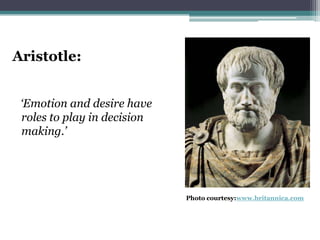
Aristotle:
‘Emotion anddesire have
roles to play in decision
making.’
Photo courtesy:www.britannica.com
7.
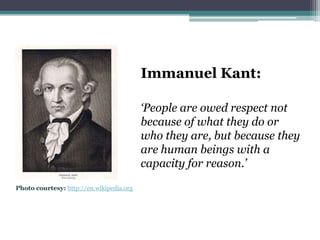
Immanuel Kant:
‘People are owed respect not
because of what they do or
who they are, but because they
are human beings with a
capacity for reason.’
Photo courtesy: http://en.wikipedia.org
8.
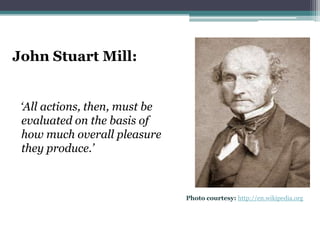
John Stuart Mill:
‘All actions, then, must be
evaluated on the basis of
how much overall pleasure
they produce.’
Photo courtesy: http://en.wikipedia.org
9.
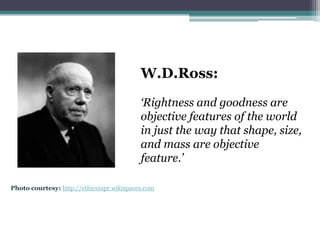
W.D.Ross:
‘Rightness and goodness are
objective features of the world
in just the way that shape, size,
and mass are objective
feature.’
Photo courtesy: http://ethicsinpr.wikispaces.com
10.
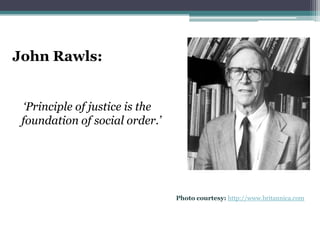
John Rawls:
‘Principle of justice is the
foundation of social order.’
Photo courtesy: http://www.britannica.com
11.
Key Principles ofEthics in Media.
• Idealism-how strongly we feel about the pursuit of
humanitarian goals.
• Relativism-belief that the only way we can decide
what’s ethical and what’s not is to rely on our own
experiences and internal moral ‘compass’.
Source: Patrick Lee Plaisance Media Ethics; Key Principles for Responsible Practice pp.13
12.
Readings:
Jay Blackand Chris Roberts Doing Ethics in
Media; Theories and Practical Applications,
‘Ethics and Moral Reasoning’, London:
Routledge, 2011 pp.17-37.
Patrick Lee Plaisance Media Ethics; Key
Principles for Responsible Practice, ‘Ethics
theory and overview’, London: SAGE
publications, 2009 pp.1-22.