Libel and Slander
Libel Libel is a false and unprivileged publication by writing, printing, picture, effigy, or other fixed representation to the eye, which exposes any person to hatred, contempt, ridicule, or obloquy, or which causes him to be shunned or avoided, or which has a tendency to injure him in his occupation. California Civil Code § 45
obloquy \OB-luh-kwee\, noun: 1. Strongly condemnatory or abusive language or utterance. 2. The condition of disgrace suffered as a result of public blame, abuse, or condemnation; ill repute. There he remained, weeping indignantly at her stream of obloquy, bitterly ashamed of his tears, until it was time for supper. --Jonathan Keates, Stendhal Dictionary.com Word of the Day, March 4, 2002
Slander Slander is a false and unprivileged publication, orally uttered, and also communications by radio or any mechanical or other means which: 1. Charges any person with crime, or with having been indicted, convicted, or punished for crime; 2. Imputes in him the present existence of an infectious, contagious, or loathsome disease;
3. Tends directly to injure him in respect to his office, profession, trade or business, either by imputing to him general disqualification in those respects which the office or other occupation peculiarly requires, or by imputing something with reference to his office, profession, trade, or business that has a natural tendency to lessen its profits; 4. Imputes to him impotence or a want of chastity; or 5. Which, by natural consequence, causes actual damage. California Civil Code § 46
Elements of Libel/Slander defamatory false publication identification fault harm (damages)
DEFAMATORY statement must harm your reputation
Libel  per se  (direct) Libel  per quod  (indirect)
Libel  per se Donaldson v. Washington Post Co. falsely reported that Michael Donaldson pleaded guilty to a murder charge Laskey v. ABC reported that Luella Mundel, a West Virginia college professor, was a “Communist” certain words can get you in trouble take care with “alleged”
courts have made exception for words spoken in the heat of an argument
Libel  per quod Implied, not evident from words themselves
What about hyperbole? usually understood to be an exaggerated statements What about parody? not reasonable to think making a factual assertion
What about opinion? opinion usually exempt . . . but opinion may not include any statement of facts that could be proven true or false
Take care with . . .  headlines promos bumpers teases B-roll generic shots
FALSITY Statement must be false (truth is a defense to defamation)
Publication some form of publication even a memo to a secretary publication must be intended single publication rule whose responsible? complicity rule -- everyone free-lance photography, excepted
Stories Told camera delivery (very slow and then overnight) Mother intercepting “obscene” material and reporting it to postmaster Swingers mailing
all stories have an “instructional” purpose or are “mildly amusing”
Identification need not refer to “victim” by name Defaming Groups: Nieman Marcus models Hell’s Angels need to sue before die
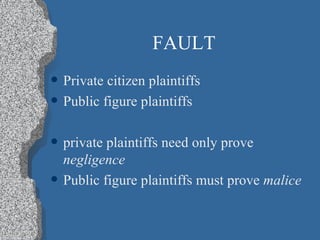
FAULT Private citizen plaintiffs Public figure plaintiffs private plaintiffs need only prove  negligence Public figure plaintiffs must prove  malice
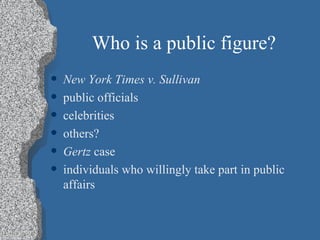
Who is a public figure? New York Times v. Sullivan public officials celebrities others? Gertz  case individuals who willingly take part in public affairs
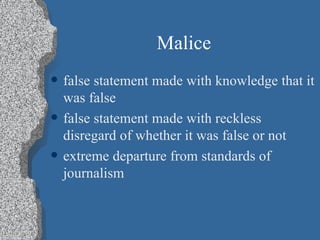
Malice false statement made with knowledge that it was false false statement made with reckless disregard of whether it was false or not extreme departure from standards of journalism
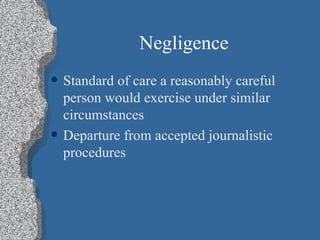
Negligence Standard of care a reasonably careful person would exercise under similar circumstances Departure from accepted journalistic procedures
burden of proof -- plaintiff must establish falsity of statement (before defendant had to establish truth) (applies to all public figure plaintiffs and private plaintiffs v. media)
Harm (damages) Injury to reputation compensatory damages presumed damages actual damages special damages punitive damages
DEFENSES truth privilege fair comment (opinion) neutral reportage (not in California) making accurate report of defamatory statements or charges against a public figure consent (minor defense)
privilege -- absolute and qualified fair comment must be opinion not published with actual malice
retraction statutes statutes of limitation libel insurance SLAPP / anti-SLAPP
Criminal Libel rare in u.s. concern in many developing countries
Libel in Cyberspace
Traditional Model Publishers Distributors Common Carriers and Conduits ISP’s
In Britain Easy to prove Defendant must prove truth of statement Publisher’s honest belief in truth of a statement doesn’t matter
In France Six main elements: Allegations or imputations Falsifying specific and precise facts Attacks to honor or reputation Identification of particular individuals Publication Bad faith
In Germany Media enjoys constitutional freedom of expression Criminal defamation: Insult Slander Malicious defamation
Insult An attack on the plaintiff’s honor which tends to lower the victim’s reputation to society at large
Slander Slanderous statements must have been communicated to a third party and must lower a person in the estimation of right-thinking members of the community.
Malicious Defamation The deliberate and intentional dissemination of false factual statements that are either defamatory or cause harm to the person.
Resources Libel Law in Other Countries http://www.hfac.uh.edu/comm/media_libel/libel/other.html

Defamation (Libel & Slander)

  • 1.
  • 2.
    Libel Libel isa false and unprivileged publication by writing, printing, picture, effigy, or other fixed representation to the eye, which exposes any person to hatred, contempt, ridicule, or obloquy, or which causes him to be shunned or avoided, or which has a tendency to injure him in his occupation. California Civil Code § 45
  • 3.
    obloquy \OB-luh-kwee\, noun:1. Strongly condemnatory or abusive language or utterance. 2. The condition of disgrace suffered as a result of public blame, abuse, or condemnation; ill repute. There he remained, weeping indignantly at her stream of obloquy, bitterly ashamed of his tears, until it was time for supper. --Jonathan Keates, Stendhal Dictionary.com Word of the Day, March 4, 2002
  • 4.
    Slander Slander isa false and unprivileged publication, orally uttered, and also communications by radio or any mechanical or other means which: 1. Charges any person with crime, or with having been indicted, convicted, or punished for crime; 2. Imputes in him the present existence of an infectious, contagious, or loathsome disease;
  • 5.
    3. Tends directlyto injure him in respect to his office, profession, trade or business, either by imputing to him general disqualification in those respects which the office or other occupation peculiarly requires, or by imputing something with reference to his office, profession, trade, or business that has a natural tendency to lessen its profits; 4. Imputes to him impotence or a want of chastity; or 5. Which, by natural consequence, causes actual damage. California Civil Code § 46
  • 6.
    Elements of Libel/Slanderdefamatory false publication identification fault harm (damages)
  • 7.
    DEFAMATORY statement mustharm your reputation
  • 8.
    Libel perse (direct) Libel per quod (indirect)
  • 9.
    Libel perse Donaldson v. Washington Post Co. falsely reported that Michael Donaldson pleaded guilty to a murder charge Laskey v. ABC reported that Luella Mundel, a West Virginia college professor, was a “Communist” certain words can get you in trouble take care with “alleged”
  • 10.
    courts have madeexception for words spoken in the heat of an argument
  • 11.
    Libel perquod Implied, not evident from words themselves
  • 12.
    What about hyperbole?usually understood to be an exaggerated statements What about parody? not reasonable to think making a factual assertion
  • 13.
    What about opinion?opinion usually exempt . . . but opinion may not include any statement of facts that could be proven true or false
  • 14.
    Take care with. . . headlines promos bumpers teases B-roll generic shots
  • 15.
    FALSITY Statement mustbe false (truth is a defense to defamation)
  • 16.
    Publication some formof publication even a memo to a secretary publication must be intended single publication rule whose responsible? complicity rule -- everyone free-lance photography, excepted
  • 17.
    Stories Told cameradelivery (very slow and then overnight) Mother intercepting “obscene” material and reporting it to postmaster Swingers mailing
  • 18.
    all stories havean “instructional” purpose or are “mildly amusing”
  • 19.
    Identification need notrefer to “victim” by name Defaming Groups: Nieman Marcus models Hell’s Angels need to sue before die
  • 20.
    FAULT Private citizenplaintiffs Public figure plaintiffs private plaintiffs need only prove negligence Public figure plaintiffs must prove malice
  • 21.
    Who is apublic figure? New York Times v. Sullivan public officials celebrities others? Gertz case individuals who willingly take part in public affairs
  • 22.
    Malice false statementmade with knowledge that it was false false statement made with reckless disregard of whether it was false or not extreme departure from standards of journalism
  • 23.
    Negligence Standard ofcare a reasonably careful person would exercise under similar circumstances Departure from accepted journalistic procedures
  • 24.
    burden of proof-- plaintiff must establish falsity of statement (before defendant had to establish truth) (applies to all public figure plaintiffs and private plaintiffs v. media)
  • 25.
    Harm (damages) Injuryto reputation compensatory damages presumed damages actual damages special damages punitive damages
  • 26.
    DEFENSES truth privilegefair comment (opinion) neutral reportage (not in California) making accurate report of defamatory statements or charges against a public figure consent (minor defense)
  • 27.
    privilege -- absoluteand qualified fair comment must be opinion not published with actual malice
  • 28.
    retraction statutes statutesof limitation libel insurance SLAPP / anti-SLAPP
  • 29.
    Criminal Libel rarein u.s. concern in many developing countries
  • 30.
  • 31.
    Traditional Model PublishersDistributors Common Carriers and Conduits ISP’s
  • 32.
    In Britain Easyto prove Defendant must prove truth of statement Publisher’s honest belief in truth of a statement doesn’t matter
  • 33.
    In France Sixmain elements: Allegations or imputations Falsifying specific and precise facts Attacks to honor or reputation Identification of particular individuals Publication Bad faith
  • 34.
    In Germany Mediaenjoys constitutional freedom of expression Criminal defamation: Insult Slander Malicious defamation
  • 35.
    Insult An attackon the plaintiff’s honor which tends to lower the victim’s reputation to society at large
  • 36.
    Slander Slanderous statementsmust have been communicated to a third party and must lower a person in the estimation of right-thinking members of the community.
  • 37.
    Malicious Defamation Thedeliberate and intentional dissemination of false factual statements that are either defamatory or cause harm to the person.
  • 38.
    Resources Libel Lawin Other Countries http://www.hfac.uh.edu/comm/media_libel/libel/other.html