Ethics in Information
Technology, Fourth Edition
Chapter 5
Freedom of Expression
Objectives
• As you read this chapter, consider the following
questions:
– What is the basis for the protection of freedom of
expression in the United States, and what types of
expression are not protected under the law?
– What are some key federal laws that affect online
freedom of expression, and how do they impact
organizations?
– What important freedom of expression issues relate
to the use of information technology?
2
First Amendment Rights
• Right to freedom of expression
– Important right for free people everywhere
– Guaranteed by the First Amendment
• Definition of free speech includes:
– Nonverbal, visual, and symbolic forms of
expression
– Right to speak anonymously
3
First Amendment Rights (cont’d.)
• Not protected by the First Amendment
– Perjury
– Fraud
– Defamation
– Obscene speech
– Incitement of panic
– Incitement to crime
– “Fighting words”
– Sedition
4
Obscene Speech
• Based on Miller v. California, speech is considered
obscene when:
– Average person finds the work appeals to the
prurient interest
– Work depicts or describes sexual conduct in an
offensive way
– Lacks serious literary, artistic, political, or scientific
value
5
Defamation
• Oral or written statement of alleged fact that is:
– False
– Harms another person
• Harm is often of a financial nature
• Slander
– Oral defamatory statement
• Libel
– Written defamatory statement
6
Freedom of Expression: Key Issues
• Controlling access to information on the Internet
• Anonymity on the Internet
• Defamation and hate speech
• Corporate blogging
• Pornography
7
Controlling Access to Information on
the Internet
• Freedom of speech on the Internet is complicated
by ease by which children can access Internet
• Communications Decency Act (CDA)
– Aimed at protecting children from pornography
– Broad language and vague definition of indecency
– Found unconstitutional in 1997
8
Controlling Access to Information on
the Internet (cont’d.)
• Child Online Protection Act (COPA)
– Applies to communication for commercial purposes
– Imposes penalties for exposing minors to harmful
material on the Web
– Found unconstitutional in 2004
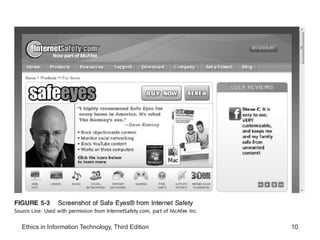
• Internet filtering
– Software installed with a Web browser
– Blocks access to certain Web sites deemed to
contain inappropriate or offensive material
9
Ethics in Information Technology, Third Edition 10
10
Controlling Access to Information on
the Internet (cont’d.)
• URL filtering
– Blocks objectionable URLs or domain names
• Keyword filtering
– Blocks keywords or phrases
• Dynamic content filtering
– Web site’s content is evaluated immediately before
being displayed
– Uses
• Object analysis
• Image recognition
11
Controlling Access to Information on
the Internet (cont’d.)
• Top-rated Internet filters for home users
– NetNanny Parental Controls
– PureSight PC
– CYBERsitter
– SafeEyes
– CyberPatrol
12
Controlling Access to Information on
the Internet (cont’d.)
• ICRA rating system
– Questionnaire for Web authors
– Generates a content label
• Platform for Internet Content Selection (PICS)
– Users configure browsers to read the label
– Relies on Web authors to rate their site
– Complement to other filtering techniques
13
Controlling Access to Information on
the Internet (cont’d.)
• ISP blocking
– Blocking is performed on the ISP server
– ClearSail/Family.NET prevents access to certain
Web sites
14
Children’s Internet Protection Act
(CIPA)
• Federally financed schools and libraries must block
computer access to:
– Obscene material
– Pornography
– Anything considered harmful to minors
15
Children’s Internet Protection Act
(CIPA)
• Schools and libraries subject to CIPA do not
receive Internet access discounts unless they:
– Put in place measures to filter pictures that are
obscene, contain child pornography, or are harmful
to minors
– Adopt a policy to monitor the online activities of
minors
– Adopt a policy restricting minors’ access to materials
harmful to them
16
Children’s Internet Protection Act
(CIPA) (cont’d.)
• CIPA does not require the tracking of Internet use
by minors or adults
• Acceptable use policy agreement is an essential
element of a successful program in schools
– Signed by:
• Students
• Parents
• Employees
17
Children’s Internet Protection Act
(CIPA) (cont’d.)
• Difficulty implementing CIPA in libraries because
their services are open to people of all ages
– Including adults with First Amendment rights
• CIPA has been upheld as constitutional by U.S.
Supreme Court (U.S. v American Library
Association)
18
Anonymity on the Internet
• Anonymous expression is expression of opinions
by people who do not reveal their identity
• Freedom to express an opinion without fear of
reprisal is an important right in democratic society
• Anonymity is even more important in countries that
do not allow free speech
• Played important role in early formation of U.S.
• In the wrong hands, it can be a tool to commit
illegal or unethical activities
19
Anonymity on the Internet (cont’d.)
• Anonymous remailer service
– Computer program that strips the originating address
from the email message
– Forwards the message to the intended recipient
– Ensures no header information can identify the
author
– Keeps what is communicated anonymous
– What is communicated and whether it is ethical or
unethical, legal or illegal, is up to the sender
20
Anonymity on the Internet (cont’d.)
• John Doe lawsuit
– Defendant communicates using a pseudonym or
anonymously so identity of defendant is temporarily
unknown
– Common in Internet libel cases
– Once John Doe lawsuit is filed, the company may
request court permission to issue subpoenas
– ISPs frequently subpoenaed to provide the identity
of anonymous “John Does”
– Anonymity on the Internet cannot be guaranteed
21
Defamation and Hate Speech
• Hate speech that can be prosecuted includes:
– Clear threats and intimidation against specific
citizens
– Sending threatening private messages over the
Internet to a person
– Displaying public messages on a Web site
describing intent to commit acts of hate-motivated
violence against specific individuals
– Libel directed at a particular person
22
Defamation and Hate Speech (cont’d.)
• Many ISPs reserve right to remove content that
does not meet their standards
• Such actions do not violate the subscriber’s First
Amendment rights because these prohibitions are
in the terms of service
– ISPs must monitor the use of their service
– Take action when terms are violated
23
Defamation and Hate Speech (cont’d.)
• Public schools and universities are legally
considered agents of the government and must
follow the First Amendment prohibition against
speech restrictions
• Corporations, private schools, and private
universities not part of state or federal government
– May prohibit students, instructors, and employees
from engaging in offensive speech
24
Corporate Blogging
• Some organizations allow employees to create
their own personal blogs to:
– Reach out to partners, customers, and employees
– Improve their corporate image
• Blogs can provide uncensored commentary and
interaction
– Criticism of corporate policies and decisions
• Could involve risk that employees might:
– Reveal company secrets
– Breach federal security disclosure laws
25
Pornography
• The Internet has been a boon to the pornography
industry
– More than 4.2 million porn Web sites are accessible
– The sites generate an estimated $1 to $7 billion a
year in revenue
– 72 million estimated visitors to porn Web sites
monthly
• Individuals free to produce and publish what they
want; however, if what they distribute is judged
obscene, they are subject to prosecute
– California v Miller set precedent for what is obscene
26
Pornography (cont’d.)
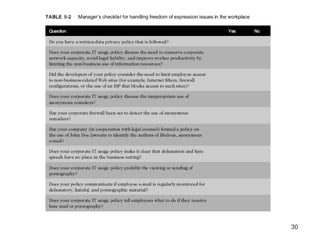
• Many organizations take steps to stop access in
the workplace
– Establishing a computer usage policy that prohibits
access to pornography sites
– Identifying those who violate the policy
– Taking action against those users
– Failure to take action against pornography could
result in sexual harassment lawsuit
27
Pornography (cont’d.)
• Numerous federal laws address child pornography
– Federal offense to produce or distribute
– Most states outlaw possession as well
• At least seven states require computer technicians
to report child pornography on clients’ computers
• Sexting is sending of sexual messages, nude or
seminude photos, or sexually explicit videos over a
cell phone
– Fast-growing trend
28
Pornography (cont’d.)
• CAN-SPAM Act
– Specifies requirements that commercial retailers
must follow when sending messages
– Each violation can result in $250 - $750 fine
– Federal Trade Commission charged with enforcing
the act, but has not done so effectively
– Deterrent in fighting the dissemination of
pornography
29
30
31
Summary
• First Amendment protects the right to:
– Freedom of religion and expression
• Does not protect obscene speech, defamation
• Key issues
– Controlling access to Internet information, especially
for children
– Anonymous communication
– Spread of defamation and hate speech
– Access to pornography
– CAN-SPAM Act limitations on email messages

ethcpp05-Unit 3.ppt

  • 1.
    Ethics in Information Technology,Fourth Edition Chapter 5 Freedom of Expression
  • 2.
    Objectives • As youread this chapter, consider the following questions: – What is the basis for the protection of freedom of expression in the United States, and what types of expression are not protected under the law? – What are some key federal laws that affect online freedom of expression, and how do they impact organizations? – What important freedom of expression issues relate to the use of information technology? 2
  • 3.
    First Amendment Rights •Right to freedom of expression – Important right for free people everywhere – Guaranteed by the First Amendment • Definition of free speech includes: – Nonverbal, visual, and symbolic forms of expression – Right to speak anonymously 3
  • 4.
    First Amendment Rights(cont’d.) • Not protected by the First Amendment – Perjury – Fraud – Defamation – Obscene speech – Incitement of panic – Incitement to crime – “Fighting words” – Sedition 4
  • 5.
    Obscene Speech • Basedon Miller v. California, speech is considered obscene when: – Average person finds the work appeals to the prurient interest – Work depicts or describes sexual conduct in an offensive way – Lacks serious literary, artistic, political, or scientific value 5
  • 6.
    Defamation • Oral orwritten statement of alleged fact that is: – False – Harms another person • Harm is often of a financial nature • Slander – Oral defamatory statement • Libel – Written defamatory statement 6
  • 7.
    Freedom of Expression:Key Issues • Controlling access to information on the Internet • Anonymity on the Internet • Defamation and hate speech • Corporate blogging • Pornography 7
  • 8.
    Controlling Access toInformation on the Internet • Freedom of speech on the Internet is complicated by ease by which children can access Internet • Communications Decency Act (CDA) – Aimed at protecting children from pornography – Broad language and vague definition of indecency – Found unconstitutional in 1997 8
  • 9.
    Controlling Access toInformation on the Internet (cont’d.) • Child Online Protection Act (COPA) – Applies to communication for commercial purposes – Imposes penalties for exposing minors to harmful material on the Web – Found unconstitutional in 2004 • Internet filtering – Software installed with a Web browser – Blocks access to certain Web sites deemed to contain inappropriate or offensive material 9
  • 10.
    Ethics in InformationTechnology, Third Edition 10 10
  • 11.
    Controlling Access toInformation on the Internet (cont’d.) • URL filtering – Blocks objectionable URLs or domain names • Keyword filtering – Blocks keywords or phrases • Dynamic content filtering – Web site’s content is evaluated immediately before being displayed – Uses • Object analysis • Image recognition 11
  • 12.
    Controlling Access toInformation on the Internet (cont’d.) • Top-rated Internet filters for home users – NetNanny Parental Controls – PureSight PC – CYBERsitter – SafeEyes – CyberPatrol 12
  • 13.
    Controlling Access toInformation on the Internet (cont’d.) • ICRA rating system – Questionnaire for Web authors – Generates a content label • Platform for Internet Content Selection (PICS) – Users configure browsers to read the label – Relies on Web authors to rate their site – Complement to other filtering techniques 13
  • 14.
    Controlling Access toInformation on the Internet (cont’d.) • ISP blocking – Blocking is performed on the ISP server – ClearSail/Family.NET prevents access to certain Web sites 14
  • 15.
    Children’s Internet ProtectionAct (CIPA) • Federally financed schools and libraries must block computer access to: – Obscene material – Pornography – Anything considered harmful to minors 15
  • 16.
    Children’s Internet ProtectionAct (CIPA) • Schools and libraries subject to CIPA do not receive Internet access discounts unless they: – Put in place measures to filter pictures that are obscene, contain child pornography, or are harmful to minors – Adopt a policy to monitor the online activities of minors – Adopt a policy restricting minors’ access to materials harmful to them 16
  • 17.
    Children’s Internet ProtectionAct (CIPA) (cont’d.) • CIPA does not require the tracking of Internet use by minors or adults • Acceptable use policy agreement is an essential element of a successful program in schools – Signed by: • Students • Parents • Employees 17
  • 18.
    Children’s Internet ProtectionAct (CIPA) (cont’d.) • Difficulty implementing CIPA in libraries because their services are open to people of all ages – Including adults with First Amendment rights • CIPA has been upheld as constitutional by U.S. Supreme Court (U.S. v American Library Association) 18
  • 19.
    Anonymity on theInternet • Anonymous expression is expression of opinions by people who do not reveal their identity • Freedom to express an opinion without fear of reprisal is an important right in democratic society • Anonymity is even more important in countries that do not allow free speech • Played important role in early formation of U.S. • In the wrong hands, it can be a tool to commit illegal or unethical activities 19
  • 20.
    Anonymity on theInternet (cont’d.) • Anonymous remailer service – Computer program that strips the originating address from the email message – Forwards the message to the intended recipient – Ensures no header information can identify the author – Keeps what is communicated anonymous – What is communicated and whether it is ethical or unethical, legal or illegal, is up to the sender 20
  • 21.
    Anonymity on theInternet (cont’d.) • John Doe lawsuit – Defendant communicates using a pseudonym or anonymously so identity of defendant is temporarily unknown – Common in Internet libel cases – Once John Doe lawsuit is filed, the company may request court permission to issue subpoenas – ISPs frequently subpoenaed to provide the identity of anonymous “John Does” – Anonymity on the Internet cannot be guaranteed 21
  • 22.
    Defamation and HateSpeech • Hate speech that can be prosecuted includes: – Clear threats and intimidation against specific citizens – Sending threatening private messages over the Internet to a person – Displaying public messages on a Web site describing intent to commit acts of hate-motivated violence against specific individuals – Libel directed at a particular person 22
  • 23.
    Defamation and HateSpeech (cont’d.) • Many ISPs reserve right to remove content that does not meet their standards • Such actions do not violate the subscriber’s First Amendment rights because these prohibitions are in the terms of service – ISPs must monitor the use of their service – Take action when terms are violated 23
  • 24.
    Defamation and HateSpeech (cont’d.) • Public schools and universities are legally considered agents of the government and must follow the First Amendment prohibition against speech restrictions • Corporations, private schools, and private universities not part of state or federal government – May prohibit students, instructors, and employees from engaging in offensive speech 24
  • 25.
    Corporate Blogging • Someorganizations allow employees to create their own personal blogs to: – Reach out to partners, customers, and employees – Improve their corporate image • Blogs can provide uncensored commentary and interaction – Criticism of corporate policies and decisions • Could involve risk that employees might: – Reveal company secrets – Breach federal security disclosure laws 25
  • 26.
    Pornography • The Internethas been a boon to the pornography industry – More than 4.2 million porn Web sites are accessible – The sites generate an estimated $1 to $7 billion a year in revenue – 72 million estimated visitors to porn Web sites monthly • Individuals free to produce and publish what they want; however, if what they distribute is judged obscene, they are subject to prosecute – California v Miller set precedent for what is obscene 26
  • 27.
    Pornography (cont’d.) • Manyorganizations take steps to stop access in the workplace – Establishing a computer usage policy that prohibits access to pornography sites – Identifying those who violate the policy – Taking action against those users – Failure to take action against pornography could result in sexual harassment lawsuit 27
  • 28.
    Pornography (cont’d.) • Numerousfederal laws address child pornography – Federal offense to produce or distribute – Most states outlaw possession as well • At least seven states require computer technicians to report child pornography on clients’ computers • Sexting is sending of sexual messages, nude or seminude photos, or sexually explicit videos over a cell phone – Fast-growing trend 28
  • 29.
    Pornography (cont’d.) • CAN-SPAMAct – Specifies requirements that commercial retailers must follow when sending messages – Each violation can result in $250 - $750 fine – Federal Trade Commission charged with enforcing the act, but has not done so effectively – Deterrent in fighting the dissemination of pornography 29
  • 30.
  • 31.
    31 Summary • First Amendmentprotects the right to: – Freedom of religion and expression • Does not protect obscene speech, defamation • Key issues – Controlling access to Internet information, especially for children – Anonymous communication – Spread of defamation and hate speech – Access to pornography – CAN-SPAM Act limitations on email messages