MEAT BALLS

RIA NISAR:11FET1007
SHREYASI BHAGWAT: 11FET1008
AMMAR BABAR:11FET1009
MEAT BALLS
•

•

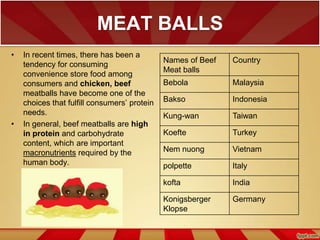
In recent times, there has been a
tendency for consuming
convenience store food among
consumers and chicken, beef
meatballs have become one of the
choices that fulfill consumers’ protein
needs.
In general, beef meatballs are high
in protein and carbohydrate
content, which are important
macronutrients required by the
human body.

Names of Beef
Meat balls

Country

Bebola

Malaysia

Bakso

Indonesia

Kung-wan

Taiwan

Koefte

Turkey

Nem nuong

Vietnam

polpette

Italy

kofta

India

Konigsberger
Klopse

Germany
MANUFACTURING
Key raw material: Standardised meat compositions are consistent raw
material solutions that can be immediately processed, requiring no further
refining processes.

Ref: www.ding-han.com
ADDITIVES
• Meatballs are commonly produced by emulsifying fine ground meat
(Asian-style) or minced meat( western-style) with starch of some sort,
mixing, salt and herbs specific to the ethnic cuisine, using ingredients
like bread crumbs, eggs and finally shaping the product into balls.
They are then cooked in boiling water, steamed, or deep fried.

extender

fillers
Chemical substances

Non-meat ingredients
of animal origin

Ingredients of plant origin

Salt (for taste, extract
salt-soluble proteins,
thus increasing the
binding and juiciness of
the product.
, shelf-life)
Nitrite (for curing colour,
flavour, shelf-life)
Ascorbic acid (to
accelerate curing
reaction)
Phosphates (for protein
structuring and water
binding)
Chemical
preservatives (for shelflife)
Antioxidants (for
flavour and shelf-life)
Monosodium
glutamate MSG (for
enhancement of flavour)
Food colouring
substances (synthetic
and of plant origin)

Milk caseinate have
functional water and fat
binding properties)
Whole milk or non-fat
dried milk
Gelatine (binding
properties and meat
extender)
Eggs (extender and
binding ingredient for
meat pieces)
Transglutaminase*
(exclusively binding
properties)

Spices

Binders: isolated soy protein (90% protein)
and
wheat gluten (80% protein)
and, less importantly, protein isolates from
other legumes.

Meat extenders:
Soy flour (50% protein)
Soy concentrate (70% protein)
Other food legumes (beans, peas, lentils),
used for special products only
Fillers:Cereal flours :wheat, rice and corn
Starches from wheat, rice, corn, potato and
cassava
Breadcrumbs
Rusk (derived by mixing and baking wheat
flour)
Roots and tubers, e.g. cassava, sweet potato
Vegetable and fruits, e.g. onions, bell pepper,
carrots, green vegetables, bananas
Polysaccharides (Hydrocolloids):
Carrageenan (max. 1%, improves sliceability
and cohesiveness). The substance can be
considered both binder and filler.
PACKAGING AND STORAGE
1)PURPOSE
microorganism

Moisture
control

Influence
on
Color, text
ure

Toxic
chemicals

2) MATERIAL OF PACKING
PA

EVOH

PET

Material

O2 Permeability

Water
vapour

PET

+

-

PA

-

+
PACKAGING AND STORAGE
4) STORAGE
Dewatered balls are subjected to freezing by liquid
nitrogen.
then they are packaged.
They are stored at -16deg C
Long storage it starts loosing is color, texture etc

3) PACKAGING
Vacuum

MAP

vacuum is drawn to prevent the damaging
effects of oxygen such as rancidity or
discoloration of the packed product.
A mixtures of gases is the introduced into the
air-free space before sealing
The gas mixture commonly used is 20%-30%
CO2 and 70%-80% N2
CO2, has a protective function, as it inhibits to
some extend the growth of bacteria and moulds.
QUALITY
CONTROL

.

GMP

•GMP outlines the measures
to be taken to ensure that
premises, equipment,
transport and employees do
not contribute to or become
food safety hazards.
•Gmp are not factory specific.

HACCP

•HACCP takes into
consideration the possible
hazards during the
production process of a
particular product.
•HACCP is factory specific.
PROCESS
STEP

HAZARD

CRITICAL
LIMIT

MOTORING
PROCEDURE

CORRECTIVE
ACTION

RECORDS

Reception
of raw
meat
materials.
CCP

Physical
,
Chemic
al,
biologic
al

Internal meat
temperature
≤4 C
Should be free
from any
sensorial
defects.

Check
purchase
specification.
Inspection of
meat surfaces
by random
sampling.
Check internal
meat
temperature.

Reject
delivery, if
target levels
not met.

Physical
characteristics
of meat
received,
certificate of
sanitary status
and origin of
meat.
Meat
temperature
recordings.

Storage in
reception
chiller

Biologic
al

chiller
temperature
≤4 C.
Meat internal
temperature
≤4 C

Temperature
control of
chilling room
and meat
(internal).

Minor
temperature
deviation:
Adjust chiller
temperature
Major
temperature
deviation:
Reject meat.

Temperature/ti
me recordings
of chiller.
Temperature
recordings of
meat.
PROCESS
STEP

HAZARD

CRITICAL LIMIT

MOTORING
PROCEDURE

CORRECTIVE
ACTION

RECORDS

Weighing Physical Visibly clean nonof nonChemical meat ingredients.
meat
ingredient
s

Check salt,
spices and
extenders for
impurities.

Reject
suspected
batches of
non-meat
ingredients.

Record of
status and
expiration
dates for
non-meat
ingredients.

Grinding
the meat

Check △t.
Check for
abnormal
tissues and
post-dressing
contamination

Improvement
in product
flow.
Discard meat
parts with
abnormal
tissues, post
dressing
contaminatio
n

△ t, temp
recording

Biological

Room temperature
≤10 C.
△t<= 20 minutes.
Meat free of
grossly abnormal
tissues and postdressing
contamination
PROCESS
STEP

HAZARD

CRITICAL
LIMIT

MOTORING
PROCEDUR
E

CORRECTIVE
ACTION

Mixing of
meat with
ingredient
s.
CCP

Biological

RT≤+10 C.
△ t<=30
minutes.
Temperature
of
meat/meat
ingredients
mix
≤+10 C

Check △ t .
Check mix
temperature
.

Adjust
time/temperature
regime.
Major deviations:
Reject batch

Ball
molding

Biological

Carry out
immediately
after mixing.
No significant
product
temperature
increase

Temp/time
control

Increase process
speed. Return
mix to chiller if
immediate
molding cannot
be done.

RECORDS

Product flow,
temperature
recording
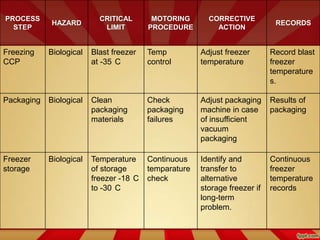
PROCESS
STEP

HAZARD

CRITICAL
LIMIT

MOTORING
PROCEDURE

CORRECTIVE
ACTION

RECORDS

Freezing
CCP

Biological

Blast freezer
at -35 C

Temp
control

Adjust freezer
temperature

Record blast
freezer
temperature
s.

Packaging

Biological

Clean
packaging
materials

Check
packaging
failures

Adjust packaging
machine in case
of insufficient
vacuum
packaging

Results of
packaging

Freezer
storage

Biological

Temperature
of storage
freezer -18 C
to -30 C

Continuous
temparature
check

Identify and
transfer to
alternative
storage freezer if
long-term
problem.

Continuous
freezer
temperature
records
MARKET
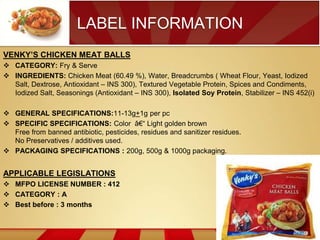
LABEL INFORMATION
VENKY’S CHICKEN MEAT BALLS
 CATEGORY: Fry & Serve
 INGREDIENTS: Chicken Meat (60.49 %), Water, Breadcrumbs ( Wheat Flour, Yeast, Iodized
Salt, Dextrose, Antioxidant – INS 300), Textured Vegetable Protein, Spices and Condiments,
Iodized Salt, Seasonings (Antioxidant – INS 300), Isolated Soy Protein, Stabilizer – INS 452(i)
 GENERAL SPECIFICATIONS:11-13g+1g per pc
 SPECIFIC SPECIFICATIONS: Color – Light golden brown
Free from banned antibiotic, pesticides, residues and sanitizer residues.
No Preservatives / additives used.
 PACKAGING SPECIFICATIONS : 200g, 500g & 1000g packaging.

APPLICABLE LEGISLATIONS
 MFPO LICENSE NUMBER : 412
 CATEGORY : A
 Best before : 3 months
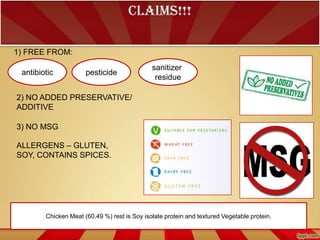
CLAIMS!!!
1) FREE FROM:
antibiotic

pesticide

sanitizer
residue

2) NO ADDED PRESERVATIVE/
ADDITIVE
3) NO MSG
ALLERGENS – GLUTEN,
SOY, CONTAINS SPICES.

Chicken Meat (60.49 %) rest is Soy isolate protein and textured Vegetable protein.
COOKING
1) INSTRUCTIONS FOR USE
Fry Chicken meat balls in a pan with little oil / heat in a non stick pan and
it is ready to eat as a snack.
Thaw the packet in refrigerator at 6 to 8 degrees centigrade for 8 hours,
or thaw in a microwave.
2) Kofta Curry
The thawed meat balls can be put into curry and served as Chicken
Kofta curry garnished with fresh cream.
Serve hot with chappati/roti/rice.
3) Other applications:
REFERENCE
• http://groceries.asda.com/asdawebstore/landing/home.shtml#/search/me
atball
• http://www.fao.org/docrep/010/ai407e/AI
407E15.htm
• http://www.venkys.com/products/fmcg/pro
cessed-chicken/chicken-meat-balls/
• http://www.tsjx.cn/en/product.asp?catalog
=56&catalogname=Meat%20Ball%20Prod
uction%20Flow%20Chart
Meatballsfinal 130910103113-phpapp02

Meatballsfinal 130910103113-phpapp02

  • 1.
    MEAT BALLS RIA NISAR:11FET1007 SHREYASIBHAGWAT: 11FET1008 AMMAR BABAR:11FET1009
  • 2.
    MEAT BALLS • • In recenttimes, there has been a tendency for consuming convenience store food among consumers and chicken, beef meatballs have become one of the choices that fulfill consumers’ protein needs. In general, beef meatballs are high in protein and carbohydrate content, which are important macronutrients required by the human body. Names of Beef Meat balls Country Bebola Malaysia Bakso Indonesia Kung-wan Taiwan Koefte Turkey Nem nuong Vietnam polpette Italy kofta India Konigsberger Klopse Germany
  • 3.
    MANUFACTURING Key raw material:Standardised meat compositions are consistent raw material solutions that can be immediately processed, requiring no further refining processes. Ref: www.ding-han.com
  • 4.
    ADDITIVES • Meatballs arecommonly produced by emulsifying fine ground meat (Asian-style) or minced meat( western-style) with starch of some sort, mixing, salt and herbs specific to the ethnic cuisine, using ingredients like bread crumbs, eggs and finally shaping the product into balls. They are then cooked in boiling water, steamed, or deep fried. extender fillers
  • 5.
    Chemical substances Non-meat ingredients ofanimal origin Ingredients of plant origin Salt (for taste, extract salt-soluble proteins, thus increasing the binding and juiciness of the product. , shelf-life) Nitrite (for curing colour, flavour, shelf-life) Ascorbic acid (to accelerate curing reaction) Phosphates (for protein structuring and water binding) Chemical preservatives (for shelflife) Antioxidants (for flavour and shelf-life) Monosodium glutamate MSG (for enhancement of flavour) Food colouring substances (synthetic and of plant origin) Milk caseinate have functional water and fat binding properties) Whole milk or non-fat dried milk Gelatine (binding properties and meat extender) Eggs (extender and binding ingredient for meat pieces) Transglutaminase* (exclusively binding properties) Spices Binders: isolated soy protein (90% protein) and wheat gluten (80% protein) and, less importantly, protein isolates from other legumes. Meat extenders: Soy flour (50% protein) Soy concentrate (70% protein) Other food legumes (beans, peas, lentils), used for special products only Fillers:Cereal flours :wheat, rice and corn Starches from wheat, rice, corn, potato and cassava Breadcrumbs Rusk (derived by mixing and baking wheat flour) Roots and tubers, e.g. cassava, sweet potato Vegetable and fruits, e.g. onions, bell pepper, carrots, green vegetables, bananas Polysaccharides (Hydrocolloids): Carrageenan (max. 1%, improves sliceability and cohesiveness). The substance can be considered both binder and filler.
  • 6.
    PACKAGING AND STORAGE 1)PURPOSE microorganism Moisture control Influence on Color,text ure Toxic chemicals 2) MATERIAL OF PACKING PA EVOH PET Material O2 Permeability Water vapour PET + - PA - +
  • 7.
    PACKAGING AND STORAGE 4)STORAGE Dewatered balls are subjected to freezing by liquid nitrogen. then they are packaged. They are stored at -16deg C Long storage it starts loosing is color, texture etc 3) PACKAGING Vacuum MAP vacuum is drawn to prevent the damaging effects of oxygen such as rancidity or discoloration of the packed product. A mixtures of gases is the introduced into the air-free space before sealing The gas mixture commonly used is 20%-30% CO2 and 70%-80% N2 CO2, has a protective function, as it inhibits to some extend the growth of bacteria and moulds.
  • 8.
    QUALITY CONTROL . GMP •GMP outlines themeasures to be taken to ensure that premises, equipment, transport and employees do not contribute to or become food safety hazards. •Gmp are not factory specific. HACCP •HACCP takes into consideration the possible hazards during the production process of a particular product. •HACCP is factory specific.
  • 9.
    PROCESS STEP HAZARD CRITICAL LIMIT MOTORING PROCEDURE CORRECTIVE ACTION RECORDS Reception of raw meat materials. CCP Physical , Chemic al, biologic al Internal meat temperature ≤4C Should be free from any sensorial defects. Check purchase specification. Inspection of meat surfaces by random sampling. Check internal meat temperature. Reject delivery, if target levels not met. Physical characteristics of meat received, certificate of sanitary status and origin of meat. Meat temperature recordings. Storage in reception chiller Biologic al chiller temperature ≤4 C. Meat internal temperature ≤4 C Temperature control of chilling room and meat (internal). Minor temperature deviation: Adjust chiller temperature Major temperature deviation: Reject meat. Temperature/ti me recordings of chiller. Temperature recordings of meat.
  • 10.
    PROCESS STEP HAZARD CRITICAL LIMIT MOTORING PROCEDURE CORRECTIVE ACTION RECORDS Weighing PhysicalVisibly clean nonof nonChemical meat ingredients. meat ingredient s Check salt, spices and extenders for impurities. Reject suspected batches of non-meat ingredients. Record of status and expiration dates for non-meat ingredients. Grinding the meat Check △t. Check for abnormal tissues and post-dressing contamination Improvement in product flow. Discard meat parts with abnormal tissues, post dressing contaminatio n △ t, temp recording Biological Room temperature ≤10 C. △t<= 20 minutes. Meat free of grossly abnormal tissues and postdressing contamination
  • 11.
    PROCESS STEP HAZARD CRITICAL LIMIT MOTORING PROCEDUR E CORRECTIVE ACTION Mixing of meat with ingredient s. CCP Biological RT≤+10C. △ t<=30 minutes. Temperature of meat/meat ingredients mix ≤+10 C Check △ t . Check mix temperature . Adjust time/temperature regime. Major deviations: Reject batch Ball molding Biological Carry out immediately after mixing. No significant product temperature increase Temp/time control Increase process speed. Return mix to chiller if immediate molding cannot be done. RECORDS Product flow, temperature recording
  • 12.
    PROCESS STEP HAZARD CRITICAL LIMIT MOTORING PROCEDURE CORRECTIVE ACTION RECORDS Freezing CCP Biological Blast freezer at -35C Temp control Adjust freezer temperature Record blast freezer temperature s. Packaging Biological Clean packaging materials Check packaging failures Adjust packaging machine in case of insufficient vacuum packaging Results of packaging Freezer storage Biological Temperature of storage freezer -18 C to -30 C Continuous temparature check Identify and transfer to alternative storage freezer if long-term problem. Continuous freezer temperature records
  • 13.
  • 14.
    LABEL INFORMATION VENKY’S CHICKENMEAT BALLS  CATEGORY: Fry & Serve  INGREDIENTS: Chicken Meat (60.49 %), Water, Breadcrumbs ( Wheat Flour, Yeast, Iodized Salt, Dextrose, Antioxidant – INS 300), Textured Vegetable Protein, Spices and Condiments, Iodized Salt, Seasonings (Antioxidant – INS 300), Isolated Soy Protein, Stabilizer – INS 452(i)  GENERAL SPECIFICATIONS:11-13g+1g per pc  SPECIFIC SPECIFICATIONS: Color – Light golden brown Free from banned antibiotic, pesticides, residues and sanitizer residues. No Preservatives / additives used.  PACKAGING SPECIFICATIONS : 200g, 500g & 1000g packaging. APPLICABLE LEGISLATIONS  MFPO LICENSE NUMBER : 412  CATEGORY : A  Best before : 3 months
  • 15.
    CLAIMS!!! 1) FREE FROM: antibiotic pesticide sanitizer residue 2)NO ADDED PRESERVATIVE/ ADDITIVE 3) NO MSG ALLERGENS – GLUTEN, SOY, CONTAINS SPICES. Chicken Meat (60.49 %) rest is Soy isolate protein and textured Vegetable protein.
  • 16.
    COOKING 1) INSTRUCTIONS FORUSE Fry Chicken meat balls in a pan with little oil / heat in a non stick pan and it is ready to eat as a snack. Thaw the packet in refrigerator at 6 to 8 degrees centigrade for 8 hours, or thaw in a microwave. 2) Kofta Curry The thawed meat balls can be put into curry and served as Chicken Kofta curry garnished with fresh cream. Serve hot with chappati/roti/rice. 3) Other applications:
  • 17.
    REFERENCE • http://groceries.asda.com/asdawebstore/landing/home.shtml#/search/me atball • http://www.fao.org/docrep/010/ai407e/AI 407E15.htm •http://www.venkys.com/products/fmcg/pro cessed-chicken/chicken-meat-balls/ • http://www.tsjx.cn/en/product.asp?catalog =56&catalogname=Meat%20Ball%20Prod uction%20Flow%20Chart

Editor's Notes

  • #4 Stirring machine and seasonings mixtureMeat ball size:30-40mmCooling machine: dewatering AND COOLINGPackage1. Continuous production line, big production and efficiency.2. Professional food machinery manufacturer, all of our machiney are made in Taiwan with high quality.ApplicationsSuitable for producing meat ball, fish meat ball, squid meat ball, croquettes, vegetarian meat ball, etc kind of ball-shaped product.
  • #5 These cheaper plant proteins “extend” the more expensive meat proteins, resulting in acceptable overall protein contents of lower cost meat products. Fillers are also mostly plant substances, low in protein and high in carbohydrates such as cereals, roots, tubers and vegetables and some refined products such as starches and flours. Pure meat products are very low in carbohydrates. Hence the addition of carbohydrate-rich substances is not an “extension” of the protein mix, but some new components “fill-up” the product volume. Apart from their volume-filling capacity, some fillers, in particular starches and flours, are also used for their capability to absorb extensive quantities of water. also used for their capability to absorb extensive quantities of water. Extenders and fillers are not standard ingredients in processed meats, in fact high quality products are often manufactured without them. But they are useful tools in cost reduction enabling the manufacture of lower-cost but still nutritive meat products.binder is used for substances of animal or plant origin, which have a significant high level of protein that serves for both water and fat binding. Such substances include high-protein soy, wheat and milk products, such as soy isolate, wheat gluten, milk protein (caseinate). They are not extenders in the first place due to the low quantities added (approx. 2%), but act through their high quality proteins that are instrumental in water binding and protein network structuring. On the other hand, some substances with little or no protein level, like starches and flours mentioned above under “fillers”, can bind water and fat by means of physical entrapment and could also be considered “binders”.
  • #6 Meat ballsThe round-shaped mixture (30-40 mm diameter) is stabilized when the meat balls are cooked in water or steamed. Meat balls need a more cohesive texture, hence the extender content is usually kept lower, but fillers in particular starches and flours are used at high levels. Due to the heat treatment (cooking/steaming) of the meat balls, high amounts of extenders would result in an atypically pale colour and lead to loss of meat flavour. The moderate use of cellulose fibres as a filler for coarse meat balls can be useful as these fibres re-hydrate at a ratio 1:9. However, excessive use of cellulose fibres in meat balls results in dry “sandy” products, as much of the water absorbed is probably lost during cooking. Hence not used.Coarse meat balls are sometimes also extended with green and red vegetables, such as parsley, carrots and bell pepper. Apart from the slight extending effect, smaller particles of such colourful ingredients can make the usually grey-coloured meat balls more attractive
  • #11 Delta t in d 2nd point is the Period from delivery of meatfrom chiller to pass throughGrinder.Delta t in the 3rd point is Periodfrom grinding to completion ofmixing/blending
  • #15 MFPO ( meat food product order) 412 is the license number given to venkys.Category A- manufacturer who makes meat food products exclusively from meat of animals slaughtered and dressed in his factiry.Category B- manufacturer who makes meat food products exclusively from meat of animals slaughtered and dressed in a recognized slaughter house including a slaughter house maintained by category A license.Category C- manufacturer who makes meat food products from poultry or pig meat at places where authorized slaughter houses do not exist. Fish products shall be covered in this category.