CabatuanNationalComprehensive HighSchool
Lesson 3
Preparing Salting,
Curing Solution And
Mixtures
Definition of Terms
1. Sanitary - free from dirt and
bacteria
2. Solution - a mixture formed for
purpose of preserving meat or fish
3. Cure- to preserve (meat, fish,
etc)for the purpose of preserving
meat or fish as by smoking or
salting
4. Disinfectant-a preparation for
disinfecting spoilage bacteria.
5. Contaminate- make impure by
mixture of unnecessary substance
or bacteria.
The following are some basic rules of
sanitary food handling practices that
must be observed by food handlers:
1. Hands should be washed thoroughly with
soap and water. A disinfectant solution of
chlorinated water should be available for
rinsing the hands before handling food.
Wearing rings, bracelets, and wrist watches
during processing should be avoided as
these can be source of contamination.
2. Whenever possible, food must not be
handled directly during preparation and
packing.
3. Packing materials must never be handled
directly particularly on the side that shall be in
direct contact with the food.
4. Food handlers should be properly dressed.

The use of gowns, aprons, head caps, or hair
nets, masks, rubber, boots, and gloves are ideal.
This prevents contamination of food by foreign
matters from the handlers' body like hair, dust
and germs extracted from the nose and mouth.
However, for small scale industries clean and
light color shirt and caps and hairnets would be
efficient.
5. Smoking in the preparation,
processing, and packing area should
never be allowed. Smoke can be
absorbed in the food or the ashes and
cigarette butts may get into the food.
Spitting and blowing of the nose should
never be done within the premises of
the plant. These unhealthy habits
contribute to contamination and spread
of diseases.
CURING INGREDIENTS AND THEIR
FUNCTIONS
Salt is the most important curing
ingredient. It makes up the bulk of the
curing mixture because it is not only a
good preservative but it provides the
most desirable flavor.
CURING INGREDIENTS AND THEIR
FUNCTIONS
As a preservative, it causes the partial
dehydration of the tissue through osmosis, at
the same time withdraws water from the
protoplasm of the spoilage organisms,
shrivelling and inactivating their cells. Besides, it
improves the ability of meat proteins to retain
either the normal moisture content of added
water and stabilize the fat protein emulsion in
sausage.
THREE KINDS OF SALT LOCALLY
AVAILABLE:
1. Solar or coarse salt
2. Pangasinan salt
3. Refined salt - the most suitable for meat
curing on account that aside from being the
most concentrated, it has the least amount
of impurities.
Sugar
Sugar is a secondary ingredient in
curing formula which counteracts
saltiness. It enhances the flavor of the
product and aids in lowering the PH of
the cure. Its role in color development
and color stability under present
commercial curing practices has been
found to be negligible.
Sugar
Refined cane sugar is the most
suitable. The use of brown sugar is
limited by the fact that it caramelizes at
a lower temperature and tends to
darken the meat in cooking. Large
amount of sugar on prolonged curing,
promotes vigorous microbial growth,
which usually causes acid fermentation
that affects palatability and color.
Nitrate and Nitrite
Nitrate and Nitrite is (salitre or
salt peter) potassium nitrate
(genuine salt peter) sodium nitrate
(chilli salt peter) and nitrites are
color fixation agents or substances
responsible for the development of
the proper color in cured meat
products.
Nitrate and Nitrite
The level of use of nitrates is
limited to 200 mg/ kg of meat. Aside
from fixing the color, the nitrite
changes the anaerobic condition of
the meat to aerobic one so that
CLOSTRIDIUM BOTULINUM and
other putrefactive bacteria can not
grow.
Vinegar
Vinegar - is added for flavor
but it also have some antiseptic
value. It aids in promoting the
shelf life of the finished product.
The vinegar to be used should
have an acetic acid content of
4.5% to 5.0%
Spices
Spices are aromatic vegetable
substances used for seasoning of food.
Usually this consists of leaves buds,
flower, fruits and seeds. Rhizomes or
other plant parts which have been dried
can be used in their entire or in
powdered form.
Spices
These spices provides the flavoring
properties to their content of volatile oil,
while in some, flavor is due to the natural
blending of the flavors of a great number of
different components like alcohol, esters
phenols and their derivatives organic acid,
sulphur containing compounds, alcholoids,
and resins. Examples of these spices are
pepper, onion, garlic, paprika, laurel,
oregano, etc.
Binders, Fillers and Emulsifiers
These are added for economical
reasons and they improve the
finished product characteristics
such as texture, appearance, slice
ability and plumpness. They also
prevent shrivelling and shrinkage to
a certain extent.
Binders, Fillers and Emulsifiers
Binders are additives which
when dissolved bind meat particles
together and hold moisture during
processing and or subsequent
reheating. Examples of these are
dried skim milk, cereal flour, starch
and carrot flour.
Binders, Fillers and Emulsifiers
Fillers are binders that contain water
soluble protein which serve as fillers for
added weight. Examples are cereal grains
and textured vegetable protein.
Emulsifiers are binders that contain
water soluble proteins which the
emulsification of ingredients. Example is
dried whey.
Ascorbic Acid
Ascorbic Acid hastens the color
production due to either a chemical reaction
with nitrate, producing more nitric oxide or
by reducing metmyoglobin (oxidized meat
pigment which is brown) to myoglobin (red).
The permissible level for this adjuncts is 7
½ oz of ascorbic acid or its salt to 160 gal.
or pickle or 4 oz. /100 lbs. of sausage met or
emulsion or 500mg/kg meat.
TECHNIQUES IN SALTING
Making brine. The salt and other ingredients
should be completely dissolved in water: the brine
should be sterilized as possible. The meat are lightly
packed in a clean, odorless periodically for density and
salt concentration and be replenished as necessary for
even curing. A temperature of 3°C to 4°C for the curing
room is the accepted standard. Salt in the effect,
lowers the moisture content of the product through
osmosis, the process which involves the passage of
water through a semi- permeable membrane from a
region of low solute concentration to a region of high
solute concentration until equilibrium.
PREPARING CURING MIX
FOR HAM AND BACON
Curing mix consists of salt, sugar
and nitrite to prolong the keeping quality
of meat. The curing mix for bacon
preparation is the same as ham
preparation. Pumping solution is also
injected into the meat. Measurement is the
same as that of ham, which is ½ cup for
every kg. meat.
PREPARING CURING MIX
FOR HAM AND BACON
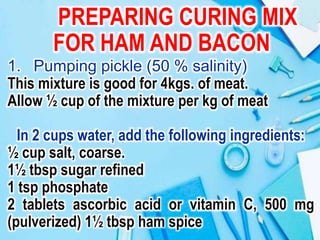
1. Pumping pickle (50 % salinity)
This mixture is good for 4kgs. of meat.
Allow ½ cup of the mixture per kg of meat
In 2 cups water, add the following ingredients:
½ cup salt, coarse.
1½ tbsp sugar refined
1 tsp phosphate
2 tablets ascorbic acid or vitamin C, 500 mg
(pulverized) 1½ tbsp ham spice
PREPARING CURING MIX
FOR HAM AND BACON
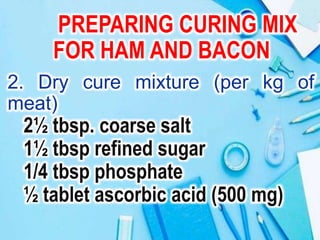
2. Dry cure mixture (per kg of
meat)
2½ tbsp. coarse salt
1½ tbsp refined sugar
1/4 tbsp phosphate
½ tablet ascorbic acid (500 mg)
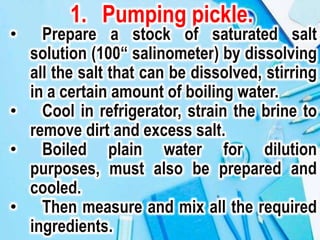
1. Pumping pickle.
• Prepare a stock of saturated salt
solution (100“ salinometer) by dissolving
all the salt that can be dissolved, stirring
in a certain amount of boiling water.
• Cool in refrigerator, strain the brine to
remove dirt and excess salt.
• Boiled plain water for dilution
purposes, must also be prepared and
cooled.
• Then measure and mix all the required
ingredients.
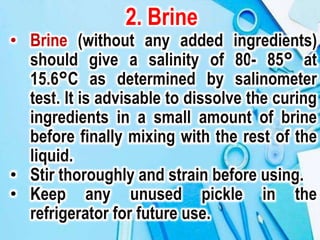
2. Brine
• Brine (without any added ingredients)
should give a salinity of 80- 85° at
15.6°C as determined by salinometer
test. It is advisable to dissolve the curing
ingredients in a small amount of brine
before finally mixing with the rest of the
liquid.
• Stir thoroughly and strain before using.
• Keep any unused pickle in the
refrigerator for future use.
• 3. Cover pickle is lower in
salinity (78") than the pumping
pickle, and the spices are
omitted.
• The same procedure in mixing
should be followed as in the
pumping pickle.
LET US REMEMBER:
Best practices for food handlers must be
strictly observed and imposed in food
processing. Tips should be followed when
selecting and buying ingredients to be used in
cooking the recipe or in the processing of food.
The technique in salting food is recommended
for everybody to follow. Likewise, the
preparation of curing mix should be done
accurately.
Lesson 3
Quiz
MULTIPLE CHOICE
Direction: Read and understand the
following sentences. Select the best
answer and write it in your quiz
notebook.
1. Which one is removed when
processing food to avoid
contamination?
a. jewelries b. apron
c. hairnet d. glove
2. Which is the most important
ingredient in curing?
a. binders b. salt
c. sugar d. vinegar
3. What is the process involved in
salting when the moisture content of
the product lowers?
a. salt concentration
b. making brine
c. osmosis
d. curing
4. What is the purpose of
curing meat?
a. accurate measurement of
ingredients
b. ham preparation
c. producing salt, sugar
d. prolong the keeping quality
of meat
5. What is the salinity of
the brine in the preparation
of pumping pickles?
a. 100 S
b. 80-85 S
c. 30 S
d. 70 S
Lesson 1
Performanc
e
1. Demonstrate the
procedure in cleaning and
sanitizing equipment, tools
and utensils.
2. Clean the oven in the
laboratory area by
following the procedure.
WEEK 3 Topic 3 FOOD PROCESSING Lesson in Senior

WEEK 3 Topic 3 FOOD PROCESSING Lesson in Senior

  • 1.
  • 2.
  • 3.
    Definition of Terms 1.Sanitary - free from dirt and bacteria 2. Solution - a mixture formed for purpose of preserving meat or fish 3. Cure- to preserve (meat, fish, etc)for the purpose of preserving meat or fish as by smoking or salting
  • 4.
    4. Disinfectant-a preparationfor disinfecting spoilage bacteria. 5. Contaminate- make impure by mixture of unnecessary substance or bacteria.
  • 5.
    The following aresome basic rules of sanitary food handling practices that must be observed by food handlers: 1. Hands should be washed thoroughly with soap and water. A disinfectant solution of chlorinated water should be available for rinsing the hands before handling food. Wearing rings, bracelets, and wrist watches during processing should be avoided as these can be source of contamination. 2. Whenever possible, food must not be handled directly during preparation and packing.
  • 6.
    3. Packing materialsmust never be handled directly particularly on the side that shall be in direct contact with the food. 4. Food handlers should be properly dressed. The use of gowns, aprons, head caps, or hair nets, masks, rubber, boots, and gloves are ideal. This prevents contamination of food by foreign matters from the handlers' body like hair, dust and germs extracted from the nose and mouth. However, for small scale industries clean and light color shirt and caps and hairnets would be efficient.

  • 7.
    5. Smoking inthe preparation, processing, and packing area should never be allowed. Smoke can be absorbed in the food or the ashes and cigarette butts may get into the food. Spitting and blowing of the nose should never be done within the premises of the plant. These unhealthy habits contribute to contamination and spread of diseases.

  • 8.
    CURING INGREDIENTS ANDTHEIR FUNCTIONS Salt is the most important curing ingredient. It makes up the bulk of the curing mixture because it is not only a good preservative but it provides the most desirable flavor.
  • 9.
    CURING INGREDIENTS ANDTHEIR FUNCTIONS As a preservative, it causes the partial dehydration of the tissue through osmosis, at the same time withdraws water from the protoplasm of the spoilage organisms, shrivelling and inactivating their cells. Besides, it improves the ability of meat proteins to retain either the normal moisture content of added water and stabilize the fat protein emulsion in sausage.
  • 10.
    THREE KINDS OFSALT LOCALLY AVAILABLE: 1. Solar or coarse salt 2. Pangasinan salt 3. Refined salt - the most suitable for meat curing on account that aside from being the most concentrated, it has the least amount of impurities.
  • 11.
    Sugar Sugar is asecondary ingredient in curing formula which counteracts saltiness. It enhances the flavor of the product and aids in lowering the PH of the cure. Its role in color development and color stability under present commercial curing practices has been found to be negligible.
  • 12.
    Sugar Refined cane sugaris the most suitable. The use of brown sugar is limited by the fact that it caramelizes at a lower temperature and tends to darken the meat in cooking. Large amount of sugar on prolonged curing, promotes vigorous microbial growth, which usually causes acid fermentation that affects palatability and color.
  • 13.
    Nitrate and Nitrite Nitrateand Nitrite is (salitre or salt peter) potassium nitrate (genuine salt peter) sodium nitrate (chilli salt peter) and nitrites are color fixation agents or substances responsible for the development of the proper color in cured meat products.
  • 14.
    Nitrate and Nitrite Thelevel of use of nitrates is limited to 200 mg/ kg of meat. Aside from fixing the color, the nitrite changes the anaerobic condition of the meat to aerobic one so that CLOSTRIDIUM BOTULINUM and other putrefactive bacteria can not grow.
  • 15.
    Vinegar Vinegar - isadded for flavor but it also have some antiseptic value. It aids in promoting the shelf life of the finished product. The vinegar to be used should have an acetic acid content of 4.5% to 5.0%
  • 16.
    Spices Spices are aromaticvegetable substances used for seasoning of food. Usually this consists of leaves buds, flower, fruits and seeds. Rhizomes or other plant parts which have been dried can be used in their entire or in powdered form.
  • 17.
    Spices These spices providesthe flavoring properties to their content of volatile oil, while in some, flavor is due to the natural blending of the flavors of a great number of different components like alcohol, esters phenols and their derivatives organic acid, sulphur containing compounds, alcholoids, and resins. Examples of these spices are pepper, onion, garlic, paprika, laurel, oregano, etc.
  • 18.
    Binders, Fillers andEmulsifiers These are added for economical reasons and they improve the finished product characteristics such as texture, appearance, slice ability and plumpness. They also prevent shrivelling and shrinkage to a certain extent.
  • 19.
    Binders, Fillers andEmulsifiers Binders are additives which when dissolved bind meat particles together and hold moisture during processing and or subsequent reheating. Examples of these are dried skim milk, cereal flour, starch and carrot flour.
  • 20.
    Binders, Fillers andEmulsifiers Fillers are binders that contain water soluble protein which serve as fillers for added weight. Examples are cereal grains and textured vegetable protein. Emulsifiers are binders that contain water soluble proteins which the emulsification of ingredients. Example is dried whey.
  • 21.
    Ascorbic Acid Ascorbic Acidhastens the color production due to either a chemical reaction with nitrate, producing more nitric oxide or by reducing metmyoglobin (oxidized meat pigment which is brown) to myoglobin (red). The permissible level for this adjuncts is 7 ½ oz of ascorbic acid or its salt to 160 gal. or pickle or 4 oz. /100 lbs. of sausage met or emulsion or 500mg/kg meat.
  • 22.
    TECHNIQUES IN SALTING Makingbrine. The salt and other ingredients should be completely dissolved in water: the brine should be sterilized as possible. The meat are lightly packed in a clean, odorless periodically for density and salt concentration and be replenished as necessary for even curing. A temperature of 3°C to 4°C for the curing room is the accepted standard. Salt in the effect, lowers the moisture content of the product through osmosis, the process which involves the passage of water through a semi- permeable membrane from a region of low solute concentration to a region of high solute concentration until equilibrium.
  • 23.
    PREPARING CURING MIX FORHAM AND BACON Curing mix consists of salt, sugar and nitrite to prolong the keeping quality of meat. The curing mix for bacon preparation is the same as ham preparation. Pumping solution is also injected into the meat. Measurement is the same as that of ham, which is ½ cup for every kg. meat.
  • 24.
    PREPARING CURING MIX FORHAM AND BACON 1. Pumping pickle (50 % salinity) This mixture is good for 4kgs. of meat. Allow ½ cup of the mixture per kg of meat In 2 cups water, add the following ingredients: ½ cup salt, coarse. 1½ tbsp sugar refined 1 tsp phosphate 2 tablets ascorbic acid or vitamin C, 500 mg (pulverized) 1½ tbsp ham spice
  • 25.
    PREPARING CURING MIX FORHAM AND BACON 2. Dry cure mixture (per kg of meat) 2½ tbsp. coarse salt 1½ tbsp refined sugar 1/4 tbsp phosphate ½ tablet ascorbic acid (500 mg)
  • 26.
    1. Pumping pickle. •Prepare a stock of saturated salt solution (100“ salinometer) by dissolving all the salt that can be dissolved, stirring in a certain amount of boiling water. • Cool in refrigerator, strain the brine to remove dirt and excess salt. • Boiled plain water for dilution purposes, must also be prepared and cooled. • Then measure and mix all the required ingredients.
  • 27.
    2. Brine • Brine(without any added ingredients) should give a salinity of 80- 85° at 15.6°C as determined by salinometer test. It is advisable to dissolve the curing ingredients in a small amount of brine before finally mixing with the rest of the liquid. • Stir thoroughly and strain before using. • Keep any unused pickle in the refrigerator for future use.
  • 28.
    • 3. Coverpickle is lower in salinity (78") than the pumping pickle, and the spices are omitted. • The same procedure in mixing should be followed as in the pumping pickle.
  • 29.
    LET US REMEMBER: Bestpractices for food handlers must be strictly observed and imposed in food processing. Tips should be followed when selecting and buying ingredients to be used in cooking the recipe or in the processing of food. The technique in salting food is recommended for everybody to follow. Likewise, the preparation of curing mix should be done accurately.
  • 30.
  • 31.
    Direction: Read andunderstand the following sentences. Select the best answer and write it in your quiz notebook. 1. Which one is removed when processing food to avoid contamination? a. jewelries b. apron c. hairnet d. glove
  • 32.
    2. Which isthe most important ingredient in curing? a. binders b. salt c. sugar d. vinegar 3. What is the process involved in salting when the moisture content of the product lowers? a. salt concentration b. making brine c. osmosis d. curing
  • 33.
    4. What isthe purpose of curing meat? a. accurate measurement of ingredients b. ham preparation c. producing salt, sugar d. prolong the keeping quality of meat
  • 34.
    5. What isthe salinity of the brine in the preparation of pumping pickles? a. 100 S b. 80-85 S c. 30 S d. 70 S
  • 35.
  • 36.
    1. Demonstrate the procedurein cleaning and sanitizing equipment, tools and utensils. 2. Clean the oven in the laboratory area by following the procedure.