

Maintaining the safety and
suitability of perishable
products: cold chain for meat
Ian Jenson
Meat & Livestock Australia
Outline
• Fresh meat definition
• International trade in fresh meat
• Safety and suitability - shelf-life
• Factors that define shelf-life – temperature
• Example: Consumer perceptions
• Temperature monitoring
• Example: Safety of product in road transport
• Example: Temperature and shelf-life
• Example: Quality of frozen product
• Conclusions
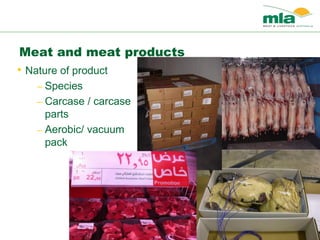
Meat and meat products
• Nature of product
– Species
– Carcase / carcase
parts
– Aerobic/ vacuum
pack
Zhang - ICoMST 2010
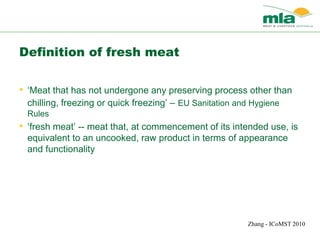
Definition of fresh meat
• ‘Meat that has not undergone any preserving process other than
chilling, freezing or quick freezing’ – EU Sanitation and Hygiene
Rules
• ‘fresh meat’ -- meat that, at commencement of its intended use, is
equivalent to an uncooked, raw product in terms of appearance
and functionality
International meat trade
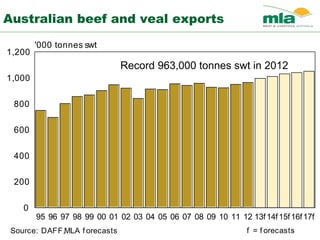
Australian beef and veal exports
Source: DAFF,MLA f orecasts
95 96 97 98 99 00 01 02 03 04 05 06 07 08 09 10 11 12 13f14f15f16f17f
0
200
400
600
800
1,000
1,200
'000 tonnes swt
f = f orecasts
Record 963,000 tonnes swt in 2012
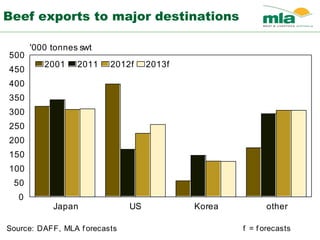
Beef exports to major destinations
Source: DAFF, MLA f orecasts
Japan US Korea other
0
50
100
150
200
250
300
350
400
450
500
'000 tonnes swt
2001 2011 2012f 2013f
f = f orecasts
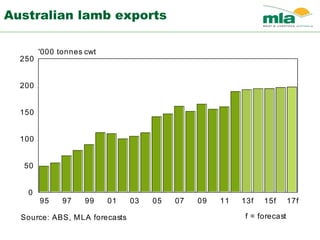
Australian lamb exports
Source: ABS, MLA forecasts
95 97 99 01 03 05 07 09 11 13f 15f 17f
0
50
100
150
200
250
'000 tonnes cwt
f = forecast
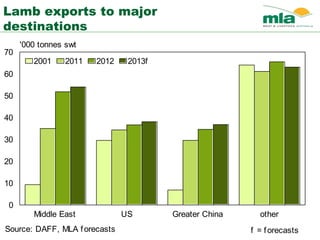
Lamb exports to major
destinations
Source: DAFF, MLA forecasts
Middle East US Greater China other
0
10
20
30
40
50
60
70
'000 tonnes swt
2001 2011 2012 2013f
f = forecasts
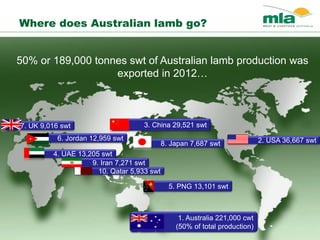
Global Lamb Exports
2. USA 36,667 swt
10. Qatar 5,933 swt
8. Japan 7,687 swt
1. Australia 221,000 cwt
(50% of total production)
3. China 29,521 swt
4. UAE 13,205 swt
7. UK 9,016 swt
6. Jordan 12,959 swt
9. Iran 7,271 swt
5. PNG 13,101 swt
Where does Australian lamb go?
50% or 189,000 tonnes swt of Australian lamb production was
exported in 2012…
Transport
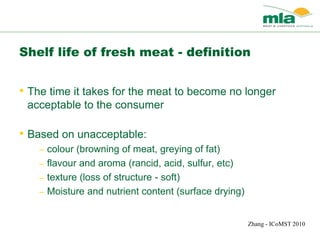
Shelf life of fresh meat - definition
• The time it takes for the meat to become no longer
acceptable to the consumer
• Based on unacceptable:
– colour (browning of meat, greying of fat)
– flavour and aroma (rancid, acid, sulfur, etc)
– texture (loss of structure - soft)
– Moisture and nutrient content (surface drying)
Zhang - ICoMST 2010
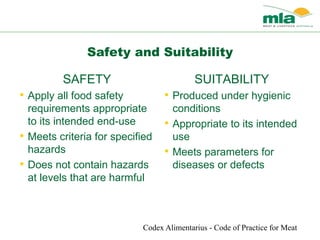
Safety and Suitability
SAFETY
• Apply all food safety
requirements appropriate
to its intended end-use
• Meets criteria for specified
hazards
• Does not contain hazards
at levels that are harmful
SUITABILITY
• Produced under hygienic
conditions
• Appropriate to its intended
use
• Meets parameters for
diseases or defects
Codex Alimentarius - Code of Practice for Meat
If stored under acceptable conditions
meat will remain safe after packing and
chilling
• Most foodborne pathogens do not grow at refrigeration
temperatures
• Safe ‘for its intended use’
• Cooking
How long can fresh meat be stored
before it becomes unsuitable?
Zhang - ICoMST 2010
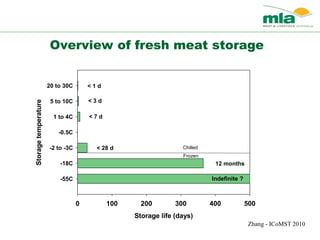
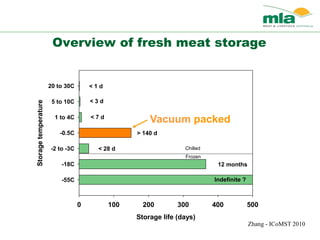
Overview of fresh meat storage
Storage life (days)
0 100 200 300 400 500
Storagetemperature
-55C
-18C
-2 to -3C
-0.5C
1 to 4C
5 to 10C
20 to 30C < 1 d
< 3 d
< 7 d
< 28 d
12 months
Indefinite ?
Chilled
Frozen
Zhang - ICoMST 2010
Overview of fresh meat storage
Storage life (days)
0 100 200 300 400 500
Storagetemperature
-55C
-18C
-2 to -3C
-0.5C
1 to 4C
5 to 10C
20 to 30C < 1 d
< 3 d
< 7 d
< 28 d
12 months
Indefinite ?
Chilled
Frozen
> 140 d
Vacuum packed
Zhang - ICoMST 2010
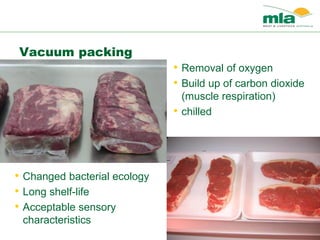
Vacuum packing
• Removal of oxygen
• Build up of carbon dioxide
(muscle respiration)
• chilled
• Changed bacterial ecology
• Long shelf-life
• Acceptable sensory
characteristics
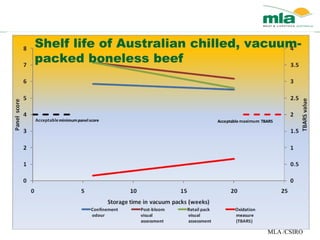
MLA /CSIRO
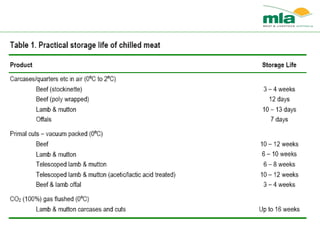
Shelf life of Australian chilled, vacuum-
packed boneless beef
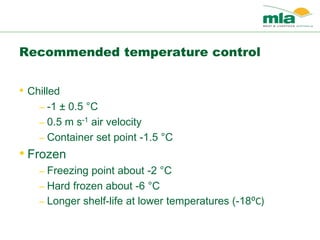
• Chilled
– -1 ± 0.5 °C
– 0.5 m s-1 air velocity
– Container set point -1.5 °C
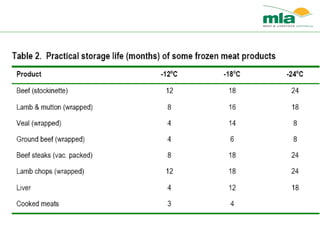
• Frozen
– Freezing point about -2 °C
– Hard frozen about -6 °C
– Longer shelf-life at lower temperatures (-18⁰C)
Recommended temperature control
How does fresh meat become
unsuitable?
Zhang - ICoMST 2010
How does fresh meat become
unsuitable?
Zhang - ICoMST 2010
• Type of product (e.g.
fat content, presence
of bone)
• Level of bacteria
• Packing method
• Storage temperature
Changes in suitability
• Microbiological
– Spoilage due to bacterial growth
– Mould growth
• Chemical
– Oxidation of fats (rancidity)
– proteolysis – breakdown of protein structure
– Colour changes
• Physical
– Drying
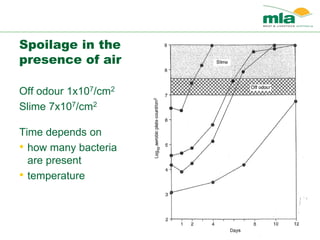
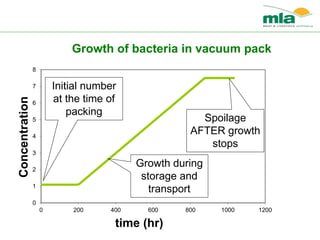
Spoilage in the
presence of air
Off odour 1x10⁷/cm2
Slime 7x10⁷/cm2
Time depends on
• how many bacteria
are present
• temperature
0
1
2
3
4
5
6
7
8
0 200 400 600 800 1000 1200
Concentration
time (hr)
Growth of bacteria in vacuum pack
Initial number
at the time of
packing
Growth during
storage and
transport
Spoilage
AFTER growth
stops
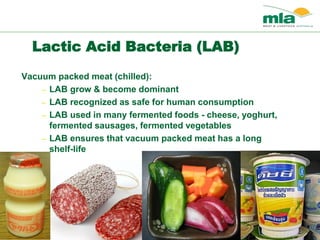
Lactic Acid Bacteria (LAB)
Vacuum packed meat (chilled):
– LAB grow & become dominant
– LAB recognized as safe for human consumption
– LAB used in many fermented foods - cheese, yoghurt,
fermented sausages, fermented vegetables
– LAB ensures that vacuum packed meat has a long
shelf-life
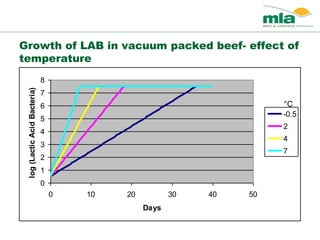
Growth of LAB in vacuum packed beef- effect of
temperature
0
1
2
3
4
5
6
7
8
0 10 20 30 40 50
Days
log(LacticAcidBacteria)
-0.5
2
4
7
°C
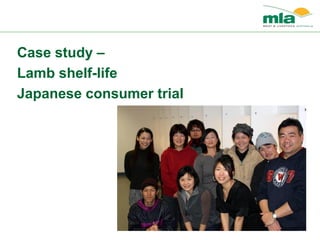
Case study –
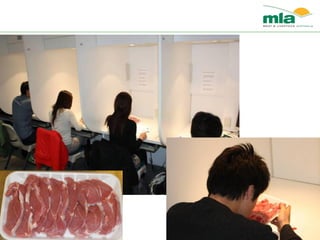
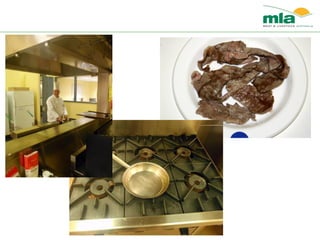
Lamb shelf-life
Japanese consumer trial
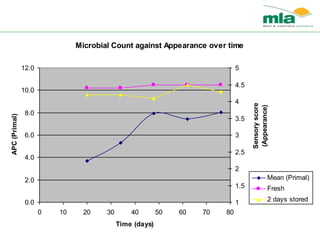
Microbial Count against Appearance over time
0.0
2.0
4.0
6.0
8.0
10.0
12.0
0 10 20 30 40 50 60 70 80
Time (days)
APC(Primal)
1
1.5
2
2.5
3
3.5
4
4.5
5
Mean (Primal)
Fresh
2 days stored
Sensoryscore
(Appearance)
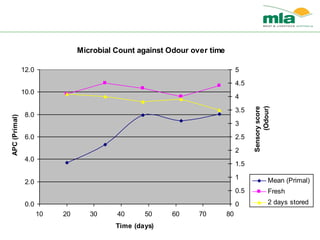
Microbial Count against Odour over time
0.0
2.0
4.0
6.0
8.0
10.0
12.0
10 20 30 40 50 60 70 80
Time (days)
APC(Primal)
0
0.5
1
1.5
2
2.5
3
3.5
4
4.5
5
Mean (Primal)
Fresh
2 days stored
Sensoryscore
(Odour)
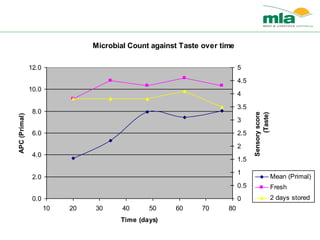
Microbial Count against Taste over time
0.0
2.0
4.0
6.0
8.0
10.0
12.0
10 20 30 40 50 60 70 80
Time (days)
APC(Primal)
0
0.5
1
1.5
2
2.5
3
3.5
4
4.5
5
Mean (Primal)
Fresh
2 days stored
Sensoryscore
(Taste)
Cold chain data
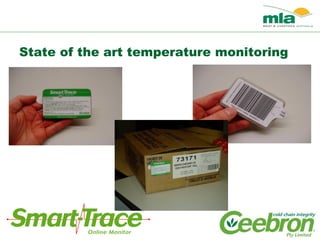
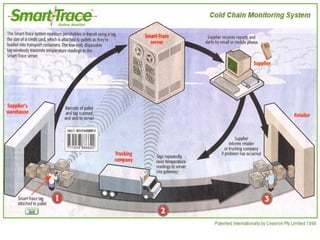
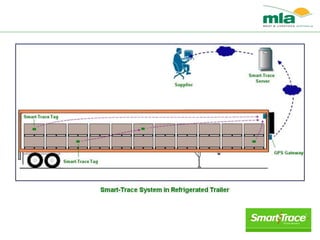
State of the art temperature monitoring
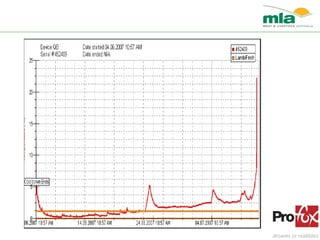
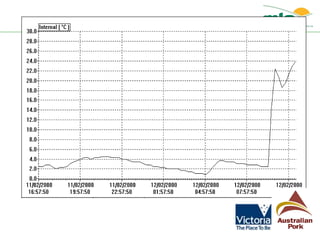
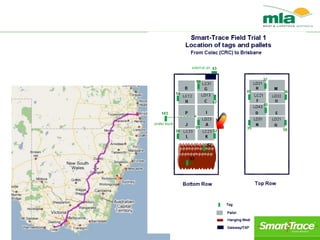
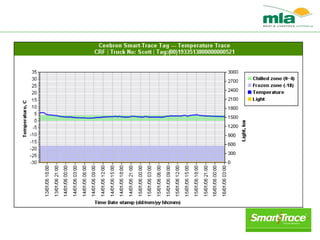
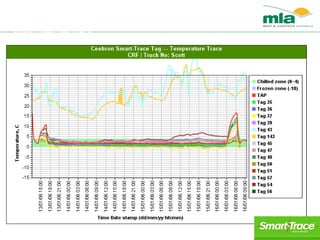
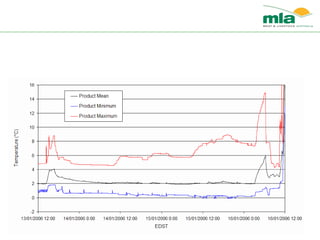
Cold chain data- safety case study
• Chilled product
• Lamb carcase
• Road transport in Australia
• Intended for retail / home consumption
Smart-Trace Field Trial 1
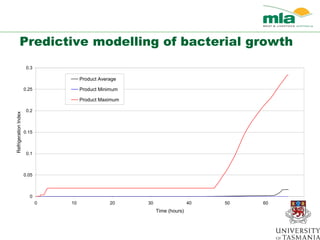
Predictive modelling of bacterial growth
0
0.05
0.1
0.15
0.2
0.25
0.3
0 10 20 30 40 50 60 70
Time (hours)
RefrigerationIndex
Product Average
Product Minimum
Product Maximum
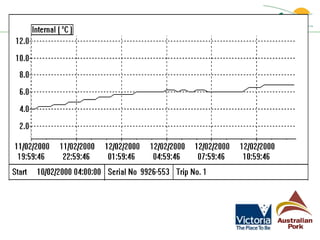
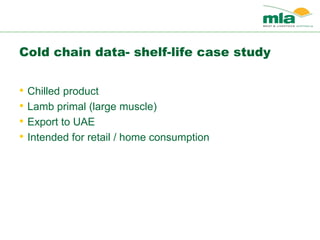
Cold chain data- shelf-life case study
• Chilled product
• Lamb primal (large muscle)
• Export to UAE
• Intended for retail / home consumption
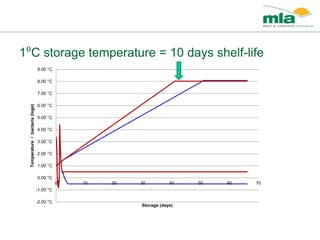
1⁰C storage temperature = 10 days shelf-life
-2.00 °C
-1.00 °C
0.00 °C
1.00 °C
2.00 °C
3.00 °C
4.00 °C
5.00 °C
6.00 °C
7.00 °C
8.00 °C
9.00 °C
0 10 20 30 40 50 60 70
Temperature/bacteria(logs)
Storage (days)
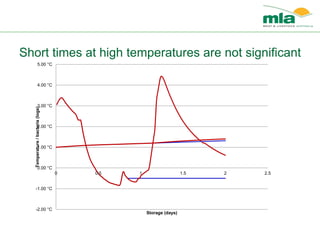
Short times at high temperatures are not significant
-2.00 °C
-1.00 °C
0.00 °C
1.00 °C
2.00 °C
3.00 °C
4.00 °C
5.00 °C
0 0.5 1 1.5 2 2.5
Temperature/bacteria(logs)
Storage (days)
Cold chain data- quality case study
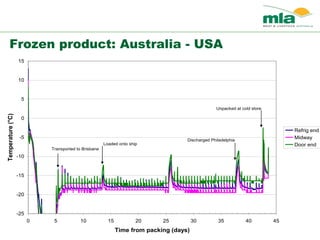
• Frozen product
• Lean beef trim
• Export to USA
• Ground for use in hamburger patties
Frozen product: Australia - USA
-25
-20
-15
-10
-5
0
5
10
15
0 5 10 15 20 25 30 35 40 45
Time from packing (days)
Temperature(°C)
Refrig end
Midway
Door endLoaded onto ship
Discharged Philadelphia
Unpacked at cold store
Transported to Brisbane
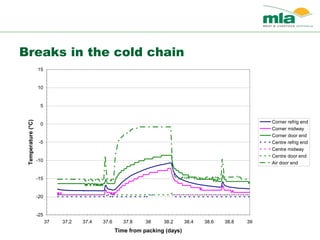
Breaks in the cold chain
-25
-20
-15
-10
-5
0
5
10
15
37 37.2 37.4 37.6 37.8 38 38.2 38.4 38.6 38.8 39
Time from packing (days)
Temperature(°C)
Corner refrig end
Corner midway
Corner door end
Centre refrig end
Centre midway
Centre door end
Air door end
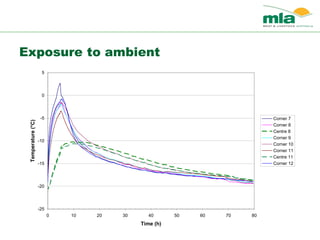
Exposure to ambient
-25
-20
-15
-10
-5
0
5
0 10 20 30 40 50 60 70 80
Time (h)
Temperature(°C)
Corner 7
Corner 8
Centre 8
Corner 9
Corner 10
Corner 11
Centre 11
Corner 12
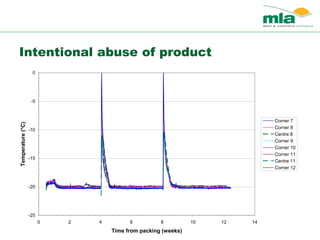
Intentional abuse of product
-25
-20
-15
-10
-5
0
0 2 4 6 8 10 12 14
Time from packing (weeks)
Temperature(°C)
Corner 7
Corner 8
Centre 8
Corner 9
Corner 10
Corner 11
Centre 11
Corner 12
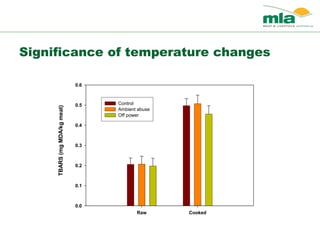
Significance of temperature changes
TBARS(mgMDA/kgmeat)
Raw Cooked
0.0
0.1
0.2
0.3
0.4
0.5
0.6
Control
Ambient abuse
Off power
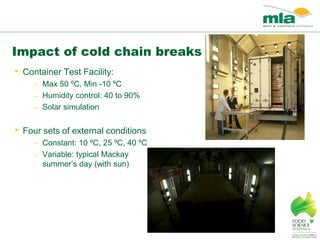
Impact of cold chain breaks
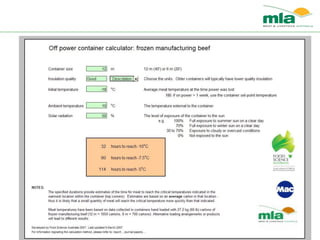
• Container Test Facility:
– Max 50 ºC, Min -10 ºC
– Humidity control: 40 to 90%
– Solar simulation
• Four sets of external conditions
– Constant: 10 ºC, 25 ºC, 40 ºC
– Variable: typical Mackay
summer’s day (with sun)
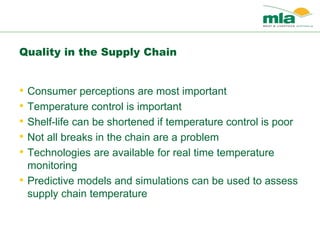
Quality in the Supply Chain
• Consumer perceptions are most important
• Temperature control is important
• Shelf-life can be shortened if temperature control is poor
• Not all breaks in the chain are a problem
• Technologies are available for real time temperature
monitoring
• Predictive models and simulations can be used to assess
supply chain temperature
Acknowledgements
Funding Research
Providers
AFRIS. AsianFoodRegulationInformationService.
We have the largest database of Asian food regulations in the world and it’s
FREE to use.
We publish a range of communication services, list a very large number of
food events and online educational webinars and continue to grow our Digital
Library.
We look forward to hearing from you soon!
www.asianfoodreg.com
adrienna@asianfoodreg.com

Cold Chain for Meat

  • 1.
    Maintaining the safetyand suitability of perishable products: cold chain for meat Ian Jenson Meat & Livestock Australia
  • 2.
    Outline • Fresh meatdefinition • International trade in fresh meat • Safety and suitability - shelf-life • Factors that define shelf-life – temperature • Example: Consumer perceptions • Temperature monitoring • Example: Safety of product in road transport • Example: Temperature and shelf-life • Example: Quality of frozen product • Conclusions
  • 3.
    Meat and meatproducts • Nature of product – Species – Carcase / carcase parts – Aerobic/ vacuum pack
  • 4.
    Zhang - ICoMST2010 Definition of fresh meat • ‘Meat that has not undergone any preserving process other than chilling, freezing or quick freezing’ – EU Sanitation and Hygiene Rules • ‘fresh meat’ -- meat that, at commencement of its intended use, is equivalent to an uncooked, raw product in terms of appearance and functionality
  • 5.
  • 6.
    Australian beef andveal exports Source: DAFF,MLA f orecasts 95 96 97 98 99 00 01 02 03 04 05 06 07 08 09 10 11 12 13f14f15f16f17f 0 200 400 600 800 1,000 1,200 '000 tonnes swt f = f orecasts Record 963,000 tonnes swt in 2012
  • 7.
    Beef exports tomajor destinations Source: DAFF, MLA f orecasts Japan US Korea other 0 50 100 150 200 250 300 350 400 450 500 '000 tonnes swt 2001 2011 2012f 2013f f = f orecasts
  • 8.
    Australian lamb exports Source:ABS, MLA forecasts 95 97 99 01 03 05 07 09 11 13f 15f 17f 0 50 100 150 200 250 '000 tonnes cwt f = forecast
  • 9.
    Lamb exports tomajor destinations Source: DAFF, MLA forecasts Middle East US Greater China other 0 10 20 30 40 50 60 70 '000 tonnes swt 2001 2011 2012 2013f f = forecasts
  • 10.
    Global Lamb Exports 2.USA 36,667 swt 10. Qatar 5,933 swt 8. Japan 7,687 swt 1. Australia 221,000 cwt (50% of total production) 3. China 29,521 swt 4. UAE 13,205 swt 7. UK 9,016 swt 6. Jordan 12,959 swt 9. Iran 7,271 swt 5. PNG 13,101 swt Where does Australian lamb go? 50% or 189,000 tonnes swt of Australian lamb production was exported in 2012…
  • 11.
  • 12.
    Shelf life offresh meat - definition • The time it takes for the meat to become no longer acceptable to the consumer • Based on unacceptable: – colour (browning of meat, greying of fat) – flavour and aroma (rancid, acid, sulfur, etc) – texture (loss of structure - soft) – Moisture and nutrient content (surface drying) Zhang - ICoMST 2010
  • 13.
    Safety and Suitability SAFETY •Apply all food safety requirements appropriate to its intended end-use • Meets criteria for specified hazards • Does not contain hazards at levels that are harmful SUITABILITY • Produced under hygienic conditions • Appropriate to its intended use • Meets parameters for diseases or defects Codex Alimentarius - Code of Practice for Meat
  • 14.
    If stored underacceptable conditions meat will remain safe after packing and chilling • Most foodborne pathogens do not grow at refrigeration temperatures • Safe ‘for its intended use’ • Cooking
  • 15.
    How long canfresh meat be stored before it becomes unsuitable? Zhang - ICoMST 2010
  • 16.
    Overview of freshmeat storage Storage life (days) 0 100 200 300 400 500 Storagetemperature -55C -18C -2 to -3C -0.5C 1 to 4C 5 to 10C 20 to 30C < 1 d < 3 d < 7 d < 28 d 12 months Indefinite ? Chilled Frozen Zhang - ICoMST 2010
  • 17.
    Overview of freshmeat storage Storage life (days) 0 100 200 300 400 500 Storagetemperature -55C -18C -2 to -3C -0.5C 1 to 4C 5 to 10C 20 to 30C < 1 d < 3 d < 7 d < 28 d 12 months Indefinite ? Chilled Frozen > 140 d Vacuum packed Zhang - ICoMST 2010
  • 18.
    Vacuum packing • Removalof oxygen • Build up of carbon dioxide (muscle respiration) • chilled • Changed bacterial ecology • Long shelf-life • Acceptable sensory characteristics
  • 19.
    MLA /CSIRO Shelf lifeof Australian chilled, vacuum- packed boneless beef
  • 20.
    • Chilled – -1± 0.5 °C – 0.5 m s-1 air velocity – Container set point -1.5 °C • Frozen – Freezing point about -2 °C – Hard frozen about -6 °C – Longer shelf-life at lower temperatures (-18⁰C) Recommended temperature control
  • 21.
    How does freshmeat become unsuitable? Zhang - ICoMST 2010
  • 22.
    How does freshmeat become unsuitable? Zhang - ICoMST 2010 • Type of product (e.g. fat content, presence of bone) • Level of bacteria • Packing method • Storage temperature
  • 23.
    Changes in suitability •Microbiological – Spoilage due to bacterial growth – Mould growth • Chemical – Oxidation of fats (rancidity) – proteolysis – breakdown of protein structure – Colour changes • Physical – Drying
  • 24.
    Spoilage in the presenceof air Off odour 1x10⁷/cm2 Slime 7x10⁷/cm2 Time depends on • how many bacteria are present • temperature
  • 25.
    0 1 2 3 4 5 6 7 8 0 200 400600 800 1000 1200 Concentration time (hr) Growth of bacteria in vacuum pack Initial number at the time of packing Growth during storage and transport Spoilage AFTER growth stops
  • 26.
    Lactic Acid Bacteria(LAB) Vacuum packed meat (chilled): – LAB grow & become dominant – LAB recognized as safe for human consumption – LAB used in many fermented foods - cheese, yoghurt, fermented sausages, fermented vegetables – LAB ensures that vacuum packed meat has a long shelf-life
  • 27.
    Growth of LABin vacuum packed beef- effect of temperature 0 1 2 3 4 5 6 7 8 0 10 20 30 40 50 Days log(LacticAcidBacteria) -0.5 2 4 7 °C
  • 28.
    Case study – Lambshelf-life Japanese consumer trial
  • 31.
    Microbial Count againstAppearance over time 0.0 2.0 4.0 6.0 8.0 10.0 12.0 0 10 20 30 40 50 60 70 80 Time (days) APC(Primal) 1 1.5 2 2.5 3 3.5 4 4.5 5 Mean (Primal) Fresh 2 days stored Sensoryscore (Appearance)
  • 32.
    Microbial Count againstOdour over time 0.0 2.0 4.0 6.0 8.0 10.0 12.0 10 20 30 40 50 60 70 80 Time (days) APC(Primal) 0 0.5 1 1.5 2 2.5 3 3.5 4 4.5 5 Mean (Primal) Fresh 2 days stored Sensoryscore (Odour)
  • 33.
    Microbial Count againstTaste over time 0.0 2.0 4.0 6.0 8.0 10.0 12.0 10 20 30 40 50 60 70 80 Time (days) APC(Primal) 0 0.5 1 1.5 2 2.5 3 3.5 4 4.5 5 Mean (Primal) Fresh 2 days stored Sensoryscore (Taste)
  • 34.
  • 38.
    State of theart temperature monitoring
  • 41.
    Cold chain data-safety case study • Chilled product • Lamb carcase • Road transport in Australia • Intended for retail / home consumption
  • 44.
  • 46.
    Predictive modelling ofbacterial growth 0 0.05 0.1 0.15 0.2 0.25 0.3 0 10 20 30 40 50 60 70 Time (hours) RefrigerationIndex Product Average Product Minimum Product Maximum
  • 47.
    Cold chain data-shelf-life case study • Chilled product • Lamb primal (large muscle) • Export to UAE • Intended for retail / home consumption
  • 48.
    1⁰C storage temperature= 10 days shelf-life -2.00 °C -1.00 °C 0.00 °C 1.00 °C 2.00 °C 3.00 °C 4.00 °C 5.00 °C 6.00 °C 7.00 °C 8.00 °C 9.00 °C 0 10 20 30 40 50 60 70 Temperature/bacteria(logs) Storage (days)
  • 49.
    Short times athigh temperatures are not significant -2.00 °C -1.00 °C 0.00 °C 1.00 °C 2.00 °C 3.00 °C 4.00 °C 5.00 °C 0 0.5 1 1.5 2 2.5 Temperature/bacteria(logs) Storage (days)
  • 50.
    Cold chain data-quality case study • Frozen product • Lean beef trim • Export to USA • Ground for use in hamburger patties
  • 51.
    Frozen product: Australia- USA -25 -20 -15 -10 -5 0 5 10 15 0 5 10 15 20 25 30 35 40 45 Time from packing (days) Temperature(°C) Refrig end Midway Door endLoaded onto ship Discharged Philadelphia Unpacked at cold store Transported to Brisbane
  • 52.
    Breaks in thecold chain -25 -20 -15 -10 -5 0 5 10 15 37 37.2 37.4 37.6 37.8 38 38.2 38.4 38.6 38.8 39 Time from packing (days) Temperature(°C) Corner refrig end Corner midway Corner door end Centre refrig end Centre midway Centre door end Air door end
  • 53.
    Exposure to ambient -25 -20 -15 -10 -5 0 5 010 20 30 40 50 60 70 80 Time (h) Temperature(°C) Corner 7 Corner 8 Centre 8 Corner 9 Corner 10 Corner 11 Centre 11 Corner 12
  • 54.
    Intentional abuse ofproduct -25 -20 -15 -10 -5 0 0 2 4 6 8 10 12 14 Time from packing (weeks) Temperature(°C) Corner 7 Corner 8 Centre 8 Corner 9 Corner 10 Corner 11 Centre 11 Corner 12
  • 55.
    Significance of temperaturechanges TBARS(mgMDA/kgmeat) Raw Cooked 0.0 0.1 0.2 0.3 0.4 0.5 0.6 Control Ambient abuse Off power
  • 56.
    Impact of coldchain breaks • Container Test Facility: – Max 50 ºC, Min -10 ºC – Humidity control: 40 to 90% – Solar simulation • Four sets of external conditions – Constant: 10 ºC, 25 ºC, 40 ºC – Variable: typical Mackay summer’s day (with sun)
  • 58.
    Quality in theSupply Chain • Consumer perceptions are most important • Temperature control is important • Shelf-life can be shortened if temperature control is poor • Not all breaks in the chain are a problem • Technologies are available for real time temperature monitoring • Predictive models and simulations can be used to assess supply chain temperature
  • 59.
  • 62.
    AFRIS. AsianFoodRegulationInformationService. We havethe largest database of Asian food regulations in the world and it’s FREE to use. We publish a range of communication services, list a very large number of food events and online educational webinars and continue to grow our Digital Library. We look forward to hearing from you soon! www.asianfoodreg.com adrienna@asianfoodreg.com