Freezing
Rick Sloan
FCS Agent
What will we learn?
 Principles of Freezing
 Freezers
 Packaging Materials
 Freezing Foods
 Shelf-life of Frozen Foods
 Emergencies
2Home Food Preservation
Principles of Freezing
3Home Food Preservation
Principles of Freezing
 Does not sterilize food.
 Extreme cold (0oF or colder):
 stops growth of microorganisms and
 Slows chemical changes, such as enzymatic
reactions.
4Home Food Preservation
Advantages of Freezing
 Many foods can be frozen.
 Natural color, flavor, and nutritive value
retained.
 Texture usually better than other methods of
food preservation.
 Foods can be frozen in less time than they can
be dried or canned.
5Home Food Preservation
Advantages of Freezing
 Simple procedures.
 Adds convenience to food preparation.
 Proportions can be adapted to needs unlike
other home preservation methods.
 Kitchen remains cool and comfortable.
6Home Food Preservation
Disadvantages of Freezing
 Texture of some foods is undesirable because
of freezing process.
 Initial investment and cost of maintaining
freezer is high.
 Storage space limited by capacity of freezer.
7Home Food Preservation
How Freezing Affects Food
Chemical changes
 Enzymes in vegetables
 Enzymes in fruit
 Rancidity
Texture Changes
 Expansion of food
 Ice crystals
8Home Food Preservation
Freezers
9Home Food Preservation
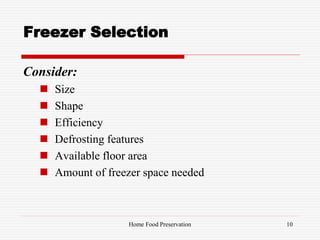
Freezer Selection
Consider:
 Size
 Shape
 Efficiency
 Defrosting features
 Available floor area
 Amount of freezer space needed
10Home Food Preservation
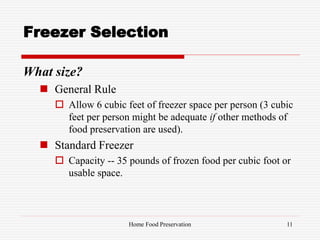
Freezer Selection
What size?
 General Rule
 Allow 6 cubic feet of freezer space per person (3 cubic
feet per person might be adequate if other methods of
food preservation are used).
 Standard Freezer
 Capacity -- 35 pounds of frozen food per cubic foot or
usable space.
11Home Food Preservation
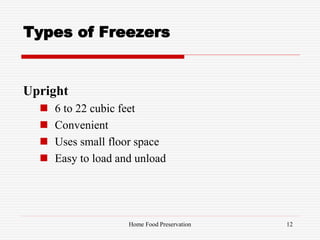
Types of Freezers
Upright
 6 to 22 cubic feet
 Convenient
 Uses small floor space
 Easy to load and unload
12Home Food Preservation
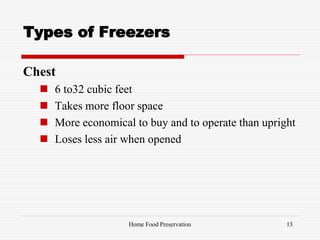
Types of Freezers
Chest
 6 to32 cubic feet
 Takes more floor space
 More economical to buy and to operate than upright
 Loses less air when opened
13Home Food Preservation
Types of Freezers
Refrigerator - Freezer Combination
 2 to 6 cubic feet
 Be sure can set temperature at 0ºF or colder
 Freezer can be above, below, or beside refrigerator
area
 Other features
 Self defrosting or manual defrost
 Receptacle clips - prevent accidental disconnecting
 Door locks and drains for defrosting
14Home Food Preservation
Location and Placement of
Freezer
 Place in convenient, cool, dry, well-ventilated
area.
 Do not place by stove, range, water heater or in
the sun.
 Do not push flush against wall. Leave space for
air circulation and cleaning.
 Be sure freezer is level.
15Home Food Preservation
Packaging Materials
16Home Food Preservation
Packaging Materials
 Moisture-vapor resistant
 Durable and leak-proof
 Not become brittle and crack at low temperatures.
 Resistant to oil, grease, or water
 Protects foods from absorption of off-flavors or odors
 Easy to seal and mark
17Home Food Preservation
Types of Packaging Materials
 Rigid Containers
 Plastic freezer containers
 Freezer boxes with liners
 Coffee canisters
 Wide mouth canning/freezing jars
 Good for liquids, soft, juicy, or liquid-
packed foods
 May be reusable
 Hold their shape and can be stored upright
18Home Food Preservation
Types of Packaging Materials
Non-Rigid Containers
 Bags
 Wrappings - cellophane, heavy-duty aluminum foil,
polyethylene, laminated paper
Good for firm, non-juicy foods
19Home Food Preservation
Freezing Foods
20Home Food Preservation
General Freezing Instructions
Selection
 Freezing does not improve quality.
 Choose the highest quality available.
 Freeze promptly.
 Remember some foods do not freeze well.
Preparation
 Work under sanitary conditions.
 Follow recommended procedures.
21Home Food Preservation
Packing Foods to be Frozen
 Cool food before freezing.
 Ice bath
 Pack in serving size quantities.
 Usually up to 1 quart
 Pack foods tightly.
 Allow for some headspace.
 Vegetables like broccoli and asparagus, bony
pieces of meat, tray packed foods, and breads,
do not need any headspace.
22Home Food Preservation
Packing Foods to be Frozen
 Press all air from bagged foods, seal bags by
twisting and then folding over loose edge
(gooseneck). Secure with string, twist-tie or
rubber band.
 Use tight lid on rigid containers and keep
sealing edge clean. Use freezer tape on loose
fitting covers.
23Home Food Preservation
Washing Fruits and Vegetables
 Wash fruits and vegetables in warm water
before freezer.
 The only exception to this rule is that
blueberries should not be washed before
freezing.
24Home Food Preservation
Labels
 Name of product
 Added ingredients
 Form of food: halves, whole, or ground
 Packing date
 Number of servings or amount
25Home Food Preservation
Freezing
 Freeze foods at <0ºF (set freezer at -10ºF at
least 24 hours before freezing foods).
 Freeze foods immediately.
 Do not overload freezer with unfrozen food.
Freeze amount that will freeze in 24 hours -- 2
to 3 pounds of food per cubic foot.
 Pack already frozen foods together so they do
not thaw.
26Home Food Preservation
Freezing
 Place unfrozen foods in contact with surfaces and in
coldest parts of freezer.
 Leave space so air can circulate.
 When food is frozen, organize freezer into types of
food.
 Arrange frozen foods so that the foods frozen
longer can be used first.
 Keep a current frozen foods inventory.
 Check freezer temperature periodically.
27Home Food Preservation
Sweetened Packs for Fruit
Syrup Pack
 Better texture
 Not needed for safety
 Fruits should be covered with syrup
 Place crumpled water-resistant paper in top of
container
28Home Food Preservation
Sweetened Packs for Fruit
Sugar Pack
 Soft sliced fruits (strawberries, peaches, etc.) make
on syrup when mixed with the right proportion of
sugar.
 Layer fruit and sugar.
 Allow it to stand for 15 minutes.
29Home Food Preservation
Unsweetened Packs for Fruit
Dry Pack
 Good for small whole fruits such as berries that
do not need sugar.
 Simply pack into containers and freeze.
 Can freeze on a tray first, so pour easily.
Pectin Syrup
 Good for strawberries and peaches.
 Mix 1 pkg. powdered pectin and 1 cup water.
Bring to boil, boil 1 minute. Remove from heat,
cool, and add 1-3/4 cups more water.
30Home Food Preservation
Unsweetened Packs for Fruit
Water or Unsweetened Juice Packs
 Texture will be mushier.
 Color poorer.
 Freezes harder, takes longer to thaw.
31Home Food Preservation
Packs for Purees or Juices
 Pack as is, with or without sugar.
 Add ascorbic acid if light-colored.
32Home Food Preservation
Artificial Sweeteners
 Can be used in the pectin syrup, juice, or water
packs.
 Or could be added just before serving
 Do not help with color retention or texture, like
sugar does.
 Use amounts on product labels.
33Home Food Preservation
Preventing Fruit Darkening
 The following work well:
 1 teaspoon (3000 mg) ascorbic acid to one
gallon of water
 Commercial ascorbic acid mixture
 Heating the fruit
 The following do not work as well:
 Citric acid solution
 Lemon juice
 Sugar syrup
 Salt/vinegar solution
34Home Food Preservation
Preventing Discoloration during
Freezing
Ascorbic Acid
 Is the most economical.
 Use powdered or tablet form.
 1/2 teaspoon powdered ascorbic acid = 1500 mg
 Crush tablets well.
 Use amount specified for each fruit.
 In syrup or liquid packs, add powder to liquid.
35Home Food Preservation
Preventing Discoloration during
Freezing
 In sugar or dry packs, dissolve 2 to 3 tablespoons in
cold water and sprinkle over fruit.
 For crushed fruit, purees or juices, mix with fruit
about 1/8 teaspoon per quart.
 Ascorbic Acid Mixtures
 Follow package directions
36Home Food Preservation
Preventing Discoloration during
Freezing
 Citric Acid or Lemon Juice
 Not as effective
 May mask flavors
 Steaming
 Best for fruits that will be cooked before use
 Follow directions in freezing publications
37Home Food Preservation
Freezing Vegetables
 Select young, tender, high-quality vegetables.
 Sort for size and ripeness.
 Wash and drain before removing skins or shells.
 Wash small lots at a time, lifting out of water.
Do not soak.
 Work in small quantities, preparing per
instructions.
38Home Food Preservation
Preventing Flavor and Color
Changes in Vegetables
Water blanching
 Use 1 gallon water per pound of vegetables.
 Place vegetables in blanching basket.
 Lower into vigorously boiling water.
 Cover and begin timing.
39Home Food Preservation
Blanching Vegetables
Steam Blanching
 Use kettle with tight lid and basket.
 Put 1 to 2 inches of boiling water in the bottom of
pan.
 Vegetables should be in a single layer in basket.
 Start timing when covered.
 Takes 1-1/2 times longer than water blanching.
40Home Food Preservation
Blanching Vegetables
Microwave Blanching (not recommended)
 Enzymes might not be inactivated.
 Does not save time or energy.
 Use specific directions and blanch small quantities
at a time.
 After blanching, cool immediately in cold water.
 Change water frequently.
41Home Food Preservation
Types of Pack for Vegetables
Dry Pack
 Pack after blanched, cooled, and drained.
 Pack quickly, excluding air.
42Home Food Preservation
Types of Pack for Vegetables
Tray Pack
 After draining, spread in a single layer on a shallow
pan.
 Freeze firm.
 After first hour, check often.
 Pack quickly, excluding air.
43Home Food Preservation
Freezing Meats and Poultry
 Keep meat or poultry and everything they touch as
clean as possible.
 Keep cold until frozen.
 Never stuff poultry before freezing.
 Store-bought meats must be over-wrapped.
 Freeze meats and poultry using the drugstore or
butcher wrap (drugstore wrap preferred except for
irregular meat cuts).
44Home Food Preservation
Freezing Fish
 Pre-treat as directed to control rancidity, flavor
changes or loss of liquid.
 Package using one of the following:
 Lemon-gelatin glaze
 Ice glaze
 Water
45Home Food Preservation
Lemon-gelatin Glaze
 Mix 1/4 cup lemon juice and 1-3/4 cups water.
 Dissolve 1 packet unflavored gelatin into 1/2
cup of this mixture.
 Heat remaining mixture to boiling and add
dissolved gelatin.
 Cool, dip fish, wrap and freeze.
46Home Food Preservation
Freezing Prepared Foods
 Many can be frozen.
 Follow directions in a credible freezer
publication.
47Home Food Preservation
Foods that Do Not Freeze Well
 Cabbage, celery, cress,
cucumbers, endive, lettuce,
parsley, radishes
 White potatoes
 Cooked macaroni, spaghetti,
rice
 Egg whites
 Meringue
 Icings made from egg whites
 Cream or custard filling
 Milk sauces
 Sour cream
 Cheese
 Mayonnaise or salad
dressing
 Gelatin
 Fruit jelly
 Fried foods
48Home Food Preservation
Thawing Foods for Serving
Fruits
 Best if served with ice crystals present.
 Thaw:
 In refrigerator -- 6 to 8 hours per pound of fruit in
syrup
 At room temperature -- 1 to 2 hours per pound
 At room temperature in cool water -- 1/2 to 1 hour
per pound
 In microwave oven - follow manufacturer’s
instructions.
49Home Food Preservation
Thawing Foods for Serving
 Dry sugar packs thaw faster than syrup packs.
 Unsweetened packs thaw the slowest.
 When used in recipes, allow for added sugar
and more juice.
50Home Food Preservation
Thawing Foods for Serving
Vegetables
 Cook without thawing except partially thaw corn-
on-the-cob and leafy greens.
51Home Food Preservation
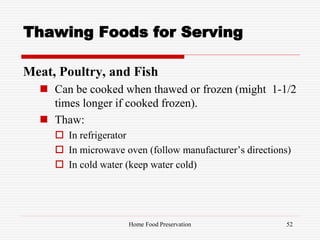
Thawing Foods for Serving
Meat, Poultry, and Fish
 Can be cooked when thawed or frozen (might 1-1/2
times longer if cooked frozen).
 Thaw:
 In refrigerator
 In microwave oven (follow manufacturer’s directions)
 In cold water (keep water cold)
52Home Food Preservation
Shelf-Life of Frozen Foods
53Home Food Preservation
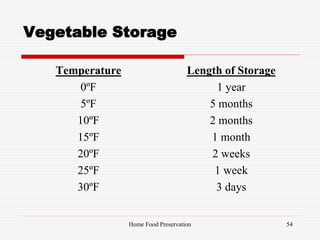
Vegetable Storage
Temperature
0ºF
5ºF
10ºF
15ºF
20ºF
25ºF
30ºF
Length of Storage
1 year
5 months
2 months
1 month
2 weeks
1 week
3 days
54Home Food Preservation
Emergencies
55Home Food Preservation
Freezer Emergencies
 If power will be off, set freezer controls to 10ºF
to -20ºF immediately.
 Do not open door.
 Foods stay frozen longer if freezer is full, well-
insulated, and in cool area.
 Full freezer -- keeps 2 to 4 days
 Half full freezer -- 24 hours
56Home Food Preservation
Freezer Emergencies
 If power interruption will be longer than 1 to
2 days, use dry ice:
 50 lbs -- keeps full 20 cubic foot freezer below
freezing for 3 to 4 days
 50 lbs -- keeps half-full freezer for 2 to 3 days
 Keep dry ice on boards or heavy cardboard on
top of food.
 Do not touch dry ice.
 Do not open freezer.
 Ventilate room.
57Home Food Preservation
Refreezing Thawed Foods
 Texture will not be as good.
 General rule:
 Refreeze if freezer temperature is 40ºF or colder or
if ice crystals are still present.
58Home Food Preservation
Best Advice for Freezing
Freeze foods quickly.
 Set freezer temperature at -10ºF 24 hours before
freezing foods.
 Spread packages out until frozen, then stack.
Hold at 0ºF or colder for best quality.
59Home Food Preservation

Freezing

  • 1.
  • 2.
    What will welearn?  Principles of Freezing  Freezers  Packaging Materials  Freezing Foods  Shelf-life of Frozen Foods  Emergencies 2Home Food Preservation
  • 3.
  • 4.
    Principles of Freezing Does not sterilize food.  Extreme cold (0oF or colder):  stops growth of microorganisms and  Slows chemical changes, such as enzymatic reactions. 4Home Food Preservation
  • 5.
    Advantages of Freezing Many foods can be frozen.  Natural color, flavor, and nutritive value retained.  Texture usually better than other methods of food preservation.  Foods can be frozen in less time than they can be dried or canned. 5Home Food Preservation
  • 6.
    Advantages of Freezing Simple procedures.  Adds convenience to food preparation.  Proportions can be adapted to needs unlike other home preservation methods.  Kitchen remains cool and comfortable. 6Home Food Preservation
  • 7.
    Disadvantages of Freezing Texture of some foods is undesirable because of freezing process.  Initial investment and cost of maintaining freezer is high.  Storage space limited by capacity of freezer. 7Home Food Preservation
  • 8.
    How Freezing AffectsFood Chemical changes  Enzymes in vegetables  Enzymes in fruit  Rancidity Texture Changes  Expansion of food  Ice crystals 8Home Food Preservation
  • 9.
  • 10.
    Freezer Selection Consider:  Size Shape  Efficiency  Defrosting features  Available floor area  Amount of freezer space needed 10Home Food Preservation
  • 11.
    Freezer Selection What size? General Rule  Allow 6 cubic feet of freezer space per person (3 cubic feet per person might be adequate if other methods of food preservation are used).  Standard Freezer  Capacity -- 35 pounds of frozen food per cubic foot or usable space. 11Home Food Preservation
  • 12.
    Types of Freezers Upright 6 to 22 cubic feet  Convenient  Uses small floor space  Easy to load and unload 12Home Food Preservation
  • 13.
    Types of Freezers Chest 6 to32 cubic feet  Takes more floor space  More economical to buy and to operate than upright  Loses less air when opened 13Home Food Preservation
  • 14.
    Types of Freezers Refrigerator- Freezer Combination  2 to 6 cubic feet  Be sure can set temperature at 0ºF or colder  Freezer can be above, below, or beside refrigerator area  Other features  Self defrosting or manual defrost  Receptacle clips - prevent accidental disconnecting  Door locks and drains for defrosting 14Home Food Preservation
  • 15.
    Location and Placementof Freezer  Place in convenient, cool, dry, well-ventilated area.  Do not place by stove, range, water heater or in the sun.  Do not push flush against wall. Leave space for air circulation and cleaning.  Be sure freezer is level. 15Home Food Preservation
  • 16.
  • 17.
    Packaging Materials  Moisture-vaporresistant  Durable and leak-proof  Not become brittle and crack at low temperatures.  Resistant to oil, grease, or water  Protects foods from absorption of off-flavors or odors  Easy to seal and mark 17Home Food Preservation
  • 18.
    Types of PackagingMaterials  Rigid Containers  Plastic freezer containers  Freezer boxes with liners  Coffee canisters  Wide mouth canning/freezing jars  Good for liquids, soft, juicy, or liquid- packed foods  May be reusable  Hold their shape and can be stored upright 18Home Food Preservation
  • 19.
    Types of PackagingMaterials Non-Rigid Containers  Bags  Wrappings - cellophane, heavy-duty aluminum foil, polyethylene, laminated paper Good for firm, non-juicy foods 19Home Food Preservation
  • 20.
  • 21.
    General Freezing Instructions Selection Freezing does not improve quality.  Choose the highest quality available.  Freeze promptly.  Remember some foods do not freeze well. Preparation  Work under sanitary conditions.  Follow recommended procedures. 21Home Food Preservation
  • 22.
    Packing Foods tobe Frozen  Cool food before freezing.  Ice bath  Pack in serving size quantities.  Usually up to 1 quart  Pack foods tightly.  Allow for some headspace.  Vegetables like broccoli and asparagus, bony pieces of meat, tray packed foods, and breads, do not need any headspace. 22Home Food Preservation
  • 23.
    Packing Foods tobe Frozen  Press all air from bagged foods, seal bags by twisting and then folding over loose edge (gooseneck). Secure with string, twist-tie or rubber band.  Use tight lid on rigid containers and keep sealing edge clean. Use freezer tape on loose fitting covers. 23Home Food Preservation
  • 24.
    Washing Fruits andVegetables  Wash fruits and vegetables in warm water before freezer.  The only exception to this rule is that blueberries should not be washed before freezing. 24Home Food Preservation
  • 25.
    Labels  Name ofproduct  Added ingredients  Form of food: halves, whole, or ground  Packing date  Number of servings or amount 25Home Food Preservation
  • 26.
    Freezing  Freeze foodsat <0ºF (set freezer at -10ºF at least 24 hours before freezing foods).  Freeze foods immediately.  Do not overload freezer with unfrozen food. Freeze amount that will freeze in 24 hours -- 2 to 3 pounds of food per cubic foot.  Pack already frozen foods together so they do not thaw. 26Home Food Preservation
  • 27.
    Freezing  Place unfrozenfoods in contact with surfaces and in coldest parts of freezer.  Leave space so air can circulate.  When food is frozen, organize freezer into types of food.  Arrange frozen foods so that the foods frozen longer can be used first.  Keep a current frozen foods inventory.  Check freezer temperature periodically. 27Home Food Preservation
  • 28.
    Sweetened Packs forFruit Syrup Pack  Better texture  Not needed for safety  Fruits should be covered with syrup  Place crumpled water-resistant paper in top of container 28Home Food Preservation
  • 29.
    Sweetened Packs forFruit Sugar Pack  Soft sliced fruits (strawberries, peaches, etc.) make on syrup when mixed with the right proportion of sugar.  Layer fruit and sugar.  Allow it to stand for 15 minutes. 29Home Food Preservation
  • 30.
    Unsweetened Packs forFruit Dry Pack  Good for small whole fruits such as berries that do not need sugar.  Simply pack into containers and freeze.  Can freeze on a tray first, so pour easily. Pectin Syrup  Good for strawberries and peaches.  Mix 1 pkg. powdered pectin and 1 cup water. Bring to boil, boil 1 minute. Remove from heat, cool, and add 1-3/4 cups more water. 30Home Food Preservation
  • 31.
    Unsweetened Packs forFruit Water or Unsweetened Juice Packs  Texture will be mushier.  Color poorer.  Freezes harder, takes longer to thaw. 31Home Food Preservation
  • 32.
    Packs for Pureesor Juices  Pack as is, with or without sugar.  Add ascorbic acid if light-colored. 32Home Food Preservation
  • 33.
    Artificial Sweeteners  Canbe used in the pectin syrup, juice, or water packs.  Or could be added just before serving  Do not help with color retention or texture, like sugar does.  Use amounts on product labels. 33Home Food Preservation
  • 34.
    Preventing Fruit Darkening The following work well:  1 teaspoon (3000 mg) ascorbic acid to one gallon of water  Commercial ascorbic acid mixture  Heating the fruit  The following do not work as well:  Citric acid solution  Lemon juice  Sugar syrup  Salt/vinegar solution 34Home Food Preservation
  • 35.
    Preventing Discoloration during Freezing AscorbicAcid  Is the most economical.  Use powdered or tablet form.  1/2 teaspoon powdered ascorbic acid = 1500 mg  Crush tablets well.  Use amount specified for each fruit.  In syrup or liquid packs, add powder to liquid. 35Home Food Preservation
  • 36.
    Preventing Discoloration during Freezing In sugar or dry packs, dissolve 2 to 3 tablespoons in cold water and sprinkle over fruit.  For crushed fruit, purees or juices, mix with fruit about 1/8 teaspoon per quart.  Ascorbic Acid Mixtures  Follow package directions 36Home Food Preservation
  • 37.
    Preventing Discoloration during Freezing Citric Acid or Lemon Juice  Not as effective  May mask flavors  Steaming  Best for fruits that will be cooked before use  Follow directions in freezing publications 37Home Food Preservation
  • 38.
    Freezing Vegetables  Selectyoung, tender, high-quality vegetables.  Sort for size and ripeness.  Wash and drain before removing skins or shells.  Wash small lots at a time, lifting out of water. Do not soak.  Work in small quantities, preparing per instructions. 38Home Food Preservation
  • 39.
    Preventing Flavor andColor Changes in Vegetables Water blanching  Use 1 gallon water per pound of vegetables.  Place vegetables in blanching basket.  Lower into vigorously boiling water.  Cover and begin timing. 39Home Food Preservation
  • 40.
    Blanching Vegetables Steam Blanching Use kettle with tight lid and basket.  Put 1 to 2 inches of boiling water in the bottom of pan.  Vegetables should be in a single layer in basket.  Start timing when covered.  Takes 1-1/2 times longer than water blanching. 40Home Food Preservation
  • 41.
    Blanching Vegetables Microwave Blanching(not recommended)  Enzymes might not be inactivated.  Does not save time or energy.  Use specific directions and blanch small quantities at a time.  After blanching, cool immediately in cold water.  Change water frequently. 41Home Food Preservation
  • 42.
    Types of Packfor Vegetables Dry Pack  Pack after blanched, cooled, and drained.  Pack quickly, excluding air. 42Home Food Preservation
  • 43.
    Types of Packfor Vegetables Tray Pack  After draining, spread in a single layer on a shallow pan.  Freeze firm.  After first hour, check often.  Pack quickly, excluding air. 43Home Food Preservation
  • 44.
    Freezing Meats andPoultry  Keep meat or poultry and everything they touch as clean as possible.  Keep cold until frozen.  Never stuff poultry before freezing.  Store-bought meats must be over-wrapped.  Freeze meats and poultry using the drugstore or butcher wrap (drugstore wrap preferred except for irregular meat cuts). 44Home Food Preservation
  • 45.
    Freezing Fish  Pre-treatas directed to control rancidity, flavor changes or loss of liquid.  Package using one of the following:  Lemon-gelatin glaze  Ice glaze  Water 45Home Food Preservation
  • 46.
    Lemon-gelatin Glaze  Mix1/4 cup lemon juice and 1-3/4 cups water.  Dissolve 1 packet unflavored gelatin into 1/2 cup of this mixture.  Heat remaining mixture to boiling and add dissolved gelatin.  Cool, dip fish, wrap and freeze. 46Home Food Preservation
  • 47.
    Freezing Prepared Foods Many can be frozen.  Follow directions in a credible freezer publication. 47Home Food Preservation
  • 48.
    Foods that DoNot Freeze Well  Cabbage, celery, cress, cucumbers, endive, lettuce, parsley, radishes  White potatoes  Cooked macaroni, spaghetti, rice  Egg whites  Meringue  Icings made from egg whites  Cream or custard filling  Milk sauces  Sour cream  Cheese  Mayonnaise or salad dressing  Gelatin  Fruit jelly  Fried foods 48Home Food Preservation
  • 49.
    Thawing Foods forServing Fruits  Best if served with ice crystals present.  Thaw:  In refrigerator -- 6 to 8 hours per pound of fruit in syrup  At room temperature -- 1 to 2 hours per pound  At room temperature in cool water -- 1/2 to 1 hour per pound  In microwave oven - follow manufacturer’s instructions. 49Home Food Preservation
  • 50.
    Thawing Foods forServing  Dry sugar packs thaw faster than syrup packs.  Unsweetened packs thaw the slowest.  When used in recipes, allow for added sugar and more juice. 50Home Food Preservation
  • 51.
    Thawing Foods forServing Vegetables  Cook without thawing except partially thaw corn- on-the-cob and leafy greens. 51Home Food Preservation
  • 52.
    Thawing Foods forServing Meat, Poultry, and Fish  Can be cooked when thawed or frozen (might 1-1/2 times longer if cooked frozen).  Thaw:  In refrigerator  In microwave oven (follow manufacturer’s directions)  In cold water (keep water cold) 52Home Food Preservation
  • 53.
    Shelf-Life of FrozenFoods 53Home Food Preservation
  • 54.
    Vegetable Storage Temperature 0ºF 5ºF 10ºF 15ºF 20ºF 25ºF 30ºF Length ofStorage 1 year 5 months 2 months 1 month 2 weeks 1 week 3 days 54Home Food Preservation
  • 55.
  • 56.
    Freezer Emergencies  Ifpower will be off, set freezer controls to 10ºF to -20ºF immediately.  Do not open door.  Foods stay frozen longer if freezer is full, well- insulated, and in cool area.  Full freezer -- keeps 2 to 4 days  Half full freezer -- 24 hours 56Home Food Preservation
  • 57.
    Freezer Emergencies  Ifpower interruption will be longer than 1 to 2 days, use dry ice:  50 lbs -- keeps full 20 cubic foot freezer below freezing for 3 to 4 days  50 lbs -- keeps half-full freezer for 2 to 3 days  Keep dry ice on boards or heavy cardboard on top of food.  Do not touch dry ice.  Do not open freezer.  Ventilate room. 57Home Food Preservation
  • 58.
    Refreezing Thawed Foods Texture will not be as good.  General rule:  Refreeze if freezer temperature is 40ºF or colder or if ice crystals are still present. 58Home Food Preservation
  • 59.
    Best Advice forFreezing Freeze foods quickly.  Set freezer temperature at -10ºF 24 hours before freezing foods.  Spread packages out until frozen, then stack. Hold at 0ºF or colder for best quality. 59Home Food Preservation