




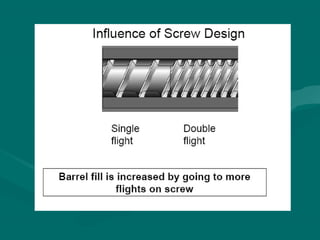
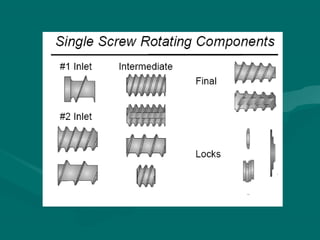

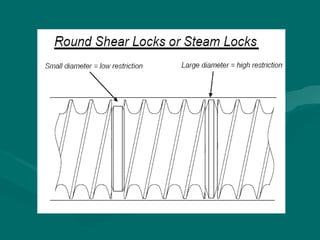
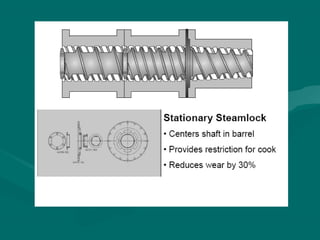


EXTRUSIONEXTRUSION
PROCESSINGPROCESSING
FOR FEEDFOR FEED
By
D DHINGRA
Senior Scientist, CIPHET, LUDHIANA
devinder.dhingra@gmail.com
Phone: 0161-2313121 Fax: 0161-2308670
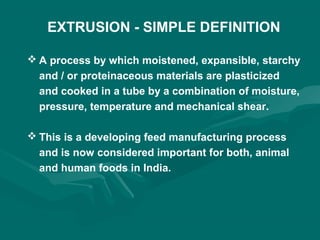
EXTRUSION - SIMPLE DEFINITION
 A process by which moistened, expansible, starchy
and / or proteinaceous materials are plasticized
and cooked in a tube by a combination of moisture,
pressure, temperature and mechanical shear.
 This is a developing feed manufacturing process
and is now considered important for both, animal
and human foods in India.
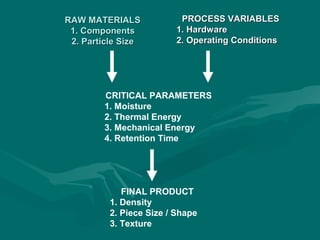
RAW MATERIALSRAW MATERIALS
1. Components1. Components
2. Particle Size2. Particle Size
PROCESS VARIABLESPROCESS VARIABLES
1. Hardware1. Hardware
2. Operating Conditions2. Operating Conditions
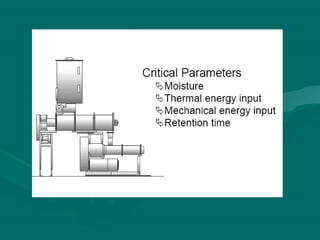
CRITICAL PARAMETERS
1. Moisture
2. Thermal Energy
3. Mechanical Energy
4. Retention Time
FINAL PRODUCT
1. Density
2. Piece Size / Shape
3. Texture
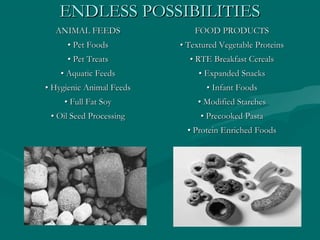
ENDLESS POSSIBILITIESENDLESS POSSIBILITIES
ANIMAL FEEDSANIMAL FEEDS FOOD PRODUCTSFOOD PRODUCTS
•• Pet FoodsPet Foods •• Textured Vegetable ProteinsTextured Vegetable Proteins
•• Pet TreatsPet Treats •• RTE Breakfast CerealsRTE Breakfast Cereals
•• Aquatic FeedsAquatic Feeds •• Expanded SnacksExpanded Snacks
•• Hygienic Animal FeedsHygienic Animal Feeds •• Infant FoodsInfant Foods
•• Full Fat SoyFull Fat Soy •• Modified StarchesModified Starches
•• Oil Seed ProcessingOil Seed Processing •• Precooked PastaPrecooked Pasta
•• Protein Enriched FoodsProtein Enriched Foods
Fundamentals of ExtrusionFundamentals of Extrusion
ProcessingProcessing
Recipe
Product characteristics
Hardware
Raw materials - primaryRaw materials - primary
considerationsconsiderations
Raw materials and their characteristics are always the mostRaw materials and their characteristics are always the most
important extrusion variable.important extrusion variable.
 PARTICLE SIZEPARTICLE SIZE
 PROTEINPROTEIN
 STARCHSTARCH
 LIPIDLIPID
 VITAMINS AND MINERALSVITAMINS AND MINERALS
 OTHERSOTHERS
Benefits of Proper Particle SizeBenefits of Proper Particle Size
Improved product appearanceImproved product appearance
Reduced incidence of plugging of die orificesReduced incidence of plugging of die orifices
Ease of cookingEase of cooking
Reduced product breakage and finesReduced product breakage and fines
Increased water stabilityIncreased water stability
Improved retention of liquid coatings due toImproved retention of liquid coatings due to
small cell structuresmall cell structure
Recipe PreparationRecipe Preparation
1.1. Grind ingredients to proper particle sizeGrind ingredients to proper particle size
2.2. Weigh individual ingredientsWeigh individual ingredients
3.3. Particle size and density of each ingredient should beParticle size and density of each ingredient should be
similarsimilar
4.4. Premix by hand the micro-ingredients (anything less than 1Premix by hand the micro-ingredients (anything less than 1
% of total recipe) and add a carrier (part of a major% of total recipe) and add a carrier (part of a major
ingredient) if necessary to bring premix size up to 3 % ofingredient) if necessary to bring premix size up to 3 % of
total recipetotal recipe
5.5. Add major ingredients, then premix (from #4) to mixer andAdd major ingredients, then premix (from #4) to mixer and
mix for 3-5 minutes. Add any liquids slowly and then mixmix for 3-5 minutes. Add any liquids slowly and then mix
for another 3-5 minutesfor another 3-5 minutes
6.6. Final grind, if requiredFinal grind, if required
7.7. Use sifter and/or magnet to detect and remove foreignUse sifter and/or magnet to detect and remove foreign
materialmaterial
PROTEINPROTEIN
 PLANT SOURCESPLANT SOURCES
–– Soy, Legumes, Wheat/corn glutens, cereal grainsSoy, Legumes, Wheat/corn glutens, cereal grains
 Good functional propertiesGood functional properties
 Lower costLower cost
 Amino acid profile may require supplementationAmino acid profile may require supplementation
 ANIMAL OR MARINE SOURCESANIMAL OR MARINE SOURCES
– Meat, Fish, Poultry, Blood, GelatinMeat, Fish, Poultry, Blood, Gelatin
 Poor functional properties unless fresh or spray driedPoor functional properties unless fresh or spray dried
 Higher costsHigher costs
 Good amino acid profileGood amino acid profile
Benefits of VegetableBenefits of Vegetable
Proteins in FeedsProteins in Feeds
 More expansion potential for floating feedsMore expansion potential for floating feeds
 More binding potential for improved durabilityMore binding potential for improved durability
 Reduced ingredient costsReduced ingredient costs
 Lower incidence of white mineral deposits in screw and die areaLower incidence of white mineral deposits in screw and die area
(phosporous and calcium from fish meal with extra salt)(phosporous and calcium from fish meal with extra salt)
 Higher oil absorption levels possible in coating operationsHigher oil absorption levels possible in coating operations
STARCHSTARCH
• Carbohydrate – energy sourceCarbohydrate – energy source
• Assists expansionAssists expansion
• Improves binding and pellet durabilityImproves binding and pellet durability
• Found in two formsFound in two forms
 AmyloseAmylose
 AmylopectinAmylopectin
• 10 - 60 % levels in feeds10 - 60 % levels in feeds
Effect of Extrusion on StarchEffect of Extrusion on Starch
• Gelatinizes starchGelatinizes starch
• Improves digestibility in most speciesImproves digestibility in most species
• Forms starch-lipid complexesForms starch-lipid complexes
• Increases binding characteristicsIncreases binding characteristics
• Increases susceptibility to enzyme hydrolysisIncreases susceptibility to enzyme hydrolysis
 Protein denatures at 60 - 70Protein denatures at 60 - 70°°
CC
 As protein denatures, it becomes insoluble (non-As protein denatures, it becomes insoluble (non-
functional)functional)
 Starch gelatinizes at 55 - 75Starch gelatinizes at 55 - 75°°
CC
 As starch gelatinizes it becomes solubleAs starch gelatinizes it becomes soluble
Purposes of Fat in FeedsPurposes of Fat in Feeds
 Energy SourceEnergy Source
 Increases Palatability (especially fish oil)Increases Palatability (especially fish oil)
 Provides Essential fatty acidsProvides Essential fatty acids
 Carrier for Fat Soluble VitaminsCarrier for Fat Soluble Vitamins
FAT SOURCESFAT SOURCES
 Animal FatAnimal Fat
 Poultry FatPoultry Fat
 Marine OilsMarine Oils
 Blended Animal and Vegetable FatsBlended Animal and Vegetable Fats
 Feed Grade Vegetable FatsFeed Grade Vegetable Fats
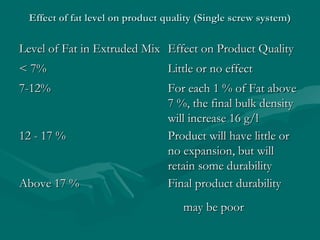
Effect of fat level on product quality (Single screw system)Effect of fat level on product quality (Single screw system)
Level of Fat in Extruded MixLevel of Fat in Extruded Mix Effect on Product QualityEffect on Product Quality
< 7%< 7% Little or no effectLittle or no effect
7-12%7-12% For each 1 % of Fat aboveFor each 1 % of Fat above
7 %, the final bulk density7 %, the final bulk density
will increase 16 g/lwill increase 16 g/l
12 - 17 %12 - 17 % Product will have little orProduct will have little or
no expansion, but willno expansion, but will
retain some durabilityretain some durability
Above 17 %Above 17 % Final product durabilityFinal product durability
may be poormay be poor
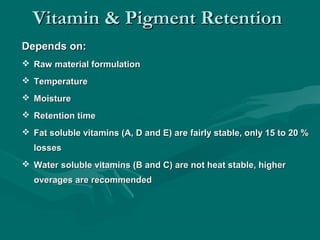
Vitamin & Pigment RetentionVitamin & Pigment Retention
Depends on:Depends on:
 Raw material formulationRaw material formulation
 TemperatureTemperature
 MoistureMoisture
 Retention timeRetention time
 Fat soluble vitamins (A, D and E) are fairly stable, only 15 to 20 %Fat soluble vitamins (A, D and E) are fairly stable, only 15 to 20 %
losseslosses
 Water soluble vitamins (B and C) are not heat stable, higherWater soluble vitamins (B and C) are not heat stable, higher
overages are recommendedoverages are recommended
NEW DEVELOPMENTSNEW DEVELOPMENTS
Aquatic FeedsAquatic Feeds
MARKET SPECIFIC EXTRUDER DESIGNS
EXAMPLE:
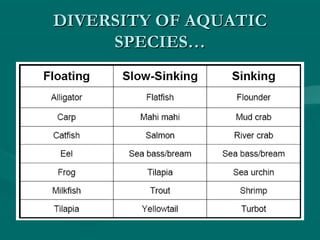
• Aquatic feed systems designed based on regional species being fed
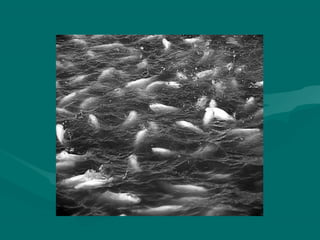
DIVERSITY OF AQUATICDIVERSITY OF AQUATIC
SPECIES…SPECIES…
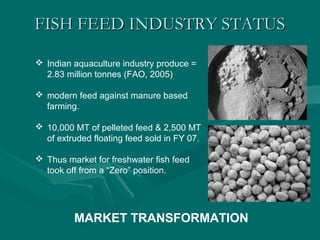
FISH FEED INDUSTRY STATUSFISH FEED INDUSTRY STATUS
 Indian aquaculture industry produce =
2.83 million tonnes (FAO, 2005)
 modern feed against manure based
farming.
 10,000 MT of pelleted feed & 2,500 MT
of extruded floating feed sold in FY 07.
 Thus market for freshwater fish feed
took off from a “Zero” position.
MARKET TRANSFORMATION
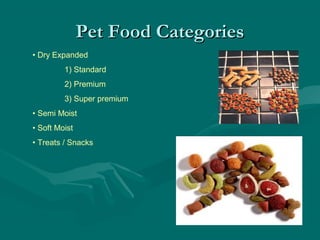
Pet Food CategoriesPet Food Categories
• Dry Expanded
1) Standard
2) Premium
3) Super premium
• Semi Moist
• Soft Moist
• Treats / Snacks
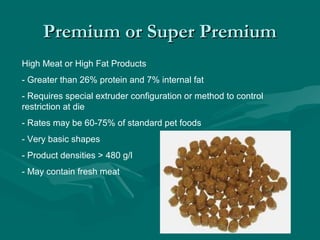
Premium or Super PremiumPremium or Super Premium
High Meat or High Fat Products
- Greater than 26% protein and 7% internal fat
- Requires special extruder configuration or method to control
restriction at die
- Rates may be 60-75% of standard pet foods
- Very basic shapes
- Product densities > 480 g/l
- May contain fresh meat
TYPES OF EXTRUDEDTYPES OF EXTRUDED
PET FOOD TREATSPET FOOD TREATS
1) Expanded Treats
2) Unexpanded Treats
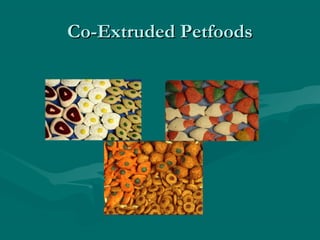
3) Co-extruded Products
4) Textured meat and Vegetable Proteins for Retort-stable Applications
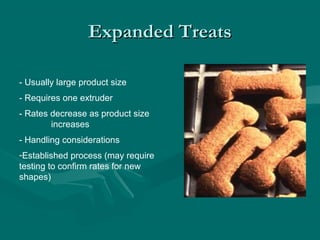
Expanded TreatsExpanded Treats
- Usually large product size
- Requires one extruder
- Rates decrease as product size
increases
- Handling considerations
-Established process (may require
testing to confirm rates for new
shapes)
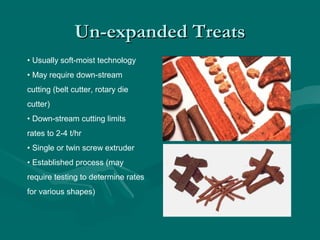
Un-expanded TreatsUn-expanded Treats
• Usually soft-moist technology
• May require down-stream
cutting (belt cutter, rotary die
cutter)
• Down-stream cutting limits
rates to 2-4 t/hr
• Single or twin screw extruder
• Established process (may
require testing to determine rates
for various shapes)
Co-Extruded PetfoodsCo-Extruded Petfoods
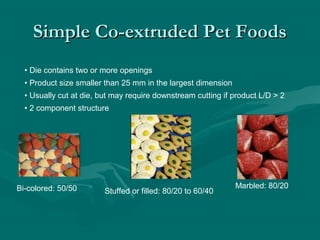
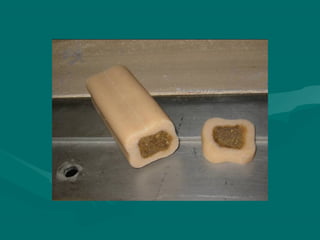
Simple Co-extruded Pet FoodsSimple Co-extruded Pet Foods
• Die contains two or more openings
• Product size smaller than 25 mm in the largest dimension
• Usually cut at die, but may require downstream cutting if product L/D > 2
• 2 component structure
Bi-colored: 50/50 Marbled: 80/20
Stuffed or filled: 80/20 to 60/40
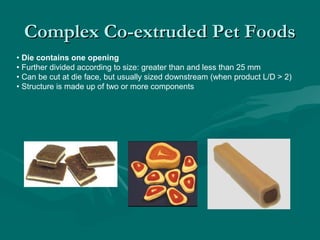
Complex Co-extruded Pet FoodsComplex Co-extruded Pet Foods
• Die contains one opening
• Further divided according to size: greater than and less than 25 mm
• Can be cut at die face, but usually sized downstream (when product L/D > 2)
• Structure is made up of two or more components
NEW DEVELOPMENTS
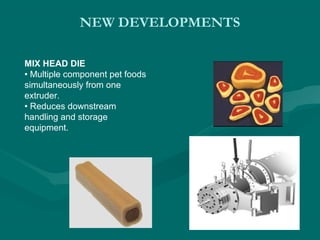
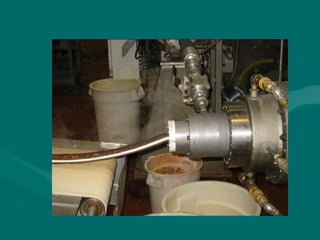
MIX HEAD DIE
• Multiple component pet foods
simultaneously from one
extruder.
• Reduces downstream
handling and storage
equipment.
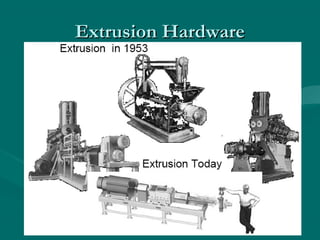
Extrusion HardwareExtrusion Hardware
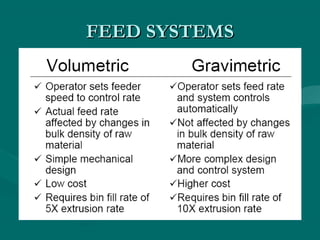
FEED SYSTEMSFEED SYSTEMS
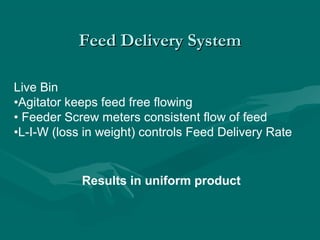
Feed Delivery SystemFeed Delivery System
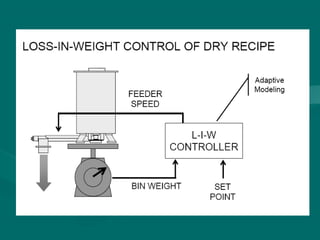
Live Bin
•Agitator keeps feed free flowing
• Feeder Screw meters consistent flow of feed
•L-I-W (loss in weight) controls Feed Delivery Rate
Results in uniform product
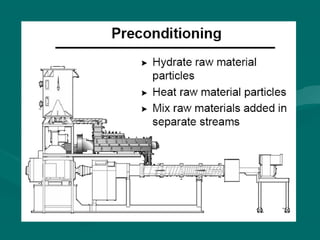
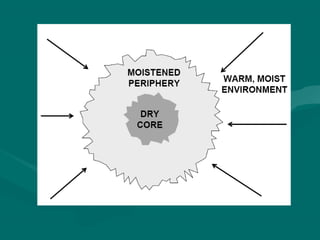
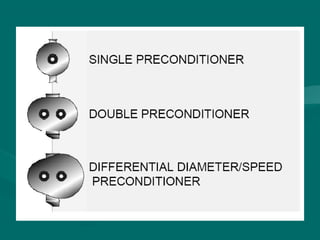
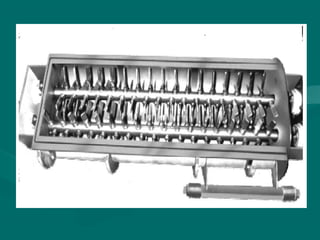
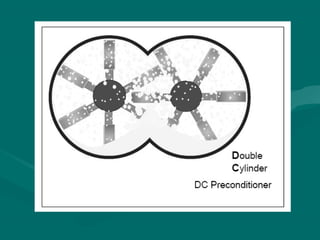
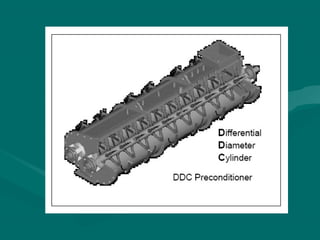
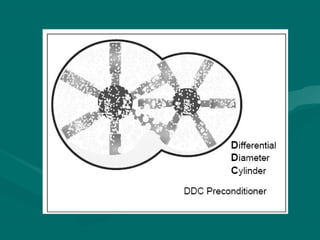
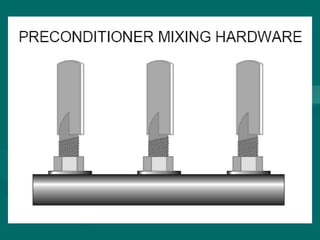
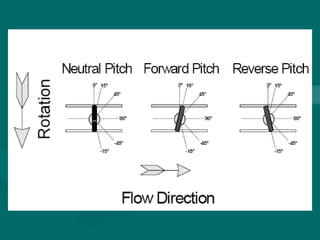
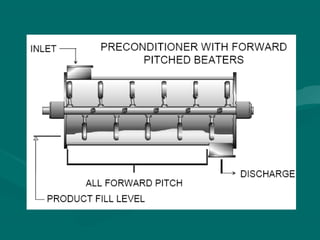
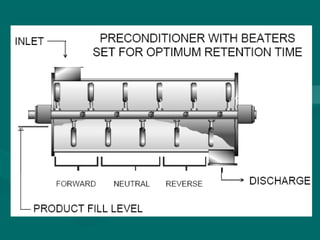
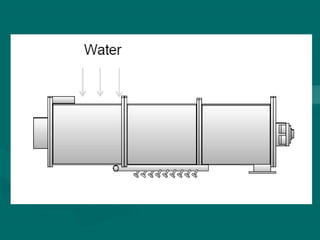
When should preconditioning be consideredWhen should preconditioning be considered
for extrusion?for extrusion?
• Preconditioning not necessary for all extrusion processes
• Any process that benefits from higher moistures and longer
retention times benefits from preconditioning
• As a guideline, consider adding preconditioning to any
process running at greater than 18% in-barrel moisture
content
BENEFITS OF EXTRUSION
• Versatile range of final products
• Ingredient flexibility
• Food safety
• Controllable final product density
– Floating, sinking or slow sinking feeds
• Improved FCR values
• Less pollution of ponds
Extrusion processing for feed

Extrusion processing for feed

  • 1.
    EXTRUSIONEXTRUSION PROCESSINGPROCESSING FOR FEEDFOR FEED By DDHINGRA Senior Scientist, CIPHET, LUDHIANA devinder.dhingra@gmail.com Phone: 0161-2313121 Fax: 0161-2308670
  • 2.
    EXTRUSION - SIMPLEDEFINITION  A process by which moistened, expansible, starchy and / or proteinaceous materials are plasticized and cooked in a tube by a combination of moisture, pressure, temperature and mechanical shear.  This is a developing feed manufacturing process and is now considered important for both, animal and human foods in India.
  • 3.
    RAW MATERIALSRAW MATERIALS 1.Components1. Components 2. Particle Size2. Particle Size PROCESS VARIABLESPROCESS VARIABLES 1. Hardware1. Hardware 2. Operating Conditions2. Operating Conditions CRITICAL PARAMETERS 1. Moisture 2. Thermal Energy 3. Mechanical Energy 4. Retention Time FINAL PRODUCT 1. Density 2. Piece Size / Shape 3. Texture
  • 4.
    ENDLESS POSSIBILITIESENDLESS POSSIBILITIES ANIMALFEEDSANIMAL FEEDS FOOD PRODUCTSFOOD PRODUCTS •• Pet FoodsPet Foods •• Textured Vegetable ProteinsTextured Vegetable Proteins •• Pet TreatsPet Treats •• RTE Breakfast CerealsRTE Breakfast Cereals •• Aquatic FeedsAquatic Feeds •• Expanded SnacksExpanded Snacks •• Hygienic Animal FeedsHygienic Animal Feeds •• Infant FoodsInfant Foods •• Full Fat SoyFull Fat Soy •• Modified StarchesModified Starches •• Oil Seed ProcessingOil Seed Processing •• Precooked PastaPrecooked Pasta •• Protein Enriched FoodsProtein Enriched Foods
  • 5.
    Fundamentals of ExtrusionFundamentalsof Extrusion ProcessingProcessing Recipe Product characteristics Hardware
  • 6.
    Raw materials -primaryRaw materials - primary considerationsconsiderations Raw materials and their characteristics are always the mostRaw materials and their characteristics are always the most important extrusion variable.important extrusion variable.  PARTICLE SIZEPARTICLE SIZE  PROTEINPROTEIN  STARCHSTARCH  LIPIDLIPID  VITAMINS AND MINERALSVITAMINS AND MINERALS  OTHERSOTHERS
  • 7.
    Benefits of ProperParticle SizeBenefits of Proper Particle Size Improved product appearanceImproved product appearance Reduced incidence of plugging of die orificesReduced incidence of plugging of die orifices Ease of cookingEase of cooking Reduced product breakage and finesReduced product breakage and fines Increased water stabilityIncreased water stability Improved retention of liquid coatings due toImproved retention of liquid coatings due to small cell structuresmall cell structure
  • 8.
    Recipe PreparationRecipe Preparation 1.1.Grind ingredients to proper particle sizeGrind ingredients to proper particle size 2.2. Weigh individual ingredientsWeigh individual ingredients 3.3. Particle size and density of each ingredient should beParticle size and density of each ingredient should be similarsimilar 4.4. Premix by hand the micro-ingredients (anything less than 1Premix by hand the micro-ingredients (anything less than 1 % of total recipe) and add a carrier (part of a major% of total recipe) and add a carrier (part of a major ingredient) if necessary to bring premix size up to 3 % ofingredient) if necessary to bring premix size up to 3 % of total recipetotal recipe 5.5. Add major ingredients, then premix (from #4) to mixer andAdd major ingredients, then premix (from #4) to mixer and mix for 3-5 minutes. Add any liquids slowly and then mixmix for 3-5 minutes. Add any liquids slowly and then mix for another 3-5 minutesfor another 3-5 minutes 6.6. Final grind, if requiredFinal grind, if required 7.7. Use sifter and/or magnet to detect and remove foreignUse sifter and/or magnet to detect and remove foreign materialmaterial
  • 9.
    PROTEINPROTEIN  PLANT SOURCESPLANTSOURCES –– Soy, Legumes, Wheat/corn glutens, cereal grainsSoy, Legumes, Wheat/corn glutens, cereal grains  Good functional propertiesGood functional properties  Lower costLower cost  Amino acid profile may require supplementationAmino acid profile may require supplementation  ANIMAL OR MARINE SOURCESANIMAL OR MARINE SOURCES – Meat, Fish, Poultry, Blood, GelatinMeat, Fish, Poultry, Blood, Gelatin  Poor functional properties unless fresh or spray driedPoor functional properties unless fresh or spray dried  Higher costsHigher costs  Good amino acid profileGood amino acid profile
  • 10.
    Benefits of VegetableBenefitsof Vegetable Proteins in FeedsProteins in Feeds  More expansion potential for floating feedsMore expansion potential for floating feeds  More binding potential for improved durabilityMore binding potential for improved durability  Reduced ingredient costsReduced ingredient costs  Lower incidence of white mineral deposits in screw and die areaLower incidence of white mineral deposits in screw and die area (phosporous and calcium from fish meal with extra salt)(phosporous and calcium from fish meal with extra salt)  Higher oil absorption levels possible in coating operationsHigher oil absorption levels possible in coating operations
  • 11.
    STARCHSTARCH • Carbohydrate –energy sourceCarbohydrate – energy source • Assists expansionAssists expansion • Improves binding and pellet durabilityImproves binding and pellet durability • Found in two formsFound in two forms  AmyloseAmylose  AmylopectinAmylopectin • 10 - 60 % levels in feeds10 - 60 % levels in feeds
  • 12.
    Effect of Extrusionon StarchEffect of Extrusion on Starch • Gelatinizes starchGelatinizes starch • Improves digestibility in most speciesImproves digestibility in most species • Forms starch-lipid complexesForms starch-lipid complexes • Increases binding characteristicsIncreases binding characteristics • Increases susceptibility to enzyme hydrolysisIncreases susceptibility to enzyme hydrolysis
  • 13.
     Protein denaturesat 60 - 70Protein denatures at 60 - 70°° CC  As protein denatures, it becomes insoluble (non-As protein denatures, it becomes insoluble (non- functional)functional)  Starch gelatinizes at 55 - 75Starch gelatinizes at 55 - 75°° CC  As starch gelatinizes it becomes solubleAs starch gelatinizes it becomes soluble
  • 14.
    Purposes of Fatin FeedsPurposes of Fat in Feeds  Energy SourceEnergy Source  Increases Palatability (especially fish oil)Increases Palatability (especially fish oil)  Provides Essential fatty acidsProvides Essential fatty acids  Carrier for Fat Soluble VitaminsCarrier for Fat Soluble Vitamins
  • 15.
    FAT SOURCESFAT SOURCES Animal FatAnimal Fat  Poultry FatPoultry Fat  Marine OilsMarine Oils  Blended Animal and Vegetable FatsBlended Animal and Vegetable Fats  Feed Grade Vegetable FatsFeed Grade Vegetable Fats
  • 16.
    Effect of fatlevel on product quality (Single screw system)Effect of fat level on product quality (Single screw system) Level of Fat in Extruded MixLevel of Fat in Extruded Mix Effect on Product QualityEffect on Product Quality < 7%< 7% Little or no effectLittle or no effect 7-12%7-12% For each 1 % of Fat aboveFor each 1 % of Fat above 7 %, the final bulk density7 %, the final bulk density will increase 16 g/lwill increase 16 g/l 12 - 17 %12 - 17 % Product will have little orProduct will have little or no expansion, but willno expansion, but will retain some durabilityretain some durability Above 17 %Above 17 % Final product durabilityFinal product durability may be poormay be poor
  • 17.
    Vitamin & PigmentRetentionVitamin & Pigment Retention Depends on:Depends on:  Raw material formulationRaw material formulation  TemperatureTemperature  MoistureMoisture  Retention timeRetention time  Fat soluble vitamins (A, D and E) are fairly stable, only 15 to 20 %Fat soluble vitamins (A, D and E) are fairly stable, only 15 to 20 % losseslosses  Water soluble vitamins (B and C) are not heat stable, higherWater soluble vitamins (B and C) are not heat stable, higher overages are recommendedoverages are recommended
  • 18.
    NEW DEVELOPMENTSNEW DEVELOPMENTS AquaticFeedsAquatic Feeds MARKET SPECIFIC EXTRUDER DESIGNS EXAMPLE: • Aquatic feed systems designed based on regional species being fed
  • 19.
    DIVERSITY OF AQUATICDIVERSITYOF AQUATIC SPECIES…SPECIES…
  • 21.
    FISH FEED INDUSTRYSTATUSFISH FEED INDUSTRY STATUS  Indian aquaculture industry produce = 2.83 million tonnes (FAO, 2005)  modern feed against manure based farming.  10,000 MT of pelleted feed & 2,500 MT of extruded floating feed sold in FY 07.  Thus market for freshwater fish feed took off from a “Zero” position. MARKET TRANSFORMATION
  • 22.
    Pet Food CategoriesPetFood Categories • Dry Expanded 1) Standard 2) Premium 3) Super premium • Semi Moist • Soft Moist • Treats / Snacks
  • 23.
    Premium or SuperPremiumPremium or Super Premium High Meat or High Fat Products - Greater than 26% protein and 7% internal fat - Requires special extruder configuration or method to control restriction at die - Rates may be 60-75% of standard pet foods - Very basic shapes - Product densities > 480 g/l - May contain fresh meat
  • 24.
    TYPES OF EXTRUDEDTYPESOF EXTRUDED PET FOOD TREATSPET FOOD TREATS 1) Expanded Treats 2) Unexpanded Treats 3) Co-extruded Products 4) Textured meat and Vegetable Proteins for Retort-stable Applications
  • 25.
    Expanded TreatsExpanded Treats -Usually large product size - Requires one extruder - Rates decrease as product size increases - Handling considerations -Established process (may require testing to confirm rates for new shapes)
  • 26.
    Un-expanded TreatsUn-expanded Treats •Usually soft-moist technology • May require down-stream cutting (belt cutter, rotary die cutter) • Down-stream cutting limits rates to 2-4 t/hr • Single or twin screw extruder • Established process (may require testing to determine rates for various shapes)
  • 29.
  • 30.
    Simple Co-extruded PetFoodsSimple Co-extruded Pet Foods • Die contains two or more openings • Product size smaller than 25 mm in the largest dimension • Usually cut at die, but may require downstream cutting if product L/D > 2 • 2 component structure Bi-colored: 50/50 Marbled: 80/20 Stuffed or filled: 80/20 to 60/40
  • 31.
    Complex Co-extruded PetFoodsComplex Co-extruded Pet Foods • Die contains one opening • Further divided according to size: greater than and less than 25 mm • Can be cut at die face, but usually sized downstream (when product L/D > 2) • Structure is made up of two or more components
  • 32.
    NEW DEVELOPMENTS MIX HEADDIE • Multiple component pet foods simultaneously from one extruder. • Reduces downstream handling and storage equipment.
  • 36.
  • 38.
  • 39.
    Feed Delivery SystemFeedDelivery System Live Bin •Agitator keeps feed free flowing • Feeder Screw meters consistent flow of feed •L-I-W (loss in weight) controls Feed Delivery Rate Results in uniform product
  • 42.
    When should preconditioningbe consideredWhen should preconditioning be considered for extrusion?for extrusion? • Preconditioning not necessary for all extrusion processes • Any process that benefits from higher moistures and longer retention times benefits from preconditioning • As a guideline, consider adding preconditioning to any process running at greater than 18% in-barrel moisture content
  • 88.
    BENEFITS OF EXTRUSION •Versatile range of final products • Ingredient flexibility • Food safety • Controllable final product density – Floating, sinking or slow sinking feeds • Improved FCR values • Less pollution of ponds