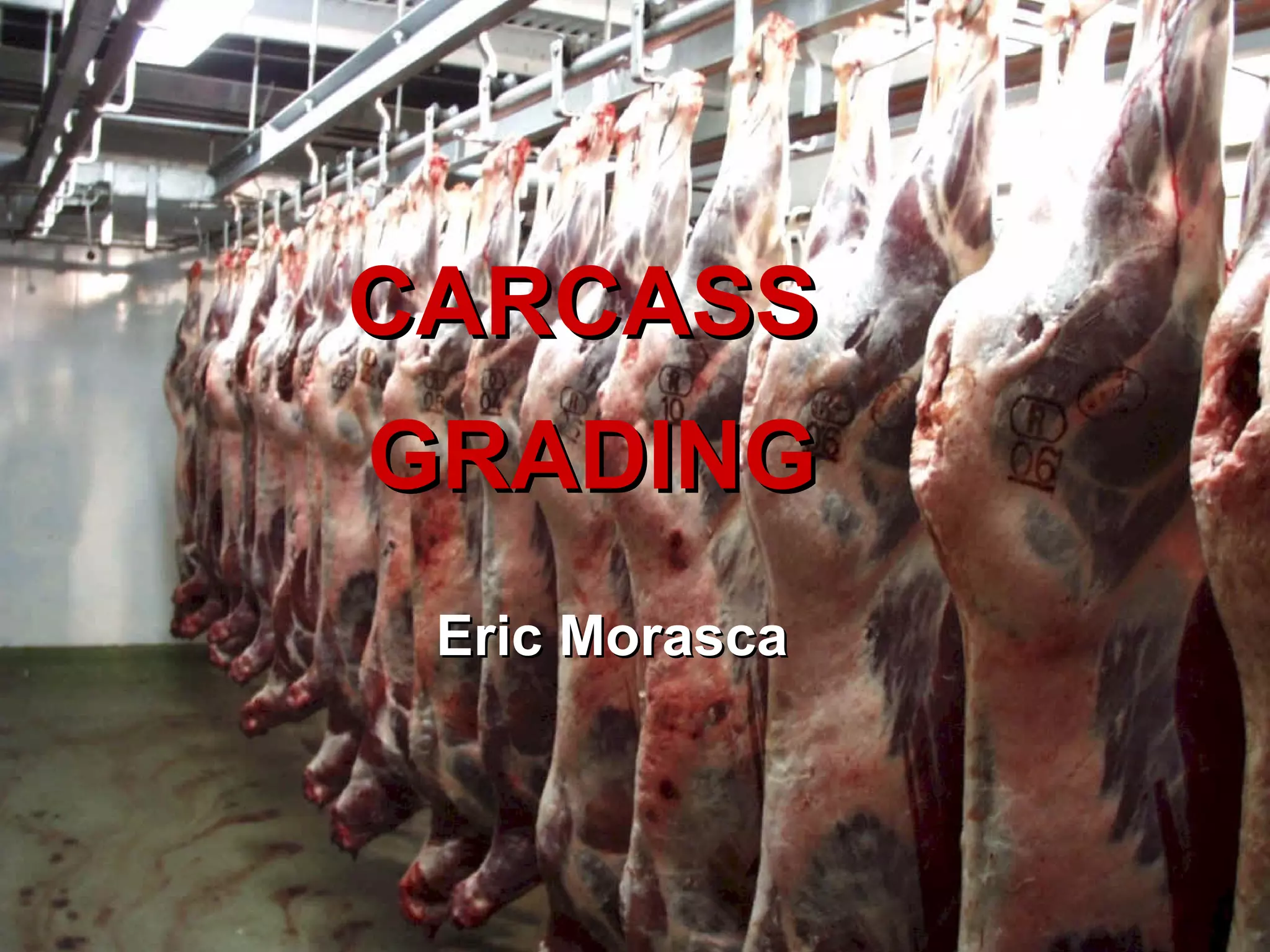
Compilation: Agricultural Education & Communication Department, California For more veterinary stuff visit www.techyvety.com CARCASS  GRADING   Eric Morasca
CARCASS EVALUATION Evaluation of beef quality and composition is important to cattle producers, meat packers and retailers, and consumers.  Consumers desire cuts of beef that are lean, nutritious, and possess desirable eating characteristics.  Meat researchers have developed reliable methods for measuring the factors that influence eating characteristics and factors affecting yield of lean cuts.  Using these evaluation techniques, producers and packers can produce and sell carcasses that meet consumer demand.  Compilation: Agricultural Education & Communication Department, California For more veterinary stuff visit www.techyvety.com
THE PURPOSE OF EVALUATION IS TO ASSIST PRODUCERS IN: Producing high-quality beef carcasses  Producing high-yielding beef carcasses  Identifying superior lines of breeding stock  Promoting a desirable, marketable product.  Compilation: Agricultural Education & Communication Department, California For more veterinary stuff visit www.techyvety.com
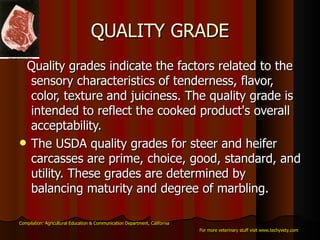
QUALITY GRADE Quality grades indicate the factors related to the sensory characteristics of tenderness, flavor, color, texture and juiciness. The quality grade is intended to reflect the cooked product's overall acceptability.  The USDA quality grades for steer and heifer carcasses are prime, choice, good, standard, and utility. These grades are determined by balancing maturity and degree of marbling. Compilation: Agricultural Education & Communication Department, California For more veterinary stuff visit www.techyvety.com
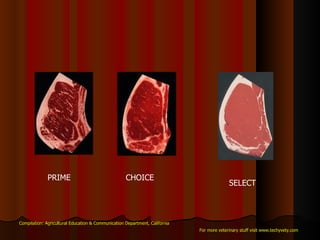
Compilation: Agricultural Education & Communication Department, California For more veterinary stuff visit www.techyvety.com PRIME CHOICE SELECT
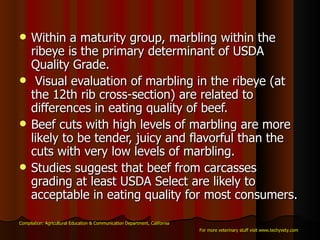
Within a maturity group, marbling within the ribeye is the primary determinant of USDA Quality Grade.  Visual evaluation of marbling in the ribeye (at the 12th rib cross-section) are related to differences in eating quality of beef.   Beef cuts with high levels of marbling are more likely to be tender, juicy and flavorful than the cuts with very low levels of marbling.   Studies suggest that beef from carcasses grading at least USDA Select are likely to acceptable in eating quality for most consumers.  Compilation: Agricultural Education & Communication Department, California For more veterinary stuff visit www.techyvety.com
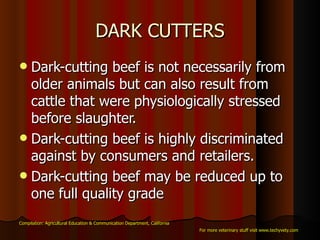
DARK CUTTERS Dark-cutting beef is not necessarily from older animals but can also result from cattle that were physiologically stressed before slaughter.  Dark-cutting beef is highly discriminated against by consumers and retailers.  Dark-cutting beef may be reduced up to one full quality grade  Compilation: Agricultural Education & Communication Department, California For more veterinary stuff visit www.techyvety.com
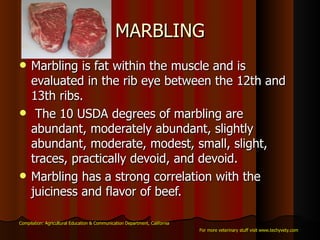
MARBLING Marbling is fat within the muscle and is evaluated in the rib eye between the 12th and 13th ribs. The 10 USDA degrees of marbling are abundant, moderately abundant, slightly abundant, moderate, modest, small, slight, traces, practically devoid, and devoid.  Marbling has a strong correlation with the juiciness and flavor of beef.  Compilation: Agricultural Education & Communication Department, California For more veterinary stuff visit www.techyvety.com
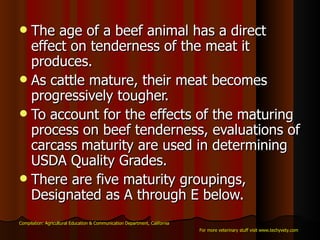
The age of a beef animal has a direct effect on tenderness of the meat it produces.   As cattle mature, their meat becomes progressively tougher.  To account for the effects of the maturing process on beef tenderness, evaluations of carcass maturity are used in determining USDA Quality Grades.   There are five maturity groupings, Designated as A through E below.  Compilation: Agricultural Education & Communication Department, California For more veterinary stuff visit www.techyvety.com
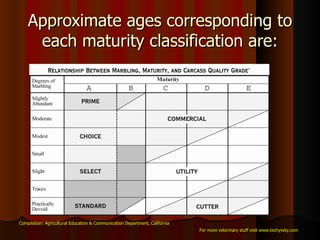
Approximate ages corresponding to each maturity classification are:  A - 9 to 30 Months  B - 30 to 42 Months  C - 42 to 72 Months  D - 72 to 96 Months  E - More Than 96 Months  Compilation: Agricultural Education & Communication Department, California For more veterinary stuff visit www.techyvety.com
Approximate ages corresponding to each maturity classification are: Compilation: Agricultural Education & Communication Department, California For more veterinary stuff visit www.techyvety.com
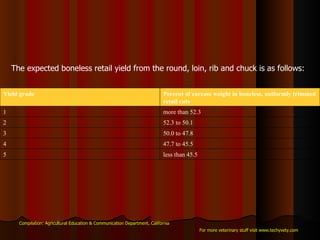
YIELD GRADES Yield grades estimate the quantity or the amount of closely trimmed boneless retail cuts from the loin, round, chuck and rib. There are five USDA yield grades, 1 through 5.  Yield grade 1 carcasses have the highest yield of retail cuts and yield grade 5, the lowest  Compilation: Agricultural Education & Communication Department, California For more veterinary stuff visit www.techyvety.com
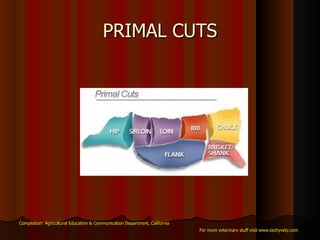
PRIMAL CUTS Compilation: Agricultural Education & Communication Department, California For more veterinary stuff visit www.techyvety.com
Compilation: Agricultural Education & Communication Department, California For more veterinary stuff visit www.techyvety.com The expected boneless retail yield from the round, loin, rib and chuck is as follows:  Yield grade Percent of carcass weight in boneless, uniformly trimmed retail cuts 1 more than 52.3 2 52.3 to 50.1 3 50.0 to 47.8 4 47.7 to 45.5 5 less than 45.5
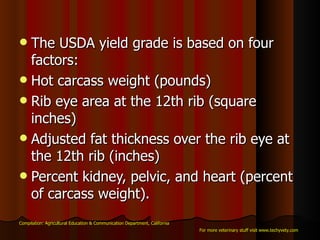
The USDA yield grade is based on four factors:  Hot carcass weight (pounds)  Rib eye area at the 12th rib (square inches)  Adjusted fat thickness over the rib eye at the 12th rib (inches)  Percent kidney, pelvic, and heart (percent of carcass weight).  Compilation: Agricultural Education & Communication Department, California For more veterinary stuff visit www.techyvety.com
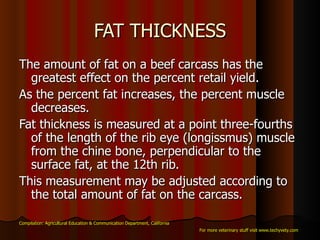
FAT THICKNESS The amount of fat on a beef carcass has the greatest effect on the percent retail yield.  As the percent fat increases, the percent muscle decreases.  Fat thickness is measured at a point three-fourths of the length of the rib eye (longissmus) muscle from the chine bone, perpendicular to the surface fat, at the 12th rib.  This measurement may be adjusted according to the total amount of fat on the carcass.  Compilation: Agricultural Education & Communication Department, California For more veterinary stuff visit www.techyvety.com
Percentage of Kidney, Pelvic and Heart Fat (KPH). This is a subjective estimate of the amount of fat surrounding the kidney knob, and fat in the pelvic and thoracic (heart) areas as a percentage of the carcass weight.  As the percentage of KPH fat increases, the percentage of retail cuts decreases.  Percentage KPH fat normally ranges from 1.0 to 4.0 percent.   Compilation: Agricultural Education & Communication Department, California For more veterinary stuff visit www.techyvety.com
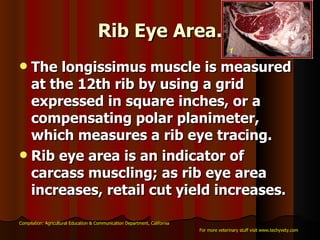
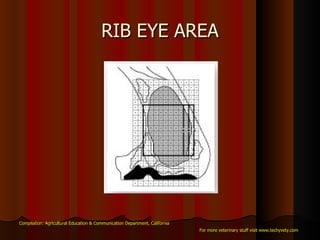
Rib Eye Area. The longissimus muscle is measured at the 12th rib by using a grid expressed in square inches, or a compensating polar planimeter, which measures a rib eye tracing.  Rib eye area is an indicator of carcass muscling; as rib eye area increases, retail cut yield increases.   Compilation: Agricultural Education & Communication Department, California For more veterinary stuff visit www.techyvety.com
RIB EYE AREA Compilation: Agricultural Education & Communication Department, California For more veterinary stuff visit www.techyvety.com
Hot Carcass Weight. Generally, as carcass weight increases, the percentage of retail cuts decreases slightly due to increased fat deposition.  If only chilled carcass weight is available, it can be adjusted to hot carcass weight by multiplying by 1.02 to correct for the evaporative weight loss of the carcass in the cooler.   Compilation: Agricultural Education & Communication Department, California For more veterinary stuff visit www.techyvety.com
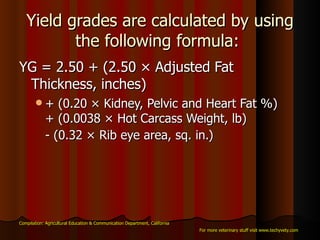
Yield grades are calculated by using the following formula:  YG = 2.50 + (2.50 × Adjusted Fat Thickness, inches)  + (0.20 × Kidney, Pelvic and Heart Fat %) + (0.0038 × Hot Carcass Weight, lb) - (0.32 × Rib eye area, sq. in.)   Compilation: Agricultural Education & Communication Department, California For more veterinary stuff visit www.techyvety.com
SOURCES http://ianrpubs.unl.edu/beef http://muextension.missouri.edu http://www.bovineengineering.com Compilation: Agricultural Education & Communication Department, California For more veterinary stuff visit www.techyvety.com

Carcass grading

  • 1.
    Compilation: Agricultural Education& Communication Department, California For more veterinary stuff visit www.techyvety.com CARCASS GRADING Eric Morasca
  • 2.
    CARCASS EVALUATION Evaluationof beef quality and composition is important to cattle producers, meat packers and retailers, and consumers. Consumers desire cuts of beef that are lean, nutritious, and possess desirable eating characteristics. Meat researchers have developed reliable methods for measuring the factors that influence eating characteristics and factors affecting yield of lean cuts. Using these evaluation techniques, producers and packers can produce and sell carcasses that meet consumer demand. Compilation: Agricultural Education & Communication Department, California For more veterinary stuff visit www.techyvety.com
  • 3.
    THE PURPOSE OFEVALUATION IS TO ASSIST PRODUCERS IN: Producing high-quality beef carcasses Producing high-yielding beef carcasses Identifying superior lines of breeding stock Promoting a desirable, marketable product. Compilation: Agricultural Education & Communication Department, California For more veterinary stuff visit www.techyvety.com
  • 4.
    QUALITY GRADE Qualitygrades indicate the factors related to the sensory characteristics of tenderness, flavor, color, texture and juiciness. The quality grade is intended to reflect the cooked product's overall acceptability. The USDA quality grades for steer and heifer carcasses are prime, choice, good, standard, and utility. These grades are determined by balancing maturity and degree of marbling. Compilation: Agricultural Education & Communication Department, California For more veterinary stuff visit www.techyvety.com
  • 5.
    Compilation: Agricultural Education& Communication Department, California For more veterinary stuff visit www.techyvety.com PRIME CHOICE SELECT
  • 6.
    Within a maturitygroup, marbling within the ribeye is the primary determinant of USDA Quality Grade.  Visual evaluation of marbling in the ribeye (at the 12th rib cross-section) are related to differences in eating quality of beef.  Beef cuts with high levels of marbling are more likely to be tender, juicy and flavorful than the cuts with very low levels of marbling.  Studies suggest that beef from carcasses grading at least USDA Select are likely to acceptable in eating quality for most consumers. Compilation: Agricultural Education & Communication Department, California For more veterinary stuff visit www.techyvety.com
  • 7.
    DARK CUTTERS Dark-cuttingbeef is not necessarily from older animals but can also result from cattle that were physiologically stressed before slaughter. Dark-cutting beef is highly discriminated against by consumers and retailers. Dark-cutting beef may be reduced up to one full quality grade Compilation: Agricultural Education & Communication Department, California For more veterinary stuff visit www.techyvety.com
  • 8.
    MARBLING Marbling isfat within the muscle and is evaluated in the rib eye between the 12th and 13th ribs. The 10 USDA degrees of marbling are abundant, moderately abundant, slightly abundant, moderate, modest, small, slight, traces, practically devoid, and devoid. Marbling has a strong correlation with the juiciness and flavor of beef. Compilation: Agricultural Education & Communication Department, California For more veterinary stuff visit www.techyvety.com
  • 9.
    The age ofa beef animal has a direct effect on tenderness of the meat it produces.  As cattle mature, their meat becomes progressively tougher. To account for the effects of the maturing process on beef tenderness, evaluations of carcass maturity are used in determining USDA Quality Grades.  There are five maturity groupings, Designated as A through E below. Compilation: Agricultural Education & Communication Department, California For more veterinary stuff visit www.techyvety.com
  • 10.
    Approximate ages correspondingto each maturity classification are: A - 9 to 30 Months B - 30 to 42 Months C - 42 to 72 Months D - 72 to 96 Months E - More Than 96 Months Compilation: Agricultural Education & Communication Department, California For more veterinary stuff visit www.techyvety.com
  • 11.
    Approximate ages correspondingto each maturity classification are: Compilation: Agricultural Education & Communication Department, California For more veterinary stuff visit www.techyvety.com
  • 12.
    YIELD GRADES Yieldgrades estimate the quantity or the amount of closely trimmed boneless retail cuts from the loin, round, chuck and rib. There are five USDA yield grades, 1 through 5. Yield grade 1 carcasses have the highest yield of retail cuts and yield grade 5, the lowest Compilation: Agricultural Education & Communication Department, California For more veterinary stuff visit www.techyvety.com
  • 13.
    PRIMAL CUTS Compilation:Agricultural Education & Communication Department, California For more veterinary stuff visit www.techyvety.com
  • 14.
    Compilation: Agricultural Education& Communication Department, California For more veterinary stuff visit www.techyvety.com The expected boneless retail yield from the round, loin, rib and chuck is as follows: Yield grade Percent of carcass weight in boneless, uniformly trimmed retail cuts 1 more than 52.3 2 52.3 to 50.1 3 50.0 to 47.8 4 47.7 to 45.5 5 less than 45.5
  • 15.
    The USDA yieldgrade is based on four factors: Hot carcass weight (pounds) Rib eye area at the 12th rib (square inches) Adjusted fat thickness over the rib eye at the 12th rib (inches) Percent kidney, pelvic, and heart (percent of carcass weight). Compilation: Agricultural Education & Communication Department, California For more veterinary stuff visit www.techyvety.com
  • 16.
    FAT THICKNESS Theamount of fat on a beef carcass has the greatest effect on the percent retail yield. As the percent fat increases, the percent muscle decreases. Fat thickness is measured at a point three-fourths of the length of the rib eye (longissmus) muscle from the chine bone, perpendicular to the surface fat, at the 12th rib. This measurement may be adjusted according to the total amount of fat on the carcass. Compilation: Agricultural Education & Communication Department, California For more veterinary stuff visit www.techyvety.com
  • 17.
    Percentage of Kidney,Pelvic and Heart Fat (KPH). This is a subjective estimate of the amount of fat surrounding the kidney knob, and fat in the pelvic and thoracic (heart) areas as a percentage of the carcass weight. As the percentage of KPH fat increases, the percentage of retail cuts decreases. Percentage KPH fat normally ranges from 1.0 to 4.0 percent. Compilation: Agricultural Education & Communication Department, California For more veterinary stuff visit www.techyvety.com
  • 18.
    Rib Eye Area.The longissimus muscle is measured at the 12th rib by using a grid expressed in square inches, or a compensating polar planimeter, which measures a rib eye tracing. Rib eye area is an indicator of carcass muscling; as rib eye area increases, retail cut yield increases. Compilation: Agricultural Education & Communication Department, California For more veterinary stuff visit www.techyvety.com
  • 19.
    RIB EYE AREACompilation: Agricultural Education & Communication Department, California For more veterinary stuff visit www.techyvety.com
  • 20.
    Hot Carcass Weight.Generally, as carcass weight increases, the percentage of retail cuts decreases slightly due to increased fat deposition. If only chilled carcass weight is available, it can be adjusted to hot carcass weight by multiplying by 1.02 to correct for the evaporative weight loss of the carcass in the cooler. Compilation: Agricultural Education & Communication Department, California For more veterinary stuff visit www.techyvety.com
  • 21.
    Yield grades arecalculated by using the following formula: YG = 2.50 + (2.50 × Adjusted Fat Thickness, inches) + (0.20 × Kidney, Pelvic and Heart Fat %) + (0.0038 × Hot Carcass Weight, lb) - (0.32 × Rib eye area, sq. in.) Compilation: Agricultural Education & Communication Department, California For more veterinary stuff visit www.techyvety.com
  • 22.
    SOURCES http://ianrpubs.unl.edu/beef http://muextension.missouri.eduhttp://www.bovineengineering.com Compilation: Agricultural Education & Communication Department, California For more veterinary stuff visit www.techyvety.com