Chef Iyer, IHMCTAN, Mumbai 1 
MMMeeeaaattt cccooooookkkeeerrryyy The beef consumed through out the world today comes from domesticated cattle developed over thousands of years. In Europe, beef was never as plentiful as other meats. Beef was a food of the very wealthy. „Turnip Townsend‟ was partially responsible for making beef more readily available in England and later in Europe. Lord Townsend conducted an experiment which showed that livestock could be kept alive in the winter by being fed turnips. These efforts later inspired Robert Bakewell to become England‟s first commercial stockbreeder. By the eighteenth century, this interest in raising and breeding livestock, along with English people‟s natural liking of beef, gave England a reputation as a nation of beef eaters. Meat is usually accepted as being the most important food purchased by the caterers due to two main reasons: 
1. It is normally the central focus of a meal and its selection determines the other foods that will be served. 
2. It is common for 40-60% of the total expenditure on food to be spent on meat. 
„Meat‟ is defined as any part of a bovine (beef type animal), pig, sheep, goat, horse, ass or mule that is fit for human consumption. The general term meat includes carcass meat, often in the form of joints, offal such as liver, kidneys, etc and processed meats such as pickled beef, hamburgers, sausages, etc. Meat may be classified in seven different ways: 
1. By the type of animal (beef, veal, pork, lamb, mutton, etc.). 
2. By the country of origin (Scotland, New Zealand, Australia, etc.). 
3. By the age andor sex of the animal (steer beef, bull beef, cow beef, lamb, mutton, etc.). 
4. The grade of meat (New Zealand lamb of high quality sold by the grade of pH). 
5. By the particular cut of meat (sirloin of beef, saddle of lamb, etc.). 
6. By the condition of the meat (fresh, chilled, frozen, pickled, etc.). 
7. By their catering uses (suitable for roasting, frying, grilling, boiling, etc.). 
BREEDS OF ANIMALS The worldwide increase in the demand for meat has resulted in newer breeds of animals becoming established as meat. The new breeds of animals are those which in the main are suitable for being reared by intensive farming methods, capable of consistently producing meat of a specific quality and weight range, having a high meat to bone ratio and a high conversion rate (i.e. the efficiency by which the animals convert the intake of foodstuffs into an increase in their body weight). The new breed of animals produced have to meet the demands of the caterer, general public and food processor as meat of a consistently high quality with a low fat content and at a reasonable price is required. THE SLAUGHTER OF ANIMALS The slaughter of animals which are for sale for human consumption is rigidly controlled by the law to ensure that the animal suffers no pain at all, that the method of slaughtering and subsequent preparation of the carcasses takes place under hygienic conditions in licensed slaughter houses and that the meat is inspected by authorized officers and found to be fit before being permitted to be sold for human consumption. The slaughtering of animals is in five main stages- 
1. Anti-mortem inspection Animals to be slaughtered are brought to the slaughter house and kept usually for a minimum of 24 to72hrs (1-3days). This resting has a beneficial effect on the quality of the dressed carcass. The inspection of each animal is done to identify any signs of disease, injury, distress, etc, prior to the animal being slaughtered. 
2. Stunning Fit animals are taken into the slaughter house and individually stunned by one of the following methods- 
a) Captive Bolt This is the stunning of the animal by the captive bolt pistol and is used for large animals such as bovines and large male pigs. Bovines are also pitted to minimize any subsequent reflex muscular action which could take place during the sticking and dressing of the carcass. Pitting is done by inserting a thin, long rod through a hole made in the skull by the bolt which has the effect of destroying the part of the brain which controls the reflexes. 
b) Electrical Stunning This method is the passing of a small current of electricity through the brain of small
2 Chef Iyer, IHMCTAN, Mumbai 
animals such as baby calves, pigs and sheep for at least 7 seconds. This method renders the animal unconscious for upto 1 ½ minutes. 
c) Carbon dioxide stunning This method is used for stunning pigs. The pigs are placed on a moving platform which passes through a tunnel containing a mixture of CO2 and air and renders the pigs unconscious. The particular benefit of this method is that subsequent bleeding of the animal is more efficient. Co2 stunning is not carried out for sheep and other type of animals having lots of fur, as Co2 being a heavy gas might get trapped inside the thick layer of fur and people handling the animals for further procedures may inhale the trapped Co2, and can be fatal. 
3. Bleeding of the animal After the animal has been stunned it is bled by making a small incision along the side of the neck and cutting the main blood vessels. The animal is usually hung up by the hind legs during this stage. It is important that as much blood as possible should be removed from the body after death as blood is an ideal medium for the growth of the bacteria which causes decomposition. 
4. Dressing the animal In this stage, the hide of this animal is removed for bovines and sheep and only the hair for pigs. The animal is cut open along the chest and stomach. Offal and viscera (intestines, etc) are removed. Large animals such as bovines and pigs are usually split down the vertebrae into two sides to facilitate handling. 
5. Inspection This is a continuous process and if anything unusual in the animal or carcass is noticed it is brought to the attention of a meat inspector. If need be the blood offal or viscera must be identifiable with the same tag number as the carcass and further tests may be carried out to ascertain that the meat or carcass is fit to be consumed. The final inspection of the carcass usually takes place in the cooling room. 
During the period in the cooling room the meat will go through a stage of setting (rigor mortis) and the muscles and joints become stiff. After a period of time the setting passes off and the carcass becomes relatively limp again. After the carcass has passed inspection and has been cooled to below 7°C (45°F), it is ready for storage prior to sale or further processing. 
1. The skeletal structure This consists of the framework composed of the bones, which are joined together in their natural positions by ligaments and joints. The skeletal structure may be divided into the head, the trunk and the limbs. 
2. Muscles The movements of the animals are caused by the muscles of the animal which have the power to contract. The size and shape of the muscles of the animal together with any associated fat that is commonly referred to as meat. Muscles are divided into three types:- 
a. Skeletal muscles or striped (striated) muscles, which are attached to the bones, are under the control of the animal. 
b. Plain muscles or non-striated or involuntary muscles which are the tissue of the intestines, the liver and the kidneys. In general terms, it is the offal of the animal. 
c. Heart muscles, which are striated, but different from voluntary muscles and not under the control of the animal. 
Muscle Tissue Meat is composed of muscle tissue. Muscle tissue is composed of very small elongated cells called muscle fibers which are bound into bundles by connective tissue. Striped or voluntary muscle is composed of innumerable parallel fibers which show up under a microscope as tiny transverse striations. The meat or lean is made up of tiny bundles of muscle fibers each 1-2 inches in length and resembles human hair. They are bound in bundles which determine its texture or grain. Fine grain has small fibers in small bundles while coarse grains have large fibers. These fibers are bound by a network of proteins called as connective tissue and each muscle fiber is covered by a sheath of connective tissue. It acts as a protective covering. At the end of the tissue, the connective tissue extends to form a tendon which is found inside the adjacent bone. Connective tissue is rich in proteins, collagen and elastin. Collagen is white in colour, while Elastin is yellow in colour. Elastin is elastic in nature and is tough, hence the name „elastin‟. The propositions of connective tissue in a muscle depend on the activity of the muscle in the live animal. The muscle in the lower part of the legs of a large animal such as steer, are subject to much greater stress during standing and walking and consequently contain a greater amount of connective tissue than the muscles in the back which has relatively less stress or strain applied to it. Connective tissue contains a large amount of a tough substance called collagen which can be
Chef Iyer, IHMCTAN, Mumbai 3 
converted by boiling to gelatin. Thus any joints containing a high proportion of connective tissue (and therefore collagen) will require a moist and slow method of cooking (boiling and stewing, braising) while those with little connective tissue are suitable for dry and quick methods (roasting, grilling or frying). Connective tissue develops with activity and exercise. Thus more exercised parts have more connective tissue and are rich in proteins. Older animals have a high percentage of connective tissue as it develops with age. Moist methods of cooking is used for parts containing more connective tissue and dry methods of cooking is used for parts containing less, because moisture and heat is required to convert collagen into gelatin. Meat containing more connective tissue is also more flavorful (because more proteins for more protein metabolism which produces bi-products which adds to the flavor of meat). Thus it is very important to know the effect of heat on connective tissue and parts that are rich in it to use the correct and easy method of cooking meat. The color of the muscle depends on the type of animal, it‟s age and whether it is fresh or preserved in some form and how long the cut surface has been exposed to air. Effect of heat in Collagen and Elastin When heat is applied in presence of moisture collagen gets converted to gelatin and becomes soft. Collagen is also softened by acids, and other enzymes like papin (papaya), bromelin (pineapple), ficin (figs), trypsin from pancreas and fungal enzymes. These proteolytic enzymes break up the proteins to amino acids. These are active at room temperature and slow acting when refrigerated but inactive when frozen and destroyed by heat at 60°C. Elastin Elastin can‟t be broken down into simpler products by action of heat, water, enzymes, etc; but has to be mechanically broken or removed from meat before cooking meat. It is an undigestible protein normally found more in older animals. Fat Fat is deposited in and on an animal as a reserve of energy or nourishment for its body. As a poor conductor of heat it also prevents loss of body heat. With the growth of the animal, the fat is laid down in the following order, first around the intestines, then the kidneys, then in the rump region and finally along the back, belly, neck and lower parts of the legs. Besides age, the type of feed will affect the quality of fat laid down by an animal as also will its state of health. The color of the fat will depend on the type of animal, the breed, the type of feed, its state of health and also its age. An important point from the palatability aspect is the melting point of the different fats. External fats, the fats laid down on the surface of a carcass have a relatively low melting point of about 32- 35°C, whereas internal fats such as kidney fat (suet) have a melting point of about 49°C. Fat is also deposited between muscle fibers and is known as „marbling‟. It is clearly seen on the cut surface of quality grade meats as tiny flecks. It is an indication of quality and of the degree of finish to the carcass. The fat introduces flavour into cooked meats and whilst being cooked provides a constant basting effect to the muscle bundles, preventing the meat from being completely dry. COMPOSITION/ CONSTITUENTS OF MEAT Meat is chiefly composed of water, proteins, fats, carbohydrates and minerals. This is the nutritional composition. Apart from this meat is also composed of coloring pigments and flavoring agents. Water Water forms about 75% of the muscle tissue. With such a high % of water in meat shrinkage can be a big problem in cooking meat. Hence when too much heat is applied there is more moisture loss and meat becomes dry as moisture evaporates with application of heat. Too moisture loss means dry meat, loss of weight and loss of profit. Proteins Protein forms about 20% of muscle tissue. Meat is made up of proteins. Protein is and important nutrient and the most abundant solid material in meat. Protein coagulates when it is heated. This means it becomes firmer and loses moisture. Coagulation is related to doneness, when protein has coagulated to the desired degree, the meat is said to be „done‟. Too high heat denatures (toughens) the proteins and causes the meat to be tough and dry. The proteins present in meat are generally grouped into three classes, myofibrillar stromal, stromal proteins and sarcoplasmic. Each of these groups performs a different function within the meat. 
1. Myofibrillar proteins make up the majority of the actual muscle fibers and affect the muscle‟s ability to relax and contract. The meat will be less tender if the muscles are contracted. The contractile matter of the muscle consists mainly of two proteins termed myosin and actin. During contraction the two join to form actomyosin – a similar condition exists shortly after the death of the animal in rigor mortis when the meat is rigid and tough.
4 Chef Iyer, IHMCTAN, Mumbai 
2. Stromal proteins (Structural Proteins) make up the muscle‟s connective tissues. There are three main types within meat: collagen, elastin and reticulum. Of these, reticulum is of least concern to culinarians. This type of stromal proteins is present in small amounts and is most commonly found in young animals. It is these-collagen and elastin–which contribute to toughness in the texture and are formed in larger quantities in mature animals than in young ones. Collagen is the protein found in greatest quantity in animals, composing up to 20 to 25% of an animal‟s total protein. The primary function of collagen is to provide strength and support. Collagen plays a part in the tenderness of the meat. It is readily broken down in cooking with moist heat. When meat is cooked in moist conditions, collagen is converted to gelatin, a protein which is soluble in water- hence muscle is liable to fall apart when overcooked. Elastin, the stromal protein found in the circulatory system and connective tissues of an animal, provides elasticity. This protein doesn‟t break down when exposed to moist heat. Often referred to as the „yellow‟ connective tissue, elastin may be removed when the meat is cut. 
3. Sarcoplasmic proteins provide the meat‟s colour, primarily in the form of myoglobin present and the amount of exposure to oxygen that induce the bright red color of the meat when butchered. 
Overall, proteins from the animal sources are utilized most efficiently by the human body. Humans digest 80-90% of meat‟s protein. All essential amino acids necessary for the human body are contained in the correct combination in animal proteins. Fat Upto to 5% of muscle tissue, though a carcass may have as much as 30% fat surrounding the muscles, organs (suet) and below skin as a protective covering etc. In muscle tissues fat is found as „marbling‟. Marbling is fat found in muscle tissues as tiny specks intermingled lean (flesh without fat). It melts while cooking and keeps the meal moist and tender in other words it tenderizes meat. Also adds flavour and prevents drying especially in roasts (drippings). A certain amount of fat is desirable for three reasons. 
1. Juiciness Marbling is fat that is deposited within the muscle tissue. The juiciness in well marbled meat is due to fat than to moisture. Surface fat protects the meat - especially roasts - from drying out during cooking as well as in storage. Adding surface fats where they are lacking is called barding. 
In case of less marbled meats, strips of fat may be inserted into the meat (using a needle known as larding needle) for better moistness, flavor etc. this is known as larding. 
2. Tenderness Marbling separates muscle fibers, making them easier to chew. 
3. Flavour Fat is perhaps the main source of flavour in meat. A well marbled prime steak tastes better than a prime steak of a lower grade. 
Carbohydrates Meat contains a small percentage of carbohydrates, which is indicated by the browning of meat. It caramelizes. Normally while hanging the animal after slaughtering this carbohydrate gets converted to lactic acid which helps in tenderizing the meat. Without this carbohydrate, the desirable flavour and appearance of browned meats would not be achieved. Colouring Pigments The colour in meat is due to Hemoglobin and Myoglobin (both are iron containing proteins). Hemoglobin present in blood contributes to the red colour. In freshly cut meat myoglobin gives a purplish (pinkish) red colour to the flesh. When exposed to atmosphere it gets converted to oxy myoglobin, due to oxidation, which is bright red in colour. As the meat ages it gets a brownish red colour (myoglobin or oxy myoglobin converts to metmyogobin). When meat is cooked, this pigmented substance breaks down into brownish substances-giving the characteristic colour of cooked meat. Flavouring Agents The so called 'extractives' contribute to the flavour of meat. From the cooking point of view there are a few agents which give flavour to meat. These are the bi-products of living muscle metabolism like lactic acid and bi-products of protein metabolism like urea, uric acid and some amino acids. Other nitrogenous compounds like creatine and creatinine also contribute to the flavour of meat. However, all the factors which contribute to the flavour of meat are not fully understood, till date. POSTMORTEM CHANGES IN MEAT Rigor Mortis 
„Rigor Mortis‟ is a condition that occurs in the body soon after death. After slaughter, changes occur in the skeletal muscles of animals. These changes are brought about by enzymes, by chemical and physical means which alter the structure and the chemical composition, and by micro organisms, this is
Chef Iyer, IHMCTAN, Mumbai 5 
characterized by muscle spasm and the stiffening of muscles and occurs in animals and human being also. All living beings respite and there are two types of respiration, aerobic and anaerobic. Aerobic respiration takes place in the presence of oxygen and the end products is CO2. This would take place normally and produces ATP (Adenosine Tri Phosphate) which provides energy, to muscles to contract and relax normally and for other body functions. In animals the end product of anaerobic respiration is Lactic Acid which when accumulated in the carcass decreases the pH and stiffens the muscles. Further more, in the absence of ATP there is a formation of permanent links between actin and myosin and forms actomyosin complex (actin - myosin) and the muscle tissue contracts because of the formation of actomyosin. The muscle passes into a state known as rigor mortis or this condition is known as Rigor Mortis. The Lactic acid gradually breaks up into lactate and water and indicates the end of Rigor Mortis and the production of water. This is characterized by the bloating of the carcass. At rigor mortis stage the meat is tough and rigid; it is therefore not consumed until after a period of storage (known as conditioning 4-5 days of 10°C). The speed with which rigor develops may be affected by many factors, some chemical, some physical. The species, the age of the animal, activity or exercise before death, the temperature of holding the carcass, and possibly the scalding procedure used with pork and poultry ( to remove the hair/ feathers) etc have some influence in rigor mortis. The onset of rigor is rapid in animals that struggle before and after stunning, considerable lactic acid being developed by this activity. Rigor sets in more rapidly in fatigued fish (trawl caught) than in the muscle of fish taken from a pen. Onset of rigor in animals chased before killing in hunting would be rapid and that the flesh would not keep as well as that from animals killed without activity prior to death. Rigor sets in more rapidly in young than in old animals. Rigor develops in 8 – 24 hours and may persist 24- 72 hours. Aging is not effective in increasing the tenderness of beef until after rigor mortis has developed. The carcass is then placed in a cooler at approximately 1C.. A gradual process, under controlled temperature and humidity, for the rigor to set in and set off is very ideal to obtain a carcass with optimum quality and tenderness. If the carcass is placed immediately after slaughter in a room at about 37C and 90% humidity for 4-5 hours rigor mortis is complete at the end of this period. Rigor sets in faster and sets off faster at higher temperatures. Green Meat Green meat is meat that has not had enough time to soften. or the meat which is still undergoing rigor mortis. It is tough and relatively flavorless. Because it takes several days for meats to reach the kitchen from the slaughter house, green meat is seldom a problem, except when meat is frozen while still green. Ageing of Meat ( hanging and conditioning) If the meat is held cold for some time after it has gone into rigor mortis, the muscle again becomes soft and pliable with improved flavour and juiciness. Some changes take place during this period known as ageing or ripening. During ageing, there is progressive tenderization of meat owing to the denaturation of the muscle proteins and mild hydrolysis of denatured proteins by the intracellular proteolytic enzymes, the cathepsins. The enzymes slowly break down the connective tissues between muscle fibers as well as the muscle fibers themselves. Holding meats in coolers under controlled conditions to provide time for natural tenderizing is called ageing (aging). Ageing or ripening is done by holding meat at a temperature of 5 to 2°C in a cold room. Ageing may take 1 to 4 weeks. The best flavour and the greatest tenderness develop in meat aged from 2 to 4 weeks. During ageing, humidity of the cold room is controlled and meat may be covered with wrapping to minimize drying and weight loss. The ageing of meat may also be affected by holding it at a higher temperature for a shorter time, usually 20°C to 48 hours. Ageing with even higher temperature for less time is practiced commercially. In such cases, ultra violet light is used to keep down surface bacterial growth. Beef is usually the only kind of meat that is commercially aged. Lamb and mutton are occasionally aged. Pork is never aged because of its high fat content. Beef : Hind and fore quarters 12-14 days, fore ribs sirloin and rump 2-3 weeks. Lamb and Mutton: the carcass needs to be hung for 4-7 days. Veal: the carcass requires hanging for a period of 4-7 days and then be used as soon as possible. When finally cut into joints the flesh of veal does not keep very well and should be used as soon as possible. Pork: A total of 7-10 days from slaughtering to utilization is sufficient for the conditioning of pork. It tends to deteriorate more quickly than other meats and should be used as soon as possible. This may be one reason that the pork carcass is processed into bacon or ham and used in culinary preparations. There are three types of aging.
6 Chef Iyer, IHMCTAN, Mumbai 
1. Dry aging Aging does not mean just storing meat in refrigerator. There is a difference between aged meat and old meat Temperature must be carefully monitored. Air flow and humidity must be controlled because bacteria will grow on cut surfaces it there is too much moisture. Ultraviolet lights are sometimes used in aging coolers to kill bacteria and mold. 
2. Fast aging To speed aging meat can be held at a higher temperature and humidity for a shorter time. Ultraviolet lights to control bacteria are especially important in fast aging. 
3. Vacuum-packaging The modern trend is to break down carcasses into smaller cuts and wrap them in air and moisture- proof plastic bags. This is called Cryovac aging. The wrapping protects meats from bacteria and mold loses more weight in cooking than do dry aged meats. 
Aging increases tenderness and flavour. Tenderizing Meats Tenderness is the most desired quality in meat. The amount and distribution of connective tissues and size of both muscle fibers and bundles of fibers determine the tenderness of meat. As the age increases, the tenderness decreases due to the number and strength of cross linkage increases with age which decreases the amount of collagen that may be solubilized during cooking. Cold room storage results in the natural ripening of meat with tenderizing from the meat's natural enzymes. There are several artificial methods of increasing the tenderness of meat to various extents. These include mechanical methods, use of enzymes and salts etc. The mechanical methods of tenderizing meat include pounding, cutting, grinding, needling or pinning and the use of ultrasonic vibrations. Mechanical methods cut or break the muscle fibers and connective tissues. The pounding process breaks and tears only surface meat fibers and connective tissues. Grinding breaks and cuts all the muscle fibers and connective tissues and increases tenderness in meat. Insertion of needle-like blades into the meat increases tenderness of certain meat cuts. Ultrasonic vibrations break the meat fibers. The art of using enzymes for tenderizing meat is an old one. Wrapping of meat in papaya leaves before cooking results in tenderization. This is the result of the action of the enzyme papin on meat proteins. This enzyme is presently commercially available and is used extensively in meat tenderization. Other enzymes used for meat tenderization are bromelin from pineapple, ficin from figs, trypsin from pancreas and fungal enzymes. The effectiveness of an enzyme as a tenderizer depends upon the way in which it is used. Commercial papin sprinkled on the surface of meat penetrates to a depth of 1 mm per hour. Penetration is improved by punching the papin treated surface. To achieve uniform tenderness, papin is injected into the veins of animals some 10 minutes before their slaughter. Tenderizing enzymes remain inactive until the meat is heated. Papin, for example becomes active when the meat is heated to 55°C and acts on the proteins until the meat temperature reaches about 82°C. Over tenderizing by enzymes is not good as it changes the texture of meat and results in the loss of flavour and juiciness. Meat may be tenderized by the use of low levels of salts. Salt increases the water holding capacity of the muscle fibers resulting in tenderness and juiciness. Salt also solubilizes the meat proteins. Another method of increasing tenderness in meat is by change of pH. Decreasing or increasing the pH of meat increases hydration and its tenderness. Soaking beef for 43 hours in concentrated vinegar increases it tenderness and juiciness. Curing of Meat The prime object of ageing or ripening and use of tenderizers is to increase the tenderness of meat. The curing of meat has additional objectives. Curing brings about the modification of meat that effects preservation, flavour, colour and tenderness due to added curing agents. Originally curing was practiced as a means of preservation before the days of refrigeration. The prime purpose of curing is to produce the unique flavoured meat products and a special purpose is to preserve the red colour of meat. Thus, cured beef (corned beef) and cured pork (ham) remain red on cooking while in the uncured condition they become brown. The ingredients used for curing are common salt, sodium nitrate or nitrite, sugar and spices. (Curing salt is 96% common salt and 4% sodium nitrate or nitrite). Salt retards microbial growth and gives flavour to the meat. Nitrite fixes the red colour of myoglobin. Nitrite has also a beneficial effect on the flavour of cured meats and an inhibitory effect on clostridium botulism. Sugar helps to stabilize colour, counteract saltiness and also adds flavour. Spices are added mainly for flavour.
Chef Iyer, IHMCTAN, Mumbai 7 
During the curing process, the curing mixture may be rubbed dry on the surface of a cut of meat or the meat may be immersed in a solution of the curing agent. The high osmotic pressure of the external fluid initially draws water and soluble proteins out of the meat. Later, salt diffuses into the meat and binds to the proteins, causing some expelled protein to diffuse back in. This causes a swelling of the meat. The salt-protein complex that forms binds water well. Curing has also some detrimental effects during storage. The pink colour of nitrite cured meat changes to brown, in the presence of oxygen. Thus cured meat should preferentially be packed in containers from which oxygen has been excluded (Curing salts enhance oxidation of lipid components and thus reduce shelf life; also there is some concern about the carcinogenic effect of nitrite, particularly when cured meat is heated to a high temperature). Smoking A cured meat may be dried and smoked. Smoking also was originally used as a method of preservation but today smoking is used mostly for its flavour contribution and coagulation of proteins. Ham is frequently processed by smoking. The sawdust from hardwoods is used as a fuel for smoking. Slow smoking is preferable since the extended period enables more drying to occur on the surface. Drying is responsible for much of the preservative action of smoking. The smoke contains compounds having antiseptic properties which destroy the microorganisms present in meat. Smoking also prevents the development of rancidity in meat. UNDERSTANDING THE BASIC CUTS (Cuts of Beef) Meat cuts are based upon two factors: 
1. The muscle and bone structure of the meat. 
2. Uses and appropriate cooking methods of various parts of the animal. 
Available Forms Carcasses, Partial Carcasses, Primals and Fabricated cuts. Carcasses The carcass is the whole animal, minus entrails, head, feet and hide (except pork which has only the entrails and head removed, at times even the head is not removed). Whole carcasses are rarely purchased because of the skill and labor required in cutting and because of the problem of total utilization. Sides, Quarters, Fore Saddles, Hind Saddles These represent the first step in breaking down a carcass. Again, these larger cuts are no longer frequently used in food service. Beef is split first through the backbone into sides. Sides are divided between the 12th and 13th ribs into forequarter and hindquarter. Veal and lamb are not split into sides but are divided between ribs 12 and 13 into fore saddle and hind saddle. Pork carcasses are not divided in this way. They are cut directly into primal cuts. Primal or Wholesale Cuts These are the primary divisions of quarters, fore saddles, hind saddles and carcasses. These cuts are still used to some extent in food service, because they are small enough to be manageable in many food service kitchens, are still large enough to allow a variety of different cuts for different uses or needs and are easier to utilize completely than quarters or halves. Each primal may be fabricated, or cut up and trimmed, in several different ways. They are always the starting point for smaller cuts. Fabricated cuts Primal cuts are fabricated into smaller cuts for roasts, steaks, chops, cutlets, stewing meats, ground meat and so forth according to individual customer requirements. Portion control cuts are ready to cook meats cut according to the customer's specifications. Portion control cuts require the least work for the cook of all meat cuts. They are also the most expensive. Deciding which forms to purchase depends on the following four factors: 
1. How much meat cutting skill do you or your staff have? 
2. How much work and storage space do you have? 
3. Can you use all cuts and lean trim on your menu? 
4. Which form gives you the best cost per portion taking into consideration the labor cost as well? 
Meat purveyors can usually cut meat more economically than food service operators. However some operations still do some of their own cutting as they feel that cutting their own meat gives them greater control over quality. COOKING AND HANDLING MEATS Tenderness and appropriate cooking methods
8 Chef Iyer, IHMCTAN, Mumbai 
The heat of cooking affects tenderness in two ways: 
1. It tenderizes connective tissue, if moisture is present and cooking is slow. 
2. It toughens protein. Even meats low in connective tissue can be tough and dry if cooked at excessively high heats for too long. 
The principle of low-heat cooking. 
1. High heat toughens and shrinks protein and results in excessive moisture loss. Therefore, low heat cooking should be the general practice for most meat cooking methods. 
2. Broiling seems to be a contradiction to this rule. The reason that carefully broiled meat stays tender is that it is done quickly. It takes time for the heat to be conducted to the interior of the meat, so the inside never gets very hot. Meat broiled well done, however, is likely to be dry. 
3. Roasts cooked at low temperature have better yields than those roasted at high heat. That is they shrink less and lost less moisture. 
4. Because liquid or steam is a better conductor of heat than air, moist heat penetrates meat quickly. Therefore to avoid overcooking, meat should be simmered, never boiled. 
Breaking down the connective tissue Connective tissue is highest in muscles that are more frequently exercised and in more mature animals. Tender cuts cooked primarily by dry heat, slightly less tender cuts cooked sometimes by dry and sometimes by moist heat, and least tender cuts cooked almost always by moist heat. Other factors influencing choice of cooking methods Fat Content: Meats high in fat, such as prime beef or lamb are generally cooked without added fat, such as by roasting or broiling. Meats low in fat, such as veal is best cooked with added fat to prevent dryness. Sautéing, pan frying or braising are generally preferable to broiling for veal chops. Developing tenderness is not the only goal of cooking. Other goals are developing flavour, preventing excessive shrinkage and nutrient loss, and developing appearance. Searing and „Sealing‟ The purpose of searing meats at high heat is to create desirable flavour and colour by browning the meat's surfaces. It was long believed that searing the surfaces of meat „seals the pores‟ keeping the juices inside, this does not actually happen. It is true that heavy browning creates a kind of crust on the surface of the meat, but this crust is no more water-proof than an unbrowned surface. Roast cooked from the start at a low temperature retain more juices than roasts that are sealed at high heat first. Steaks, chops and cutlets cooked very quickly at high heat retain more moisture at first because the intense heat drives the juices away from the hot surface into the meat. This permits browning, because moisture would create steam and inhibit browning. DONENESS The meaning of the term „doneness‟ depends on whether the cooking method uses dry heat or moist heat. Dry heat Meat is done when the proteins have reached the desired degree of coagulation, as indicated by internal temperature, while still preserving natural tenderness and juiciness. Moist Heat Meat is done when connective tissues have broken down enough for the meat to be palatable. With a few exceptions, meat cooked by moist heat is always well done. As meat cooks, its pigments change colour. These colour changes indicate degrees of doneness. Red meat (beef and lamb) changes from red to pink to gray or gray brown. Rare Browned surface-thin layer of cooked meat (gray in colour outside) and red interior. Medium Thicker layer of gray and pink in colour interior. Well done Gray throughout.(gray or dark brown in colour interior.) While meat (veal, pork) changes from pink or gray pink to white or off-white. It is generally cooked well done. Pork must be cooked long enough to eliminate the danger of trichinosis. Testing doneness is one of the most difficult and critical aspects of meat cooking. Anyone can put a steak on a grill or a roast in the oven. But it takes experience and skill to take it off the fire at the right time. Colour change cannot be used by the cook to test doneness, because it would be necessary to cut the meat. Piercing the meat and examining the colour of the juices is not a reliable method. Internal Temperatures
Chef Iyer, IHMCTAN, Mumbai 9 
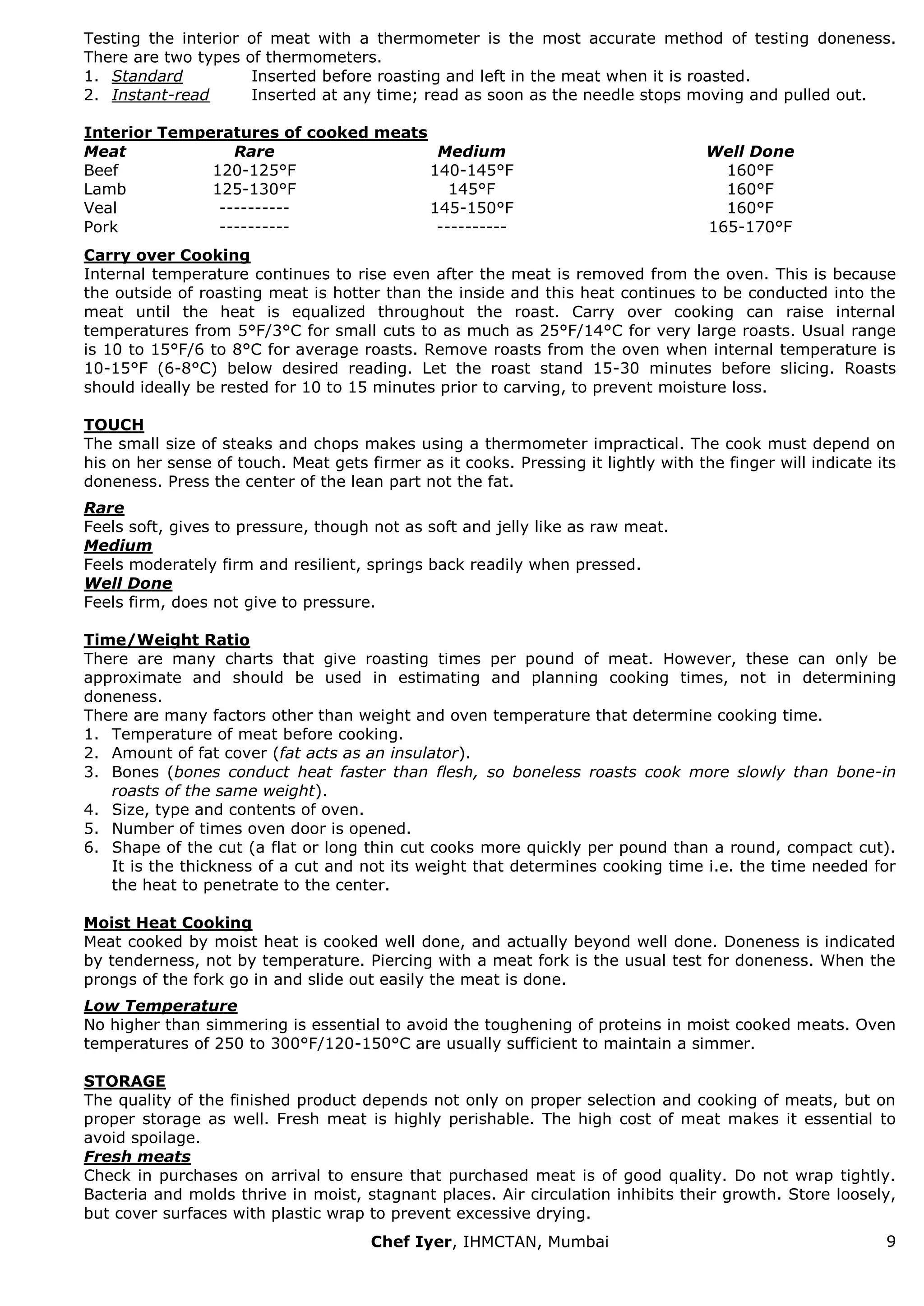
Testing the interior of meat with a thermometer is the most accurate method of testing doneness. There are two types of thermometers. 
1. Standard Inserted before roasting and left in the meat when it is roasted. 
2. Instant-read Inserted at any time; read as soon as the needle stops moving and pulled out. 
Interior Temperatures of cooked meats 
Meat 
Rare 
Medium 
Well Done 
Beef 
120-125°F 
140-145°F 
160°F 
Lamb 
125-130°F 
145°F 
160°F 
Veal 
---------- 
145-150°F 
160°F 
Pork 
---------- 
---------- 
165-170°F 
Carry over Cooking Internal temperature continues to rise even after the meat is removed from the oven. This is because the outside of roasting meat is hotter than the inside and this heat continues to be conducted into the meat until the heat is equalized throughout the roast. Carry over cooking can raise internal temperatures from 5°F/3°C for small cuts to as much as 25°F/14°C for very large roasts. Usual range is 10 to 15°F/6 to 8°C for average roasts. Remove roasts from the oven when internal temperature is 10-15°F (6-8°C) below desired reading. Let the roast stand 15-30 minutes before slicing. Roasts should ideally be rested for 10 to 15 minutes prior to carving, to prevent moisture loss. TOUCH The small size of steaks and chops makes using a thermometer impractical. The cook must depend on his on her sense of touch. Meat gets firmer as it cooks. Pressing it lightly with the finger will indicate its doneness. Press the center of the lean part not the fat. Rare Feels soft, gives to pressure, though not as soft and jelly like as raw meat. Medium Feels moderately firm and resilient, springs back readily when pressed. Well Done Feels firm, does not give to pressure. Time/Weight Ratio There are many charts that give roasting times per pound of meat. However, these can only be approximate and should be used in estimating and planning cooking times, not in determining doneness. There are many factors other than weight and oven temperature that determine cooking time. 
1. Temperature of meat before cooking. 
2. Amount of fat cover (fat acts as an insulator). 
3. Bones (bones conduct heat faster than flesh, so boneless roasts cook more slowly than bone-in roasts of the same weight). 
4. Size, type and contents of oven. 
5. Number of times oven door is opened. 
6. Shape of the cut (a flat or long thin cut cooks more quickly per pound than a round, compact cut). It is the thickness of a cut and not its weight that determines cooking time i.e. the time needed for the heat to penetrate to the center. 
Moist Heat Cooking Meat cooked by moist heat is cooked well done, and actually beyond well done. Doneness is indicated by tenderness, not by temperature. Piercing with a meat fork is the usual test for doneness. When the prongs of the fork go in and slide out easily the meat is done. Low Temperature No higher than simmering is essential to avoid the toughening of proteins in moist cooked meats. Oven temperatures of 250 to 300°F/120-150°C are usually sufficient to maintain a simmer. STORAGE The quality of the finished product depends not only on proper selection and cooking of meats, but on proper storage as well. Fresh meat is highly perishable. The high cost of meat makes it essential to avoid spoilage. Fresh meats Check in purchases on arrival to ensure that purchased meat is of good quality. Do not wrap tightly. Bacteria and molds thrive in moist, stagnant places. Air circulation inhibits their growth. Store loosely, but cover surfaces with plastic wrap to prevent excessive drying.
10 Chef Iyer, IHMCTAN, Mumbai 
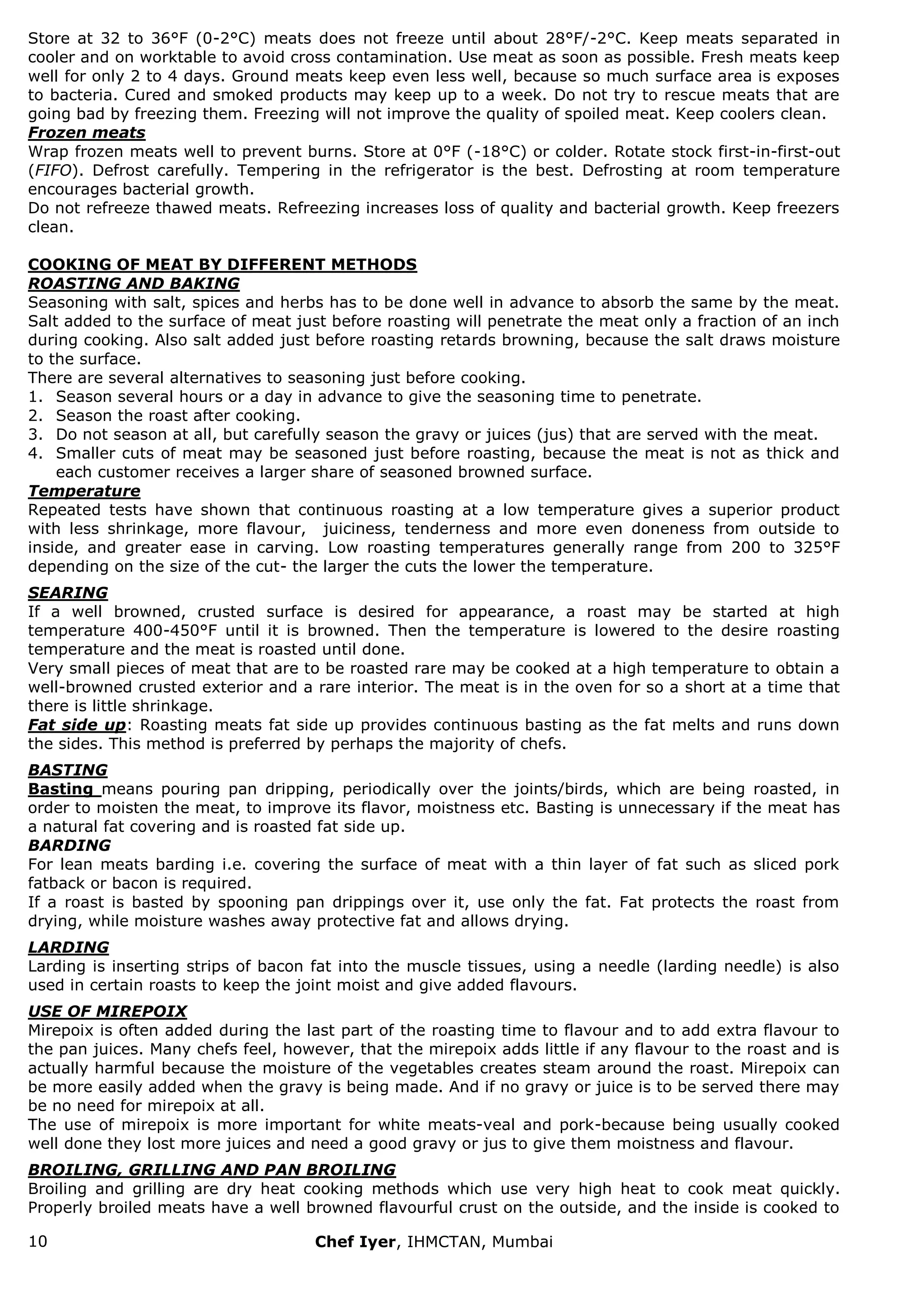
Store at 32 to 36°F (0-2°C) meats does not freeze until about 28°F/-2°C. Keep meats separated in cooler and on worktable to avoid cross contamination. Use meat as soon as possible. Fresh meats keep well for only 2 to 4 days. Ground meats keep even less well, because so much surface area is exposes to bacteria. Cured and smoked products may keep up to a week. Do not try to rescue meats that are going bad by freezing them. Freezing will not improve the quality of spoiled meat. Keep coolers clean. Frozen meats Wrap frozen meats well to prevent burns. Store at 0°F (-18°C) or colder. Rotate stock first-in-first-out (FIFO). Defrost carefully. Tempering in the refrigerator is the best. Defrosting at room temperature encourages bacterial growth. Do not refreeze thawed meats. Refreezing increases loss of quality and bacterial growth. Keep freezers clean. COOKING OF MEAT BY DIFFERENT METHODS ROASTING AND BAKING Seasoning with salt, spices and herbs has to be done well in advance to absorb the same by the meat. Salt added to the surface of meat just before roasting will penetrate the meat only a fraction of an inch during cooking. Also salt added just before roasting retards browning, because the salt draws moisture to the surface. There are several alternatives to seasoning just before cooking. 
1. Season several hours or a day in advance to give the seasoning time to penetrate. 
2. Season the roast after cooking. 
3. Do not season at all, but carefully season the gravy or juices (jus) that are served with the meat. 
4. Smaller cuts of meat may be seasoned just before roasting, because the meat is not as thick and each customer receives a larger share of seasoned browned surface. 
Temperature Repeated tests have shown that continuous roasting at a low temperature gives a superior product with less shrinkage, more flavour, juiciness, tenderness and more even doneness from outside to inside, and greater ease in carving. Low roasting temperatures generally range from 200 to 325°F depending on the size of the cut- the larger the cuts the lower the temperature. SEARING If a well browned, crusted surface is desired for appearance, a roast may be started at high temperature 400-450°F until it is browned. Then the temperature is lowered to the desire roasting temperature and the meat is roasted until done. Very small pieces of meat that are to be roasted rare may be cooked at a high temperature to obtain a well-browned crusted exterior and a rare interior. The meat is in the oven for so a short at a time that there is little shrinkage. Fat side up: Roasting meats fat side up provides continuous basting as the fat melts and runs down the sides. This method is preferred by perhaps the majority of chefs. BASTING Basting means pouring pan dripping, periodically over the joints/birds, which are being roasted, in order to moisten the meat, to improve its flavor, moistness etc. Basting is unnecessary if the meat has a natural fat covering and is roasted fat side up. BARDING For lean meats barding i.e. covering the surface of meat with a thin layer of fat such as sliced pork fatback or bacon is required. If a roast is basted by spooning pan drippings over it, use only the fat. Fat protects the roast from drying, while moisture washes away protective fat and allows drying. LARDING Larding is inserting strips of bacon fat into the muscle tissues, using a needle (larding needle) is also used in certain roasts to keep the joint moist and give added flavours. USE OF MIREPOIX Mirepoix is often added during the last part of the roasting time to flavour and to add extra flavour to the pan juices. Many chefs feel, however, that the mirepoix adds little if any flavour to the roast and is actually harmful because the moisture of the vegetables creates steam around the roast. Mirepoix can be more easily added when the gravy is being made. And if no gravy or juice is to be served there may be no need for mirepoix at all. The use of mirepoix is more important for white meats-veal and pork-because being usually cooked well done they lost more juices and need a good gravy or jus to give them moistness and flavour. BROILING, GRILLING AND PAN BROILING 
Broiling and grilling are dry heat cooking methods which use very high heat to cook meat quickly. Properly broiled meats have a well browned flavourful crust on the outside, and the inside is cooked to
Chef Iyer, IHMCTAN, Mumbai 11 
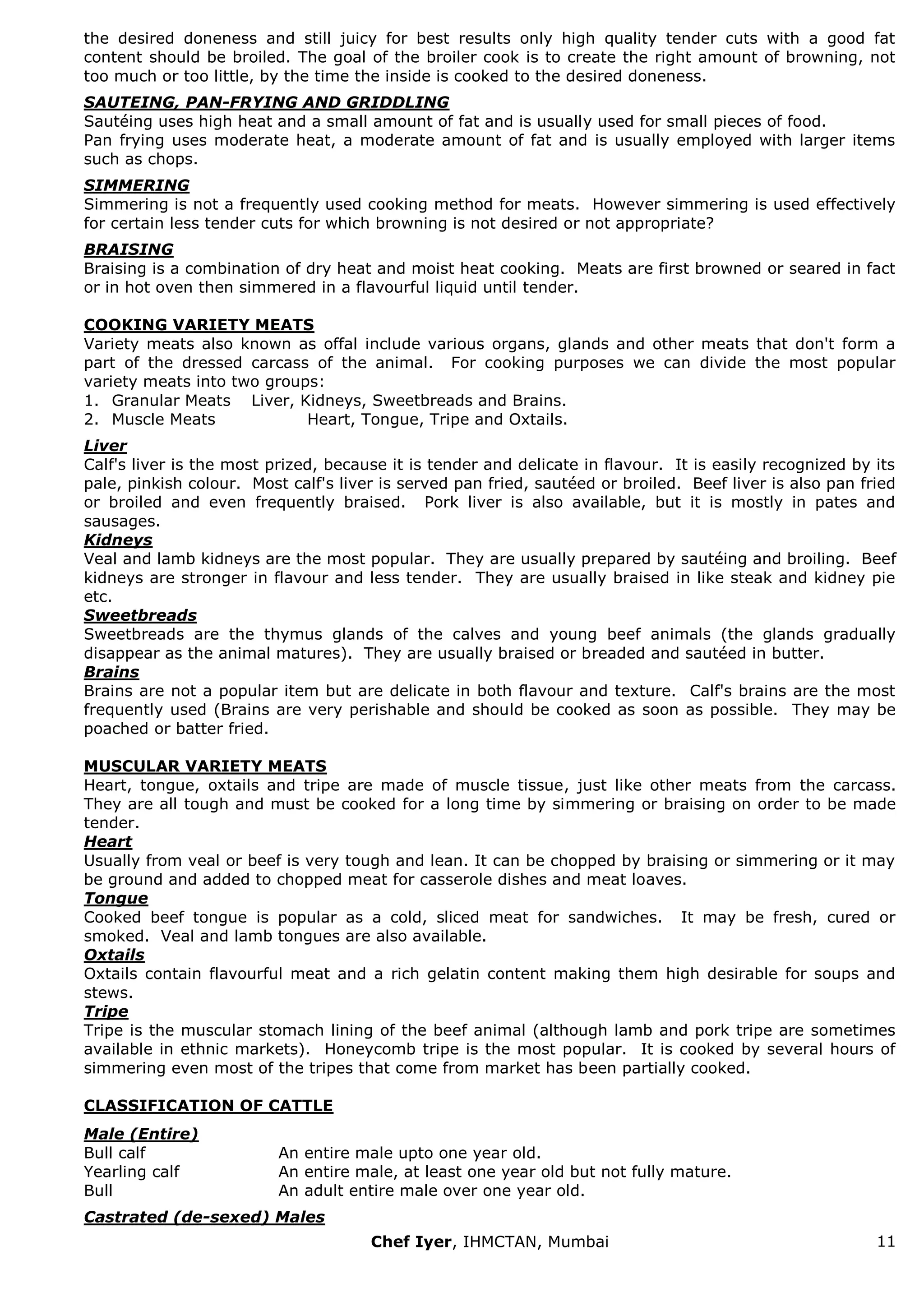
the desired doneness and still juicy for best results only high quality tender cuts with a good fat content should be broiled. The goal of the broiler cook is to create the right amount of browning, not too much or too little, by the time the inside is cooked to the desired doneness. SAUTEING, PAN-FRYING AND GRIDDLING Sautéing uses high heat and a small amount of fat and is usually used for small pieces of food. Pan frying uses moderate heat, a moderate amount of fat and is usually employed with larger items such as chops. SIMMERING Simmering is not a frequently used cooking method for meats. However simmering is used effectively for certain less tender cuts for which browning is not desired or not appropriate? BRAISING Braising is a combination of dry heat and moist heat cooking. Meats are first browned or seared in fact or in hot oven then simmered in a flavourful liquid until tender. COOKING VARIETY MEATS Variety meats also known as offal include various organs, glands and other meats that don't form a part of the dressed carcass of the animal. For cooking purposes we can divide the most popular variety meats into two groups: 
1. Granular Meats Liver, Kidneys, Sweetbreads and Brains. 
2. Muscle Meats Heart, Tongue, Tripe and Oxtails. 
Liver Calf's liver is the most prized, because it is tender and delicate in flavour. It is easily recognized by its pale, pinkish colour. Most calf's liver is served pan fried, sautéed or broiled. Beef liver is also pan fried or broiled and even frequently braised. Pork liver is also available, but it is mostly in pates and sausages. Kidneys Veal and lamb kidneys are the most popular. They are usually prepared by sautéing and broiling. Beef kidneys are stronger in flavour and less tender. They are usually braised in like steak and kidney pie etc. Sweetbreads Sweetbreads are the thymus glands of the calves and young beef animals (the glands gradually disappear as the animal matures). They are usually braised or breaded and sautéed in butter. Brains Brains are not a popular item but are delicate in both flavour and texture. Calf's brains are the most frequently used (Brains are very perishable and should be cooked as soon as possible. They may be poached or batter fried. MUSCULAR VARIETY MEATS Heart, tongue, oxtails and tripe are made of muscle tissue, just like other meats from the carcass. They are all tough and must be cooked for a long time by simmering or braising on order to be made tender. Heart Usually from veal or beef is very tough and lean. It can be chopped by braising or simmering or it may be ground and added to chopped meat for casserole dishes and meat loaves. Tongue Cooked beef tongue is popular as a cold, sliced meat for sandwiches. It may be fresh, cured or smoked. Veal and lamb tongues are also available. Oxtails Oxtails contain flavourful meat and a rich gelatin content making them high desirable for soups and stews. Tripe Tripe is the muscular stomach lining of the beef animal (although lamb and pork tripe are sometimes available in ethnic markets). Honeycomb tripe is the most popular. It is cooked by several hours of simmering even most of the tripes that come from market has been partially cooked. CLASSIFICATION OF CATTLE 
Male (Entire) 
Bull calf 
An entire male upto one year old. 
Yearling calf 
An entire male, at least one year old but not fully mature. 
Bull 
An adult entire male over one year old. 
Castrated (de-sexed) Males
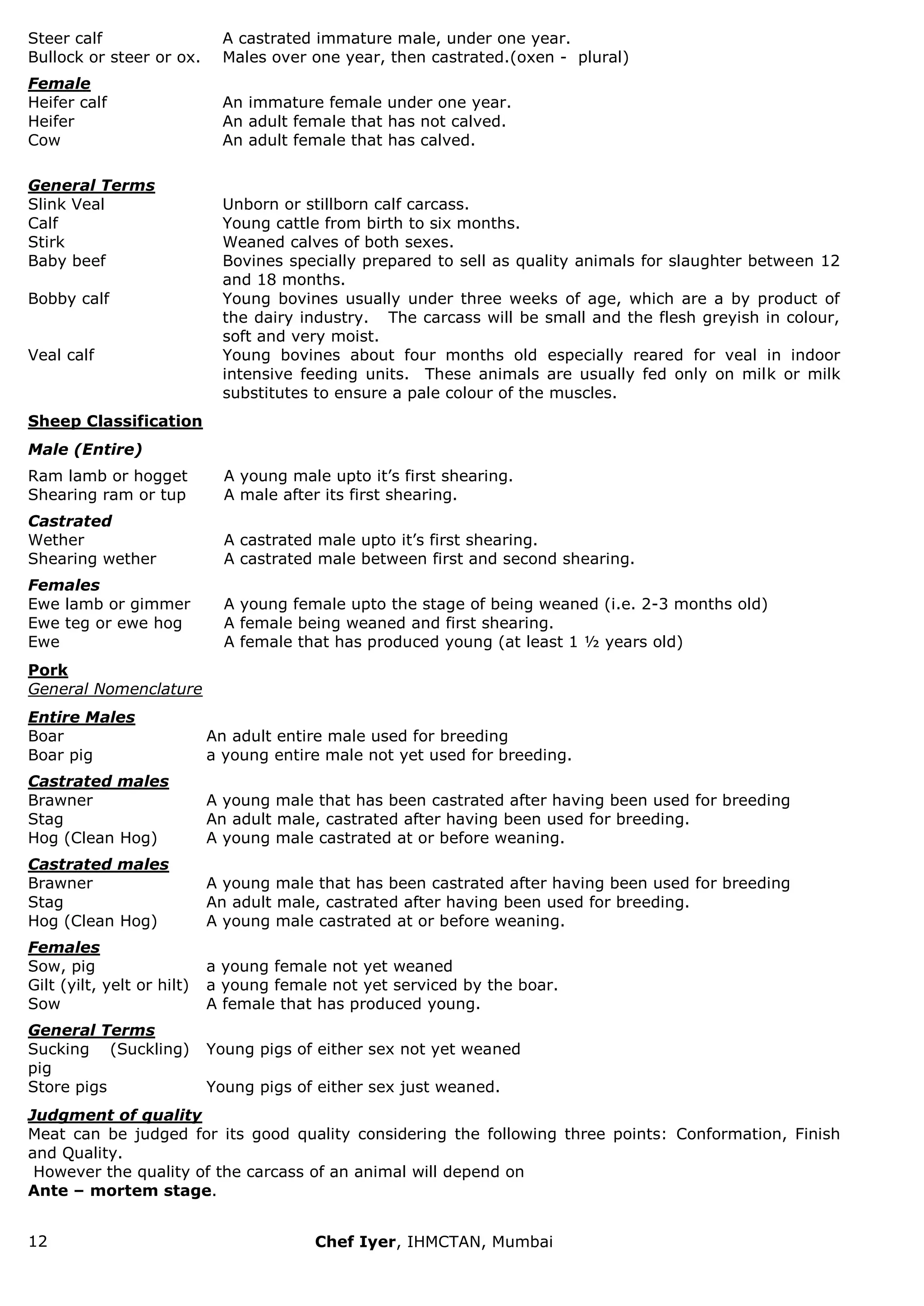
12 Chef Iyer, IHMCTAN, Mumbai 
Steer calf 
A castrated immature male, under one year. 
Bullock or steer or ox. 
Males over one year, then castrated.(oxen - plural) 
Female 
Heifer calf 
An immature female under one year. 
Heifer 
An adult female that has not calved. 
Cow 
An adult female that has calved. 
General Terms 
Slink Veal 
Unborn or stillborn calf carcass. 
Calf 
Young cattle from birth to six months. 
Stirk 
Weaned calves of both sexes. 
Baby beef 
Bovines specially prepared to sell as quality animals for slaughter between 12 and 18 months. 
Bobby calf 
Young bovines usually under three weeks of age, which are a by product of the dairy industry. The carcass will be small and the flesh greyish in colour, soft and very moist. 
Veal calf 
Young bovines about four months old especially reared for veal in indoor intensive feeding units. These animals are usually fed only on milk or milk substitutes to ensure a pale colour of the muscles. 
Sheep Classification 
Male (Entire) 
Ram lamb or hogget 
A young male upto it‟s first shearing. 
Shearing ram or tup 
A male after its first shearing. 
Castrated 
Wether 
A castrated male upto it‟s first shearing. 
Shearing wether 
A castrated male between first and second shearing. 
Females 
Ewe lamb or gimmer 
A young female upto the stage of being weaned (i.e. 2-3 months old) 
Ewe teg or ewe hog 
A female being weaned and first shearing. 
Ewe 
A female that has produced young (at least 1 ½ years old) 
Pork General Nomenclature 
Entire Males 
Boar 
An adult entire male used for breeding 
Boar pig 
a young entire male not yet used for breeding. 
Castrated males 
Brawner 
A young male that has been castrated after having been used for breeding 
Stag 
An adult male, castrated after having been used for breeding. 
Hog (Clean Hog) 
A young male castrated at or before weaning. 
Castrated males 
Brawner 
A young male that has been castrated after having been used for breeding 
Stag 
An adult male, castrated after having been used for breeding. 
Hog (Clean Hog) 
A young male castrated at or before weaning. 
Females 
Sow, pig 
a young female not yet weaned 
Gilt (yilt, yelt or hilt) 
a young female not yet serviced by the boar. 
Sow 
A female that has produced young. 
General Terms 
Sucking (Suckling) pig 
Young pigs of either sex not yet weaned 
Store pigs 
Young pigs of either sex just weaned. 
Judgment of quality Meat can be judged for its good quality considering the following three points: Conformation, Finish and Quality. However the quality of the carcass of an animal will depend on Ante – mortem stage.
Chef Iyer, IHMCTAN, Mumbai 13 
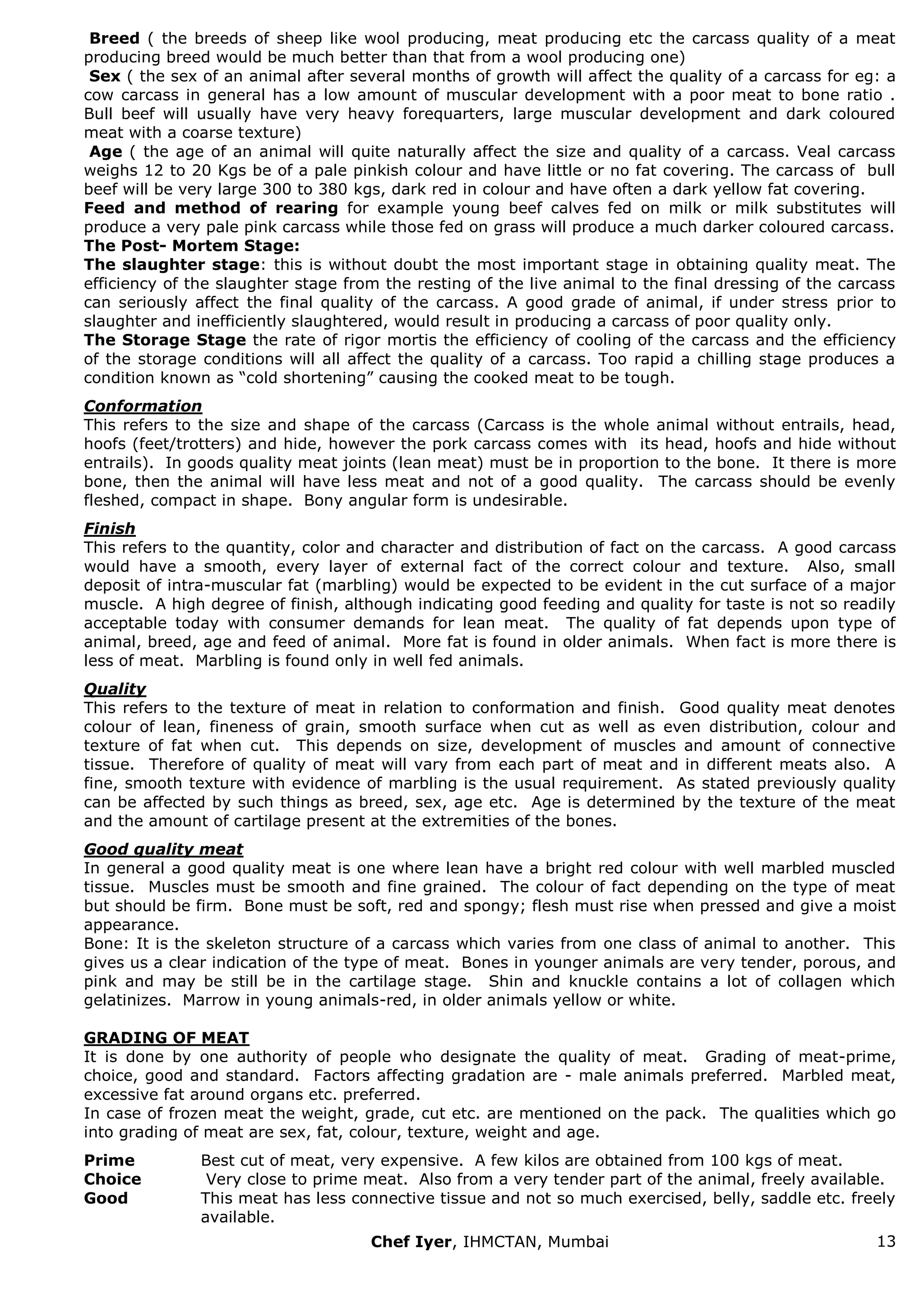
Breed ( the breeds of sheep like wool producing, meat producing etc the carcass quality of a meat producing breed would be much better than that from a wool producing one) Sex ( the sex of an animal after several months of growth will affect the quality of a carcass for eg: a cow carcass in general has a low amount of muscular development with a poor meat to bone ratio . Bull beef will usually have very heavy forequarters, large muscular development and dark coloured meat with a coarse texture) Age ( the age of an animal will quite naturally affect the size and quality of a carcass. Veal carcass weighs 12 to 20 Kgs be of a pale pinkish colour and have little or no fat covering. The carcass of bull beef will be very large 300 to 380 kgs, dark red in colour and have often a dark yellow fat covering. Feed and method of rearing for example young beef calves fed on milk or milk substitutes will produce a very pale pink carcass while those fed on grass will produce a much darker coloured carcass. The Post- Mortem Stage: The slaughter stage: this is without doubt the most important stage in obtaining quality meat. The efficiency of the slaughter stage from the resting of the live animal to the final dressing of the carcass can seriously affect the final quality of the carcass. A good grade of animal, if under stress prior to slaughter and inefficiently slaughtered, would result in producing a carcass of poor quality only. The Storage Stage the rate of rigor mortis the efficiency of cooling of the carcass and the efficiency of the storage conditions will all affect the quality of a carcass. Too rapid a chilling stage produces a condition known as “cold shortening” causing the cooked meat to be tough. Conformation This refers to the size and shape of the carcass (Carcass is the whole animal without entrails, head, hoofs (feet/trotters) and hide, however the pork carcass comes with its head, hoofs and hide without entrails). In goods quality meat joints (lean meat) must be in proportion to the bone. It there is more bone, then the animal will have less meat and not of a good quality. The carcass should be evenly fleshed, compact in shape. Bony angular form is undesirable. Finish This refers to the quantity, color and character and distribution of fact on the carcass. A good carcass would have a smooth, every layer of external fact of the correct colour and texture. Also, small deposit of intra-muscular fat (marbling) would be expected to be evident in the cut surface of a major muscle. A high degree of finish, although indicating good feeding and quality for taste is not so readily acceptable today with consumer demands for lean meat. The quality of fat depends upon type of animal, breed, age and feed of animal. More fat is found in older animals. When fact is more there is less of meat. Marbling is found only in well fed animals. Quality This refers to the texture of meat in relation to conformation and finish. Good quality meat denotes colour of lean, fineness of grain, smooth surface when cut as well as even distribution, colour and texture of fat when cut. This depends on size, development of muscles and amount of connective tissue. Therefore of quality of meat will vary from each part of meat and in different meats also. A fine, smooth texture with evidence of marbling is the usual requirement. As stated previously quality can be affected by such things as breed, sex, age etc. Age is determined by the texture of the meat and the amount of cartilage present at the extremities of the bones. Good quality meat In general a good quality meat is one where lean have a bright red colour with well marbled muscled tissue. Muscles must be smooth and fine grained. The colour of fact depending on the type of meat but should be firm. Bone must be soft, red and spongy; flesh must rise when pressed and give a moist appearance. Bone: It is the skeleton structure of a carcass which varies from one class of animal to another. This gives us a clear indication of the type of meat. Bones in younger animals are very tender, porous, and pink and may be still be in the cartilage stage. Shin and knuckle contains a lot of collagen which gelatinizes. Marrow in young animals-red, in older animals yellow or white. GRADING OF MEAT It is done by one authority of people who designate the quality of meat. Grading of meat-prime, choice, good and standard. Factors affecting gradation are - male animals preferred. Marbled meat, excessive fat around organs etc. preferred. In case of frozen meat the weight, grade, cut etc. are mentioned on the pack. The qualities which go into grading of meat are sex, fat, colour, texture, weight and age. 
Prime 
Best cut of meat, very expensive. A few kilos are obtained from 100 kgs of meat. 
Choice 
Very close to prime meat. Also from a very tender part of the animal, freely available. 
Good 
This meat has less connective tissue and not so much exercised, belly, saddle etc. freely available.
14 Chef Iyer, IHMCTAN, Mumbai 
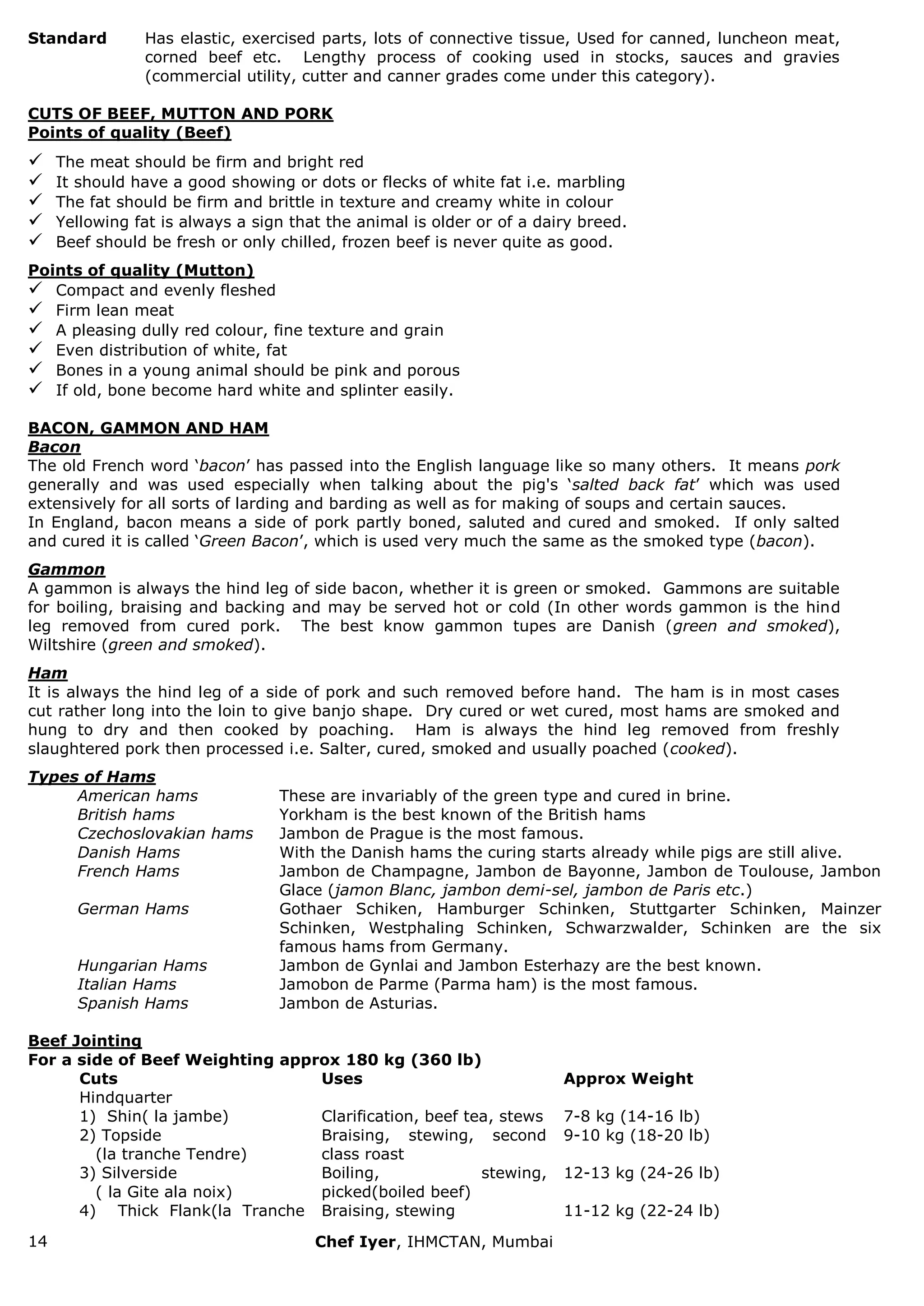
Standard 
Has elastic, exercised parts, lots of connective tissue, Used for canned, luncheon meat, corned beef etc. Lengthy process of cooking used in stocks, sauces and gravies (commercial utility, cutter and canner grades come under this category). 
CUTS OF BEEF, MUTTON AND PORK Points of quality (Beef) 
 The meat should be firm and bright red 
 It should have a good showing or dots or flecks of white fat i.e. marbling 
 The fat should be firm and brittle in texture and creamy white in colour 
 Yellowing fat is always a sign that the animal is older or of a dairy breed. 
 Beef should be fresh or only chilled, frozen beef is never quite as good. 
Points of quality (Mutton) 
 Compact and evenly fleshed 
 Firm lean meat 
 A pleasing dully red colour, fine texture and grain 
 Even distribution of white, fat 
 Bones in a young animal should be pink and porous 
 If old, bone become hard white and splinter easily. 
BACON, GAMMON AND HAM Bacon The old French word „bacon‟ has passed into the English language like so many others. It means pork generally and was used especially when talking about the pig's „salted back fat‟ which was used extensively for all sorts of larding and barding as well as for making of soups and certain sauces. In England, bacon means a side of pork partly boned, saluted and cured and smoked. If only salted and cured it is called „Green Bacon‟, which is used very much the same as the smoked type (bacon). Gammon A gammon is always the hind leg of side bacon, whether it is green or smoked. Gammons are suitable for boiling, braising and backing and may be served hot or cold (In other words gammon is the hind leg removed from cured pork. The best know gammon tupes are Danish (green and smoked), Wiltshire (green and smoked). Ham It is always the hind leg of a side of pork and such removed before hand. The ham is in most cases cut rather long into the loin to give banjo shape. Dry cured or wet cured, most hams are smoked and hung to dry and then cooked by poaching. Ham is always the hind leg removed from freshly slaughtered pork then processed i.e. Salter, cured, smoked and usually poached (cooked). Types of Hams 
American hams 
These are invariably of the green type and cured in brine. 
British hams 
Yorkham is the best known of the British hams 
Czechoslovakian hams 
Jambon de Prague is the most famous. 
Danish Hams 
With the Danish hams the curing starts already while pigs are still alive. 
French Hams 
Jambon de Champagne, Jambon de Bayonne, Jambon de Toulouse, Jambon Glace (jamon Blanc, jambon demi-sel, jambon de Paris etc.) 
German Hams 
Gothaer Schiken, Hamburger Schinken, Stuttgarter Schinken, Mainzer Schinken, Westphaling Schinken, Schwarzwalder, Schinken are the six famous hams from Germany. 
Hungarian Hams 
Jambon de Gynlai and Jambon Esterhazy are the best known. 
Italian Hams 
Jamobon de Parme (Parma ham) is the most famous. 
Spanish Hams 
Jambon de Asturias. 
Beef Jointing For a side of Beef Weighting approx 180 kg (360 lb) 
Cuts 
Uses 
Approx Weight 
Hindquarter 
1) Shin( la jambe) 
Clarification, beef tea, stews 
7-8 kg (14-16 lb) 
2) Topside (la tranche Tendre) 
Braising, stewing, second class roast 
9-10 kg (18-20 lb) 
3) Silverside ( la Gite ala noix) 
Boiling, stewing, picked(boiled beef) 
12-13 kg (24-26 lb) 
4) Thick Flank(la Tranche 
Braising, stewing 
11-12 kg (22-24 lb)
Chef Iyer, IHMCTAN, Mumbai 15 
grasse) 
5) Rump(la Culotte de boeuf) 
Grilling, frying(rumsteaks) 
9-10 kg (18-20 lb) 
6) Sirloin ( l‟ Aloyou de boeuf) 
Roasting, grilling, frying (Entrecotes) 
10-11 kg (20-22 lb) 
7) Wing Ribs ( la Cote de boeuf) 
First class roast, grilling, frying 
4-5 kg (8-10 lb) 
8) Thin Flank ( la Bavette) 
Stewing, boiling, mincing, sausages 
9-10 kg (18-20 lb) 
9) Fillet ( le Filet de Boeuf) 
Roasting, grilling, frying 
3-4 kg (6-8 lb) 
FOREQUARTER 
10) Fore Ribs (les Cotes Premieres) 
Good roast, grilling, frying 
7-8 kg (14-16 lb) 
11) Middle ribs ( les Cotes Decouvertes) 
roasting and braising 
9-10 kg (18-20 lb) 
12) Chuck ribs( les Cotes de Collier) 
Stewing, braising, mincing 
13-15 kg (27-30 lb) 
13) Sticking piece(la Collier) 
Stewing, mincing, sausages 
8-9 kg (16-18 lb) 
14) Brisket ( La Poitrine) 
Boiling, brined and boiled pressed beef 
17-18 kg (34-36 lb) 
15) Plate ( le Plate de Cotes) 
Stewing, boiling, mincing, sausages 
9-10 kg (18-20 lb) 
16) Leg of mutton Cut ( la Tallon du Collier) 
Braising whole and steaks, stewing 
10-11 kg (20-22 lb) 
17) Shank ( la Jambe) 
Clarification, beef tea, second-class mince 
6-7 kg (12-14 lb) 
Kidney 
Stews and pies 
7-8 kg (14-16 lb) 
Fat 
First class dripping 
Marrow 
Sauces and soups 
Bones 
White and brown stocks 
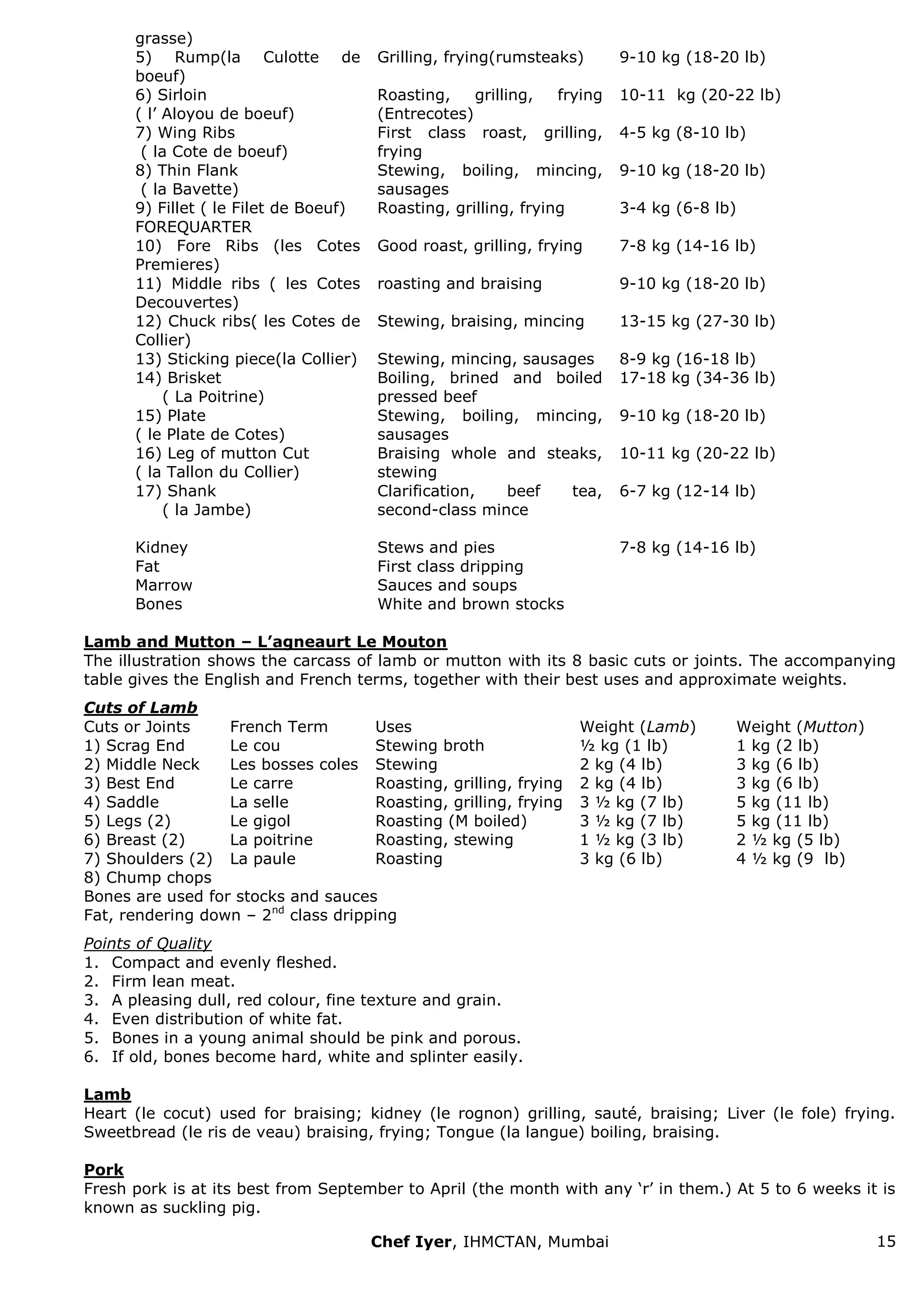
Lamb and Mutton – L‟agneaurt Le Mouton The illustration shows the carcass of lamb or mutton with its 8 basic cuts or joints. The accompanying table gives the English and French terms, together with their best uses and approximate weights. Cuts of Lamb 
Cuts or Joints 
French Term 
Uses 
Weight (Lamb) 
Weight (Mutton) 
1) Scrag End 
Le cou 
Stewing broth 
½ kg (1 lb) 
1 kg (2 lb) 
2) Middle Neck 
Les bosses coles 
Stewing 
2 kg (4 lb) 
3 kg (6 lb) 
3) Best End 
Le carre 
Roasting, grilling, frying 
2 kg (4 lb) 
3 kg (6 lb) 
4) Saddle 
La selle 
Roasting, grilling, frying 
3 ½ kg (7 lb) 
5 kg (11 lb) 
5) Legs (2) 
Le gigol 
Roasting (M boiled) 
3 ½ kg (7 lb) 
5 kg (11 lb) 
6) Breast (2) 
La poitrine 
Roasting, stewing 
1 ½ kg (3 lb) 
2 ½ kg (5 lb) 
7) Shoulders (2) 
La paule 
Roasting 
3 kg (6 lb) 
4 ½ kg (9 lb) 
8) Chump chops 
Bones are used for stocks and sauces Fat, rendering down – 2nd class dripping Points of Quality 
1. Compact and evenly fleshed. 
2. Firm lean meat. 
3. A pleasing dull, red colour, fine texture and grain. 
4. Even distribution of white fat. 
5. Bones in a young animal should be pink and porous. 
6. If old, bones become hard, white and splinter easily. 
Lamb Heart (le cocut) used for braising; kidney (le rognon) grilling, sauté, braising; Liver (le fole) frying. Sweetbread (le ris de veau) braising, frying; Tongue (la langue) boiling, braising. Pork Fresh pork is at its best from September to April (the month with any „r‟ in them.) At 5 to 6 weeks it is known as suckling pig.
16 Chef Iyer, IHMCTAN, Mumbai 
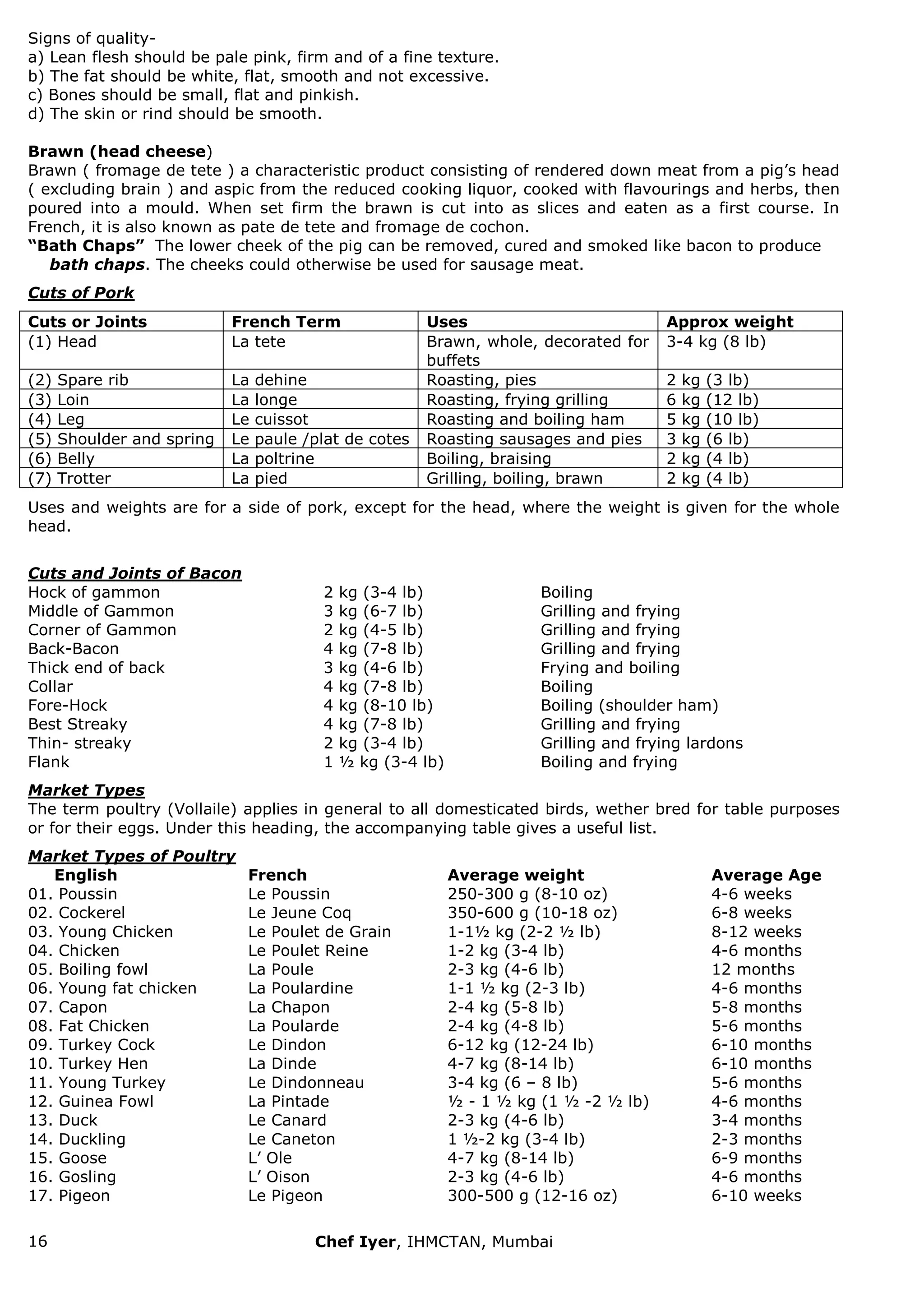
Signs of quality- a) Lean flesh should be pale pink, firm and of a fine texture. b) The fat should be white, flat, smooth and not excessive. c) Bones should be small, flat and pinkish. d) The skin or rind should be smooth. Brawn (head cheese) Brawn ( fromage de tete ) a characteristic product consisting of rendered down meat from a pig‟s head ( excluding brain ) and aspic from the reduced cooking liquor, cooked with flavourings and herbs, then poured into a mould. When set firm the brawn is cut into as slices and eaten as a first course. In French, it is also known as pate de tete and fromage de cochon. “Bath Chaps” The lower cheek of the pig can be removed, cured and smoked like bacon to produce bath chaps. The cheeks could otherwise be used for sausage meat. Cuts of Pork 
Cuts or Joints 
French Term 
Uses 
Approx weight 
(1) Head 
La tete 
Brawn, whole, decorated for buffets 
3-4 kg (8 lb) 
(2) Spare rib 
La dehine 
Roasting, pies 
2 kg (3 lb) 
(3) Loin 
La longe 
Roasting, frying grilling 
6 kg (12 lb) 
(4) Leg 
Le cuissot 
Roasting and boiling ham 
5 kg (10 lb) 
(5) Shoulder and spring 
Le paule /plat de cotes 
Roasting sausages and pies 
3 kg (6 lb) 
(6) Belly 
La poltrine 
Boiling, braising 
2 kg (4 lb) 
(7) Trotter 
La pied 
Grilling, boiling, brawn 
2 kg (4 lb) 
Uses and weights are for a side of pork, except for the head, where the weight is given for the whole head. Cuts and Joints of Bacon 
Hock of gammon 
2 kg (3-4 lb) 
Boiling 
Middle of Gammon 
3 kg (6-7 lb) 
Grilling and frying 
Corner of Gammon 
2 kg (4-5 lb) 
Grilling and frying 
Back-Bacon 
4 kg (7-8 lb) 
Grilling and frying 
Thick end of back 
3 kg (4-6 lb) 
Frying and boiling 
Collar 
4 kg (7-8 lb) 
Boiling 
Fore-Hock 
4 kg (8-10 lb) 
Boiling (shoulder ham) 
Best Streaky 
4 kg (7-8 lb) 
Grilling and frying 
Thin- streaky 
2 kg (3-4 lb) 
Grilling and frying lardons 
Flank 
1 ½ kg (3-4 lb) 
Boiling and frying 
Market Types The term poultry (Vollaile) applies in general to all domesticated birds, wether bred for table purposes or for their eggs. Under this heading, the accompanying table gives a useful list. Market Types of Poultry 
English 
French 
Average weight 
Average Age 
01. Poussin 
Le Poussin 
250-300 g (8-10 oz) 
4-6 weeks 
02. Cockerel 
Le Jeune Coq 
350-600 g (10-18 oz) 
6-8 weeks 
03. Young Chicken 
Le Poulet de Grain 
1-1½ kg (2-2 ½ lb) 
8-12 weeks 
04. Chicken 
Le Poulet Reine 
1-2 kg (3-4 lb) 
4-6 months 
05. Boiling fowl 
La Poule 
2-3 kg (4-6 lb) 
12 months 
06. Young fat chicken 
La Poulardine 
1-1 ½ kg (2-3 lb) 
4-6 months 
07. Capon 
La Chapon 
2-4 kg (5-8 lb) 
5-8 months 
08. Fat Chicken 
La Poularde 
2-4 kg (4-8 lb) 
5-6 months 
09. Turkey Cock 
Le Dindon 
6-12 kg (12-24 lb) 
6-10 months 
10. Turkey Hen 
La Dinde 
4-7 kg (8-14 lb) 
6-10 months 
11. Young Turkey 
Le Dindonneau 
3-4 kg (6 – 8 lb) 
5-6 months 
12. Guinea Fowl 
La Pintade 
½ - 1 ½ kg (1 ½ -2 ½ lb) 
4-6 months 
13. Duck 
Le Canard 
2-3 kg (4-6 lb) 
3-4 months 
14. Duckling 
Le Caneton 
1 ½-2 kg (3-4 lb) 
2-3 months 
15. Goose 
L‟ Ole 
4-7 kg (8-14 lb) 
6-9 months 
16. Gosling 
L‟ Oison 
2-3 kg (4-6 lb) 
4-6 months 
17. Pigeon 
Le Pigeon 
300-500 g (12-16 oz) 
6-10 weeks
Chef Iyer, IHMCTAN, Mumbai 17 
The Capon and the Fat Chicken (Chapon, Poularde) are desexed birds (castrated cocks and overiotomized hens). It will be appreciated that that the weights and ages given above are optimum for fresh, farm bred and reared poultry and are not necessarily related to the broiler or frozen poultry which is becoming increasingly popular in the market. Feathered Game Preparation, Dressing and Cuts The seasons listed below are when the game birds are at their best or allowed to be shot with modern deep freezing they are often available all the year round. 
English 
French 
Season 
Pheasant 
Le faisan 
Oct-Dec 
Partridge 
La perdrix 
Sep-Oct 
Young partridge 
Le perdreau 
Sep-Dec 
Rock partridge 
La bartavelle 
September 
Woodcock 
La becasse 
Sep-Apr 
Snipe 
La becassine 
Sep-Dec 
Hazel hen 
La gelinorre 
Sep-Dec 
Mountain cock 
Le coq de bruyere 
Sep-Dec 
Ptarmigan 
La poule de neige 
December 
Grouse 
La grousse 
12 Aug to Dec 
Wild duck 
Le canard sauvage 
Sep-Dec 
Teal 
La saroehe 
Dec-Jan 
Plover 
Le pluvier 
Sep-Dec 
Lapwing 
Le vanneau 
Sep-Dec 
Quail 
La caille 
July-Sep 
Cornerake 
Le rale 
July-Sep 
Fieldfare 
La grive 
Sep-Dec 
Ortolan 
Vortolan 
Sep-Dec 
Lark 
Valouette 
Sep-Dec 
Guinea fowl 
La punitade 
Note that guinea fowl originally was a wild bird and it is nowadays bred in special farms. Because of this it is often classified under the Poultry section. With all the feathered game the flavor will improve by hanging for a few days in a cool, well ventilated place. Care should be taken with water birds not to get them too high (a certain smell from hanging). After plucking, game birds are prepared very much like poultry. V.K.Iyer 10.02.2013..

Meat cookery revised 2013.

  • 1.
    Chef Iyer, IHMCTAN,Mumbai 1 MMMeeeaaattt cccooooookkkeeerrryyy The beef consumed through out the world today comes from domesticated cattle developed over thousands of years. In Europe, beef was never as plentiful as other meats. Beef was a food of the very wealthy. „Turnip Townsend‟ was partially responsible for making beef more readily available in England and later in Europe. Lord Townsend conducted an experiment which showed that livestock could be kept alive in the winter by being fed turnips. These efforts later inspired Robert Bakewell to become England‟s first commercial stockbreeder. By the eighteenth century, this interest in raising and breeding livestock, along with English people‟s natural liking of beef, gave England a reputation as a nation of beef eaters. Meat is usually accepted as being the most important food purchased by the caterers due to two main reasons: 1. It is normally the central focus of a meal and its selection determines the other foods that will be served. 2. It is common for 40-60% of the total expenditure on food to be spent on meat. „Meat‟ is defined as any part of a bovine (beef type animal), pig, sheep, goat, horse, ass or mule that is fit for human consumption. The general term meat includes carcass meat, often in the form of joints, offal such as liver, kidneys, etc and processed meats such as pickled beef, hamburgers, sausages, etc. Meat may be classified in seven different ways: 1. By the type of animal (beef, veal, pork, lamb, mutton, etc.). 2. By the country of origin (Scotland, New Zealand, Australia, etc.). 3. By the age andor sex of the animal (steer beef, bull beef, cow beef, lamb, mutton, etc.). 4. The grade of meat (New Zealand lamb of high quality sold by the grade of pH). 5. By the particular cut of meat (sirloin of beef, saddle of lamb, etc.). 6. By the condition of the meat (fresh, chilled, frozen, pickled, etc.). 7. By their catering uses (suitable for roasting, frying, grilling, boiling, etc.). BREEDS OF ANIMALS The worldwide increase in the demand for meat has resulted in newer breeds of animals becoming established as meat. The new breeds of animals are those which in the main are suitable for being reared by intensive farming methods, capable of consistently producing meat of a specific quality and weight range, having a high meat to bone ratio and a high conversion rate (i.e. the efficiency by which the animals convert the intake of foodstuffs into an increase in their body weight). The new breed of animals produced have to meet the demands of the caterer, general public and food processor as meat of a consistently high quality with a low fat content and at a reasonable price is required. THE SLAUGHTER OF ANIMALS The slaughter of animals which are for sale for human consumption is rigidly controlled by the law to ensure that the animal suffers no pain at all, that the method of slaughtering and subsequent preparation of the carcasses takes place under hygienic conditions in licensed slaughter houses and that the meat is inspected by authorized officers and found to be fit before being permitted to be sold for human consumption. The slaughtering of animals is in five main stages- 1. Anti-mortem inspection Animals to be slaughtered are brought to the slaughter house and kept usually for a minimum of 24 to72hrs (1-3days). This resting has a beneficial effect on the quality of the dressed carcass. The inspection of each animal is done to identify any signs of disease, injury, distress, etc, prior to the animal being slaughtered. 2. Stunning Fit animals are taken into the slaughter house and individually stunned by one of the following methods- a) Captive Bolt This is the stunning of the animal by the captive bolt pistol and is used for large animals such as bovines and large male pigs. Bovines are also pitted to minimize any subsequent reflex muscular action which could take place during the sticking and dressing of the carcass. Pitting is done by inserting a thin, long rod through a hole made in the skull by the bolt which has the effect of destroying the part of the brain which controls the reflexes. b) Electrical Stunning This method is the passing of a small current of electricity through the brain of small
  • 2.
    2 Chef Iyer,IHMCTAN, Mumbai animals such as baby calves, pigs and sheep for at least 7 seconds. This method renders the animal unconscious for upto 1 ½ minutes. c) Carbon dioxide stunning This method is used for stunning pigs. The pigs are placed on a moving platform which passes through a tunnel containing a mixture of CO2 and air and renders the pigs unconscious. The particular benefit of this method is that subsequent bleeding of the animal is more efficient. Co2 stunning is not carried out for sheep and other type of animals having lots of fur, as Co2 being a heavy gas might get trapped inside the thick layer of fur and people handling the animals for further procedures may inhale the trapped Co2, and can be fatal. 3. Bleeding of the animal After the animal has been stunned it is bled by making a small incision along the side of the neck and cutting the main blood vessels. The animal is usually hung up by the hind legs during this stage. It is important that as much blood as possible should be removed from the body after death as blood is an ideal medium for the growth of the bacteria which causes decomposition. 4. Dressing the animal In this stage, the hide of this animal is removed for bovines and sheep and only the hair for pigs. The animal is cut open along the chest and stomach. Offal and viscera (intestines, etc) are removed. Large animals such as bovines and pigs are usually split down the vertebrae into two sides to facilitate handling. 5. Inspection This is a continuous process and if anything unusual in the animal or carcass is noticed it is brought to the attention of a meat inspector. If need be the blood offal or viscera must be identifiable with the same tag number as the carcass and further tests may be carried out to ascertain that the meat or carcass is fit to be consumed. The final inspection of the carcass usually takes place in the cooling room. During the period in the cooling room the meat will go through a stage of setting (rigor mortis) and the muscles and joints become stiff. After a period of time the setting passes off and the carcass becomes relatively limp again. After the carcass has passed inspection and has been cooled to below 7°C (45°F), it is ready for storage prior to sale or further processing. 1. The skeletal structure This consists of the framework composed of the bones, which are joined together in their natural positions by ligaments and joints. The skeletal structure may be divided into the head, the trunk and the limbs. 2. Muscles The movements of the animals are caused by the muscles of the animal which have the power to contract. The size and shape of the muscles of the animal together with any associated fat that is commonly referred to as meat. Muscles are divided into three types:- a. Skeletal muscles or striped (striated) muscles, which are attached to the bones, are under the control of the animal. b. Plain muscles or non-striated or involuntary muscles which are the tissue of the intestines, the liver and the kidneys. In general terms, it is the offal of the animal. c. Heart muscles, which are striated, but different from voluntary muscles and not under the control of the animal. Muscle Tissue Meat is composed of muscle tissue. Muscle tissue is composed of very small elongated cells called muscle fibers which are bound into bundles by connective tissue. Striped or voluntary muscle is composed of innumerable parallel fibers which show up under a microscope as tiny transverse striations. The meat or lean is made up of tiny bundles of muscle fibers each 1-2 inches in length and resembles human hair. They are bound in bundles which determine its texture or grain. Fine grain has small fibers in small bundles while coarse grains have large fibers. These fibers are bound by a network of proteins called as connective tissue and each muscle fiber is covered by a sheath of connective tissue. It acts as a protective covering. At the end of the tissue, the connective tissue extends to form a tendon which is found inside the adjacent bone. Connective tissue is rich in proteins, collagen and elastin. Collagen is white in colour, while Elastin is yellow in colour. Elastin is elastic in nature and is tough, hence the name „elastin‟. The propositions of connective tissue in a muscle depend on the activity of the muscle in the live animal. The muscle in the lower part of the legs of a large animal such as steer, are subject to much greater stress during standing and walking and consequently contain a greater amount of connective tissue than the muscles in the back which has relatively less stress or strain applied to it. Connective tissue contains a large amount of a tough substance called collagen which can be
  • 3.
    Chef Iyer, IHMCTAN,Mumbai 3 converted by boiling to gelatin. Thus any joints containing a high proportion of connective tissue (and therefore collagen) will require a moist and slow method of cooking (boiling and stewing, braising) while those with little connective tissue are suitable for dry and quick methods (roasting, grilling or frying). Connective tissue develops with activity and exercise. Thus more exercised parts have more connective tissue and are rich in proteins. Older animals have a high percentage of connective tissue as it develops with age. Moist methods of cooking is used for parts containing more connective tissue and dry methods of cooking is used for parts containing less, because moisture and heat is required to convert collagen into gelatin. Meat containing more connective tissue is also more flavorful (because more proteins for more protein metabolism which produces bi-products which adds to the flavor of meat). Thus it is very important to know the effect of heat on connective tissue and parts that are rich in it to use the correct and easy method of cooking meat. The color of the muscle depends on the type of animal, it‟s age and whether it is fresh or preserved in some form and how long the cut surface has been exposed to air. Effect of heat in Collagen and Elastin When heat is applied in presence of moisture collagen gets converted to gelatin and becomes soft. Collagen is also softened by acids, and other enzymes like papin (papaya), bromelin (pineapple), ficin (figs), trypsin from pancreas and fungal enzymes. These proteolytic enzymes break up the proteins to amino acids. These are active at room temperature and slow acting when refrigerated but inactive when frozen and destroyed by heat at 60°C. Elastin Elastin can‟t be broken down into simpler products by action of heat, water, enzymes, etc; but has to be mechanically broken or removed from meat before cooking meat. It is an undigestible protein normally found more in older animals. Fat Fat is deposited in and on an animal as a reserve of energy or nourishment for its body. As a poor conductor of heat it also prevents loss of body heat. With the growth of the animal, the fat is laid down in the following order, first around the intestines, then the kidneys, then in the rump region and finally along the back, belly, neck and lower parts of the legs. Besides age, the type of feed will affect the quality of fat laid down by an animal as also will its state of health. The color of the fat will depend on the type of animal, the breed, the type of feed, its state of health and also its age. An important point from the palatability aspect is the melting point of the different fats. External fats, the fats laid down on the surface of a carcass have a relatively low melting point of about 32- 35°C, whereas internal fats such as kidney fat (suet) have a melting point of about 49°C. Fat is also deposited between muscle fibers and is known as „marbling‟. It is clearly seen on the cut surface of quality grade meats as tiny flecks. It is an indication of quality and of the degree of finish to the carcass. The fat introduces flavour into cooked meats and whilst being cooked provides a constant basting effect to the muscle bundles, preventing the meat from being completely dry. COMPOSITION/ CONSTITUENTS OF MEAT Meat is chiefly composed of water, proteins, fats, carbohydrates and minerals. This is the nutritional composition. Apart from this meat is also composed of coloring pigments and flavoring agents. Water Water forms about 75% of the muscle tissue. With such a high % of water in meat shrinkage can be a big problem in cooking meat. Hence when too much heat is applied there is more moisture loss and meat becomes dry as moisture evaporates with application of heat. Too moisture loss means dry meat, loss of weight and loss of profit. Proteins Protein forms about 20% of muscle tissue. Meat is made up of proteins. Protein is and important nutrient and the most abundant solid material in meat. Protein coagulates when it is heated. This means it becomes firmer and loses moisture. Coagulation is related to doneness, when protein has coagulated to the desired degree, the meat is said to be „done‟. Too high heat denatures (toughens) the proteins and causes the meat to be tough and dry. The proteins present in meat are generally grouped into three classes, myofibrillar stromal, stromal proteins and sarcoplasmic. Each of these groups performs a different function within the meat. 1. Myofibrillar proteins make up the majority of the actual muscle fibers and affect the muscle‟s ability to relax and contract. The meat will be less tender if the muscles are contracted. The contractile matter of the muscle consists mainly of two proteins termed myosin and actin. During contraction the two join to form actomyosin – a similar condition exists shortly after the death of the animal in rigor mortis when the meat is rigid and tough.
  • 4.
    4 Chef Iyer,IHMCTAN, Mumbai 2. Stromal proteins (Structural Proteins) make up the muscle‟s connective tissues. There are three main types within meat: collagen, elastin and reticulum. Of these, reticulum is of least concern to culinarians. This type of stromal proteins is present in small amounts and is most commonly found in young animals. It is these-collagen and elastin–which contribute to toughness in the texture and are formed in larger quantities in mature animals than in young ones. Collagen is the protein found in greatest quantity in animals, composing up to 20 to 25% of an animal‟s total protein. The primary function of collagen is to provide strength and support. Collagen plays a part in the tenderness of the meat. It is readily broken down in cooking with moist heat. When meat is cooked in moist conditions, collagen is converted to gelatin, a protein which is soluble in water- hence muscle is liable to fall apart when overcooked. Elastin, the stromal protein found in the circulatory system and connective tissues of an animal, provides elasticity. This protein doesn‟t break down when exposed to moist heat. Often referred to as the „yellow‟ connective tissue, elastin may be removed when the meat is cut. 3. Sarcoplasmic proteins provide the meat‟s colour, primarily in the form of myoglobin present and the amount of exposure to oxygen that induce the bright red color of the meat when butchered. Overall, proteins from the animal sources are utilized most efficiently by the human body. Humans digest 80-90% of meat‟s protein. All essential amino acids necessary for the human body are contained in the correct combination in animal proteins. Fat Upto to 5% of muscle tissue, though a carcass may have as much as 30% fat surrounding the muscles, organs (suet) and below skin as a protective covering etc. In muscle tissues fat is found as „marbling‟. Marbling is fat found in muscle tissues as tiny specks intermingled lean (flesh without fat). It melts while cooking and keeps the meal moist and tender in other words it tenderizes meat. Also adds flavour and prevents drying especially in roasts (drippings). A certain amount of fat is desirable for three reasons. 1. Juiciness Marbling is fat that is deposited within the muscle tissue. The juiciness in well marbled meat is due to fat than to moisture. Surface fat protects the meat - especially roasts - from drying out during cooking as well as in storage. Adding surface fats where they are lacking is called barding. In case of less marbled meats, strips of fat may be inserted into the meat (using a needle known as larding needle) for better moistness, flavor etc. this is known as larding. 2. Tenderness Marbling separates muscle fibers, making them easier to chew. 3. Flavour Fat is perhaps the main source of flavour in meat. A well marbled prime steak tastes better than a prime steak of a lower grade. Carbohydrates Meat contains a small percentage of carbohydrates, which is indicated by the browning of meat. It caramelizes. Normally while hanging the animal after slaughtering this carbohydrate gets converted to lactic acid which helps in tenderizing the meat. Without this carbohydrate, the desirable flavour and appearance of browned meats would not be achieved. Colouring Pigments The colour in meat is due to Hemoglobin and Myoglobin (both are iron containing proteins). Hemoglobin present in blood contributes to the red colour. In freshly cut meat myoglobin gives a purplish (pinkish) red colour to the flesh. When exposed to atmosphere it gets converted to oxy myoglobin, due to oxidation, which is bright red in colour. As the meat ages it gets a brownish red colour (myoglobin or oxy myoglobin converts to metmyogobin). When meat is cooked, this pigmented substance breaks down into brownish substances-giving the characteristic colour of cooked meat. Flavouring Agents The so called 'extractives' contribute to the flavour of meat. From the cooking point of view there are a few agents which give flavour to meat. These are the bi-products of living muscle metabolism like lactic acid and bi-products of protein metabolism like urea, uric acid and some amino acids. Other nitrogenous compounds like creatine and creatinine also contribute to the flavour of meat. However, all the factors which contribute to the flavour of meat are not fully understood, till date. POSTMORTEM CHANGES IN MEAT Rigor Mortis „Rigor Mortis‟ is a condition that occurs in the body soon after death. After slaughter, changes occur in the skeletal muscles of animals. These changes are brought about by enzymes, by chemical and physical means which alter the structure and the chemical composition, and by micro organisms, this is
  • 5.
    Chef Iyer, IHMCTAN,Mumbai 5 characterized by muscle spasm and the stiffening of muscles and occurs in animals and human being also. All living beings respite and there are two types of respiration, aerobic and anaerobic. Aerobic respiration takes place in the presence of oxygen and the end products is CO2. This would take place normally and produces ATP (Adenosine Tri Phosphate) which provides energy, to muscles to contract and relax normally and for other body functions. In animals the end product of anaerobic respiration is Lactic Acid which when accumulated in the carcass decreases the pH and stiffens the muscles. Further more, in the absence of ATP there is a formation of permanent links between actin and myosin and forms actomyosin complex (actin - myosin) and the muscle tissue contracts because of the formation of actomyosin. The muscle passes into a state known as rigor mortis or this condition is known as Rigor Mortis. The Lactic acid gradually breaks up into lactate and water and indicates the end of Rigor Mortis and the production of water. This is characterized by the bloating of the carcass. At rigor mortis stage the meat is tough and rigid; it is therefore not consumed until after a period of storage (known as conditioning 4-5 days of 10°C). The speed with which rigor develops may be affected by many factors, some chemical, some physical. The species, the age of the animal, activity or exercise before death, the temperature of holding the carcass, and possibly the scalding procedure used with pork and poultry ( to remove the hair/ feathers) etc have some influence in rigor mortis. The onset of rigor is rapid in animals that struggle before and after stunning, considerable lactic acid being developed by this activity. Rigor sets in more rapidly in fatigued fish (trawl caught) than in the muscle of fish taken from a pen. Onset of rigor in animals chased before killing in hunting would be rapid and that the flesh would not keep as well as that from animals killed without activity prior to death. Rigor sets in more rapidly in young than in old animals. Rigor develops in 8 – 24 hours and may persist 24- 72 hours. Aging is not effective in increasing the tenderness of beef until after rigor mortis has developed. The carcass is then placed in a cooler at approximately 1C.. A gradual process, under controlled temperature and humidity, for the rigor to set in and set off is very ideal to obtain a carcass with optimum quality and tenderness. If the carcass is placed immediately after slaughter in a room at about 37C and 90% humidity for 4-5 hours rigor mortis is complete at the end of this period. Rigor sets in faster and sets off faster at higher temperatures. Green Meat Green meat is meat that has not had enough time to soften. or the meat which is still undergoing rigor mortis. It is tough and relatively flavorless. Because it takes several days for meats to reach the kitchen from the slaughter house, green meat is seldom a problem, except when meat is frozen while still green. Ageing of Meat ( hanging and conditioning) If the meat is held cold for some time after it has gone into rigor mortis, the muscle again becomes soft and pliable with improved flavour and juiciness. Some changes take place during this period known as ageing or ripening. During ageing, there is progressive tenderization of meat owing to the denaturation of the muscle proteins and mild hydrolysis of denatured proteins by the intracellular proteolytic enzymes, the cathepsins. The enzymes slowly break down the connective tissues between muscle fibers as well as the muscle fibers themselves. Holding meats in coolers under controlled conditions to provide time for natural tenderizing is called ageing (aging). Ageing or ripening is done by holding meat at a temperature of 5 to 2°C in a cold room. Ageing may take 1 to 4 weeks. The best flavour and the greatest tenderness develop in meat aged from 2 to 4 weeks. During ageing, humidity of the cold room is controlled and meat may be covered with wrapping to minimize drying and weight loss. The ageing of meat may also be affected by holding it at a higher temperature for a shorter time, usually 20°C to 48 hours. Ageing with even higher temperature for less time is practiced commercially. In such cases, ultra violet light is used to keep down surface bacterial growth. Beef is usually the only kind of meat that is commercially aged. Lamb and mutton are occasionally aged. Pork is never aged because of its high fat content. Beef : Hind and fore quarters 12-14 days, fore ribs sirloin and rump 2-3 weeks. Lamb and Mutton: the carcass needs to be hung for 4-7 days. Veal: the carcass requires hanging for a period of 4-7 days and then be used as soon as possible. When finally cut into joints the flesh of veal does not keep very well and should be used as soon as possible. Pork: A total of 7-10 days from slaughtering to utilization is sufficient for the conditioning of pork. It tends to deteriorate more quickly than other meats and should be used as soon as possible. This may be one reason that the pork carcass is processed into bacon or ham and used in culinary preparations. There are three types of aging.
  • 6.
    6 Chef Iyer,IHMCTAN, Mumbai 1. Dry aging Aging does not mean just storing meat in refrigerator. There is a difference between aged meat and old meat Temperature must be carefully monitored. Air flow and humidity must be controlled because bacteria will grow on cut surfaces it there is too much moisture. Ultraviolet lights are sometimes used in aging coolers to kill bacteria and mold. 2. Fast aging To speed aging meat can be held at a higher temperature and humidity for a shorter time. Ultraviolet lights to control bacteria are especially important in fast aging. 3. Vacuum-packaging The modern trend is to break down carcasses into smaller cuts and wrap them in air and moisture- proof plastic bags. This is called Cryovac aging. The wrapping protects meats from bacteria and mold loses more weight in cooking than do dry aged meats. Aging increases tenderness and flavour. Tenderizing Meats Tenderness is the most desired quality in meat. The amount and distribution of connective tissues and size of both muscle fibers and bundles of fibers determine the tenderness of meat. As the age increases, the tenderness decreases due to the number and strength of cross linkage increases with age which decreases the amount of collagen that may be solubilized during cooking. Cold room storage results in the natural ripening of meat with tenderizing from the meat's natural enzymes. There are several artificial methods of increasing the tenderness of meat to various extents. These include mechanical methods, use of enzymes and salts etc. The mechanical methods of tenderizing meat include pounding, cutting, grinding, needling or pinning and the use of ultrasonic vibrations. Mechanical methods cut or break the muscle fibers and connective tissues. The pounding process breaks and tears only surface meat fibers and connective tissues. Grinding breaks and cuts all the muscle fibers and connective tissues and increases tenderness in meat. Insertion of needle-like blades into the meat increases tenderness of certain meat cuts. Ultrasonic vibrations break the meat fibers. The art of using enzymes for tenderizing meat is an old one. Wrapping of meat in papaya leaves before cooking results in tenderization. This is the result of the action of the enzyme papin on meat proteins. This enzyme is presently commercially available and is used extensively in meat tenderization. Other enzymes used for meat tenderization are bromelin from pineapple, ficin from figs, trypsin from pancreas and fungal enzymes. The effectiveness of an enzyme as a tenderizer depends upon the way in which it is used. Commercial papin sprinkled on the surface of meat penetrates to a depth of 1 mm per hour. Penetration is improved by punching the papin treated surface. To achieve uniform tenderness, papin is injected into the veins of animals some 10 minutes before their slaughter. Tenderizing enzymes remain inactive until the meat is heated. Papin, for example becomes active when the meat is heated to 55°C and acts on the proteins until the meat temperature reaches about 82°C. Over tenderizing by enzymes is not good as it changes the texture of meat and results in the loss of flavour and juiciness. Meat may be tenderized by the use of low levels of salts. Salt increases the water holding capacity of the muscle fibers resulting in tenderness and juiciness. Salt also solubilizes the meat proteins. Another method of increasing tenderness in meat is by change of pH. Decreasing or increasing the pH of meat increases hydration and its tenderness. Soaking beef for 43 hours in concentrated vinegar increases it tenderness and juiciness. Curing of Meat The prime object of ageing or ripening and use of tenderizers is to increase the tenderness of meat. The curing of meat has additional objectives. Curing brings about the modification of meat that effects preservation, flavour, colour and tenderness due to added curing agents. Originally curing was practiced as a means of preservation before the days of refrigeration. The prime purpose of curing is to produce the unique flavoured meat products and a special purpose is to preserve the red colour of meat. Thus, cured beef (corned beef) and cured pork (ham) remain red on cooking while in the uncured condition they become brown. The ingredients used for curing are common salt, sodium nitrate or nitrite, sugar and spices. (Curing salt is 96% common salt and 4% sodium nitrate or nitrite). Salt retards microbial growth and gives flavour to the meat. Nitrite fixes the red colour of myoglobin. Nitrite has also a beneficial effect on the flavour of cured meats and an inhibitory effect on clostridium botulism. Sugar helps to stabilize colour, counteract saltiness and also adds flavour. Spices are added mainly for flavour.
  • 7.
    Chef Iyer, IHMCTAN,Mumbai 7 During the curing process, the curing mixture may be rubbed dry on the surface of a cut of meat or the meat may be immersed in a solution of the curing agent. The high osmotic pressure of the external fluid initially draws water and soluble proteins out of the meat. Later, salt diffuses into the meat and binds to the proteins, causing some expelled protein to diffuse back in. This causes a swelling of the meat. The salt-protein complex that forms binds water well. Curing has also some detrimental effects during storage. The pink colour of nitrite cured meat changes to brown, in the presence of oxygen. Thus cured meat should preferentially be packed in containers from which oxygen has been excluded (Curing salts enhance oxidation of lipid components and thus reduce shelf life; also there is some concern about the carcinogenic effect of nitrite, particularly when cured meat is heated to a high temperature). Smoking A cured meat may be dried and smoked. Smoking also was originally used as a method of preservation but today smoking is used mostly for its flavour contribution and coagulation of proteins. Ham is frequently processed by smoking. The sawdust from hardwoods is used as a fuel for smoking. Slow smoking is preferable since the extended period enables more drying to occur on the surface. Drying is responsible for much of the preservative action of smoking. The smoke contains compounds having antiseptic properties which destroy the microorganisms present in meat. Smoking also prevents the development of rancidity in meat. UNDERSTANDING THE BASIC CUTS (Cuts of Beef) Meat cuts are based upon two factors: 1. The muscle and bone structure of the meat. 2. Uses and appropriate cooking methods of various parts of the animal. Available Forms Carcasses, Partial Carcasses, Primals and Fabricated cuts. Carcasses The carcass is the whole animal, minus entrails, head, feet and hide (except pork which has only the entrails and head removed, at times even the head is not removed). Whole carcasses are rarely purchased because of the skill and labor required in cutting and because of the problem of total utilization. Sides, Quarters, Fore Saddles, Hind Saddles These represent the first step in breaking down a carcass. Again, these larger cuts are no longer frequently used in food service. Beef is split first through the backbone into sides. Sides are divided between the 12th and 13th ribs into forequarter and hindquarter. Veal and lamb are not split into sides but are divided between ribs 12 and 13 into fore saddle and hind saddle. Pork carcasses are not divided in this way. They are cut directly into primal cuts. Primal or Wholesale Cuts These are the primary divisions of quarters, fore saddles, hind saddles and carcasses. These cuts are still used to some extent in food service, because they are small enough to be manageable in many food service kitchens, are still large enough to allow a variety of different cuts for different uses or needs and are easier to utilize completely than quarters or halves. Each primal may be fabricated, or cut up and trimmed, in several different ways. They are always the starting point for smaller cuts. Fabricated cuts Primal cuts are fabricated into smaller cuts for roasts, steaks, chops, cutlets, stewing meats, ground meat and so forth according to individual customer requirements. Portion control cuts are ready to cook meats cut according to the customer's specifications. Portion control cuts require the least work for the cook of all meat cuts. They are also the most expensive. Deciding which forms to purchase depends on the following four factors: 1. How much meat cutting skill do you or your staff have? 2. How much work and storage space do you have? 3. Can you use all cuts and lean trim on your menu? 4. Which form gives you the best cost per portion taking into consideration the labor cost as well? Meat purveyors can usually cut meat more economically than food service operators. However some operations still do some of their own cutting as they feel that cutting their own meat gives them greater control over quality. COOKING AND HANDLING MEATS Tenderness and appropriate cooking methods
  • 8.
    8 Chef Iyer,IHMCTAN, Mumbai The heat of cooking affects tenderness in two ways: 1. It tenderizes connective tissue, if moisture is present and cooking is slow. 2. It toughens protein. Even meats low in connective tissue can be tough and dry if cooked at excessively high heats for too long. The principle of low-heat cooking. 1. High heat toughens and shrinks protein and results in excessive moisture loss. Therefore, low heat cooking should be the general practice for most meat cooking methods. 2. Broiling seems to be a contradiction to this rule. The reason that carefully broiled meat stays tender is that it is done quickly. It takes time for the heat to be conducted to the interior of the meat, so the inside never gets very hot. Meat broiled well done, however, is likely to be dry. 3. Roasts cooked at low temperature have better yields than those roasted at high heat. That is they shrink less and lost less moisture. 4. Because liquid or steam is a better conductor of heat than air, moist heat penetrates meat quickly. Therefore to avoid overcooking, meat should be simmered, never boiled. Breaking down the connective tissue Connective tissue is highest in muscles that are more frequently exercised and in more mature animals. Tender cuts cooked primarily by dry heat, slightly less tender cuts cooked sometimes by dry and sometimes by moist heat, and least tender cuts cooked almost always by moist heat. Other factors influencing choice of cooking methods Fat Content: Meats high in fat, such as prime beef or lamb are generally cooked without added fat, such as by roasting or broiling. Meats low in fat, such as veal is best cooked with added fat to prevent dryness. Sautéing, pan frying or braising are generally preferable to broiling for veal chops. Developing tenderness is not the only goal of cooking. Other goals are developing flavour, preventing excessive shrinkage and nutrient loss, and developing appearance. Searing and „Sealing‟ The purpose of searing meats at high heat is to create desirable flavour and colour by browning the meat's surfaces. It was long believed that searing the surfaces of meat „seals the pores‟ keeping the juices inside, this does not actually happen. It is true that heavy browning creates a kind of crust on the surface of the meat, but this crust is no more water-proof than an unbrowned surface. Roast cooked from the start at a low temperature retain more juices than roasts that are sealed at high heat first. Steaks, chops and cutlets cooked very quickly at high heat retain more moisture at first because the intense heat drives the juices away from the hot surface into the meat. This permits browning, because moisture would create steam and inhibit browning. DONENESS The meaning of the term „doneness‟ depends on whether the cooking method uses dry heat or moist heat. Dry heat Meat is done when the proteins have reached the desired degree of coagulation, as indicated by internal temperature, while still preserving natural tenderness and juiciness. Moist Heat Meat is done when connective tissues have broken down enough for the meat to be palatable. With a few exceptions, meat cooked by moist heat is always well done. As meat cooks, its pigments change colour. These colour changes indicate degrees of doneness. Red meat (beef and lamb) changes from red to pink to gray or gray brown. Rare Browned surface-thin layer of cooked meat (gray in colour outside) and red interior. Medium Thicker layer of gray and pink in colour interior. Well done Gray throughout.(gray or dark brown in colour interior.) While meat (veal, pork) changes from pink or gray pink to white or off-white. It is generally cooked well done. Pork must be cooked long enough to eliminate the danger of trichinosis. Testing doneness is one of the most difficult and critical aspects of meat cooking. Anyone can put a steak on a grill or a roast in the oven. But it takes experience and skill to take it off the fire at the right time. Colour change cannot be used by the cook to test doneness, because it would be necessary to cut the meat. Piercing the meat and examining the colour of the juices is not a reliable method. Internal Temperatures
  • 9.
    Chef Iyer, IHMCTAN,Mumbai 9 Testing the interior of meat with a thermometer is the most accurate method of testing doneness. There are two types of thermometers. 1. Standard Inserted before roasting and left in the meat when it is roasted. 2. Instant-read Inserted at any time; read as soon as the needle stops moving and pulled out. Interior Temperatures of cooked meats Meat Rare Medium Well Done Beef 120-125°F 140-145°F 160°F Lamb 125-130°F 145°F 160°F Veal ---------- 145-150°F 160°F Pork ---------- ---------- 165-170°F Carry over Cooking Internal temperature continues to rise even after the meat is removed from the oven. This is because the outside of roasting meat is hotter than the inside and this heat continues to be conducted into the meat until the heat is equalized throughout the roast. Carry over cooking can raise internal temperatures from 5°F/3°C for small cuts to as much as 25°F/14°C for very large roasts. Usual range is 10 to 15°F/6 to 8°C for average roasts. Remove roasts from the oven when internal temperature is 10-15°F (6-8°C) below desired reading. Let the roast stand 15-30 minutes before slicing. Roasts should ideally be rested for 10 to 15 minutes prior to carving, to prevent moisture loss. TOUCH The small size of steaks and chops makes using a thermometer impractical. The cook must depend on his on her sense of touch. Meat gets firmer as it cooks. Pressing it lightly with the finger will indicate its doneness. Press the center of the lean part not the fat. Rare Feels soft, gives to pressure, though not as soft and jelly like as raw meat. Medium Feels moderately firm and resilient, springs back readily when pressed. Well Done Feels firm, does not give to pressure. Time/Weight Ratio There are many charts that give roasting times per pound of meat. However, these can only be approximate and should be used in estimating and planning cooking times, not in determining doneness. There are many factors other than weight and oven temperature that determine cooking time. 1. Temperature of meat before cooking. 2. Amount of fat cover (fat acts as an insulator). 3. Bones (bones conduct heat faster than flesh, so boneless roasts cook more slowly than bone-in roasts of the same weight). 4. Size, type and contents of oven. 5. Number of times oven door is opened. 6. Shape of the cut (a flat or long thin cut cooks more quickly per pound than a round, compact cut). It is the thickness of a cut and not its weight that determines cooking time i.e. the time needed for the heat to penetrate to the center. Moist Heat Cooking Meat cooked by moist heat is cooked well done, and actually beyond well done. Doneness is indicated by tenderness, not by temperature. Piercing with a meat fork is the usual test for doneness. When the prongs of the fork go in and slide out easily the meat is done. Low Temperature No higher than simmering is essential to avoid the toughening of proteins in moist cooked meats. Oven temperatures of 250 to 300°F/120-150°C are usually sufficient to maintain a simmer. STORAGE The quality of the finished product depends not only on proper selection and cooking of meats, but on proper storage as well. Fresh meat is highly perishable. The high cost of meat makes it essential to avoid spoilage. Fresh meats Check in purchases on arrival to ensure that purchased meat is of good quality. Do not wrap tightly. Bacteria and molds thrive in moist, stagnant places. Air circulation inhibits their growth. Store loosely, but cover surfaces with plastic wrap to prevent excessive drying.
  • 10.
    10 Chef Iyer,IHMCTAN, Mumbai Store at 32 to 36°F (0-2°C) meats does not freeze until about 28°F/-2°C. Keep meats separated in cooler and on worktable to avoid cross contamination. Use meat as soon as possible. Fresh meats keep well for only 2 to 4 days. Ground meats keep even less well, because so much surface area is exposes to bacteria. Cured and smoked products may keep up to a week. Do not try to rescue meats that are going bad by freezing them. Freezing will not improve the quality of spoiled meat. Keep coolers clean. Frozen meats Wrap frozen meats well to prevent burns. Store at 0°F (-18°C) or colder. Rotate stock first-in-first-out (FIFO). Defrost carefully. Tempering in the refrigerator is the best. Defrosting at room temperature encourages bacterial growth. Do not refreeze thawed meats. Refreezing increases loss of quality and bacterial growth. Keep freezers clean. COOKING OF MEAT BY DIFFERENT METHODS ROASTING AND BAKING Seasoning with salt, spices and herbs has to be done well in advance to absorb the same by the meat. Salt added to the surface of meat just before roasting will penetrate the meat only a fraction of an inch during cooking. Also salt added just before roasting retards browning, because the salt draws moisture to the surface. There are several alternatives to seasoning just before cooking. 1. Season several hours or a day in advance to give the seasoning time to penetrate. 2. Season the roast after cooking. 3. Do not season at all, but carefully season the gravy or juices (jus) that are served with the meat. 4. Smaller cuts of meat may be seasoned just before roasting, because the meat is not as thick and each customer receives a larger share of seasoned browned surface. Temperature Repeated tests have shown that continuous roasting at a low temperature gives a superior product with less shrinkage, more flavour, juiciness, tenderness and more even doneness from outside to inside, and greater ease in carving. Low roasting temperatures generally range from 200 to 325°F depending on the size of the cut- the larger the cuts the lower the temperature. SEARING If a well browned, crusted surface is desired for appearance, a roast may be started at high temperature 400-450°F until it is browned. Then the temperature is lowered to the desire roasting temperature and the meat is roasted until done. Very small pieces of meat that are to be roasted rare may be cooked at a high temperature to obtain a well-browned crusted exterior and a rare interior. The meat is in the oven for so a short at a time that there is little shrinkage. Fat side up: Roasting meats fat side up provides continuous basting as the fat melts and runs down the sides. This method is preferred by perhaps the majority of chefs. BASTING Basting means pouring pan dripping, periodically over the joints/birds, which are being roasted, in order to moisten the meat, to improve its flavor, moistness etc. Basting is unnecessary if the meat has a natural fat covering and is roasted fat side up. BARDING For lean meats barding i.e. covering the surface of meat with a thin layer of fat such as sliced pork fatback or bacon is required. If a roast is basted by spooning pan drippings over it, use only the fat. Fat protects the roast from drying, while moisture washes away protective fat and allows drying. LARDING Larding is inserting strips of bacon fat into the muscle tissues, using a needle (larding needle) is also used in certain roasts to keep the joint moist and give added flavours. USE OF MIREPOIX Mirepoix is often added during the last part of the roasting time to flavour and to add extra flavour to the pan juices. Many chefs feel, however, that the mirepoix adds little if any flavour to the roast and is actually harmful because the moisture of the vegetables creates steam around the roast. Mirepoix can be more easily added when the gravy is being made. And if no gravy or juice is to be served there may be no need for mirepoix at all. The use of mirepoix is more important for white meats-veal and pork-because being usually cooked well done they lost more juices and need a good gravy or jus to give them moistness and flavour. BROILING, GRILLING AND PAN BROILING Broiling and grilling are dry heat cooking methods which use very high heat to cook meat quickly. Properly broiled meats have a well browned flavourful crust on the outside, and the inside is cooked to
  • 11.
    Chef Iyer, IHMCTAN,Mumbai 11 the desired doneness and still juicy for best results only high quality tender cuts with a good fat content should be broiled. The goal of the broiler cook is to create the right amount of browning, not too much or too little, by the time the inside is cooked to the desired doneness. SAUTEING, PAN-FRYING AND GRIDDLING Sautéing uses high heat and a small amount of fat and is usually used for small pieces of food. Pan frying uses moderate heat, a moderate amount of fat and is usually employed with larger items such as chops. SIMMERING Simmering is not a frequently used cooking method for meats. However simmering is used effectively for certain less tender cuts for which browning is not desired or not appropriate? BRAISING Braising is a combination of dry heat and moist heat cooking. Meats are first browned or seared in fact or in hot oven then simmered in a flavourful liquid until tender. COOKING VARIETY MEATS Variety meats also known as offal include various organs, glands and other meats that don't form a part of the dressed carcass of the animal. For cooking purposes we can divide the most popular variety meats into two groups: 1. Granular Meats Liver, Kidneys, Sweetbreads and Brains. 2. Muscle Meats Heart, Tongue, Tripe and Oxtails. Liver Calf's liver is the most prized, because it is tender and delicate in flavour. It is easily recognized by its pale, pinkish colour. Most calf's liver is served pan fried, sautéed or broiled. Beef liver is also pan fried or broiled and even frequently braised. Pork liver is also available, but it is mostly in pates and sausages. Kidneys Veal and lamb kidneys are the most popular. They are usually prepared by sautéing and broiling. Beef kidneys are stronger in flavour and less tender. They are usually braised in like steak and kidney pie etc. Sweetbreads Sweetbreads are the thymus glands of the calves and young beef animals (the glands gradually disappear as the animal matures). They are usually braised or breaded and sautéed in butter. Brains Brains are not a popular item but are delicate in both flavour and texture. Calf's brains are the most frequently used (Brains are very perishable and should be cooked as soon as possible. They may be poached or batter fried. MUSCULAR VARIETY MEATS Heart, tongue, oxtails and tripe are made of muscle tissue, just like other meats from the carcass. They are all tough and must be cooked for a long time by simmering or braising on order to be made tender. Heart Usually from veal or beef is very tough and lean. It can be chopped by braising or simmering or it may be ground and added to chopped meat for casserole dishes and meat loaves. Tongue Cooked beef tongue is popular as a cold, sliced meat for sandwiches. It may be fresh, cured or smoked. Veal and lamb tongues are also available. Oxtails Oxtails contain flavourful meat and a rich gelatin content making them high desirable for soups and stews. Tripe Tripe is the muscular stomach lining of the beef animal (although lamb and pork tripe are sometimes available in ethnic markets). Honeycomb tripe is the most popular. It is cooked by several hours of simmering even most of the tripes that come from market has been partially cooked. CLASSIFICATION OF CATTLE Male (Entire) Bull calf An entire male upto one year old. Yearling calf An entire male, at least one year old but not fully mature. Bull An adult entire male over one year old. Castrated (de-sexed) Males
  • 12.
    12 Chef Iyer,IHMCTAN, Mumbai Steer calf A castrated immature male, under one year. Bullock or steer or ox. Males over one year, then castrated.(oxen - plural) Female Heifer calf An immature female under one year. Heifer An adult female that has not calved. Cow An adult female that has calved. General Terms Slink Veal Unborn or stillborn calf carcass. Calf Young cattle from birth to six months. Stirk Weaned calves of both sexes. Baby beef Bovines specially prepared to sell as quality animals for slaughter between 12 and 18 months. Bobby calf Young bovines usually under three weeks of age, which are a by product of the dairy industry. The carcass will be small and the flesh greyish in colour, soft and very moist. Veal calf Young bovines about four months old especially reared for veal in indoor intensive feeding units. These animals are usually fed only on milk or milk substitutes to ensure a pale colour of the muscles. Sheep Classification Male (Entire) Ram lamb or hogget A young male upto it‟s first shearing. Shearing ram or tup A male after its first shearing. Castrated Wether A castrated male upto it‟s first shearing. Shearing wether A castrated male between first and second shearing. Females Ewe lamb or gimmer A young female upto the stage of being weaned (i.e. 2-3 months old) Ewe teg or ewe hog A female being weaned and first shearing. Ewe A female that has produced young (at least 1 ½ years old) Pork General Nomenclature Entire Males Boar An adult entire male used for breeding Boar pig a young entire male not yet used for breeding. Castrated males Brawner A young male that has been castrated after having been used for breeding Stag An adult male, castrated after having been used for breeding. Hog (Clean Hog) A young male castrated at or before weaning. Castrated males Brawner A young male that has been castrated after having been used for breeding Stag An adult male, castrated after having been used for breeding. Hog (Clean Hog) A young male castrated at or before weaning. Females Sow, pig a young female not yet weaned Gilt (yilt, yelt or hilt) a young female not yet serviced by the boar. Sow A female that has produced young. General Terms Sucking (Suckling) pig Young pigs of either sex not yet weaned Store pigs Young pigs of either sex just weaned. Judgment of quality Meat can be judged for its good quality considering the following three points: Conformation, Finish and Quality. However the quality of the carcass of an animal will depend on Ante – mortem stage.
  • 13.
    Chef Iyer, IHMCTAN,Mumbai 13 Breed ( the breeds of sheep like wool producing, meat producing etc the carcass quality of a meat producing breed would be much better than that from a wool producing one) Sex ( the sex of an animal after several months of growth will affect the quality of a carcass for eg: a cow carcass in general has a low amount of muscular development with a poor meat to bone ratio . Bull beef will usually have very heavy forequarters, large muscular development and dark coloured meat with a coarse texture) Age ( the age of an animal will quite naturally affect the size and quality of a carcass. Veal carcass weighs 12 to 20 Kgs be of a pale pinkish colour and have little or no fat covering. The carcass of bull beef will be very large 300 to 380 kgs, dark red in colour and have often a dark yellow fat covering. Feed and method of rearing for example young beef calves fed on milk or milk substitutes will produce a very pale pink carcass while those fed on grass will produce a much darker coloured carcass. The Post- Mortem Stage: The slaughter stage: this is without doubt the most important stage in obtaining quality meat. The efficiency of the slaughter stage from the resting of the live animal to the final dressing of the carcass can seriously affect the final quality of the carcass. A good grade of animal, if under stress prior to slaughter and inefficiently slaughtered, would result in producing a carcass of poor quality only. The Storage Stage the rate of rigor mortis the efficiency of cooling of the carcass and the efficiency of the storage conditions will all affect the quality of a carcass. Too rapid a chilling stage produces a condition known as “cold shortening” causing the cooked meat to be tough. Conformation This refers to the size and shape of the carcass (Carcass is the whole animal without entrails, head, hoofs (feet/trotters) and hide, however the pork carcass comes with its head, hoofs and hide without entrails). In goods quality meat joints (lean meat) must be in proportion to the bone. It there is more bone, then the animal will have less meat and not of a good quality. The carcass should be evenly fleshed, compact in shape. Bony angular form is undesirable. Finish This refers to the quantity, color and character and distribution of fact on the carcass. A good carcass would have a smooth, every layer of external fact of the correct colour and texture. Also, small deposit of intra-muscular fat (marbling) would be expected to be evident in the cut surface of a major muscle. A high degree of finish, although indicating good feeding and quality for taste is not so readily acceptable today with consumer demands for lean meat. The quality of fat depends upon type of animal, breed, age and feed of animal. More fat is found in older animals. When fact is more there is less of meat. Marbling is found only in well fed animals. Quality This refers to the texture of meat in relation to conformation and finish. Good quality meat denotes colour of lean, fineness of grain, smooth surface when cut as well as even distribution, colour and texture of fat when cut. This depends on size, development of muscles and amount of connective tissue. Therefore of quality of meat will vary from each part of meat and in different meats also. A fine, smooth texture with evidence of marbling is the usual requirement. As stated previously quality can be affected by such things as breed, sex, age etc. Age is determined by the texture of the meat and the amount of cartilage present at the extremities of the bones. Good quality meat In general a good quality meat is one where lean have a bright red colour with well marbled muscled tissue. Muscles must be smooth and fine grained. The colour of fact depending on the type of meat but should be firm. Bone must be soft, red and spongy; flesh must rise when pressed and give a moist appearance. Bone: It is the skeleton structure of a carcass which varies from one class of animal to another. This gives us a clear indication of the type of meat. Bones in younger animals are very tender, porous, and pink and may be still be in the cartilage stage. Shin and knuckle contains a lot of collagen which gelatinizes. Marrow in young animals-red, in older animals yellow or white. GRADING OF MEAT It is done by one authority of people who designate the quality of meat. Grading of meat-prime, choice, good and standard. Factors affecting gradation are - male animals preferred. Marbled meat, excessive fat around organs etc. preferred. In case of frozen meat the weight, grade, cut etc. are mentioned on the pack. The qualities which go into grading of meat are sex, fat, colour, texture, weight and age. Prime Best cut of meat, very expensive. A few kilos are obtained from 100 kgs of meat. Choice Very close to prime meat. Also from a very tender part of the animal, freely available. Good This meat has less connective tissue and not so much exercised, belly, saddle etc. freely available.
  • 14.
    14 Chef Iyer,IHMCTAN, Mumbai Standard Has elastic, exercised parts, lots of connective tissue, Used for canned, luncheon meat, corned beef etc. Lengthy process of cooking used in stocks, sauces and gravies (commercial utility, cutter and canner grades come under this category). CUTS OF BEEF, MUTTON AND PORK Points of quality (Beef)  The meat should be firm and bright red  It should have a good showing or dots or flecks of white fat i.e. marbling  The fat should be firm and brittle in texture and creamy white in colour  Yellowing fat is always a sign that the animal is older or of a dairy breed.  Beef should be fresh or only chilled, frozen beef is never quite as good. Points of quality (Mutton)  Compact and evenly fleshed  Firm lean meat  A pleasing dully red colour, fine texture and grain  Even distribution of white, fat  Bones in a young animal should be pink and porous  If old, bone become hard white and splinter easily. BACON, GAMMON AND HAM Bacon The old French word „bacon‟ has passed into the English language like so many others. It means pork generally and was used especially when talking about the pig's „salted back fat‟ which was used extensively for all sorts of larding and barding as well as for making of soups and certain sauces. In England, bacon means a side of pork partly boned, saluted and cured and smoked. If only salted and cured it is called „Green Bacon‟, which is used very much the same as the smoked type (bacon). Gammon A gammon is always the hind leg of side bacon, whether it is green or smoked. Gammons are suitable for boiling, braising and backing and may be served hot or cold (In other words gammon is the hind leg removed from cured pork. The best know gammon tupes are Danish (green and smoked), Wiltshire (green and smoked). Ham It is always the hind leg of a side of pork and such removed before hand. The ham is in most cases cut rather long into the loin to give banjo shape. Dry cured or wet cured, most hams are smoked and hung to dry and then cooked by poaching. Ham is always the hind leg removed from freshly slaughtered pork then processed i.e. Salter, cured, smoked and usually poached (cooked). Types of Hams American hams These are invariably of the green type and cured in brine. British hams Yorkham is the best known of the British hams Czechoslovakian hams Jambon de Prague is the most famous. Danish Hams With the Danish hams the curing starts already while pigs are still alive. French Hams Jambon de Champagne, Jambon de Bayonne, Jambon de Toulouse, Jambon Glace (jamon Blanc, jambon demi-sel, jambon de Paris etc.) German Hams Gothaer Schiken, Hamburger Schinken, Stuttgarter Schinken, Mainzer Schinken, Westphaling Schinken, Schwarzwalder, Schinken are the six famous hams from Germany. Hungarian Hams Jambon de Gynlai and Jambon Esterhazy are the best known. Italian Hams Jamobon de Parme (Parma ham) is the most famous. Spanish Hams Jambon de Asturias. Beef Jointing For a side of Beef Weighting approx 180 kg (360 lb) Cuts Uses Approx Weight Hindquarter 1) Shin( la jambe) Clarification, beef tea, stews 7-8 kg (14-16 lb) 2) Topside (la tranche Tendre) Braising, stewing, second class roast 9-10 kg (18-20 lb) 3) Silverside ( la Gite ala noix) Boiling, stewing, picked(boiled beef) 12-13 kg (24-26 lb) 4) Thick Flank(la Tranche Braising, stewing 11-12 kg (22-24 lb)
  • 15.
    Chef Iyer, IHMCTAN,Mumbai 15 grasse) 5) Rump(la Culotte de boeuf) Grilling, frying(rumsteaks) 9-10 kg (18-20 lb) 6) Sirloin ( l‟ Aloyou de boeuf) Roasting, grilling, frying (Entrecotes) 10-11 kg (20-22 lb) 7) Wing Ribs ( la Cote de boeuf) First class roast, grilling, frying 4-5 kg (8-10 lb) 8) Thin Flank ( la Bavette) Stewing, boiling, mincing, sausages 9-10 kg (18-20 lb) 9) Fillet ( le Filet de Boeuf) Roasting, grilling, frying 3-4 kg (6-8 lb) FOREQUARTER 10) Fore Ribs (les Cotes Premieres) Good roast, grilling, frying 7-8 kg (14-16 lb) 11) Middle ribs ( les Cotes Decouvertes) roasting and braising 9-10 kg (18-20 lb) 12) Chuck ribs( les Cotes de Collier) Stewing, braising, mincing 13-15 kg (27-30 lb) 13) Sticking piece(la Collier) Stewing, mincing, sausages 8-9 kg (16-18 lb) 14) Brisket ( La Poitrine) Boiling, brined and boiled pressed beef 17-18 kg (34-36 lb) 15) Plate ( le Plate de Cotes) Stewing, boiling, mincing, sausages 9-10 kg (18-20 lb) 16) Leg of mutton Cut ( la Tallon du Collier) Braising whole and steaks, stewing 10-11 kg (20-22 lb) 17) Shank ( la Jambe) Clarification, beef tea, second-class mince 6-7 kg (12-14 lb) Kidney Stews and pies 7-8 kg (14-16 lb) Fat First class dripping Marrow Sauces and soups Bones White and brown stocks Lamb and Mutton – L‟agneaurt Le Mouton The illustration shows the carcass of lamb or mutton with its 8 basic cuts or joints. The accompanying table gives the English and French terms, together with their best uses and approximate weights. Cuts of Lamb Cuts or Joints French Term Uses Weight (Lamb) Weight (Mutton) 1) Scrag End Le cou Stewing broth ½ kg (1 lb) 1 kg (2 lb) 2) Middle Neck Les bosses coles Stewing 2 kg (4 lb) 3 kg (6 lb) 3) Best End Le carre Roasting, grilling, frying 2 kg (4 lb) 3 kg (6 lb) 4) Saddle La selle Roasting, grilling, frying 3 ½ kg (7 lb) 5 kg (11 lb) 5) Legs (2) Le gigol Roasting (M boiled) 3 ½ kg (7 lb) 5 kg (11 lb) 6) Breast (2) La poitrine Roasting, stewing 1 ½ kg (3 lb) 2 ½ kg (5 lb) 7) Shoulders (2) La paule Roasting 3 kg (6 lb) 4 ½ kg (9 lb) 8) Chump chops Bones are used for stocks and sauces Fat, rendering down – 2nd class dripping Points of Quality 1. Compact and evenly fleshed. 2. Firm lean meat. 3. A pleasing dull, red colour, fine texture and grain. 4. Even distribution of white fat. 5. Bones in a young animal should be pink and porous. 6. If old, bones become hard, white and splinter easily. Lamb Heart (le cocut) used for braising; kidney (le rognon) grilling, sauté, braising; Liver (le fole) frying. Sweetbread (le ris de veau) braising, frying; Tongue (la langue) boiling, braising. Pork Fresh pork is at its best from September to April (the month with any „r‟ in them.) At 5 to 6 weeks it is known as suckling pig.
  • 16.
    16 Chef Iyer,IHMCTAN, Mumbai Signs of quality- a) Lean flesh should be pale pink, firm and of a fine texture. b) The fat should be white, flat, smooth and not excessive. c) Bones should be small, flat and pinkish. d) The skin or rind should be smooth. Brawn (head cheese) Brawn ( fromage de tete ) a characteristic product consisting of rendered down meat from a pig‟s head ( excluding brain ) and aspic from the reduced cooking liquor, cooked with flavourings and herbs, then poured into a mould. When set firm the brawn is cut into as slices and eaten as a first course. In French, it is also known as pate de tete and fromage de cochon. “Bath Chaps” The lower cheek of the pig can be removed, cured and smoked like bacon to produce bath chaps. The cheeks could otherwise be used for sausage meat. Cuts of Pork Cuts or Joints French Term Uses Approx weight (1) Head La tete Brawn, whole, decorated for buffets 3-4 kg (8 lb) (2) Spare rib La dehine Roasting, pies 2 kg (3 lb) (3) Loin La longe Roasting, frying grilling 6 kg (12 lb) (4) Leg Le cuissot Roasting and boiling ham 5 kg (10 lb) (5) Shoulder and spring Le paule /plat de cotes Roasting sausages and pies 3 kg (6 lb) (6) Belly La poltrine Boiling, braising 2 kg (4 lb) (7) Trotter La pied Grilling, boiling, brawn 2 kg (4 lb) Uses and weights are for a side of pork, except for the head, where the weight is given for the whole head. Cuts and Joints of Bacon Hock of gammon 2 kg (3-4 lb) Boiling Middle of Gammon 3 kg (6-7 lb) Grilling and frying Corner of Gammon 2 kg (4-5 lb) Grilling and frying Back-Bacon 4 kg (7-8 lb) Grilling and frying Thick end of back 3 kg (4-6 lb) Frying and boiling Collar 4 kg (7-8 lb) Boiling Fore-Hock 4 kg (8-10 lb) Boiling (shoulder ham) Best Streaky 4 kg (7-8 lb) Grilling and frying Thin- streaky 2 kg (3-4 lb) Grilling and frying lardons Flank 1 ½ kg (3-4 lb) Boiling and frying Market Types The term poultry (Vollaile) applies in general to all domesticated birds, wether bred for table purposes or for their eggs. Under this heading, the accompanying table gives a useful list. Market Types of Poultry English French Average weight Average Age 01. Poussin Le Poussin 250-300 g (8-10 oz) 4-6 weeks 02. Cockerel Le Jeune Coq 350-600 g (10-18 oz) 6-8 weeks 03. Young Chicken Le Poulet de Grain 1-1½ kg (2-2 ½ lb) 8-12 weeks 04. Chicken Le Poulet Reine 1-2 kg (3-4 lb) 4-6 months 05. Boiling fowl La Poule 2-3 kg (4-6 lb) 12 months 06. Young fat chicken La Poulardine 1-1 ½ kg (2-3 lb) 4-6 months 07. Capon La Chapon 2-4 kg (5-8 lb) 5-8 months 08. Fat Chicken La Poularde 2-4 kg (4-8 lb) 5-6 months 09. Turkey Cock Le Dindon 6-12 kg (12-24 lb) 6-10 months 10. Turkey Hen La Dinde 4-7 kg (8-14 lb) 6-10 months 11. Young Turkey Le Dindonneau 3-4 kg (6 – 8 lb) 5-6 months 12. Guinea Fowl La Pintade ½ - 1 ½ kg (1 ½ -2 ½ lb) 4-6 months 13. Duck Le Canard 2-3 kg (4-6 lb) 3-4 months 14. Duckling Le Caneton 1 ½-2 kg (3-4 lb) 2-3 months 15. Goose L‟ Ole 4-7 kg (8-14 lb) 6-9 months 16. Gosling L‟ Oison 2-3 kg (4-6 lb) 4-6 months 17. Pigeon Le Pigeon 300-500 g (12-16 oz) 6-10 weeks
  • 17.
    Chef Iyer, IHMCTAN,Mumbai 17 The Capon and the Fat Chicken (Chapon, Poularde) are desexed birds (castrated cocks and overiotomized hens). It will be appreciated that that the weights and ages given above are optimum for fresh, farm bred and reared poultry and are not necessarily related to the broiler or frozen poultry which is becoming increasingly popular in the market. Feathered Game Preparation, Dressing and Cuts The seasons listed below are when the game birds are at their best or allowed to be shot with modern deep freezing they are often available all the year round. English French Season Pheasant Le faisan Oct-Dec Partridge La perdrix Sep-Oct Young partridge Le perdreau Sep-Dec Rock partridge La bartavelle September Woodcock La becasse Sep-Apr Snipe La becassine Sep-Dec Hazel hen La gelinorre Sep-Dec Mountain cock Le coq de bruyere Sep-Dec Ptarmigan La poule de neige December Grouse La grousse 12 Aug to Dec Wild duck Le canard sauvage Sep-Dec Teal La saroehe Dec-Jan Plover Le pluvier Sep-Dec Lapwing Le vanneau Sep-Dec Quail La caille July-Sep Cornerake Le rale July-Sep Fieldfare La grive Sep-Dec Ortolan Vortolan Sep-Dec Lark Valouette Sep-Dec Guinea fowl La punitade Note that guinea fowl originally was a wild bird and it is nowadays bred in special farms. Because of this it is often classified under the Poultry section. With all the feathered game the flavor will improve by hanging for a few days in a cool, well ventilated place. Care should be taken with water birds not to get them too high (a certain smell from hanging). After plucking, game birds are prepared very much like poultry. V.K.Iyer 10.02.2013..