Introduction to Meat
Cookery
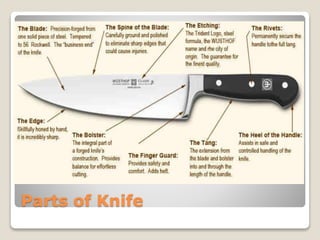
Parts of Knife
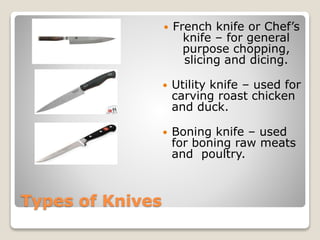
Types of Knives
 French knife or Chef’s
knife – for general
purpose chopping,
slicing and dicing.
 Utility knife – used for
carving roast chicken
and duck.
 Boning knife – used
for boning raw meats
and poultry.
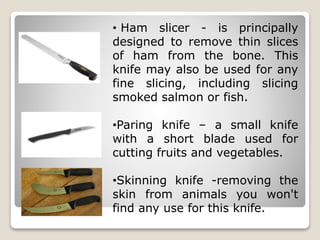
• Ham slicer - is principally
designed to remove thin slices
of ham from the bone. This
knife may also be used for any
fine slicing, including slicing
smoked salmon or fish.
•Paring knife – a small knife
with a short blade used for
cutting fruits and vegetables.
•Skinning knife -removing the
skin from animals you won't
find any use for this knife.
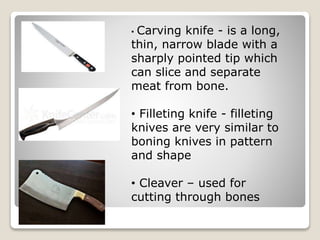
• Carving knife - is a long,
thin, narrow blade with a
sharply pointed tip which
can slice and separate
meat from bone.
• Filleting knife - filleting
knives are very similar to
boning knives in pattern
and shape
• Cleaver – used for
cutting through bones
Composition of Meat
 Water – 70% of muscle tissue
 Protein – 20% of muscular tissue. Protein
coagulates when it is heated. It becomes
firmer and loses moisture. When protein has
coagulated to the desired degree, the meat is
said to be done.
 Fat – 5% of the muscle tissue. The fat in
meat contributes:
a. Juiciness
Marbling is fat that is depositedd within
the muscle tissue. Surface fat protects the
meat from drying out during cooking. Adding
surface fat is called barding.
b. Tenderness
Marbling separates meat fibers making
meat easier to chew.
c. Flavor
Fat is the main source of flavor in
meat.
 Carbohydrates – it plays a necessary part
in the complex reaction called the mallard
reaction which takes place when meats
are browned by roasting, broiling or
sauteeing. Without carbohydrates,
desirable flavor if browned meats would
not be achieved.
Structure of Meat
 Muscle tissue – lean meat is composed of
long, thin fibers bound together in bundles.
These determines the texture or grain of a
piece of meat.
Fine – grained meat is composed of
small fiber
Coarse – textured meat has large
fibers.
 Connective tissue – These are network of
proteins that bound the muscle together.
Connective tissue is tough. Meats are high in
connective tissue if the muscle are more
exercised like meat from legs and the meat
from older animals.
Kinds of Connective Tissue
 Collagen – white connective tissue that
dissolves or breaks down by long slow
cooking with liquid. Moist – heat cooking
methods at low temperature are not
effective for turning a meat high in
connective tissue into a tender juicy
finished product. Acid helps dissolve
collagen.
 Elastin – yellow connective tissue and is
not broken down in cooking. Tenderizing
can be accomplished only by removing
elastin by pounding and by slicing and
grinding.
Basic Preparation of Meat
 Washing
 Skinning
 Dicing
Meat are diced when it is cut into
cubes for various types of casseroles,
stems and curry, and dishes such as steak
and kidney pie and pudding.
 Trimming
Leave an even thickness of fat. How
much fat you trim off will depend on the
type of meat preference and the cooking
process to be used.
 Slicing
 Seasoning
◦ Use white pepper or cayenne pepper on food
which you want to keep attractive with white
color.
◦ Add salt to roast and grill after the meat has
browned – adding salt before cooking will
extract the juices of meat to the surface and so
slow down the browning reaction.
 Coating
 Flour – coat the meat before cooking, otherwise
the meat become sticky and unpleasant.
 Bread crumbs – coat the meat in flour, then egg
wash and finally with bread crumbs.
Different Kinds of Meat and Its
Source
 Pork – meat from domesticated pigs.
Typically high in fat.
 Beef – meat from cattle over one year
old.
 Lamb – meat from domesticated sheep.
 Carabeef – meat from carabao.
 Chevron – meat from dear.
 Veal – flesh of a young calf.
Doneness of Meat
Doneness – refers to the desired quality of
cooked meat.
 Rare – when pressed with finger the meat is
very soft and jelly like texture.
 Medium rare – when pressed with finger
meat feels springy and resistant.
 Medium – when pressed with finger meat
feels firm and there is a definite resistance.
 Well done – when pressed with a finger the
meat feels hard rough.
Nutrient Content of Meat
 Protein – the major constituent of meat
after water. Meat contains 7 grams of
protein per ounce.
 Fat – content vary widely according to the
grade of meat and its cut.
 Carbohydrates – meat contains very little
carbohydrates, glycogen found in liver
and muscle tissue is present when the
animal is alive but the glucose that makes
up the glycogen is broken down to lactic
acid during and after slaughter.
 Vitamins – meat is an excellent source of
vitamin B complex – thiamin (B₁), riboflavin
(B₂), pyrodoxine (B₆), niacin(B₁₂), and some
folate.
 Minerals – meat is an excellent source of
iron, zinc, copper phosphorus and a few
other trace of minerals
Market Forms of Meat
 Fresh meat – meat that is recently
slaughtered and has not been preserved.
 Chilled meat – a meat that is placed in a
chiller or slightly cold
 Frozen meat – meat covered with or
surrounded by ice.
 Cured meat – to preserve as by salting,
smoking or aging.
 Processed meat – means of curing meat
by chemical process
Marinating
 a process of putting meat or fish in a
sauce for a period of time to add
flavor or to make the meat or fish
more tender
General Guidelines for Marinating
 Meat and poultry are generally marinated
for 2 hours up to 2 days
 Seafood and fish should be marinated for
no longer than 1 hour.
 Use a non-reactive container.
 Wait for your marinade to cool down
before pouring over the meat of your
choice.
 Always refrigerate your meat while it’s
marinating.
 Never reuse marinades.
Types of Marinades
 Pineapple marinade – This sweet, fruity
marinade works great on any cut of pork
or chicken. What you get with this
marinade is a great Hawaiian Terriyaki
flavor.
 Pork chop marinade – a great Asian
marinade that works well on all cuts of
pork, particularly pork chops.
Reminiscent of a terriyaki marinade with a
hint of heat from the chilli sauce.
 Jamaican jerk marinade – jerk seasonings
and jerk rubs that gets that jerk flavor deep
into the meat.
 Pork rib marinade – uses a pork rub for the
seasoning with vinegar and water to turn it
into a marinade.
 Terriyaki marinade – this marinade is sure to
add flavor to whatever you’re grilling. The
marinade works particularly well with pork
and poultry.
 Bourbon marinade – is a great sweet
bourbon marinade that works perfectly on
any food. This is a mild marinade so you will
want several hours marinating time with it
before you grill.
 Boston Butt Injection Marinade – works
well for injecting pork roasts that will be
smoked and pulled.
 Mustard Vinegar Marinade – a simple
mustard marinade that tenderizes and
adds flavor. It works well on pork and
poultry.
 Carne Asada Marinade – if a delicious
Mexican dish is wanted, then this is a
great marinade to start with.

Introduction to Meat Cookery

  • 1.
  • 2.
  • 3.
    Types of Knives French knife or Chef’s knife – for general purpose chopping, slicing and dicing.  Utility knife – used for carving roast chicken and duck.  Boning knife – used for boning raw meats and poultry.
  • 4.
    • Ham slicer- is principally designed to remove thin slices of ham from the bone. This knife may also be used for any fine slicing, including slicing smoked salmon or fish. •Paring knife – a small knife with a short blade used for cutting fruits and vegetables. •Skinning knife -removing the skin from animals you won't find any use for this knife.
  • 5.
    • Carving knife- is a long, thin, narrow blade with a sharply pointed tip which can slice and separate meat from bone. • Filleting knife - filleting knives are very similar to boning knives in pattern and shape • Cleaver – used for cutting through bones
  • 6.
    Composition of Meat Water – 70% of muscle tissue  Protein – 20% of muscular tissue. Protein coagulates when it is heated. It becomes firmer and loses moisture. When protein has coagulated to the desired degree, the meat is said to be done.  Fat – 5% of the muscle tissue. The fat in meat contributes: a. Juiciness Marbling is fat that is depositedd within the muscle tissue. Surface fat protects the meat from drying out during cooking. Adding surface fat is called barding.
  • 7.
    b. Tenderness Marbling separatesmeat fibers making meat easier to chew. c. Flavor Fat is the main source of flavor in meat.  Carbohydrates – it plays a necessary part in the complex reaction called the mallard reaction which takes place when meats are browned by roasting, broiling or sauteeing. Without carbohydrates, desirable flavor if browned meats would not be achieved.
  • 8.
    Structure of Meat Muscle tissue – lean meat is composed of long, thin fibers bound together in bundles. These determines the texture or grain of a piece of meat. Fine – grained meat is composed of small fiber Coarse – textured meat has large fibers.  Connective tissue – These are network of proteins that bound the muscle together. Connective tissue is tough. Meats are high in connective tissue if the muscle are more exercised like meat from legs and the meat from older animals.
  • 9.
    Kinds of ConnectiveTissue  Collagen – white connective tissue that dissolves or breaks down by long slow cooking with liquid. Moist – heat cooking methods at low temperature are not effective for turning a meat high in connective tissue into a tender juicy finished product. Acid helps dissolve collagen.  Elastin – yellow connective tissue and is not broken down in cooking. Tenderizing can be accomplished only by removing elastin by pounding and by slicing and grinding.
  • 10.
    Basic Preparation ofMeat  Washing  Skinning  Dicing Meat are diced when it is cut into cubes for various types of casseroles, stems and curry, and dishes such as steak and kidney pie and pudding.  Trimming Leave an even thickness of fat. How much fat you trim off will depend on the type of meat preference and the cooking process to be used.
  • 11.
     Slicing  Seasoning ◦Use white pepper or cayenne pepper on food which you want to keep attractive with white color. ◦ Add salt to roast and grill after the meat has browned – adding salt before cooking will extract the juices of meat to the surface and so slow down the browning reaction.  Coating  Flour – coat the meat before cooking, otherwise the meat become sticky and unpleasant.  Bread crumbs – coat the meat in flour, then egg wash and finally with bread crumbs.
  • 12.
    Different Kinds ofMeat and Its Source  Pork – meat from domesticated pigs. Typically high in fat.  Beef – meat from cattle over one year old.  Lamb – meat from domesticated sheep.  Carabeef – meat from carabao.  Chevron – meat from dear.  Veal – flesh of a young calf.
  • 13.
    Doneness of Meat Doneness– refers to the desired quality of cooked meat.  Rare – when pressed with finger the meat is very soft and jelly like texture.  Medium rare – when pressed with finger meat feels springy and resistant.  Medium – when pressed with finger meat feels firm and there is a definite resistance.  Well done – when pressed with a finger the meat feels hard rough.
  • 14.
    Nutrient Content ofMeat  Protein – the major constituent of meat after water. Meat contains 7 grams of protein per ounce.  Fat – content vary widely according to the grade of meat and its cut.  Carbohydrates – meat contains very little carbohydrates, glycogen found in liver and muscle tissue is present when the animal is alive but the glucose that makes up the glycogen is broken down to lactic acid during and after slaughter.
  • 15.
     Vitamins –meat is an excellent source of vitamin B complex – thiamin (B₁), riboflavin (B₂), pyrodoxine (B₆), niacin(B₁₂), and some folate.  Minerals – meat is an excellent source of iron, zinc, copper phosphorus and a few other trace of minerals
  • 16.
    Market Forms ofMeat  Fresh meat – meat that is recently slaughtered and has not been preserved.  Chilled meat – a meat that is placed in a chiller or slightly cold  Frozen meat – meat covered with or surrounded by ice.  Cured meat – to preserve as by salting, smoking or aging.  Processed meat – means of curing meat by chemical process
  • 17.
    Marinating  a processof putting meat or fish in a sauce for a period of time to add flavor or to make the meat or fish more tender
  • 18.
    General Guidelines forMarinating  Meat and poultry are generally marinated for 2 hours up to 2 days  Seafood and fish should be marinated for no longer than 1 hour.  Use a non-reactive container.  Wait for your marinade to cool down before pouring over the meat of your choice.  Always refrigerate your meat while it’s marinating.  Never reuse marinades.
  • 19.
    Types of Marinades Pineapple marinade – This sweet, fruity marinade works great on any cut of pork or chicken. What you get with this marinade is a great Hawaiian Terriyaki flavor.  Pork chop marinade – a great Asian marinade that works well on all cuts of pork, particularly pork chops. Reminiscent of a terriyaki marinade with a hint of heat from the chilli sauce.
  • 20.
     Jamaican jerkmarinade – jerk seasonings and jerk rubs that gets that jerk flavor deep into the meat.  Pork rib marinade – uses a pork rub for the seasoning with vinegar and water to turn it into a marinade.  Terriyaki marinade – this marinade is sure to add flavor to whatever you’re grilling. The marinade works particularly well with pork and poultry.  Bourbon marinade – is a great sweet bourbon marinade that works perfectly on any food. This is a mild marinade so you will want several hours marinating time with it before you grill.
  • 21.
     Boston ButtInjection Marinade – works well for injecting pork roasts that will be smoked and pulled.  Mustard Vinegar Marinade – a simple mustard marinade that tenderizes and adds flavor. It works well on pork and poultry.  Carne Asada Marinade – if a delicious Mexican dish is wanted, then this is a great marinade to start with.