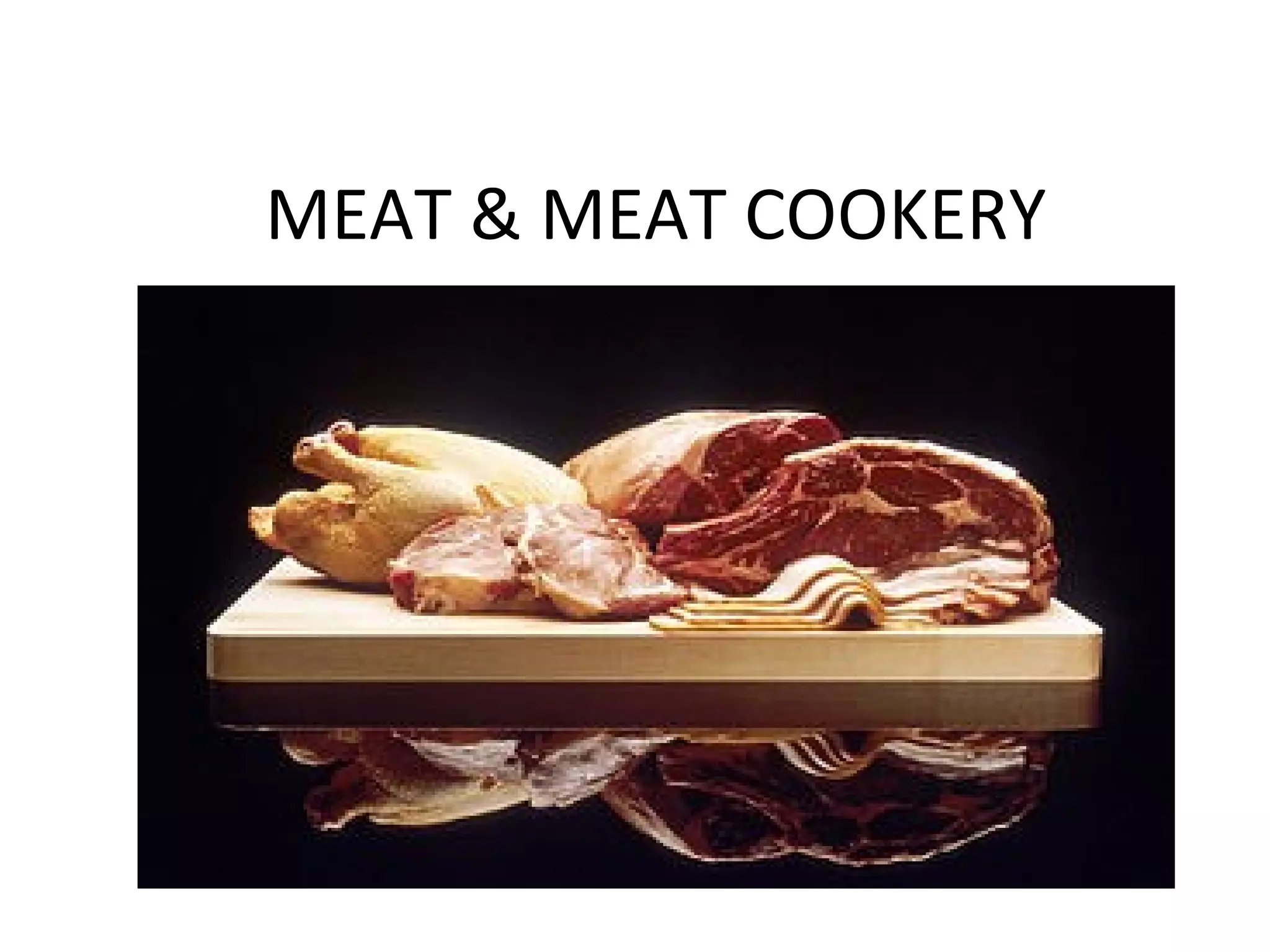
MEAT & MEAT COOKERY
Meat
• refers to the edible flesh of animals
• is animal flesh that is eaten as food
Composition:
Meat consist of :
Water – 75%
Protein – 19%
Intramuscular fat – 2.5 %
Carbohydrates – 2.3%
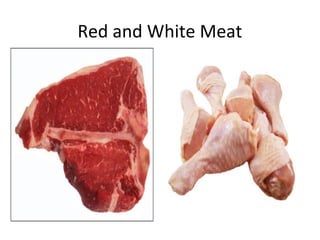
Red and White Meat
Red Meat
• The color depends on the concentration of
  myoglobin in muscle fiber. When myoglobin is
  exposed to oxygen reddish color appears.
• Redness depends on species, animal age, and
  narrow muscle fibres.
Examples :
Red meats L: Beef, veal, lamb, mutton,
  carabeef
White Meat
• white meat may also refer to any lighter-
  colored meat.
• It is believe that white meat is healthier than
  red meat
Examples: pork, poultry and game, fish and
  shellfish
Meats from Diff. Animals
•   Pork – pig/hog
•   Beef – cow/cattle
•   Chevron – goat
•   Venison – deer
•   Lamb and mutton- sheep
•   Carabeef - carabao
Structure of Meat:
1)Lean Tissue – consist of one or more muscles which is
   made up of many bundles of muscle fibers.
2)Connective Tissue – Surround the fibers and unites
   them in bundles.
  a) Collagen – arranged in parallel , do not stretch,
   color is white, disintegrate in hot water
  b) Elastin – yellowish portion, do not tenderize while
    cooking
3) Fat – around or between muscles
Composition of Meat:

Water
• Water is about 75% of muscle tissue. Shrinkage can
  be a big problem in cooking meat which result to loss
  of weight and loss of profit.
Protein
• About 20% of the muscle tissue is a protein. Protein
  coagulates when it is heated. This means firmer and
  loses moisture. Coagulation is related to doneness.
Fat
• 5 % of the muscle tissue is fat. A beef carcass
  can be as much as 30% fat.
1. Juiciness – Marbling is fat deposited within
  the muscle tissue. Juiciness depends on how
   much marble contains in the meat.
2. Tenderness – Marbling separates muscle
  fibers, making them easier to chew.
3. Flavor – Flavor depends on the marbling.
BEEF
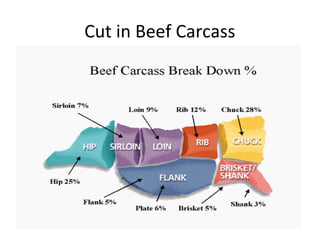
Cut in Beef Carcass
BEEF
• Beef is the meat of domesticated mature
  cattle usually over 12 months of age. It has
  distinctive flavor and firm texture. It is usually
  bright, cherry red in color with creamy white
  fat. Cattle is the collective name for all
  domesticated oxen
• Cattle are classified as;
• Bulls – male cattle, usually not raised to be
  eaten.
• Calves – young cows or bulls prized for their
  meat.
• Cows – female cattle after the first calving,
  raised principally for milk and calf production..
• Steers – male cattle castrated prior to maturity
  and principally raised for beef.
Basic Cuts
Paypay ( chuck)
Tadyang (ribs)
Kadera (sirloin)
Tapadera (rump)
Kenche (hind shank)
Kenche (fore shank)
Puntay peche (brisket)
Campto (flank)
Pierna corta (round)
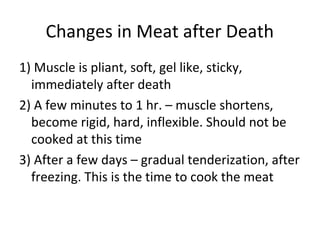
Changes in Meat after Death
1) Muscle is pliant, soft, gel like, sticky,
  immediately after death
2) A few minutes to 1 hr. – muscle shortens,
  become rigid, hard, inflexible. Should not be
  cooked at this time
3) After a few days – gradual tenderization, after
  freezing. This is the time to cook the meat
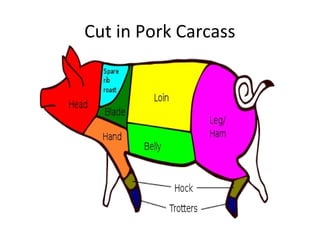
Cut in Pork Carcass
Pork Carcass Basic Cuts
•   Casim (picnic)
•   Pork chops
•   Loins
•   Pata (fore shank) (hind shank)
•   Spare ribs
•   Bacon
•   Pigue (ham)
Effects of Cooking Meats
• Changes in pigment – myoglobin from bright red
  color to grayish brown.
• Changes in meat protein- Decrease in length of fiber
  causing shrinkage. Excessive heating makes the meat
  tougher, stringy and rubbery.
• Fat melts , causing shrinkage
• Loss in moisture
• Heat converts collagen into gelatin. This requires
  more heat
• Long cooking develops better flavor
Factors Influencing Flavor
• Flavor is due to decomposition of protein and
  oxidation of fat. Saltiness and sweetness of the
  blood. The distinctive flavor of animal is affected by
  specie, sex, age, amount of exercise, degree of
  ripening.
• The older the animal the stronger the flavor.
• More exercised animals have tougher meat
• The more varied the feed, the more distinctive its
  flavor.
Storage of Meats:
Fresh Meats:
1.Check purchases as soon as it arrives to ensure
  the quality.
2.Do not wrap tightly, bacteria and mold thrive
  in moist. Allow air to circulate to inhibits the
  growth of bacteria.
3.Do not open vacuum packed meats until it is
  ready to use.
4.. Store at 32⁰ to 36⁰ F

Meat & meat cookery

  • 1.
    MEAT & MEATCOOKERY
  • 2.
    Meat • refers tothe edible flesh of animals • is animal flesh that is eaten as food
  • 3.
    Composition: Meat consist of: Water – 75% Protein – 19% Intramuscular fat – 2.5 % Carbohydrates – 2.3%
  • 4.
  • 5.
    Red Meat • Thecolor depends on the concentration of myoglobin in muscle fiber. When myoglobin is exposed to oxygen reddish color appears. • Redness depends on species, animal age, and narrow muscle fibres. Examples : Red meats L: Beef, veal, lamb, mutton, carabeef
  • 6.
    White Meat • whitemeat may also refer to any lighter- colored meat. • It is believe that white meat is healthier than red meat Examples: pork, poultry and game, fish and shellfish
  • 7.
    Meats from Diff.Animals • Pork – pig/hog • Beef – cow/cattle • Chevron – goat • Venison – deer • Lamb and mutton- sheep • Carabeef - carabao
  • 8.
    Structure of Meat: 1)LeanTissue – consist of one or more muscles which is made up of many bundles of muscle fibers. 2)Connective Tissue – Surround the fibers and unites them in bundles. a) Collagen – arranged in parallel , do not stretch, color is white, disintegrate in hot water b) Elastin – yellowish portion, do not tenderize while cooking 3) Fat – around or between muscles
  • 9.
    Composition of Meat: Water •Water is about 75% of muscle tissue. Shrinkage can be a big problem in cooking meat which result to loss of weight and loss of profit. Protein • About 20% of the muscle tissue is a protein. Protein coagulates when it is heated. This means firmer and loses moisture. Coagulation is related to doneness.
  • 10.
    Fat • 5 %of the muscle tissue is fat. A beef carcass can be as much as 30% fat. 1. Juiciness – Marbling is fat deposited within the muscle tissue. Juiciness depends on how much marble contains in the meat. 2. Tenderness – Marbling separates muscle fibers, making them easier to chew. 3. Flavor – Flavor depends on the marbling.
  • 11.
  • 12.
    Cut in BeefCarcass
  • 13.
    BEEF • Beef isthe meat of domesticated mature cattle usually over 12 months of age. It has distinctive flavor and firm texture. It is usually bright, cherry red in color with creamy white fat. Cattle is the collective name for all domesticated oxen
  • 14.
    • Cattle areclassified as; • Bulls – male cattle, usually not raised to be eaten. • Calves – young cows or bulls prized for their meat. • Cows – female cattle after the first calving, raised principally for milk and calf production.. • Steers – male cattle castrated prior to maturity and principally raised for beef.
  • 15.
    Basic Cuts Paypay (chuck) Tadyang (ribs) Kadera (sirloin) Tapadera (rump) Kenche (hind shank) Kenche (fore shank) Puntay peche (brisket) Campto (flank) Pierna corta (round)
  • 16.
    Changes in Meatafter Death 1) Muscle is pliant, soft, gel like, sticky, immediately after death 2) A few minutes to 1 hr. – muscle shortens, become rigid, hard, inflexible. Should not be cooked at this time 3) After a few days – gradual tenderization, after freezing. This is the time to cook the meat
  • 17.
    Cut in PorkCarcass
  • 18.
    Pork Carcass BasicCuts • Casim (picnic) • Pork chops • Loins • Pata (fore shank) (hind shank) • Spare ribs • Bacon • Pigue (ham)
  • 19.
    Effects of CookingMeats • Changes in pigment – myoglobin from bright red color to grayish brown. • Changes in meat protein- Decrease in length of fiber causing shrinkage. Excessive heating makes the meat tougher, stringy and rubbery. • Fat melts , causing shrinkage • Loss in moisture • Heat converts collagen into gelatin. This requires more heat • Long cooking develops better flavor
  • 20.
    Factors Influencing Flavor •Flavor is due to decomposition of protein and oxidation of fat. Saltiness and sweetness of the blood. The distinctive flavor of animal is affected by specie, sex, age, amount of exercise, degree of ripening. • The older the animal the stronger the flavor. • More exercised animals have tougher meat • The more varied the feed, the more distinctive its flavor.
  • 21.
    Storage of Meats: FreshMeats: 1.Check purchases as soon as it arrives to ensure the quality. 2.Do not wrap tightly, bacteria and mold thrive in moist. Allow air to circulate to inhibits the growth of bacteria. 3.Do not open vacuum packed meats until it is ready to use. 4.. Store at 32⁰ to 36⁰ F

Editor's Notes

  • #6 Meat can be broadly classified as "red" or "white" depending on the concentration of myoglobin in muscle fibre. When myoglobin is exposed to oxygen , reddish oxymyoglobin develops, making myoglobin-rich meat appear red. The redness of meat depends on species, animal age, and fibre type: Red meat contains more narrow muscle fibres that tend to operate over long periods without rest, [55] while white meat contains more broad fibres that tend to work in short fast bursts. [55] The meat of adult mammals such as cows , sheep , goats , and horses is generally considered red, while domestic chicken and turkey breast meat is generally considered white.
  • #7 Poultry and game Chicken Duck Turkey Goose Pheasant Grouse Ostrich Quail Partridge Rabbit Venison Livestock Beef and Veal Bison Dog Goat Guinea pig Horse Kangaroo Lamb and mutton Llama Pork Yak Fish and seafood Crab Crayfish Lobster Prawn Shrimp Anchovy Basa Bass Catfish Carp Cod Crappie Dolphin Eel Flounder Grouper Haddock Halibut Herring Kingfish Mackerel Mahi Mahi Marlin Milkfish Orange roughy Perch Pike Pollock Salmon Sardine Sole Swordfish Tilapia Trout Tuna Walleye Whale
  • #13 It is important to know the location of bones when cutting or working with meats. This makes meat fabrication and carving easier and aids in identifying cuts. An entire beef carcass can range in weight from 500 to more than 800 pounds (225-360 kg.)