Program Objective: Develop the Wellness Lifestyle mindset in High School
Students through education of the basics and habit formation
Program Goals:
• To promote nutrition, health, and wellness through
education.
• To help develop physically strong and healthy
youth
– You will be our Nutrition Speakers for the Wellness Campus
Why are you here?
Wellness Talk
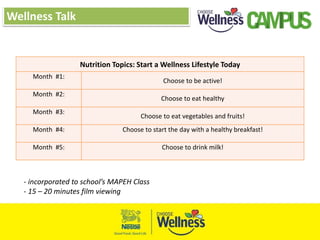
Nutrition Topics: Start a Wellness Lifestyle Today
Month #1:
Choose to be active!
Month #2:
Choose to eat healthy
Month #3:
Choose to eat vegetables and fruits!
Month #4: Choose to start the day with a healthy breakfast!
Month #5: Choose to drink milk!
- incorporated to school’s MAPEH Class
- 15 – 20 minutes film viewing
Film Viewing Activity
Wellness Talk Mechanics
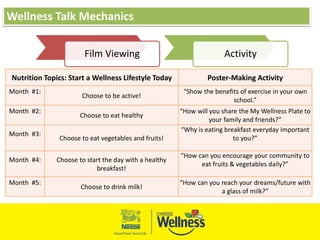
Nutrition Topics: Start a Wellness Lifestyle Today Poster-Making Activity
Month #1:
Choose to be active!
“Show the benefits of exercise in your own
school.”
Month #2:
Choose to eat healthy
“How will you share the My Wellness Plate to
your family and friends?”
Month #3:
Choose to eat vegetables and fruits!
“Why is eating breakfast everyday important
to you?”
Month #4: Choose to start the day with a healthy
breakfast!
“How can you encourage your community to
eat fruits & vegetables daily?”
Month #5:
Choose to drink milk!
“How can you reach your dreams/future with
a glass of milk?”
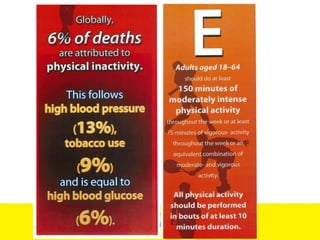
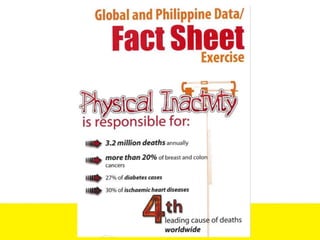
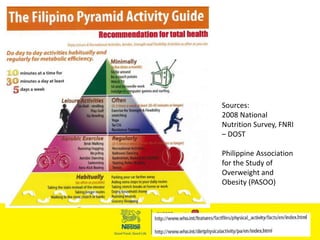
Module 1: Choose to be active!
Sources:
2008 National
Nutrition Survey, FNRI
– DOST
Philippine Association
for the Study of
Overweight and
Obesity (PASOO)
Module 5: Benefits of Exercise
• Begin 30-minute exercise program
– specific benefits:
• can strengthen heart and blood vessel
• expand the volume that the heart can deliver to tissues at each
beat reducing heart’s workload
• redistribution of body water that eases the transit of blood
through the peripheral arteries
– secondary benefits:
• raises HDL
• lowers blood pressure
• speeds weight loss and loss of body fat
• reduces emotional stress and makes you alert and active
Module 1: Choose to be active!
Exercise at least 30 minutes to 1 hour
everyday.
Module 2: Choose to eat healthy!
Nutrition Situation of Adolescents
in the Philippines
Based on 2011 National Nutrition Survey, FNRI - DOST
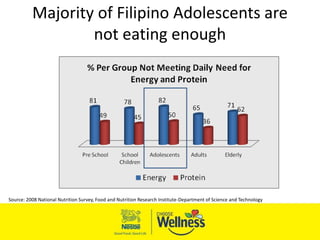
Majority of Filipino Adolescents are
not eating enough
Source: 2008 National Nutrition Survey, Food and Nutrition Research Institute-Department of Science and Technology
Majority of Filipino Adolescents are
not eating enough
Source: 2008 National Nutrition Survey, Food and Nutrition Research Institute-Department of Science and Technology
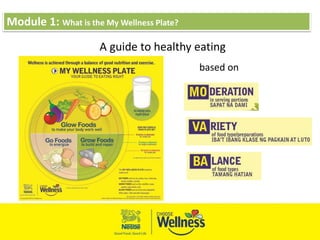
Module 1: What is the My Wellness Plate?
A guide to healthy eating
based on
Module 1: What is the My Wellness Plate?
> Glow Foods make your
body work well. (body-
regulating foods)
> Glow Foods include
fruits and vegetables
> Fruits & Vegetables are
good sources of fiber,
vitamins & minerals, and
antioxidants.
Module 1: What is the My Wellness Plate?
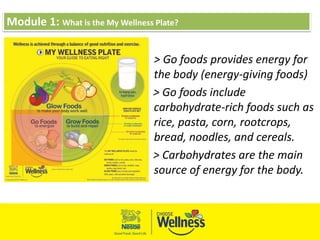
> Go foods provides energy for
the body (energy-giving foods)
> Go foods include
carbohydrate-rich foods such as
rice, pasta, corn, rootcrops,
bread, noodles, and cereals.
> Carbohydrates are the main
source of energy for the body.
Module 1: What is the My Wellness Plate?
> Grow foods build and repair
body cells and tissues (body-
building foods)
> Grow foods include protein-
rich foods such as fish, shellfish,
meat, poultry, egg, beans and
nuts.
> Proteins are complex
molecules – building block of
life made of chains of amino
acids
Module 1: What is the My Wellness Plate?
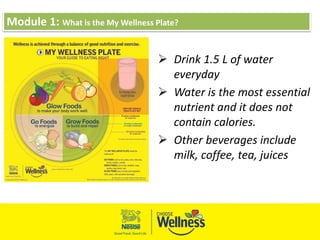
 Drink 1.5 L of water
everyday
 Water is the most essential
nutrient and it does not
contain calories.
 Other beverages include
milk, coffee, tea, juices
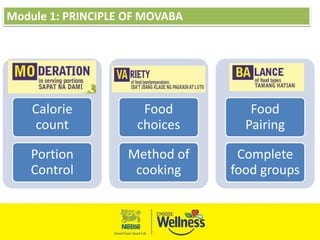
Module 1: PRINCIPLE OF MOVABA
Calorie
count
Portion
Control
Food
choices
Method of
cooking
Food
Pairing
Complete
food groups
Module 1: MY WELLNESS PLATE SAMPLE
RICE, FISH
PINAKBET & BANANA
Module 2
Importance of a healthy diet:
 Enhances general wellness
 Maintains the right body weight
 Reduces the risk to lifestyle diseases
Module 2: Choose to eat healthy!
FOLLOW THE MY WELLNESS PLATE AS
A GUIDE FOR EVERYDAY MEALS.
Module 3: Choose to eat fruits & vegetables!
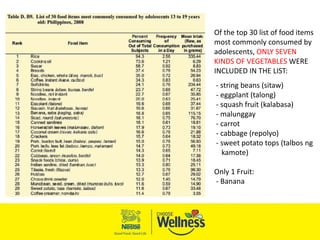
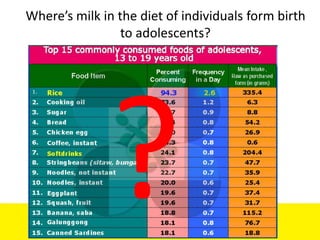
Of the top 30 list of food items
most commonly consumed by
adolescents, ONLY SEVEN
KINDS OF VEGETABLES WERE
INCLUDED IN THE LIST:
- string beans (sitaw)
- eggplant (talong)
- squash fruit (kalabasa)
- malunggay
- carrot
- cabbage (repolyo)
- sweet potato tops (talbos ng
kamote)
Only 1 Fruit:
- Banana
Module 3: Paint your plate!
Health Benefits of Eating Vegetables and Fruits
 Fruits and vegetables are low in calories and fat.
 It has vitamins and minerals that our body needs.
 It provides fiber to the diet.
 It gives flavor and texture to the food.
 It has antioxidant that helps protect the body from free
radicals that contributes to aging and other diseases.
What is the recommended serving per day?
5 –A- Day
Eat 5-9 servings of fruits and vegetables.
 Vegetable: at least 3 servings - 3 cups (cooked), 4.5 cups (raw)
 Fruits: at least 2 servings – e.g. 1 slice for big fruits like
papaya, watermelon and pineapple
Module 4: Choose to eat breakfast!
Literatures on breakfast:
• Studies on adults have shown that breakfast
intake is associated with lower body weight or
less weight gain over time.
Trends in Breakfast Consumption in the US
by Siega-Riz, A., et.al. American Journal of Clinical
Nutrition (1998)
• This is an analysis on the trend of breakfast consumption in
the US from 1965 to 1991:
– Results showed a decline in breakfast consumption from 1965 to 1991,
particularly for older adolescents aged 15 – 18 yo. (boys: 1965 (89.7%)
to 1991 (74.9%); girls: 1965 (84.4%) to 1991 (64.7%).
– Reason for the decline: change in behavior of adolescents
- Less frequent breakfast consumption is associated to rise in
obesity among adolescents.
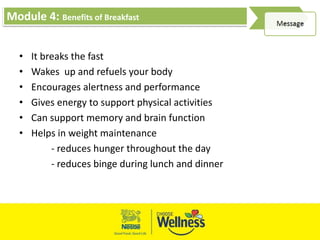
Module 4: Benefits of Breakfast
• It breaks the fast
• Wakes up and refuels your body
• Encourages alertness and performance
• Gives energy to support physical activities
• Can support memory and brain function
• Helps in weight maintenance
- reduces hunger throughout the day
- reduces binge during lunch and dinner
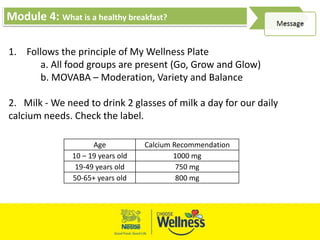
Module 4: What is a healthy breakfast?
1. Follows the principle of My Wellness Plate
a. All food groups are present (Go, Grow and Glow)
b. MOVABA – Moderation, Variety and Balance
2. Milk - We need to drink 2 glasses of milk a day for our daily
calcium needs. Check the label.
Age Calcium Recommendation
10 – 19 years old 1000 mg
19-49 years old 750 mg
50-65+ years old 800 mg
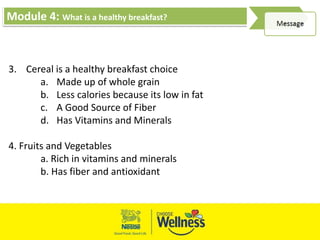
Module 4: What is a healthy breakfast?
3. Cereal is a healthy breakfast choice
a. Made up of whole grain
b. Less calories because its low in fat
c. A Good Source of Fiber
d. Has Vitamins and Minerals
4. Fruits and Vegetables
a. Rich in vitamins and minerals
b. Has fiber and antioxidant
Module 5: Choose to drink milk!
Where’s milk in the diet of individuals form birth
to adolescents?
Where’s milk in the diet of individuals form birth
to adolescents?
Where’s milk in the diet of individuals form birth
to adolescents?
Module 5: Goodness of Milk
Why Drink Milk?
• Best source of calcium, important mineral for bones, teeth
and other metabolic function. 99% of calcium is stored in
bones and teeth and the other 1% is found in blood and
tissues. When you don’t have enough calcium, blood steals
calcium from your bones.
• Has vitamins and minerals aside from calcium like protein,
vitamin A, B12, D, Potassium, phosphorus, niacin, riboflavin
• More nutritious than soy milk (soy has lower protein,
riboflavin, and has little vitamin A and D)
• Recommended for all ages
Module 5: How much milk do you need?
2 glasses every day is all you need to keep your bones and body
healthy.
Calcium Recommendation
Reference: FNRI, RENI, 2002 edition
10 – 18 years old 1000mg
19-49 years old 750 mg
50-65+ years old 800 mg
Module 5: Did you know?
• Aside from calcium, EXERCISE is important in building healthy
bones. Exercise helps activate body chemicals to deposit
calcium in our bones and to prevent osteoporosis.
• Osteoporosis a condition which the bones become fragile and
brittle, leading to a higher risk of fractures (breaks or cracks)
than in normal bone.
Risk factors are:
Low calcium intake
No exercise
Poor diet
Hereditary
Early menopause
Module 5: How to increase calcium intake?
I have lactose intolerance Try yogurt
I don’t like the taste and
smell
Try flavored milk of blend it with your
favorite fruit (smoothie)
It might make me fat Use low fat or non-fat varieties for less
calories
Low fat - <3g /100g; <1.5g/ml
Non-fat - <.5g/100g or 100ml
Other sources of calcium Sardines, small fishes with bones, dark
green vegetables like broccoli, ampalaya
Module 5:
Drink 2 glasses of milk daily and/or
consumer calcium-rich foods.

Wellness Campus Nutrition Presentation (MODULES)

  • 1.
    Program Objective: Developthe Wellness Lifestyle mindset in High School Students through education of the basics and habit formation
  • 2.
    Program Goals: • Topromote nutrition, health, and wellness through education. • To help develop physically strong and healthy youth
  • 3.
    – You willbe our Nutrition Speakers for the Wellness Campus Why are you here?
  • 4.
    Wellness Talk Nutrition Topics:Start a Wellness Lifestyle Today Month #1: Choose to be active! Month #2: Choose to eat healthy Month #3: Choose to eat vegetables and fruits! Month #4: Choose to start the day with a healthy breakfast! Month #5: Choose to drink milk! - incorporated to school’s MAPEH Class - 15 – 20 minutes film viewing
  • 5.
    Film Viewing Activity WellnessTalk Mechanics Nutrition Topics: Start a Wellness Lifestyle Today Poster-Making Activity Month #1: Choose to be active! “Show the benefits of exercise in your own school.” Month #2: Choose to eat healthy “How will you share the My Wellness Plate to your family and friends?” Month #3: Choose to eat vegetables and fruits! “Why is eating breakfast everyday important to you?” Month #4: Choose to start the day with a healthy breakfast! “How can you encourage your community to eat fruits & vegetables daily?” Month #5: Choose to drink milk! “How can you reach your dreams/future with a glass of milk?”
  • 6.
    Module 1: Chooseto be active!
  • 10.
    Sources: 2008 National Nutrition Survey,FNRI – DOST Philippine Association for the Study of Overweight and Obesity (PASOO)
  • 11.
    Module 5: Benefitsof Exercise • Begin 30-minute exercise program – specific benefits: • can strengthen heart and blood vessel • expand the volume that the heart can deliver to tissues at each beat reducing heart’s workload • redistribution of body water that eases the transit of blood through the peripheral arteries – secondary benefits: • raises HDL • lowers blood pressure • speeds weight loss and loss of body fat • reduces emotional stress and makes you alert and active
  • 12.
    Module 1: Chooseto be active! Exercise at least 30 minutes to 1 hour everyday.
  • 13.
    Module 2: Chooseto eat healthy!
  • 14.
    Nutrition Situation ofAdolescents in the Philippines Based on 2011 National Nutrition Survey, FNRI - DOST
  • 15.
    Majority of FilipinoAdolescents are not eating enough Source: 2008 National Nutrition Survey, Food and Nutrition Research Institute-Department of Science and Technology
  • 16.
    Majority of FilipinoAdolescents are not eating enough Source: 2008 National Nutrition Survey, Food and Nutrition Research Institute-Department of Science and Technology
  • 18.
    Module 1: Whatis the My Wellness Plate? A guide to healthy eating based on
  • 19.
    Module 1: Whatis the My Wellness Plate? > Glow Foods make your body work well. (body- regulating foods) > Glow Foods include fruits and vegetables > Fruits & Vegetables are good sources of fiber, vitamins & minerals, and antioxidants.
  • 20.
    Module 1: Whatis the My Wellness Plate? > Go foods provides energy for the body (energy-giving foods) > Go foods include carbohydrate-rich foods such as rice, pasta, corn, rootcrops, bread, noodles, and cereals. > Carbohydrates are the main source of energy for the body.
  • 21.
    Module 1: Whatis the My Wellness Plate? > Grow foods build and repair body cells and tissues (body- building foods) > Grow foods include protein- rich foods such as fish, shellfish, meat, poultry, egg, beans and nuts. > Proteins are complex molecules – building block of life made of chains of amino acids
  • 22.
    Module 1: Whatis the My Wellness Plate?  Drink 1.5 L of water everyday  Water is the most essential nutrient and it does not contain calories.  Other beverages include milk, coffee, tea, juices
  • 23.
    Module 1: PRINCIPLEOF MOVABA Calorie count Portion Control Food choices Method of cooking Food Pairing Complete food groups
  • 24.
    Module 1: MYWELLNESS PLATE SAMPLE RICE, FISH PINAKBET & BANANA
  • 25.
    Module 2 Importance ofa healthy diet:  Enhances general wellness  Maintains the right body weight  Reduces the risk to lifestyle diseases
  • 26.
    Module 2: Chooseto eat healthy! FOLLOW THE MY WELLNESS PLATE AS A GUIDE FOR EVERYDAY MEALS.
  • 27.
    Module 3: Chooseto eat fruits & vegetables!
  • 28.
    Of the top30 list of food items most commonly consumed by adolescents, ONLY SEVEN KINDS OF VEGETABLES WERE INCLUDED IN THE LIST: - string beans (sitaw) - eggplant (talong) - squash fruit (kalabasa) - malunggay - carrot - cabbage (repolyo) - sweet potato tops (talbos ng kamote) Only 1 Fruit: - Banana
  • 29.
    Module 3: Paintyour plate! Health Benefits of Eating Vegetables and Fruits  Fruits and vegetables are low in calories and fat.  It has vitamins and minerals that our body needs.  It provides fiber to the diet.  It gives flavor and texture to the food.  It has antioxidant that helps protect the body from free radicals that contributes to aging and other diseases. What is the recommended serving per day? 5 –A- Day Eat 5-9 servings of fruits and vegetables.  Vegetable: at least 3 servings - 3 cups (cooked), 4.5 cups (raw)  Fruits: at least 2 servings – e.g. 1 slice for big fruits like papaya, watermelon and pineapple
  • 30.
    Module 4: Chooseto eat breakfast!
  • 31.
    Literatures on breakfast: •Studies on adults have shown that breakfast intake is associated with lower body weight or less weight gain over time.
  • 32.
    Trends in BreakfastConsumption in the US by Siega-Riz, A., et.al. American Journal of Clinical Nutrition (1998) • This is an analysis on the trend of breakfast consumption in the US from 1965 to 1991: – Results showed a decline in breakfast consumption from 1965 to 1991, particularly for older adolescents aged 15 – 18 yo. (boys: 1965 (89.7%) to 1991 (74.9%); girls: 1965 (84.4%) to 1991 (64.7%). – Reason for the decline: change in behavior of adolescents - Less frequent breakfast consumption is associated to rise in obesity among adolescents.
  • 33.
    Module 4: Benefitsof Breakfast • It breaks the fast • Wakes up and refuels your body • Encourages alertness and performance • Gives energy to support physical activities • Can support memory and brain function • Helps in weight maintenance - reduces hunger throughout the day - reduces binge during lunch and dinner
  • 34.
    Module 4: Whatis a healthy breakfast? 1. Follows the principle of My Wellness Plate a. All food groups are present (Go, Grow and Glow) b. MOVABA – Moderation, Variety and Balance 2. Milk - We need to drink 2 glasses of milk a day for our daily calcium needs. Check the label. Age Calcium Recommendation 10 – 19 years old 1000 mg 19-49 years old 750 mg 50-65+ years old 800 mg
  • 35.
    Module 4: Whatis a healthy breakfast? 3. Cereal is a healthy breakfast choice a. Made up of whole grain b. Less calories because its low in fat c. A Good Source of Fiber d. Has Vitamins and Minerals 4. Fruits and Vegetables a. Rich in vitamins and minerals b. Has fiber and antioxidant
  • 36.
    Module 5: Chooseto drink milk!
  • 37.
    Where’s milk inthe diet of individuals form birth to adolescents?
  • 38.
    Where’s milk inthe diet of individuals form birth to adolescents?
  • 39.
    Where’s milk inthe diet of individuals form birth to adolescents?
  • 40.
    Module 5: Goodnessof Milk Why Drink Milk? • Best source of calcium, important mineral for bones, teeth and other metabolic function. 99% of calcium is stored in bones and teeth and the other 1% is found in blood and tissues. When you don’t have enough calcium, blood steals calcium from your bones. • Has vitamins and minerals aside from calcium like protein, vitamin A, B12, D, Potassium, phosphorus, niacin, riboflavin • More nutritious than soy milk (soy has lower protein, riboflavin, and has little vitamin A and D) • Recommended for all ages
  • 41.
    Module 5: Howmuch milk do you need? 2 glasses every day is all you need to keep your bones and body healthy. Calcium Recommendation Reference: FNRI, RENI, 2002 edition 10 – 18 years old 1000mg 19-49 years old 750 mg 50-65+ years old 800 mg
  • 42.
    Module 5: Didyou know? • Aside from calcium, EXERCISE is important in building healthy bones. Exercise helps activate body chemicals to deposit calcium in our bones and to prevent osteoporosis. • Osteoporosis a condition which the bones become fragile and brittle, leading to a higher risk of fractures (breaks or cracks) than in normal bone. Risk factors are: Low calcium intake No exercise Poor diet Hereditary Early menopause
  • 43.
    Module 5: Howto increase calcium intake? I have lactose intolerance Try yogurt I don’t like the taste and smell Try flavored milk of blend it with your favorite fruit (smoothie) It might make me fat Use low fat or non-fat varieties for less calories Low fat - <3g /100g; <1.5g/ml Non-fat - <.5g/100g or 100ml Other sources of calcium Sardines, small fishes with bones, dark green vegetables like broccoli, ampalaya
  • 44.
    Module 5: Drink 2glasses of milk daily and/or consumer calcium-rich foods.

Editor's Notes

  • #2 Age wherein they are more independent Will make their own decisions
  • #15 Emphasize that Filipino adolescents are suffering from both under and over nutrition.
  • #17 Because they are not eating enough they are deficient to important vitamins
  • #26 3 key message
  • #27 Call to action
  • #29 FNRI-NNS, 2008
  • #33 Consumption of breakfast is declining even in the US and reason is change in behaviour and lifestyle (sleeping late etc)
  • #45 Call to action