CCGPS Mathematics
Unit-by-Unit Grade Level Webinar
                   Kindergarten
          Unit 1: Counting With Friends
                          May 1, 2012
             Session will be begin at 3:15 pm
             While you are waiting, please do the following:
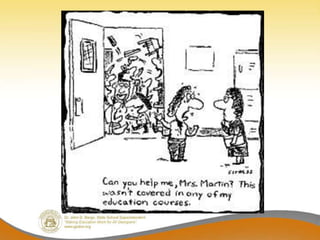
         Configure your microphone and speakers by going to:
                   Tools – Audio – Audio setup wizard
                         Document downloads:
  When you are prompted to download a document, please choose or
 create the folder to which the document should be saved, so that you
                           may retrieve it later.
Clearing up confusion
• This webinar focuses on CCGPS content specific to one grade level
and one unit within that grade.
• For information about CCGPS across a single grade span, please
access the list of recorded GPB sessions on Georgiastandards.org.
• For information about the Standards for Mathematical
Practice, please access the list of recorded Blackboard sessions from
Fall 2011 on GeorgiaStandards.org.
• CCGPS is taught and assessed from 2012-2013 and beyond. I do
not have any information on any changes to GKIDS.
• A list of resources will be provided at the end of this webinar and
this list has also been included in your document downloads.
CCGPS Mathematics
Unit-by-Unit Grade Level Webinar
                Kindergarten
       Unit 1: Counting With Friends
                    May 1, 2012

      Turtle Gunn Toms– tgunn@doe.k12.ga.us
         Elementary Mathematics Specialist

    These materials are for nonprofit educational
    purposes only. Any other use may constitute
              copyright infringement.
Welcome!
• Thank you for taking the time to join us in this
discussion of Unit 1.
• At the end of today’s session you should have at least 3
takeaways:
    The big idea of Unit 1
    Something to think about… food for thought
       How might I prepare for the start of school next year?
       What is my conceptual understanding of the material in this unit?
    a list of resources and support available for CCGPS
   mathematics
• Please provide feedback at the end of today’s session.
   Feedback helps us all to become better teachers and
   learners.
   Feedback helps as we develop the remaining unit-by-unit
   webinars.
   Please visit http://ccgpsmathematicsK-5.wikispaces.com/
   to share your feedback. This is our “baby”wiki!
• After reviewing the remaining units, please contact us
with content area focus/format suggestions for future
webinars. Wiki, anyone?
              Turtle Gunn Toms– tgunn@doe.k12.ga.us
                 Elementary Mathematics Specialist
Welcome!
• For today’s session:
    Did you read the Kindergarten mathematics
    CCGPS?
     Did you read Kindergarten Unit One?
     Make sure you download and save the documents
    from this session.
    Ask questions and share resources/ideas for the
    common good.
    Join the K-5 wiki.
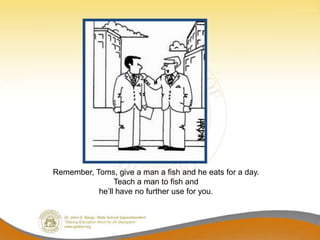
Remember, Toms, give a man a fish and he eats for a day.
                Teach a man to fish and
           he’ll have no further use for you.
Activate your Brain
When you think of 7, what do you see?
When you think of 27, what do you see?
          How about 127?
         How about 1,027?
       How about 1,000,027?
           1,000,000,027?
What’s the big idea?

• Developing deep understanding of
quantity, relationships among numbers, and
representation of number.
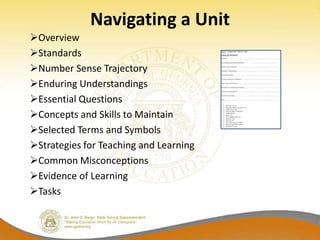
Navigating a Unit
Overview
Standards
Number Sense Trajectory
Enduring Understandings
Essential Questions
Concepts and Skills to Maintain
Selected Terms and Symbols
Strategies for Teaching and Learning
Common Misconceptions
Evidence of Learning
Tasks
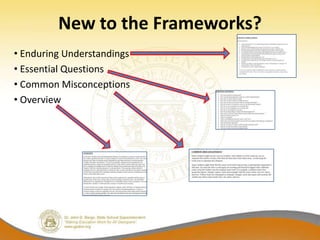
New to the Frameworks?
• Enduring Understandings
• Essential Questions
• Common Misconceptions
• Overview
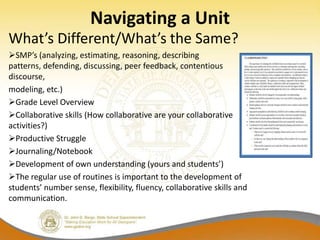
Navigating a Unit
What’s Different/What’s the Same?
SMP’s (analyzing, estimating, reasoning, describing
patterns, defending, discussing, peer feedback, contentious
discourse,
modeling, etc.)
Grade Level Overview
Collaborative skills (How collaborative are your collaborative
activities?)
Productive Struggle
Journaling/Notebook
Development of own understanding (yours and students’)
The regular use of routines is important to the development of
students’ number sense, flexibility, fluency, collaborative skills and
communication.
Navigating a Unit
Classroom Routines and Rituals
    http://www.edutopia.org/math-social-activity-
    cooperative-learning-video
    http://www.edutopia.org/math-social-activity-sel
    http://www.youtube.com/user/responsiveclassroom/vi
    deos
    http://www.responsiveclassroom.org/category/categor
    y/first-weeks-school
Navigating a Unit
Journaling
http://www.kindergartenkindergarten.com/2010/07/setting-up-
            math-problemsolving-notebooks.html
Sense-making
http://www.youtube.com/user/mitcccnyorg?feature=watch
Navigating a Unit
Mathematical Community of Learners-
 http://www.insidemathematics.org/index.php/video-tours-of-
 inside-mathematics/classroom-teachers/157-teachers-reflect-
               mathematics-teaching-practices
“Remember that we all climb the hills differently. We take
different paths, different steps, and different journeys. We
each reach landmarks in different ways and at different times.
If we push or pull children up the hill and make them practice
our steps, our ways, or, worse yet, drop them by helicopter at
points of the journey without the climb of getting there, we
may get them up the mountain - but they won’t own it. They
may reach the vista, but they won’t feel empowered by the
climb. They won’t take on the next hill in the journey. And
most important, they won’t have learned how to climb, how
to mathematize their own lived worlds. If, however, we
support their steps, work with them as young
mathematicians, the climbs and the vistas and the joys of the
journey will be theirs forever” C. Fosnot
What’s the big idea?

• Developing deep understanding of
quantity, relationships among numbers, and
representation of number.
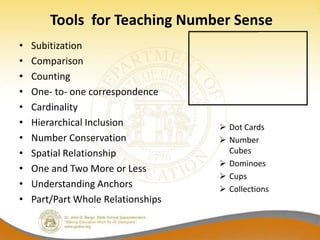
Tools for Teaching Number Sense
•   Subitization
•   Comparison
•   Counting
•   One- to- one correspondence
•   Cardinality
•   Hierarchical Inclusion           Dot Cards
•   Number Conservation              Number
•   Spatial Relationship              Cubes
                                     Dominoes
•   One and Two More or Less
                                     Cups
•   Understanding Anchors            Collections
•   Part/Part Whole Relationships
Developing Number Sense
    How do you know what they know?


http://www.youtube.com/watch?v=-bKtBXO2gNA&feature=plcp

http://www.youtube.com/watch?v=HZdH6t7thfU&feature=plcp
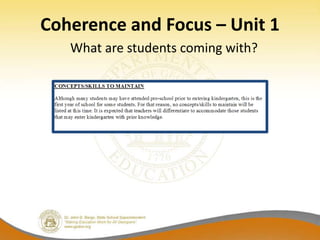
Coherence and Focus – Unit 1
   What are students coming with?
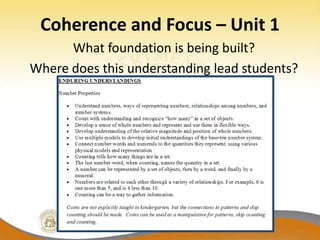
Coherence and Focus – Unit 1
      What foundation is being built?
Where does this understanding lead students?
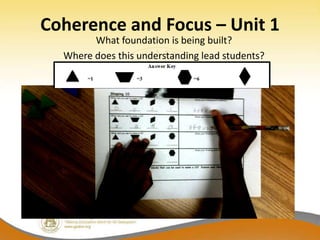
Coherence and Focus – Unit 1
        What foundation is being built?
  Where does this understanding lead students?
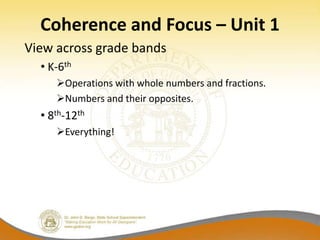
Coherence and Focus – Unit 1
View across grade bands
  • K-6th
     Operations with whole numbers and fractions.
     Numbers and their opposites.
  • 8th-12th
     Everything!
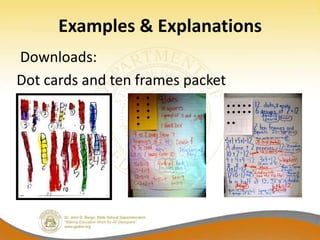
Examples & Explanations
Downloads:
Dot cards and ten frames packet
Examples & Explanations

http://secc.sedl.org/common_core_videos/

http://gradekcommoncoremath.hcpss.wikispaces.net
/Rekenreks
Assessment
               How might it look?
Examples of how balanced assessments can be
assembled.
  http://map.mathshell.org/materials/tests.php
  The target audience for these sample assessments :
     1. teachers who have already begun work with
        mathematical practice standards
     2. designers of future CCSSM-aligned assessments
         http://map.mathshell.org/materials/pd.php
      (while you are at it, have a look at their Professional Learning!)
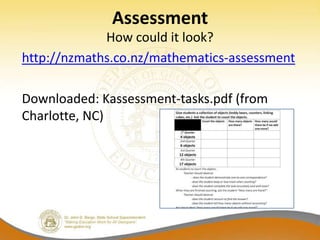
Assessment
             How could it look?
http://nzmaths.co.nz/mathematics-assessment

Downloaded: Kassessment-tasks.pdf (from
Charlotte, NC)
Resource List
The following list is provided as a sample of
available resources and is for informational
purposes only. It is your responsibility to
investigate them to determine their value and
appropriateness for your district. GaDOE does
not endorse or recommend the purchase of or
use of any particular resource.
Resources
• Common Core Resources
    SEDL videos - https://www.georgiastandards.org/Common-
   Core/Pages/Math.aspx or http://secc.sedl.org/common_core_videos/
    Illustrative Mathematics - http://www.illustrativemathematics.org/
    Dana Center's CCSS Toolbox - http://www.ccsstoolbox.com/
    Arizona DOE - http://www.azed.gov/standards-practices/mathematics-
   standards/
    Ohio DOE -
   http://www.ode.state.oh.us/GD/Templates/Pages/ODE/ODEPrimary.aspx?pa
   ge=2&TopicRelationID=1704
    Inside Mathematics- http://www.insidemathematics.org/
    Common Core Standards - http://www.corestandards.org/
    Tools for the Common Core Standards - http://commoncoretools.me/
    Phil Daro talks about the Common Core Mathematics Standards -
   http://serpmedia.org/daro-talks/index.html
Resources
• Books
   Van De Walle and Lovin, Teaching Student-Centered
    Mathematics, K-3
   Fosnot and Dolk, Young Mathematicians at Work
   Wright, et al, Teaching Number in the Classroom
   Wright, et al, Early Numeracy
   Parrish, Number Talks
   Clements and Sarama, Learning and Teaching Early Math
   Shumway, Number Sense Routines (preview!)
   Wedekind, Math Exchanges (preview!)
Resources
• Professional Learning Resources
    Inside Mathematics- http://www.insidemathematics.org/
    Edutopia – http://www.edutopia.org
    Teaching Channel - http://www.teachingchannel.org
   Annenberg Learner - http://www.learner.org/resources/series32.html


• Assessment Resources
    MARS - http://www.nottingham.ac.uk/~ttzedweb/MARS/
    MAP - http://www.map.mathshell.org.uk/materials/index.php
    PARCC - http://www.parcconline.org/parcc-states
Phil Daro says:
it’s just the easy part to design and write something down.
The hard part comes… with putting them to work.
And the users have ultimate control over how they’re used.
So no matter how well designed the tool is – the user has control.
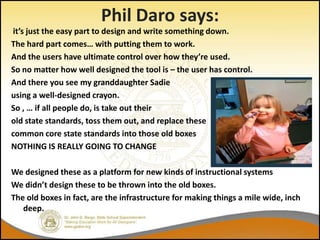
And there you see my granddaughter Sadie
using a well-designed crayon.
So , … if all people do, is take out their
old state standards, toss them out, and replace these
common core state standards into those old boxes
NOTHING IS REALLY GOING TO CHANGE

We designed these as a platform for new kinds of instructional systems
We didn’t design these to be thrown into the old boxes.
The old boxes in fact, are the infrastructure for making things a mile wide, inch
   deep.
As you start your day tomorrow…
Who dares to teach must never cease to learn ~ John Cotton Dana


       http://www.youtube.com/watch?v=JEa0xpWi7C4
Thank You!
  Please visit http://ccgpsmathematicsK-5.wikispaces.com/ to provide us
                            with your feedback!


                       Turtle Gunn Toms
                    Program Specialist (K-5)
                     tgunn@doe.k12.ga.us

 These materials are for nonprofit educational purposes
only. Any other use may constitute copyright infringement.

Math Unit 1 Webinar

  • 1.
    CCGPS Mathematics Unit-by-Unit GradeLevel Webinar Kindergarten Unit 1: Counting With Friends May 1, 2012 Session will be begin at 3:15 pm While you are waiting, please do the following: Configure your microphone and speakers by going to: Tools – Audio – Audio setup wizard Document downloads: When you are prompted to download a document, please choose or create the folder to which the document should be saved, so that you may retrieve it later.
  • 2.
    Clearing up confusion •This webinar focuses on CCGPS content specific to one grade level and one unit within that grade. • For information about CCGPS across a single grade span, please access the list of recorded GPB sessions on Georgiastandards.org. • For information about the Standards for Mathematical Practice, please access the list of recorded Blackboard sessions from Fall 2011 on GeorgiaStandards.org. • CCGPS is taught and assessed from 2012-2013 and beyond. I do not have any information on any changes to GKIDS. • A list of resources will be provided at the end of this webinar and this list has also been included in your document downloads.
  • 3.
    CCGPS Mathematics Unit-by-Unit GradeLevel Webinar Kindergarten Unit 1: Counting With Friends May 1, 2012 Turtle Gunn Toms– tgunn@doe.k12.ga.us Elementary Mathematics Specialist These materials are for nonprofit educational purposes only. Any other use may constitute copyright infringement.
  • 4.
    Welcome! • Thank youfor taking the time to join us in this discussion of Unit 1. • At the end of today’s session you should have at least 3 takeaways:  The big idea of Unit 1  Something to think about… food for thought  How might I prepare for the start of school next year?  What is my conceptual understanding of the material in this unit?  a list of resources and support available for CCGPS mathematics
  • 5.
    • Please providefeedback at the end of today’s session. Feedback helps us all to become better teachers and learners. Feedback helps as we develop the remaining unit-by-unit webinars. Please visit http://ccgpsmathematicsK-5.wikispaces.com/ to share your feedback. This is our “baby”wiki! • After reviewing the remaining units, please contact us with content area focus/format suggestions for future webinars. Wiki, anyone? Turtle Gunn Toms– tgunn@doe.k12.ga.us Elementary Mathematics Specialist
  • 6.
    Welcome! • For today’ssession: Did you read the Kindergarten mathematics CCGPS?  Did you read Kindergarten Unit One?  Make sure you download and save the documents from this session. Ask questions and share resources/ideas for the common good. Join the K-5 wiki.
  • 7.
    Remember, Toms, givea man a fish and he eats for a day. Teach a man to fish and he’ll have no further use for you.
  • 8.
    Activate your Brain Whenyou think of 7, what do you see? When you think of 27, what do you see? How about 127? How about 1,027? How about 1,000,027? 1,000,000,027?
  • 9.
    What’s the bigidea? • Developing deep understanding of quantity, relationships among numbers, and representation of number.
  • 10.
    Navigating a Unit Overview Standards NumberSense Trajectory Enduring Understandings Essential Questions Concepts and Skills to Maintain Selected Terms and Symbols Strategies for Teaching and Learning Common Misconceptions Evidence of Learning Tasks
  • 11.
    New to theFrameworks? • Enduring Understandings • Essential Questions • Common Misconceptions • Overview
  • 12.
    Navigating a Unit What’sDifferent/What’s the Same? SMP’s (analyzing, estimating, reasoning, describing patterns, defending, discussing, peer feedback, contentious discourse, modeling, etc.) Grade Level Overview Collaborative skills (How collaborative are your collaborative activities?) Productive Struggle Journaling/Notebook Development of own understanding (yours and students’) The regular use of routines is important to the development of students’ number sense, flexibility, fluency, collaborative skills and communication.
  • 13.
    Navigating a Unit ClassroomRoutines and Rituals http://www.edutopia.org/math-social-activity- cooperative-learning-video http://www.edutopia.org/math-social-activity-sel http://www.youtube.com/user/responsiveclassroom/vi deos http://www.responsiveclassroom.org/category/categor y/first-weeks-school
  • 14.
    Navigating a Unit Journaling http://www.kindergartenkindergarten.com/2010/07/setting-up- math-problemsolving-notebooks.html Sense-making http://www.youtube.com/user/mitcccnyorg?feature=watch
  • 15.
    Navigating a Unit MathematicalCommunity of Learners- http://www.insidemathematics.org/index.php/video-tours-of- inside-mathematics/classroom-teachers/157-teachers-reflect- mathematics-teaching-practices
  • 16.
    “Remember that weall climb the hills differently. We take different paths, different steps, and different journeys. We each reach landmarks in different ways and at different times. If we push or pull children up the hill and make them practice our steps, our ways, or, worse yet, drop them by helicopter at points of the journey without the climb of getting there, we may get them up the mountain - but they won’t own it. They may reach the vista, but they won’t feel empowered by the climb. They won’t take on the next hill in the journey. And most important, they won’t have learned how to climb, how to mathematize their own lived worlds. If, however, we support their steps, work with them as young mathematicians, the climbs and the vistas and the joys of the journey will be theirs forever” C. Fosnot
  • 18.
    What’s the bigidea? • Developing deep understanding of quantity, relationships among numbers, and representation of number.
  • 19.
    Tools for TeachingNumber Sense • Subitization • Comparison • Counting • One- to- one correspondence • Cardinality • Hierarchical Inclusion  Dot Cards • Number Conservation  Number • Spatial Relationship Cubes  Dominoes • One and Two More or Less  Cups • Understanding Anchors  Collections • Part/Part Whole Relationships
  • 20.
    Developing Number Sense How do you know what they know? http://www.youtube.com/watch?v=-bKtBXO2gNA&feature=plcp http://www.youtube.com/watch?v=HZdH6t7thfU&feature=plcp
  • 21.
    Coherence and Focus– Unit 1 What are students coming with?
  • 22.
    Coherence and Focus– Unit 1 What foundation is being built? Where does this understanding lead students?
  • 23.
    Coherence and Focus– Unit 1 What foundation is being built? Where does this understanding lead students?
  • 24.
    Coherence and Focus– Unit 1 View across grade bands • K-6th Operations with whole numbers and fractions. Numbers and their opposites. • 8th-12th Everything!
  • 25.
    Examples & Explanations Downloads: Dotcards and ten frames packet
  • 26.
  • 27.
    Assessment How might it look? Examples of how balanced assessments can be assembled. http://map.mathshell.org/materials/tests.php The target audience for these sample assessments : 1. teachers who have already begun work with mathematical practice standards 2. designers of future CCSSM-aligned assessments http://map.mathshell.org/materials/pd.php (while you are at it, have a look at their Professional Learning!)
  • 28.
    Assessment How could it look? http://nzmaths.co.nz/mathematics-assessment Downloaded: Kassessment-tasks.pdf (from Charlotte, NC)
  • 29.
    Resource List The followinglist is provided as a sample of available resources and is for informational purposes only. It is your responsibility to investigate them to determine their value and appropriateness for your district. GaDOE does not endorse or recommend the purchase of or use of any particular resource.
  • 30.
    Resources • Common CoreResources  SEDL videos - https://www.georgiastandards.org/Common- Core/Pages/Math.aspx or http://secc.sedl.org/common_core_videos/  Illustrative Mathematics - http://www.illustrativemathematics.org/  Dana Center's CCSS Toolbox - http://www.ccsstoolbox.com/  Arizona DOE - http://www.azed.gov/standards-practices/mathematics- standards/  Ohio DOE - http://www.ode.state.oh.us/GD/Templates/Pages/ODE/ODEPrimary.aspx?pa ge=2&TopicRelationID=1704  Inside Mathematics- http://www.insidemathematics.org/  Common Core Standards - http://www.corestandards.org/  Tools for the Common Core Standards - http://commoncoretools.me/  Phil Daro talks about the Common Core Mathematics Standards - http://serpmedia.org/daro-talks/index.html
  • 31.
    Resources • Books  Van De Walle and Lovin, Teaching Student-Centered Mathematics, K-3  Fosnot and Dolk, Young Mathematicians at Work  Wright, et al, Teaching Number in the Classroom  Wright, et al, Early Numeracy  Parrish, Number Talks  Clements and Sarama, Learning and Teaching Early Math  Shumway, Number Sense Routines (preview!)  Wedekind, Math Exchanges (preview!)
  • 32.
    Resources • Professional LearningResources  Inside Mathematics- http://www.insidemathematics.org/  Edutopia – http://www.edutopia.org  Teaching Channel - http://www.teachingchannel.org Annenberg Learner - http://www.learner.org/resources/series32.html • Assessment Resources  MARS - http://www.nottingham.ac.uk/~ttzedweb/MARS/  MAP - http://www.map.mathshell.org.uk/materials/index.php  PARCC - http://www.parcconline.org/parcc-states
  • 33.
    Phil Daro says: it’sjust the easy part to design and write something down. The hard part comes… with putting them to work. And the users have ultimate control over how they’re used. So no matter how well designed the tool is – the user has control. And there you see my granddaughter Sadie using a well-designed crayon. So , … if all people do, is take out their old state standards, toss them out, and replace these common core state standards into those old boxes NOTHING IS REALLY GOING TO CHANGE We designed these as a platform for new kinds of instructional systems We didn’t design these to be thrown into the old boxes. The old boxes in fact, are the infrastructure for making things a mile wide, inch deep.
  • 34.
    As you startyour day tomorrow… Who dares to teach must never cease to learn ~ John Cotton Dana http://www.youtube.com/watch?v=JEa0xpWi7C4
  • 35.
    Thank You! Please visit http://ccgpsmathematicsK-5.wikispaces.com/ to provide us with your feedback! Turtle Gunn Toms Program Specialist (K-5) tgunn@doe.k12.ga.us These materials are for nonprofit educational purposes only. Any other use may constitute copyright infringement.