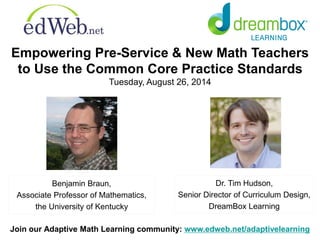



Empowering Pre-Service & New Math Teachers 
to Use the Common Core Practice Standards 
Tuesday, August 26, 2014 
Dr. Tim Hudson, 
Senior Director of Curriculum Design, 
DreamBox Learning 
Benjamin Braun, 
Associate Professor of Mathematics, 
the University of Kentucky 
Join our Adaptive Math Learning community: www.edweb.net/adaptivelearning
Join our community 
Adaptive Math Learning 
www.edweb.net/adaptivelearning 
• Invitations to upcoming webinars 
• Webinar archives and resources 
• Online discussions 
• CE quizzes for archived webinars 
The recording, slides, and 
chat log will be posted in the 
Webinar Archives folder of 
the Community Toolbox.
Webinar Tips 
• For better audio/video, close other applications 
(like Skype) that use bandwidth. 
• Maximize your screen for a larger view by using 
the link in the upper right corner. 
• A CE certificate for today’s webinar will be emailed 
to you 24 hours after the live session. 
• If you are viewing this as a recording, you will 
need to take the CE quiz located in the Webinar 
Archives folder of the Community Toolbox. 
• Tweeting? Use #edwebchat
Empowering Pre-Service & 
New Math Teachers to Use the 
Common Core Practice 
Standards 
August 26, 2014
Benjamin Braun, PhD 
Associate Professor of Mathematics, U of Kentucky 
Editor-in-Chief, American Mathematical Society blog “On 
Teaching and Learning Mathematics” 
Twitter: @BraunMath 
Tim Hudson, PhD 
Senior Director of Curriculum Design, DreamBox Learning 
Former K-12 Mathematics Curriculum Coordinator, 
Parkway School District 
Twitter: @DocHudsonMath
1970-1990 
• “Back to basics” movements in 1970s led to 
influential reports arguing in favor of balance 
between conceptual and procedural 
understanding: 
o A Nation at Risk (1983, NCEE) 
o An Agenda for Action (1980, NCTM) 
• NCTM Standards released in 1989.
2000-2001 
• Role of standards-based assessment increased in 
early 2000’s with No Child Left Behind. 
• At the same time, updated NCTM Standards 
released in 2000, and National Research Council 
report Adding It Up released in 2001.
2004 
• Must read: “The Math Wars,” Alan H. 
Schoenfeld, Educational Policy, Vol. 18 No. 1, 
January and March 2004, pp. 253-286. (PDF 
versions available online.)
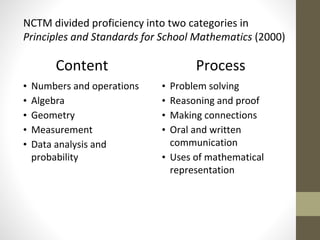
NCTM divided proficiency into two categories in 
Principles and Standards for School Mathematics (2000) 
Content 
• Numbers and operations 
• Algebra 
• Geometry 
• Measurement 
• Data analysis and 
probability 
Process 
• Problem solving 
• Reasoning and proof 
• Making connections 
• Oral and written 
communication 
• Uses of mathematical 
representation
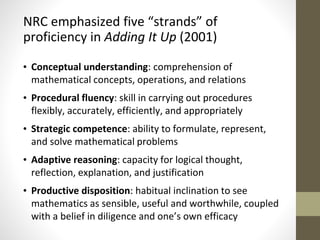
NRC emphasized five “strands” of 
proficiency in Adding It Up (2001) 
• Conceptual understanding: comprehension of 
mathematical concepts, operations, and relations 
• Procedural fluency: skill in carrying out procedures 
flexibly, accurately, efficiently, and appropriately 
• Strategic competence: ability to formulate, represent, 
and solve mathematical problems 
• Adaptive reasoning: capacity for logical thought, 
reflection, explanation, and justification 
• Productive disposition: habitual inclination to see 
mathematics as sensible, useful and worthwhile, coupled 
with a belief in diligence and one’s own efficacy
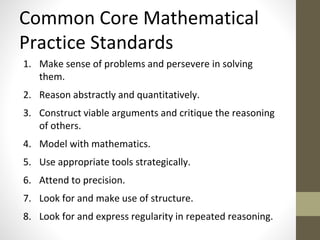
Common Core Mathematical 
Practice Standards 
1. Make sense of problems and persevere in solving 
them. 
2. Reason abstractly and quantitatively. 
3. Construct viable arguments and critique the reasoning 
of others. 
4. Model with mathematics. 
5. Use appropriate tools strategically. 
6. Attend to precision. 
7. Look for and make use of structure. 
8. Look for and express regularity in repeated reasoning.
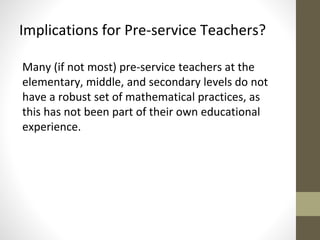
Implications for Pre-service Teachers? 
Many (if not most) pre-service teachers at the 
elementary, middle, and secondary levels do not 
have a robust set of mathematical practices, as 
this has not been part of their own educational 
experience.
Implications for Pre-service Teachers? 
This creates a disconnect between content and 
methods courses, and also between pre-service 
coursework and in-service curriculum and 
assessment expectations.
Implications for Pre-service Teachers? 
Teacher educators, including faculty teaching both 
methods and content courses, need to ensure that 
pre-service teachers enter the beginning of their 
careers with an understanding that mathematical 
proficiency extends beyond content.
Implications for Pre-service Teachers? 
Challenges to incorporating practices in pre-service 
teacher courses include balancing 
practices and content, effectively training college 
faculty (including adjuncts and TAs), and building 
quality connections between content and 
methods instructors so these courses articulate 
well.
Implications for Pre-service Teachers? 
Even in non-CCSS states, the NRC and NCTM 
reports of the past 30+ years have had a major 
impact on curriculum and assessment, so this 
matters even in non-CCSS states.
Implications for Year 1-3 Teachers? 
In situations where there has been inadequate 
Pre-Service training for mathematics teachers, 
new teachers need even more content-specific 
support.
Implications for Year 1-3 Teachers? 
Many schools, districts, and states do not have 
adequate mathematics curriculum leadership to 
support new math teachers in content-specific 
ways.
Implications for Year 1-3 Teachers? 
New teacher induction and PD often emphasizes 
other aspects of teaching instead of curriculum 
(i.e., classroom management, parent 
communication, or building culture).
Implications for Year 1-3 Teachers? 
What are math teachers hired to accomplish? 
What is mathematics? 
How do people learn mathematics?
Grant Wiggins 
What’s the job of a teacher? 
The crying need for a genuine job 
description. 
grantwiggins.wordpress.com 7-25-14
Grant Wiggins 
“A real job description would be 
written around key learning goals and 
Mission-related outcomes. 
• What am I expected to cause in students? 
• What am I supposed to accomplish? 
Whatever the answer, that’s my job.” 
grantwiggins.wordpress.com 7-25-14
Must Cause 4 Things in Learners 
1. greater interest in the subject 
and in learning than was there 
before, as determined by 
observations, surveys, and client 
feedback 
grantwiggins.wordpress.com 7-25-14
Must Cause 4 Things in Learners 
2. successful learning related to 
key course goals, as reflected in 
mutually agreed-upon evidence 
grantwiggins.wordpress.com 7-25-14
Must Cause 4 Things in Learners 
3. greater confidence and feelings 
of efficacy as revealed by 
student behavior and reports 
(and as eventually reflected in 
improved results) 
grantwiggins.wordpress.com 7-25-14
Must Cause 4 Things in Learners 
4. a passion and intellectual 
direction in each learner as 
determined by student-initiated 
pursuits, observations, surveys, 
and behavior. 
grantwiggins.wordpress.com 7-25-14
Does Your Mission Obligate 
Teachers to Achieve these Goals? 
Do Teachers Hired at Your School 
Know these are their Goals? 
Do Teachers Receive Feedback about 
how well they’ve Achieved these Goals? 
1. greater interest than was there before 
2. successful learning related to key goals 
3. greater confidence and feelings of efficacy 
4. a passion and intellectual direction 
grantwiggins.wordpress.com 7-25-14
Two ways to incorporate mathematical 
practices in teacher training and 
professional development
Using Writing Assignments 
Pre-service teachers need to write and discuss 
mathematical practices explicitly in content 
courses. This can’t be “left to the methods 
courses” to handle, there must be a dialogue.
Using Writing Assignments 
One of the best tools we have for this task is 
writing assignments. 
• Personal writing, e.g reflective essays 
• Expository writing, e.g. report on good 
contact/practices contact points 
• Critical writing, e.g. analyzing practices of 
peers
Example of a Personal Essay Prompt 
There are eight Standards for Mathematical Practice in the 
Common Core State Standards for Mathematics. Select at least 
three of these standards to consider. For each of the standards 
that you select, discuss a situation where you have observed one 
of your classmates demonstrating that practice in their work. 
This situation might have arisen from in-class group work, from 
working with a study group on homework, from hallway 
discussions of a problem, etc, but you should discuss a moment 
when your classmate was using one of these practices when 
working on a mathematical problem. You should explicitly 
connect each situation with the written description of the related 
practice standard given in the Common Core.
Low-threshold high-ceiling problems 
• Nothing is better than doing mathematics while 
receiving quality feedback for developing good 
mathematical practices, which teachers must 
have if they are to help others develop them. 
• Students need to engage with low-threshold-high- 
ceiling (LTHC) problems. 
• Open (unsolved) problems in math are a great 
source of LTHC problems!
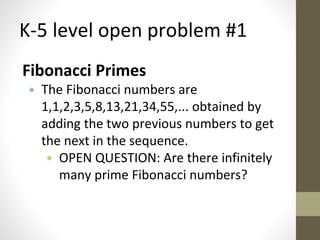
K-5 level open problem #1 
Fibonacci Primes 
• The Fibonacci numbers are 
1,1,2,3,5,8,13,21,34,55,... obtained by 
adding the two previous numbers to get 
the next in the sequence. 
• OPEN QUESTION: Are there infinitely 
many prime Fibonacci numbers?
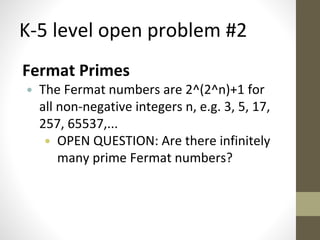
K-5 level open problem #2 
Fermat Primes 
• The Fermat numbers are 2^(2^n)+1 for 
all non-negative integers n, e.g. 3, 5, 17, 
257, 65537,... 
• OPEN QUESTION: Are there infinitely 
many prime Fermat numbers?
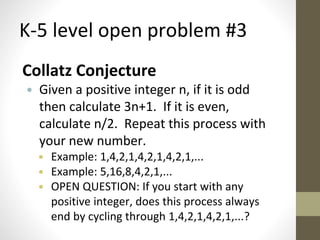
K-5 level open problem #3 
Collatz Conjecture 
• Given a positive integer n, if it is odd 
then calculate 3n+1. If it is even, 
calculate n/2. Repeat this process with 
your new number. 
• Example: 1,4,2,1,4,2,1,4,2,1,... 
• Example: 5,16,8,4,2,1,... 
• OPEN QUESTION: If you start with any 
positive integer, does this process always 
end by cycling through 1,4,2,1,4,2,1,...?
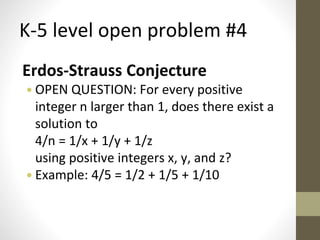
K-5 level open problem #4 
Erdos-Strauss Conjecture 
• OPEN QUESTION: For every positive 
integer n larger than 1, does there exist a 
solution to 
4/n = 1/x + 1/y + 1/z 
using positive integers x, y, and z? 
• Example: 4/5 = 1/2 + 1/5 + 1/10
Higher-level open problems 
• Parity of the partition function 
• Irrationality of Euler-Mascheroni constant 
• Lagarias’s reformulation of the Riemann 
Hypothesis 
Many more are available at: 
http://en.wikipedia.org/wiki/List_of_conjectures
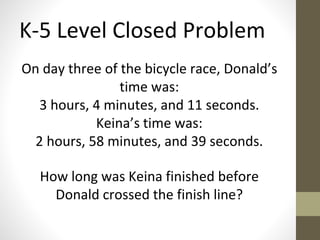
K-5 Level Closed Problem 
On day three of the bicycle race, Donald’s 
time was: 
3 hours, 4 minutes, and 11 seconds. 
Keina’s time was: 
2 hours, 58 minutes, and 39 seconds. 
How long was Keina finished before 
Donald crossed the finish line?
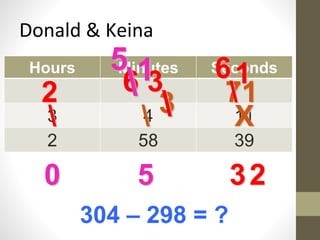
Donald & Keina 
61 
Hours Minutes Seconds 
71 
6 3 
 3 X 
3 4 11 
2 58 39 
3 
 2 
 
5 1 
0 5 2 
304 – 298 = ?
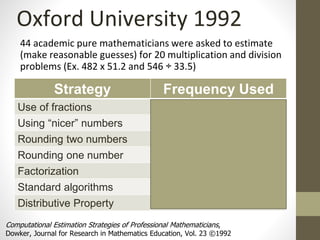
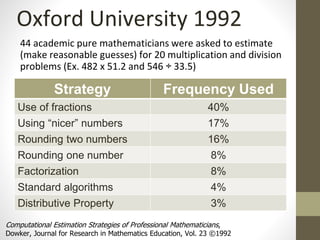
Oxford University 1992 
44 academic pure mathematicians were asked to estimate 
(make reasonable guesses) for 20 multiplication and division 
problems (Ex. 482 x 51.2 and 546 ÷ 33.5) 
Strategy Frequency Used 
Use of fractions 40% 
Using “nicer” numbers 17% 
Rounding two numbers 16% 
Rounding one number 8% 
Factorization 8% 
Standard algorithms 4% 
Distributive Property 3% 
Computational Estimation Strategies of Professional Mathematicians, 
Dowker, Journal for Research in Mathematics Education, Vol. 23 ©1992
Oxford University 1992 
44 academic pure mathematicians were asked to estimate 
(make reasonable guesses) for 20 multiplication and division 
problems (Ex. 482 x 51.2 and 546 ÷ 33.5) 
Strategy Frequency Used 
Use of fractions 40% 
Using “nicer” numbers 17% 
Rounding two numbers 16% 
Rounding one number 8% 
Factorization 8% 
Standard algorithms 4% 
Distributive Property 3% 
Computational Estimation Strategies of Professional Mathematicians, 
Dowker, Journal for Research in Mathematics Education, Vol. 23 ©1992
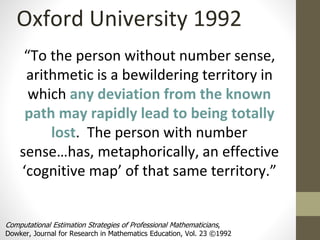
Oxford University 1992 
“To the person without number sense, 
arithmetic is a bewildering territory in 
which any deviation from the known 
path may rapidly lead to being totally 
lost. The person with number 
sense…has, metaphorically, an effective 
‘cognitive map’ of that same territory.” 
Computational Estimation Strategies of Professional Mathematicians, 
Dowker, Journal for Research in Mathematics Education, Vol. 23 ©1992
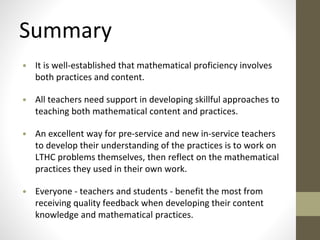
Summary 
• It is well-established that mathematical proficiency involves 
both practices and content. 
• All teachers need support in developing skillful approaches to 
teaching both mathematical content and practices. 
• An excellent way for pre-service and new in-service teachers 
to develop their understanding of the practices is to work on 
LTHC problems themselves, then reflect on the mathematical 
practices they used in their own work. 
• Everyone - teachers and students - benefit the most from 
receiving quality feedback when developing their content 
knowledge and mathematical practices.
Q & A
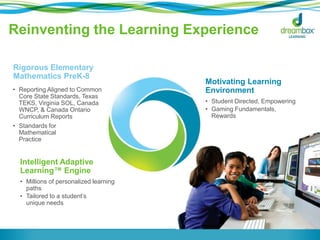
Reinventing the Learning Experience 
Intelligent Adaptive 
Learning™ Engine 
• Millions of personalized learning 
paths 
• Tailored to a student’s 
unique needs 
Motivating Learning 
Environment 
• Student Directed, Empowering 
• Gaming Fundamentals, 
Rewards 
Rigorous Elementary 
Mathematics PreK-8 
• Reporting Aligned to Common 
Core State Standards, Texas 
TEKS, Virginia SOL, Canada 
WNCP, & Canada Ontario 
Curriculum Reports 
• Standards for 
Mathematical 
Practice
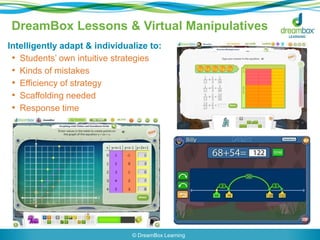
DreamBox Lessons & Virtual Manipulatives 
Intelligently adapt & individualize to: 
• Students’ own intuitive strategies 
• Kinds of mistakes 
• Efficiency of strategy 
• Scaffolding needed 
• Response time 
© DreamBox Learning
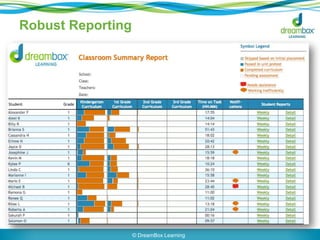
Robust Reporting 
© DreamBox Learning
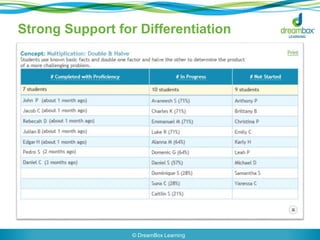
Strong Support for Differentiation 
© DreamBox Learning
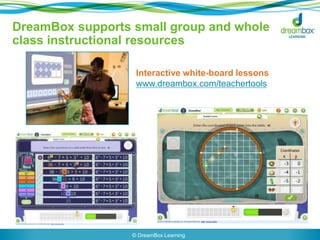
DreamBox supports small group and whole 
class instructional resources 
Interactive white-board lessons 
www.dreambox.com/teachertools 
© DreamBox Learning
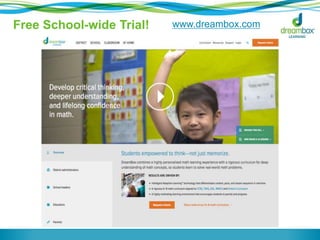
Free School-wide Trial! www.dreambox.com
Thank you!
Join our community 
Adaptive Math Learning 
www.edweb.net/adaptivelearning 
• Invitations to upcoming webinars 
• Webinar archives and resources 
• Online discussions 
• CE quizzes for archived webinars 
The recording, slides, and 
chat log will be posted in the 
Webinar Archives folder of 
the Community Toolbox.
Thank you to our sponsor: 
www.dreambox.com
Stay tuned for information on upcoming webinars! 
Join our Adaptive Math Learning community for an invitation: 
www.edweb.net/adaptivelearning

Empowering Pre-Service & New Math Teachers to Use the Common Core Practice Standards

  • 1.
    Empowering Pre-Service &New Math Teachers to Use the Common Core Practice Standards Tuesday, August 26, 2014 Dr. Tim Hudson, Senior Director of Curriculum Design, DreamBox Learning Benjamin Braun, Associate Professor of Mathematics, the University of Kentucky Join our Adaptive Math Learning community: www.edweb.net/adaptivelearning
  • 2.
    Join our community Adaptive Math Learning www.edweb.net/adaptivelearning • Invitations to upcoming webinars • Webinar archives and resources • Online discussions • CE quizzes for archived webinars The recording, slides, and chat log will be posted in the Webinar Archives folder of the Community Toolbox.
  • 3.
    Webinar Tips •For better audio/video, close other applications (like Skype) that use bandwidth. • Maximize your screen for a larger view by using the link in the upper right corner. • A CE certificate for today’s webinar will be emailed to you 24 hours after the live session. • If you are viewing this as a recording, you will need to take the CE quiz located in the Webinar Archives folder of the Community Toolbox. • Tweeting? Use #edwebchat
  • 4.
    Empowering Pre-Service & New Math Teachers to Use the Common Core Practice Standards August 26, 2014
  • 5.
    Benjamin Braun, PhD Associate Professor of Mathematics, U of Kentucky Editor-in-Chief, American Mathematical Society blog “On Teaching and Learning Mathematics” Twitter: @BraunMath Tim Hudson, PhD Senior Director of Curriculum Design, DreamBox Learning Former K-12 Mathematics Curriculum Coordinator, Parkway School District Twitter: @DocHudsonMath
  • 6.
    1970-1990 • “Backto basics” movements in 1970s led to influential reports arguing in favor of balance between conceptual and procedural understanding: o A Nation at Risk (1983, NCEE) o An Agenda for Action (1980, NCTM) • NCTM Standards released in 1989.
  • 7.
    2000-2001 • Roleof standards-based assessment increased in early 2000’s with No Child Left Behind. • At the same time, updated NCTM Standards released in 2000, and National Research Council report Adding It Up released in 2001.
  • 8.
    2004 • Mustread: “The Math Wars,” Alan H. Schoenfeld, Educational Policy, Vol. 18 No. 1, January and March 2004, pp. 253-286. (PDF versions available online.)
  • 9.
    NCTM divided proficiencyinto two categories in Principles and Standards for School Mathematics (2000) Content • Numbers and operations • Algebra • Geometry • Measurement • Data analysis and probability Process • Problem solving • Reasoning and proof • Making connections • Oral and written communication • Uses of mathematical representation
  • 10.
    NRC emphasized five“strands” of proficiency in Adding It Up (2001) • Conceptual understanding: comprehension of mathematical concepts, operations, and relations • Procedural fluency: skill in carrying out procedures flexibly, accurately, efficiently, and appropriately • Strategic competence: ability to formulate, represent, and solve mathematical problems • Adaptive reasoning: capacity for logical thought, reflection, explanation, and justification • Productive disposition: habitual inclination to see mathematics as sensible, useful and worthwhile, coupled with a belief in diligence and one’s own efficacy
  • 11.
    Common Core Mathematical Practice Standards 1. Make sense of problems and persevere in solving them. 2. Reason abstractly and quantitatively. 3. Construct viable arguments and critique the reasoning of others. 4. Model with mathematics. 5. Use appropriate tools strategically. 6. Attend to precision. 7. Look for and make use of structure. 8. Look for and express regularity in repeated reasoning.
  • 12.
    Implications for Pre-serviceTeachers? Many (if not most) pre-service teachers at the elementary, middle, and secondary levels do not have a robust set of mathematical practices, as this has not been part of their own educational experience.
  • 13.
    Implications for Pre-serviceTeachers? This creates a disconnect between content and methods courses, and also between pre-service coursework and in-service curriculum and assessment expectations.
  • 14.
    Implications for Pre-serviceTeachers? Teacher educators, including faculty teaching both methods and content courses, need to ensure that pre-service teachers enter the beginning of their careers with an understanding that mathematical proficiency extends beyond content.
  • 15.
    Implications for Pre-serviceTeachers? Challenges to incorporating practices in pre-service teacher courses include balancing practices and content, effectively training college faculty (including adjuncts and TAs), and building quality connections between content and methods instructors so these courses articulate well.
  • 16.
    Implications for Pre-serviceTeachers? Even in non-CCSS states, the NRC and NCTM reports of the past 30+ years have had a major impact on curriculum and assessment, so this matters even in non-CCSS states.
  • 17.
    Implications for Year1-3 Teachers? In situations where there has been inadequate Pre-Service training for mathematics teachers, new teachers need even more content-specific support.
  • 18.
    Implications for Year1-3 Teachers? Many schools, districts, and states do not have adequate mathematics curriculum leadership to support new math teachers in content-specific ways.
  • 19.
    Implications for Year1-3 Teachers? New teacher induction and PD often emphasizes other aspects of teaching instead of curriculum (i.e., classroom management, parent communication, or building culture).
  • 20.
    Implications for Year1-3 Teachers? What are math teachers hired to accomplish? What is mathematics? How do people learn mathematics?
  • 21.
    Grant Wiggins What’sthe job of a teacher? The crying need for a genuine job description. grantwiggins.wordpress.com 7-25-14
  • 22.
    Grant Wiggins “Areal job description would be written around key learning goals and Mission-related outcomes. • What am I expected to cause in students? • What am I supposed to accomplish? Whatever the answer, that’s my job.” grantwiggins.wordpress.com 7-25-14
  • 23.
    Must Cause 4Things in Learners 1. greater interest in the subject and in learning than was there before, as determined by observations, surveys, and client feedback grantwiggins.wordpress.com 7-25-14
  • 24.
    Must Cause 4Things in Learners 2. successful learning related to key course goals, as reflected in mutually agreed-upon evidence grantwiggins.wordpress.com 7-25-14
  • 25.
    Must Cause 4Things in Learners 3. greater confidence and feelings of efficacy as revealed by student behavior and reports (and as eventually reflected in improved results) grantwiggins.wordpress.com 7-25-14
  • 26.
    Must Cause 4Things in Learners 4. a passion and intellectual direction in each learner as determined by student-initiated pursuits, observations, surveys, and behavior. grantwiggins.wordpress.com 7-25-14
  • 27.
    Does Your MissionObligate Teachers to Achieve these Goals? Do Teachers Hired at Your School Know these are their Goals? Do Teachers Receive Feedback about how well they’ve Achieved these Goals? 1. greater interest than was there before 2. successful learning related to key goals 3. greater confidence and feelings of efficacy 4. a passion and intellectual direction grantwiggins.wordpress.com 7-25-14
  • 28.
    Two ways toincorporate mathematical practices in teacher training and professional development
  • 29.
    Using Writing Assignments Pre-service teachers need to write and discuss mathematical practices explicitly in content courses. This can’t be “left to the methods courses” to handle, there must be a dialogue.
  • 30.
    Using Writing Assignments One of the best tools we have for this task is writing assignments. • Personal writing, e.g reflective essays • Expository writing, e.g. report on good contact/practices contact points • Critical writing, e.g. analyzing practices of peers
  • 31.
    Example of aPersonal Essay Prompt There are eight Standards for Mathematical Practice in the Common Core State Standards for Mathematics. Select at least three of these standards to consider. For each of the standards that you select, discuss a situation where you have observed one of your classmates demonstrating that practice in their work. This situation might have arisen from in-class group work, from working with a study group on homework, from hallway discussions of a problem, etc, but you should discuss a moment when your classmate was using one of these practices when working on a mathematical problem. You should explicitly connect each situation with the written description of the related practice standard given in the Common Core.
  • 32.
    Low-threshold high-ceiling problems • Nothing is better than doing mathematics while receiving quality feedback for developing good mathematical practices, which teachers must have if they are to help others develop them. • Students need to engage with low-threshold-high- ceiling (LTHC) problems. • Open (unsolved) problems in math are a great source of LTHC problems!
  • 33.
    K-5 level openproblem #1 Fibonacci Primes • The Fibonacci numbers are 1,1,2,3,5,8,13,21,34,55,... obtained by adding the two previous numbers to get the next in the sequence. • OPEN QUESTION: Are there infinitely many prime Fibonacci numbers?
  • 34.
    K-5 level openproblem #2 Fermat Primes • The Fermat numbers are 2^(2^n)+1 for all non-negative integers n, e.g. 3, 5, 17, 257, 65537,... • OPEN QUESTION: Are there infinitely many prime Fermat numbers?
  • 35.
    K-5 level openproblem #3 Collatz Conjecture • Given a positive integer n, if it is odd then calculate 3n+1. If it is even, calculate n/2. Repeat this process with your new number. • Example: 1,4,2,1,4,2,1,4,2,1,... • Example: 5,16,8,4,2,1,... • OPEN QUESTION: If you start with any positive integer, does this process always end by cycling through 1,4,2,1,4,2,1,...?
  • 36.
    K-5 level openproblem #4 Erdos-Strauss Conjecture • OPEN QUESTION: For every positive integer n larger than 1, does there exist a solution to 4/n = 1/x + 1/y + 1/z using positive integers x, y, and z? • Example: 4/5 = 1/2 + 1/5 + 1/10
  • 37.
    Higher-level open problems • Parity of the partition function • Irrationality of Euler-Mascheroni constant • Lagarias’s reformulation of the Riemann Hypothesis Many more are available at: http://en.wikipedia.org/wiki/List_of_conjectures
  • 38.
    K-5 Level ClosedProblem On day three of the bicycle race, Donald’s time was: 3 hours, 4 minutes, and 11 seconds. Keina’s time was: 2 hours, 58 minutes, and 39 seconds. How long was Keina finished before Donald crossed the finish line?
  • 39.
    Donald & Keina 61 Hours Minutes Seconds 71 6 3 3 X 3 4 11 2 58 39 3 2 5 1 0 5 2 304 – 298 = ?
  • 40.
    Oxford University 1992 44 academic pure mathematicians were asked to estimate (make reasonable guesses) for 20 multiplication and division problems (Ex. 482 x 51.2 and 546 ÷ 33.5) Strategy Frequency Used Use of fractions 40% Using “nicer” numbers 17% Rounding two numbers 16% Rounding one number 8% Factorization 8% Standard algorithms 4% Distributive Property 3% Computational Estimation Strategies of Professional Mathematicians, Dowker, Journal for Research in Mathematics Education, Vol. 23 ©1992
  • 41.
    Oxford University 1992 44 academic pure mathematicians were asked to estimate (make reasonable guesses) for 20 multiplication and division problems (Ex. 482 x 51.2 and 546 ÷ 33.5) Strategy Frequency Used Use of fractions 40% Using “nicer” numbers 17% Rounding two numbers 16% Rounding one number 8% Factorization 8% Standard algorithms 4% Distributive Property 3% Computational Estimation Strategies of Professional Mathematicians, Dowker, Journal for Research in Mathematics Education, Vol. 23 ©1992
  • 42.
    Oxford University 1992 “To the person without number sense, arithmetic is a bewildering territory in which any deviation from the known path may rapidly lead to being totally lost. The person with number sense…has, metaphorically, an effective ‘cognitive map’ of that same territory.” Computational Estimation Strategies of Professional Mathematicians, Dowker, Journal for Research in Mathematics Education, Vol. 23 ©1992
  • 43.
    Summary • Itis well-established that mathematical proficiency involves both practices and content. • All teachers need support in developing skillful approaches to teaching both mathematical content and practices. • An excellent way for pre-service and new in-service teachers to develop their understanding of the practices is to work on LTHC problems themselves, then reflect on the mathematical practices they used in their own work. • Everyone - teachers and students - benefit the most from receiving quality feedback when developing their content knowledge and mathematical practices.
  • 44.
  • 45.
    Reinventing the LearningExperience Intelligent Adaptive Learning™ Engine • Millions of personalized learning paths • Tailored to a student’s unique needs Motivating Learning Environment • Student Directed, Empowering • Gaming Fundamentals, Rewards Rigorous Elementary Mathematics PreK-8 • Reporting Aligned to Common Core State Standards, Texas TEKS, Virginia SOL, Canada WNCP, & Canada Ontario Curriculum Reports • Standards for Mathematical Practice
  • 46.
    DreamBox Lessons &Virtual Manipulatives Intelligently adapt & individualize to: • Students’ own intuitive strategies • Kinds of mistakes • Efficiency of strategy • Scaffolding needed • Response time © DreamBox Learning
  • 47.
    Robust Reporting ©DreamBox Learning
  • 48.
    Strong Support forDifferentiation © DreamBox Learning
  • 49.
    DreamBox supports smallgroup and whole class instructional resources Interactive white-board lessons www.dreambox.com/teachertools © DreamBox Learning
  • 50.
    Free School-wide Trial!www.dreambox.com
  • 51.
  • 52.
    Join our community Adaptive Math Learning www.edweb.net/adaptivelearning • Invitations to upcoming webinars • Webinar archives and resources • Online discussions • CE quizzes for archived webinars The recording, slides, and chat log will be posted in the Webinar Archives folder of the Community Toolbox.
  • 53.
    Thank you toour sponsor: www.dreambox.com
  • 54.
    Stay tuned forinformation on upcoming webinars! Join our Adaptive Math Learning community for an invitation: www.edweb.net/adaptivelearning