An Education Worth Having 
Exploring what really makes a difference to 
learning 
John Hattie
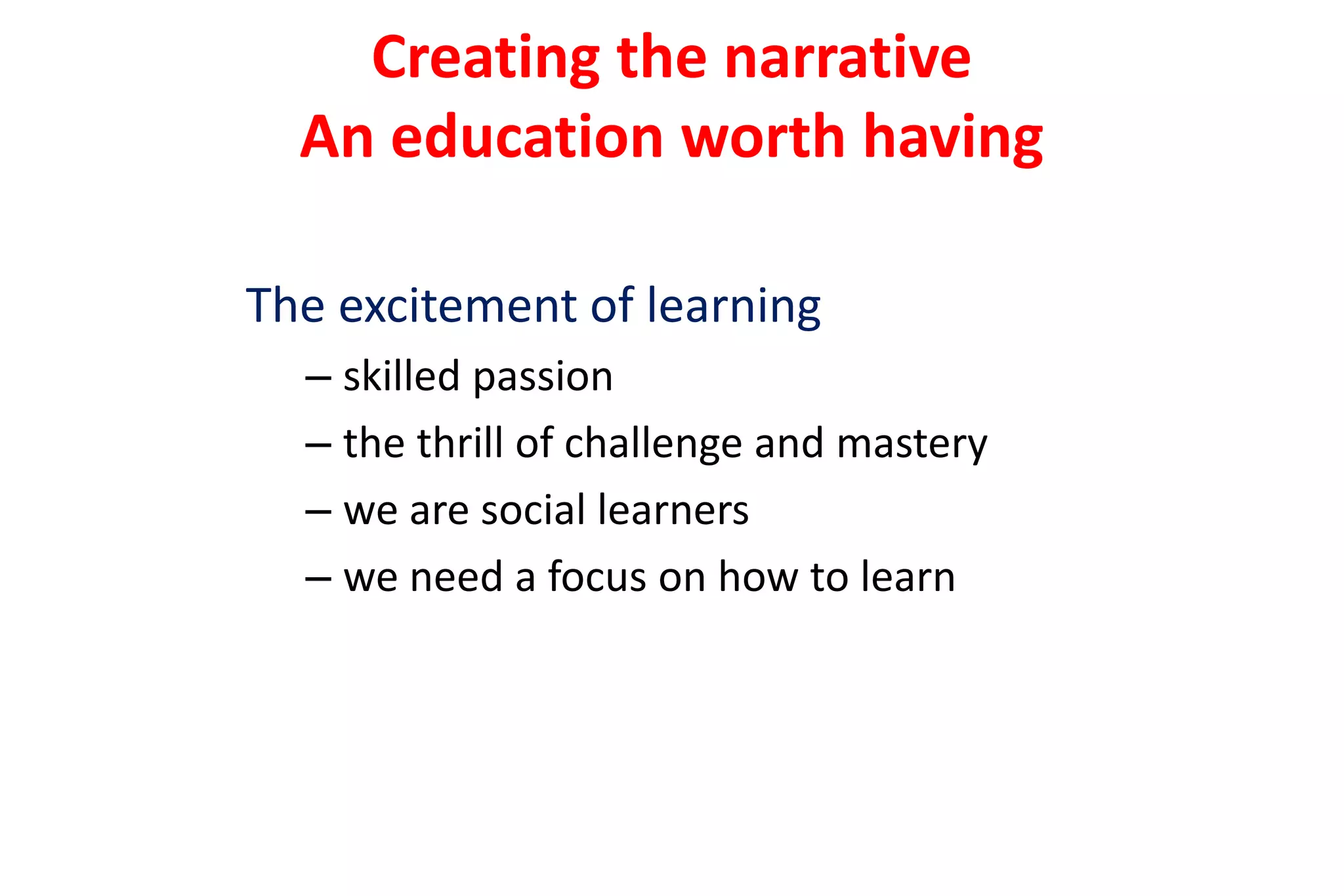
Creating the narrative 
An education worth having 
The excitement of learning 
– skilled passion 
– the thrill of challenge and mastery 
– we are social learners 
– we need a focus on how to learn
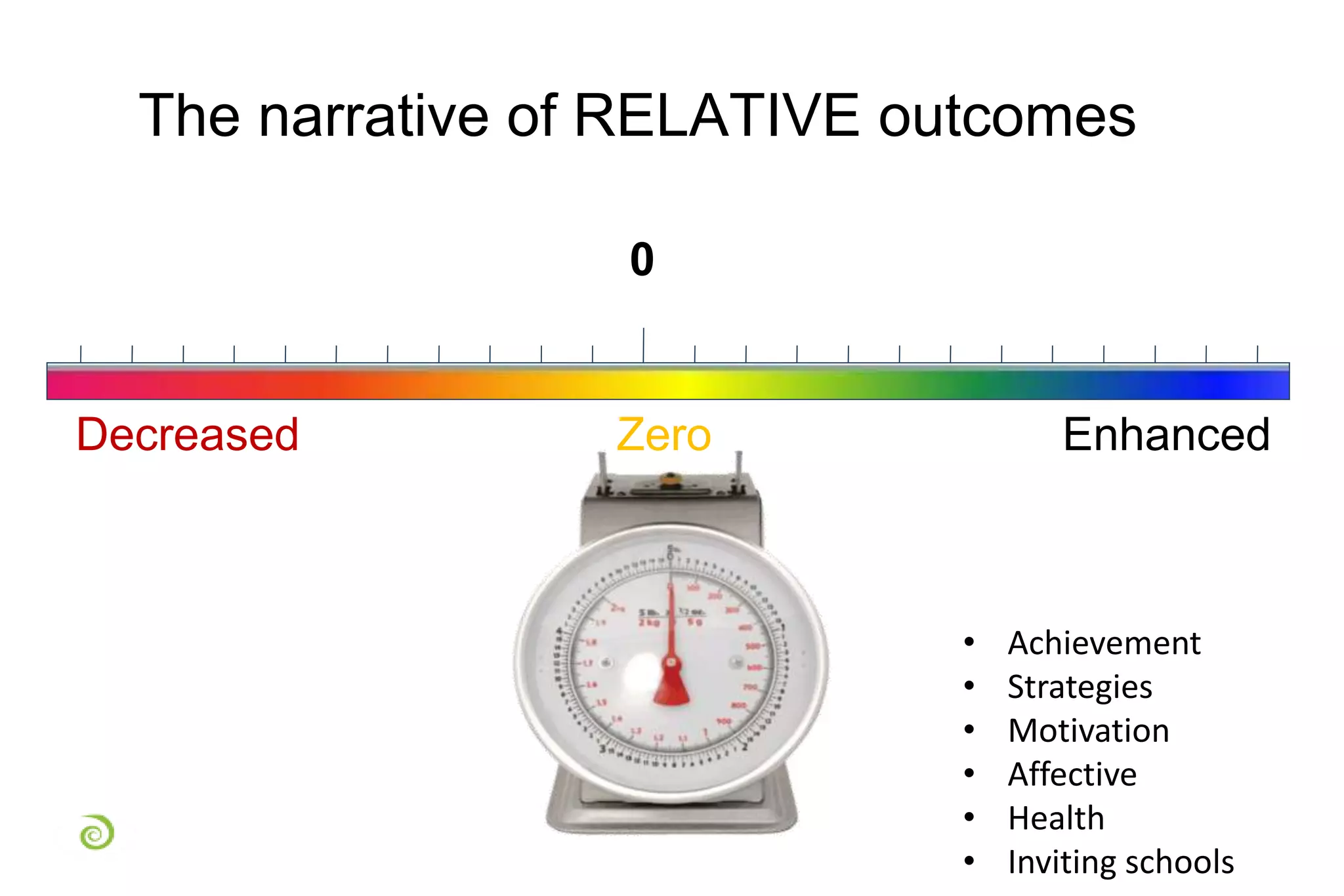
The narrative of RELATIVE outcomes 
0 
Decreased Zero Enhanced 
• Achievement 
• Strategies 
• Motivation 
• Affective 
• Health 
• Inviting schools
No. of effects 
d=.40 
 1100+ meta-analysis 
 65,000 studies, 
 ¼ billion students
attributes of the students 
structure of schools or classes 
the deep teaching programs 
technology 
accountability 
the home or parents 
summer school, length of school day or 
school year 
individualised instruction 
class size 
learning styles 
repeating classes 
Which of these?
Not many attributes of the students .08 
Not the structure of schools or classes .10 
Not the deep teaching programs .16 
Not technology (yet) .22 
Not accountability .22 
Not the home or parents .25 
Not summer school, length of school day or 
school year .07 
Not individualised instruction .22 
Not class size .21 
Not learning styles .17 
Not repeating classes -.13
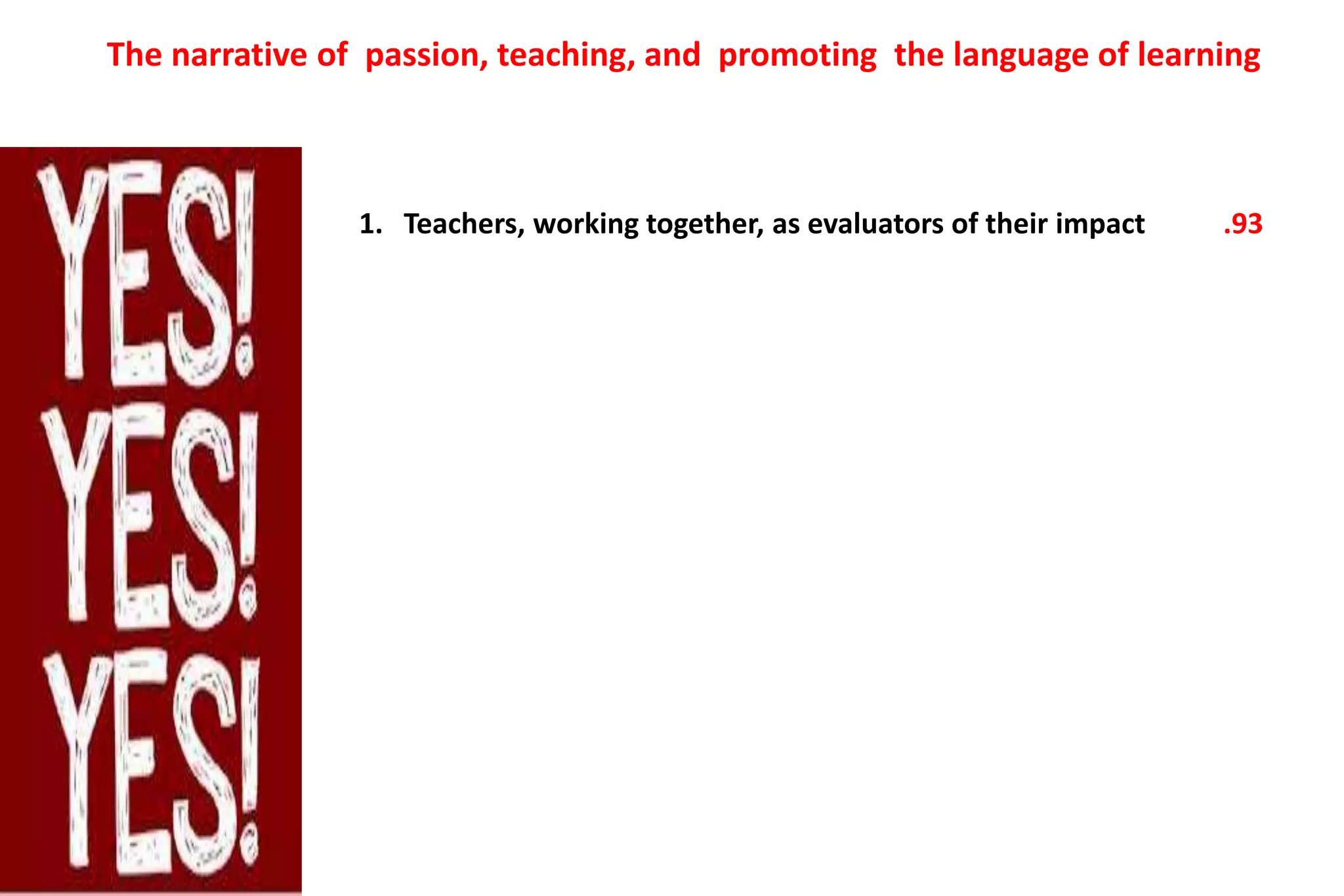
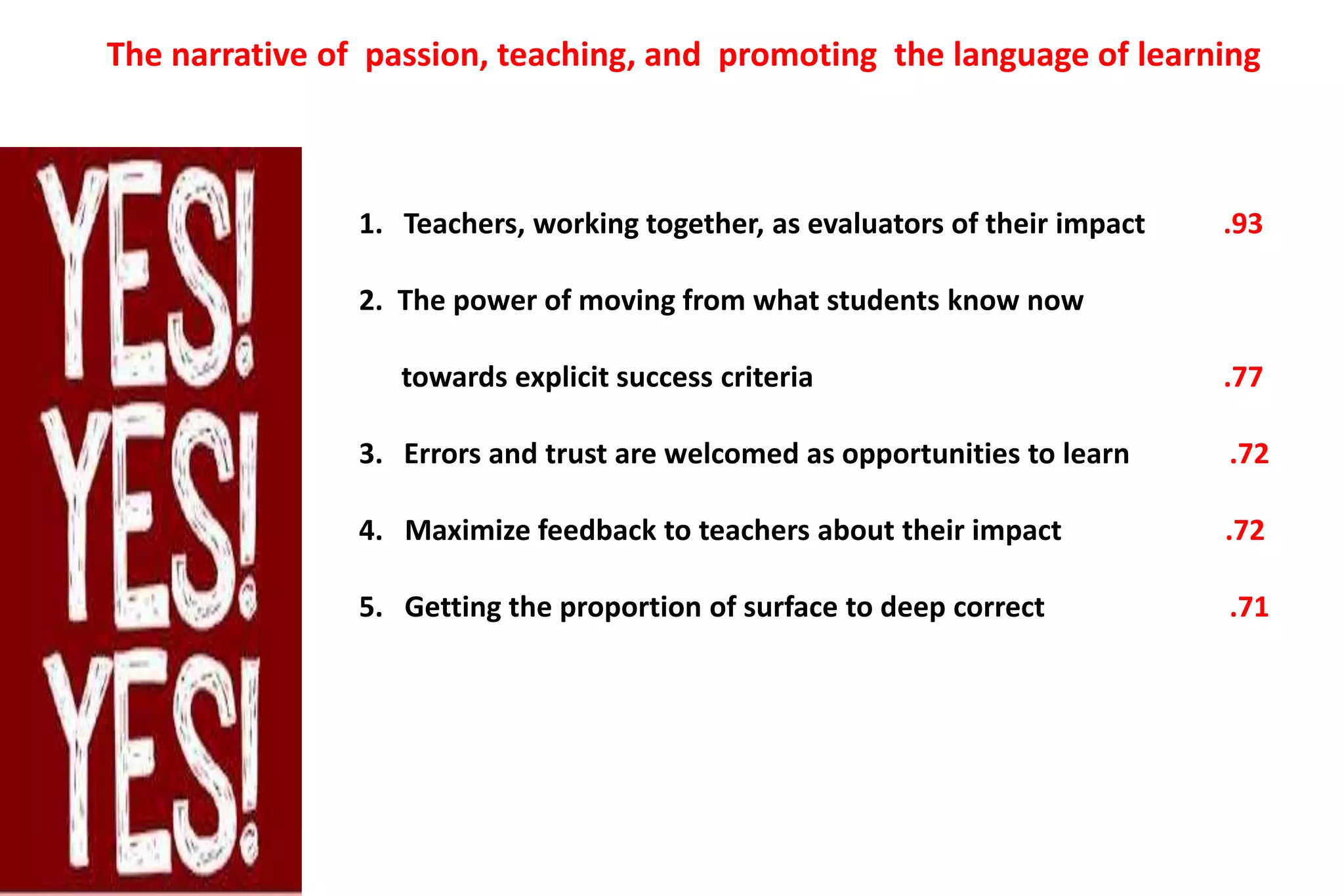
The narrative of passion, teaching, and promoting the language of learning 
1. Teachers, working together, as evaluators of their impact .93
The narrative of passion, teaching, and promoting the language of learning 
1. Teachers, working together, as evaluators of their impact .93 
2. The power of moving from what students know now 
towards explicit success criteria .77
The narrative of passion, teaching, and promoting the language of learning 
1. Teachers, working together, as evaluators of their impact .93 
2. The power of moving from what students know now 
towards explicit success criteria .77 
3. Errors and trust are welcomed as opportunities to learn .72
The narrative of passion, teaching, and promoting the language of learning 
1. Teachers, working together, as evaluators of their impact .93 
2. The power of moving from what students know now 
towards explicit success criteria .77 
3. Errors and trust are welcomed as opportunities to learn .72 
4. Maximize feedback to teachers about their impact .72
The narrative of passion, teaching, and promoting the language of learning 
1. Teachers, working together, as evaluators of their impact .93 
2. The power of moving from what students know now 
towards explicit success criteria .77 
3. Errors and trust are welcomed as opportunities to learn .72 
4. Maximize feedback to teachers about their impact .72 
5. Getting the proportion of surface to deep correct .71
The narrative of passion, teaching, and promoting the language of learning 
1. Teachers, working together, as evaluators of their impact .93 
2. The power of moving from what students know now 
towards explicit success criteria .77 
3. Errors and trust are welcomed as opportunities to learn .72 
4. Maximize feedback to teachers about their impact .72 
5. Getting the proportion of surface to deep correct .71 
6. The Goldilocks principles of challenge, and deliberate practice to 
attain these challenges .60
Do you know 
your impact?
Psychological capital – 
self- efficacy 
optimism 
hope 
resilience
Can we teach students how to learn?
The search for strategies = 400+ 
Brain Gym Mindfulness 
Collaborative problem solving Mnemonics 
Comprehension Monitoring Monitoring 
Concept Mapping Note taking 
Critical thinking techniques Planning 
Discussion groups Practice / Rehearsal 
Distributed Practice Practice Testing 
Elaborative Interrogation Re-reading 
Environmental structuring Retrieval cueing 
Error monitoring Selecting Main Idea 
Examination skills Self-monitoring 
Help-seeking Self-questioning 
Highlighting/Underlining Self-regulation 
Interleaved Practice Sleep 
Keeping records & monitoring Summarization 
Learning Styles Think Aloud 
Listening & Notetaking Time Management 
Memorisation Underlining/Highlighting
A Model of Learning
Dispositions 
RESILIENCE – emotional strength 
1. Inquisitive 2. Persistent 
3. Adventurous 4. Focused 
RESOURCEFULNESS – cognitive capability 
5. Imaginative 6. Connecting 
7. Crafting 8. Capitalising 
REFLECTION – strategic awareness 
9. Methodical 10. Self-evaluative 
11. Self-aware 12. Transferring 
RELATING – social sophistication 
13. Collaborative 14. Open-minded 
15. Independent 16. Empathic 
Prior Achievement
Inputs Learning 
Up front 
Learning 
Consolidating 
Learning 
Dispositions 
Achievement 
The difference between initial & subsequent learning
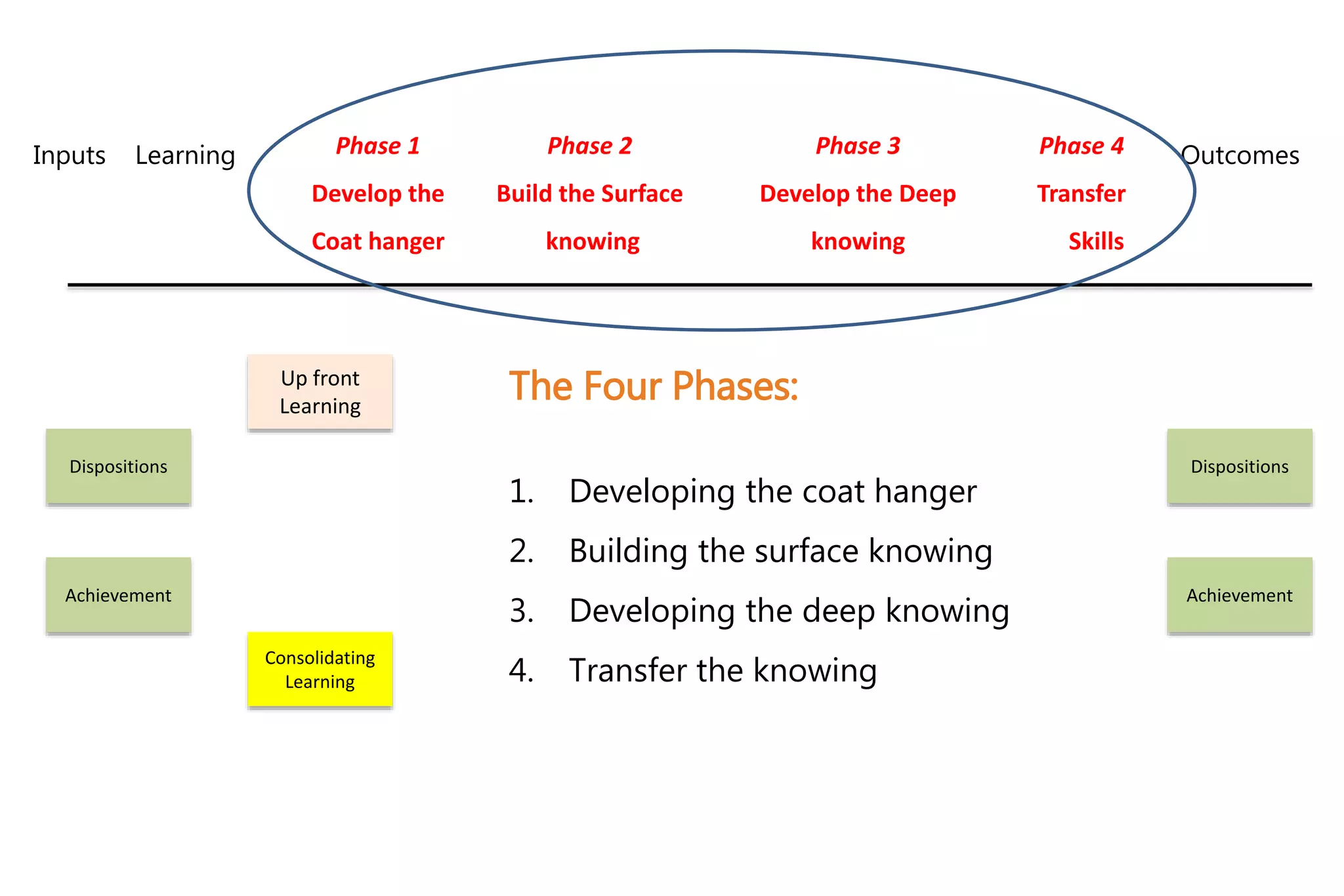
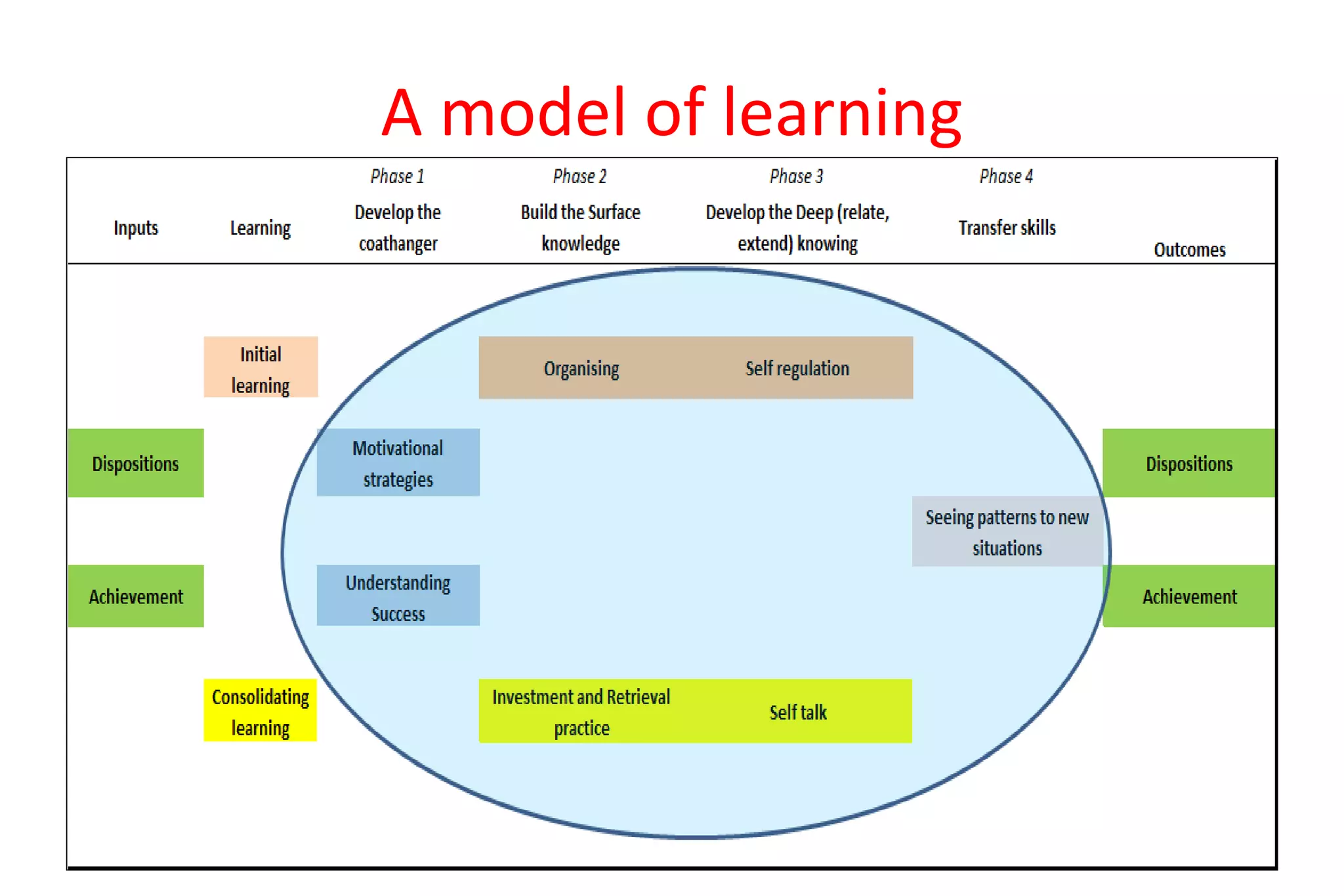
Inputs Learning Phase 1 Phase 2 Phase 3 Phase 4 Outcomes 
Develop the Build the Surface Develop the Deep Transfer 
Coat hanger knowing knowing Skills 
Up front 
Learning 
Consolidating 
Learning 
Dispositions 
Achievement 
Dispositions 
Achievement 
The Four Phases: 
1. Developing the coat hanger 
2. Building the surface knowing 
3. Developing the deep knowing 
4. Transfer the knowing
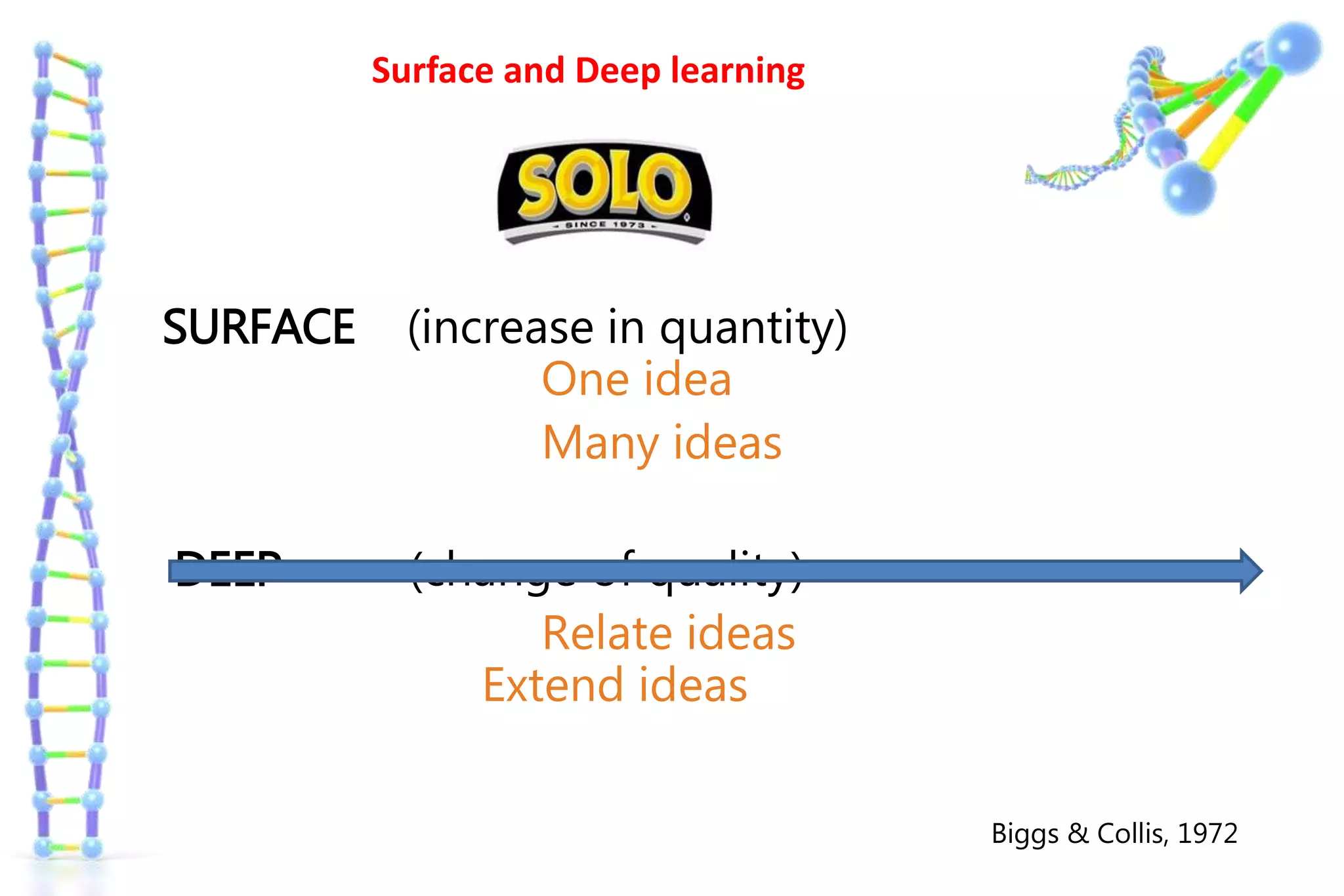
SURFACE (increase in quantity) 
One idea 
Many ideas 
DEEP (change of quality) 
Relate ideas 
Extend ideas 
Biggs & Collis, 1972 
Surface and Deep learning
An over emphasis on surface knowing 
Learning strategies 90+% are surface 
Teacher questions 90+% are surface 
Lesson observations 90+% are surface 
Test analyses 90+% are surface 
Visible Learning 90+% are surface 
We privilege a 
grammar of surface learning
Phase 1 Phase 2 Phase 3 Phase 4 
Develop the Build the Surface Develop the Deep Transfer 
Coat hanger knowledge (relate, extend) knowing Skills 
Inputs Learning Outcomes 
Dispositions 
Achievement 
Dispositions 
Achievement 
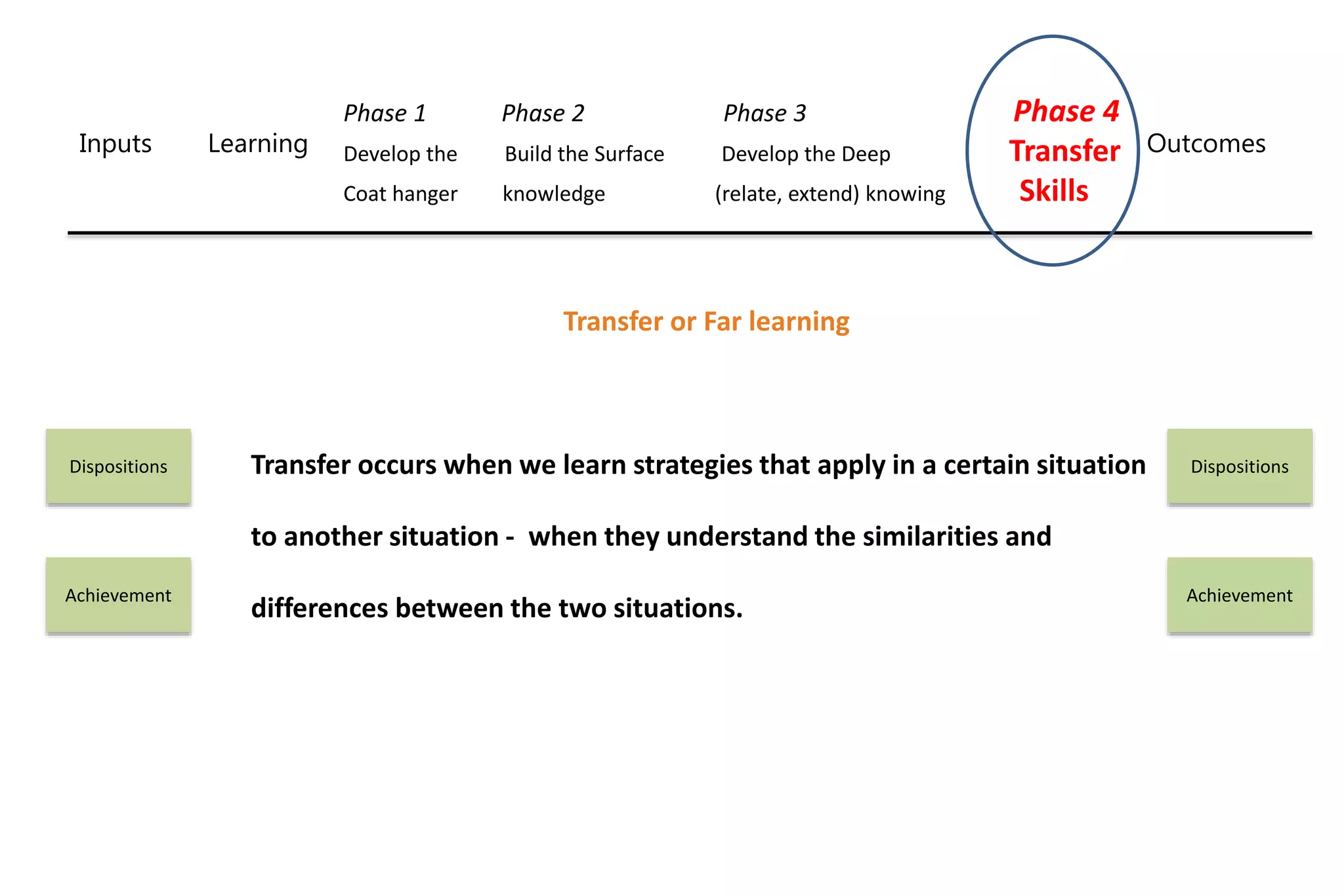
Transfer or Far learning 
Transfer occurs when we learn strategies that apply in a certain situation 
to another situation - when they understand the similarities and 
differences between the two situations.
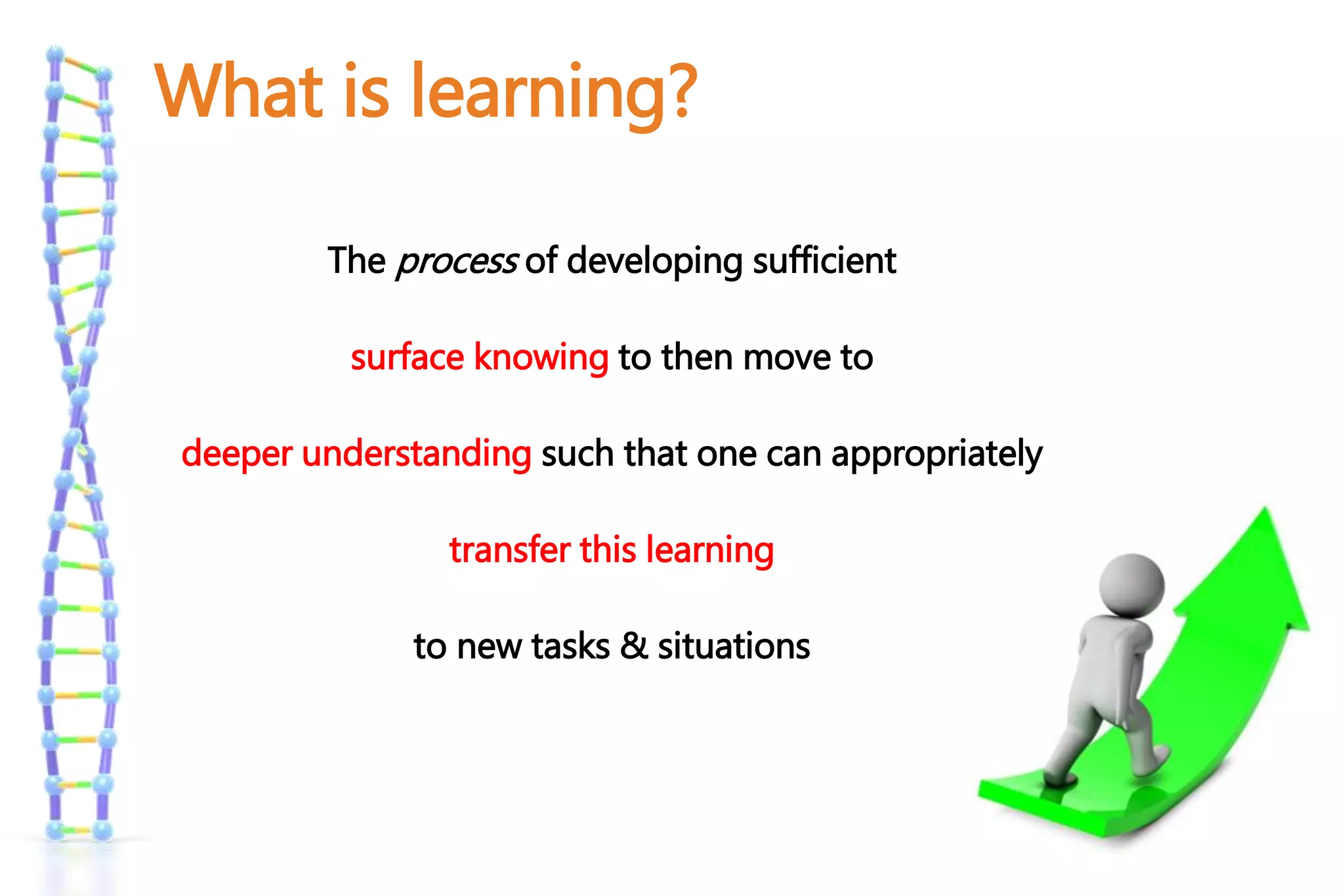
What is learning? 
The process of developing sufficient 
surface knowing to then move to 
deeper understanding such that one can appropriately 
transfer this learning 
to new tasks & situations
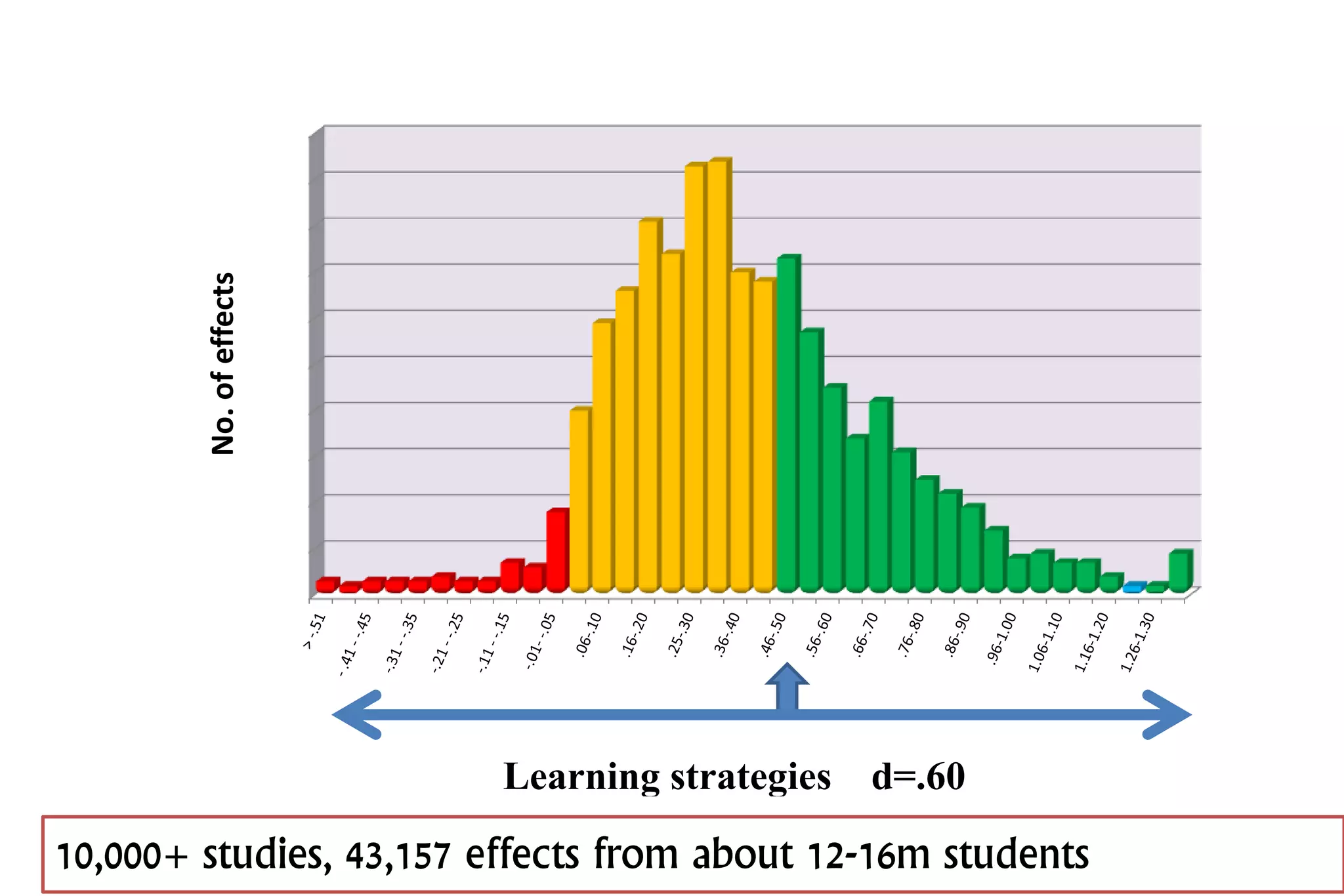
No. of effects 
Learning strategies d=.60 
10,000+ studies, 43,157 effects from about 12-16m students
Phase 1 Phase 2 Phase 3 Phase 4 
Develop the Build the Surface Develop the Deep Transfer 
Coathanger knowledge (relate, extend) knowing Skills 
Inputs Outcomes 
Dispositions 
Achievement 
Dispositions 
Self-efficacy 
Achievement 
Initial 
Learning 
Organising 
Summarisation 
Organising 
Self-regulation 
Planning, 
Evaluation 
Strategy Monitoring 
Consolidating 
Learning 
Investment & Retrieval Practice 
Rehearsal & Memorisation 
Practice Testing 
Receiving Feedback 
Self-Talk 
Self – Consequences 
Self- Verbalisation & 
Self-Questioning 
Help Speaking 
Transfer 
Detecting 
Similarities & Differences 
Problem Solving 
Understanding Success 
Outlining 
Concept Mapping 
Setting Standards
A model of learning
Deep programs ????? 
Rank Influence Effect-size 
91 Inquiry based methods 0.31 
143 Individualized instruction 0.22 
144 Visual/Audio-visual methods 0.22 
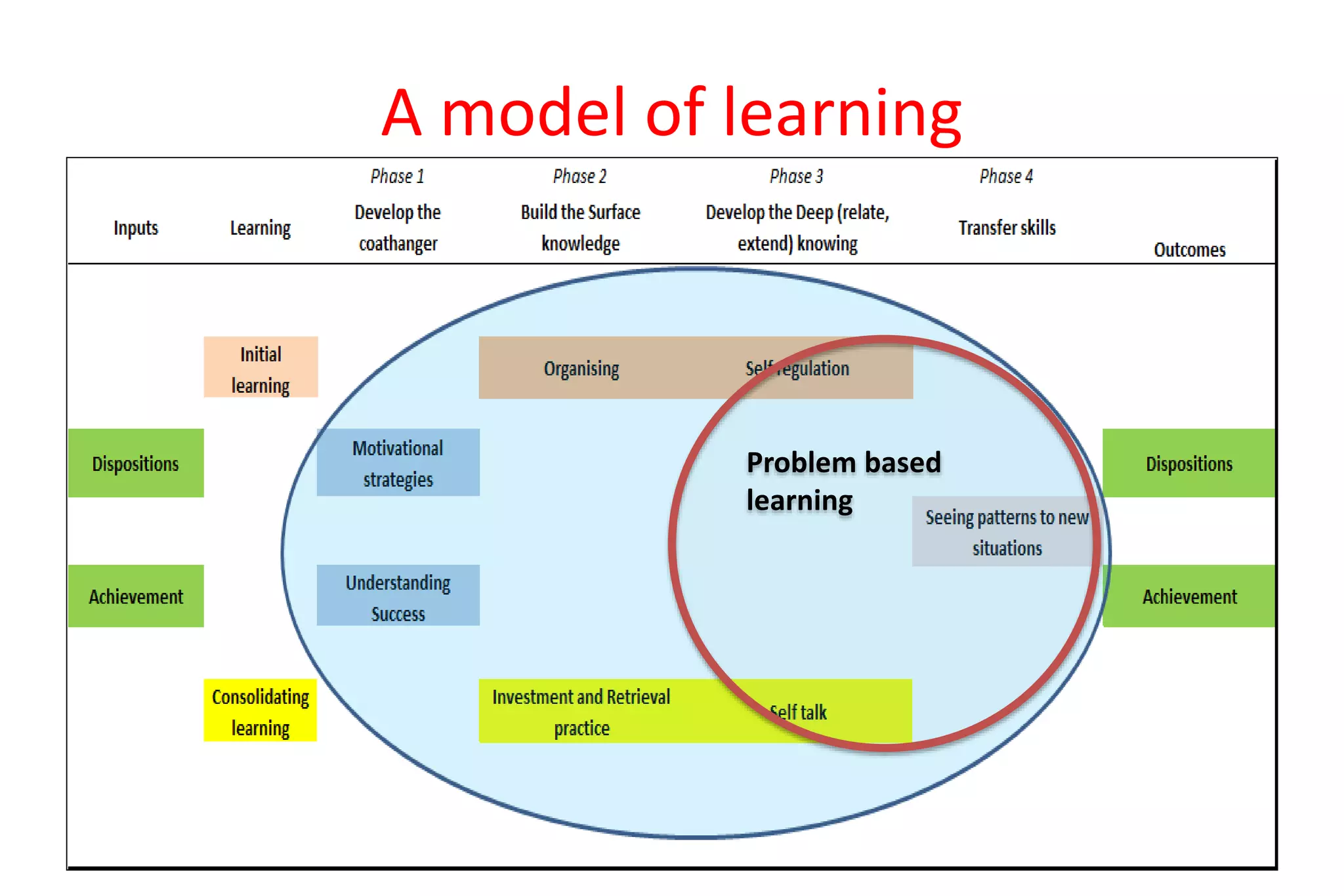
168 Problem based learning 0.15 
184 Whole language 0.06
A model of learning 
Problem based 
learning
1.
1. 
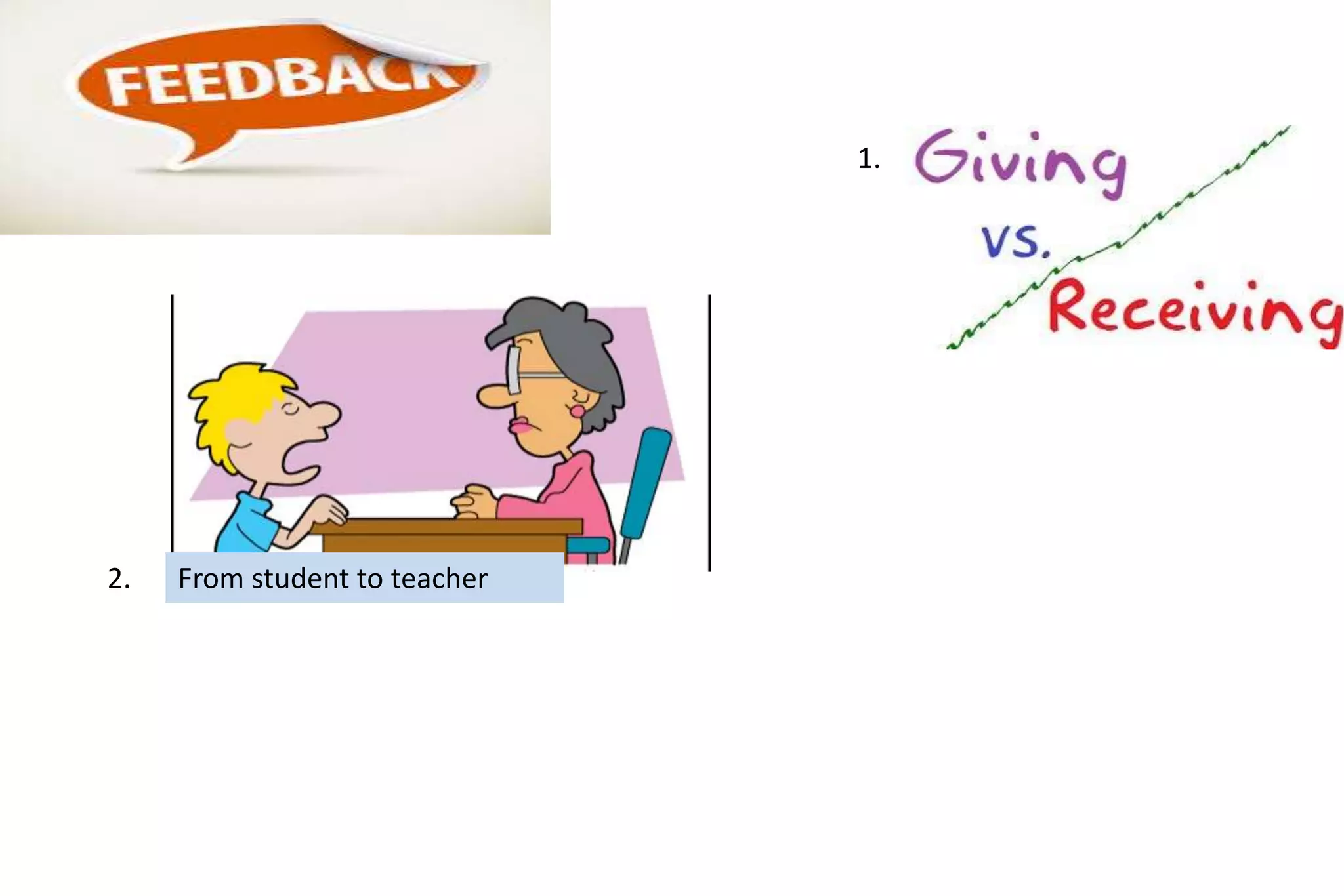
2. From student to teacher
1. 
From student to teacher 
How am I going? 
Where to next? 
2. 
3.
1. 
From student to teacher 
How am I going? 
Where to next? 
The value of not knowing 
2. 
3. 
4. 
.
Move from Narrow Excellence 
to a Defensible Basket of Goods 
PISA + PIRLS
Move from Narrow Excellence 
to a Defensible Basket of Goods 
PISA + PIRLS 
Human Development 
Health 
Equal Opportunity 
Safety & Security 
Governance 
Innovation 
Quality of Life
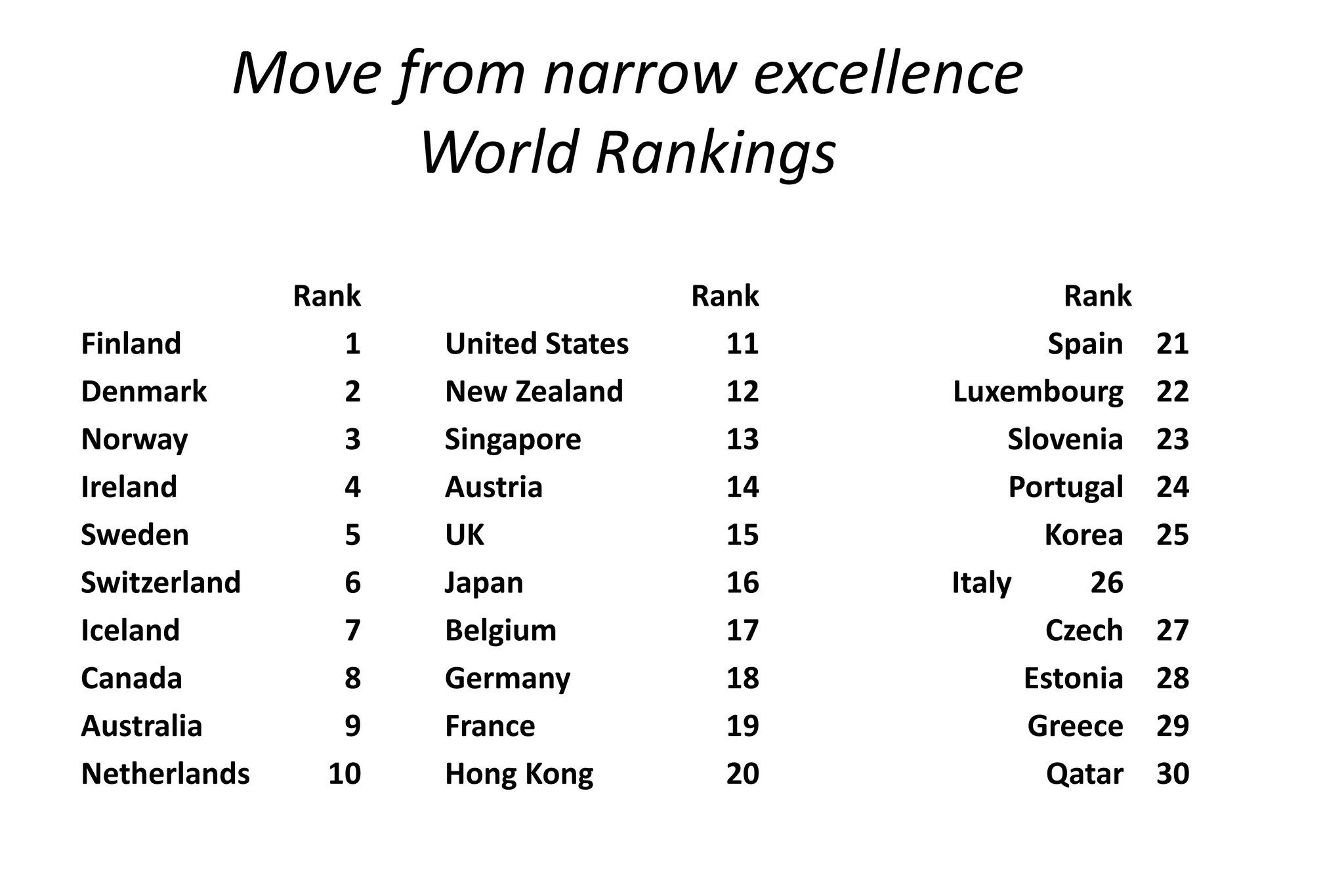
Move from narrow excellence 
World Rankings 
Rank Rank Rank 
Finland 1 United States 11 Spain 21 
Denmark 2 New Zealand 12 Luxembourg 22 
Norway 3 Singapore 13 Slovenia 23 
Ireland 4 Austria 14 Portugal 24 
Sweden 5 UK 15 Korea 25 
Switzerland 6 Japan 16 Italy 26 
Iceland 7 Belgium 17 Czech 27 
Canada 8 Germany 18 Estonia 28 
Australia 9 France 19 Greece 29 
Netherlands 10 Hong Kong 20 Qatar 30
Narrative of Year’s growth for Year’s input 
25% 
20% 
15% 
10% 
5% 
0% 
<200 200-240 241-280 281-320 321-360 361-400 401-440 441-480 481-520 521-560 561-600 601-640 641-680 681-720 > 721 
Non-Aboriginal 
Aboriginal 
• Not necessarily low SES, immigrants 
• Not closing the gap 
Every child deserves at least a year’s growth for a year’s input
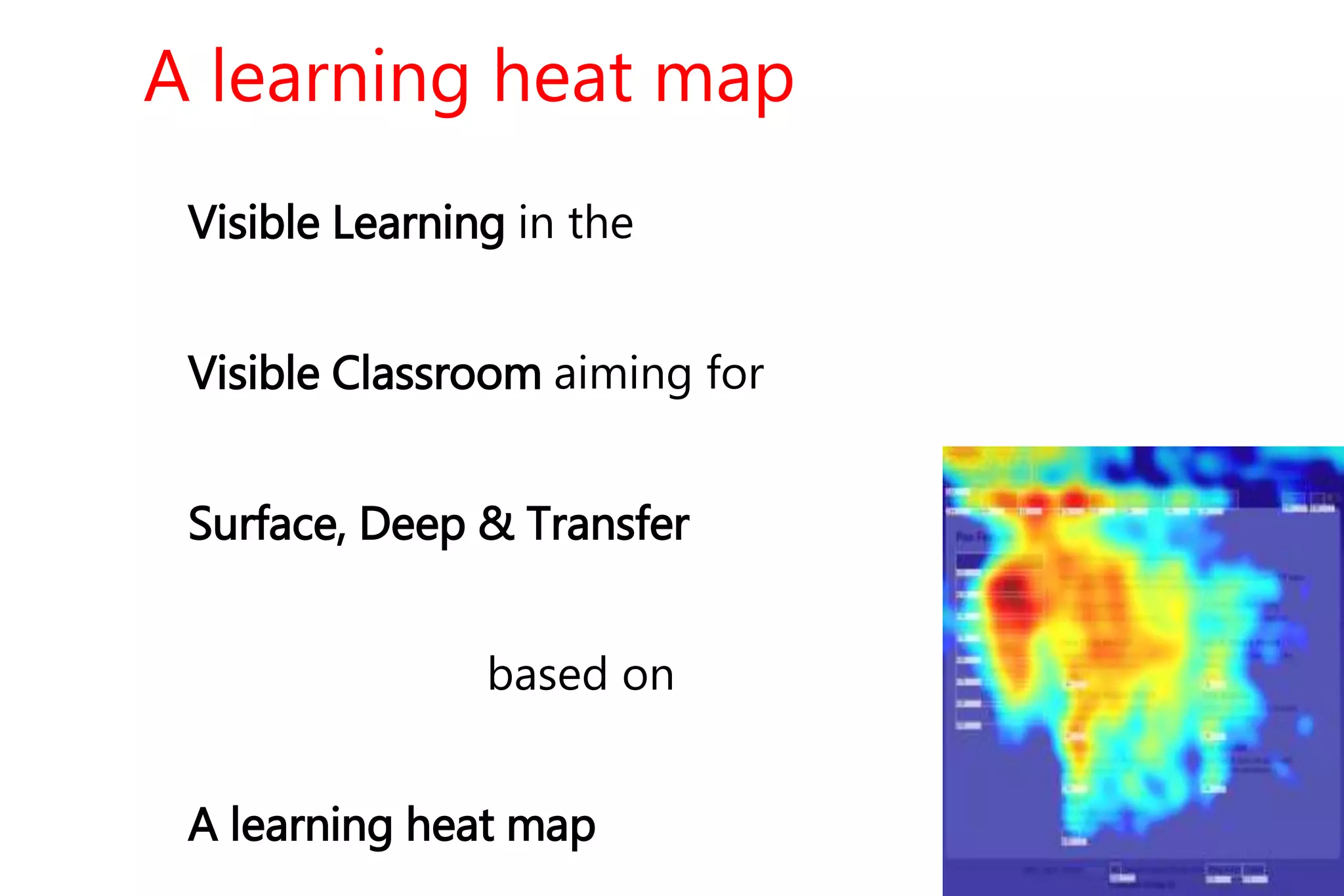
A learning heat map 
Visible Learning in the 
Visible Classroom aiming for 
Surface, Deep & Transfer 
based on 
A learning heat map
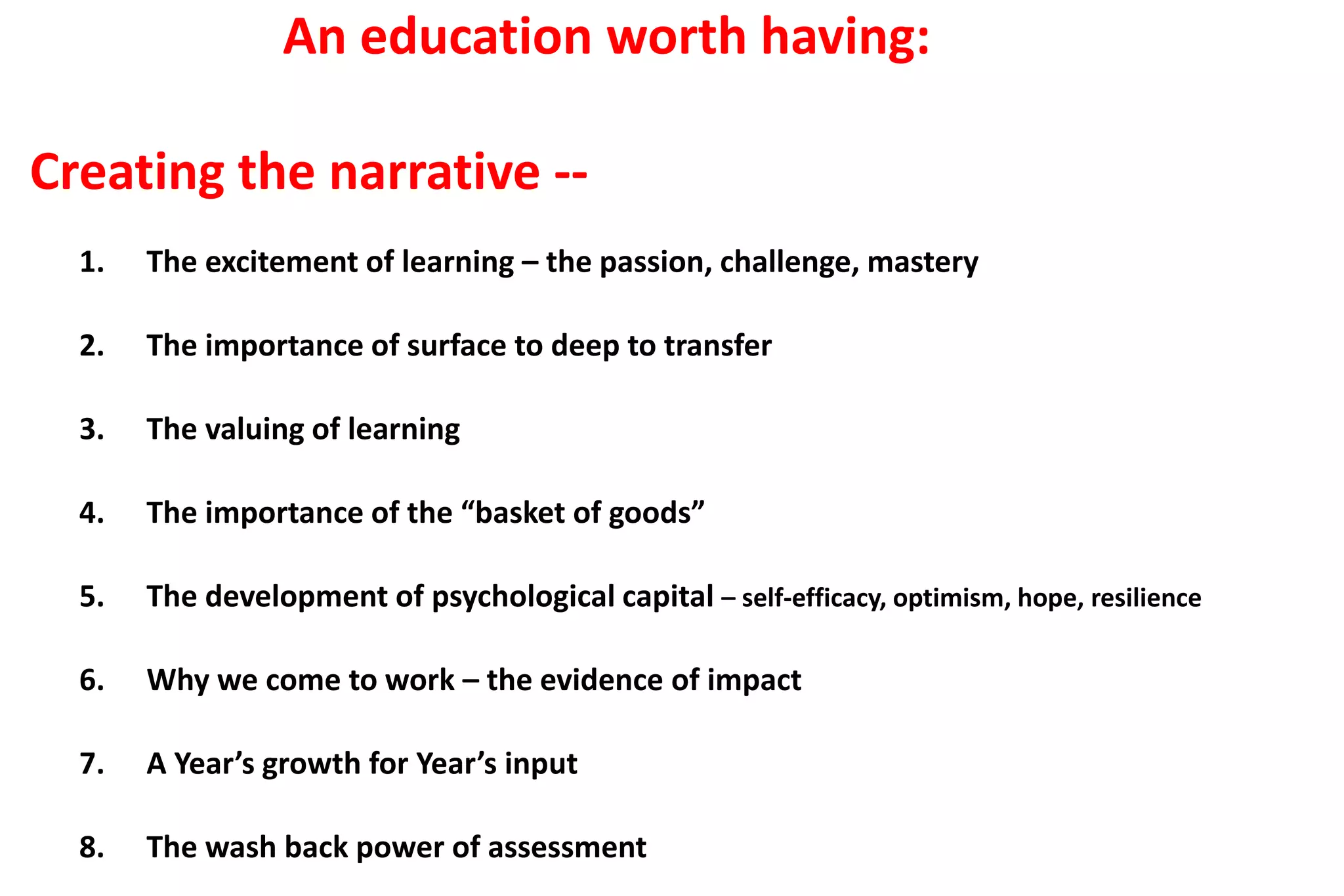
An education worth having: 
Creating the narrative -- 
1. The excitement of learning – the passion, challenge, mastery 
2. The importance of surface to deep to transfer 
3. The valuing of learning 
4. The importance of the “basket of goods” 
5. The development of psychological capital – self-efficacy, optimism, hope, resilience 
6. Why we come to work – the evidence of impact 
7. A Year’s growth for Year’s input 
8. The wash back power of assessment
Schools as inviting places to come and learn 
• And be my friend 
• And engage in the challenge 
• And master and be skilled in some subjects 
• And be esteemed as a learner 
• And know what success looks like 
• And know what to do when you do not know what to do
Thanks 
Visible learning in 
action

5th Annual Conf | John Hattie Keynote

  • 1.
    An Education WorthHaving Exploring what really makes a difference to learning John Hattie
  • 2.
    Creating the narrative An education worth having The excitement of learning – skilled passion – the thrill of challenge and mastery – we are social learners – we need a focus on how to learn
  • 3.
    The narrative ofRELATIVE outcomes 0 Decreased Zero Enhanced • Achievement • Strategies • Motivation • Affective • Health • Inviting schools
  • 4.
    No. of effects d=.40  1100+ meta-analysis  65,000 studies,  ¼ billion students
  • 5.
    attributes of thestudents structure of schools or classes the deep teaching programs technology accountability the home or parents summer school, length of school day or school year individualised instruction class size learning styles repeating classes Which of these?
  • 6.
    Not many attributesof the students .08 Not the structure of schools or classes .10 Not the deep teaching programs .16 Not technology (yet) .22 Not accountability .22 Not the home or parents .25 Not summer school, length of school day or school year .07 Not individualised instruction .22 Not class size .21 Not learning styles .17 Not repeating classes -.13
  • 7.
    The narrative ofpassion, teaching, and promoting the language of learning 1. Teachers, working together, as evaluators of their impact .93
  • 8.
    The narrative ofpassion, teaching, and promoting the language of learning 1. Teachers, working together, as evaluators of their impact .93 2. The power of moving from what students know now towards explicit success criteria .77
  • 9.
    The narrative ofpassion, teaching, and promoting the language of learning 1. Teachers, working together, as evaluators of their impact .93 2. The power of moving from what students know now towards explicit success criteria .77 3. Errors and trust are welcomed as opportunities to learn .72
  • 10.
    The narrative ofpassion, teaching, and promoting the language of learning 1. Teachers, working together, as evaluators of their impact .93 2. The power of moving from what students know now towards explicit success criteria .77 3. Errors and trust are welcomed as opportunities to learn .72 4. Maximize feedback to teachers about their impact .72
  • 11.
    The narrative ofpassion, teaching, and promoting the language of learning 1. Teachers, working together, as evaluators of their impact .93 2. The power of moving from what students know now towards explicit success criteria .77 3. Errors and trust are welcomed as opportunities to learn .72 4. Maximize feedback to teachers about their impact .72 5. Getting the proportion of surface to deep correct .71
  • 12.
    The narrative ofpassion, teaching, and promoting the language of learning 1. Teachers, working together, as evaluators of their impact .93 2. The power of moving from what students know now towards explicit success criteria .77 3. Errors and trust are welcomed as opportunities to learn .72 4. Maximize feedback to teachers about their impact .72 5. Getting the proportion of surface to deep correct .71 6. The Goldilocks principles of challenge, and deliberate practice to attain these challenges .60
  • 13.
    Do you know your impact?
  • 18.
    Psychological capital – self- efficacy optimism hope resilience
  • 19.
    Can we teachstudents how to learn?
  • 21.
    The search forstrategies = 400+ Brain Gym Mindfulness Collaborative problem solving Mnemonics Comprehension Monitoring Monitoring Concept Mapping Note taking Critical thinking techniques Planning Discussion groups Practice / Rehearsal Distributed Practice Practice Testing Elaborative Interrogation Re-reading Environmental structuring Retrieval cueing Error monitoring Selecting Main Idea Examination skills Self-monitoring Help-seeking Self-questioning Highlighting/Underlining Self-regulation Interleaved Practice Sleep Keeping records & monitoring Summarization Learning Styles Think Aloud Listening & Notetaking Time Management Memorisation Underlining/Highlighting
  • 22.
    A Model ofLearning
  • 23.
    Dispositions RESILIENCE –emotional strength 1. Inquisitive 2. Persistent 3. Adventurous 4. Focused RESOURCEFULNESS – cognitive capability 5. Imaginative 6. Connecting 7. Crafting 8. Capitalising REFLECTION – strategic awareness 9. Methodical 10. Self-evaluative 11. Self-aware 12. Transferring RELATING – social sophistication 13. Collaborative 14. Open-minded 15. Independent 16. Empathic Prior Achievement
  • 24.
    Inputs Learning Upfront Learning Consolidating Learning Dispositions Achievement The difference between initial & subsequent learning
  • 25.
    Inputs Learning Phase1 Phase 2 Phase 3 Phase 4 Outcomes Develop the Build the Surface Develop the Deep Transfer Coat hanger knowing knowing Skills Up front Learning Consolidating Learning Dispositions Achievement Dispositions Achievement The Four Phases: 1. Developing the coat hanger 2. Building the surface knowing 3. Developing the deep knowing 4. Transfer the knowing
  • 26.
    SURFACE (increase inquantity) One idea Many ideas DEEP (change of quality) Relate ideas Extend ideas Biggs & Collis, 1972 Surface and Deep learning
  • 27.
    An over emphasison surface knowing Learning strategies 90+% are surface Teacher questions 90+% are surface Lesson observations 90+% are surface Test analyses 90+% are surface Visible Learning 90+% are surface We privilege a grammar of surface learning
  • 28.
    Phase 1 Phase2 Phase 3 Phase 4 Develop the Build the Surface Develop the Deep Transfer Coat hanger knowledge (relate, extend) knowing Skills Inputs Learning Outcomes Dispositions Achievement Dispositions Achievement Transfer or Far learning Transfer occurs when we learn strategies that apply in a certain situation to another situation - when they understand the similarities and differences between the two situations.
  • 29.
    What is learning? The process of developing sufficient surface knowing to then move to deeper understanding such that one can appropriately transfer this learning to new tasks & situations
  • 30.
    No. of effects Learning strategies d=.60 10,000+ studies, 43,157 effects from about 12-16m students
  • 31.
    Phase 1 Phase2 Phase 3 Phase 4 Develop the Build the Surface Develop the Deep Transfer Coathanger knowledge (relate, extend) knowing Skills Inputs Outcomes Dispositions Achievement Dispositions Self-efficacy Achievement Initial Learning Organising Summarisation Organising Self-regulation Planning, Evaluation Strategy Monitoring Consolidating Learning Investment & Retrieval Practice Rehearsal & Memorisation Practice Testing Receiving Feedback Self-Talk Self – Consequences Self- Verbalisation & Self-Questioning Help Speaking Transfer Detecting Similarities & Differences Problem Solving Understanding Success Outlining Concept Mapping Setting Standards
  • 32.
    A model oflearning
  • 33.
    Deep programs ????? Rank Influence Effect-size 91 Inquiry based methods 0.31 143 Individualized instruction 0.22 144 Visual/Audio-visual methods 0.22 168 Problem based learning 0.15 184 Whole language 0.06
  • 34.
    A model oflearning Problem based learning
  • 35.
  • 36.
    1. 2. Fromstudent to teacher
  • 37.
    1. From studentto teacher How am I going? Where to next? 2. 3.
  • 38.
    1. From studentto teacher How am I going? Where to next? The value of not knowing 2. 3. 4. .
  • 39.
    Move from NarrowExcellence to a Defensible Basket of Goods PISA + PIRLS
  • 40.
    Move from NarrowExcellence to a Defensible Basket of Goods PISA + PIRLS Human Development Health Equal Opportunity Safety & Security Governance Innovation Quality of Life
  • 41.
    Move from narrowexcellence World Rankings Rank Rank Rank Finland 1 United States 11 Spain 21 Denmark 2 New Zealand 12 Luxembourg 22 Norway 3 Singapore 13 Slovenia 23 Ireland 4 Austria 14 Portugal 24 Sweden 5 UK 15 Korea 25 Switzerland 6 Japan 16 Italy 26 Iceland 7 Belgium 17 Czech 27 Canada 8 Germany 18 Estonia 28 Australia 9 France 19 Greece 29 Netherlands 10 Hong Kong 20 Qatar 30
  • 42.
    Narrative of Year’sgrowth for Year’s input 25% 20% 15% 10% 5% 0% <200 200-240 241-280 281-320 321-360 361-400 401-440 441-480 481-520 521-560 561-600 601-640 641-680 681-720 > 721 Non-Aboriginal Aboriginal • Not necessarily low SES, immigrants • Not closing the gap Every child deserves at least a year’s growth for a year’s input
  • 43.
    A learning heatmap Visible Learning in the Visible Classroom aiming for Surface, Deep & Transfer based on A learning heat map
  • 44.
    An education worthhaving: Creating the narrative -- 1. The excitement of learning – the passion, challenge, mastery 2. The importance of surface to deep to transfer 3. The valuing of learning 4. The importance of the “basket of goods” 5. The development of psychological capital – self-efficacy, optimism, hope, resilience 6. Why we come to work – the evidence of impact 7. A Year’s growth for Year’s input 8. The wash back power of assessment
  • 45.
    Schools as invitingplaces to come and learn • And be my friend • And engage in the challenge • And master and be skilled in some subjects • And be esteemed as a learner • And know what success looks like • And know what to do when you do not know what to do
  • 46.