EVAAS for Educators

Adriane Mingo, Heather Stewart, Yvette Stewart
  http://region6pd.ncdpi.wikispaces.net
Today’s Presenters
 Adriane Mingo
 Professional Development
 Consultant
 Region 6
 Adriane.mingo@dpi.nc.dpi


 Heather Stewart
 Professional Development
 Consultant
 Region 4
 Heather.stewart@dpi.nc.gov
Purpose


• Be familiar with proactive assessments
• Understand the various EVAAS reports
• Be familiar with student projection reports
Outcomes:
• Locate resources associated with the
  EVAAS
• Be familiar with various EVAAS Reports
• Understand At-Risk and Preparedness
  Reports
• Be familiar with Student Projection Reports
Can We Agree?

•   To be actively involved
•   Value differences
•   Agree to disagree
•   Listen
Agenda

• Welcome, introductions, agenda overview
• Resources
• Value-Added
• Reports
• Reflections
• Questions
Resources
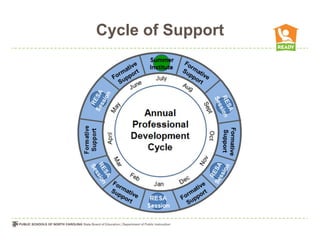
Cycle of Support
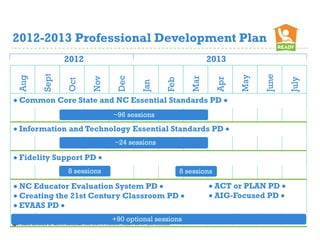
2012-2013 Professional Development Plan
              2012                                        2013
       Sept


                                                                          June
                                                                    May
 Aug


                            Dec


                                                    Mar
                     Nov


                                                              Apr


                                                                                 July
                                           Feb
              Oct


                                   Jan
 Common Core State and NC Essential Standards PD 
                           ~96 sessions

 Information and Technology Essential Standards PD 
                           ~24 sessions

 Fidelity Support PD 
              8 sessions                         8 sessions

 NC Educator Evaluation System PD                        ACT or PLAN PD 
 Creating the 21st Century Classroom PD                  AIG-Focused PD 
 EVAAS PD 
                           +90 optional sessions
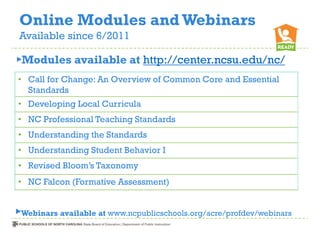
Online Modules and Webinars
Available since 6/2011

►Modules available at http://center.ncsu.edu/nc/
• Call for Change: An Overview of Common Core and Essential
  Standards
• Developing Local Curricula
• NC Professional Teaching Standards
• Understanding the Standards
• Understanding Student Behavior I
• Revised Bloom’s Taxonomy
• NC Falcon (Formative Assessment)


►Webinars available at www.ncpublicschools.org/acre/profdev/webinars
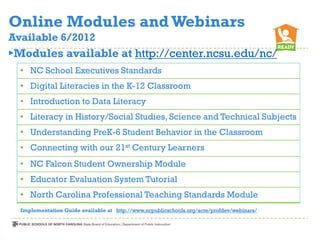
Online Modules and Webinars
Available 6/2012
►Modules available at http://center.ncsu.edu/nc/
  • NC School Executives Standards
  • Digital Literacies in the K-12 Classroom
  • Introduction to Data Literacy
  • Literacy in History/Social Studies, Science and Technical Subjects
  • Understanding PreK-6 Student Behavior in the Classroom
  • Connecting with our 21st Century Learners
  • NC Falcon Student Ownership Module
  • Educator Evaluation System Tutorial
  • North Carolina Professional Teaching Standards Module
  Implementation Guide available at http://www.ncpublicschools.org/acre/profdev/webinars/
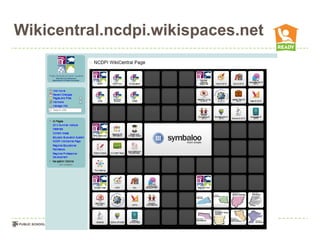
Wikicentral.ncdpi.wikispaces.net
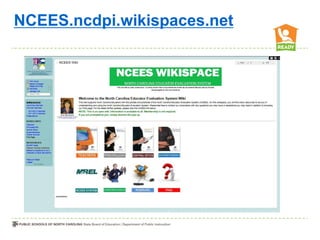
NCEES.ncdpi.wikispaces.net
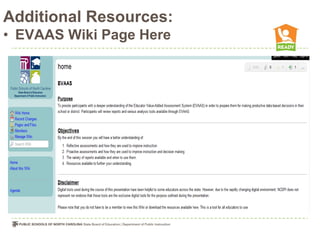
Additional Resources:
• EVAAS Wiki Page Here
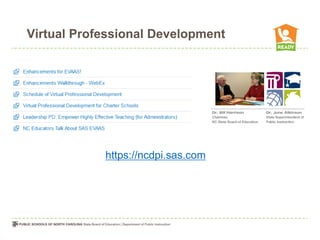
Virtual Professional Development


            https://ncdpi.sas.com
Data Literacy Module
              https://center.ncsu.edu/nc


                Data Resource Guide
http://www.ncpublicschools.org/acre/improvement/resources/
Educator Effectiveness

• Questions on Standard 6 or 8? Email
  educatoreffectiveness@dpi.nc.gov
• Learn more about Measures of Student
  Learning/Common Exams at
 http://www.ncpublicschools.org/educatoreffect/
Questions about Cloud & IIS

• The Cloud is here –
  www.Cloud.FI.NCSU.EDU


• For further questions, email…
  – Technology_READY@dpi.nc.gov
  – IIS_READY@dpi.nc.gov
Pre-Assessment
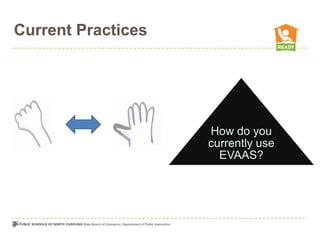
Current Practices


                    How do you
                    currently use
                      EVAAS?
It’s Connected
Benefits and Considerations for
  Teacher Use
• Understand academic                     Professional
  preparedness of students             Development is the
  before they enter the
                                              Key
  classroom.
                                  • Culture of School
• Monitor student progress,
  ensuring growth opportunities   • Sensitivity of Data
  for all students.
                                  • Finger Pointing and Blame
• Modify curriculum, student        Game
  support, and instructional
  strategies to address the       • Window vs. Mirror
  needs of all students.
Benefits for Principals
• Gain a consolidated view of student progress and teacher
  effectiveness, as well as the impact of instruction and
  performance.
• Bring clarity to strategic planning and function as a catalyst
  for conversations that must take place to ensure that all
  students reach their potential.
• Understand and leverage the strengths of effective
  teachers.
• Use the valuable resource of effective teaching to benefit
  as many students as possible.
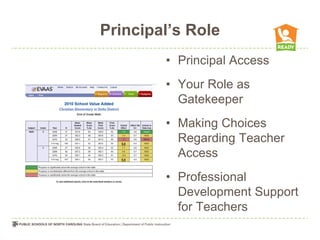
Principal’s Role
        • Principal Access
        • Your Role as
          Gatekeeper
        • Making Choices
          Regarding Teacher
          Access
        • Professional
          Development Support
          for Teachers
Education Value-Added
                                           Assessment System

• Answers the question of how effective a
  schooling experience is
• Produces reports that
  -Predict student success
  -Show the effects of schooling at particular
   schools
  -Reveal patterns in subgroup performance
  http://www.sas.com/apps/webnet/video-
  sharing.html?videoToLoad=rtmp://channel.sas.com/vod/clip/9000_EVAAS16x9_rev_F8dotCom&height=295&width=480&poster
  Frame=null&caption=null&captionShowAtStart=0&referralPage=http%3A//www.sas.com/govedu/edu/k12/evaas/index.html
The EVAAS Philosophy

• All students deserve opportunities to make appropriate
  academic progress every year.
• There is no “one size fits all” way of educating students
  who enter a class at different levels of academic
  achievement.
The EVAAS Philosophy


• Adjustments to instruction should be based on the
  students’ academic needs, not on socio-economic
  factors.
• "What teachers know and can do is the most important
  influence on what students learn." (National
  Commission on Teaching and America's Future, 1996)
ACHIEVEMENT VS. GROWTH
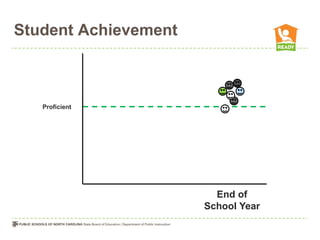
Student Achievement


   Proficient


                        End of
                      School Year
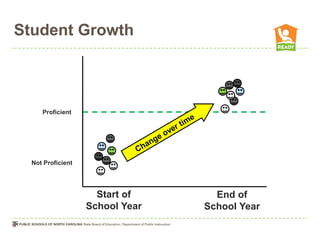
Student Growth


     Proficient


  Not Proficient


                     Start of      End of
                   School Year   School Year
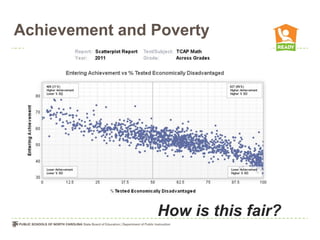
Achievement and Poverty


                How is this fair?
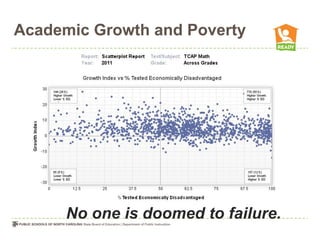
Academic Growth and Poverty


      No one is doomed to failure.
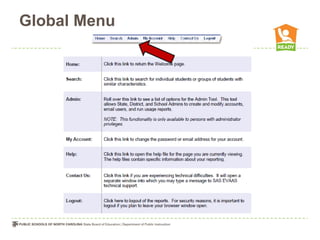
Global Menu
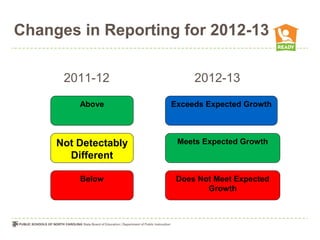
Changes in Reporting for 2012-13

      2011-12              2012-13
         Above        Exceeds Expected Growth


     Not Detectably    Meets Expected Growth
       Different

         Below         Does Not Meet Expected
                              Growth
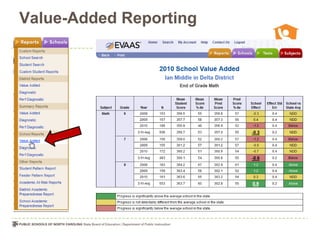
Value-Added Reporting
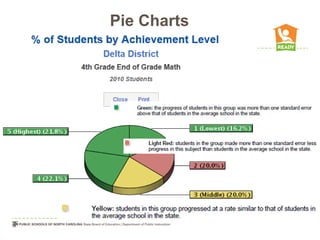
Pie Charts
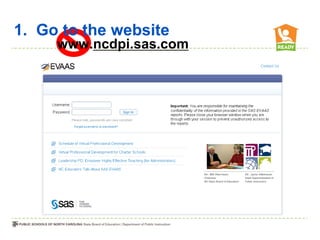
1. Go to the website
     www.ncdpi.sas.com
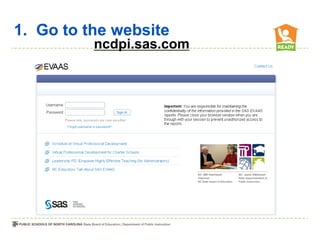
1. Go to the website
          ncdpi.sas.com
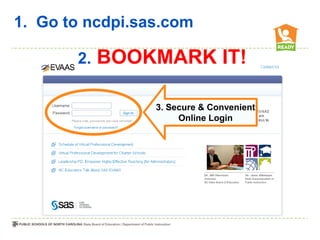
1. Go to ncdpi.sas.com

       2.   BOOKMARK IT!

                 3. Secure & Convenient
                      Online Login
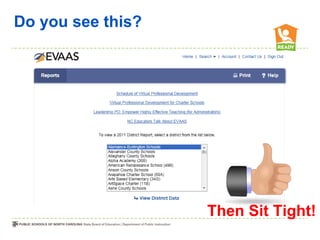
Do you see this?


                   Then Sit Tight!
What Are Projections?
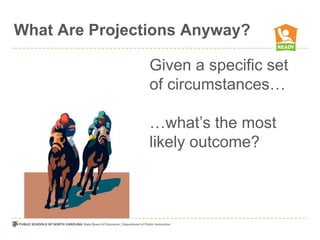
What Are Projections Anyway?

                Given a specific set
                of circumstances…

                …what’s the most
                likely outcome?
What Are Projections Anyway?
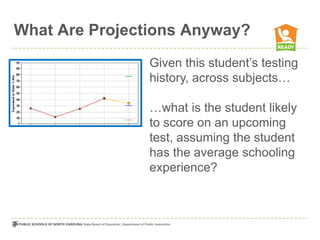
                Given this student’s testing
                history, across subjects…

                …what is the student likely
                to score on an upcoming
                test, assuming the student
                has the average schooling
                experience?
EVAAS Projections
What are they based on?

• Expectations based on what we know
    » About this student and other students who have
      already taken this test
    » Prior test scores (EOC/EOG), across subjects
    » Their scores on the test we’re projecting to
What’s the Value of the Projections?

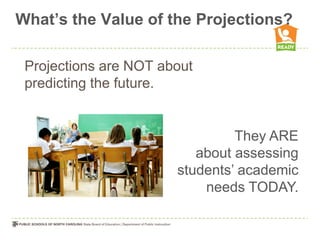
 Projections are NOT about
 predicting the future.


                                They ARE
                          about assessing
                       students’ academic
                           needs TODAY.
Assessing Students’ Needs
• What are this student’s chances for success?
• What goals should we have for this student this
  year?
• What goals should we have for this student in
  future years?


What can I do to help this student get there?
Using Projections to Take Action

                  • Identify students
                  • Assess the level of risk
                  • Plan schedules
                  • Identify high-achievers
                  • Assess the opportunities
                  • Inform
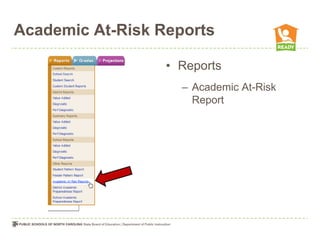
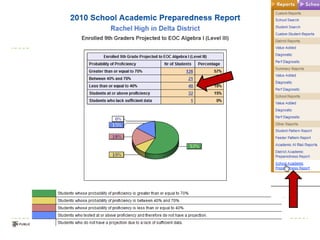
Academic At-Risk Reports

                  • Reports
                    – Academic At-Risk
                      Report
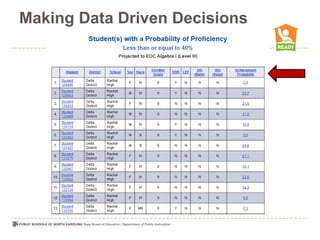
Making Data Driven Decisions
Data Mining


                     Data
                      or
              Knowledge discovery
REFLECTION + PROJECTION =
TODAY
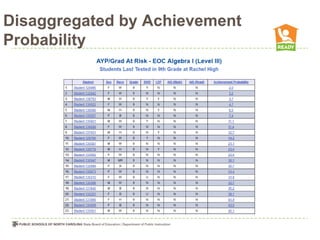
Disaggregated by Achievement
Probability
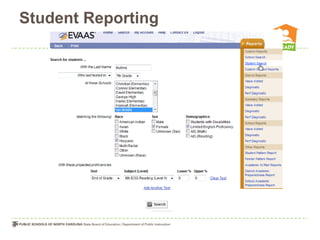
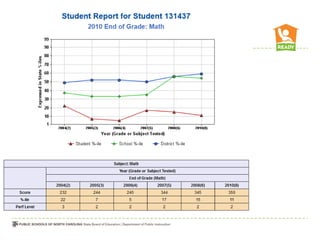
Student Reporting
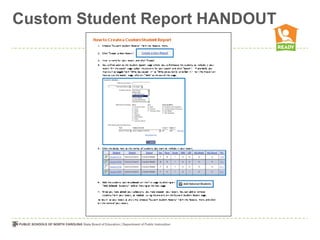
Custom Student Report HANDOUT
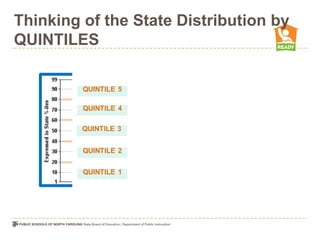
Thinking of the State Distribution by
QUINTILES
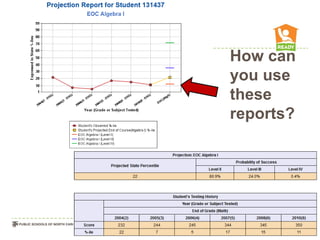
How can
you use
these
reports?
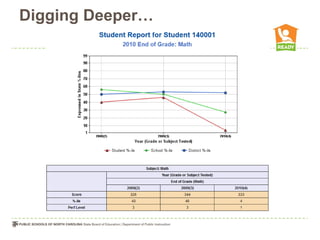
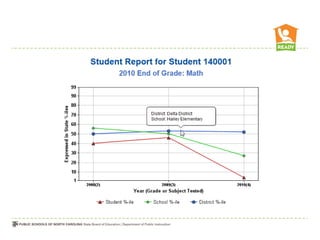
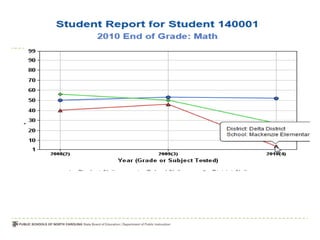
Digging Deeper…
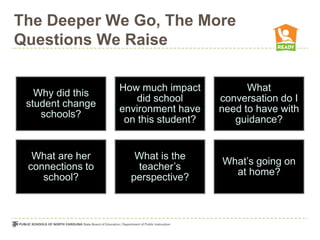
The Deeper We Go, The More
Questions We Raise

                  How much impact           What
   Why did this
                      did school      conversation do I
 student change
                  environment have    need to have with
    schools?
                   on this student?      guidance?


  What are her       What is the
                                      What’s going on
 connections to      teacher’s
                                        at home?
    school?         perspective?
Questions?
EVAAS Assignment


               Take 30 minutes to
               complete the three
               tasks on the
               assignment sheet.
Graffiti Walk


Tell us
what you
think about
EVASS
Review

  Insights from Assignment


  Questions


  What’s Next?
REFLECTIONS
More Support with EVAAS

• Dr. Sandy Horn – retired NC teacher,
  employed by SAS to provide PD for EVAAS.
• Full list of PD opportunities and Dr. Horn's
  contact information is available here:
  https://ncdpi.sas.com/evaas/signin.jsf
Overview of Four Types of Interactive
PD Opportunities
 • Drop-in                  • One-Hour Web
   Conferences: 30-           Conferences with
   minute live sessions       Individual Districts
   on various topics           – District-specific
     – EVAAS Q and A             reporting for central
                                 office staff charged
     – EVAAS Diagnostic          with deployment of
       and Academic              EVAAS training.
       Preparedness
       Reports: Tools for
       School Improvement

 •
Overview of Four Types of Interactive
PD Opportunities
 • One-Hour Web             • One- to Two-Hour
   Conferences with           Web Conferences
   Individual Schools         – Customized to meet
   – Explore                    needs of participants
     interpretation of
     school’s reporting
     and how it can be
     used to improve AYP
     success this year as
     well as prepare for
     upcoming school
     year
Closure

          Please take a moment to answer
          the survey.
            http://go.ncsu.edu/ncdpi-resa_survey
Regional PD Contact Information


Adriane Mingo
adriane.mingo@dpi.nc.gov
(704) 326-1301

Evaas training 10 12-12 pdf

  • 1.
    EVAAS for Educators AdrianeMingo, Heather Stewart, Yvette Stewart http://region6pd.ncdpi.wikispaces.net
  • 2.
    Today’s Presenters AdrianeMingo Professional Development Consultant Region 6 Adriane.mingo@dpi.nc.dpi Heather Stewart Professional Development Consultant Region 4 Heather.stewart@dpi.nc.gov
  • 3.
    Purpose • Be familiarwith proactive assessments • Understand the various EVAAS reports • Be familiar with student projection reports
  • 4.
    Outcomes: • Locate resourcesassociated with the EVAAS • Be familiar with various EVAAS Reports • Understand At-Risk and Preparedness Reports • Be familiar with Student Projection Reports
  • 5.
    Can We Agree? • To be actively involved • Value differences • Agree to disagree • Listen
  • 6.
    Agenda • Welcome, introductions,agenda overview • Resources • Value-Added • Reports • Reflections • Questions
  • 7.
  • 8.
  • 9.
    2012-2013 Professional DevelopmentPlan 2012 2013 Sept June May Aug Dec Mar Nov Apr July Feb Oct Jan  Common Core State and NC Essential Standards PD  ~96 sessions  Information and Technology Essential Standards PD  ~24 sessions  Fidelity Support PD  8 sessions 8 sessions  NC Educator Evaluation System PD   ACT or PLAN PD   Creating the 21st Century Classroom PD   AIG-Focused PD   EVAAS PD  +90 optional sessions
  • 10.
    Online Modules andWebinars Available since 6/2011 ►Modules available at http://center.ncsu.edu/nc/ • Call for Change: An Overview of Common Core and Essential Standards • Developing Local Curricula • NC Professional Teaching Standards • Understanding the Standards • Understanding Student Behavior I • Revised Bloom’s Taxonomy • NC Falcon (Formative Assessment) ►Webinars available at www.ncpublicschools.org/acre/profdev/webinars
  • 11.
    Online Modules andWebinars Available 6/2012 ►Modules available at http://center.ncsu.edu/nc/ • NC School Executives Standards • Digital Literacies in the K-12 Classroom • Introduction to Data Literacy • Literacy in History/Social Studies, Science and Technical Subjects • Understanding PreK-6 Student Behavior in the Classroom • Connecting with our 21st Century Learners • NC Falcon Student Ownership Module • Educator Evaluation System Tutorial • North Carolina Professional Teaching Standards Module Implementation Guide available at http://www.ncpublicschools.org/acre/profdev/webinars/
  • 12.
  • 13.
  • 14.
  • 15.
    Virtual Professional Development https://ncdpi.sas.com
  • 16.
    Data Literacy Module https://center.ncsu.edu/nc Data Resource Guide http://www.ncpublicschools.org/acre/improvement/resources/
  • 17.
    Educator Effectiveness • Questionson Standard 6 or 8? Email educatoreffectiveness@dpi.nc.gov • Learn more about Measures of Student Learning/Common Exams at http://www.ncpublicschools.org/educatoreffect/
  • 18.
    Questions about Cloud& IIS • The Cloud is here – www.Cloud.FI.NCSU.EDU • For further questions, email… – Technology_READY@dpi.nc.gov – IIS_READY@dpi.nc.gov
  • 19.
  • 20.
    Current Practices How do you currently use EVAAS?
  • 21.
  • 22.
    Benefits and Considerationsfor Teacher Use • Understand academic Professional preparedness of students Development is the before they enter the Key classroom. • Culture of School • Monitor student progress, ensuring growth opportunities • Sensitivity of Data for all students. • Finger Pointing and Blame • Modify curriculum, student Game support, and instructional strategies to address the • Window vs. Mirror needs of all students.
  • 23.
    Benefits for Principals •Gain a consolidated view of student progress and teacher effectiveness, as well as the impact of instruction and performance. • Bring clarity to strategic planning and function as a catalyst for conversations that must take place to ensure that all students reach their potential. • Understand and leverage the strengths of effective teachers. • Use the valuable resource of effective teaching to benefit as many students as possible.
  • 24.
    Principal’s Role • Principal Access • Your Role as Gatekeeper • Making Choices Regarding Teacher Access • Professional Development Support for Teachers
  • 25.
    Education Value-Added Assessment System • Answers the question of how effective a schooling experience is • Produces reports that -Predict student success -Show the effects of schooling at particular schools -Reveal patterns in subgroup performance http://www.sas.com/apps/webnet/video- sharing.html?videoToLoad=rtmp://channel.sas.com/vod/clip/9000_EVAAS16x9_rev_F8dotCom&height=295&width=480&poster Frame=null&caption=null&captionShowAtStart=0&referralPage=http%3A//www.sas.com/govedu/edu/k12/evaas/index.html
  • 26.
    The EVAAS Philosophy •All students deserve opportunities to make appropriate academic progress every year. • There is no “one size fits all” way of educating students who enter a class at different levels of academic achievement.
  • 27.
    The EVAAS Philosophy •Adjustments to instruction should be based on the students’ academic needs, not on socio-economic factors. • "What teachers know and can do is the most important influence on what students learn." (National Commission on Teaching and America's Future, 1996)
  • 28.
  • 29.
    Student Achievement Proficient End of School Year
  • 30.
    Student Growth Proficient Not Proficient Start of End of School Year School Year
  • 31.
    Achievement and Poverty How is this fair?
  • 32.
    Academic Growth andPoverty No one is doomed to failure.
  • 33.
  • 34.
    Changes in Reportingfor 2012-13 2011-12 2012-13 Above Exceeds Expected Growth Not Detectably Meets Expected Growth Different Below Does Not Meet Expected Growth
  • 35.
  • 36.
  • 37.
    1. Go tothe website www.ncdpi.sas.com
  • 38.
    1. Go tothe website ncdpi.sas.com
  • 39.
    1. Go toncdpi.sas.com 2. BOOKMARK IT! 3. Secure & Convenient Online Login
  • 40.
    Do you seethis? Then Sit Tight!
  • 41.
  • 42.
    What Are ProjectionsAnyway? Given a specific set of circumstances… …what’s the most likely outcome?
  • 43.
    What Are ProjectionsAnyway? Given this student’s testing history, across subjects… …what is the student likely to score on an upcoming test, assuming the student has the average schooling experience?
  • 44.
    EVAAS Projections What arethey based on? • Expectations based on what we know » About this student and other students who have already taken this test » Prior test scores (EOC/EOG), across subjects » Their scores on the test we’re projecting to
  • 45.
    What’s the Valueof the Projections? Projections are NOT about predicting the future. They ARE about assessing students’ academic needs TODAY.
  • 46.
    Assessing Students’ Needs •What are this student’s chances for success? • What goals should we have for this student this year? • What goals should we have for this student in future years? What can I do to help this student get there?
  • 47.
    Using Projections toTake Action • Identify students • Assess the level of risk • Plan schedules • Identify high-achievers • Assess the opportunities • Inform
  • 48.
    Academic At-Risk Reports • Reports – Academic At-Risk Report
  • 49.
  • 50.
    Data Mining Data or Knowledge discovery
  • 51.
  • 52.
  • 54.
  • 55.
  • 56.
    Thinking of theState Distribution by QUINTILES
  • 58.
  • 59.
  • 62.
    The Deeper WeGo, The More Questions We Raise How much impact What Why did this did school conversation do I student change environment have need to have with schools? on this student? guidance? What are her What is the What’s going on connections to teacher’s at home? school? perspective?
  • 63.
  • 64.
    EVAAS Assignment Take 30 minutes to complete the three tasks on the assignment sheet.
  • 65.
    Graffiti Walk Tell us whatyou think about EVASS
  • 66.
    Review Insightsfrom Assignment Questions What’s Next?
  • 67.
  • 68.
    More Support withEVAAS • Dr. Sandy Horn – retired NC teacher, employed by SAS to provide PD for EVAAS. • Full list of PD opportunities and Dr. Horn's contact information is available here: https://ncdpi.sas.com/evaas/signin.jsf
  • 69.
    Overview of FourTypes of Interactive PD Opportunities • Drop-in • One-Hour Web Conferences: 30- Conferences with minute live sessions Individual Districts on various topics – District-specific – EVAAS Q and A reporting for central office staff charged – EVAAS Diagnostic with deployment of and Academic EVAAS training. Preparedness Reports: Tools for School Improvement •
  • 70.
    Overview of FourTypes of Interactive PD Opportunities • One-Hour Web • One- to Two-Hour Conferences with Web Conferences Individual Schools – Customized to meet – Explore needs of participants interpretation of school’s reporting and how it can be used to improve AYP success this year as well as prepare for upcoming school year
  • 71.
    Closure Please take a moment to answer the survey. http://go.ncsu.edu/ncdpi-resa_survey
  • 72.
    Regional PD ContactInformation Adriane Mingo adriane.mingo@dpi.nc.gov (704) 326-1301