COMMON CORE STATE
STANDARDS
Dayana Fernández
Ben Cohen
Warm-Up
• Think about the following phrases, including your
level of agreement or disagreement. Be prepared
to give a response.
– “The US mathematics curriculum is a mile wide and
an inch deep.”
– “Let’s be clear: [Public schools have] accomplished
nothing. Doors of opportunity are closing for families
and communities across our city.”
– “The rigorous Common Core learning standards…
represent a once-in-a-generation opportunity for the
United States to improve public schools nationally.”
What are the CCSS?
• The Common Core State Standards in
Mathematics and English Language Arts
describe what every U.S. student should
know and be able to do to be ready for
success after high school.
• Broad, clear statements of the knowledge
and skills students should master at every
grade level from K-12.
Why are they important?
• Standards that are clear and challenging help
teachers, students and parents better
understand what they should be working to
achieve.
• Require that students demonstrate a deeper
grasp of academic content and critical thinking
skills, complex texts, sophisticated math skills.
• Before CCSS states had their own standards
that were not clear or ambitious enough.
Adoption
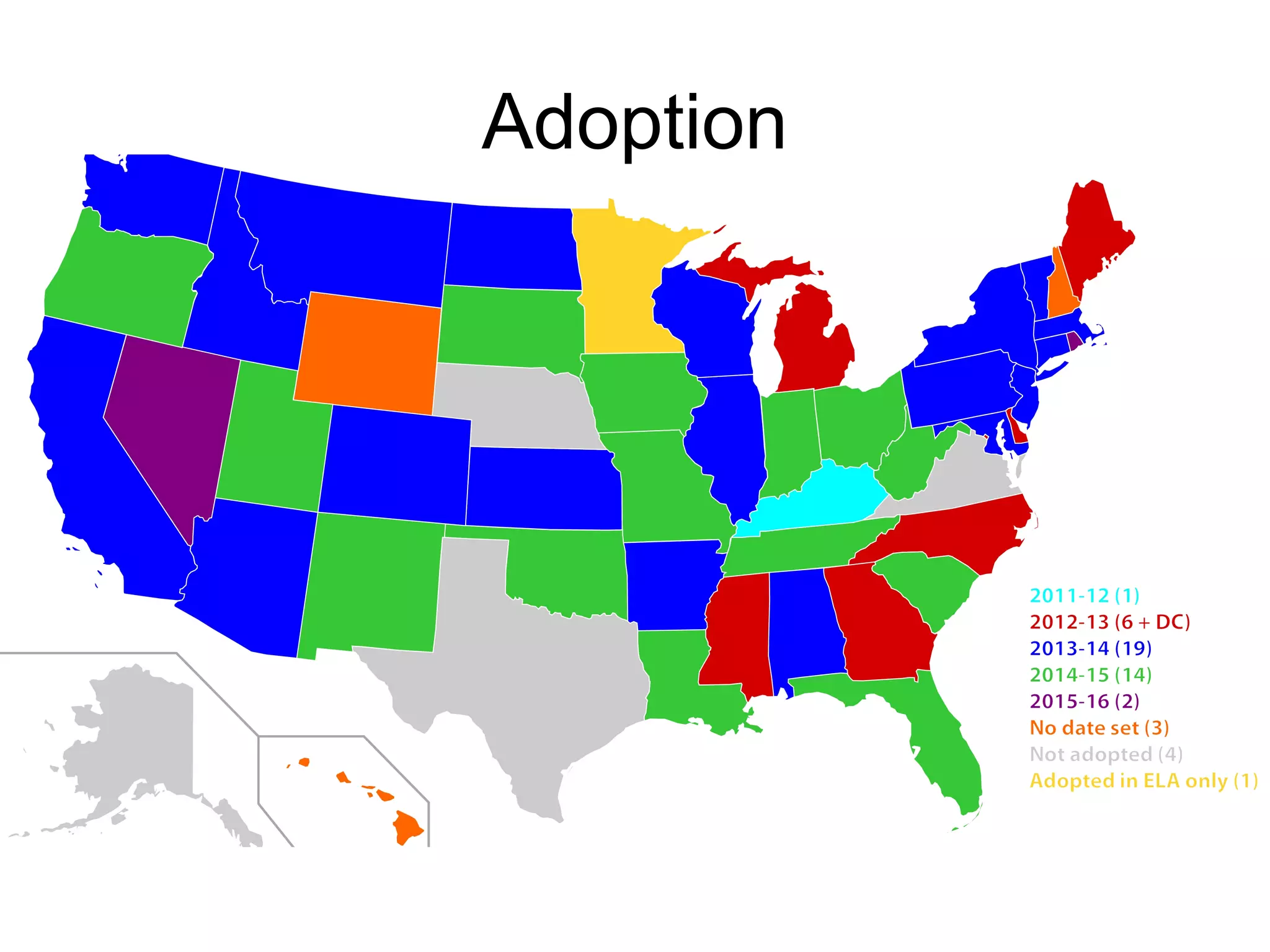
• 45 states plus D.C. have fully adopted
CCSS; Minnesota has adopted CCSS in
ELA only.
– All states plan to fully implement CCSS by the
2014-15 school year except NV and RI (201516); HI, NH, and WY have not set adoption
dates yet.

• Texas, Virginia, Nebraska, and Alaska
have not adopted the CCSS.
Adoption
Myth VS Fact
Content and Quality: General
• Myth: Adopting common standards will bring
state standards down to LCD, which means
states with high standards, will be taking a step
backward.
• Fact: CCSS are designed to build upon the most
advanced current thinking about preparing all
students for success in college and their
careers. This will result in moving even the best
state standards to the next level.
Content and Quality: General
• Myth: CCSS are not internationally
benchmarked.
• Fact: International benchmarking played a
significant role in the CCSS and the
college and career ready standards.
Content and Quality: General
• Myth: The standards only include skills
and do not address the importance of
content knowledge.
• Fact: They recognize that both content
and skills are important.
Process
• Myth: No teachers were involved in writing
the standards.
• Fact: The drafting process relied on
teachers and standards experts from
across the country.
Process
• Myth: The standards are not research or
evidence based.
• Fact: They have made careful use of a large and
growing body of evidence: scholarly research,
surveys on skills required of students entering
college and workforce, assessment data
identifying college and career ready
performance, and comparisons to standards
from high performing states and nations.
Implementation
• Myth: The standards tell teachers what to
teach.
• Fact: They establish what students need
to learn, but teachers decide how to teach
the material.
Implementation
• Myth: The standards are implemented
through NCLB and the federal government
will be involved.
• Fact: The CCSS initiative is a state-led
effort that is not part of NCLB and
adoption of the standards is NOT
mandatory.
Implementation
• Myth: The standards amount to a national
curriculum for schools.
• Fact: They are NOT a curriculum. They
ARE a clear set of shared goals and
expectations for what knowledge and skills
will help students succeed.
CONTENT
AREAS
ELA/Foreign Language
• In addition to foundation and critical content, the
standards require that students systematically
acquire knowledge in literature and other
disciplines through reading, writing, speaking,
and listening.
• The four strands align with the Foreign
Language area of Communication by
emphasizing purpose:
– Interpersonal: Listening and speaking; reading and
writing.
– Interpretive: Reading, listening, viewing.
– Presentational: writing, speaking, visually
representing.
ELA/Foreign Language
• The CCSS strand of language aligns with
the proficiency levels of foreign language:
– Novice (beginning level, regardless of age or
grade)
– Intermediate
– Advanced
ELA/Foreign Language
•
•
•

Reading: the use of both literacy and informational texts is
suggested.
Writing: a balance of writing to explain, persuade, and to convey
experience is suggested.
Main overlapping concepts:
- Key ideas and details
- Craft and structure
- Integration of knowledge and ideas
- Range of reading and level of text complexity
- Text types and purposes
- Production and distribution of writing
- Research to build and present knowledge
- Range of writing
- Comprehension and collaboration
- Presentation of knowledge and ideas
- Conventions of standard English/relevant language
- Knowledge of language
- Vocabulary acquisition and use
ELA/Foreign Language
• Reading: “Read closely to determine what the text says
explicitly and to make logical inferences from it; cite
specific textual evidence when writing or speaking to
support conclusions drawn from the text.”
• Writing: “Write arguments to support claims in an
analysis of substantive topics or texts using valid
reasoning and relevant and sufficient evidence.”
• Speaking and Listening: “Prepare for and participate
effectively in a range of conversations and collaborations
with diverse partners, building on others’ ideas and
expressing their own clearly and persuasively.”
• Language: “Demonstrate command of the conventions of
standard English (or relevant language) grammar and
usage when writing or speaking.”
Mathematics
• The CCSS for Mathematics emphasize three
areas:
– Focus (explore fewer topics in more detail).
– Coherence (concepts logically linked between
grades and to other subjects).
– Rigor (applications to real-world situations; deep
understanding of concepts).

• In addition to content standards, there are
eight CC Standards for Mathematical
Practice describing what abilities (not just
content knowledge) students should possess.
Mathematics
• Kindergarten: “Correctly name shapes regardless
of their orientations or overall size.”
• Grade 4: “Classify two-dimensional figures based
on the presence or absence of parallel or
perpendicular lines, or the presence or absence of
angles of a specified size. Recognize right
triangles as a category, and identify right
triangles.”
• Grade 8: “Describe the effect of dilations,
translations, rotations, and reflections on twodimensional figures using coordinates.”
Mathematics
• CC Standards for Mathematical Practice:
– Make sense of problems and persevere in solving
them.
– Reason abstractly and quantitatively.
– Construct viable arguments and critique the reasoning
of others.
– Model with mathematics.
– Use appropriate tools strategically.
– Attend to precision.
– Look for and make use of structure.
– Look for and express regularity in repeated reasoning.
Science/Technology
• CCSS include “Literacy in Science &
Technical Subjects” describing the skills and
content knowledge students should possess
in grades 6-8, 9-10, and 11-12.
• CCSS are designed to complement rather
than replace existing science content
standards.
• Maryland is one of 26 states that developed
Next Generation Science Standards (NGSS),
which were released in April 2013.
Science/Technology
• NGSS, like CCSS, focus on both content
and practice.
• Every standard has three dimensions:
– “Disciplinary core ideas.”
– “Scientific and engineering practices.”
– “Cross-cutting concepts.”

• NGSS aligned with ELA and Mathematics
Common Core standards.
Science/Technology
• Grades 6-8: “Follow precisely a multistep procedure
when carrying out experiments, taking measurements,
or performing technical tasks.”
• Grades 9-10: “Follow precisely a complex multistep
procedure when carrying out experiments, taking
measurements, or performing technical tasks,
attending to special cases or exceptions defined in the
text.”
• Grades 11-12: “Follow precisely a complex multistep
procedure when carrying out experiments, taking
measurements, or performing technical tasks; analyze
the specific results based on explanations in the text.”
Social Studies
• Like science, the CCSS include a set of
standards for “Literacy in History/Social
Studies” for grades 6-8, 9-10, and 11-12.
• The National Council for the Social
Studies (NCSS) is currently drafting what
it calls the “C3” (College, Career, and
Civic Life) framework to align its standards
with the CCSS.
Social Studies
• Grades 6-8: “Cite specific textual evidence to
support analysis of primary and secondary
sources.”
• Grades 9-10: “Cite specific textual evidence to
support analysis of primary and secondary
sources, attending to such features as the date
and origin of the information.”
• Grades 11-12: “Cite specific textual evidence to
support analysis of primary and secondary
sources, connecting insights gained from specific
details to an understanding of the text as a whole.”
ASSESSMENTS
PARCC Assessments
• PARCC (Partnership for Assessment of
Readiness for College and Careers)
assessments are designed to complement
Common Core adoption.
• Assessments are computer-based and
include short answer, longer free-response,
and deeper multiple-choice questions.
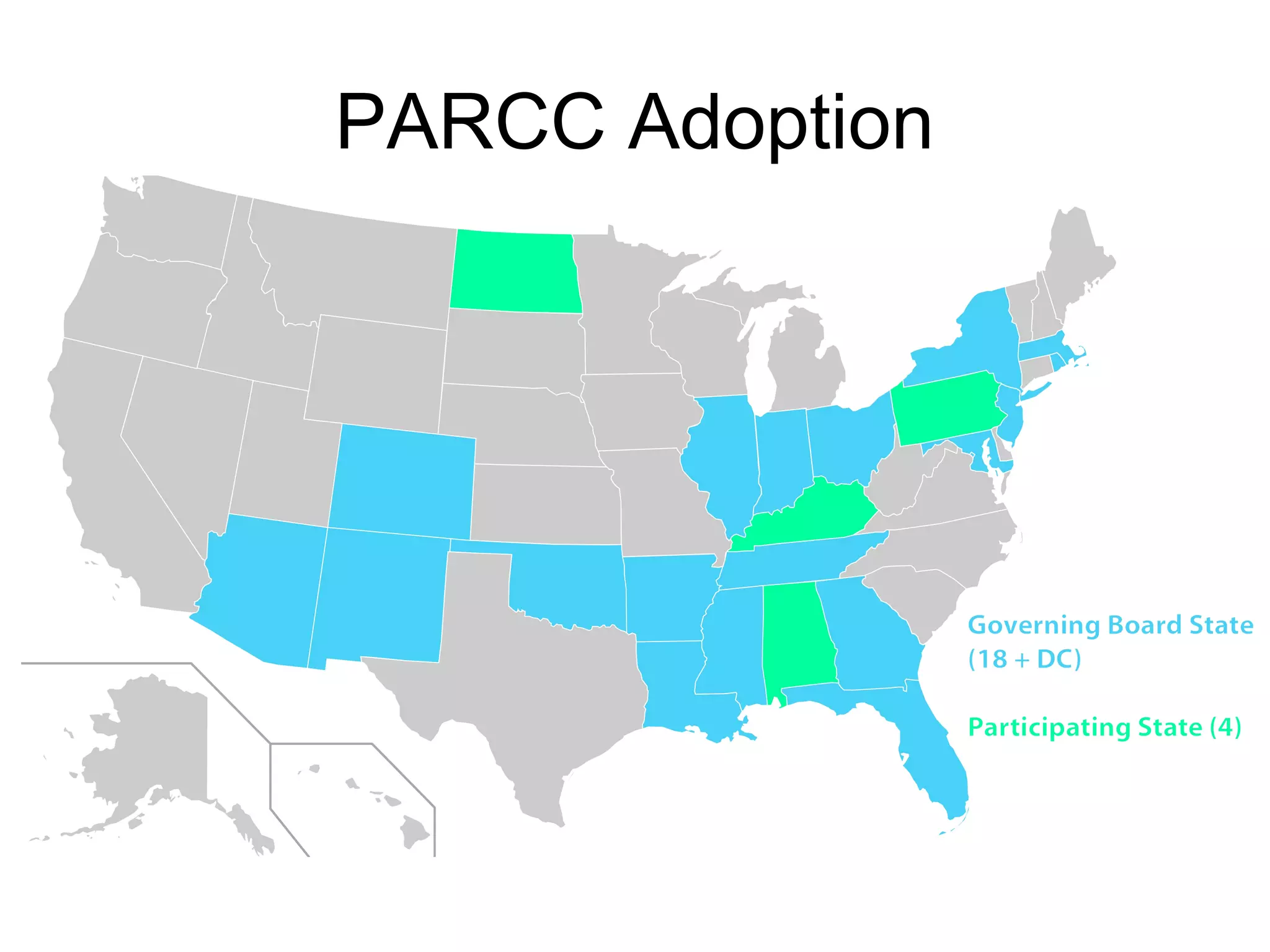
• 22 states (including MD) currently give, or are
planning to give, PARCC assessments.
PARCC Assessments
• Two components:
– Performance-based assessment (PBA), given
roughly 75% of the way through the year.
– End-of-year assessment (EOY), given roughly
90% of the way through the year.

• Assessments in ELA/Literacy and
Mathematics.
PARCC Adoption
MD PARCC Timeline
• 2013-14 school year:
– Reading and Mathematics MSA’s given in grades 3-8.
– HSA’s given in Biology, Government, Algebra/Data
Analysis, and English 10.

• 2014-15 school year:
– MSA’s discontinued.
– PARCC ELA and Mathematics assessments given in
grades 3-8.
– PARCC English and Mathematics assessments given
to high school students.
– HSA’s given in Biology and Government.
ACTIVITY
TIME!
Activity
• Separate into your school groups. Each
group will be given a math activity.
• Your job is not to work out the problem,
but to determine which of the Common
Core Standards for Mathematical Practice
apply to the given problem.
– If it helps you, feel free to work it out!

Common Core State Standards

  • 1.
  • 2.
    Warm-Up • Think aboutthe following phrases, including your level of agreement or disagreement. Be prepared to give a response. – “The US mathematics curriculum is a mile wide and an inch deep.” – “Let’s be clear: [Public schools have] accomplished nothing. Doors of opportunity are closing for families and communities across our city.” – “The rigorous Common Core learning standards… represent a once-in-a-generation opportunity for the United States to improve public schools nationally.”
  • 3.
    What are theCCSS? • The Common Core State Standards in Mathematics and English Language Arts describe what every U.S. student should know and be able to do to be ready for success after high school. • Broad, clear statements of the knowledge and skills students should master at every grade level from K-12.
  • 4.
    Why are theyimportant? • Standards that are clear and challenging help teachers, students and parents better understand what they should be working to achieve. • Require that students demonstrate a deeper grasp of academic content and critical thinking skills, complex texts, sophisticated math skills. • Before CCSS states had their own standards that were not clear or ambitious enough.
  • 5.
    Adoption • 45 statesplus D.C. have fully adopted CCSS; Minnesota has adopted CCSS in ELA only. – All states plan to fully implement CCSS by the 2014-15 school year except NV and RI (201516); HI, NH, and WY have not set adoption dates yet. • Texas, Virginia, Nebraska, and Alaska have not adopted the CCSS.
  • 6.
  • 7.
  • 8.
    Content and Quality:General • Myth: Adopting common standards will bring state standards down to LCD, which means states with high standards, will be taking a step backward. • Fact: CCSS are designed to build upon the most advanced current thinking about preparing all students for success in college and their careers. This will result in moving even the best state standards to the next level.
  • 9.
    Content and Quality:General • Myth: CCSS are not internationally benchmarked. • Fact: International benchmarking played a significant role in the CCSS and the college and career ready standards.
  • 10.
    Content and Quality:General • Myth: The standards only include skills and do not address the importance of content knowledge. • Fact: They recognize that both content and skills are important.
  • 11.
    Process • Myth: Noteachers were involved in writing the standards. • Fact: The drafting process relied on teachers and standards experts from across the country.
  • 12.
    Process • Myth: Thestandards are not research or evidence based. • Fact: They have made careful use of a large and growing body of evidence: scholarly research, surveys on skills required of students entering college and workforce, assessment data identifying college and career ready performance, and comparisons to standards from high performing states and nations.
  • 13.
    Implementation • Myth: Thestandards tell teachers what to teach. • Fact: They establish what students need to learn, but teachers decide how to teach the material.
  • 14.
    Implementation • Myth: Thestandards are implemented through NCLB and the federal government will be involved. • Fact: The CCSS initiative is a state-led effort that is not part of NCLB and adoption of the standards is NOT mandatory.
  • 15.
    Implementation • Myth: Thestandards amount to a national curriculum for schools. • Fact: They are NOT a curriculum. They ARE a clear set of shared goals and expectations for what knowledge and skills will help students succeed.
  • 16.
  • 17.
    ELA/Foreign Language • Inaddition to foundation and critical content, the standards require that students systematically acquire knowledge in literature and other disciplines through reading, writing, speaking, and listening. • The four strands align with the Foreign Language area of Communication by emphasizing purpose: – Interpersonal: Listening and speaking; reading and writing. – Interpretive: Reading, listening, viewing. – Presentational: writing, speaking, visually representing.
  • 18.
    ELA/Foreign Language • TheCCSS strand of language aligns with the proficiency levels of foreign language: – Novice (beginning level, regardless of age or grade) – Intermediate – Advanced
  • 19.
    ELA/Foreign Language • • • Reading: theuse of both literacy and informational texts is suggested. Writing: a balance of writing to explain, persuade, and to convey experience is suggested. Main overlapping concepts: - Key ideas and details - Craft and structure - Integration of knowledge and ideas - Range of reading and level of text complexity - Text types and purposes - Production and distribution of writing - Research to build and present knowledge - Range of writing - Comprehension and collaboration - Presentation of knowledge and ideas - Conventions of standard English/relevant language - Knowledge of language - Vocabulary acquisition and use
  • 20.
    ELA/Foreign Language • Reading:“Read closely to determine what the text says explicitly and to make logical inferences from it; cite specific textual evidence when writing or speaking to support conclusions drawn from the text.” • Writing: “Write arguments to support claims in an analysis of substantive topics or texts using valid reasoning and relevant and sufficient evidence.” • Speaking and Listening: “Prepare for and participate effectively in a range of conversations and collaborations with diverse partners, building on others’ ideas and expressing their own clearly and persuasively.” • Language: “Demonstrate command of the conventions of standard English (or relevant language) grammar and usage when writing or speaking.”
  • 21.
    Mathematics • The CCSSfor Mathematics emphasize three areas: – Focus (explore fewer topics in more detail). – Coherence (concepts logically linked between grades and to other subjects). – Rigor (applications to real-world situations; deep understanding of concepts). • In addition to content standards, there are eight CC Standards for Mathematical Practice describing what abilities (not just content knowledge) students should possess.
  • 22.
    Mathematics • Kindergarten: “Correctlyname shapes regardless of their orientations or overall size.” • Grade 4: “Classify two-dimensional figures based on the presence or absence of parallel or perpendicular lines, or the presence or absence of angles of a specified size. Recognize right triangles as a category, and identify right triangles.” • Grade 8: “Describe the effect of dilations, translations, rotations, and reflections on twodimensional figures using coordinates.”
  • 23.
    Mathematics • CC Standardsfor Mathematical Practice: – Make sense of problems and persevere in solving them. – Reason abstractly and quantitatively. – Construct viable arguments and critique the reasoning of others. – Model with mathematics. – Use appropriate tools strategically. – Attend to precision. – Look for and make use of structure. – Look for and express regularity in repeated reasoning.
  • 24.
    Science/Technology • CCSS include“Literacy in Science & Technical Subjects” describing the skills and content knowledge students should possess in grades 6-8, 9-10, and 11-12. • CCSS are designed to complement rather than replace existing science content standards. • Maryland is one of 26 states that developed Next Generation Science Standards (NGSS), which were released in April 2013.
  • 25.
    Science/Technology • NGSS, likeCCSS, focus on both content and practice. • Every standard has three dimensions: – “Disciplinary core ideas.” – “Scientific and engineering practices.” – “Cross-cutting concepts.” • NGSS aligned with ELA and Mathematics Common Core standards.
  • 26.
    Science/Technology • Grades 6-8:“Follow precisely a multistep procedure when carrying out experiments, taking measurements, or performing technical tasks.” • Grades 9-10: “Follow precisely a complex multistep procedure when carrying out experiments, taking measurements, or performing technical tasks, attending to special cases or exceptions defined in the text.” • Grades 11-12: “Follow precisely a complex multistep procedure when carrying out experiments, taking measurements, or performing technical tasks; analyze the specific results based on explanations in the text.”
  • 27.
    Social Studies • Likescience, the CCSS include a set of standards for “Literacy in History/Social Studies” for grades 6-8, 9-10, and 11-12. • The National Council for the Social Studies (NCSS) is currently drafting what it calls the “C3” (College, Career, and Civic Life) framework to align its standards with the CCSS.
  • 28.
    Social Studies • Grades6-8: “Cite specific textual evidence to support analysis of primary and secondary sources.” • Grades 9-10: “Cite specific textual evidence to support analysis of primary and secondary sources, attending to such features as the date and origin of the information.” • Grades 11-12: “Cite specific textual evidence to support analysis of primary and secondary sources, connecting insights gained from specific details to an understanding of the text as a whole.”
  • 29.
  • 30.
    PARCC Assessments • PARCC(Partnership for Assessment of Readiness for College and Careers) assessments are designed to complement Common Core adoption. • Assessments are computer-based and include short answer, longer free-response, and deeper multiple-choice questions. • 22 states (including MD) currently give, or are planning to give, PARCC assessments.
  • 31.
    PARCC Assessments • Twocomponents: – Performance-based assessment (PBA), given roughly 75% of the way through the year. – End-of-year assessment (EOY), given roughly 90% of the way through the year. • Assessments in ELA/Literacy and Mathematics.
  • 32.
  • 33.
    MD PARCC Timeline •2013-14 school year: – Reading and Mathematics MSA’s given in grades 3-8. – HSA’s given in Biology, Government, Algebra/Data Analysis, and English 10. • 2014-15 school year: – MSA’s discontinued. – PARCC ELA and Mathematics assessments given in grades 3-8. – PARCC English and Mathematics assessments given to high school students. – HSA’s given in Biology and Government.
  • 34.
  • 35.
    Activity • Separate intoyour school groups. Each group will be given a math activity. • Your job is not to work out the problem, but to determine which of the Common Core Standards for Mathematical Practice apply to the given problem. – If it helps you, feel free to work it out!