Measuring VolumeHow much space?By Moira Whitehouse  PhD
We have learned that all matter• takes up space• has mass Mass isthe amount of matter in an objectVolume ishow much space an object takes up.
Now let’s look at how mass and volume are different.Volume is more like size.Mass is more like weight.
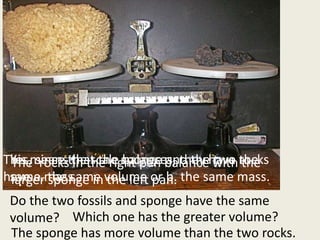
•Mass is different than size and volume.This means that the sponge and the two rocks have a. the same volume or b. the same mass.  Yes, since the scale balances, they have the same mass.The  rocks in the right pan balance with the larger sponge in the left pan..  Do the two fossils and sponge have the same volume?  Which one has the greater volume?The sponge has more volume than the two rocks.
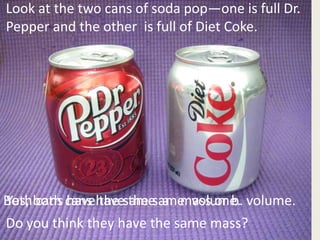
Look at the two cans of soda pop—one is full Dr. Pepper and the other  is full of Diet Coke. Both cans have the same  a.  mass or b. volume. Yes, both cans have the same  volume. Do you think they have the same mass?
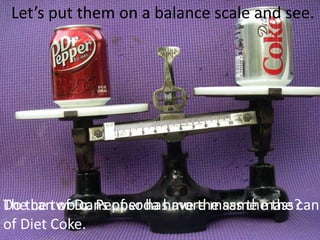
Let’s put them on a balance scale and see.Do the two cans of soda have the same mass? The can of Dr. Pepper has more mass the the can of Diet Coke.
Back to volume--the amount of space that an object takes up. How is it measured?Volume is measured by seeing how much stuff (like a solid, gas, or liquid) it takes to fill a space or a container.Scientists used a cubed meter for the standard size to describe “how much” space.
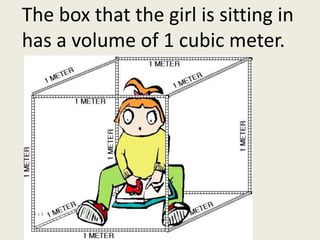
The box that the girl is sitting in has a volume of 1 cubic meter.
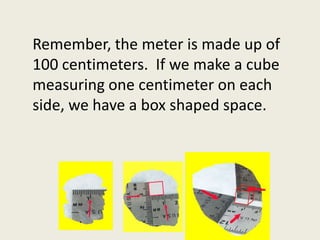
Remember, the meter is made up of 100 centimeters.  If we make a cube measuring one centimeter on each side, we have a box shaped space.
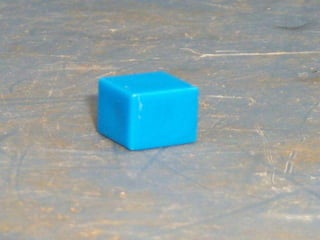
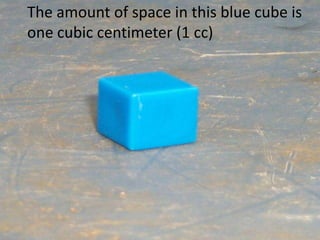
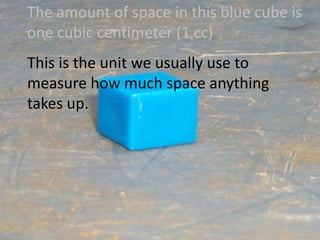
The amount of space in this blue cube is one cubic centimeter (1 cc)
The amount of space in this blue cube is one cubic centimeter (1 cc)This is the unit we usually use to measure how much space anything takes up.
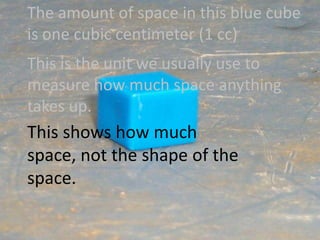
The amount of space in this blue cube is one cubic centimeter (1 cc)This is the unit we usually use to measure how much space anything takes up.This shows how much space, not the shape of the space.
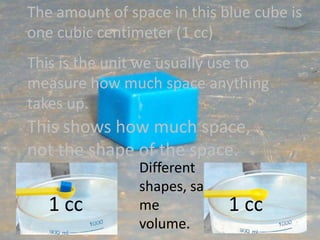
The amount of space in this blue cube is one cubic centimeter (1 cc)This is the unit we usually use to measure how much space anything takes up.This shows how much space, not the shape of the space.Different shapes, same volume.1 cc1 cc
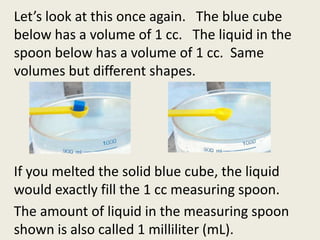
Let’s look at this once again.   The blue cube below has a volume of 1 cc.   The liquid in the spoon below has a volume of 1 cc.  Same volumes but different shapes.If you melted the solid blue cube, the liquid would exactly fill the 1 cc measuring spoon.The amount of liquid in the measuring spoon shown is also called 1 milliliter (mL).
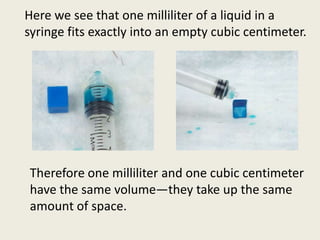
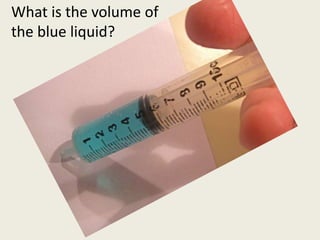
Here we see that one milliliter of a liquid in a syringe fits exactly into an empty cubic centimeter.  Therefore one milliliter and one cubic centimeter have the same volume—they take up the same amount of space.
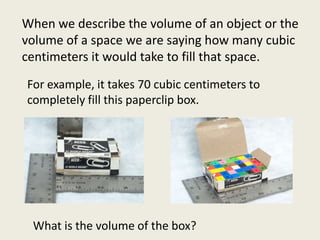
When we describe the volume of an object or the volume of a space we are saying how many cubic centimeters it would take to fill that space.For example, it takes 70 cubic centimeters to completely fill this paperclip box.    What is the volume of the box?
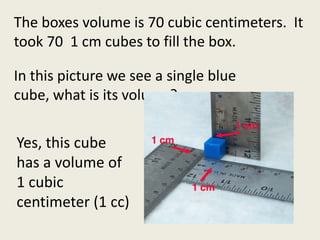
The boxes volume is 70 cubic centimeters.  It took 70  1 cm cubes to fill the box.  In this picture we see a single blue cube, what is its volume?Yes, this cube has a volume of 1 cubic centimeter (1 cc)
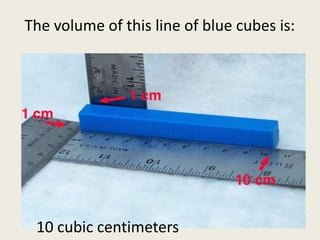
The volume of this line of blue cubes is:10 cubic centimeters
The volume of this square of blue cubes is:100 cubic centimeters
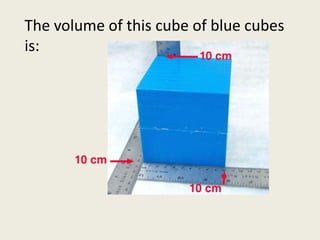
The volume of this cube of blue cubes is:
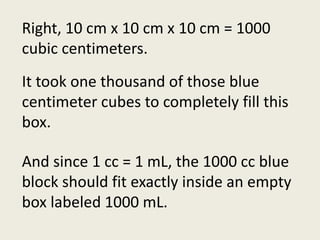
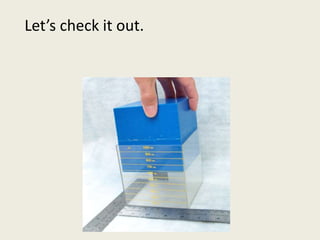
Right, 10 cm x 10 cm x 10 cm = 1000 cubic centimeters.It took one thousand of those blue centimeter cubes to completely fill this box.And since 1 cc = 1 mL, the 1000 cc blue block should fit exactly inside an empty box labeled 1000 mL.
Let’s check it out.
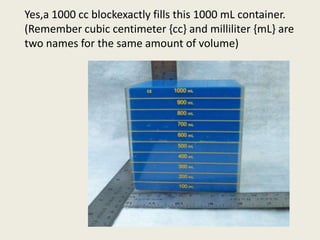
Yes,a 1000 cc blockexactly fills this 1000 mL container.  (Remember cubic centimeter {cc} and milliliter {mL} are two names for the same amount of volume)
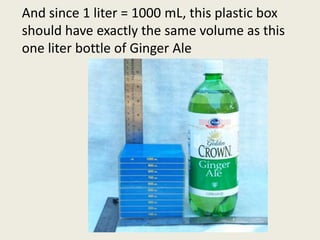
And since 1 liter = 1000 mL, this plastic box should have exactly the same volume as this one liter bottle of Ginger Ale
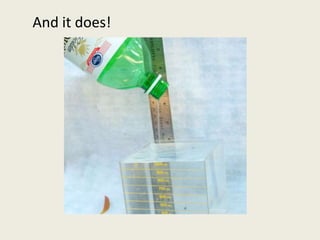
And it does!
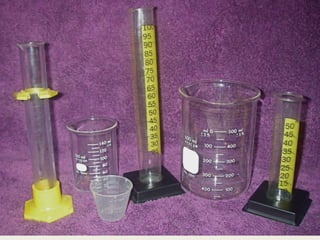
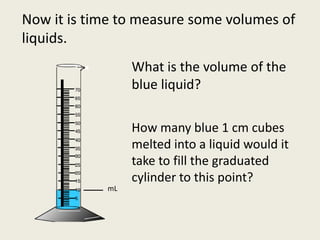
To measure the volume of liquids in the classroom, we have special tools called graduated cylinders, syringes and beakers. The units we use to measure the volume of liquids are cubic centimeters (cc) and milliliters (mL).
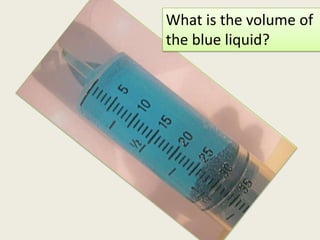
Now it is time to measure some volumes of liquids.What is the volume of the blue liquid?How many blue 1 cm cubes melted into a liquid would it  take to fill the graduated cylinder to this point?mL
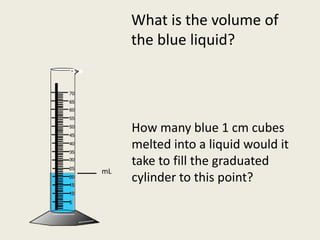
What is the volume of the blue liquid?How many blue 1 cm cubes melted into a liquid would it  take to fill the graduated cylinder to this point?mL
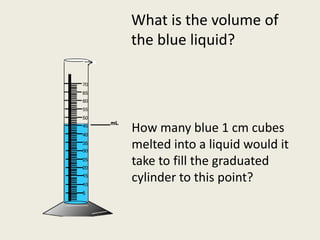
What is the volume of the blue liquid?How many blue 1 cm cubes melted into a liquid would it  take to fill the graduated cylinder to this point?
What is the volume of the blue liquid?
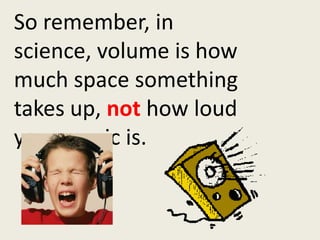
So remember, in science, volume is how much space something takes up, not how loud your music is.

MEASURING VOLUME (teach)

  • 1.
    Measuring VolumeHow muchspace?By Moira Whitehouse PhD
  • 2.
    We have learnedthat all matter• takes up space• has mass Mass isthe amount of matter in an objectVolume ishow much space an object takes up.
  • 3.
    Now let’s lookat how mass and volume are different.Volume is more like size.Mass is more like weight.
  • 4.
    •Mass is differentthan size and volume.This means that the sponge and the two rocks have a. the same volume or b. the same mass. Yes, since the scale balances, they have the same mass.The rocks in the right pan balance with the larger sponge in the left pan.. Do the two fossils and sponge have the same volume? Which one has the greater volume?The sponge has more volume than the two rocks.
  • 5.
    Look at thetwo cans of soda pop—one is full Dr. Pepper and the other is full of Diet Coke. Both cans have the same a. mass or b. volume. Yes, both cans have the same volume. Do you think they have the same mass?
  • 6.
    Let’s put themon a balance scale and see.Do the two cans of soda have the same mass? The can of Dr. Pepper has more mass the the can of Diet Coke.
  • 7.
    Back to volume--theamount of space that an object takes up. How is it measured?Volume is measured by seeing how much stuff (like a solid, gas, or liquid) it takes to fill a space or a container.Scientists used a cubed meter for the standard size to describe “how much” space.
  • 8.
    The box thatthe girl is sitting in has a volume of 1 cubic meter.
  • 9.
    Remember, the meteris made up of 100 centimeters. If we make a cube measuring one centimeter on each side, we have a box shaped space.
  • 11.
    The amount ofspace in this blue cube is one cubic centimeter (1 cc)
  • 12.
    The amount ofspace in this blue cube is one cubic centimeter (1 cc)This is the unit we usually use to measure how much space anything takes up.
  • 13.
    The amount ofspace in this blue cube is one cubic centimeter (1 cc)This is the unit we usually use to measure how much space anything takes up.This shows how much space, not the shape of the space.
  • 14.
    The amount ofspace in this blue cube is one cubic centimeter (1 cc)This is the unit we usually use to measure how much space anything takes up.This shows how much space, not the shape of the space.Different shapes, same volume.1 cc1 cc
  • 15.
    Let’s look atthis once again. The blue cube below has a volume of 1 cc. The liquid in the spoon below has a volume of 1 cc. Same volumes but different shapes.If you melted the solid blue cube, the liquid would exactly fill the 1 cc measuring spoon.The amount of liquid in the measuring spoon shown is also called 1 milliliter (mL).
  • 16.
    Here we seethat one milliliter of a liquid in a syringe fits exactly into an empty cubic centimeter. Therefore one milliliter and one cubic centimeter have the same volume—they take up the same amount of space.
  • 17.
    When we describethe volume of an object or the volume of a space we are saying how many cubic centimeters it would take to fill that space.For example, it takes 70 cubic centimeters to completely fill this paperclip box. What is the volume of the box?
  • 18.
    The boxes volumeis 70 cubic centimeters. It took 70 1 cm cubes to fill the box. In this picture we see a single blue cube, what is its volume?Yes, this cube has a volume of 1 cubic centimeter (1 cc)
  • 19.
    The volume ofthis line of blue cubes is:10 cubic centimeters
  • 20.
    The volume ofthis square of blue cubes is:100 cubic centimeters
  • 21.
    The volume ofthis cube of blue cubes is:
  • 22.
    Right, 10 cmx 10 cm x 10 cm = 1000 cubic centimeters.It took one thousand of those blue centimeter cubes to completely fill this box.And since 1 cc = 1 mL, the 1000 cc blue block should fit exactly inside an empty box labeled 1000 mL.
  • 23.
  • 24.
    Yes,a 1000 ccblockexactly fills this 1000 mL container. (Remember cubic centimeter {cc} and milliliter {mL} are two names for the same amount of volume)
  • 25.
    And since 1liter = 1000 mL, this plastic box should have exactly the same volume as this one liter bottle of Ginger Ale
  • 26.
  • 27.
    To measure thevolume of liquids in the classroom, we have special tools called graduated cylinders, syringes and beakers. The units we use to measure the volume of liquids are cubic centimeters (cc) and milliliters (mL).
  • 29.
    Now it istime to measure some volumes of liquids.What is the volume of the blue liquid?How many blue 1 cm cubes melted into a liquid would it take to fill the graduated cylinder to this point?mL
  • 30.
    What is thevolume of the blue liquid?How many blue 1 cm cubes melted into a liquid would it take to fill the graduated cylinder to this point?mL
  • 31.
    What is thevolume of the blue liquid?How many blue 1 cm cubes melted into a liquid would it take to fill the graduated cylinder to this point?
  • 32.
    What is thevolume of the blue liquid?
  • 33.
    What is thevolume of the blue liquid?
  • 34.
    So remember, inscience, volume is how much space something takes up, not how loud your music is.