Rectangles
Shape and Space
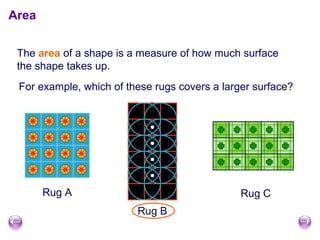
The area of a shape is a measure of how much surface
the shape takes up.
Area
For example, which of these rugs covers a larger surface?
Rug A
Rug B
Rug C
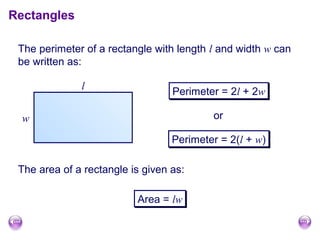
The perimeter of a rectangle with length l and width w can
be written as:
Rectangles
l
w
Perimeter = 2l + 2wPerimeter = 2l + 2w
or
Perimeter = 2(l + w)Perimeter = 2(l + w)
The area of a rectangle is given as:
Area = lwArea = lw
Area of a rectangle
Area is measured in square units.
For example, we can use mm2
, cm2
, m2
or km2
.
The 2
tells us that there are two dimensions, length and width.
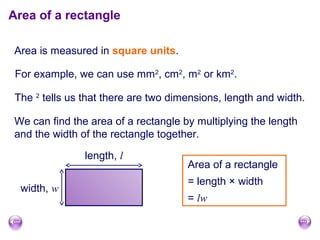
We can find the area of a rectangle by multiplying the length
and the width of the rectangle together.
length, l
width, w
Area of a rectangle
= length × width
= lw
Area of a rectangle
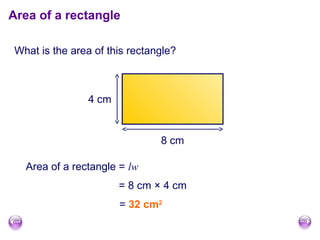
What is the area of this rectangle?
8 cm
4 cm
Area of a rectangle = lw
= 8 cm × 4 cm
= 32 cm2
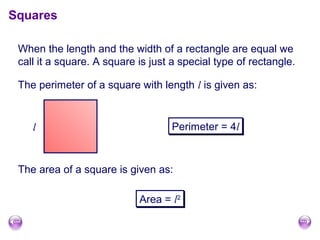
When the length and the width of a rectangle are equal we
call it a square. A square is just a special type of rectangle.
Squares
Perimeter = 4lPerimeter = 4l
The area of a square is given as:
Area = l2Area = l2
l
The perimeter of a square with length l is given as:
Area of shapes made from rectangles
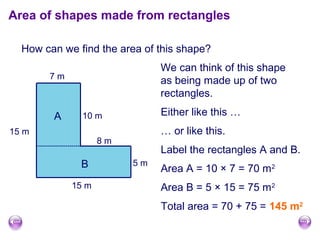
How can we find the area of this shape?
7 m
10 m
8 m
5 m
15 m
15 m
We can think of this shape
as being made up of two
rectangles.
Either like this …
… or like this.
Label the rectangles A and B.
A
B Area A = 10 × 7 = 70 m2
Area B = 5 × 15 = 75 m2
Total area = 70 + 75 = 145 m2
Area of shapes made from rectangles
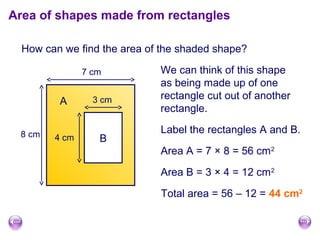
How can we find the area of the shaded shape?
We can think of this shape
as being made up of one
rectangle cut out of another
rectangle.
7 cm
8 cm
3 cm
4 cm
Label the rectangles A and B.
A
B
Area A = 7 × 8 = 56 cm2
Area B = 3 × 4 = 12 cm2
Total area = 56 – 12 = 44 cm2
Shapes made from rectangles

Area of-rectangles

  • 1.
  • 2.
    The area ofa shape is a measure of how much surface the shape takes up. Area For example, which of these rugs covers a larger surface? Rug A Rug B Rug C
  • 3.
    The perimeter ofa rectangle with length l and width w can be written as: Rectangles l w Perimeter = 2l + 2wPerimeter = 2l + 2w or Perimeter = 2(l + w)Perimeter = 2(l + w) The area of a rectangle is given as: Area = lwArea = lw
  • 4.
    Area of arectangle Area is measured in square units. For example, we can use mm2 , cm2 , m2 or km2 . The 2 tells us that there are two dimensions, length and width. We can find the area of a rectangle by multiplying the length and the width of the rectangle together. length, l width, w Area of a rectangle = length × width = lw
  • 5.
    Area of arectangle What is the area of this rectangle? 8 cm 4 cm Area of a rectangle = lw = 8 cm × 4 cm = 32 cm2
  • 6.
    When the lengthand the width of a rectangle are equal we call it a square. A square is just a special type of rectangle. Squares Perimeter = 4lPerimeter = 4l The area of a square is given as: Area = l2Area = l2 l The perimeter of a square with length l is given as:
  • 7.
    Area of shapesmade from rectangles How can we find the area of this shape? 7 m 10 m 8 m 5 m 15 m 15 m We can think of this shape as being made up of two rectangles. Either like this … … or like this. Label the rectangles A and B. A B Area A = 10 × 7 = 70 m2 Area B = 5 × 15 = 75 m2 Total area = 70 + 75 = 145 m2
  • 8.
    Area of shapesmade from rectangles How can we find the area of the shaded shape? We can think of this shape as being made up of one rectangle cut out of another rectangle. 7 cm 8 cm 3 cm 4 cm Label the rectangles A and B. A B Area A = 7 × 8 = 56 cm2 Area B = 3 × 4 = 12 cm2 Total area = 56 – 12 = 44 cm2
  • 9.
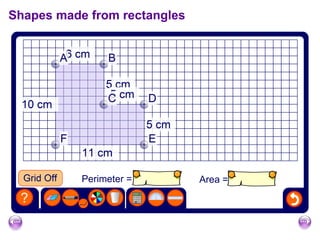
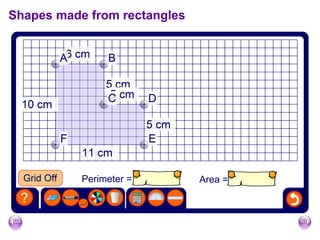
    Shapes made fromrectangles
  • 10.
    Shapes made fromrectangles

Editor's Notes

  • #2 The aim of this unit is to teach pupils to: Identify and use the geometric properties of triangles, quadrilaterals and other polygons to solve problems; explain and justify inferences and deductions using mathematical reasoning Understand congruence and similarity Identify and use the properties of circles Material in this unit is linked to the Key Stage 3 Framework supplement of examples pp 184-197.
  • #3 Discuss how we can compare the area of the rugs by counting the squares that make up each pattern. Conclude that Rug B covers the largest surface.
  • #5 This formula should be revision from key stage 2 work.
  • #6 The length and the width of the rectangle can be modified to make the arithmetic more challenging. Different units could also be used to stress that units must be the same before they are substituted into a formula.
  • #8 Discuss ways to divide this composite shape into rectangles. A third possibility not shown on this slide would be to take the square of area 15 m × 15 m and to subtract the area of the rectangle 10 m × 8 m. This gives us 225 m2 – 80 m2 = 145 m2.
  • #9 Discuss ways to find the shaded area before revealing the solution.
  • #10 Modify the compound shape on the board and discuss the various ways to find its area by splitting it into two rectangles or by subtracting a rectangle. Turn off the square grid and hide the lengths of some of the sides by clicking on them. Discuss how the lengths of these missing sides can be found and use these lengths to find the perimeter and the area.