By- Vivek Singh
ABPS
JAGDISHPUR
Measurement
Part-1
Chapter-8
FOR CLASS - V
Measurement
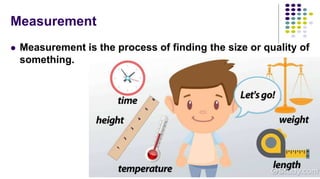
 Measurement is the process of finding the size or quality of
something.
History of measurement
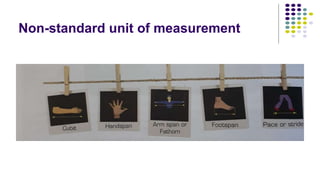
 In early times, people used different body parts such as the
hand and the palm to measure length.
 Some of the measures used in ancient times were hand
span, cubit, and fathom.
Non-standard unit of measurement
Unit
 A fixed quality that is used as a standard of measurement is
called a unit.
Measurement of length
 Length is the size or measurement of an object from its one
end to another.
 Metre rule and measuring tape are some instruments used
for measuring length.
 The standard unit used to measure length is metre(m).
 Millimetre, centimetre, and metre are used to measure
smaller lengths. Examples are- length of a pencil or a cloth
piece.
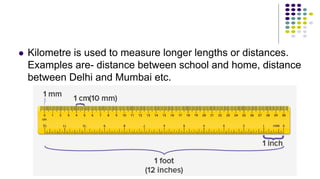
 Kilometre is used to measure longer lengths or distances.
Examples are- distance between school and home, distance
between Delhi and Mumbai etc.
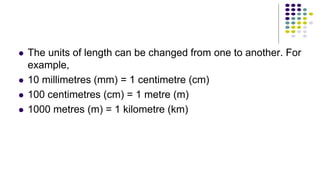
 The units of length can be changed from one to another. For
example,
 10 millimetres (mm) = 1 centimetre (cm)
 100 centimetres (cm) = 1 metre (m)
 1000 metres (m) = 1 kilometre (km)
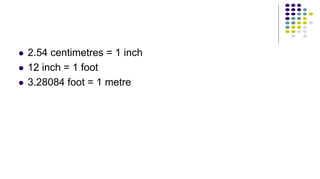
 2.54 centimetres = 1 inch
 12 inch = 1 foot
 3.28084 foot = 1 metre
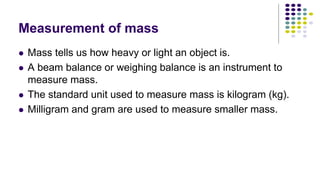
Measurement of mass
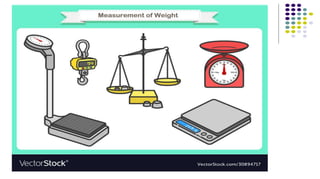
 Mass tells us how heavy or light an object is.
 A beam balance or weighing balance is an instrument to
measure mass.
 The standard unit used to measure mass is kilogram (kg).
 Milligram and gram are used to measure smaller mass.
 The units of mass can be changed from one to another. For
example,
 1000 milligrams (mg) = 1 gram (g)
 1000 grams (g) = 1 kilogram (kg)
Measurement of capacity
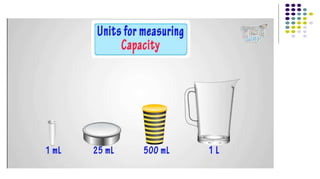
 Capacity of a container is the amount of liquid it can hold.
 A measuring cylinder is an instrument used to measure
capacity.
 The standard unit used to measure capacity is litre.
 Millilitre and litre are used to measure smaller capacities
such as water in a bottle. Kilolitre is used to measure larger
capacities like that of a big tank of water.
 The units of capacity can be changed from one to another.
For example,
 1000 millilitres (mL) = 1 litre (L)
 1000 litres (L) = 1 kilolitre (kL)
Measurement of time
 The period between two events is called time.
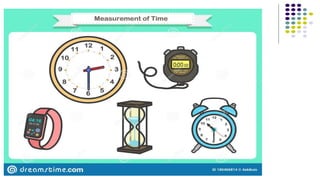
 A clock or a watch is an instrument used to measure time.
 Some of the units used to measure time are second (s),
minute (min), and hour (h).
 The units of time can be changed from one to another.
 For example,
 60 seconds (s) = 1 minute (min)
 60 minutes (min) = 1 hour (h)
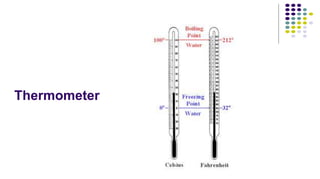
Measurement of temperature
 Temperature is the measurement of how hot or cold an
object is.
 It is measured using an instrument called a thermometer.
 Units used to measure temperature are degree Celsius (C)
or degree Fahrenheit (F).
 Doctors use a thermometer to measure of a patient who has
fever.
Thermometer
JAY HIND

Measurement

  • 1.
  • 2.
    Measurement  Measurement isthe process of finding the size or quality of something.
  • 3.
    History of measurement In early times, people used different body parts such as the hand and the palm to measure length.  Some of the measures used in ancient times were hand span, cubit, and fathom.
  • 4.
  • 5.
    Unit  A fixedquality that is used as a standard of measurement is called a unit.
  • 6.
    Measurement of length Length is the size or measurement of an object from its one end to another.  Metre rule and measuring tape are some instruments used for measuring length.  The standard unit used to measure length is metre(m).  Millimetre, centimetre, and metre are used to measure smaller lengths. Examples are- length of a pencil or a cloth piece.
  • 7.
     Kilometre isused to measure longer lengths or distances. Examples are- distance between school and home, distance between Delhi and Mumbai etc.
  • 8.
     The unitsof length can be changed from one to another. For example,  10 millimetres (mm) = 1 centimetre (cm)  100 centimetres (cm) = 1 metre (m)  1000 metres (m) = 1 kilometre (km)
  • 9.
     2.54 centimetres= 1 inch  12 inch = 1 foot  3.28084 foot = 1 metre
  • 10.
    Measurement of mass Mass tells us how heavy or light an object is.  A beam balance or weighing balance is an instrument to measure mass.  The standard unit used to measure mass is kilogram (kg).  Milligram and gram are used to measure smaller mass.
  • 12.
     The unitsof mass can be changed from one to another. For example,  1000 milligrams (mg) = 1 gram (g)  1000 grams (g) = 1 kilogram (kg)
  • 13.
    Measurement of capacity Capacity of a container is the amount of liquid it can hold.  A measuring cylinder is an instrument used to measure capacity.  The standard unit used to measure capacity is litre.  Millilitre and litre are used to measure smaller capacities such as water in a bottle. Kilolitre is used to measure larger capacities like that of a big tank of water.
  • 15.
     The unitsof capacity can be changed from one to another. For example,  1000 millilitres (mL) = 1 litre (L)  1000 litres (L) = 1 kilolitre (kL)
  • 16.
    Measurement of time The period between two events is called time.  A clock or a watch is an instrument used to measure time.  Some of the units used to measure time are second (s), minute (min), and hour (h).
  • 18.
     The unitsof time can be changed from one to another.  For example,  60 seconds (s) = 1 minute (min)  60 minutes (min) = 1 hour (h)
  • 19.
    Measurement of temperature Temperature is the measurement of how hot or cold an object is.  It is measured using an instrument called a thermometer.  Units used to measure temperature are degree Celsius (C) or degree Fahrenheit (F).  Doctors use a thermometer to measure of a patient who has fever.
  • 20.
  • 21.