
Strategy is Not Operational
Effectiveness
By
Dr. Michael McDermott
mcdermottm1@nku.edu
Structure
1. Common mistakes in discussing strategy
2. The Limited Advantages of Being Better –
Operational Effectiveness
3. The Significant Advantages of Being Smarter –
Genuine Strategy
4. Smarter can beat Better
5. The Critical and Sustainable Advantages of Being
Better and Smarter – Operational Effectiveness
and Genuine Strategy
6. Smarter and Better is Invincible
© McDermott, 2012.

2
Common mistakes in discussing strategy
• Many people, including executives, often make
the mistake of equating operational effectiveness
with strategy:
• Strategy is not:
– transferring production to a lower cost location; or,
– Increasing productivity; or,
– Lowering costs

• Improving operational effectiveness is great, but
it’s not strategy
© McDermott, 2012.

3
What is Operational Effectiveness (OE)?
• It’s all about internal performance
• It’s about being:
– Better, or
– Cheaper, or
– Faster, or
– Wider (i.e. more international)

© McDermott, 2012.

4
Nature and Limitations of Operational
Effectiveness
Nature of OE

Implications

• OE means performing
similar activities better
than rivals perform
them

• Constant improvement or
getting better is seldom
sufficient for profitability

• Constant improvement
in operational
effectiveness is
necessary to achieve
superior profitability.

• And that is tough – hence
many companies exit an
industry where they have
exhausted all possibilities

© McDermott, 2012.

5
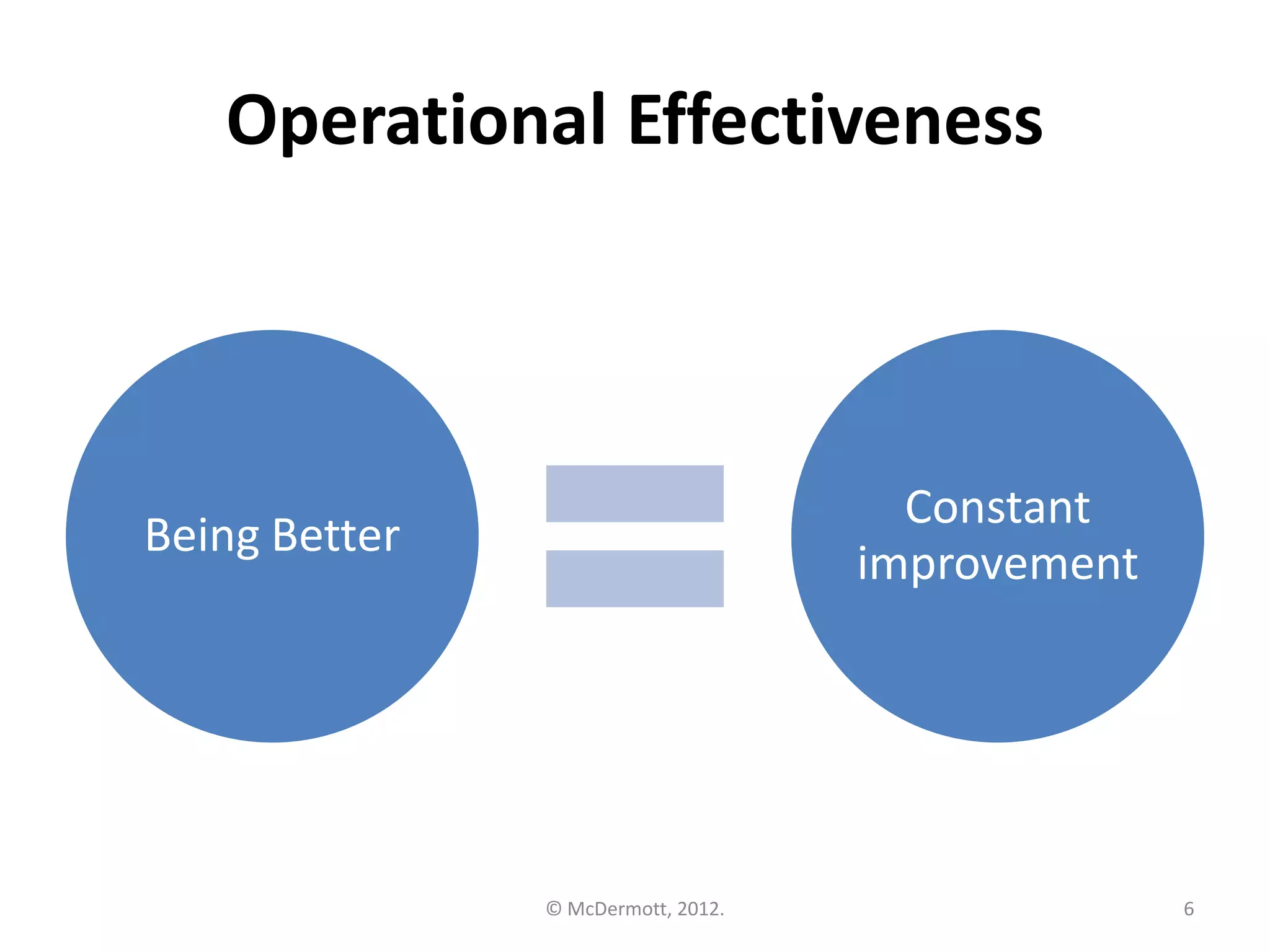
Operational Effectiveness

Constant
improvement

Being Better

© McDermott, 2012.

6
Operational Effectiveness

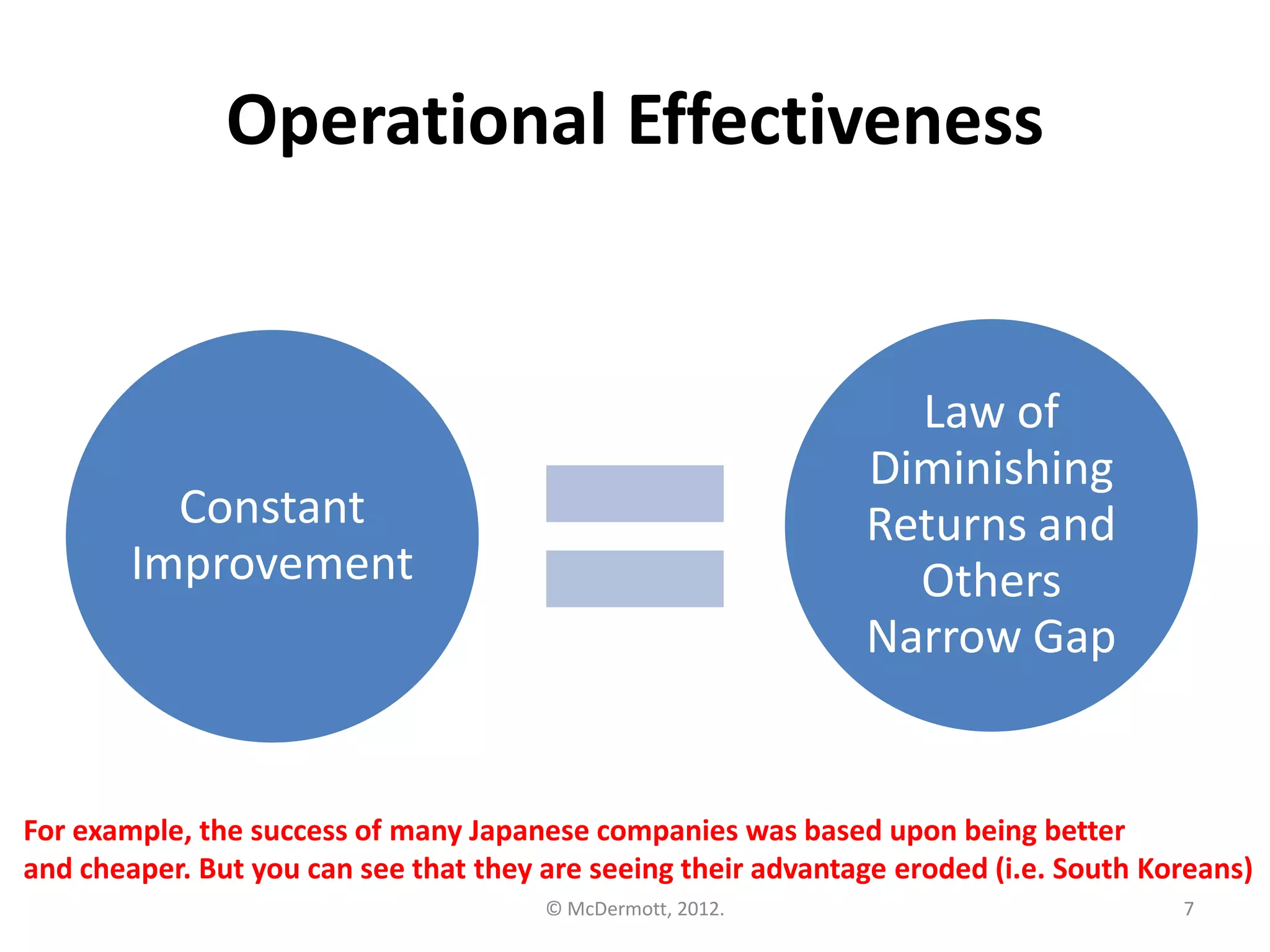
Law of
Diminishing
Returns and
Others
Narrow Gap

Constant
Improvement

For example, the success of many Japanese companies was based upon being better
and cheaper. But you can see that they are seeing their advantage eroded (i.e. South Koreans)
© McDermott, 2012.

7
Nature and Limitations of Operational
Effectiveness
Nature of OE

Limitations of OE

• OE means performing
similar activities better
than rivals perform
them

• Constant improvement or
getting better is seldom
sufficient for profitability

• Constant improvement
in operational
effectiveness is
necessary to achieve
superior profitability.

• And that is tough – hence
many companies exit an
industry where they have
exhausted all possibilities

© McDermott, 2012.

8
The Limitations of OE
• Those who rely exclusively upon OE are
quickly overtaken
• Just think of the TV, PC industries
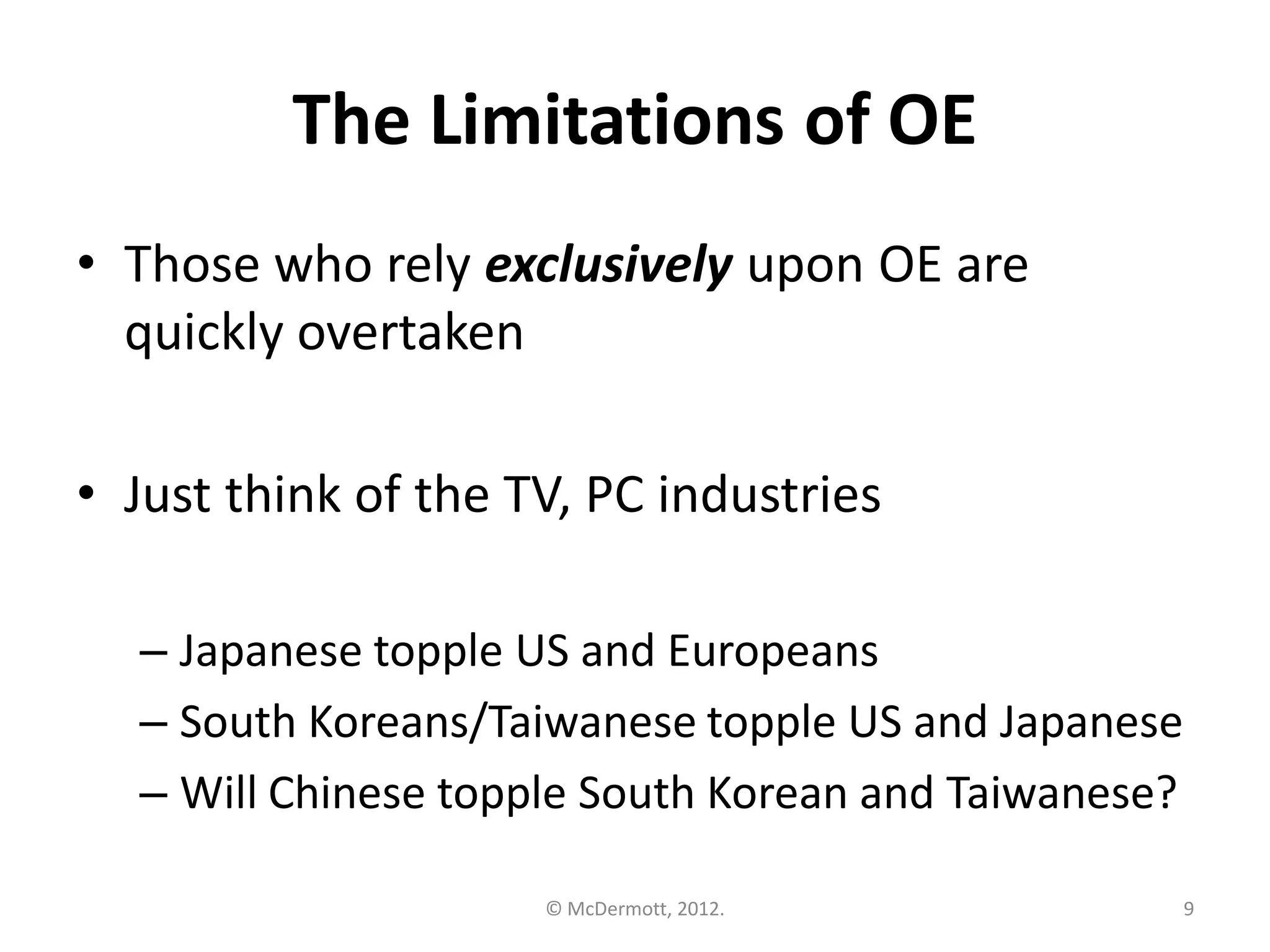
– Japanese topple US and Europeans
– South Koreans/Taiwanese topple US and Japanese
– Will Chinese topple South Korean and Taiwanese?
© McDermott, 2012.

9
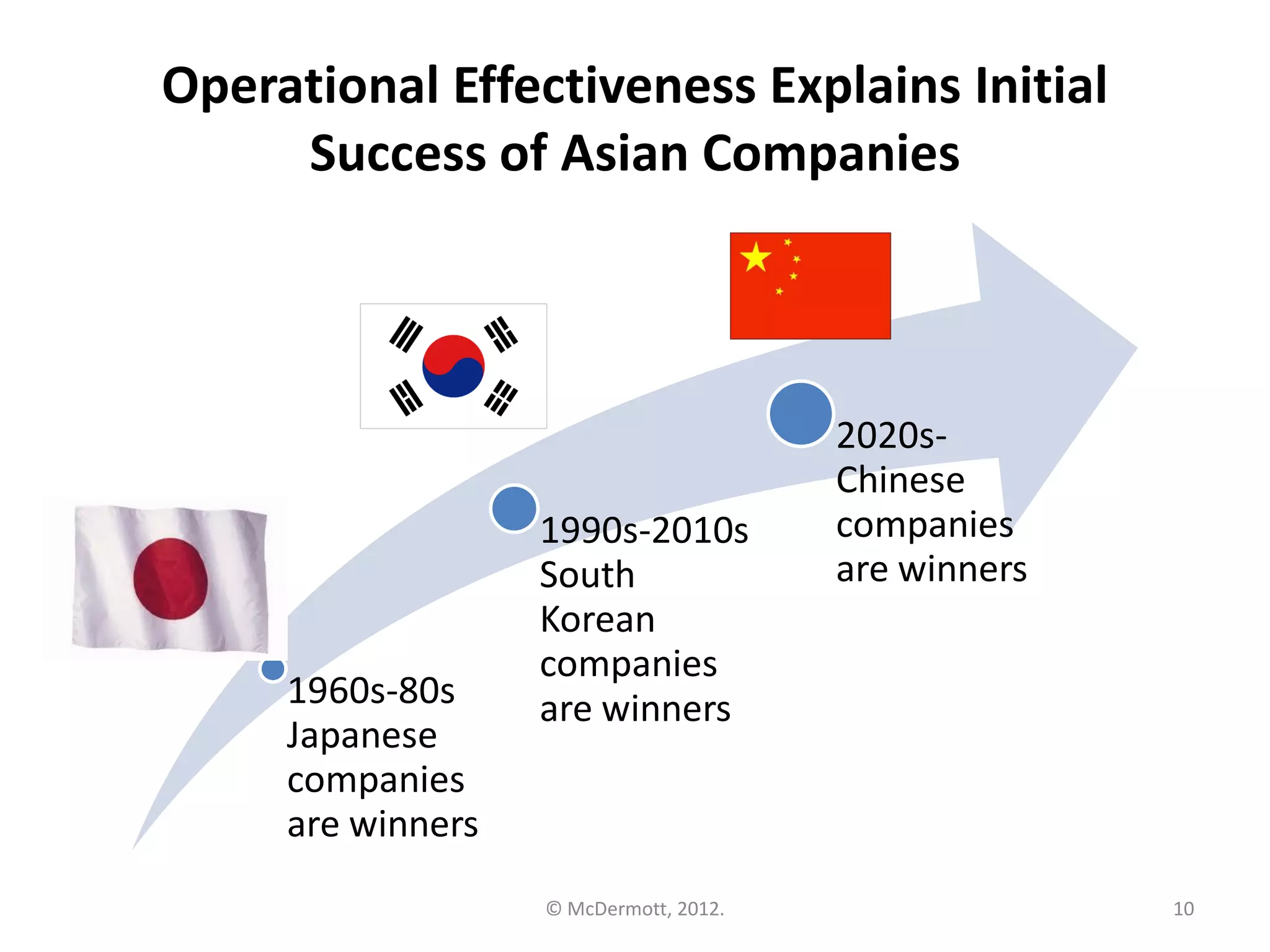
Operational Effectiveness Explains Initial
Success of Asian Companies

1960s-80s
Japanese
companies
are winners

1990s-2010s
South
Korean
companies
are winners

© McDermott, 2012.

2020sChinese
companies
are winners

10
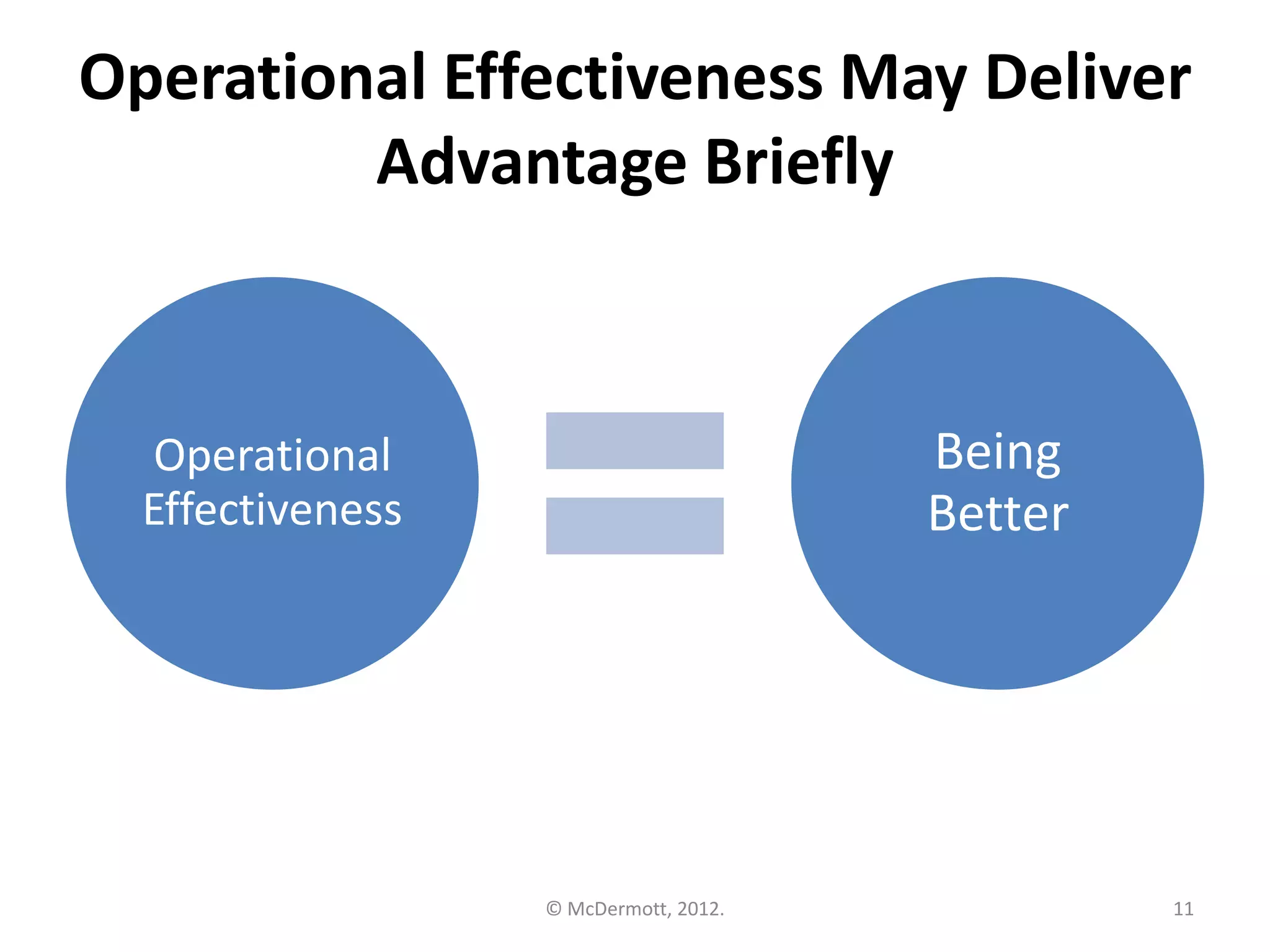
Operational Effectiveness May Deliver
Advantage Briefly

Being
Better

Operational
Effectiveness

© McDermott, 2012.

11
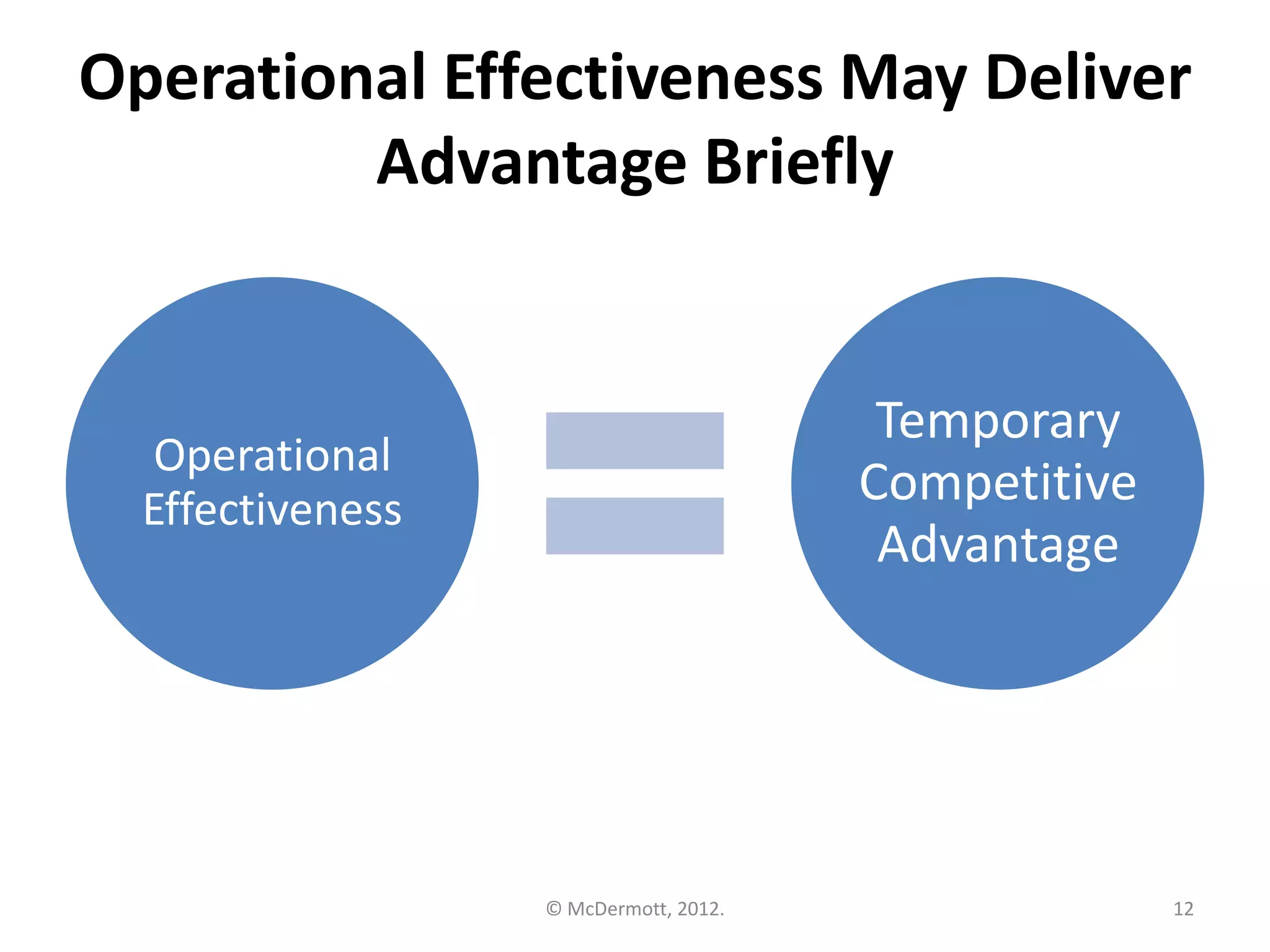
Operational Effectiveness May Deliver
Advantage Briefly

Temporary
Competitive
Advantage

Operational
Effectiveness

© McDermott, 2012.

12
Running out of steam:
the limitations of OE
• Companies that are copycats simply exploiting differences
in operational efficiency soon come undone;
• Once gaps in OE narrow, such companies struggle;

• Because they lack a distinct competitive position.
• In short, they need to learn strategy!
• In Porter’s terms they need to develop a unique
competitive position

© McDermott, 2012.

13
Japanese Winners in the Past
According to Porter, since they
were better, they did not need to
be smarter

© McDermott, 2012.

14
© McDermott, 2012.

15
Surely they were more than just Better?
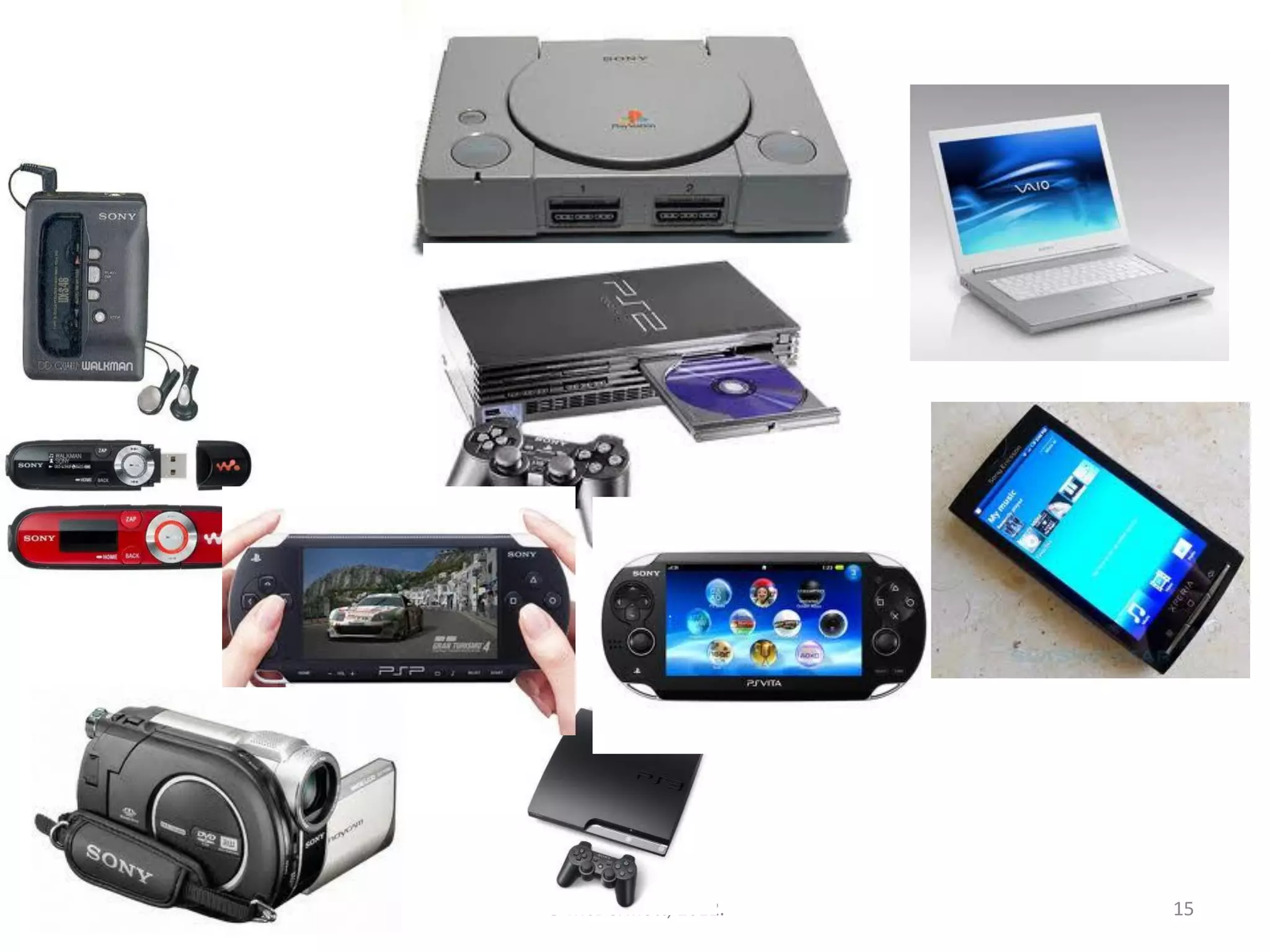
• In the 1980s-1990s, Sony was “the Apple” of today.
• Surely it was “smarter”, rather than just better?
• What’s the difference between Sony then and Apple
today?
• Both made great products that are “better”, but Apple
realized that its focus needs to be the consumer
experience not simply the products.
• Apple’s success may reflect a total customer-centric
business model – that is “smarter”;
• Sony’s focus was, and appears to remain, simply
offering “better” products.
© McDermott, 2012.

16
Future Japanese Winners Must Also
Be Smarter

Do they
have
genuine
strategy?
© McDermott, 2012.

17
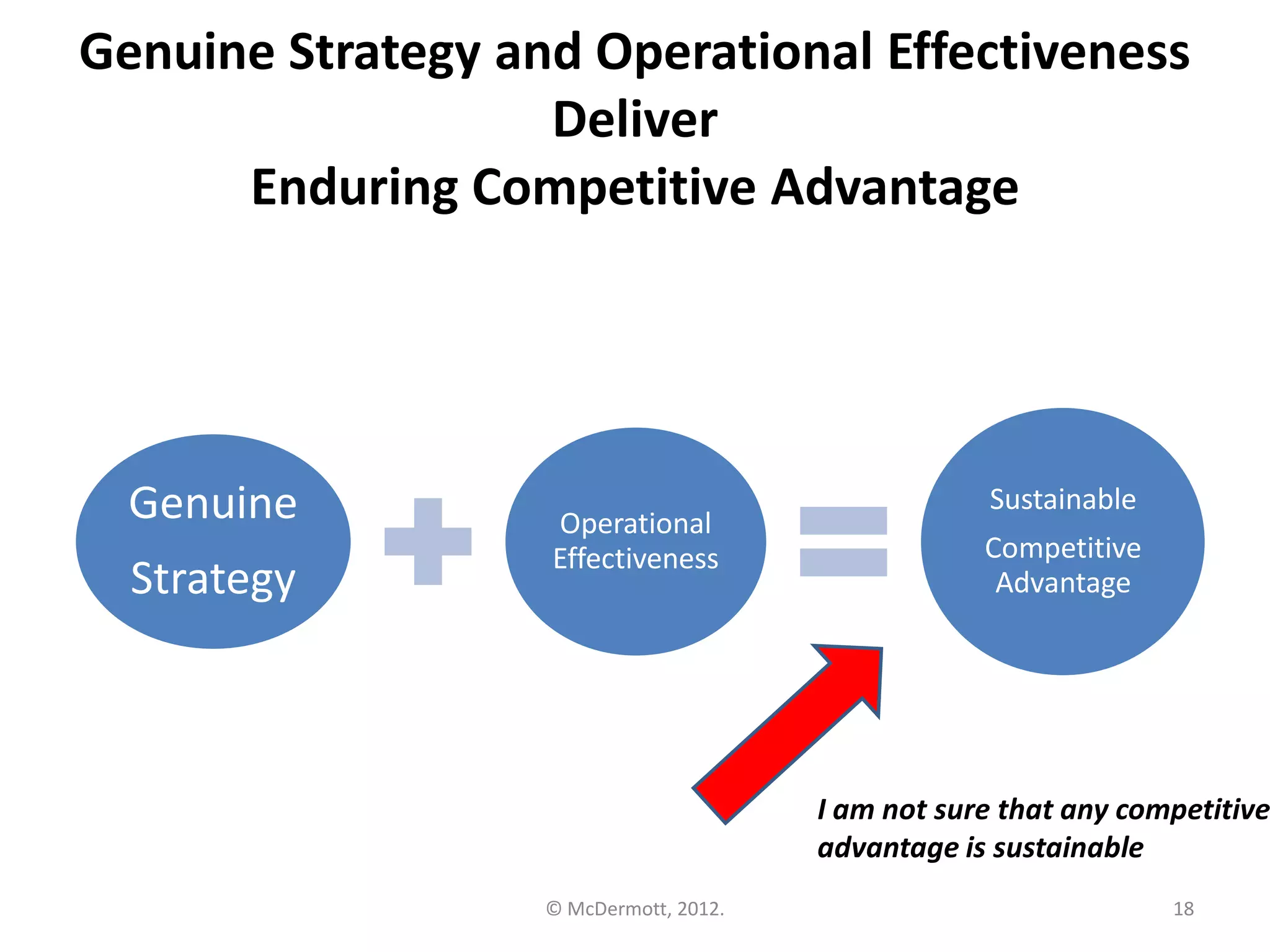
Genuine Strategy and Operational Effectiveness
Deliver
Enduring Competitive Advantage

Genuine
Strategy

Operational
Effectiveness

Sustainable
Competitive
Advantage

I am not sure that any competitive
advantage is sustainable
© McDermott, 2012.

18
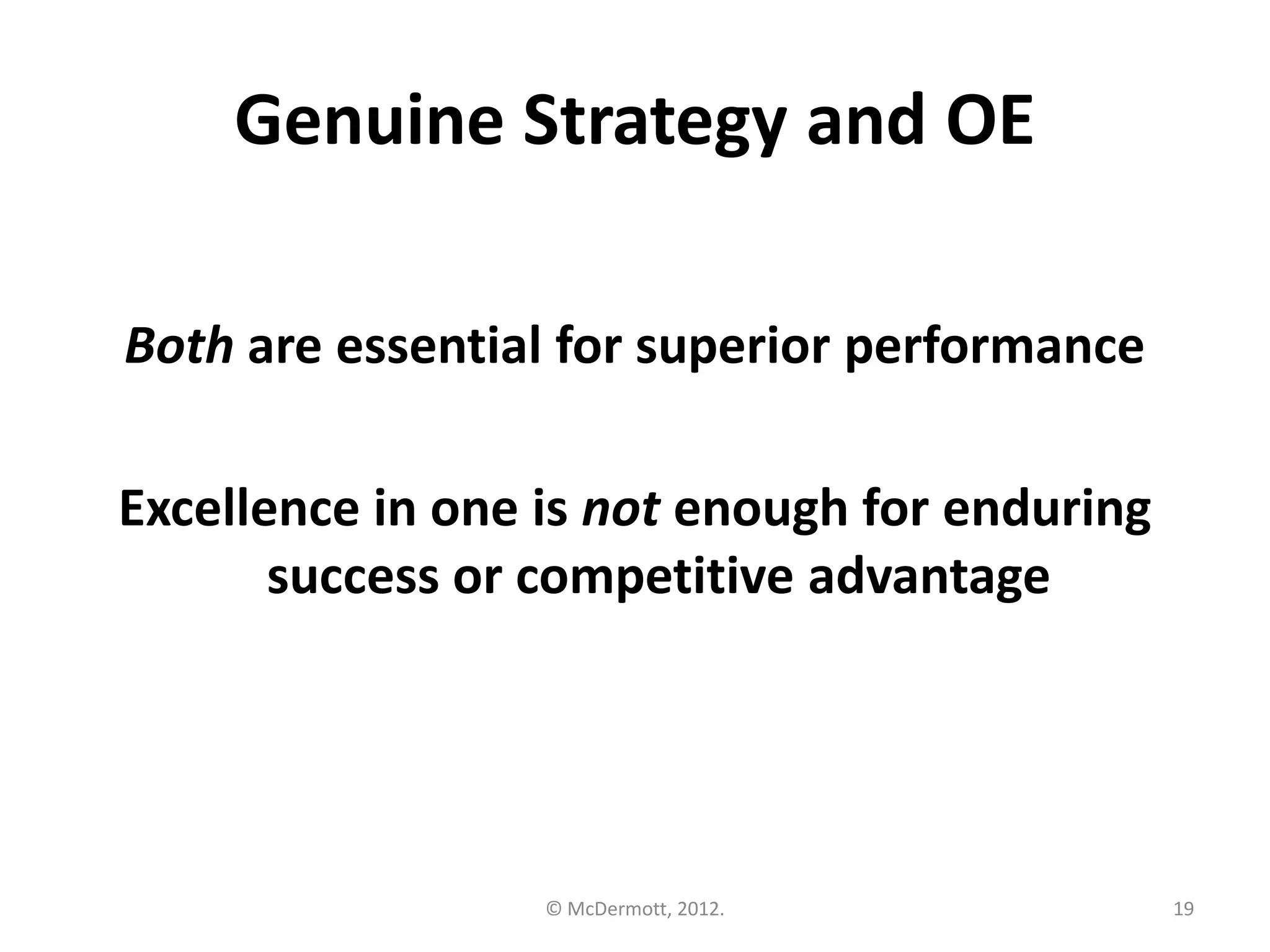
Genuine Strategy and OE
Both are essential for superior performance
Excellence in one is not enough for enduring
success or competitive advantage

© McDermott, 2012.

19
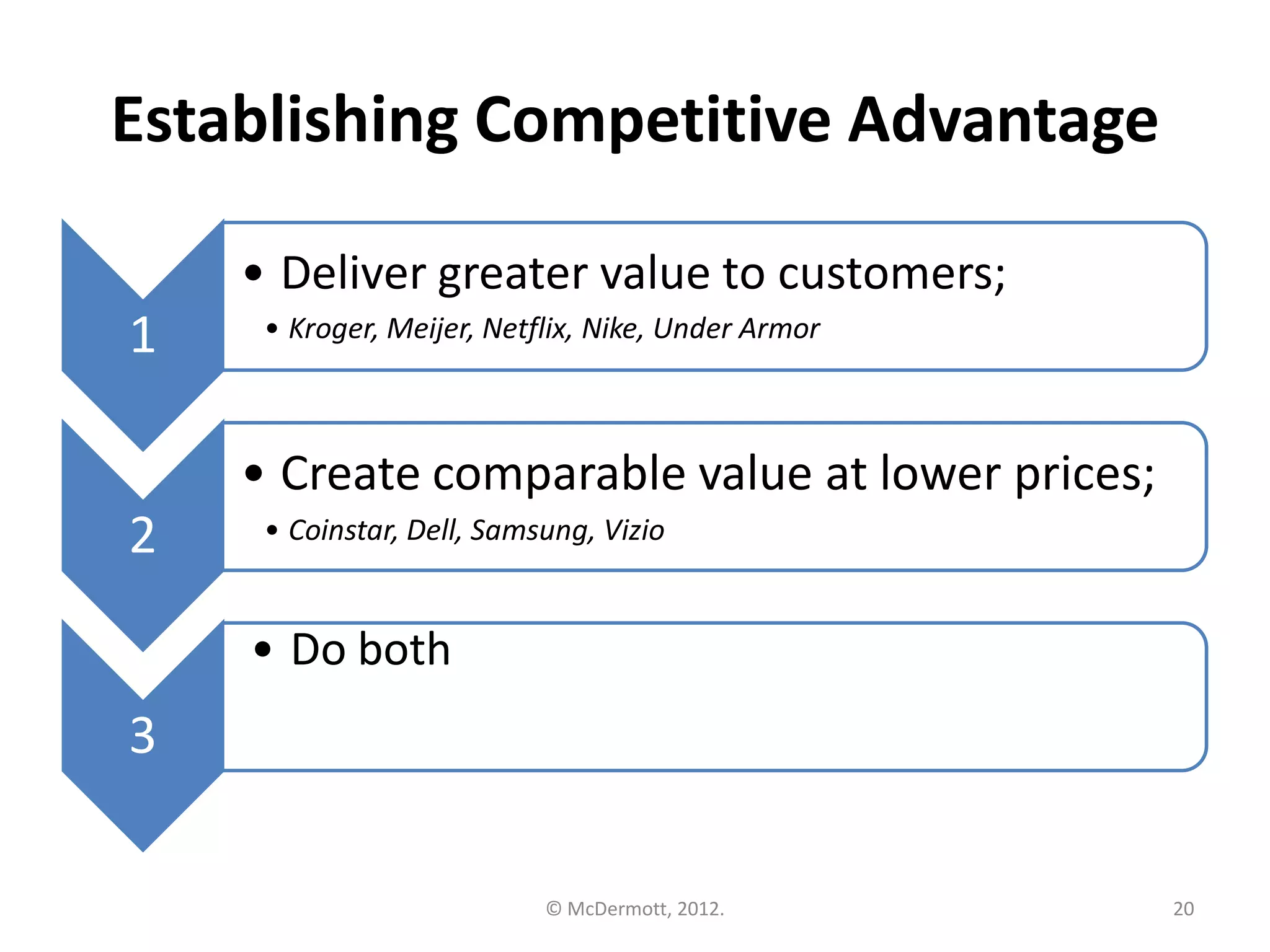
Establishing Competitive Advantage
• Deliver greater value to customers;

1

• Kroger, Meijer, Netflix, Nike, Under Armor

• Create comparable value at lower prices;

2

• Coinstar, Dell, Samsung, Vizio

• Do both

3
© McDermott, 2012.

20
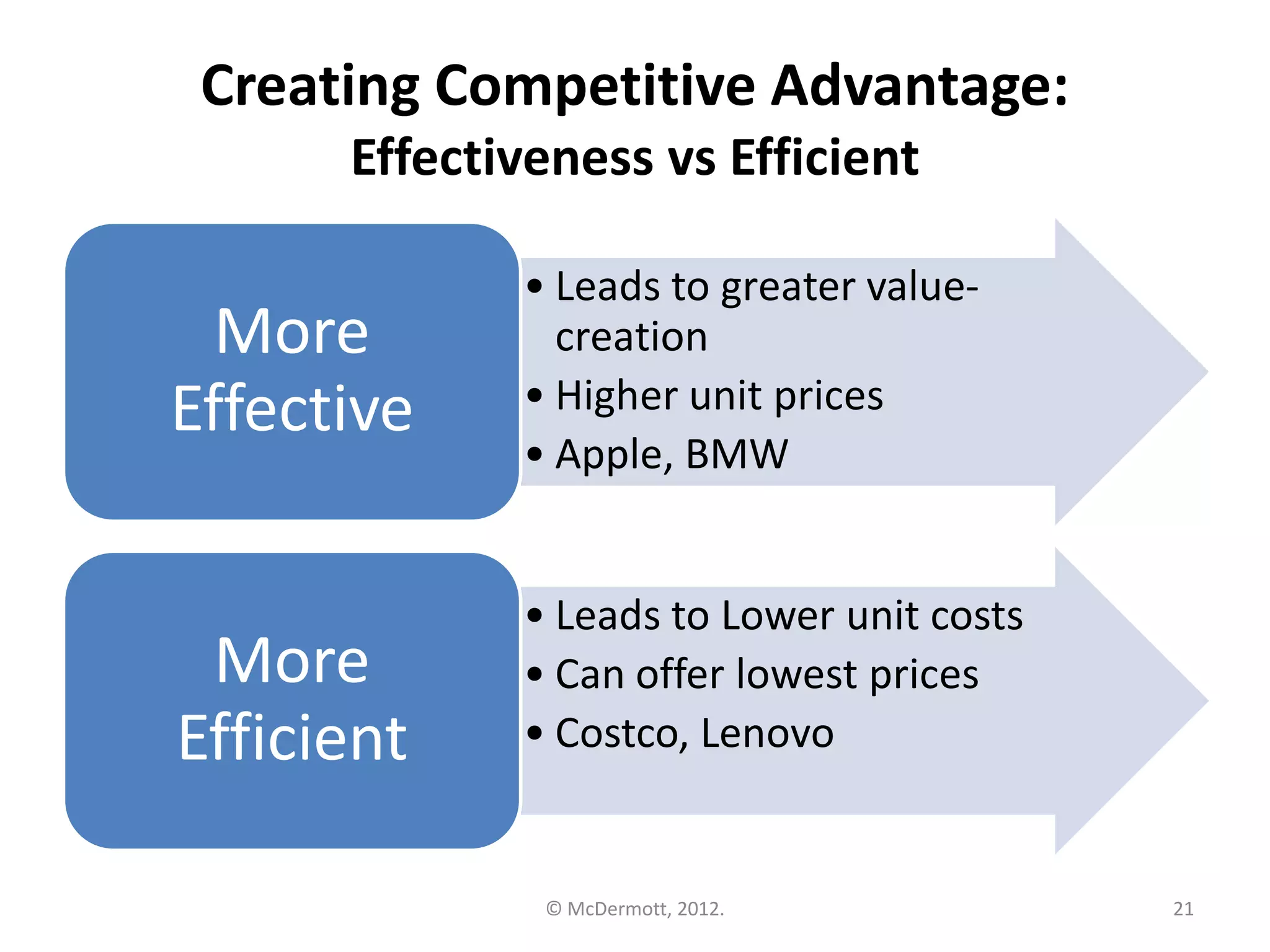
Creating Competitive Advantage:
Effectiveness vs Efficient

More
Effective

More
Efficient

• Leads to greater valuecreation
• Higher unit prices
• Apple, BMW

• Leads to Lower unit costs
• Can offer lowest prices
• Costco, Lenovo

© McDermott, 2012.

21
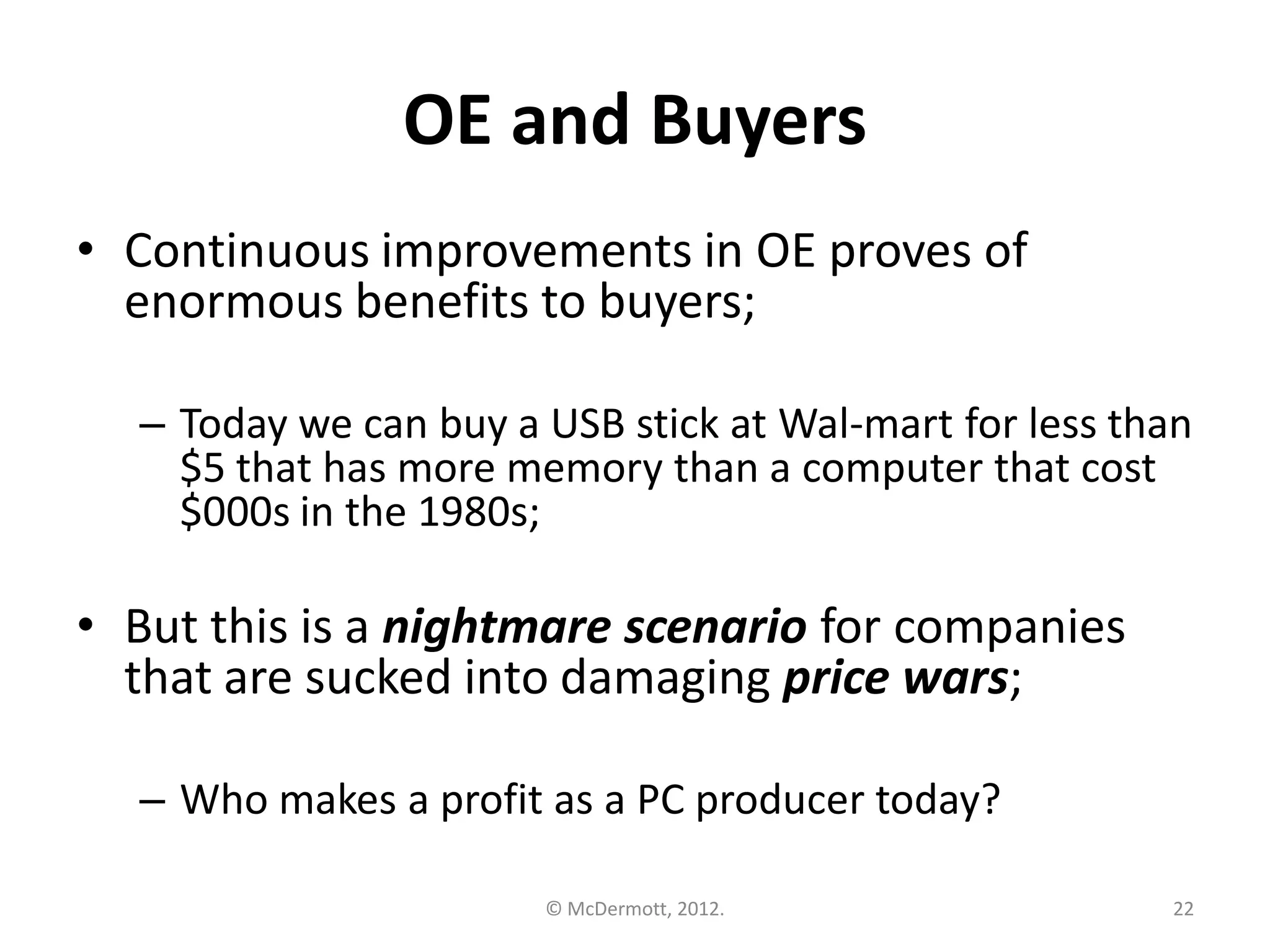
OE and Buyers
• Continuous improvements in OE proves of
enormous benefits to buyers;
– Today we can buy a USB stick at Wal-mart for less than
$5 that has more memory than a computer that cost
$000s in the 1980s;

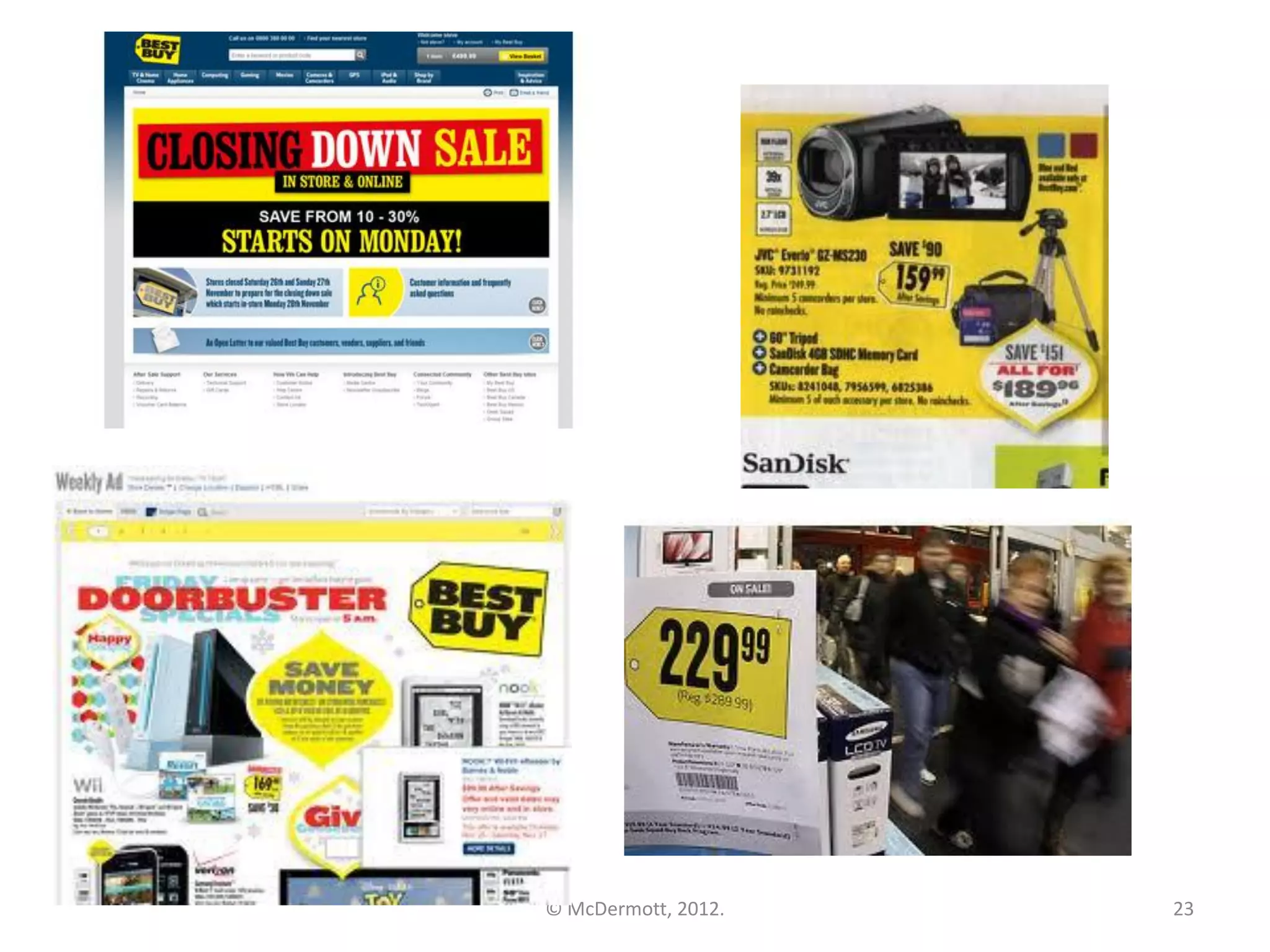
• But this is a nightmare scenario for companies
that are sucked into damaging price wars;
– Who makes a profit as a PC producer today?
© McDermott, 2012.

22
© McDermott, 2012.

23
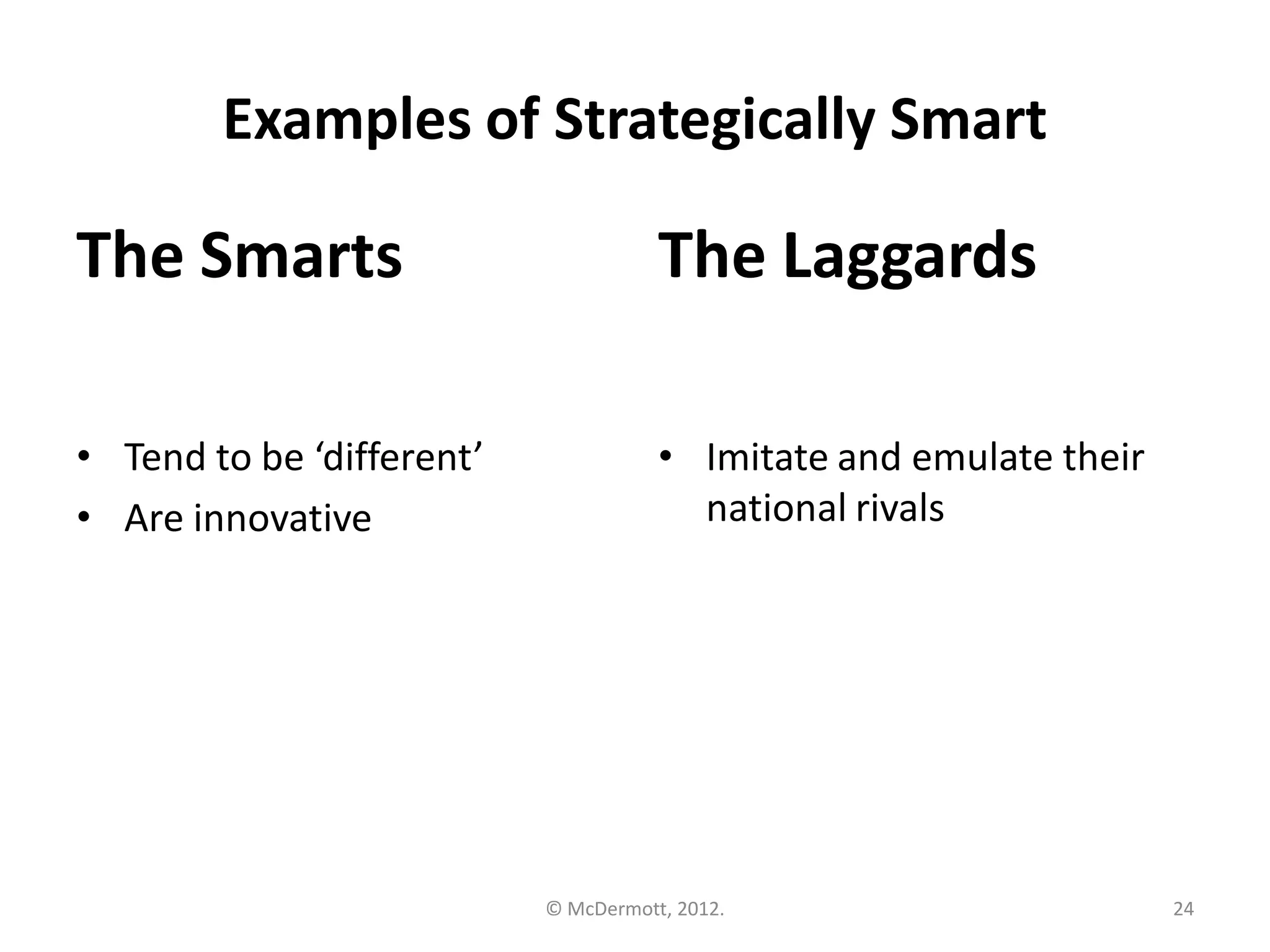
Examples of Strategically Smart

The Smarts

The Laggards

• Tend to be ‘different’
• Are innovative

• Imitate and emulate their
national rivals

© McDermott, 2012.

24
OE and Competition
• Companies converge
• They all follow the exact same strategic path
– From “made-in-China” to “sold-in-Wal-mart”

• And this is a race that no producer wins
– So let’s reduce the number of ‘runners’ – and
acquire our rivals

• In a ‘buy or be bought’ world, no one enjoys
true competitive advantage
© McDermott, 2012.

25
It does not
have to be
this way!
© McDermott, 2012.

26
Competitive Strategy is
about being different!
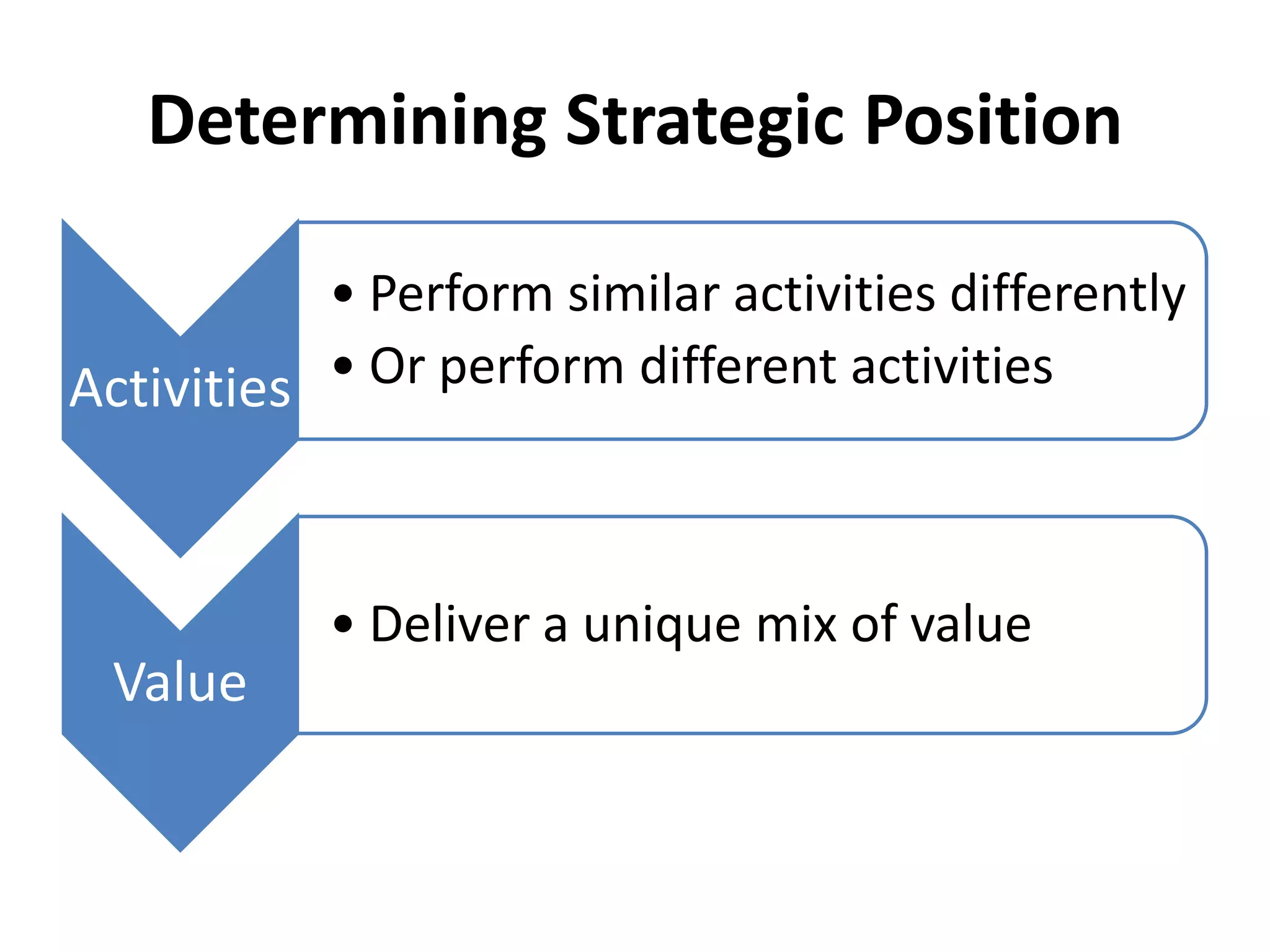
Determining Strategic Position
• Perform similar activities differently
Activities • Or perform different activities

• Deliver a unique mix of value

Value
What do they offer?
• Often low cost
• Because they do things differently
• But in addition to that they often ‘break the
rules’ in order to better meet the needs of
their target market
Nature of Strategic Positioning
• Means performing different activities from
rivals or performing similar activities in
different ways
• Competitive advantage requires developing a
distinct strategic position
What’s the Solution?
• According to Porter, it’s focusing upon creating
a strong competitive position (i.e. developing
a strategy)

• Kim & Mauborgne suggest that the solution is
developing a Blue Ocean Strategy
• Rumelt suggests that the company must focus
all energies on its “big issue” problem
© McDermott, 2012.

33

Strategy is not operational effectiveness

  • 1.
    Strategy is NotOperational Effectiveness By Dr. Michael McDermott mcdermottm1@nku.edu
  • 2.
    Structure 1. Common mistakesin discussing strategy 2. The Limited Advantages of Being Better – Operational Effectiveness 3. The Significant Advantages of Being Smarter – Genuine Strategy 4. Smarter can beat Better 5. The Critical and Sustainable Advantages of Being Better and Smarter – Operational Effectiveness and Genuine Strategy 6. Smarter and Better is Invincible © McDermott, 2012. 2
  • 3.
    Common mistakes indiscussing strategy • Many people, including executives, often make the mistake of equating operational effectiveness with strategy: • Strategy is not: – transferring production to a lower cost location; or, – Increasing productivity; or, – Lowering costs • Improving operational effectiveness is great, but it’s not strategy © McDermott, 2012. 3
  • 4.
    What is OperationalEffectiveness (OE)? • It’s all about internal performance • It’s about being: – Better, or – Cheaper, or – Faster, or – Wider (i.e. more international) © McDermott, 2012. 4
  • 5.
    Nature and Limitationsof Operational Effectiveness Nature of OE Implications • OE means performing similar activities better than rivals perform them • Constant improvement or getting better is seldom sufficient for profitability • Constant improvement in operational effectiveness is necessary to achieve superior profitability. • And that is tough – hence many companies exit an industry where they have exhausted all possibilities © McDermott, 2012. 5
  • 6.
  • 7.
    Operational Effectiveness Law of Diminishing Returnsand Others Narrow Gap Constant Improvement For example, the success of many Japanese companies was based upon being better and cheaper. But you can see that they are seeing their advantage eroded (i.e. South Koreans) © McDermott, 2012. 7
  • 8.
    Nature and Limitationsof Operational Effectiveness Nature of OE Limitations of OE • OE means performing similar activities better than rivals perform them • Constant improvement or getting better is seldom sufficient for profitability • Constant improvement in operational effectiveness is necessary to achieve superior profitability. • And that is tough – hence many companies exit an industry where they have exhausted all possibilities © McDermott, 2012. 8
  • 9.
    The Limitations ofOE • Those who rely exclusively upon OE are quickly overtaken • Just think of the TV, PC industries – Japanese topple US and Europeans – South Koreans/Taiwanese topple US and Japanese – Will Chinese topple South Korean and Taiwanese? © McDermott, 2012. 9
  • 10.
    Operational Effectiveness ExplainsInitial Success of Asian Companies 1960s-80s Japanese companies are winners 1990s-2010s South Korean companies are winners © McDermott, 2012. 2020sChinese companies are winners 10
  • 11.
    Operational Effectiveness MayDeliver Advantage Briefly Being Better Operational Effectiveness © McDermott, 2012. 11
  • 12.
    Operational Effectiveness MayDeliver Advantage Briefly Temporary Competitive Advantage Operational Effectiveness © McDermott, 2012. 12
  • 13.
    Running out ofsteam: the limitations of OE • Companies that are copycats simply exploiting differences in operational efficiency soon come undone; • Once gaps in OE narrow, such companies struggle; • Because they lack a distinct competitive position. • In short, they need to learn strategy! • In Porter’s terms they need to develop a unique competitive position © McDermott, 2012. 13
  • 14.
    Japanese Winners inthe Past According to Porter, since they were better, they did not need to be smarter © McDermott, 2012. 14
  • 15.
  • 16.
    Surely they weremore than just Better? • In the 1980s-1990s, Sony was “the Apple” of today. • Surely it was “smarter”, rather than just better? • What’s the difference between Sony then and Apple today? • Both made great products that are “better”, but Apple realized that its focus needs to be the consumer experience not simply the products. • Apple’s success may reflect a total customer-centric business model – that is “smarter”; • Sony’s focus was, and appears to remain, simply offering “better” products. © McDermott, 2012. 16
  • 17.
    Future Japanese WinnersMust Also Be Smarter Do they have genuine strategy? © McDermott, 2012. 17
  • 18.
    Genuine Strategy andOperational Effectiveness Deliver Enduring Competitive Advantage Genuine Strategy Operational Effectiveness Sustainable Competitive Advantage I am not sure that any competitive advantage is sustainable © McDermott, 2012. 18
  • 19.
    Genuine Strategy andOE Both are essential for superior performance Excellence in one is not enough for enduring success or competitive advantage © McDermott, 2012. 19
  • 20.
    Establishing Competitive Advantage •Deliver greater value to customers; 1 • Kroger, Meijer, Netflix, Nike, Under Armor • Create comparable value at lower prices; 2 • Coinstar, Dell, Samsung, Vizio • Do both 3 © McDermott, 2012. 20
  • 21.
    Creating Competitive Advantage: Effectivenessvs Efficient More Effective More Efficient • Leads to greater valuecreation • Higher unit prices • Apple, BMW • Leads to Lower unit costs • Can offer lowest prices • Costco, Lenovo © McDermott, 2012. 21
  • 22.
    OE and Buyers •Continuous improvements in OE proves of enormous benefits to buyers; – Today we can buy a USB stick at Wal-mart for less than $5 that has more memory than a computer that cost $000s in the 1980s; • But this is a nightmare scenario for companies that are sucked into damaging price wars; – Who makes a profit as a PC producer today? © McDermott, 2012. 22
  • 23.
  • 24.
    Examples of StrategicallySmart The Smarts The Laggards • Tend to be ‘different’ • Are innovative • Imitate and emulate their national rivals © McDermott, 2012. 24
  • 25.
    OE and Competition •Companies converge • They all follow the exact same strategic path – From “made-in-China” to “sold-in-Wal-mart” • And this is a race that no producer wins – So let’s reduce the number of ‘runners’ – and acquire our rivals • In a ‘buy or be bought’ world, no one enjoys true competitive advantage © McDermott, 2012. 25
  • 26.
    It does not haveto be this way! © McDermott, 2012. 26
  • 27.
  • 28.
    Determining Strategic Position •Perform similar activities differently Activities • Or perform different activities • Deliver a unique mix of value Value
  • 30.
    What do theyoffer? • Often low cost • Because they do things differently • But in addition to that they often ‘break the rules’ in order to better meet the needs of their target market
  • 32.
    Nature of StrategicPositioning • Means performing different activities from rivals or performing similar activities in different ways • Competitive advantage requires developing a distinct strategic position
  • 33.
    What’s the Solution? •According to Porter, it’s focusing upon creating a strong competitive position (i.e. developing a strategy) • Kim & Mauborgne suggest that the solution is developing a Blue Ocean Strategy • Rumelt suggests that the company must focus all energies on its “big issue” problem © McDermott, 2012. 33